 by Tom Gurney
Tom Gurney BSc (Hons) is an art history expert with over 20 years experience
Email: tomgurney1@gmail.com / Phone: +44 7429 011000
The Crucifixion in the Museo Correr
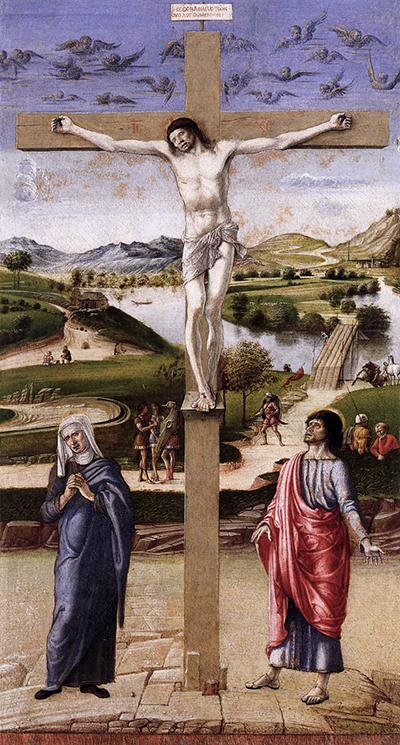
In Giovanni Bellini’s Crucifixion at the Museo Correr in Venice, the cross stands on a pale shelf of rock. Mary lowers her eyes on the left, while Saint John the Evangelist looks up from the right. Behind them a plank bridge crosses blue water, a boat floats near the bank and small groups of people occupy the paths. The picture is just over half a metre high, but Bellini leaves room for both the grief at the foot of the cross and the life of the country around it. [1]
The Getty exhibited it as Crucifixion with the Virgin and Saint John the Evangelist. Venice’s civic catalogue identifies it as Cl. I n. 0028. The Museo Correr’s illustrated entry dates it to about 1465–70 and gives its dimensions as 54.5 × 30 cm. The Getty’s 2017 exhibition placed it about 1458–59. An Anderson photograph now in the Fondazione Zeri records the painting at the Correr in 1892–93. Its negative number, 11665, is also recorded in the civic catalogue. [1] [2] [3] [16]
At a Glance
- ArtistGiovanni Bellini
- CollectionMuseo Correr, Venice
- InventoryCl. I n. 0028
- DateFifteenth century; dating differs among catalogues
- SupportWood panel
The work in Bellini’s career
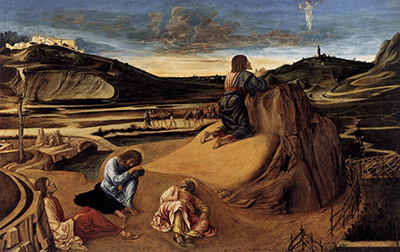
The Agony in the Garden
c. 1458–60Presentation at the Temple
c. 1475The Crucifixion in the Museo Correr
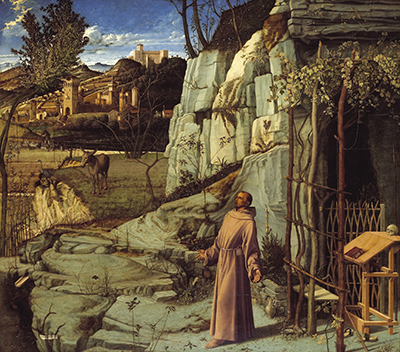
Dating discussed in the articleSt. Francis in the Desert
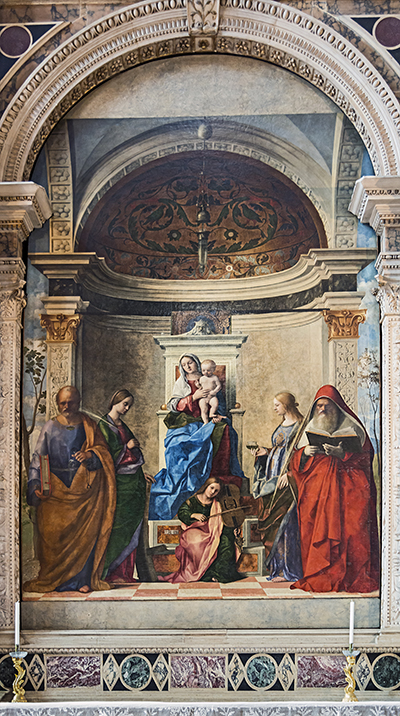
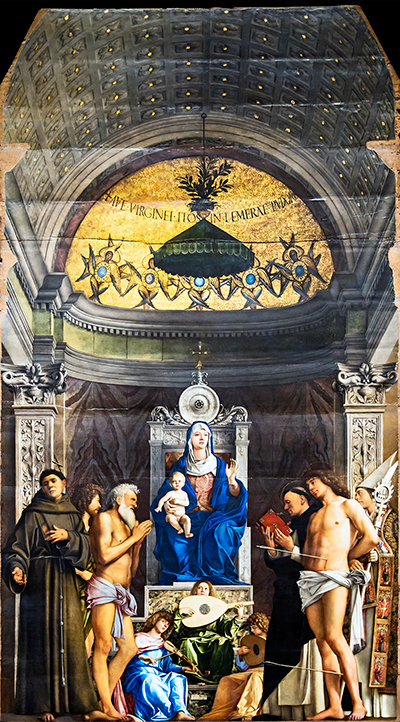
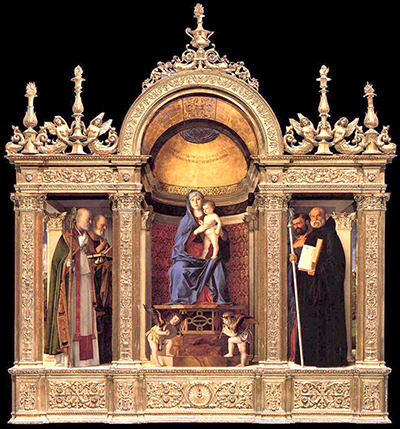
Late 1470sFrari Triptych
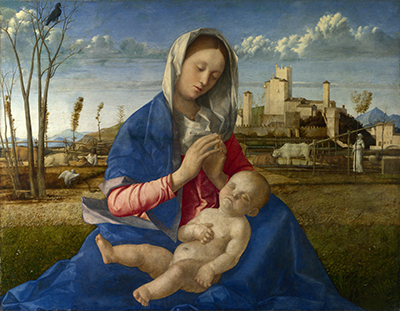
1488Madonna of the Meadow
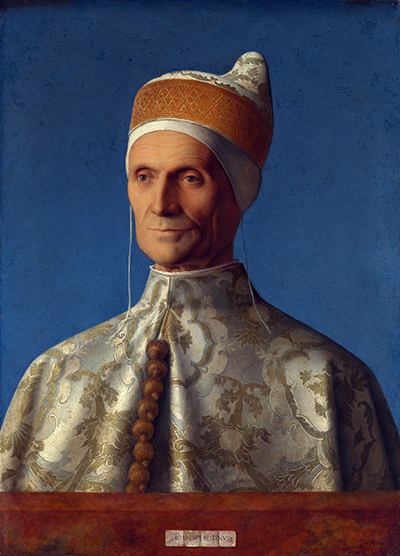
c. 1500–05Doge Leonardo Loredan
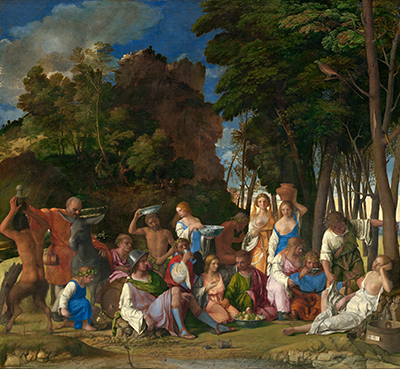
c. 1501–02The Feast of the Gods
Bellini’s signed date 1514Mary and John at the foot of the cross
The Gospel of John tells how Jesus, looking down from the cross, entrusts his mother and the disciple he loves to each other. The disciple is traditionally identified as John the Evangelist, as in the Getty’s title. In Bellini’s painting Mary and John stand apart, with the upright of the cross between them. The scene includes neither of the men crucified alongside Jesus in the Gospel account. That leaves the eye free to move among the three figures and attend to their gestures. [1] [3] [4]
Mary clasps her hands against her chest. The white fabric around her head makes the tilt of her face especially clear against the dark blue mantle. John’s bare feet draw attention to where he has stopped on the stone. His head turns towards Christ, and his open hand extends out into the space beside him. Their responses take the eye in different directions. John draws it upwards towards the body. Mary brings it down towards her hands. Christ’s head falls towards her side, while the cross holds all three figures in place. [1]
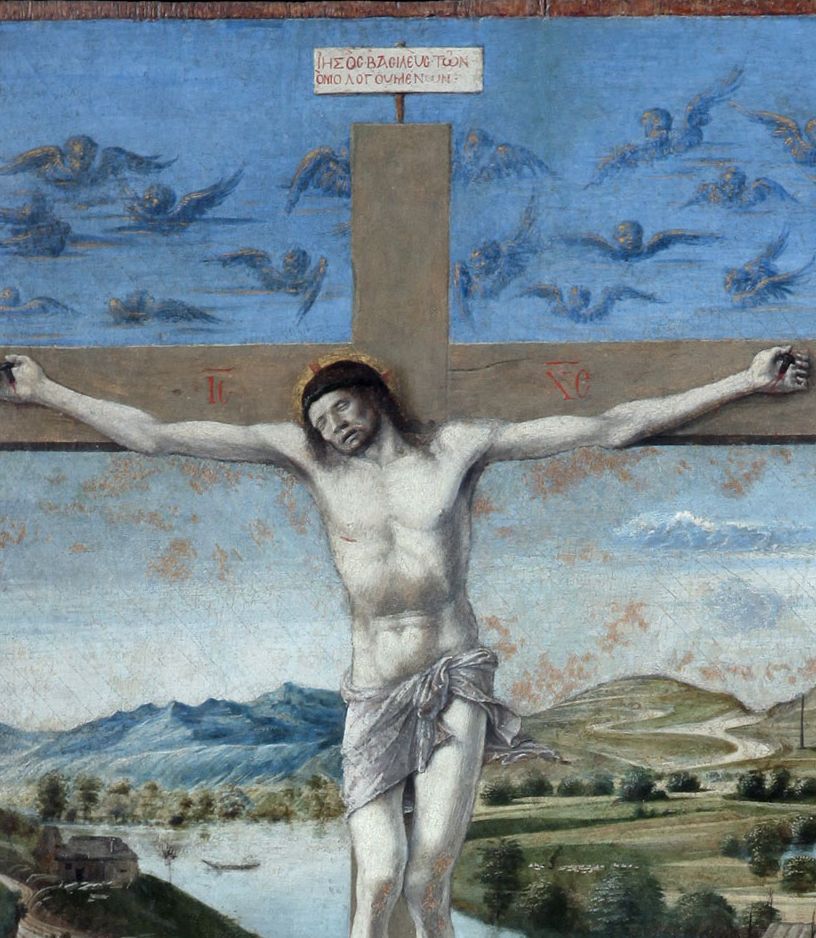
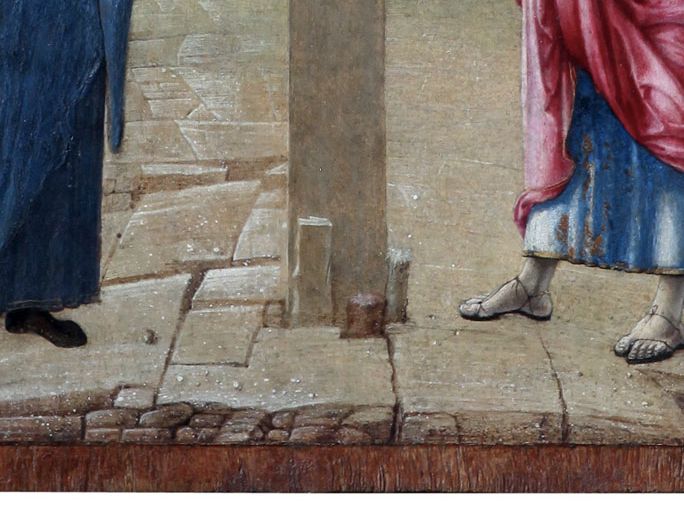
The crossbar occupies almost the full width of the panel. Christ’s hands curl around the nails, his arms fall below the line of the timber towards his shoulders, and his feet rest on a small projecting support. The wooden upright continues down to a narrow gap in the rock, where Bellini paints wedges bracing it at ground level. The wedges make the weight of the structure imaginable. At the opposite end of the cross, a pale tablet bears a Greek inscription. The curators of the 2023 Musée Jacquemart-André exhibition associated its lettering and the gold on the winged figures with Byzantine icons. John’s Gospel likewise singles out the inscription, saying it was written in Hebrew, Latin and Greek. [1] [4] [5]
The bridge and the river
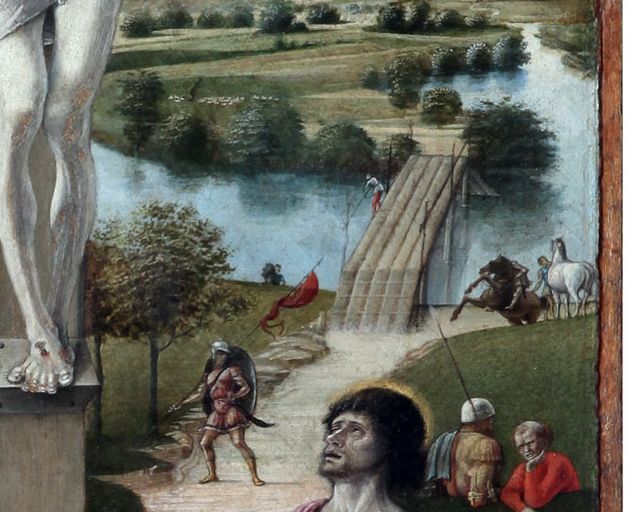
Just behind the mourners, the edge of the rock drops away in layers. The landscape opens on either side of the cross. To the right, a pale path leads past a figure with a red banner and up towards the plank bridge. The bridge is seen from above. Its slant and the narrowing of its timbers carry the eye from the near bank into the fields beyond. The river also opens out on the left, where a boat leaves a small dark mark on the bright surface. On the far bank, scattered houses and the pale line of a road give way to hills and blue ridges. [1]
Bellini makes the foreground and the middle distance feel connected even though their figures are very different in scale. Two figures in short tunics and brightly coloured hose stand behind the cross. Further right, a few small figures gather with horses at the water’s edge. The painting leaves their relation to the Crucifixion open. The Museo Correr reads the ordinary life in the landscape as continuous with the event taking place in the foreground. That continuity helps explain why the bridge is so absorbing. The eye can follow it away from the cross and then return along the path to the rocky ledge. [1]
The water is brightest in the open and darkens close to the trees. Getty curator Davide Gasparotto and art historian Keith Christiansen drew attention to the reflections, linking Bellini’s treatment of the river and its foliage to Netherlandish painting. The light and colour also help establish distance. The pale body and pink-red mantle stand out strongly in the front, while the hills recede through successive shades of blue and grey. The light on the water carries the eye across the interruption of the cross. [1] [6]
The Correr describes the panel as a picture for private devotion. Its proportions make sense for close looking. From a little distance the cross and the two mourners are clear. Move closer and the winged faces, the lines of the planks and the light along the water become legible. There is time to move between Mary’s clasped hands and the tiny gestures of the people down the slope. Bellini gives a viewer something to return to during prolonged contemplation, even within a scene whose outcome is already familiar. [1] [6]
When Bellini painted it
The painting survives on wood. The Correr gives tempera with possible oil, while the Getty’s checklist lists oil and tempera and gives an unframed size of 53.3 × 29.5 cm. Venice’s civic database records tempera and gives the measurements as 54 × 30 cm. The Paris exhibition label included gold as well as tempera and oil. Gold can be seen picking out the wings in the blue sky. The catalogue entries differ on the presence of oil and give no details about where Bellini might have used it. [1] [2] [3] [5] [6]
The dates depend in part on which works scholars place beside the Crucifixion. The civic database proposes about 1453–55. The Paris exhibition used about 1459, close to the Getty estimate. Christiansen points to a comparison with manuscript illumination in support of an early date, and Antonio Mazzotta discusses the Correr panel alongside the miniatures associated with Bellini in an Albi manuscript of Strabo’s Geography. The library dates the manuscript to 1458–59. The small gold accents and sharply defined forms explain the appeal of such a comparison. The manuscript provides a dated point of reference for Bellini’s style, while the panel’s own date remains an estimate. [1] [2] [3] [5] [6] [7] [8]
Bellini and the Passion
The Correr sees Mantegna’s influence in the sharp contours, the weight of the figures and the angular treatment of the rocks. Mantegna’s own Crucifixion, now in the Louvre, was made between late 1456 and 1459 for the lower tier of the San Zeno altarpiece in Verona. Its broad format accommodates three crosses and groups of onlookers. The small, narrow Correr picture uses some of the same vocabulary of cut rock and carefully placed figures to set apart Mary and John. Bellini allows much of the remaining activity to take place far below the eye-line of the crucified Christ, so the body remains clearly visible even against the busy terrain. [1] [7] [9]
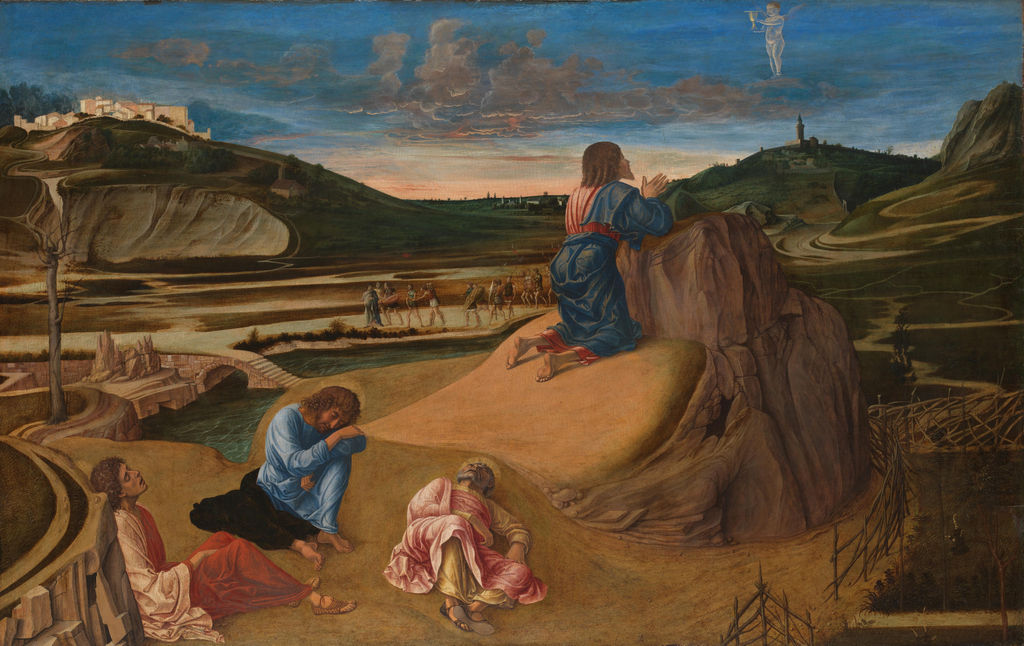
Bellini’s Agony in the Garden in London offers another way to see how he used distance in a Passion scene. In that broader painting, dated by the National Gallery to about 1458–60, Christ prays before his arrest as Judas and a group of soldiers approach from beyond the river. A viewer can read the threat because Bellini makes it possible to follow their route across the land. In the Correr picture the execution has already taken place, and the people on the paths make the surrounding world feel inhabited. Both paintings reward a search through the middle distance. In London it reveals what is about to happen. In Venice it shows what continues around the cross. [1] [10]
Other Crucifixions associated with Bellini
The Museo Correr also holds the wide Crucifixion catalogued under Jacopo Bellini, Cl. I n. 0029. It was the central panel of a predella, the row of small scenes below an altarpiece. Mary faints among the women and soldiers stand behind the cross. The 2019 Berlin exhibition catalogue allowed for possible participation by Giovanni and Gentile in that panel. The shape, the crowd at the cross and the inventory number distinguish it from Giovanni’s narrow picture. [11] [12]
The Getty exhibition placed the Correr panel in company with several of Giovanni’s other treatments of the subject. The much broader Le Calvaire at the Louvre, formerly in the Contini Bonacossi collection, also has Mary and John. Italy’s national catalogue identifies another painting with those two mourners as a work of Bellini’s workshop and relates it to that former Contini Bonacossi panel. The painting listed by the Getty from the Galleria Corsini in Florence, about 1475, leaves Christ alone against a deep, open landscape. The larger Crucifixion lent from the former Banca Popolare di Vicenza collection, dated by the Getty to about 1495–1500, also isolates Christ and places tombstones and skulls below him. It is known as the Crucifixion in a Jewish Cemetery in the Palazzo degli Alberti collection in Prato. In the Correr panel, the two standing mourners, the winged figures and the bridge behind John distinguish the painting at a glance. [3] [5] [6] [13] [14] [15]
Annotated Details from Crucifixion
Numbered overview and cropped details. Photograph Fondazione Musei Civici di Venezia via Wikimedia Commons. Image source. CC BY 4.0.
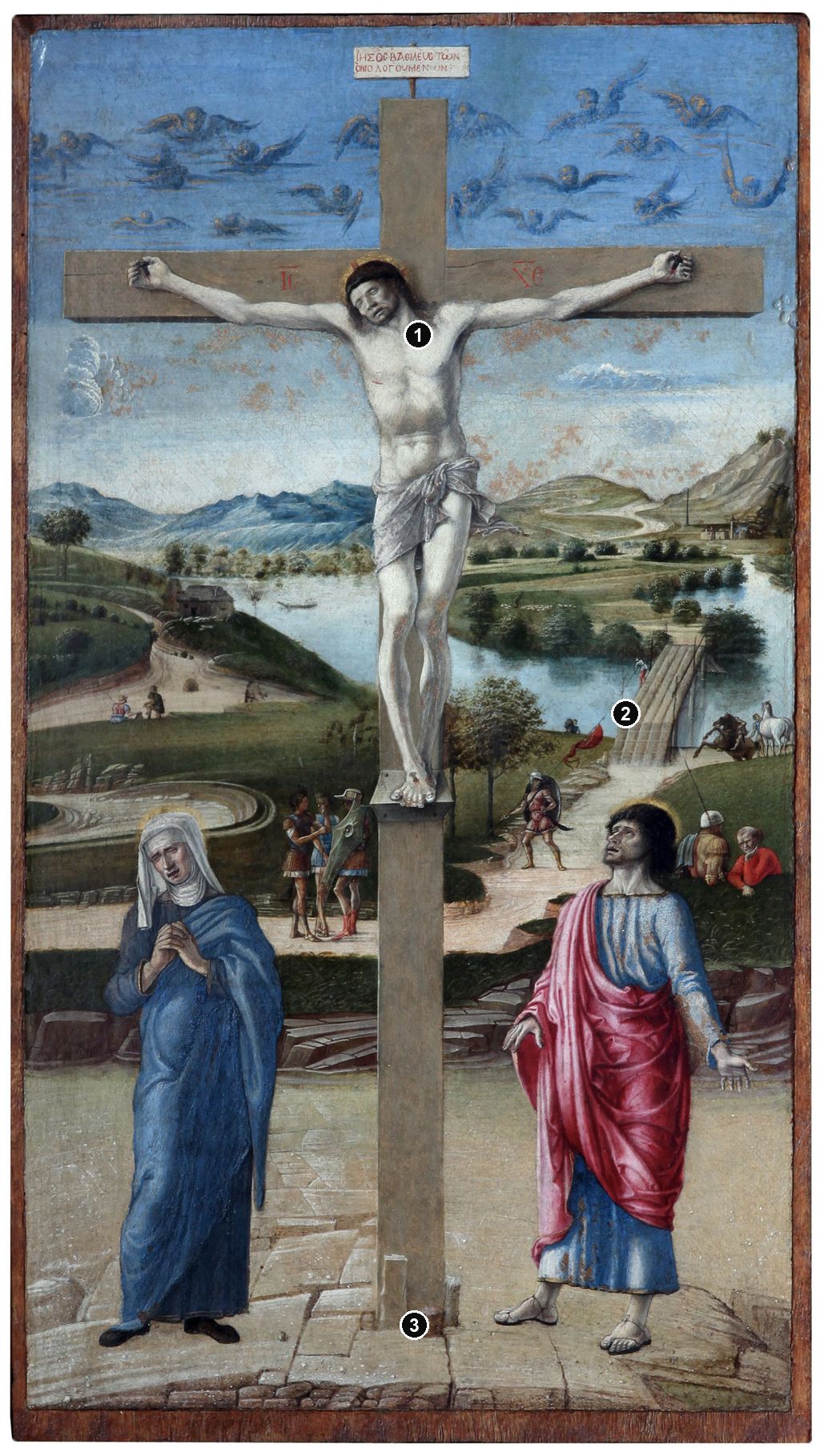
Details from CRUCIFIXION
These broad crops follow the Correr painting from the cross to the bridge and the foreground figures.
Christ and the crossbar
The upright rises through the image to the painted notice. The crossbar spans much of the panel and sets the central figure against the blue sky.
The bridge and water
The oblique bridge carries the eye away from the foreground and across the water. Its level and angle help establish distance.
The feet of the cross
The timber meets the pale rock in a narrow, dark gap. Notice the rough edges of the ledge beside the folds of the mourners’ clothing.
Related reading
Artworks directory
Discussion
Look again at the images and ideas explored in Crucifixion by Giovanni Bellini. These editorial prompts invite your observations.
Reader Insights
How does the inhabited landscape affect your reading of Mary and John in the foreground?
Which details in the small Correr panel invite the closest look?
What role does the bridge play in moving your attention between the cross and the distant town?
Join the Conversation
Share a detail, comparison or question about Crucifixion by Giovanni Bellini below.
References
- Fondazione Musei Civici di Venezia, Giovanni Bellini, Crocifissione View source.
- Civici Musei di Venezia, object record 2347, Crocifissione, Cl. I n. 0028 View source.
- J. Paul Getty Museum, Giovanni Bellini: Landscapes of Faith in Renaissance Venice, exhibition checklist View source.
- Gospel of John 19, especially verses 17–27 View source.
- Musée Jacquemart-André, Giovanni Bellini. Influences croisées, photographed gallery labels, p. 17 View source.
- J. Paul Getty Museum, Davide Gasparotto and Keith Christiansen on the Crucifixions, curatorial transcript View source.
- Antonio Mazzotta, “An early drawing by Giovanni Bellini”, The Burlington Magazine 162 (2020), pp. 776–78 View source.
- Médiathèque Pierre-Amalric, Albi, Strabo’s De situ orbis geographia, MS 77 View source.
- Musée du Louvre, Andrea Mantegna, La Crucifixion, INV 368 View source.
- National Gallery, London, Giovanni Bellini, The Agony in the Garden, NG726 View source.
- Museo Correr via Google Arts & Culture, Jacopo Bellini, Crucifixion, Cl. I n. 29 View source.
- Staatliche Museen zu Berlin, Mantegna und Bellini, 2019 checklist View source.
- Musée du Louvre, Giovanni Bellini, Le Calvaire, RF 1970 39 View source.
- Italian national heritage catalogue, workshop of Giovanni Bellini, Crocifissione di Cristo con la Madonna e San Giovanni, 0303270100 View source.
- Intesa Sanpaolo, reopening of the Galleria di Palazzo degli Alberti in Prato View source.
- Fondazione Federico Zeri, Anderson photograph of Giovanni Bellini’s Correr Crucifixion, negative 11665 View source.