 by Tom Gurney
Tom Gurney BSc (Hons) is an art history expert with over 20 years experience
Email: tomgurney1@gmail.com / Phone: +44 7429 011000
Bellini’s banquet and its changing landscape
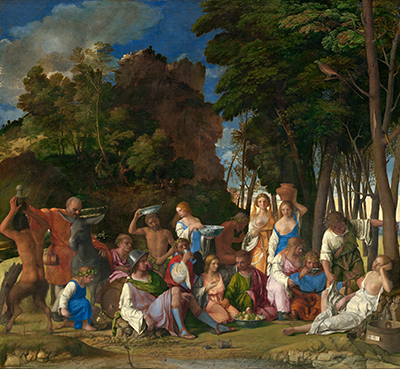
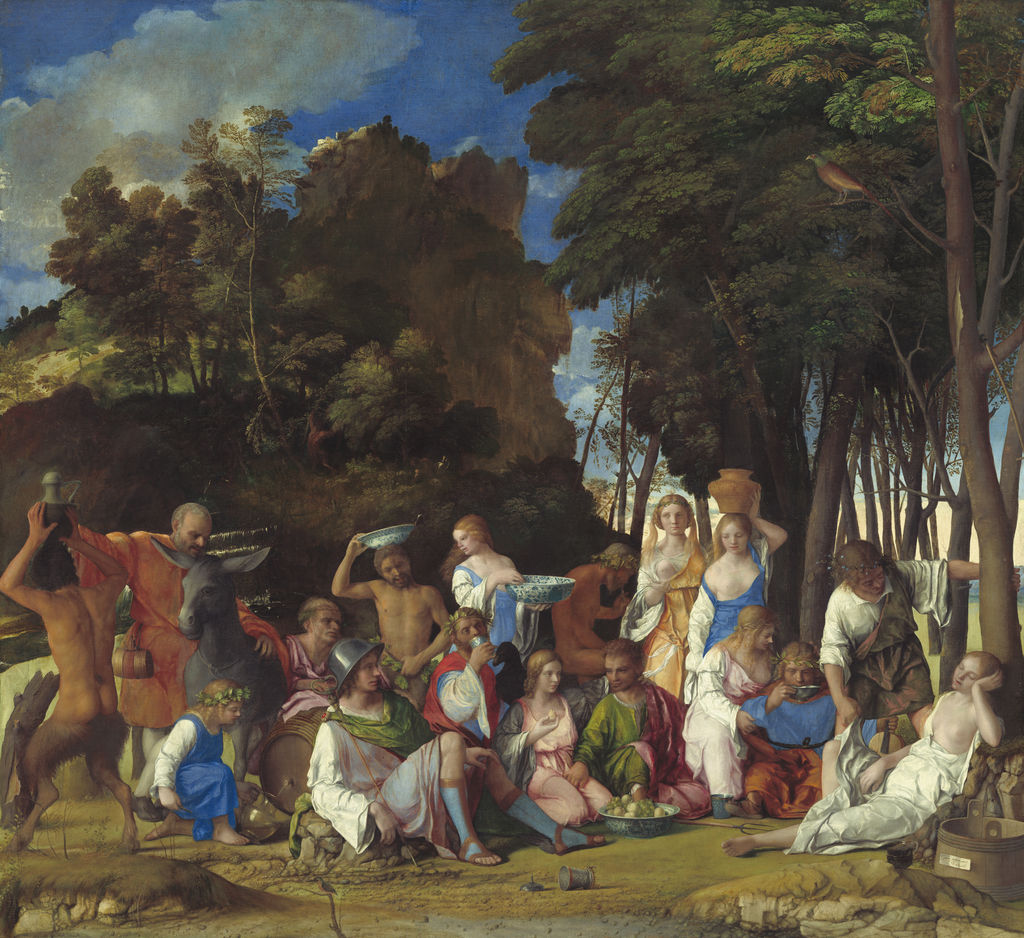
At the lower left of The Feast of the Gods, a child draws wine into a glass jug. At the far right a man lifts the garment of a sleeping woman. Between them, gods eat, drink and lounge on the ground. The man’s gesture holds the threat at the centre of the ancient story. The apparently ordinary task at the opposite edge later helped identify the painting when it was taken from the palace in Ferrara. [1] [2]
The National Gallery of Art in Washington credits the painting to Bellini and Titian and dates it 1514/1529. Bellini signed the oil on canvas, which measures 170.2 by 188 centimetres, in 1514. Titian’s later revision accounts for the second date. Beneath his rock and hillside lie traces of Bellini’s woodland and an intervening landscape whose painter remains uncertain. [1] [3]
At a Glance
- Museum creditGiovanni Bellini and Titian
- Date1514/1529, National Gallery of Art
- MediumOil on canvas
- CollectionNational Gallery of Art, Washington, Widener 1942.9.1
The work in Bellini’s career
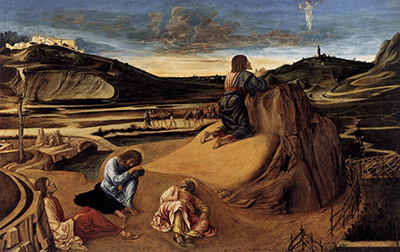
The Agony in the Garden
c. 1458–60Presentation at the Temple
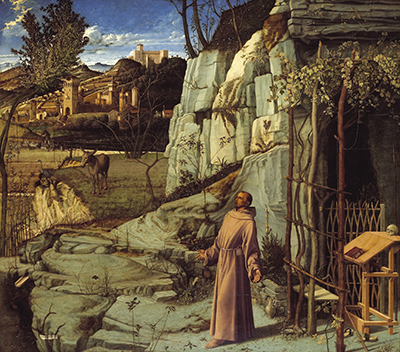
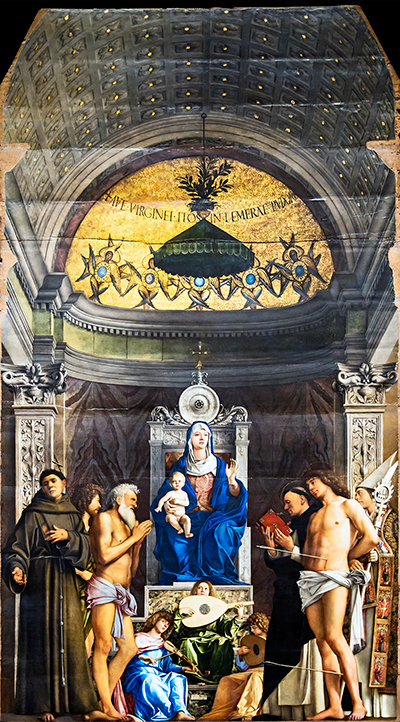
c. 1475St. Francis in the Desert
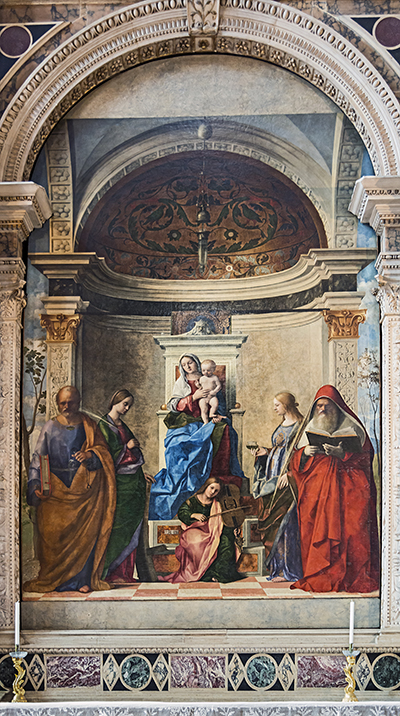
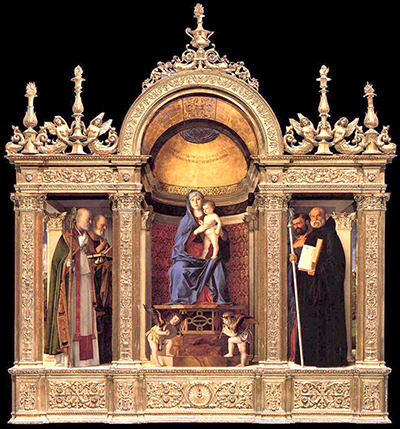
Late 1470sFrari Triptych
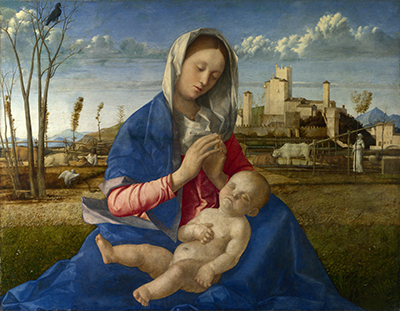
1488Madonna of the Meadow
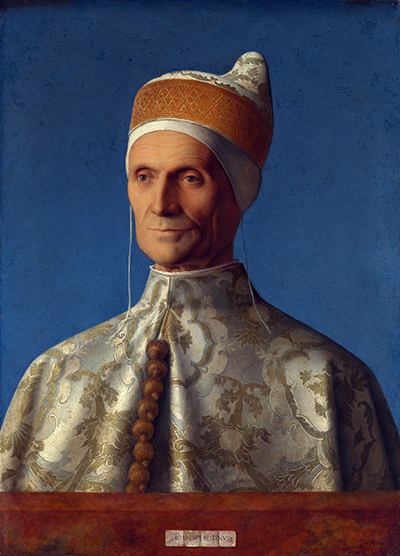
c. 1500–05Doge Leonardo Loredan
c. 1501–02The Feast of the Gods
Bellini’s signed date 1514Looking across the feast
The company sits and stands in a band close to the front of the picture. A turn of the head or an arm reaching towards a vessel draws the eye from one group to the next. The people overlap, but few seem far away. Standing figures generally rise behind seated ones without receding deep into the clearing. Pink, blue and green garments punctuate the row, and a raised jug, a glass and several bowls give separate groups something to do. Above them the dark rock rises on the left, while a stand of trees closes the right. [1] [3]
The child filling the glass jug is Bacchus, the god of wine, shown with an ivy crown. The donkey stands just behind him. Closer to the centre, the seated Mercury can be recognised by his winged footwear and the caduceus, his staff with two intertwined snakes. A shadowed figure nearby has been suggested as Faunus. [2] [4]
The vessels reward a second look. A bowl near the centre is lifted high enough for its blue decoration to be seen. Another dish, full of fruit, repeats the blue and white at ground level. The firm pale rims stand out against cloth and grass. On the left, the transparent jug makes the wine itself visible. The National Gallery of Art compares the glass to prized Venetian ware and the dishes to Chinese porcelain, scarce and highly valued in Renaissance Italy. Several garments shimmer like shot silk, a weave whose colour shifts as differently coloured threads catch the light. A court viewer could recognise the banquet’s luxuries even though the company using them belonged to an ancient story. [1] [2]
In Andrea Mantegna’s Adoration of the Magi at the Getty, a Magus presents the Christ Child with gold coins in a small Chinese porcelain cup. The precious container is part of the gift. In The Feast, the blue-and-white bowls do the work of tableware. One holds fruit, and another is carried among the guests. The comparison makes clear how differently such a luxury could be used in a religious scene and in a feast commissioned for a private room. [2] [5]
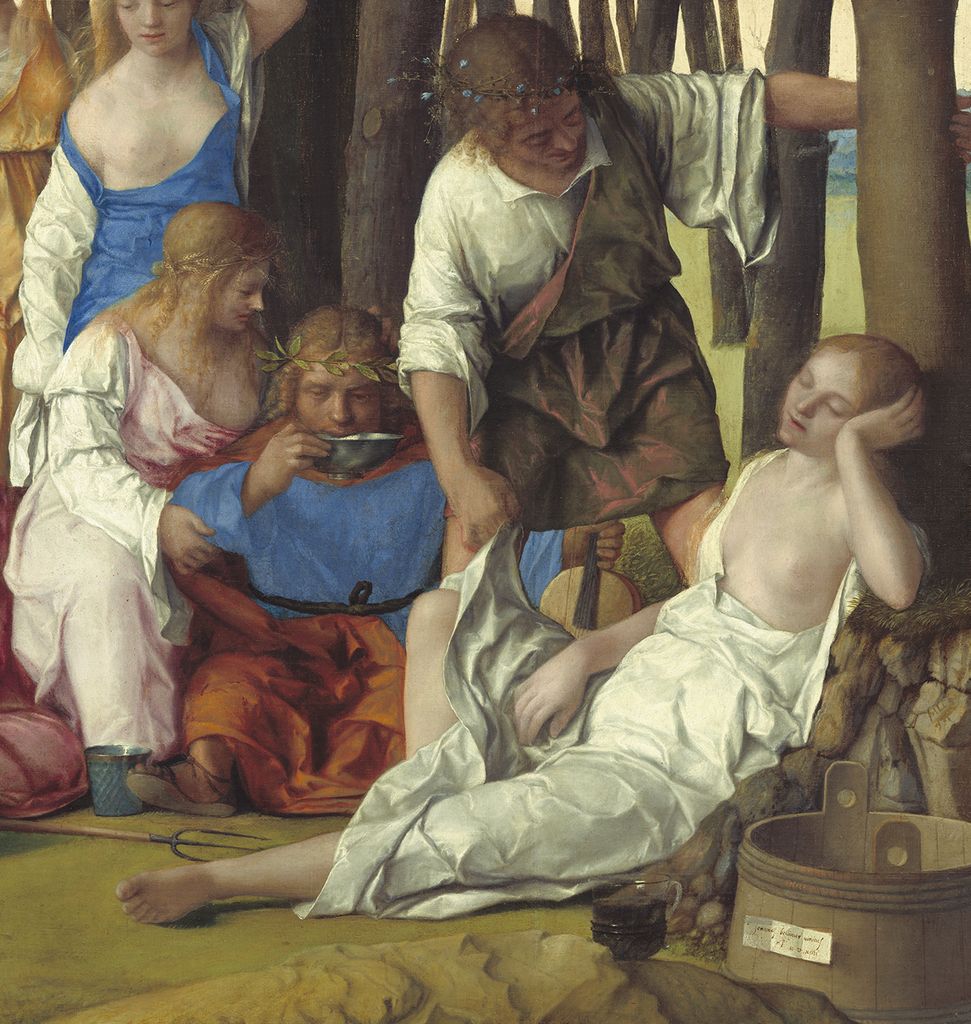
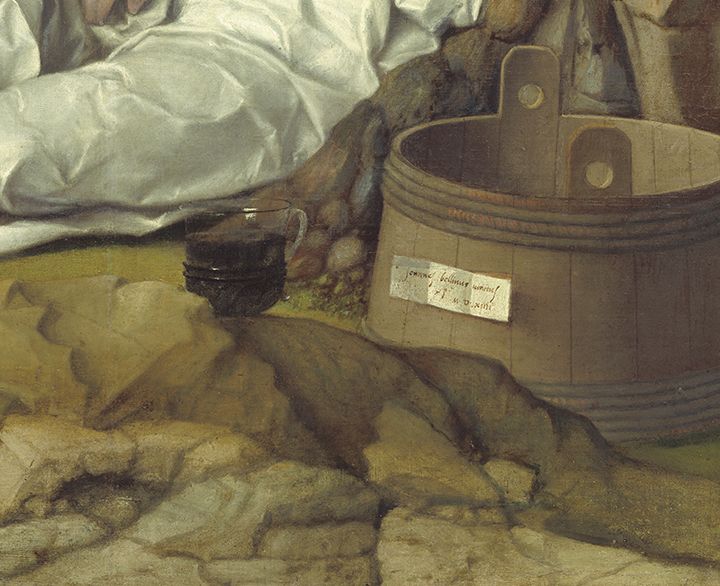
At the lower right a little rectangle of painted paper appears fixed to the side of a wooden tub. Bellini calls himself Venetian and gives the year in Roman numerals, MDXIIII. Its slant against the face of the tub gives the signature a place inside the scene. [1]
Priapus, Lotis and the donkey
In the first book of Ovid’s Fasti, the story begins during a celebration of Bacchus, also called Liber. Lotis has already rebuffed Priapus, the guardian of gardens, when weariness from the festivities sends her to sleep. He approaches quietly and starts lifting her clothing in an attempted sexual assault. Silenus’s donkey brays. The noise wakes her, she escapes and the witnesses laugh at Priapus. The story is one of several in this part of the poem that explain why particular animals are sacrificed to particular gods. Here it accounts for the sacrifice of a donkey to Priapus. [6] [7]
Bellini depicts the interval before the bray. Low to the right, Lotis still sleeps as Priapus reaches towards her garment. Her body has settled across the ground, and he stoops close to it. At the opposite end the donkey is still among the drinkers. Once the viewer knows the story, the animal becomes as important as the hand at the nymph’s feet. The large distance between the two places gives the interruption its imagined force. A sound originating on the left will break the quiet on the right and bring the rest of the gathering into an action that is taking place at its edge. [1] [6]
Ovid tells a parallel story in Book 6 of the Fasti, this time about Vesta. She too sleeps through the approach of Priapus until a donkey brays. With Vesta, goddess of the hearth, the same incident explains a different ritual association. Ovid connects the animal’s service to Vesta with the custom of garlanding donkeys at her festival. Myrto Garani treats the episodes together as two ancient explanations built on the same interruption, each with its own place in Ovid’s calendar. The donkey appears in both passages, but the Bacchic setting of the picture points to the account of Lotis. [6] [7]
Monica Centanni argues for close attention to the Latin verse. She connects the figure’s gardener-like appearance to Ovid’s description of Priapus as a guardian of gardens and the hand low on the garment to the poet’s account of a covering being pulled from the feet. She also proposes that a tree above the sleeping figure might be a maple, the tree named in the Lotis passage. The painted gesture and the verse can be compared directly. The proposed maple depends on identifying a tree in a background that underwent extensive changes. [6] [8]
Readers in Bellini’s time could encounter a version of the incident in Giovanni Bonsignori’s vernacular adaptation of the Metamorphoses. As Centanni shows, that retelling borrows from both episodes in the Fasti and also carries the nymph’s story towards a transformation. Its illustration breaks the story into successive incidents. Centanni finds the particular conjunction of the feet, the guardian of gardens and the setting closer to the Latin Lotis passage. The comparisons leave open which version Bellini encountered and how it was communicated to him. [8]
Scholars have also asked what reading these stories together might have offered a learned visitor to Alfonso’s room. Anthony Colantuono has proposed a natural-philosophical reading involving the Halcyon Days around the winter solstice and connecting the work to themes of love and marriage in the ensemble. Colantuono’s argument concerns the programme as a whole. The National Gallery of Art’s Alex Dean, writing for a modern audience, approaches the canvas through the exercise of power, including the duke’s wealth and the gods’ authority. That approach also invites a closer look at Lotis. She is asleep and cannot intervene in a scene in which the other figures are free to drink, talk and reach for the things they want. [2] [9]
Alfonso d’Este and the room in Ferrara
On 14 November 1514 Alfonso I d’Este, Duke of Ferrara, ordered a final payment of 85 gold ducats to Bellini. Bellini’s signature and the order agree on the year. By then he had spent decades painting altarpieces and devotional pictures in Venice and had only two years to live. This commission asked him to work on a similar scale for a court room devoted to ancient subjects. Alfonso’s sister Isabella d’Este had separately sought a work by Bellini for her own collection. That patronage history has prompted a suggestion that she may have had a part in the early stages of The Feast. The surviving payment order puts Alfonso in direct contact with the commission. It leaves the identity of the person who first approached Bellini open. [1] [3] [8] [10]
A letter written by the humanist Mario Equicola to Isabella on 9 October 1511 gives a glimpse of the planning. Equicola says that the duke wanted him to stay another eight days and that he had found and written out six stories for a room. That is direct evidence of a humanist choosing and preparing subjects for the duke. The number of stories in the letter belongs to the planning stage. The surviving correspondence leaves open how much of Equicola’s selection reached the walls and how freely the artists worked with what he provided. [8] [11]
The finished picture hung in Alfonso’s Camerino d’Alabastro, generally located in the Via Coperta, the covered link between the ducal palace and the castle. A room associated with private study and viewing allowed people with access to examine the canvases at close quarters. Where each picture hung is harder to establish. On 23 April 1518 the Este envoy Jacopo Tebaldi reported that Titian wanted clarification about the wall for The Worship of Venus. Titian remembered three pictures across what the letter calls the face of the study. He wanted to know whether his own canvas would go towards the chapel, in the middle or towards the castle. Even the question has been read differently. The three positions might mean places on one wall or different walls. [10] [12] [13]
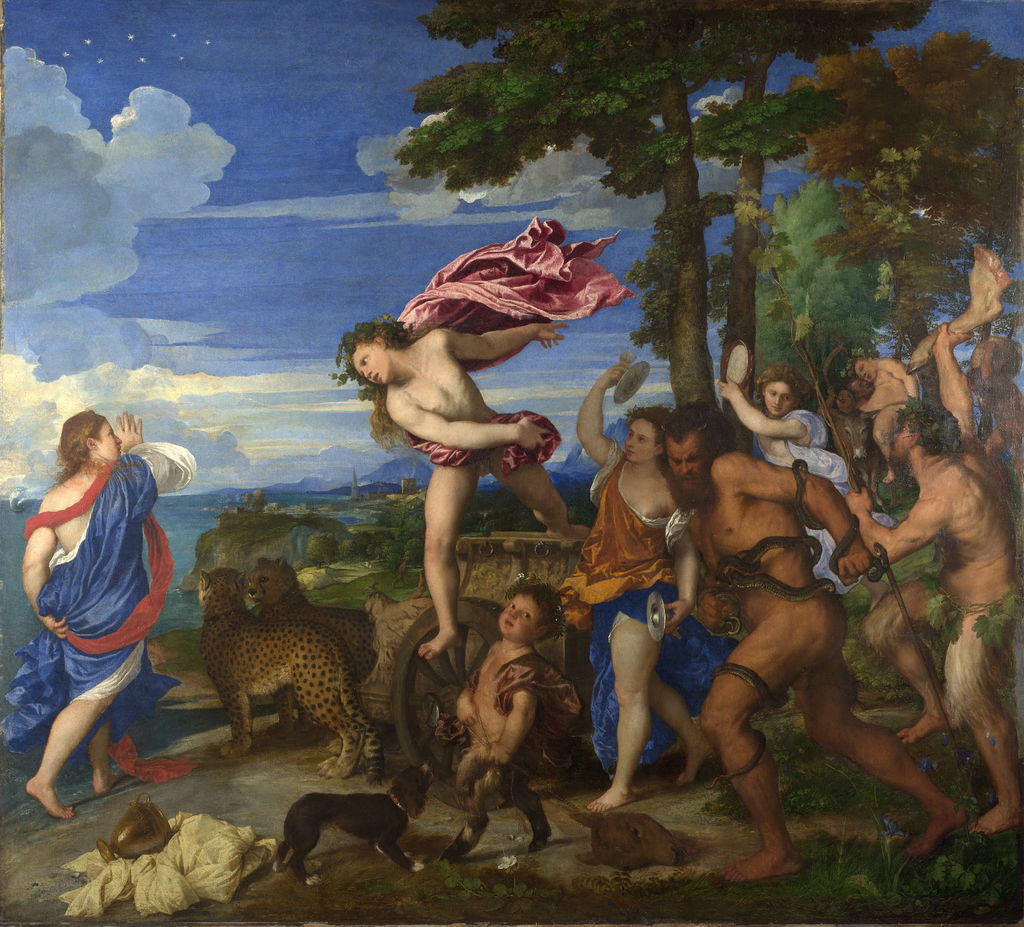
Titian’s three surviving paintings for the room show how much could be done with the idea of an ancient revel. In Bacchus and Ariadne, now in the National Gallery in London, Bacchus is airborne as he leaves his chariot and Ariadne twists towards him. His noisy, advancing train is a different use of the god from the absorbed child at the wine vessel in Bellini. The distant sea gives Ariadne’s side of Titian’s picture an opening quite unlike the wooded enclosure behind Lotis. The leap announces Titian’s encounter at once, where the danger to Lotis takes a while to register. [1] [13]
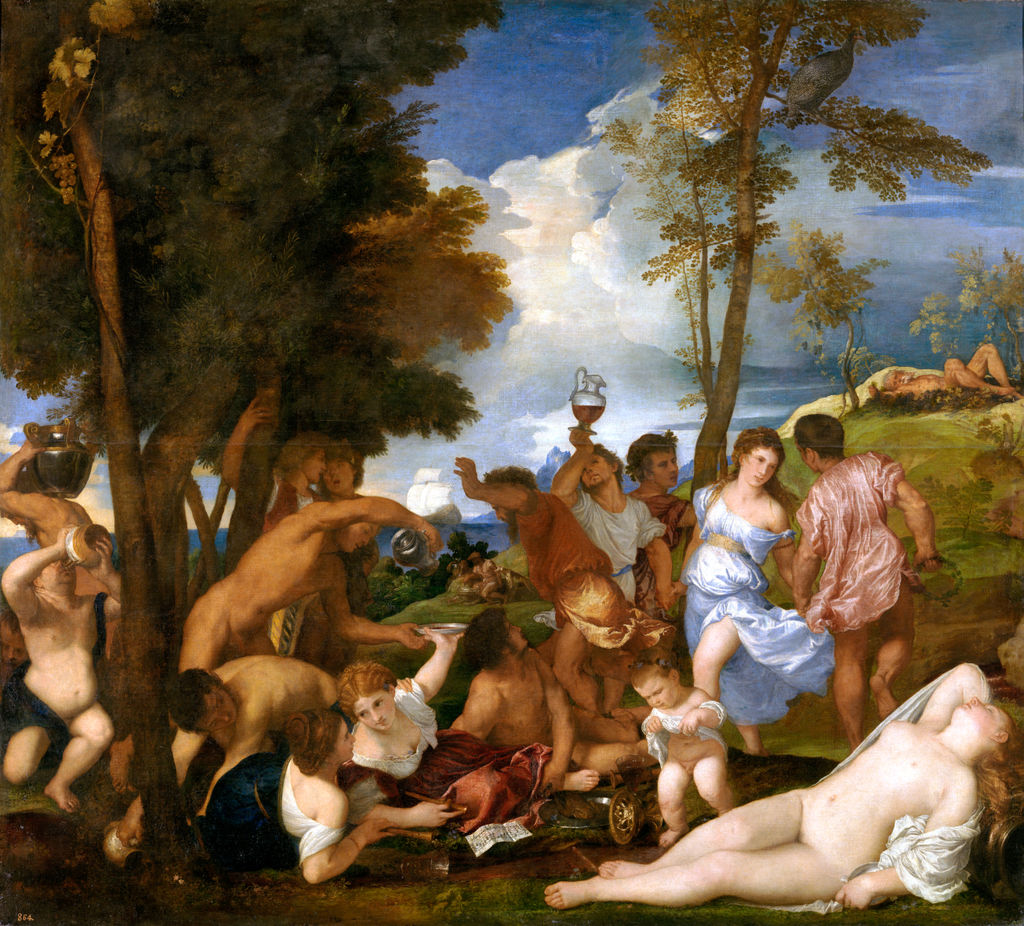
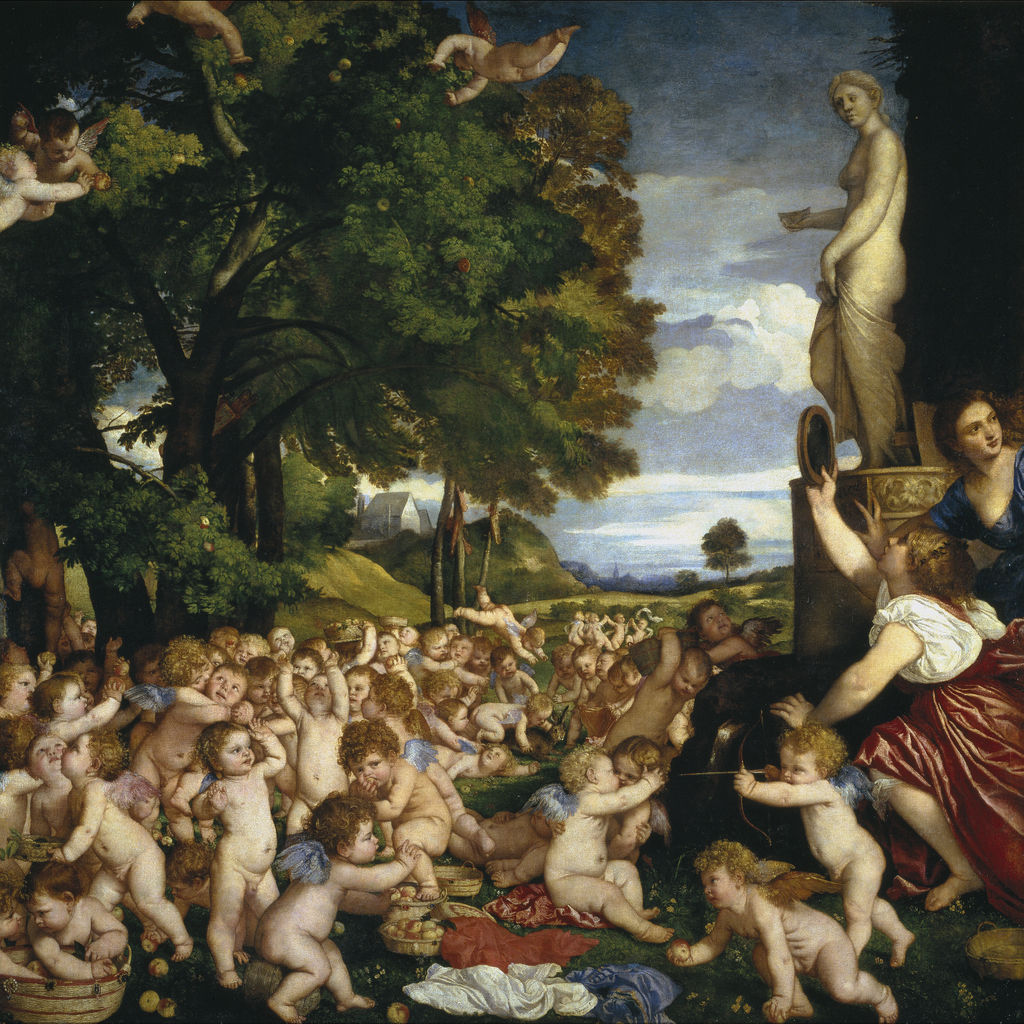
In The Worship of Venus, at the Prado, a mass of winged children fills the foreground below a statue of the goddess. Some reach for apples in the trees as others play on the ground. In the Prado’s Bacchanal of the Andrians, drinking, dancing and reclining bodies extend from the wine gathering into the landscape, with a pale sleeper on the lower right. Both Prado pictures draw on Philostratus, whose Greek text describes pictures, while the story of Lotis comes from a Roman poem about the calendar. As Valeska von Rosen notes, Equicola later told Isabella that he had seen her copy of Philostratus in the duke’s hands in the study. The reported sighting gives a concrete instance of a text used to think about pictures in a room built to display them. [11] [14] [15]
A large bacchanal by Dosso Dossi is recorded with the ensemble. One proposed identification is the Triumph of Bacchus in Mumbai. The proposal remains disputed. Dosso’s ten smaller scenes from Virgil’s Aeneid, probably displayed above the large canvases, were a separate group. Titian may have wanted the remade landscape of Bellini’s Feast to work in company with his own canvases. Changes in the scale of the scenery, the open sky and the treatment of distant ground make that a plausible explanation. The documents leave the exact arrangement and the instructions for repainting uncertain. [3] [11] [12] [13] [16]
How the landscape changed
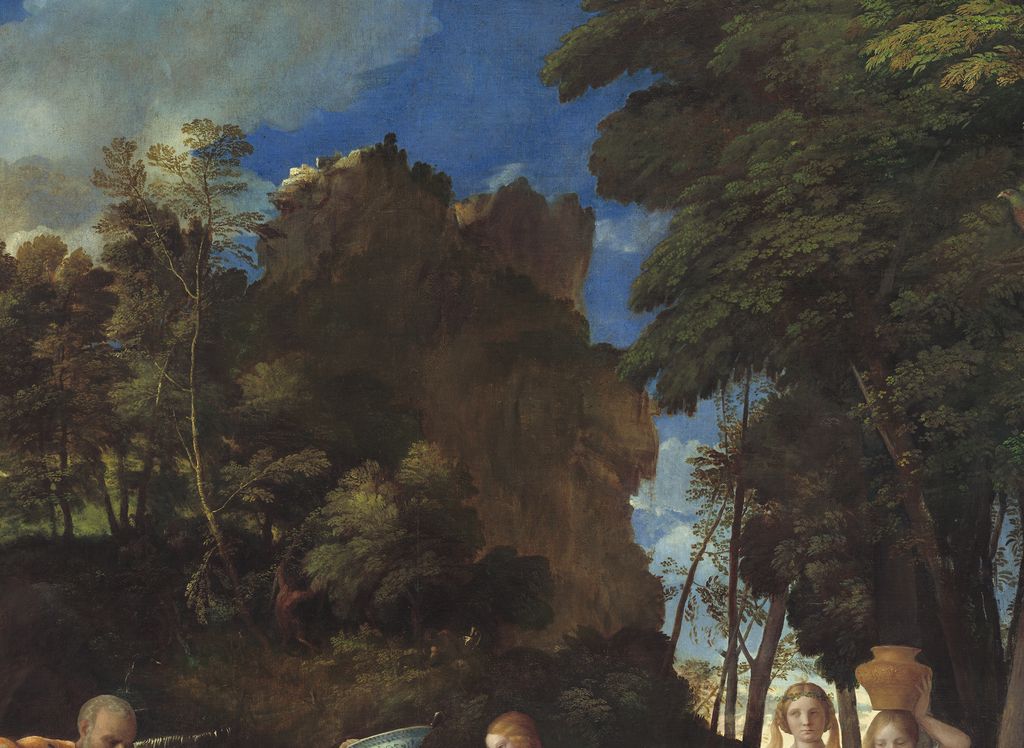
Imagine the trees at the right continuing across the canvas. In Bellini’s first scheme upright trunks formed a more continuous background to the figures. The trunks were close together and largely kept the eye within the clearing. In the intermediate version, a lower hillside with buildings replaced part of that screen on the left. The low ridge and its buildings would have drawn the eye beyond the company, while keeping the overall horizon much lower than the one in the visible painting. The great mass of rock and the atmospheric terrain now on the left belong to Titian’s later revision, conventionally dated to 1529. [3] [17]
Dosso Dossi, painter to the Este court, is often credited with the intermediate scheme. His association with the room and comparisons with his painted foliage make the suggestion intelligible. The surviving evidence gives the hillside a place in the sequence of paint layers. Attribution and the exact year of the intervention remain open. The pheasant in the upper branches on the right raises a more local version of the question. It has been associated with an intervention by Dosso. An older National Gallery of Art account even entertains the duke, an amateur painter, as a possibility for the bird. [2] [3] [17] [18]
What the conservation tests revealed
Conservators at the National Gallery of Art examined and treated the canvas over four years. Their work in the late 1980s culminated in a 1990 reinstallation with before-and-after photographs and analytical images. David Bull led the treatment, and the Gallery published his findings alongside those of Joyce Plesters. There was a practical reason to present the analytical images separately. They allowed visitors to see evidence of Bellini’s trees while Titian’s landscape was kept in place on the canvas. [19]
An X-radiograph records how much radiation passes through the materials of the picture. Some pigments contain elements that absorb X-rays relatively strongly. An earlier form painted with one of those materials can register even beneath another form. Infrared reflectance imaging looks for light returned from the canvas at wavelengths beyond visible red. Some overlying paints are more transparent there than they are in visible light, and different materials reflect or absorb differently. A hidden shape can consequently stand out in one image and be difficult to distinguish in another. The light and dark tones in those images register properties of the materials, so a dark trace can mark the position of a feature without telling us what colour it was. [3] [17]
A paint cross-section offers another kind of evidence. A tiny sample can be prepared so that conservators see its layers edge on. In a background sample, azurite was found in the first paint above Bellini’s trees. The order of the layers establishes that the azurite-bearing paint at that spot went on after the trees. A different cross-section, from the sky, illustrates the preparation beneath the design. Jill Dunkerton and Marika Spring identify lead white with a little lamp black, yellow iron oxide and dolomite in the priming, the preparatory coat below the painted forms. Barbara Berrie and Louisa Matthew found two forms of lead white in the priming beneath a sampled part of a nymph’s flesh, while they found only one of those forms in the flesh paint above. Such instances make it possible to distinguish local painting steps even where the white pigment is broadly similar. [17] [20] [21]
In 2025 John Delaney and Kathryn Dooley published a mapping study of the area around a satyr and a nymph holding a bowl. Their false-colour infrared image assigns visible colours to data from selected infrared wavelengths. It makes the submerged tree shapes more legible and also picks out brushy strokes from the intervening hillside. The same study uses a characteristic absorption in the reflected infrared light to plot azurite. The plot shows how the pigment extends across the strokes in the hillside, connecting the earlier point sample with a wider region of the composition. [17]
Azurite also appears in the map where blue ornament is painted on the nymph’s bowl. The strokes behind her and the design she holds belong to distinct features, and the pigment alone cannot date either application. Berrie reports another distinct use of azurite, in the blue of Bellini’s distant horizon, where she found traces of an opaque yellowish glass containing antimony. She interprets the glass as a way of modifying the colour. A reconstruction can suggest how a buried hill sat in relation to the figures, while a map can show where a particular substance is detectable. The materials and shapes can be recovered in part. The exact appearance of the earlier landscape and the painter responsible for it remain open. [3] [17] [22]
The paint of the figures preserves evidence of a different kind. In the blue tunic of young Bacchus, Bull described an underlayer of ultramarine mixed with lead white and a thin, more intensely coloured glaze of ultramarine above it. Finger marks in the glaze show where wet paint was dabbed, breaking up the surface and giving the blue some texture. Vera-Simone Schulz points to Bull’s observation of similar dabbing on a nymph’s paler blue dress. The resemblance is evidence of a shared way of working the paint in two passages of cloth. [23]
X-rays also show earlier versions of some women’s necklines. Titian was once credited with the changes, while Maria H. Loh reads the evidence as Bellini rethinking the figures during the initial work. Centanni leaves room for a different hand. The lines beneath the costumes show that the forms changed. Deciding when that happened involves interpreting their relation to the paint around them, independently of the evidence for a second hillside. [8] [18] [24]
From Ferrara to Washington
On 1 December 1598 the Este agent Annibale Roncaglia reported that five gilt-framed paintings had been taken from the Ferrara room. He identified this one by a particularly recognisable detail, the child drawing wine from a little vessel, and credited its landscape to Titian. The letter supplies early evidence of Titian’s role. Roncaglia had the help of two people who knew the room. His account links the visible canvas to its Ferrara setting, although it gives no date for Titian’s work. [12]
Cardinal Pietro Aldobrandini took the painting from Ferrara in 1598, and it appears in his inventory of 1603. It remained in Roman family collections for almost two centuries. One consequence of its time in Rome may survive in Edinburgh. The National Galleries of Scotland holds a full-size copy, probably made in Rome, and suggests a possible connection with Nicolas Poussin. The catalogue lists the copy under an unknown artist and gives a date of about 1625–50. It records the composition as someone encountered it in its revised form. [1] [25]
In 1796 or 1797, Pietro Camuccini bought the original for his brother Vincenzo’s collection. The collection was sold in 1853 and the painting went to the fourth Duke of Northumberland at Alnwick Castle. It passed down in the family and in 1916 two London dealers bought it on joint account. It was in New York for the Metropolitan Museum of Art’s 1920 exhibition, where the credit was to Carl W. Hamilton. Hamilton appears to have had it on credit, without completing the purchase. [1]
Joseph Widener acquired the canvas in 1921 using funds from his father’s estate. A dealer’s letter from September 1921 anticipates delivery in October, while the entry in Agnew’s records puts the sale in 1922. The painting entered the National Gallery of Art as a gift in 1942 and is part of the Widener Collection. [1]
Annotated Details from The Feast of the Gods at the National Gallery of Art
Numbered overview and cropped details. Photograph National Gallery of Art, Washington via Wikimedia Commons. Image source. CC0 1.0.
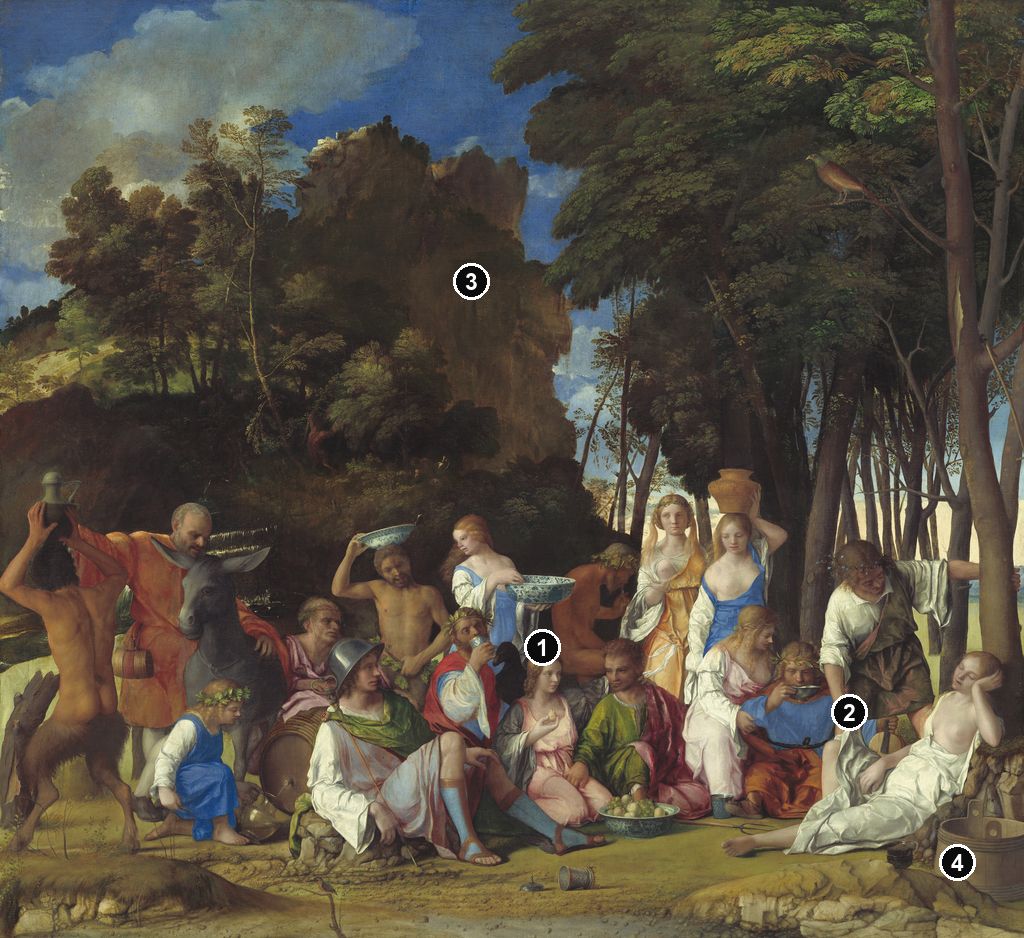
Details from THE FEAST OF THE GODS AT THE NATIONAL GALLERY OF ART
The painted details show the figures and the landscape visible today. Scientific images are separately linked from the article.
Vessels amid the feast
Bottles, bowls and cups share the foreground with brightly coloured clothes. The figures raise, hold and exchange them across the gathering.
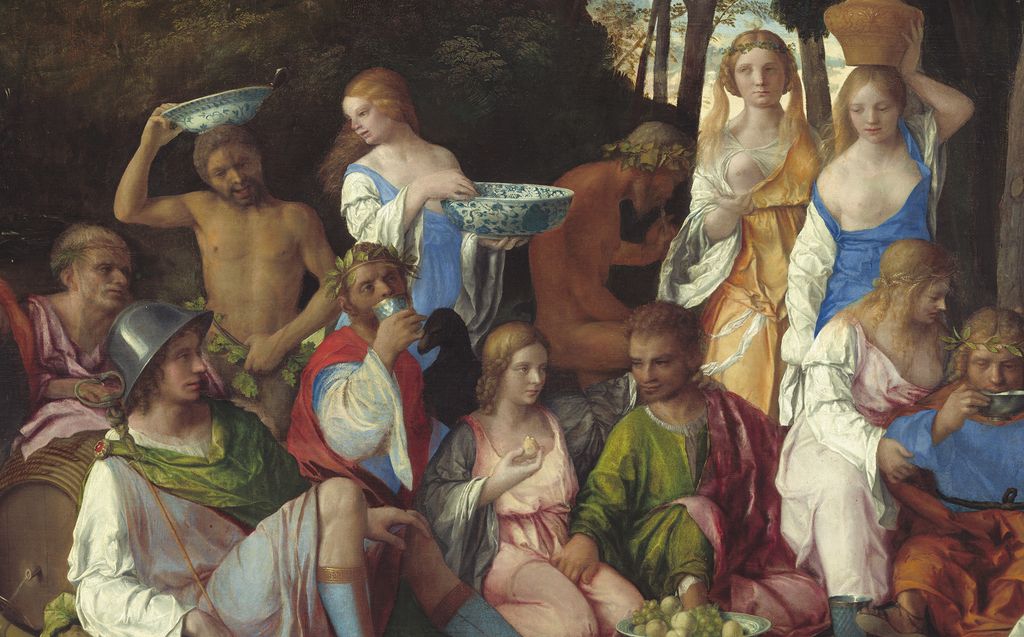
The right-hand group
A standing man leans towards the reclining woman at the right. Her outstretched legs and their proximity make the action easy to locate within the long gathering.
Rock and woodland
The broad rocky face on the left and the closer upright trunks at right compress different kinds of landscape into the same view.
The painted slip of paper
The pale label is painted against the staves of the wooden tub. Its placement keeps the signature and date within the space of the feast.
Related reading
Artworks directory
Discussion
Look again at the images and ideas explored in The Feast of the Gods. These editorial prompts invite your observations.
Reader Insights
How does placing the donkey and Lotis at opposite ends affect the moment the painting conveys?
What can the scientific images establish about the order of the landscapes?
What role do the vessels and gestures play in connecting different groups at the table?
Join the Conversation
Share a detail, comparison or question about The Feast of the Gods below.
References
- National Gallery of Art, The Feast of the Gods, accession 1942.9.1 View source.
- Alex Dean, Layers of Power in The Feast of the Gods, National Gallery of Art View source.
- National Gallery of Art, Bellini and Titian, The Feast of the Gods, collection highlight View source.
- National Gallery of Art, West Building Tour, stop 315 View source.
- J. Paul Getty Museum, The Adoration of the Magi, exhibition text View source.
- Ovid, Fasti 1.391–440, Latin text edited by Sir James George Frazer View source.
- Myrto Garani, Ovid and the Ass, Edizioni Ca' Foscari View source.
- Monica Centanni, A pedibus tracto velamine, Padova University Press, pp. 350–56 View source.
- Anthony Colantuono, Dies Alcyoniae, The Art Bulletin, abstract View source.
- Ugo Soragni, Il Festino degli Dei di Giovanni Bellini, Acta Concordium, pp. 2–3 and 10–11 View source.
- Valeska von Rosen, Diletto dei sensi und diletto dell’intelletto, Städel-Jahrbuch, pp. 83–84 and 102 View source.
- Gaia Prignano, Iconografia musicale nella Ferrara di Alfonso I d’Este, Università di Bologna, pp. 159–62 View source.
- National Gallery, London, Titian’s Bacchus and Ariadne, NG35 View source.
- Museo del Prado, Titian’s Worship of Venus, P000419 View source.
- Museo del Prado, Titian’s Bacchanal of the Andrians, P000418 View source.
- Galleria Borghese, Dosso Dossi’s Aeneas Frieze, exhibition introduction View source.
- John Delaney and Kathryn Dooley, Europhysics News 56/4, pp. 13–14 and fig. 2 View source.
- Maria H. Loh, Titian Remade, Getty Publications, pp. 64–65 View source.
- National Gallery of Art, Reinstallation of Bellini/Titian Feast of the Gods, 1990 View source.
- Jill Dunkerton and Marika Spring, Titian’s Painting Technique to c.1540, National Gallery Technical Bulletin, p. 15 and fig. 24 View source.
- Barbara Berrie and Louisa Matthew, Lead White from Venice, p. 296 and fig. 4C View source.
- Barbara H. Berrie, Mining for Color, Early Science and Medicine, pp. 329–30 and fig. 6 View source.
- Vera-Simone Schulz, Das Parlament der Dinge, pp. 44–45, citing David Bull’s conservation report View source.
- Monica Centanni, Fantasmi dell’antico, pp. 550–52 View source.
- National Galleries of Scotland, The Feast of the Gods, copy after Giovanni Bellini, NG 458 View source.