


 by Tom Gurney
Tom Gurney BSc (Hons) is an art history expert with over 20 years experience
Email: tomgurney1@gmail.com / Phone: +44 7429 011000
Giovanni Bellini’s painted works
Two paintings called The Transfiguration can show the same six figures and give a radically different impression of the event. A picture called Madonna and Child is harder to identify by title alone. Giovanni Bellini repeatedly painted the same holy figures for different settings, and the designs remained in use among his assistants and followers. The collection name, support and attribution are often as revealing as the title. A panel made for prayer at home brings the faces close. A church altarpiece can give each saint a recognisable silhouette at a distance and leave smaller episodes for someone who comes up to the altar. Looking across the two formats helps explain why Bellini returned to a few subjects so often. [1]
At a Glance
- ScopePainted works discussed in this cluster
- SubjectsDevotional panels, Passion scenes, altarpieces, portraits and late narrative works
- WorkshopAttribution and versions vary by object
Paintings catalogue
Madonnas for close viewing
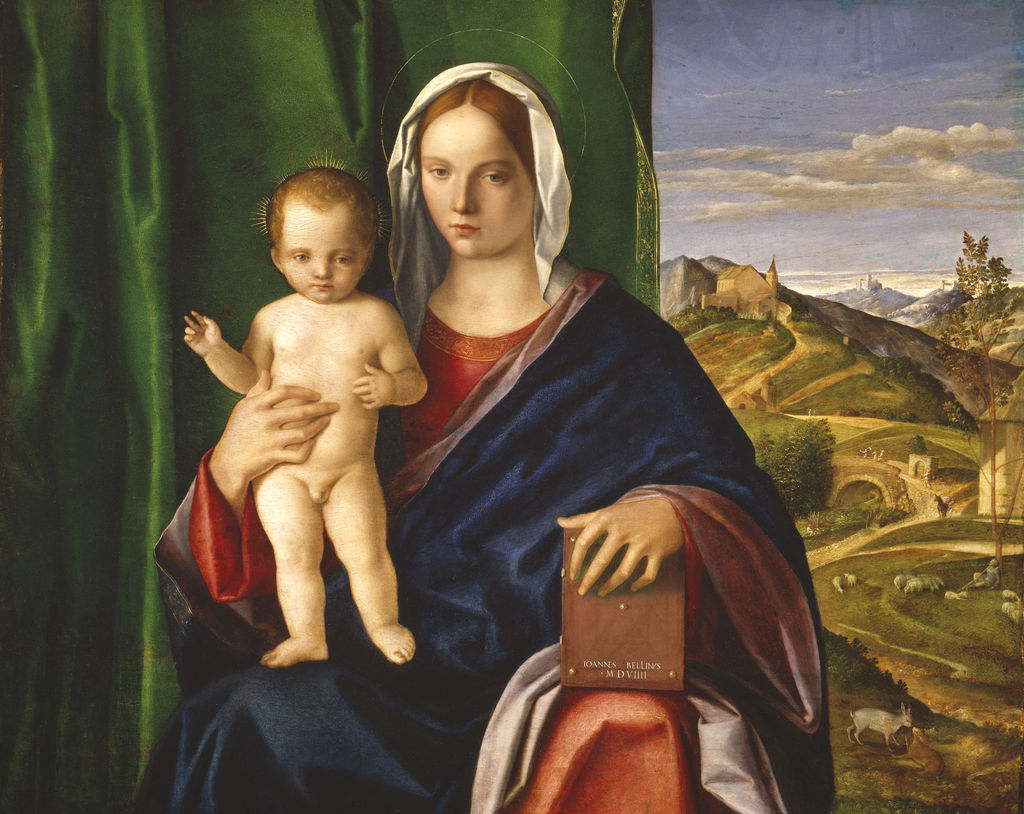
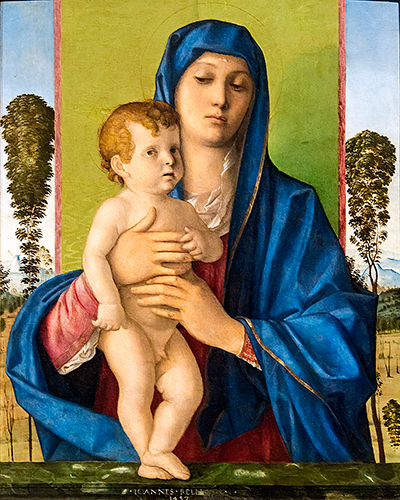
Start with the boundary between the Virgin and the world around her. In the Accademia’s Madonna of the Small Trees, a green cloth interrupts the view behind her and the two slender trees show up against the sky on either side. The cloth gives her silhouette a clear setting, while the openings allow the eye to wander. The Detroit Madonna and Child also uses a green curtain, which the museum interprets as an interior boundary that lets the spectator feel close to the figures. The Detroit picture’s provenance names the Mocenigo family as its commissioners. Here a readily recognisable type of devotional picture can be associated with a particular household. [2] [3]
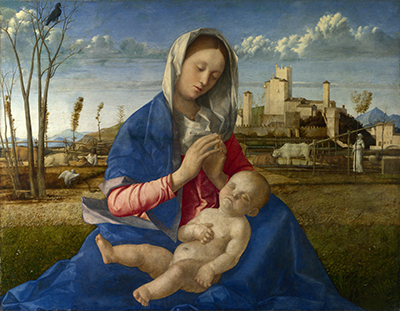
In the London Madonna of the Meadow, Mary sits directly on the ground. Her blue mantle makes a compact shape at the centre, with the sleeping child laid across her lap. Look past them and the picture changes pace. Small figures and animals occupy the field, and moving clouds and changes in light suggest weather passing over the countryside. In the curtain pictures, the cloth makes it easy to return from the distant view to a face or hand. In London, the land continues on either side of Mary and the surrounding activity brings out her stillness. The same relationship between mother and child could therefore be given a more sheltered or exposed setting. [2] [3] [4]
- Madonna of the Small Trees, the signed 1487 Virgin and Child with the two trees, Gallerie dell’Accademia, Venice. [2]
- Madonna of the Meadow (Madonna del Prato), about 1500–05, National Gallery, London, NG599. [4]
- Madonna and Child, 1509, Detroit Institute of Arts, 28.115. [3]
Repeated designs and workshop hands
The Accademia identifies the same cartoon, a full-size preparatory design, behind the mother and child in the Small Trees and in its painting of the Virgin and Child between Saints Paul and George. Compare the relative position of the two bodies before looking at the added figures and setting. A familiar group could be transferred from a design and then given a different set of relationships. Designs travelled further. A preparatory drawing for a sacred conversation at Museum Boijmans Van Beuningen shows Cima da Conegliano adapting a frontal Christ Child type which the museum traces back to Bellini. The drawing gives an example outside Bellini’s own painted catalogue of how widely such a figure could circulate. [2] [5]
A signature and an attribution answer different questions. The Städel in Frankfurt records a signature on the painted ledge of its Madonna and Child with Saint John the Baptist and Saint Elizabeth, which it catalogues as Bellini and workshop. Its curators also draw attention to an unusually revealing detail. The two companions have been arranged so that they face Mary’s back, with the child hidden from them. The use of standard patterns is visible in the way the group fits together. The National Gallery, in turn, catalogues its Virgin and Child NG2901 as workshop of Giovanni Bellini. During cleaning, the gallery found that the painted slip of paper and its signature were additions and removed them. These are two different kinds of evidence for how a picture came to bear the Bellini name. [6] [7]
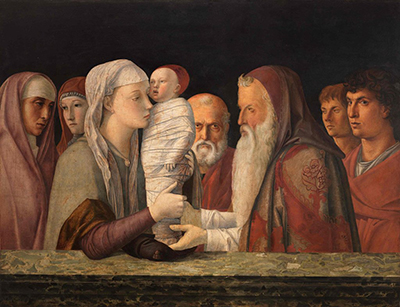
The Presentation at the Temple in the Querini Stampalia is another way to follow a composition across collections. Its central handover of the swaddled child, dark background and half-length figures recall Mantegna’s version in Berlin. Bellini adds a figure at either side and replaces Mantegna’s painted frame with a low parapet, widening the space around the exchange. Berlin also holds a separate workshop version after Bellini. That distinction matters when comparing photographs captioned simply Presentation at the Temple. In Madrid, the Thyssen’s Mystical Subject (Nunc dimittis) gives the viewer a different arrangement. One interpretation identifies the figure at right as Simeon, with the encounter taking place in an open landscape. The museum records a debate over the degree of workshop participation. Its subject and attribution history both deserve their own labels. [8] [9] [10]
- Presentation at the Temple, the wider composition attributed to Bellini, Fondazione Querini Stampalia, Venice, dated there to about 1475. [8]
Christ’s Passion and the solitary saints
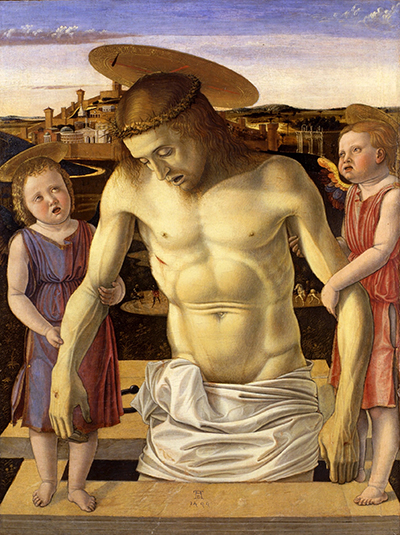
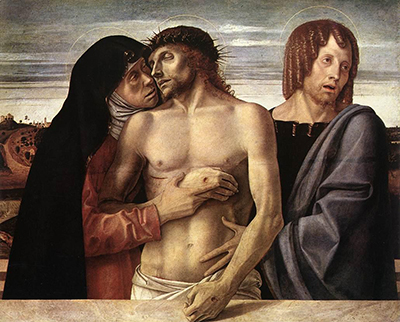
Look at the people physically supporting Christ in the Brera Pietà. The Virgin and Saint John are close against his body, and the parapet brings the group up to the painted surface. The surrounding air and the pale background allow the eye to register the difference between the living faces and the dead Christ. At the Museo Correr, the attendants in the corresponding devotional type are angels. A distant town opens up behind them. The National Gallery’s separately catalogued Dead Christ Supported by Two Angels, NG3912, encloses Christ and the angels against darkness. The open background in the Correr panel lets the eye travel from the figures to the horizon. In London, attention remains almost entirely on the figure’s weight, wounds and pallor. [11] [12] [13]
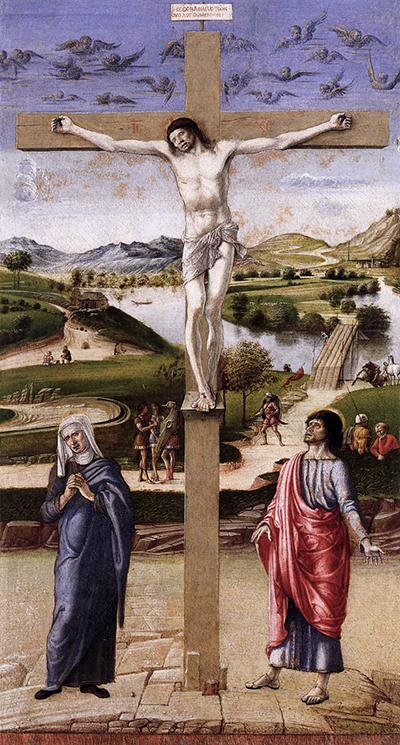
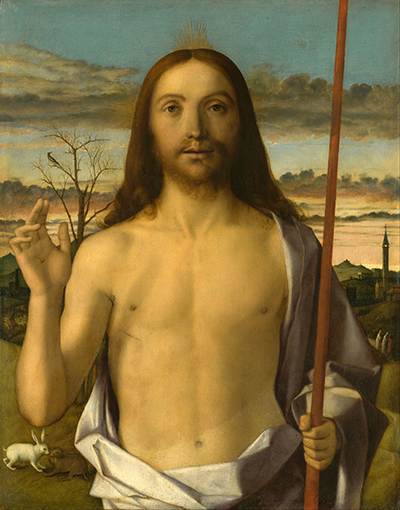
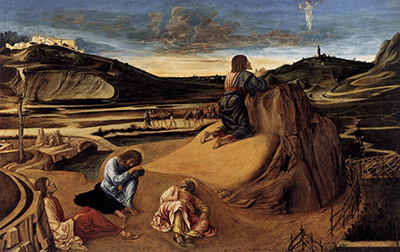
In Christ Blessing at the Kimbell, the raised hand and outward look address the spectator directly. The sign of the wound in the hand makes a connection between the blessing and the subjects of the Passion. In a narrative picture such as The Agony in the Garden, the distance between the figures carries the action. Christ prays while the disciples sleep, and the approaching group led by Judas is still some way off. Bellini uses the distance the soldiers have to travel and the spreading light in the sky to make something that is about to happen felt in a still image. His narrow Correr Crucifixion offers a way to compare a painting in which the execution has happened, the cross is the vertical axis and the Virgin and Saint John witness the event beside it. [14] [15] [16]
- Crucifixion, the narrow panel with the Virgin and Saint John the Evangelist, Museo Correr, Venice. The Louvre owns a separate Crucifixion with the same attendants. [16]
- The Agony in the Garden, National Gallery, London, NG726. Mantegna’s painting of the subject in the same collection is a different panel. [15]
- Pietà (The Dead Christ Supported by the Virgin Mary and Saint John), about 1460, Pinacoteca di Brera, Milan, inv. 228. [11]
- The Dead Christ Supported by Two Angels, the panel with the distant town, about 1465 according to Giorgio Fossaluzza, Museo Correr, Venice, inv. cl. I, 39. [12]
- Christ Blessing, about 1500, Kimbell Art Museum, Fort Worth, AP 1967.07. [14]
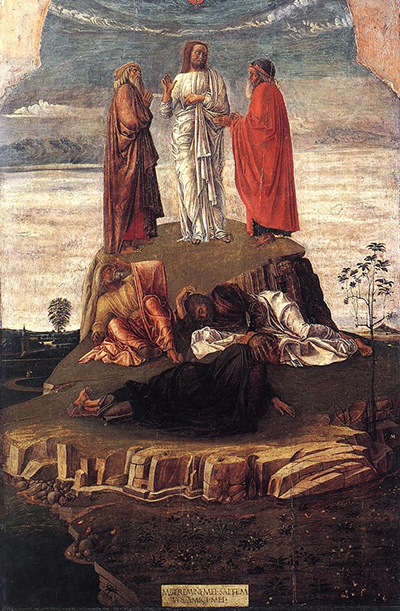
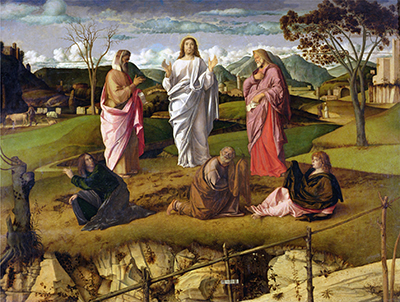
In the two Transfigurations, where Christ appears in glory between Moses and Elijah, the shape of the panel governs how the viewer approaches the miracle. In the narrow Correr panel the eye rises from the apostles over steep shelves of rock to the figures above. The wide Naples version allows the foreground fence, grass and distant land to register alongside the action. The Louvre’s dossier on the Naples painting places it around 1478–79. Capodimonte’s comparative conservation work treats the paintings as distinct approaches to the same subject, with the later artist still making changes under the surface as he developed the picture. [17] [18]
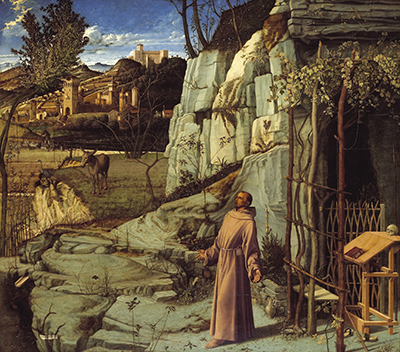
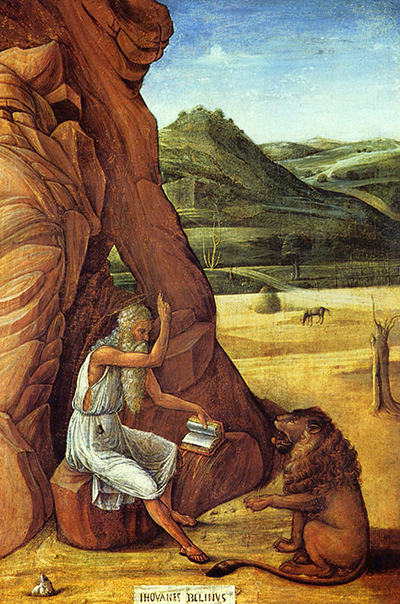
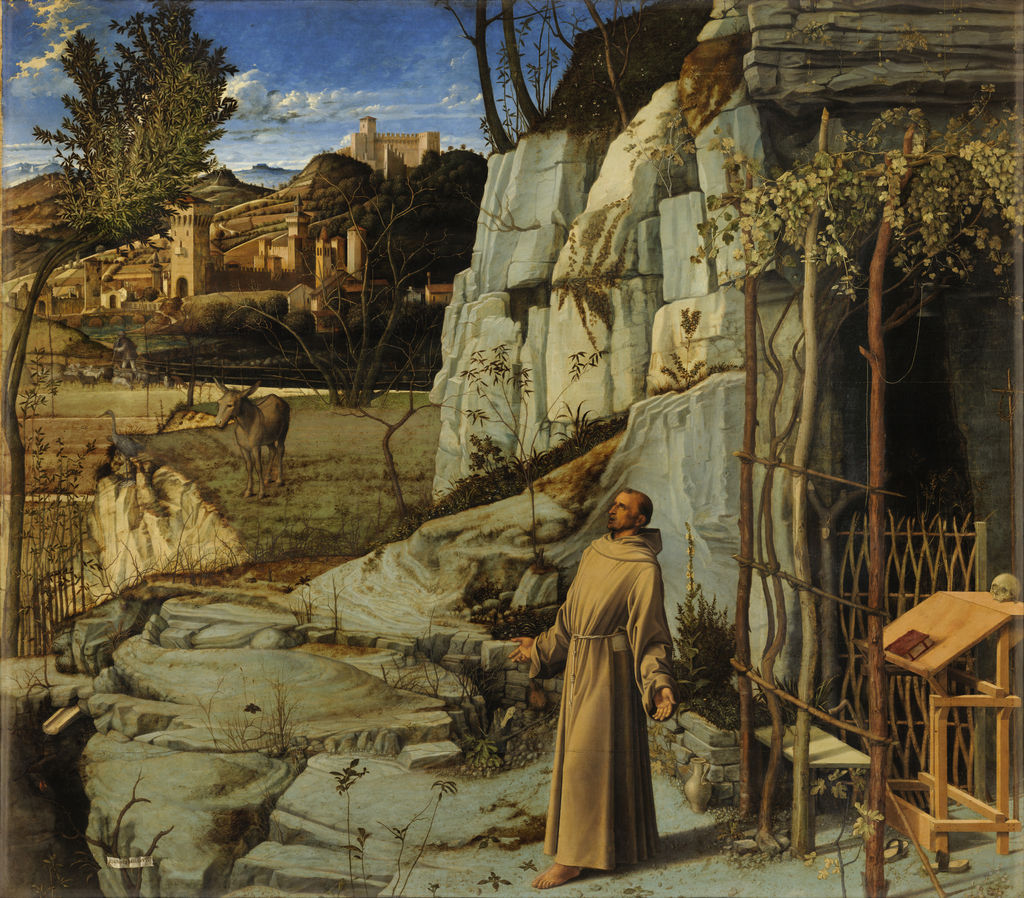
Setting also distinguishes Bellini’s pictures of saints in retreat. The Barber’s early Jerome has an encounter to attend to, with the lion close by and its paw raised. The London and Washington reading Jeromes give more weight to sustained study, as the Getty’s exhibition comparison shows. In the Frick Saint Francis, the figure stands open to a light which reaches across the rocks and buildings. The distance between the small saint and the extent of the landscape does much of the work. A viewer can move from plants or an animal near the ground to the higher rocks, then return to the illuminated face. The Uffizi’s Sacred Allegory uses spatial movement very differently. The terrace places a company of figures near the viewer and the water and cliffs open beyond it. The Uffizi leaves the overall meaning of the gathering unresolved. [16] [19] [20]
- Transfiguration, Venice, the earlier, tall composition, Museo Correr. [17] [18]
- Transfiguration of Christ, Naples, the later, wide panel with the foreground fence, Museo e Real Bosco di Capodimonte. [17] [18]
- Saint Jerome in the Wilderness, the early composition with the lion holding up its paw, Barber Institute of Fine Arts, Birmingham. [16]
- Saint Francis in the Desert, also known as Saint Francis in Ecstasy, Frick Collection, New York. [19]

Altarpieces and the scale of a church
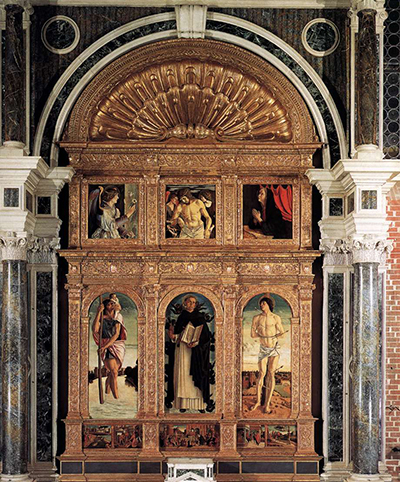
An altarpiece is easiest to compare when its frame and original position are kept in view. At Santi Giovanni e Paolo in Venice the Saint Vincent Ferrer Polyptych gives the saint a tall central compartment. The small scenes in the predella, the row at the foot of the ensemble, tell stories of his miracles. You can recognise the central figure from across the church, whereas it takes closer attention to read the episodes below. The scenes also have links with the figures directly above. As Antonio Mazzotta points out, the panel of Saint Christopher shows him standing in water and the predella immediately below includes a miracle involving a drowned girl. Seen together, the details direct the eye vertically as well as along the rows. [21]
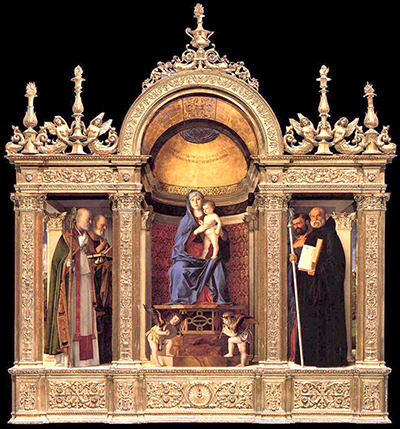
The Pesaro altarpiece also distributes stories and figures around a central image. In the core panel, the opening in the throne lets the eye through to the country beyond the Coronation. The uppermost component has its own history. Pesaro’s museum and the Vatican identify the Vatican Lamentation over the Dead Christ as the upper panel of the ensemble originally made for San Francesco. A reproduction of the Coronation or a photograph of the restored grouping therefore needs a label identifying what is included. Comparison with the Frari triptych brings the frame itself into view. The three painted divisions in the Frari are still read through the large wooden frame. The basilica’s conservation project treats that woodwork as integral to the object. [22] [23] [24]
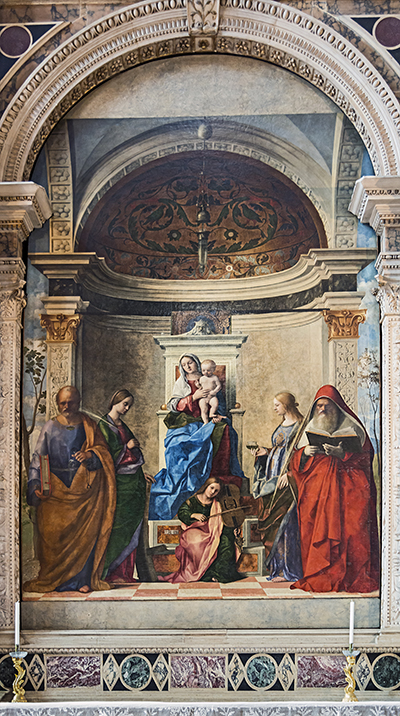
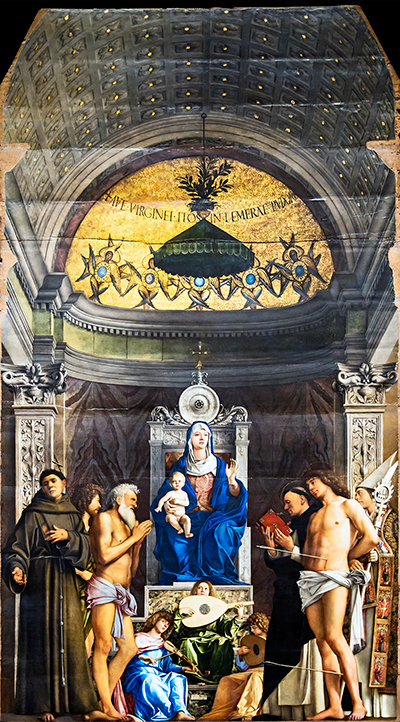
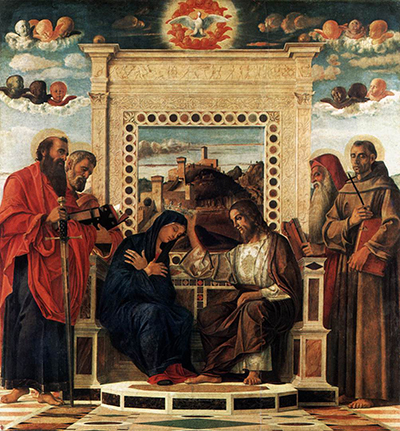
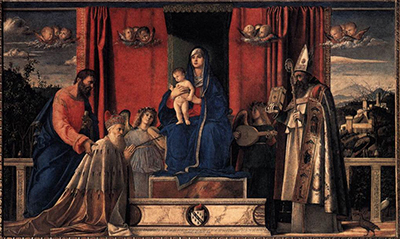
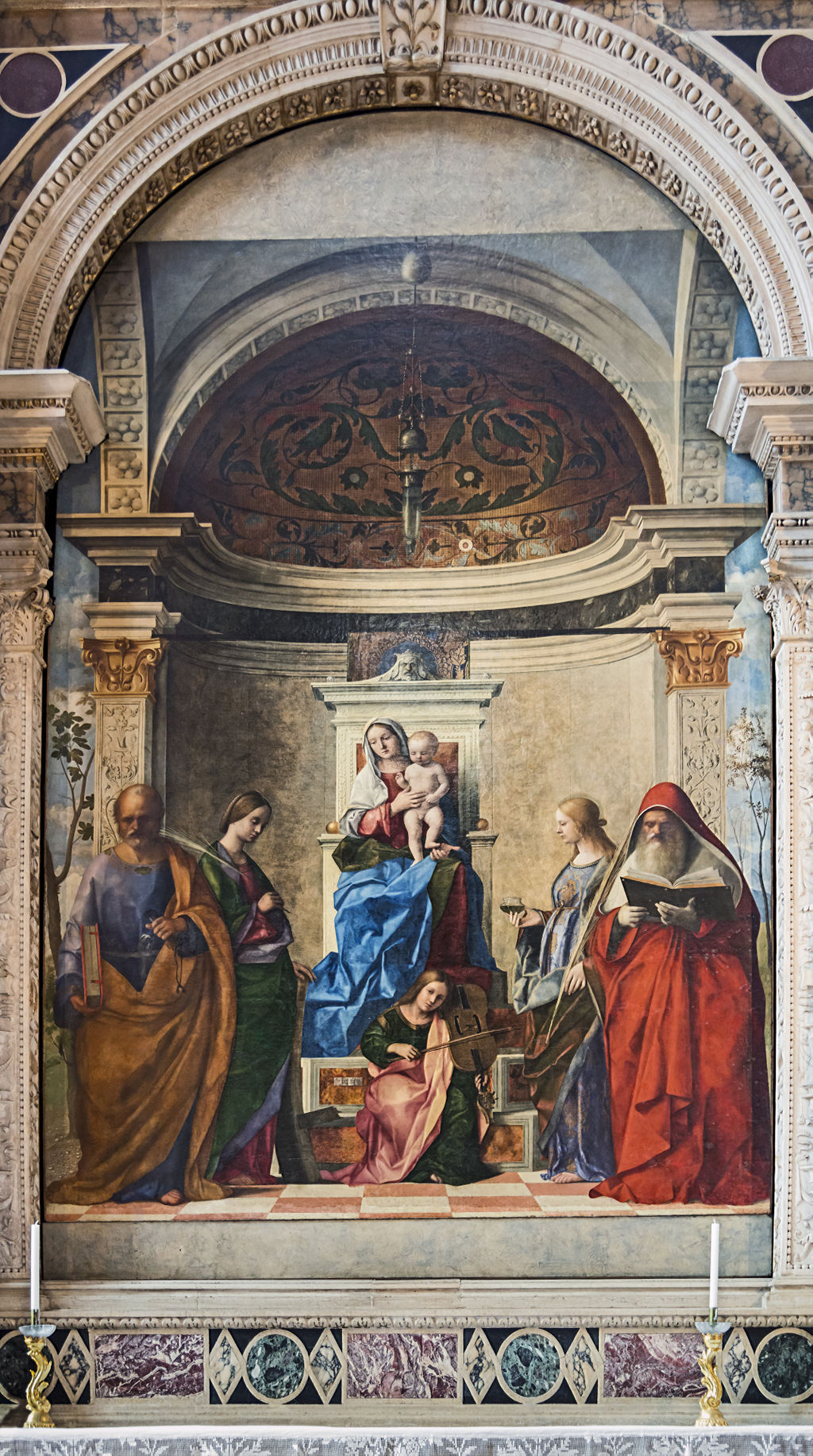
The San Giobbe painting invites a different way of reading the church wall. Its saints and angels occupy a single perspectival interior. Follow the floor and the architecture behind the figures and they appear to share the same space as the throne. The Accademia relates that illusion to the painting’s original setting. At San Zaccaria, Bellini again gives the saints and the Virgin a common architectural space, with a musician at the foot of the throne and daylight visible to the sides. That light gives the setting a sense of openness, even though the throne, bowed heads and arch keep the gathering concentrated around its centre. The sacra conversazione, or holy conversation, describes their shared presence. They can form that gathering without anyone appearing to speak. [25] [26]
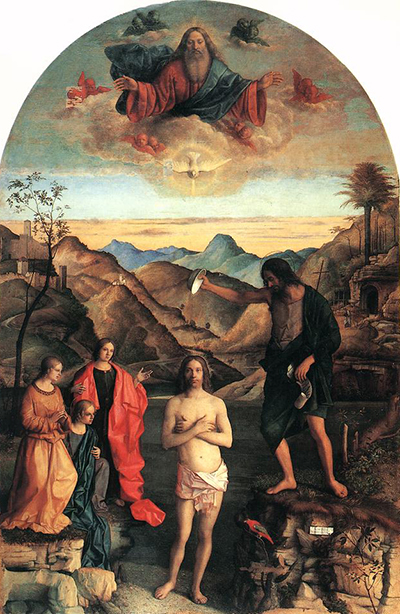
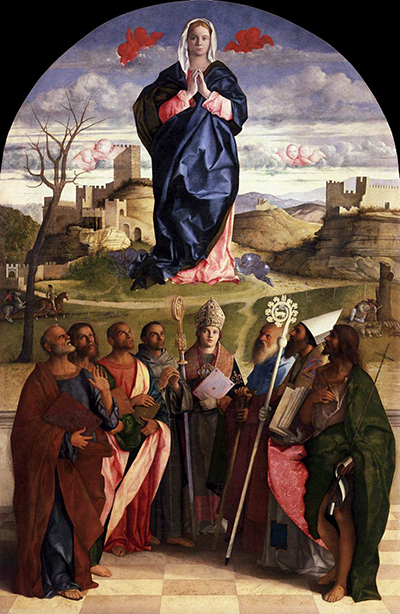
The two altarpieces at San Pietro Martire in Murano answer another question about a painting’s setting. The 1488 Barbarigo Altarpiece puts a kneeling doge before the enthroned Virgin. The Italian national catalogue traces the work from the Barbarigo palace to Murano. The late Virgin in Glory sets the Virgin above a semicircle of saints and has its own panel and conservation record. At the Garzadori altar in Vicenza’s Santa Corona, the architecture frames a biblical episode outdoors. The central exchange between Christ and John is set against an expanse of land and sky, so the water and the interval between the figures have room to shape what worshippers see from below. [27] [28] [29]
- Saint Vincent Ferrer Altarpiece, multi-panel ensemble, Basilica dei Santi Giovanni e Paolo, Venice. [21]
- Pesaro Altarpiece, the Coronation of the Virgin ensemble, Musei Civici, Pesaro, with the upper Lamentation in the Vatican Pinacoteca. [22] [23]
- Frari Triptych, 1488, sacristy of the Basilica dei Frari, Venice. [24]
- San Giobbe Altarpiece, formerly in San Giobbe, now Gallerie dell’Accademia, Venice. The museum gives a range from 1478 to the late 1480s. [25]
- Barbarigo Altarpiece, the 1488 work with Agostino Barbarigo, San Pietro Martire, Murano, national catalogue 0500123237. [27]
- Baptism of Christ, Garzadori altar, Santa Corona, Vicenza. [28]
- San Zaccaria Altarpiece, the 1505 enthroned Madonna with saints and musician in the church of San Zaccaria, Venice. [26]
- Virgin in Glory with Eight Saints, dated 1510–15 by the conservation sponsor, San Pietro Martire, Murano. [29]

Confraternity painting, portraiture and late subjects
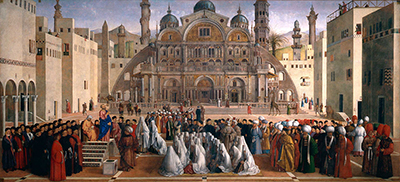
A second kind of large sacred picture was made for collective viewing in a confraternity. The Brera’s Saint Mark Preaching in Alexandria is over seven metres wide. A viewer reads the separate clusters of listeners, then the architecture across the width of the square. It was begun by Gentile Bellini for the Scuola Grande di San Marco and completed by Giovanni after Gentile’s death. Brera credits both painters. The commission and its completion establish that continuity, even when a single passage can be difficult to assign. [30]
- Saint Mark Preaching in Alexandria, commissioned in 1504, Gentile and Giovanni Bellini, Pinacoteca di Brera, Milan, inv. 160. [30]
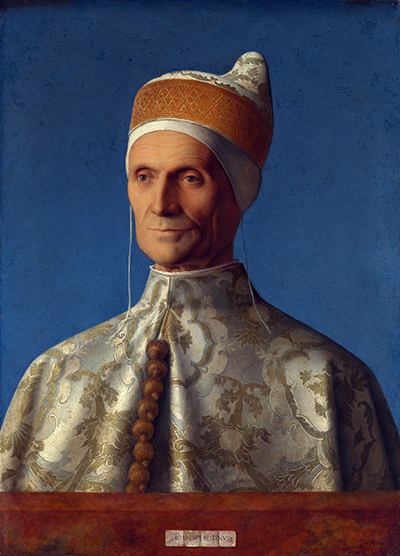
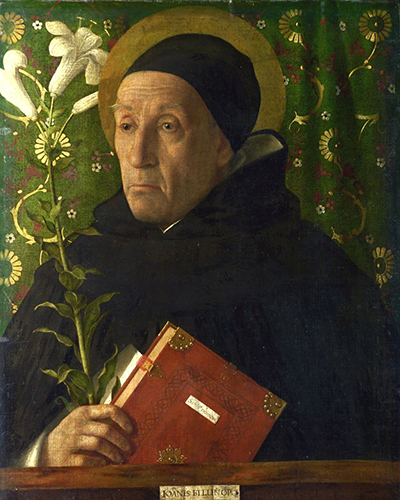
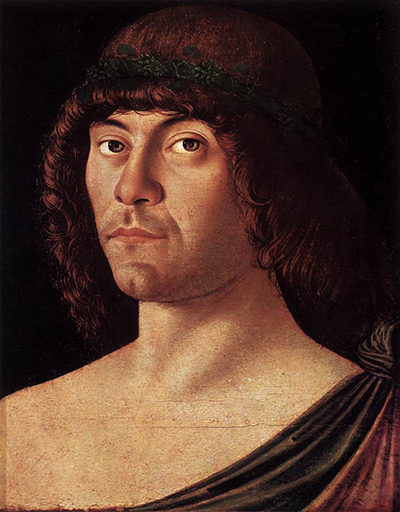
A half-length portrait offers another kind of public presence. Leonardo Loredan’s patterned robes carry the information about his rank, while his slight turn gives the viewer two sides of his face and lets the light model it unevenly. Compare that with the Milan portrait conventionally called Portrait of a Humanist. Its laurel wreath raises a question about learning, honour and the sitter’s public identity, which the London and Berlin exhibition checklist leaves open. The late portrait of Fra Teodoro of Urbino has a different kind of double identity. The habit, book and lily let the sitter appear in the guise of Saint Dominic. The National Gallery notes that the dating and identifying inscription were probably added after the painting, a qualification worth keeping alongside the name on the label. [31] [32] [33]
- Doge Leonardo Loredan, about 1501–02, National Gallery, London, NG189. [31]
- Portrait of a Humanist, Pinacoteca del Castello Sforzesco, Milan. The sitter’s proposed identification as Andrea Mantegna remains tentative. [32]
- Portrait of Fra Teodoro of Urbino as Saint Dominic, about 1515, Victoria and Albert Museum, catalogued by the National Gallery under loan number L1115. [33]
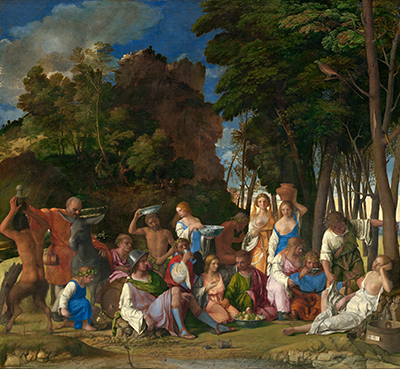
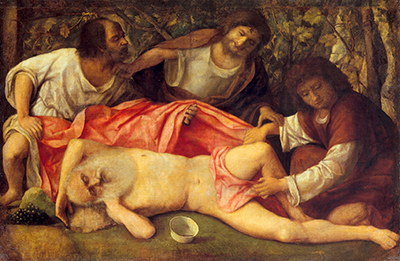
Late works bring different kinds of narrative into view. In Washington’s Feast of the Gods, the objects of a banquet and the company around it belong to a mythological story associated with Alfonso d’Este’s private rooms in Ferrara. Bellini signed and dated the canvas in 1514, and the National Gallery of Art credits the painting to Bellini and Titian. The landscape visible now includes subsequent work, which belongs to the history of that commission. In Besançon’s Drunkenness of Noah, the exposed body and the men gathered around it belong to Genesis, even though the low, close group can at first look like a scene of ordinary human misbehaviour. The French catalogue records earlier assignments to Cariani, Giorgione and Titian. For a further example of secular subject matter, the Kunsthistorisches Museum in Vienna catalogues Bellini’s late Young Woman at Her Toilette, where the disposition of two mirrors makes the woman’s absorption in her own appearance a subject in itself. [34] [35] [36]
- The Feast of the Gods, begun by Bellini, signed 1514 and subsequently altered, National Gallery of Art, Washington, 1942.9.1. [34]
- The Drunkenness of Noah, about 1515, Musée des Beaux-Arts et d’Archéologie, Besançon, 896.1.13. [35]
Tempera, oil and the picture beneath the surface
A single date for the adoption of oil would misrepresent the evidence. The Getty’s checklist gives oil and tempera for the early Correr Crucifixion, tempera for the closely related subject in the Louvre, and a combination of tempera and oil again for the Kimbell Christ Blessing around 1500. The National Gallery identified walnut oil in its Dead Christ Supported by Two Angels, made about 1465–70. In that picture the gallery compares a boldly touched highlight beneath Christ’s eye with the fine marks used to make his beard. Both marks belong to an early experiment with oil. The sharpness or delicacy of a passage alone will tell you little about the binding medium. [13] [14] [16]
Technical examination also helps explain how apparently spontaneous effects came about. An infrared image of the Frick Saint Francis shows lines beneath the paint that establish the shaded parts of the saint’s head. The painter was already considering the fall of light while working out the form. Reflectography and radiography at Capodimonte revealed changes of mind beneath the later Transfiguration. The two investigations show how preparatory work can fix some decisions and leave others open during painting. Bellini’s drawings offer a related body of evidence on paper. Underdrawing, visible through examination of the painted object, has a different physical relationship to the picture. [17] [19]
Read the support line of a museum label with similar care. The National Gallery lists Madonna of the Meadow as originally painted on wood and now on composite board. The Hermitage records a different history for its Bellini Madonna and Child, whose painted layer was transferred from wood to canvas in the nineteenth century. Fra Teodoro’s portrait is catalogued as oil on canvas from the outset. One can compare the three pictures as painted surfaces today, while retaining the evidence of their different structures and later treatments. [4] [33] [37]
Some of the brightness in Bellini’s paintings comes from materials which behave differently as the viewer moves or the light changes. A team studying the later Transfiguration used chemical imaging to identify shell gold, made from gold powder, in the rays around Christ’s head and the mineral pigment stibnite in the grey of his cloak. In Frankfurt, the blue of the Städel Madonna owes its intensity to ultramarine. Such choices matter alongside the binder. Bellini used both a luminous blue cloth and gold that physically reflects light, choosing effects suited to the part of the picture and the work it had to do. [6] [38]
Prints and Reproductions
A modern art print reproduces a painting. The place to begin a search is the full object title and collection, especially for a subject such as the Madonna and Child or Transfiguration. For the latter, the tall Correr version will suit a vertical format and the Capodimonte version needs space for its broad view of the countryside. Compare the listing image with the holding collection’s photograph and look at what remains visible at the edges. A print of the Frari triptych may show the whole framed ensemble or concentrate on the Virgin and Child in the central panel. The two views suit different uses. [17] [18] [24]
Check the dimensions of the printed image as well as the overall paper or frame size. A substantial white border can make the picture itself much smaller than the advertised sheet. For a large reproduction, look at the detail preview if there is one. The lower edge of Loredan’s portrait should retain the painted signature slip when the full composition has been reproduced. In the Madonna of the Meadow, the small figures and animals and the faint changes in the clouds give an indication of how much detail you will be able to see. Colours in a photograph can vary with capture and display, so a screen preview is most useful for comparing the crop, proportions and level of detail. [4] [31]
As an Amazon Associate, TheHistoryOfArt.org earns from qualifying purchases.
Videos on Giovanni Bellini
Explore Bellini’s work through museum talks and close readings.
Giovanni Bellini: A pioneering Venetian artist
The National Gallery introduces Bellini through examples of natural light and landscape.
Watch on YouTubeRelated reading
Artworks directory
Discussion
Look again at the images and ideas explored in Giovanni Bellini Paintings. These editorial prompts invite your observations.
Reader Insights
Which repeated subject makes Bellini’s changes of design easiest to see?
How does the intended setting affect what you notice in an altarpiece or a small devotional panel?
What do the drawings and technical studies add to the way you compare paintings in the catalogue?
Join the Conversation
Share a detail, comparison or question about Giovanni Bellini Paintings below.
References
- National Gallery, London, Giovanni Bellini, artist and collection catalogue. View source.
- Gallerie dell’Accademia, Venice, Madonna col Bambino (detta Madonna degli alberetti), collection catalogue (in Italian). View source.
- Detroit Institute of Arts, Madonna and Child, 28.115, object and provenance record. View source.
- National Gallery, London, Madonna of the Meadow, NG599. View source.
- Museum Boijmans Van Beuningen, Madonna met kind, drawing by Cima da Conegliano and catalogue commentary (in Dutch). View source.
- Städel Museum, Madonna mit Kind, Johannes dem Täufer und der heiligen Elisabeth, inv. 853 (in German). View source.
- National Gallery, London, The Virgin and Child, NG2901, workshop of Giovanni Bellini. View source.
- Fondazione Querini Stampalia, Giovanni Bellini, Presentazione di Gesù al Tempio, 1475 ca., collection study (in Italian). View source.
- Gemäldegalerie, Staatliche Museen zu Berlin, Andrea Mantegna, Giovanni Bellini and Their Circles, introduction to the conservation research edited by Babette Hartwieg and Neville Rowley. View source.
- Mar Borobia, Museo Nacional Thyssen-Bornemisza, Asunto Místico (“Nunc dimittis”), object catalogue (in Spanish). View source.
- Pinacoteca di Brera, Pietà, inv. 228 (in Italian). View source.
- Giorgio Fossaluzza, Giovanni Bellini, Il Cristo in Pietà sorretto da due angeli, in Giovanni Bellini: dall’icona alla storia, ed. Andrea De Marchi, Andrea Di Lorenzo and Lavinia Galli Michero, cat. 6, Università degli Studi di Verona repository (in Italian). View source.
- National Gallery, London, The Dead Christ supported by Two Angels, NG3912. View source.
- Kimbell Art Museum, Christ Blessing, AP 1967.07. View source.
- National Gallery, London, The Agony in the Garden, NG726. View source.
- J. Paul Getty Museum, Giovanni Bellini: Landscapes of Faith in Renaissance Venice, 2017 exhibition checklist, especially nos. 3–4 and 8–11. View source.
- Museo e Real Bosco di Capodimonte, Il restauro della Trasfigurazione di Giovanni Bellini. Tavole a confronto, conservation research (in Italian). View source.
- Musée du Louvre, Naples à Paris: La Transfiguration du Christ, 2023 exhibition dossier (in French). View source.
- The Frick Collection, In a New Light: Bellini’s St. Francis in the Desert. Technique and Working Method, 2011 conservation exhibition. View source.
- Gallerie degli Uffizi, Allegoria sacra, collection catalogue (in Italian). View source.
- Antonio Mazzotta, Reflections on the Date and Impact of Giovanni Bellini’s Saint Vincent Ferrer Polyptych, Colnaghi Studies Journal 3, 2018. View source.
- Pesaro Musei, Incoronazione della Vergine, bilingual object guide. View source.
- Musei Vaticani, Giovanni Bellini, Compianto sul Cristo morto, Vatican Pinacoteca catalogue (in Italian). View source.
- Basilica dei Frari, Al via il progetto di studio e restauro del Trittico dei Frari di Giovanni Bellini, conservation project (in Italian). View source.
- Gallerie dell’Accademia, Venice, Pala di San Giobbe, collection catalogue (in Italian). View source.
- Chorus, Associazione per le Chiese del Patriarcato di Venezia, Madonna Enthroned with Saints, San Zaccaria object record. View source.
- Ministero della Cultura, Catalogo Generale dei Beni Culturali, Il doge Barbarigo dinanzi alla Vergine in trono, ICCD 0500123237 (in Italian). View source.
- Regione del Veneto, Chiesa di Santa Corona, site and altar record (in Italian). View source.
- Venetian Heritage, Madonna in Gloria con Otto Santi, Murano conservation project. View source.
- Pinacoteca di Brera, St. Mark Preaching in Alexandria, collection catalogue. View source.
- National Gallery, London, Doge Leonardo Loredan, NG189. View source.
- Gemäldegalerie, Staatliche Museen zu Berlin, Mantegna und Bellini: Werkliste, 2019 bilingual exhibition checklist, Milan Portrait of a Humanist (Andrea Mantegna?). View source.
- National Gallery, London, Portrait of Fra Teodoro of Urbino as Saint Dominic, L1115. View source.
- National Gallery of Art, Washington, The Feast of the Gods, 1942.9.1. View source.
- Ghislaine Courtet and Virginie Frelin-Cartigny, L’Ivresse de Noé ; La Dérision de Noé, Joconde M0332001018, Besançon inv. 896.1.13 (in French). View source.
- Kunsthistorisches Museum, Vienna, Titian’s Vision of Women, exhibition catalogue website, entry for Bellini’s Young Woman at Her Toilet. View source.
- State Hermitage Museum, Мадонна с Младенцем, collection entry (in Russian). View source.
- Laurence de Viguerie et al., An investigation of Bellini’s Transfiguration in the Capodimonte museum by means of XRF and visible reflectance hyperspectral imaging, Heritage Science 11, 163 (2023). View source.