 by Tom Gurney
Tom Gurney BSc (Hons) is an art history expert with over 20 years experience
Email: tomgurney1@gmail.com / Phone: +44 7429 011000
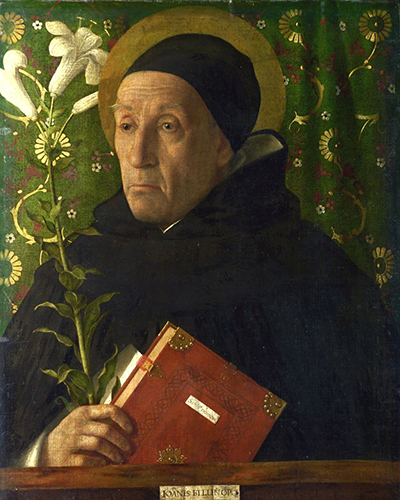
Fra Teodoro in the guise of Saint Dominic
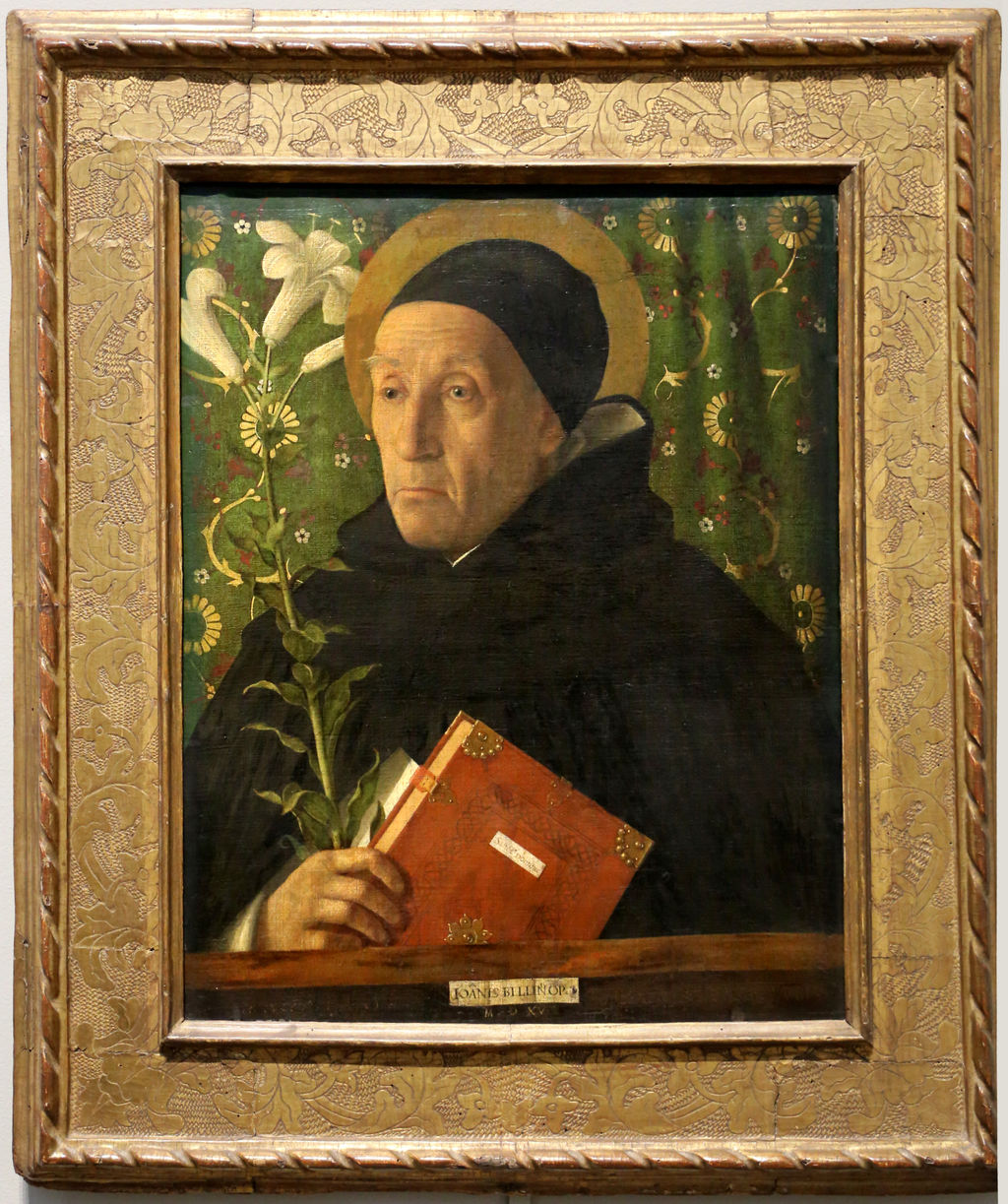
The old friar in Giovanni Bellini’s portrait looks past us, with one hand wrapped around a lily stem and a red book. The book has a small white label naming Saint Dominic. At the bottom of the picture, much fainter letters identify Brother Teodoro of Urbino. Both names matter. Bellini gives the founder of the Dominican Order the face of a friar who belonged to it some three centuries later. The National Gallery in London calls the painting Portrait of Fra Teodoro of Urbino as Saint Dominic and dates it to about 1515. It is an oil painting on canvas, 62.9 × 50.8 cm, on long-term loan from the Victoria and Albert Museum under the National Gallery number L1115. [1] [2]
At a Glance
- ArtistGiovanni Bellini
- DateAbout 1515 (National Gallery); 1513 (V&A)
- MediumOil on canvas
- LocationVictoria and Albert Museum, on loan to the National Gallery, London
The work in Bellini’s career
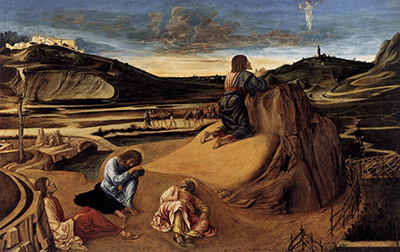
The Agony in the Garden
c. 1458–60Presentation at the Temple
c. 1475Fra Teodoro in the guise of Saint Dominic
About 1515 (National Gallery); 1513 (V&A)St. Francis in the Desert
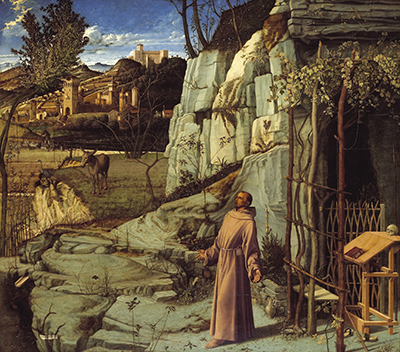
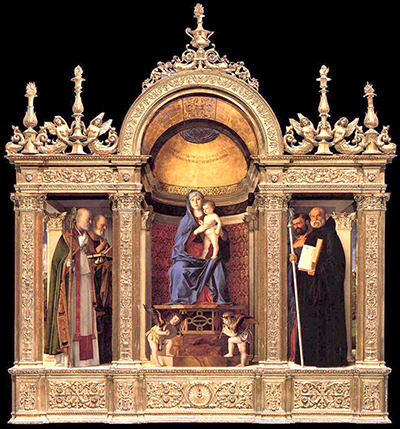
Late 1470sFrari Triptych
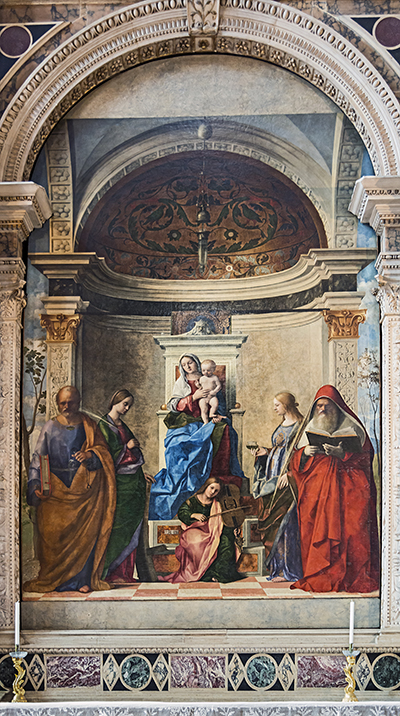
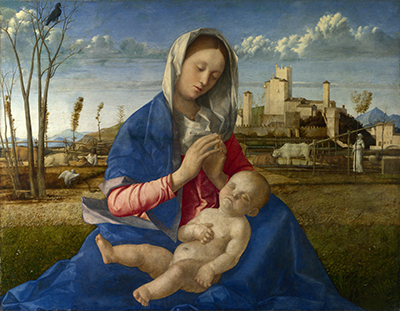
1488Madonna of the Meadow
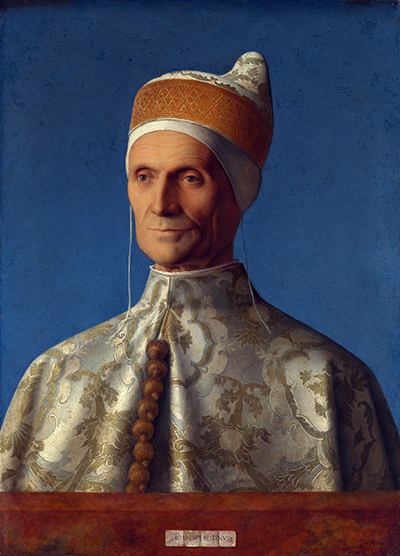
c. 1500–05Doge Leonardo Loredan
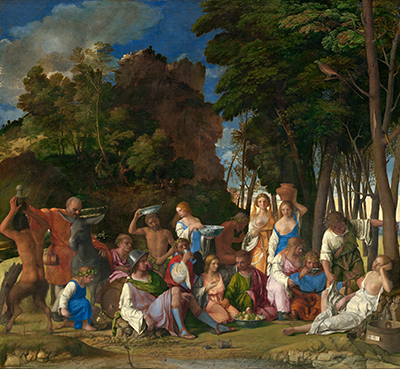
c. 1501–02The Feast of the Gods
Bellini’s signed date 1514The friar, the lily and the book
Teodoro is shown from the waist up, his shoulders broad beneath his cloak and his head turned slightly to our left. There is barely room behind him for the folds of green cloth. The black cap brings the lit forehead and brows into focus, while a glimpse of the white habit under his chin sets off the closed mouth. Follow the bridge of the nose and the faint creases around his eyes and lips. The face has enough specificity to hold attention before we try to identify it. His distant gaze can suggest weariness or reflection, while the actual circumstances of the sitting are unknown. [1]
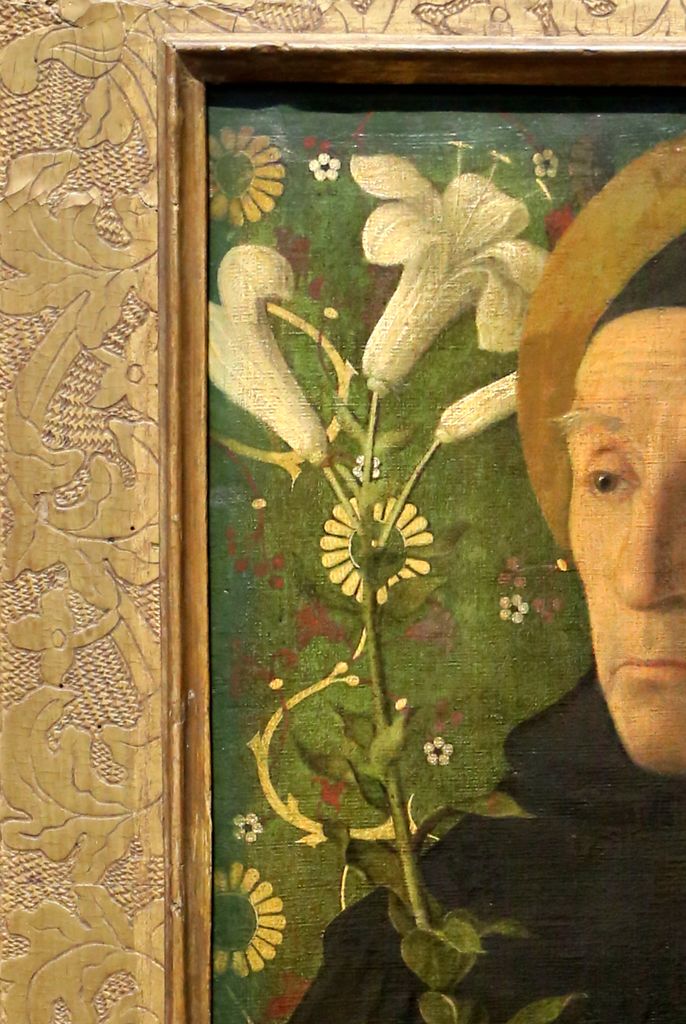
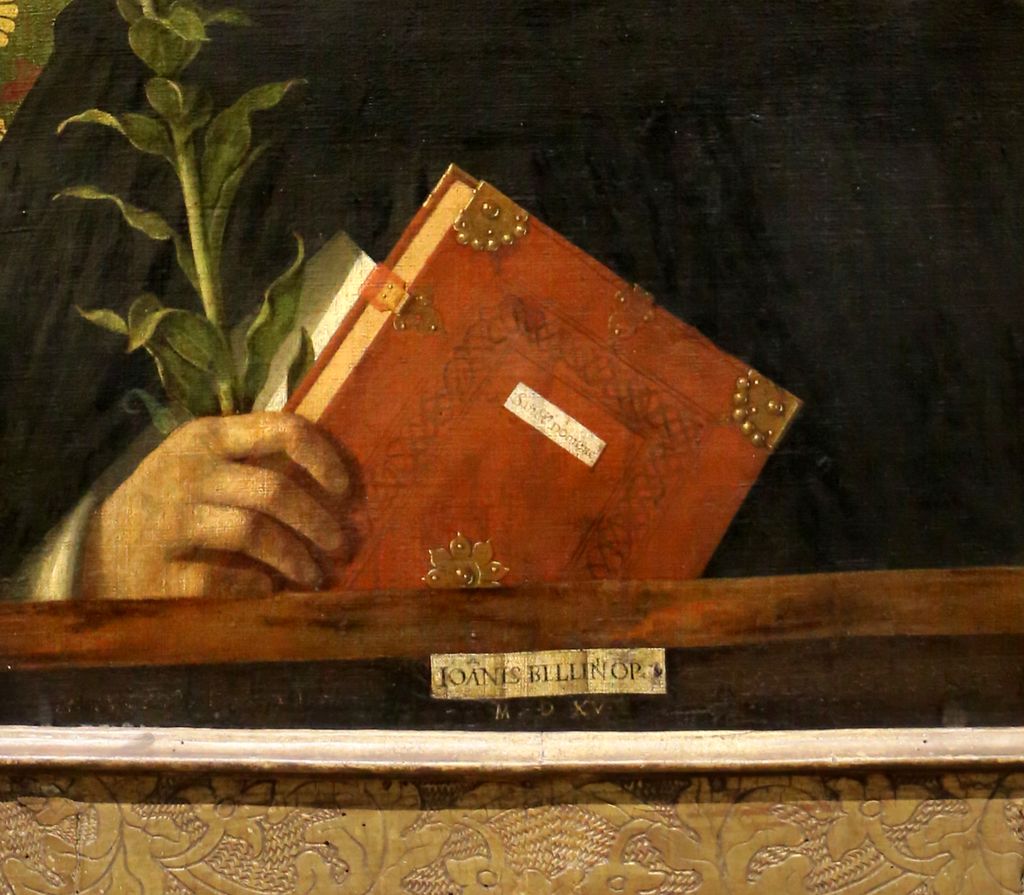
The lily rises to the left of his face, through a patch of background where the fabric is full of smaller flowers. Some of the painted leaves and stems on the cloth are close enough in colour to the lily to make us look twice. The large white blooms interrupt the pattern and draw the eye back down the tall stem towards the hand. Below, the angle of the book breaks the horizontal line of the ledge. Its warm binding, decorated corners and little label give it a firm outline against the cloak. The hand connects the two objects. It brings forward the flower, an emblem of purity, and presents the book inscribed for Dominic at the edge of the sitter’s space. [1]
The National Gallery explains that the book and lily were painted before the visible hand. Their outlines continue under the fingers, a clue that these objects were integral to the design. The halo gives a different kind of clue. Its edge passes in front of part of the lily even though the flower is held forward of the head. This overlap has led the Gallery to suggest that the halo could be a later addition. The figure’s association with Dominic already has support in the lily and the name on the book. It need not depend on when the halo was painted. [1]
What the inscriptions establish
The small illusionistic paper label on the ledge is a cartellino. It holds Bellini’s painted signature, and its pale colour picks up the white label higher up on the book. A viewer moving between those two slips encounters the names of painter and saint. The third name is harder to find. The Gallery reads the faint inscription on the ledge as IMAGO FRATRIS THEODORI URBINATIS, or ‘Image of Brother Teodoro of Urbino’. Below the signature, M.D.XV gives the year 1515. The Gallery considers the identification and the date probable additions, possibly preserving information passed down about the picture. The date therefore carries a different kind of authority from the signature. The V&A records 1513 in its collection database and gives no reason there for that date. [1] [2]
The National Gallery calls it the last known portrait by the artist, who died in 1516, and his only surviving portrait painted on canvas. Its unusually ample figure includes the friar’s hand and the things he holds. In the earlier Doge Leonardo Loredan, painted in oil on poplar, a fictive ledge and signed slip also anchor the portrait. The doge’s cap and patterned robes identify his office, and his hands are below the edge of the picture. For Teodoro, the visible grasp is central to how we recognise the role he takes on. [1] [3]
Brother Teodoro and the convent in Venice
The name on the picture has a counterpart in the records of the Dominican convent of Santi Giovanni e Paolo, known in Venice as San Zanipolo. A historical National Gallery catalogue credits the scholar Gustav Ludwig with finding a document from 1514 that names a Friar Theodorus of Urbino at the convent. The name and setting give the identification more substance than the likeness alone could supply. The link runs in the other direction too. The convent document establishes a friar of that name, while the painted inscription links the name to the face. [4] [5]
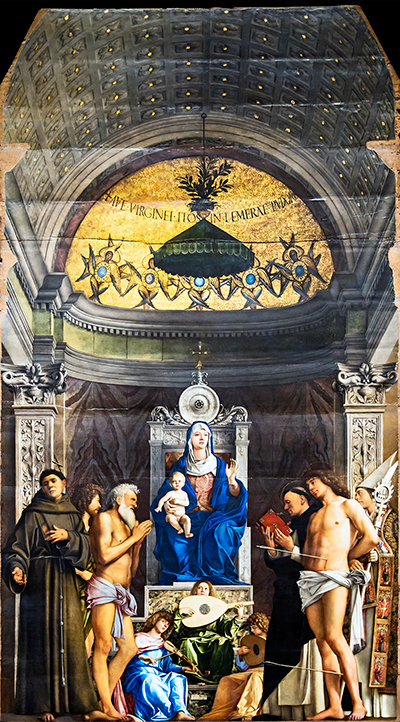
Bellini and his family had longstanding ties to Santi Giovanni e Paolo. His polyptych of Saint Vincent Ferrer still belongs to the basilica, where the painter was buried. Some accounts have wondered if Teodoro was his confessor or spiritual adviser. The National Gallery leaves the relationship open, and the convent record cited in its historical catalogue specifies membership of the community. We also lack the details of the original commission and the place where the portrait first hung. The surviving polyptych establishes Bellini’s work for the church independently of the portrait’s ownership history. [1] [4] [6]
Why a living friar appears as a saint
Dominic had founded the Order of Preachers in the early thirteenth century. He died in 1221, and Pope Gregory IX canonised him in 1234. A Renaissance artist could give a sitter the attributes of a saint to suggest a shared vocation or a quality to emulate. Here the Dominican habit belongs equally to the founder and his later follower. Valentina Castegnaro reads the likeness and the attributes together as an expression of the aspiration to follow the founder’s example. R. R. Gainullina also discusses the picture within a group of Dominican portraits that adopt the guise of saints of the order. This reading gives weight to both the observable age of the sitter and the choice of a recognisable devotional figure. [5] [7] [8]
The lily can carry that association without singling out Dominic by itself. Lorenzo Lotto’s 1542 portrait of the Dominican preacher Fra Lorenzo da Bergamo also shows a friar with a lily and halo. The Walters Art Museum relates Fra Lorenzo’s guise to Thomas Aquinas and identifies the sitter with the help of a payment recorded by Lotto. In Bellini’s picture the book label specifies which saint the figure evokes. The inscription may preserve a memory of the sitter. It leaves open how Bellini and the first owner understood the painting. [1] [5] [8] [9]
Other Dominican paintings by Bellini and his workshop
The National Gallery’s A Dominican, with the Attributes of Saint Peter Martyr (NG808) is a separate oil painting on poplar, dated about 1490–1500. That friar’s identity remains unknown. X-rays show that he originally held a scroll, which was later covered by a palm, and the Gallery dates the addition of the weapons identifying Peter Martyr to about a century after the first painting. In L1115 the underlayers around the hand point to a different history. Bellini planned the hand around the lily and the book, and the possibility of a later halo leaves that evidence intact. [1] [10]
Peter Martyr also appears in Bellini’s The Assassination of Saint Peter Martyr (NG812), a wide narrative painting in which the attack takes place among trees. The National Gallery now attributes that work to Bellini himself, following an earlier workshop attribution. In the Courtauld’s distinct workshop version of about 1509, the groups of attackers and friars closely follow Bellini’s composition. In Bari, a monumental Saint Peter Martyr by Bellini from a Dominican church in Monopoli shows the saint standing with the weapons of his martyrdom. These paintings use narrative action or the signs of a saint’s death to identify Peter. Teodoro’s painting relies on the emblems of the Dominican founder and the assertive presence of a particular face. [11] [12] [13] [14]
From the Soulages collection to London
By 1856 the portrait was catalogued as no. 582 in the collection formed by Jules Soulages. The description of a Dominican with a book, lily and patterned green curtain identifies the same image even though the catalogue calls the sitter simply a Dominican monk. In 1857 it appeared under a similar title at the Art Treasures Exhibition in Manchester, identified in the National Portrait Gallery’s record of George Scharf’s exhibition sketchbook. The V&A records acquisition from the Soulages collection under accession 767-1865. The National Gallery’s 1906 catalogue records that the work came on loan in 1895 in an exchange involving watercolours. It was previously catalogued as NG1440 and now carries its loan number, L1115. [2] [4] [15] [16]
The 1906 catalogue titled the picture St. Dominic, although it also transcribed the faint inscription naming Teodoro. The two historical titles show how readily either the sitter or the saint can take the foreground in a description. The red book and lily are visible at a distance. The sitter’s name is close to the bottom edge and takes longer to make out. At the scale of the painting, the face holds its own between those two ways of identifying him. Bellini’s image lets a viewer encounter an individual friar and see the example he was depicted as following. [1] [4] [5]
Annotated Details from Portrait of Fra Teodoro of Urbino
Numbered overview and cropped details. Photograph Sailko via Wikimedia Commons. Image source. CC BY 3.0.
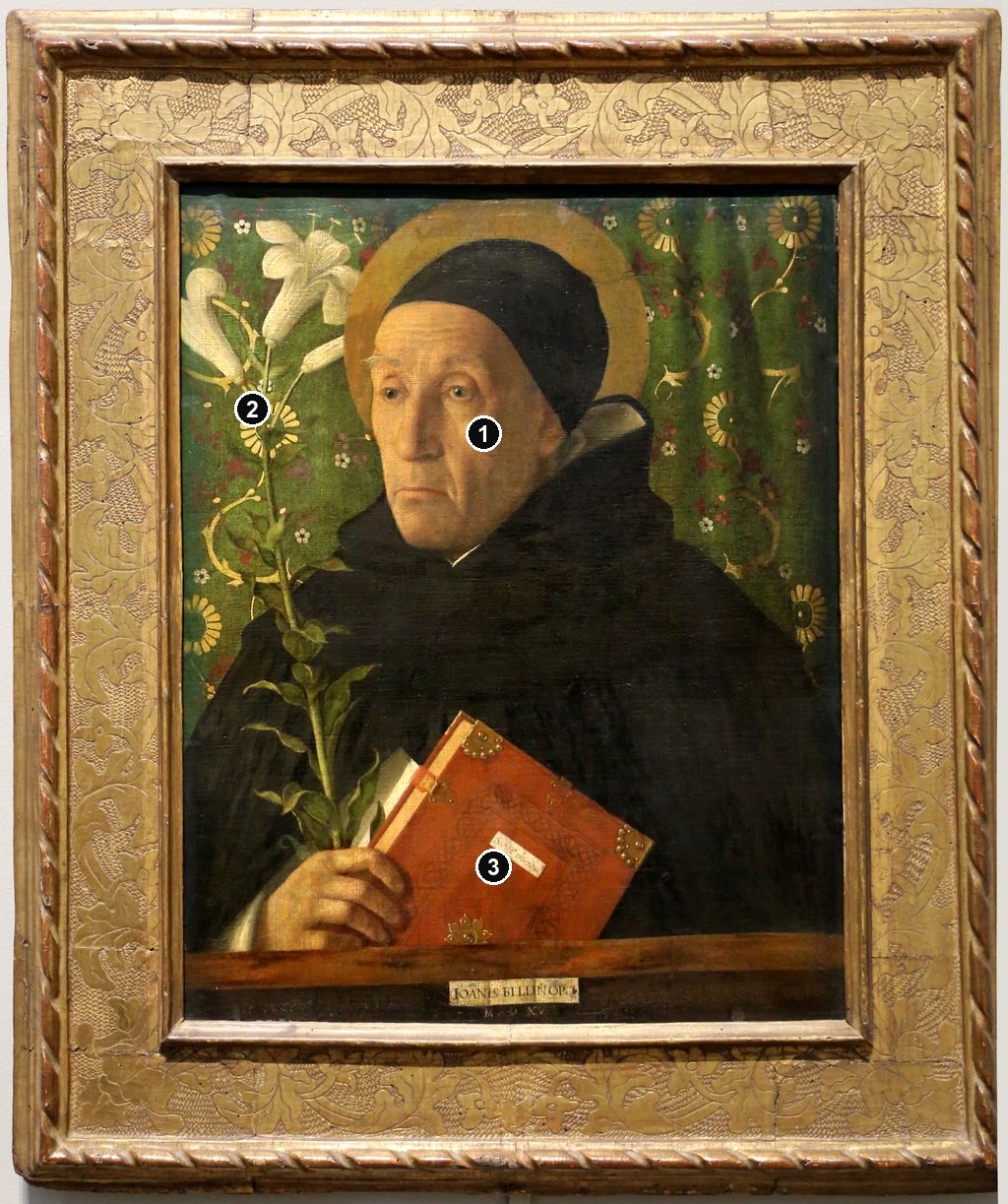
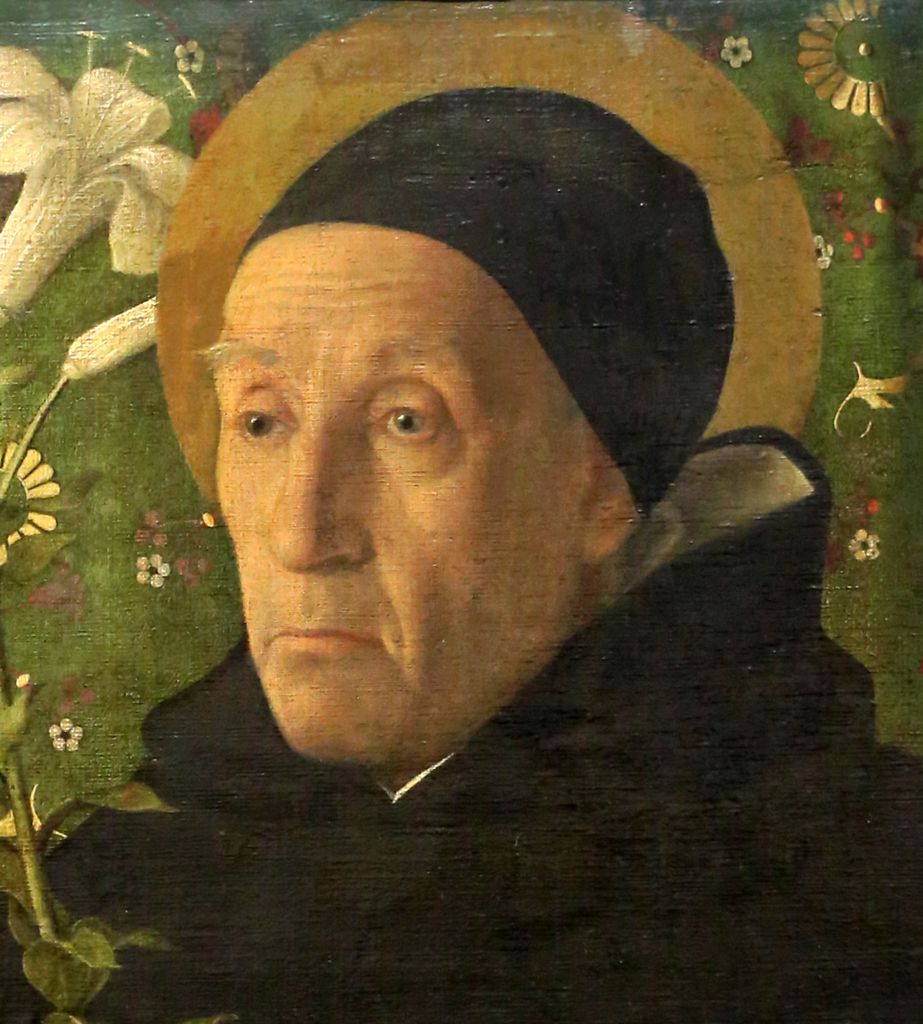
Details from PORTRAIT OF FRA TEODORO OF URBINO
The portrait’s signs of Dominican identity sit very close to the sitter’s face and hands.
The face beneath the halo
A broad gold halo borders the head. The eyes look towards the edge of the painting, and light catches the sitter’s temple and nose.
Lily against the backcloth
The white blossoms rise on the side where the friar turns his head. The pale stems and petals are visible against the patterned green fabric.
The book and the parapet
The friar’s fingers are painted beside the corners of his book. Its warm binding stands out against the dark habit and the horizontal ledge.
Related reading
Artworks directory
Discussion
Look again at the images and ideas explored in Portrait of Brother Teodoro da Urbino by Giovanni Bellini. These editorial prompts invite your observations.
Reader Insights
Which of the painted objects help connect Teodoro to Saint Dominic?
What can the inscription establish about the sitter and the date?
What changes when you read the face as that of a living friar?
Join the Conversation
Share a detail, comparison or question about Portrait of Brother Teodoro da Urbino by Giovanni Bellini below.
References
- National Gallery, Portrait of Fra Teodoro of Urbino as Saint Dominic, L1115 View source.
- Victoria and Albert Museum, Portrait of Fra Teodoro of Urbino as Saint Dominic, 767-1865, collection record View source.
- National Gallery, Doge Leonardo Loredan, NG189 View source.
- National Gallery, Descriptive and Historical Catalogue of the Pictures, Foreign Schools, 1906, no. 1440, pp. 55–56 View source.
- Valentina Castegnaro, Sotto mentite spoglie: il criptoritratto in Italia tra Umanesimo e Rinascimento, University of Verona, pp. 99–101 View source.
- Basilica dei Santi Giovanni e Paolo, Arte View source.
- Order of Preachers, Saint Dominique entre centre et périphérie View source.
- R. R. Gainullina, The Allegorical Portrait in Sixteenth-Century Italian Painting, HSE University Journal of Art & Design, 2025, pp. 52–55 View source.
- Walters Art Museum, Lorenzo Lotto, Portrait of Fra Lorenzo da Bergamo, 37.1104 View source.
- National Gallery, A Dominican, with the Attributes of Saint Peter Martyr, NG808 View source.
- National Gallery, The Assassination of Saint Peter Martyr, NG812 View source.
- National Gallery, Giovanni Bellini, artist record View source.
- Courtauld Gallery, Workshop of Giovanni Bellini, Assassination of Saint Peter Martyr, P.1947.LF.29 View source.
- Pinacoteca Corrado Giaquinto, Pittura Veneta View source.
- J. C. Robinson, Catalogue of the Soulages Collection, 1856, no. 582, pp. 161–62 View source.
- National Portrait Gallery, Scharf Sketchbook 49, pp. 50 verso–51 recto, Manchester Art Treasures Exhibition, cat. 76 View source.