 by Tom Gurney
Tom Gurney BSc (Hons) is an art history expert with over 20 years experience
Email: tomgurney1@gmail.com / Phone: +44 7429 011000
Bellini’s St. Francis in the Desert
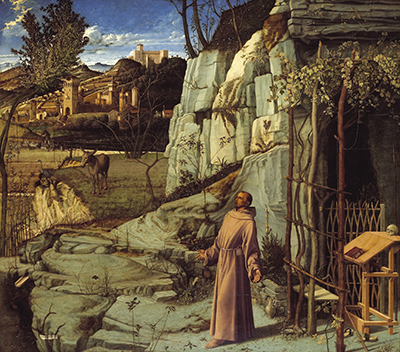
Francis of Assisi has stepped barefoot onto a ledge. His arms hang open, his lips part and his eyes turn towards light entering the painting from the upper left. His shadow falls sharply across the ground, and the folds of his brown habit darken against the pale rock. Across the valley, the same warm light catches walls, rooftops and fields. The landscape is large enough for the saint to look almost incidental at first. Once you have found him, the turn of his face gives the whole scene a direction. [1] [2]
The Frick Collection in New York calls the painting St. Francis in the Desert. St Francis in Ecstasy, another established title for the same work, was used in the Frick’s own 1968 catalogue. Bellini painted the panel around 1475–80 in oil on poplar. The wooden support measures 124.6 × 142 cm, and the museum records it as 1915.1.03. The earliest known description, written in Venice in 1525, already named Francis and singled out the care with which Bellini painted the landscape. [1] [3] [4] [5] [6]
At a Glance
- ArtistGiovanni Bellini
- DateLate 1470s
- CollectionThe Frick Collection, New York
- Also known asSt Francis in Ecstasy
- SupportWood panel
The work in Bellini’s career
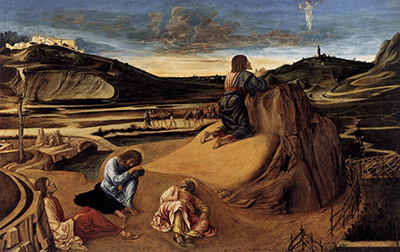
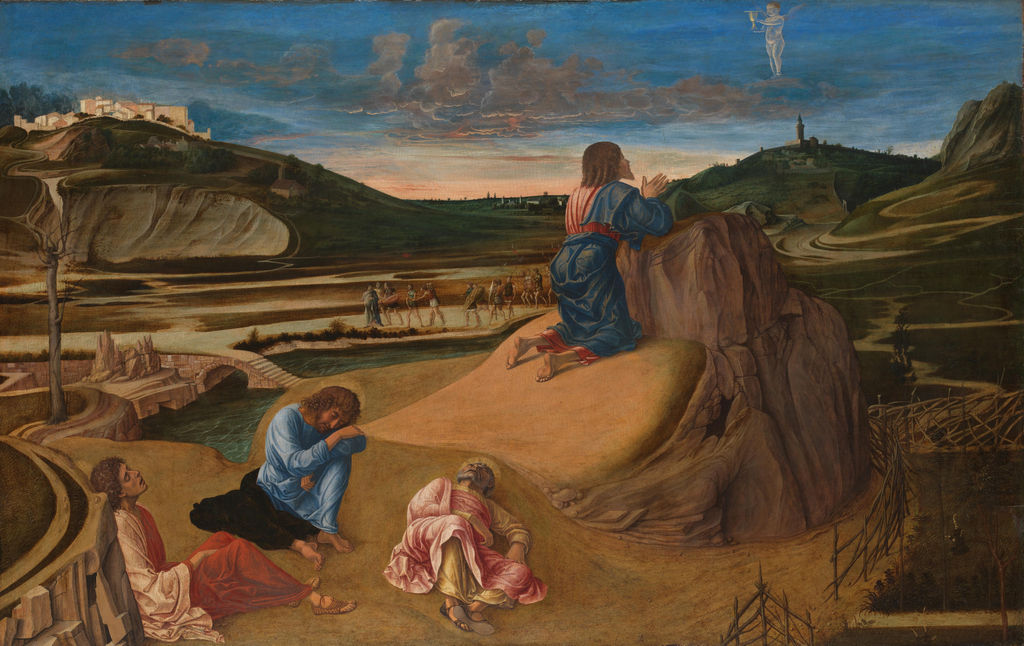
The Agony in the Garden
c. 1458–60Presentation at the Temple
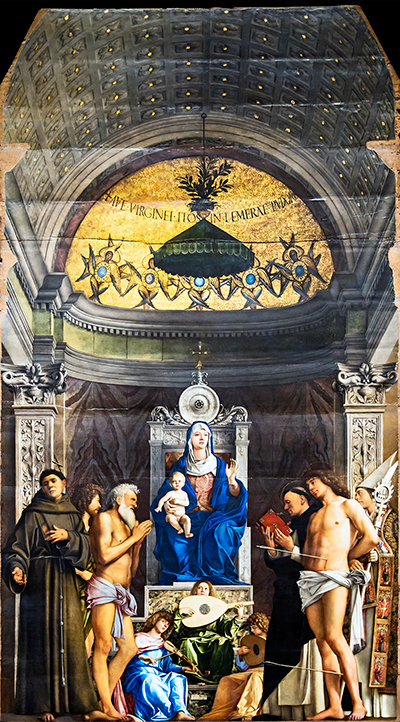
c. 1475St. Francis in the Desert
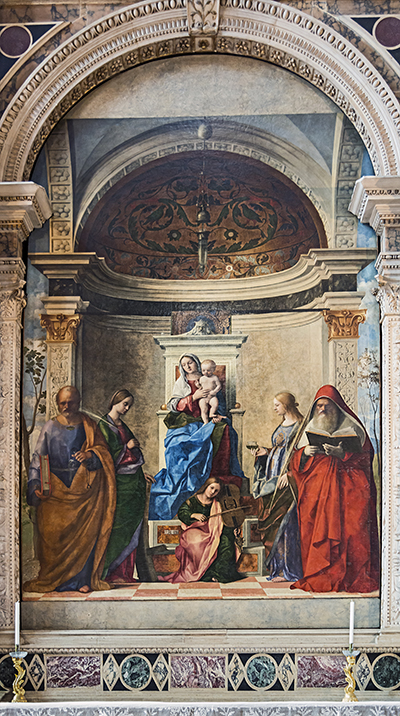
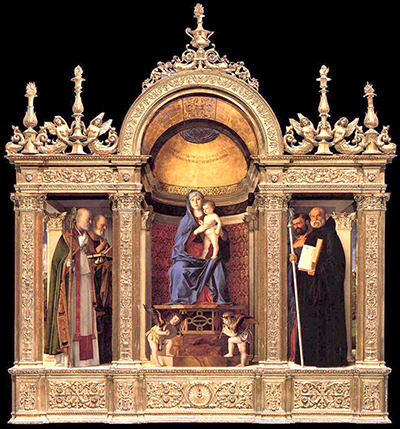
Late 1470sFrari Triptych
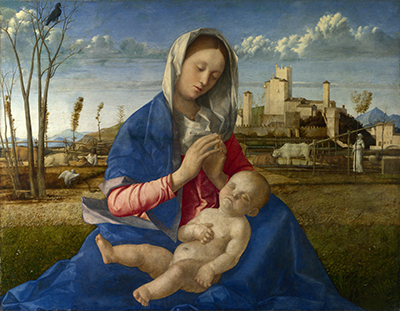
1488Madonna of the Meadow
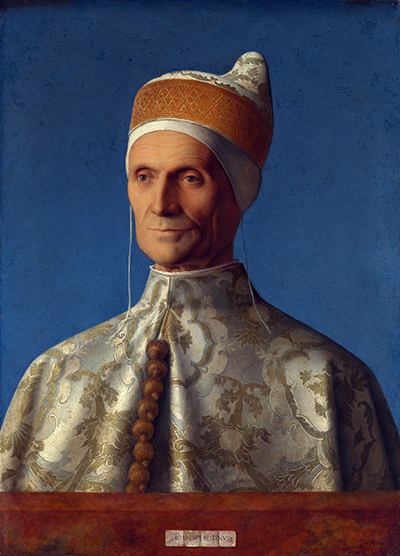
c. 1500–05Doge Leonardo Loredan
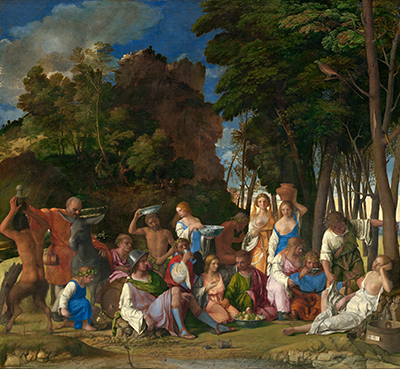
c. 1501–02The Feast of the Gods
Bellini’s signed date 1514From the shelter to the town
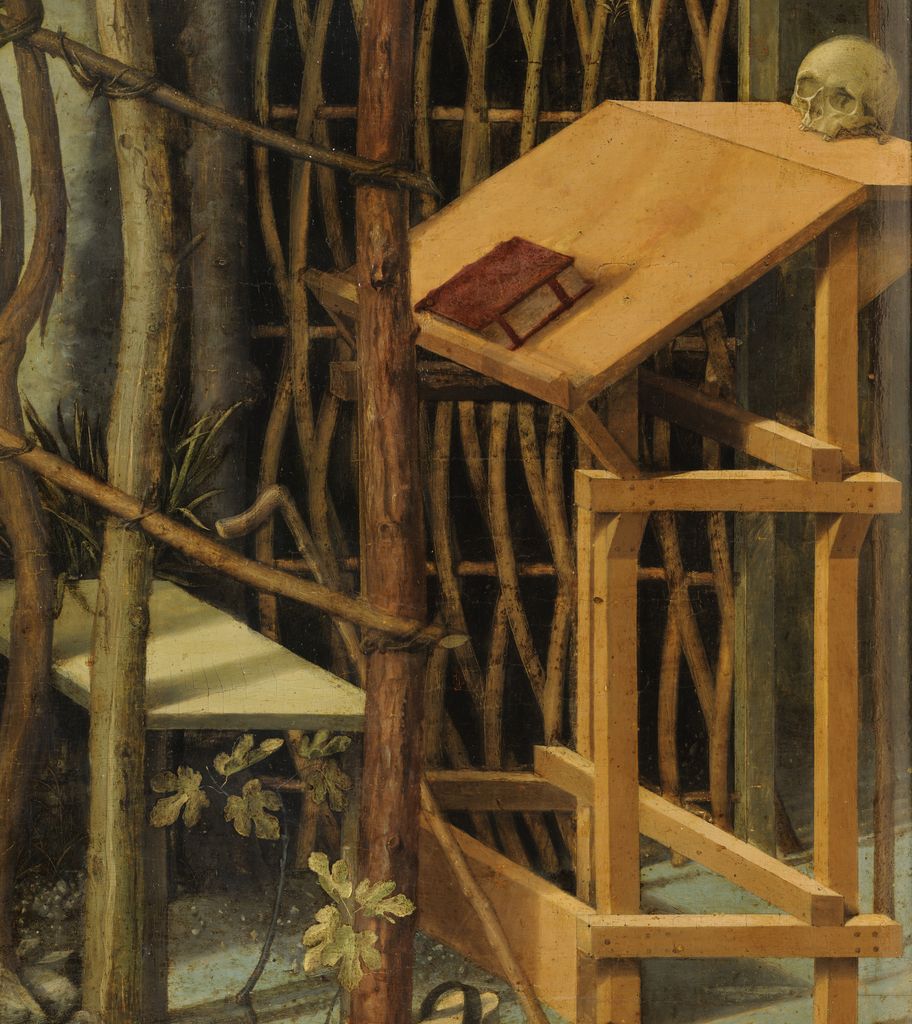
Bellini’s desert is a place of retreat on the edge of a settled world. Behind the saint, a shelter of poles and woven branches leans against the rock. A vine spreads over its roof. A red book rests on a sloping reading desk, with a skull on the narrow shelf beyond it. A bell hangs above, with a cord to ring the hours of prayer. The sandals on the rocky ground and the vessel near the shelter give Francis a domestic scale. Someone has tended the little garden and fitted a place to read into an uneven cliff. [2] [4]
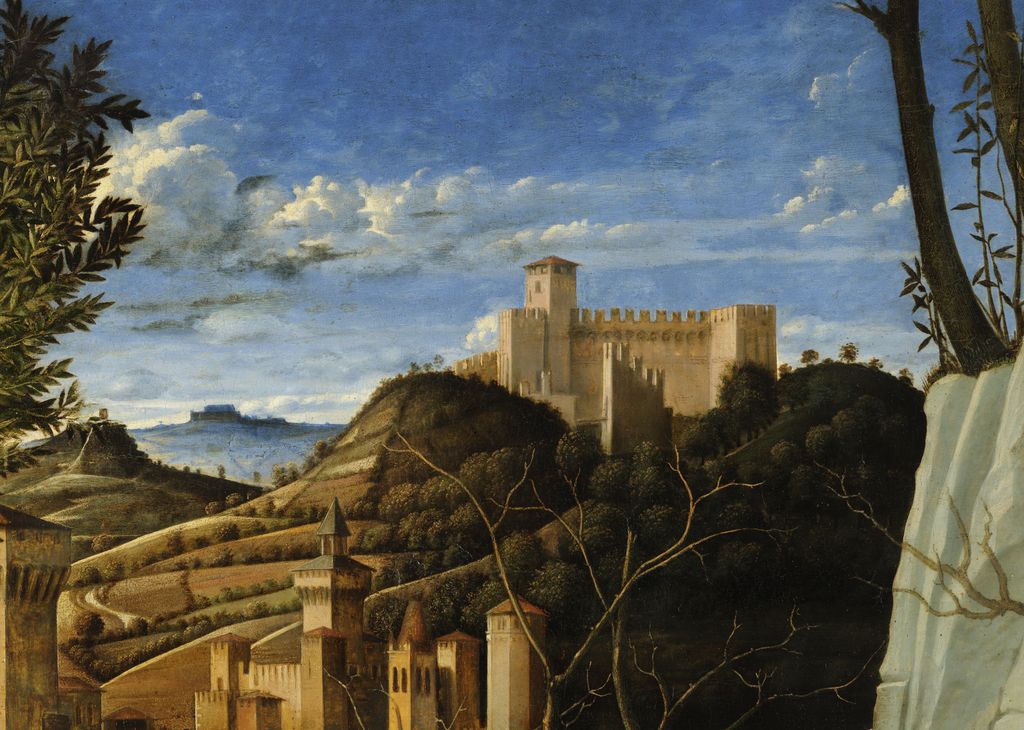
At the left, water issues from the rock. Look near the lower border for the small scrap of paper, drawn as though attached to a twig, on which Bellini signed his name. Farther back, a long-legged bird stands at the lip of the rocky shelf and a donkey looks out from the enclosed ground beyond. A rabbit peers from a crevice and a shepherd tends his flock at a distance. Beyond the pasture, a bridge, walls and a hilltop fortress mark out a landscape of paths and boundaries. The geographer Jean Barrot singles out the field enclosures as features of managed pasture. The visible work of keeping animals, closing off fields and building across water makes Francis’s decision to live apart from society more tangible. [2] [4] [7] [8]
Those details have invited precise and sometimes incompatible readings. Norman Hammond compared the painted birds with actual species, identifying the large bird near the donkey as a heron and weighing the evidence for a kingfisher near the signature. The small bird’s proportions and plumage matter when a proposed reading depends on identifying it as a particular bird named in scripture. An animal can also help structure the scene. The donkey’s stillness gives the eye a place to pause between the foreground ledge and the busy arrangement of towers and fields. [7] [9]
A useful comparison is Bellini’s Saint Jerome in the Desert in the Uffizi. Jerome too occupies rocky ground within sight of buildings. He sits with his book and the light helps him read. Francis has left his book at the desk and turned towards the light itself. In both pictures, the town gives the hermit’s solitude a visible measure. The different positions of the saints explain what each has withdrawn to do. [4] [10]
What is happening to Francis?
Francis of Assisi founded the Franciscan order. According to the tradition surrounding his life, he withdrew to La Verna in the Apennines in 1224, saw a winged, crucified figure and received the marks of Christ’s wounds on his own body. Earlier artists made the connection explicit. In Giotto’s panel in the Louvre, the saint kneels beneath the winged figure and fine rays join their bodies. Bellini’s Francis stands upright, his hands held low, with minute red marks in his palms. The picture gives us his response to the light while leaving its source outside the frame. [1] [5] [11]
Jan van Eyck’s small panel of the same episode in Philadelphia offers another comparison. There too a rocky ledge and a distant city give a great deal of attention to the created world. The seraph remains in plain view, and Brother Leo, Francis’s companion, sits nearby. Bellini dispenses with the companion and devotes a remarkably large panel to a solitary figure in a similarly elaborate landscape. The difference is especially clear if you look at where each saint directs his eyes. With Van Eyck, you can find the figure he sees. With Bellini, you follow the gaze to the corner and judge the light by its effects across the picture. [4] [5] [12]
The Frick’s exhibition account identifies the receiving of the stigmata as the most likely subject. The wounds certainly belong to Bellini’s design. Under magnification, conservators found translucent red over opaque scarlet on the hands. The old network of cracks helped establish that the red was original. Tiny remnants on the left foot show that it once carried a wound too. The surface there was worn by later cleaning, and the mark can no longer be made out with the naked eye. The examination found no trace of the lance wound normally shown at the side. In 2011 the study team read those findings as signs of the saint’s likeness to Christ within a larger devotional image. [1] [5]
There was once a plausible explanation for the empty sky. Marco Boschini’s 1660 poem on Venetian painting described Christ appearing to Francis as a fiery seraph. The upper edge of the panel has indeed been cut. X-rays show that the support consists of three horizontal boards, and the cut edge has lost the unpainted margin one would expect. The positions of the surviving original nails, which once fixed the panel to crosspieces, are nearly symmetrical. That pattern suggests the loss amounted at most to a few centimetres. There was probably room in the missing strip for a little more sky, foliage and cliff. The evidence leaves much less room for the figure Boschini described. [5] [13]
Marilyn Aronberg Lavin has argued that the absent wound in the side helps place the scene after La Verna. She connects Francis’s expression with a tradition recorded by Thomas of Celano in which God reassured the saint, near the end of his life, that his sins were forgiven and that he would enter heaven. Lavin also compares the unmarked side with early images of Christ still alive on the Cross, before the spear thrust. This interpretation explains the presence of wounds already received and the saint’s joy without requiring a seraph in the sky. It remains a proposal about Bellini’s subject. [14]
Oskar Bätschmann sees spiritual elevation in solitude and finds it plausible that Francis is singing. The open mouth makes the suggestion possible, and the landscape has often called to mind Francis’s Canticle of the Creatures, which praises God through the sun, wind and other parts of creation. The barefoot saint and the illuminated tree have also prompted a comparison with Moses before the burning bush. Those associations explain why the title Ecstasy has proved durable. A viewer can recognise the signs of La Verna, the language of praise and the gesture of standing on holy ground without assigning every plant or animal to one fixed account. [4] [9] [15]
How Bellini painted the light
The laurel follows the left edge of the panel, then bends inwards above the distant buildings. Its brighter leaves make the light visible before we follow its effects across the rocks and onto Francis. Emanuele Lugli observes that the donkey has a short shadow while Francis casts a long, dark one. Light that seems continuous across the valley does different things in different parts of the painting. The laurel also bends into the area where a messenger might be expected in a familiar scene of stigmatisation. Its shape and position help explain why the image sustains several readings even when the search for a single written source runs out of evidence. [2] [9]
Bellini had much of that lighting in mind before he put down the visible colours. The Frick brought the panel to the Metropolitan Museum of Art’s conservation centre in 2010, where a team led by Charlotte Hale examined it with infrared reflectography, X-radiography, microscopy and paint analysis. The infrared image records dark marks beneath areas of paint. On the white gesso ground, Bellini had brushed an underdrawing in a fluid black medium. Fine strokes trace the top of Francis’s head and small folds beneath his eye. Short parallel lines set the neck and cowl in shadow, and intersecting strokes model the chin. Marks beside the figure anticipate the lit and shaded faces of the surrounding rock. [5] [16]
The drawing of the distant country is more linear and economical. Infrared also shows that Bellini adjusted the positions of hands, fingers and a foot, and altered the crossing over the water. He first planned a bridge with upright supports and a horizontal span that ended on the near bank. The finished bridge is arched and partly ruined, ending on the far bank. Its curves take up the contours of the bank and hills around it. Compare that change in a small piece of architecture with the precise hatching in the face and the broader planning around the rocks. Bellini varied his drawing according to what each part of the picture had to do. [5]
The painted surface varies just as much. Bellini used freely brushed paint in the azurite-tinted rock and a more textured application for the burst of golden light in the upper-left sky. The Frick’s study also describes boldly applied ultramarine in the sky and the exceptional delicacy of the vine tendrils above the hermitage. Up close, one part of the landscape retains the drag and deposit of the brush while another seems to have been drawn with its tip. Rutherglen’s detail guide also identifies impressions of fingertips in a preparatory layer, especially apparent near the shelter and the shepherd. They may record assistants spreading that layer by hand. The prints establish a way of working while leaving the identity of the hands unknown. [2] [5] [16]
A change of mind at the lectern
The reading desk originally stopped at the upper edge of the sloping surface that holds the book. Bellini widened and repositioned parts of it, and added the level shelf, skull and slender reed cross over the dark background. In the infrared image, the weave of the willow fence continues beneath the additions. The skull and cross belong to the final design, and their physical relationship to the underlying fence shows that Bellini introduced them during painting. [5] [16]
That change gives the reading corner a stronger connection with the rest of the picture. The skull brings mortality into view, and a cross with a tiny crown of thorns points towards the Passion. The study team also noted that the skull recalls the iconography of the scholar-hermit Jerome and that the reed cross recalls John the Baptist, another saint associated with wilderness. In the full painting the little cross is easy to miss. For a viewer returning to the corner after seeing Francis’s marked palms, the additions bring his reading, prayer and bodily resemblance to Christ into the same scene. [5] [16]
From a Venetian collection to the Frick
The 1525 account comes from the Venetian collector and writer Marcantonio Michiel. He saw the picture in Taddeo Contarini’s palace in the parish of Santa Fosca and said that Bellini had begun it for Zuan, or Giovanni, Michiel. Giovanni was the patron named in the account, Marcantonio the person who recorded it and Contarini the documented owner in 1525. The precise terms of the commission and the painting’s first destination remain uncertain. The Frick’s exhibition account favours a private devotional purpose. The museum’s provenance essay also records a proposal that it was intended for the Franciscan church on San Francesco del Deserto, an island in the Venetian lagoon. The title and Franciscan subject make the association intelligible, although the first secure location is Contarini’s residence. [1] [3] [4] [13]
Contarini also owned Giorgione’s Three Philosophers. A 1556 inventory puts Giorgione’s painting in the main hall and Bellini’s in an adjoining room. In 2023–24 the Frick borrowed Giorgione’s painting from Vienna’s Kunsthistorisches Museum and displayed the works together again. The reunion invited a comparison suggested by the collector’s own surroundings. In each painting, a figure attends to light near a rocky outcrop. Some scholars have proposed that the Giorgione was made as a companion to the Bellini. The inventory establishes where the works hung by 1556, decades after both painters died. [3] [17]
By 1589 the Bellini had passed to the Giustinian family through marriage. It subsequently entered the Cornaro collection, where it is documented in an inventory of 1753. In 1812 a Milan dealer sold it to the Parisian collector Joseph Desforges. Desforges’s son sold the panel to the English dealer William Buchanan in 1850. The National Gallery in London declined the chance to buy it in 1851, and Captain Joseph Dingwall purchased it for £735 at Christie’s in 1852. The picture stayed for decades at an estate in Berkshire and returned to the London market after the death of Mary Ann Driver, its last owner there. The National Gallery declined it again in 1914. Henry Clay Frick bought the panel through Knoedler in 1915 for $170,000 and installed it between two Titians in the Living Hall of his New York house. [13]
That journey put a picture of withdrawal into several very different settings. Contarini’s guests encountered the painting in a house with other Venetian landscapes, and Frick placed it among Renaissance portraits. In the museum’s temporary home at Frick Madison, it was given a room of its own with light from a trapezoidal window before the Giorgione was installed nearby. Bellini makes room for those shifts in attention within the composition itself. The signs of Francis’s experience are small enough to reward close inspection, while the light he turns towards is legible from the other side of the room. [13] [17]
Annotated Details from St. Francis in the Desert
Numbered overview and cropped details. Photograph The Frick Collection, Google Arts & Culture reproduction via Wikimedia Commons. Image source. Public Domain Mark 1.0.
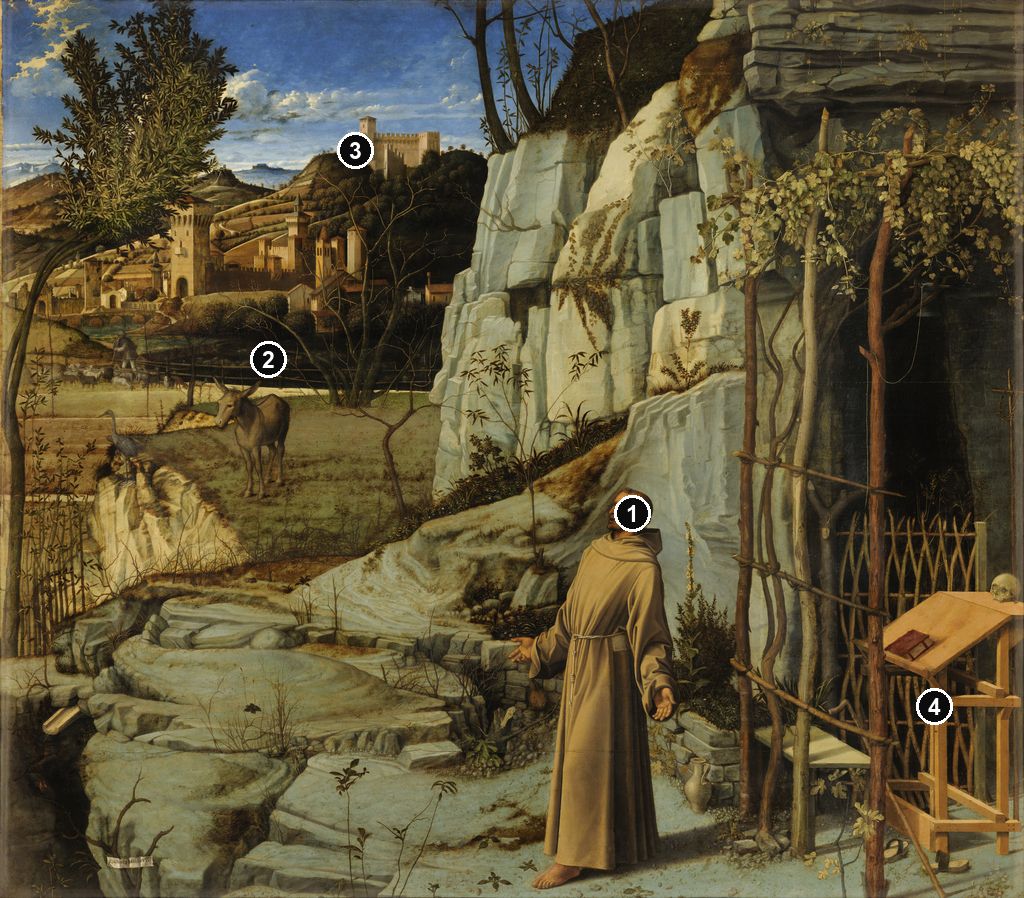
Details from ST. FRANCIS IN THE DESERT
Compare Francis at the mouth of the shelter with the small figures and buildings in the landscape.
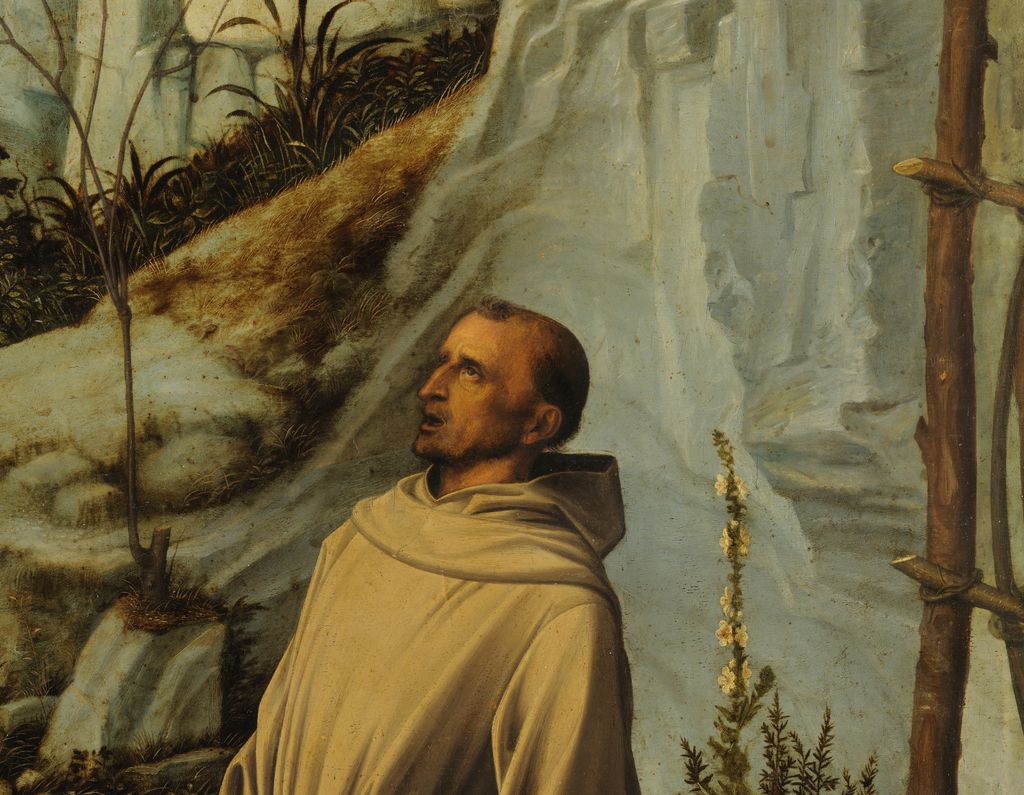
The saint’s lifted face
Francis tips his face into the light. The line of the jaw and the lit brow make the upward turn discernible at the scale of the entire panel.
The donkey in the field
The donkey is among the small signs of ordinary life scattered across the painted scene. Look for it beyond the broken ground in front of Francis.
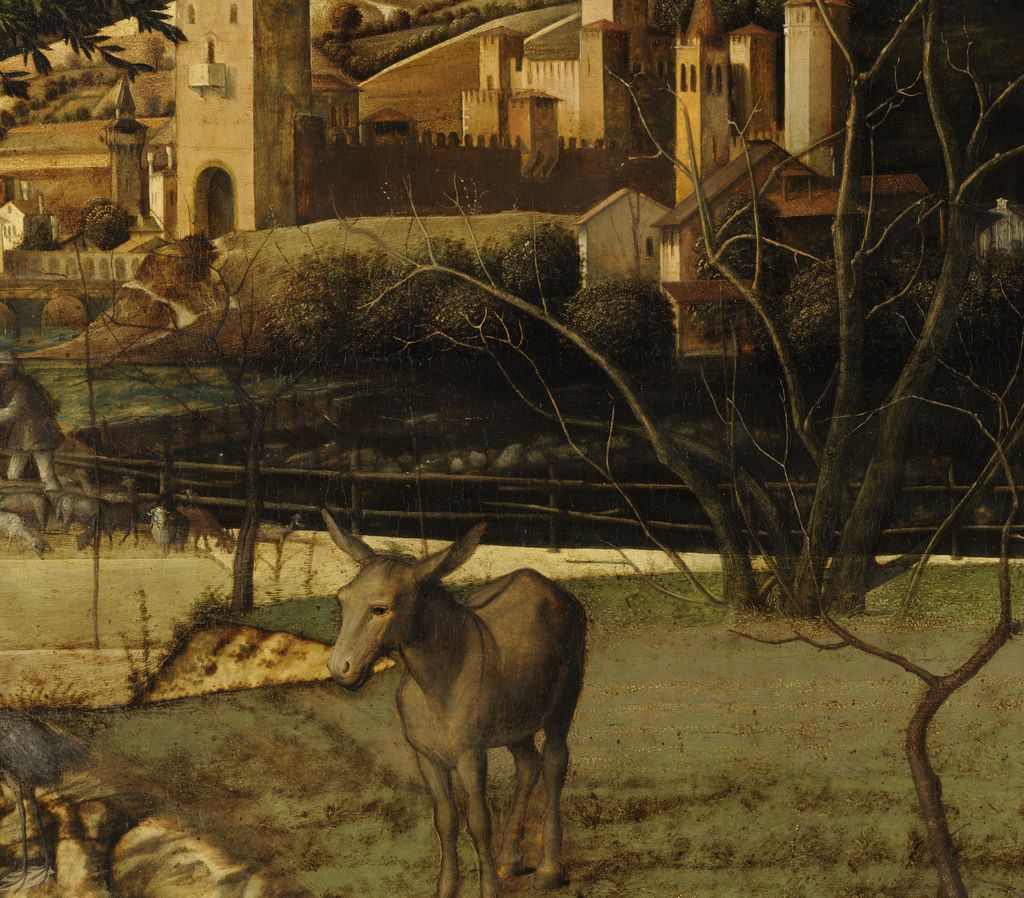
The hillside town
The distant walls and roofs are light enough to pull the eye from the rocky foreground across to the far side of the valley.
The saint’s shelter
The sloping desk and the woven screen sit beside the rock mass. Their manufactured straight edges and repeating lines stand out against the fractures in the stone.
Videos on Giovanni Bellini
Explore Bellini’s work through museum talks and close readings.
Bellini, St. Francis
A close reading of the saint and the landscape in the Frick’s painting.
Watch on YouTubeRelated reading
Artworks directory
Discussion
Look again at the images and ideas explored in St Francis in Ecstasy by Giovanni Bellini. These editorial prompts invite your observations.
Reader Insights
What changes when you look at the buildings and animals before returning to Francis?
Which parts of the figure’s gesture matter most to your reading of the subject?
Which details of daily life around Francis shape your interpretation of the event?
Join the Conversation
Share a detail, comparison or question about St Francis in Ecstasy by Giovanni Bellini below.
References
- The Frick Collection, St. Francis in the Desert View source.
- The Frick Collection, gigapixel image and detail guide, Google Arts & Culture View source.
- The Frick Collection, Bellini and Giorgione in the House of Taddeo Contarini, exhibition introduction and audio View source.
- Oskar Bätschmann, “Giovanni Bellini’s San Francesco nel deserto,” Solitudo, 2018 View source.
- The Frick Collection, In a New Light, results of the 2010 technical examination View source.
- Fondazione Federico Zeri, Estasi di san Francesco d’Assisi, catalogue record View source.
- Norman Hammond, “Bellini’s Birds: Avifauna in the Frick ‘St. Francis’,” The Burlington Magazine 149, 2007 View source.
- Jean Barrot, “Le paysage en peinture,” Mappemonde, 1997 View source.
- Emanuele Lugli, “Between Form and Representation: The Frick St Francis,” Art History 32, 2009 View source.
- Gallerie degli Uffizi, Giovanni Bellini, San Girolamo nel deserto View source.
- Musée du Louvre, Giotto, Saint François d’Assise recevant les stigmates View source.
- Philadelphia Museum of Art, Jan van Eyck, Saint Francis of Assisi Receiving the Stigmata View source.
- Christopher Snow Hopkins, “Mapping Provenance: Bellini’s ‘St. Francis in the Desert’,” The Frick Collection, 2022 View source.
- Marilyn Aronberg Lavin, “Bellini’s Frick Saint Francis and the Source of the Absent Side Wound,” Artibus et Historiae 85, 2022 View source.
- The Frick Collection, Frick Madison virtual gallery 13, St. Francis in the Desert and the Canticle View source.
- The Frick Collection, In a New Light, “Technique and Working Method” View source.
- The Frick Collection, “Frick Reunites Masterpieces by Giorgione and Bellini,” 2023 View source.