 by Tom Gurney
Tom Gurney BSc (Hons) is an art history expert with over 20 years experience
Email: tomgurney1@gmail.com / Phone: +44 7429 011000
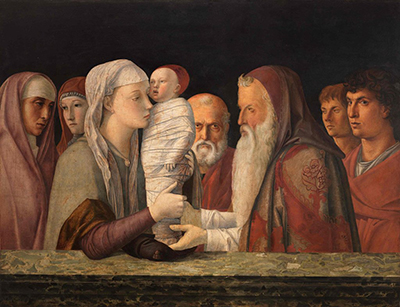
The Querini Stampalia Presentation
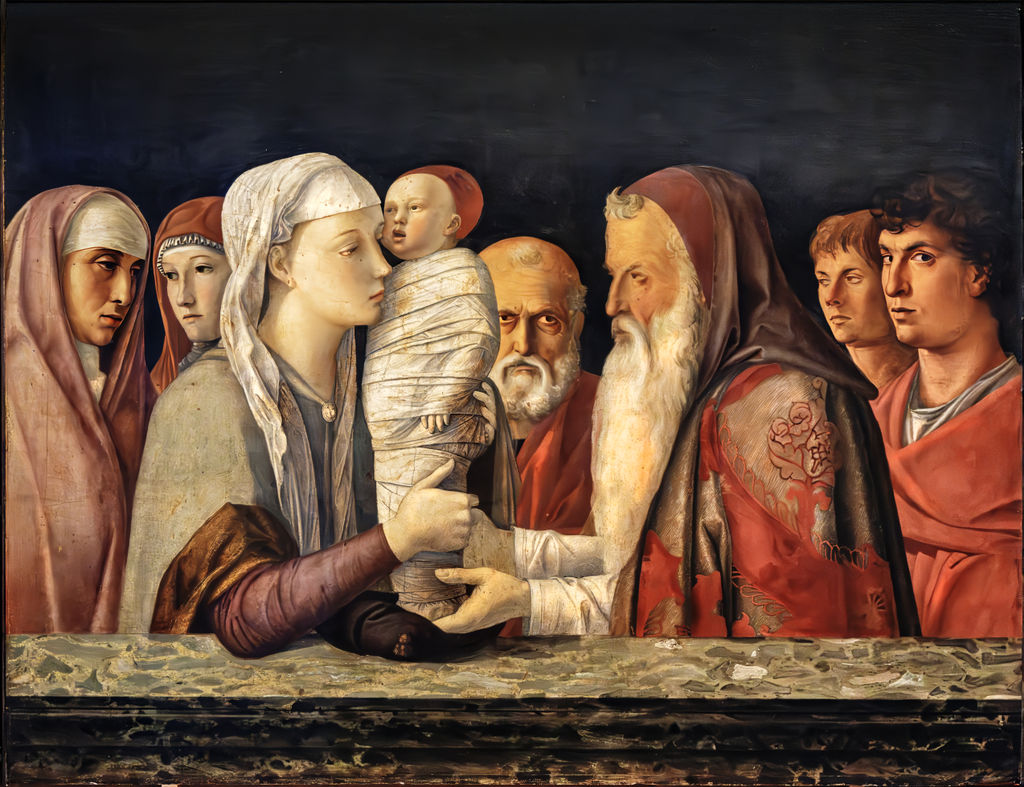
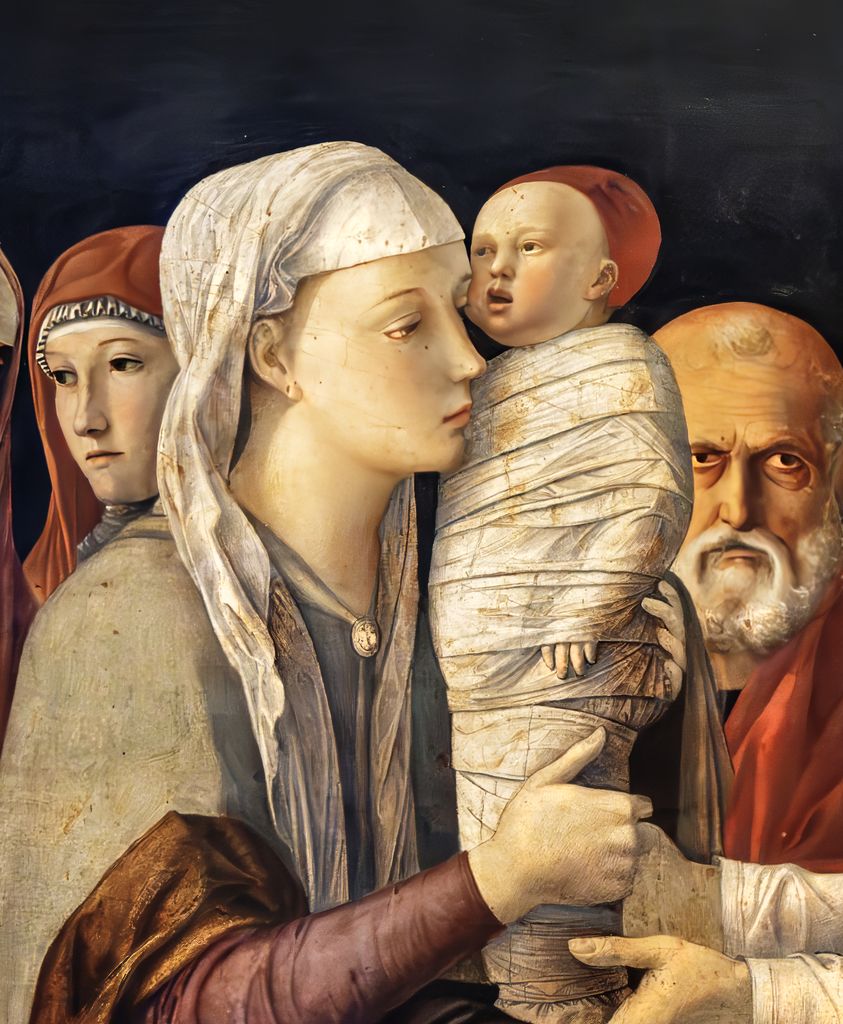
Giovanni Bellini holds the action of the Presentation at the Temple in the space between four hands. Mary has lifted her swaddled infant upright. Simeon reaches out from the right, his fingers just below the child's wrappings, while Joseph watches from behind. Four more faces crowd the edges. All seven figures rise above a ledge of mottled stone. The painting belongs to the Fondazione Querini Stampalia in Venice, where it is catalogued as inventory 2/29. Bellini painted it in oil on wood around 1470–75, and it measures approximately 80 by 105 centimetres. The closely related work by Andrea Mantegna in Berlin, painted about 1454, gave Bellini the arrangement of the central figures. The ledge, the side witnesses and the quality of the light make the encounter recognisably his own. [1] [2]
At a Glance
- ArtistGiovanni Bellini
- DateAbout 1470–75
- MediumOil on wood, according to the joint exhibition catalogue
- LocationFondazione Querini Stampalia, Venice
The work in Bellini’s career
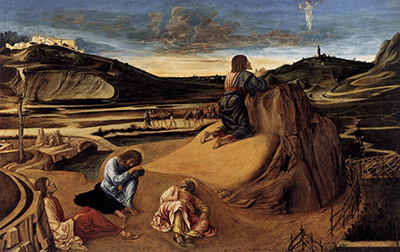
The Agony in the Garden
c. 1458–60Presentation at the Temple
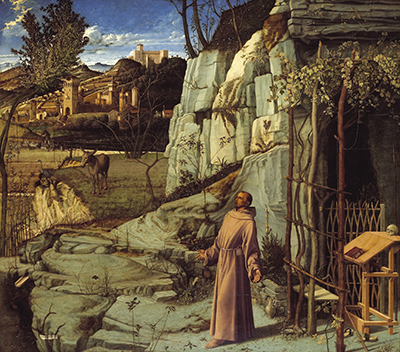
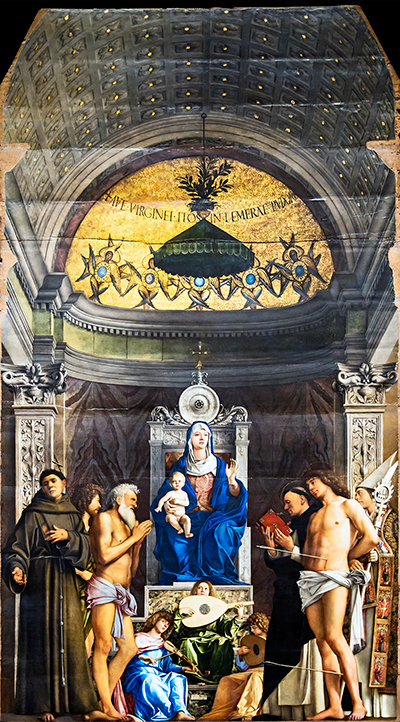
c. 1475St. Francis in the Desert
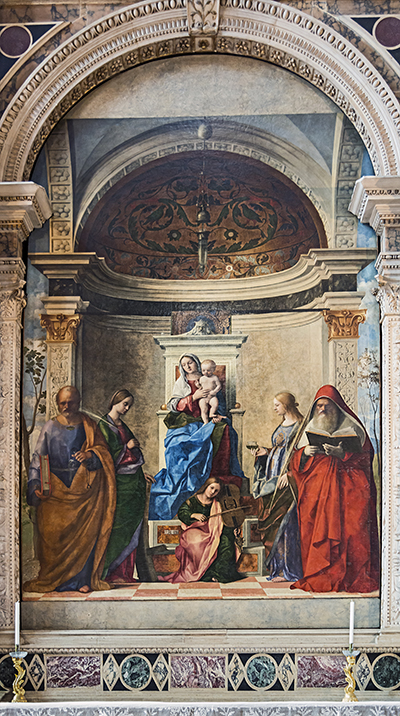
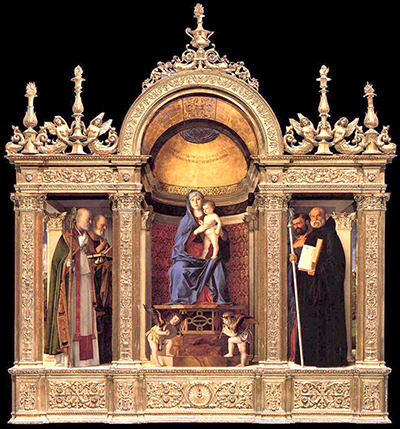
Late 1470sFrari Triptych
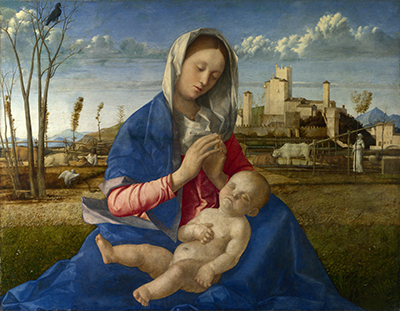
1488Madonna of the Meadow
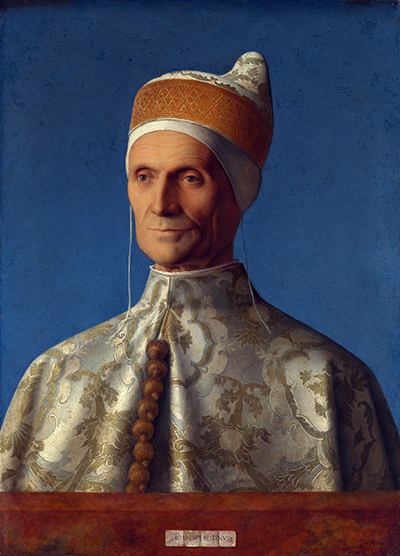
c. 1500–05Doge Leonardo Loredan
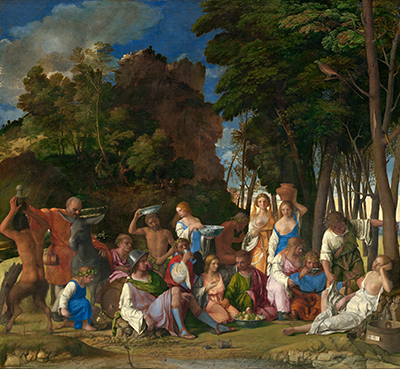
c. 1501–02The Feast of the Gods
Bellini’s signed date 1514Mary and Simeon at the ledge
In Luke's Gospel, Mary and Joseph bring Jesus to the Temple in Jerusalem in accordance with Jewish law. Simeon, a devout man who has been promised that he will see the Messiah before he dies, takes the child in his arms and blesses God. He then warns Mary of the suffering in store for her. Luke also tells of the aged prophetess Anna, who gives thanks and speaks about the child. Artists sometimes dress Simeon as a priest, as Bellini does here, although Luke describes him as a righteous man. Bellini depicts the Presentation that follows the circumcision and naming in Luke's narrative. These are separate episodes. [3] [4]
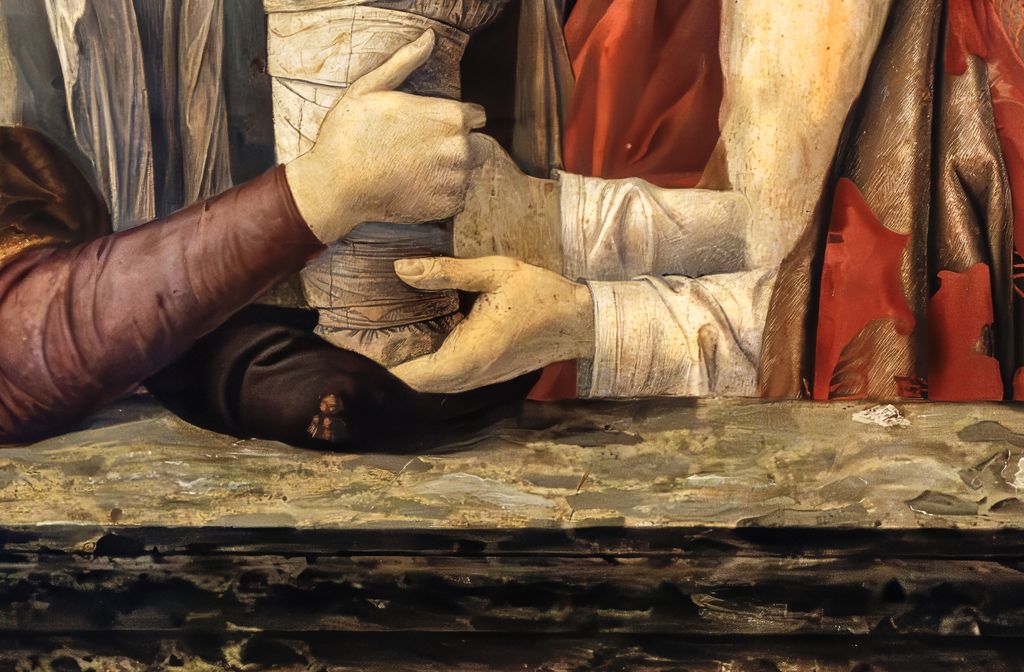
The birds brought as an offering in Luke and the architecture of the Temple are absent. The figures are seen from the waist or chest up against darkness. Bellini gives Mary a white veil that falls along the side of her face and a heavy sleeve that folds sharply at the ledge. Her lower hand closes firmly round the child's legs. Simeon's upturned hands are poised to take his weight. A small hand peeps out between the bands, and the child's face turns towards Mary's. There is time to register how much of the child she still holds before the transfer is complete. Just behind him, Joseph's brow, nose and white beard emerge from the dark. His sharply lit face occupies the gap between the two adults without interrupting their exchange. [2] [4]
The Querini Stampalia reads the wrapping and the stone ledge in the light of Simeon's prophecy. Bands that protect a newborn can also recall the cloth used to wrap a body for burial. The slab below them can suggest the edge of a tomb. In this reading, a scene of welcome already carries the memory of Christ's death for the viewer who knows how his story ends. Mary's grip makes that association personal. The subject and the close range of the figures fit the private devotion the foundation associates with family chapels, bedrooms and studies. The room and patron for which Bellini originally painted the panel remain unknown. [2] [4]
What Bellini changed in Mantegna's composition
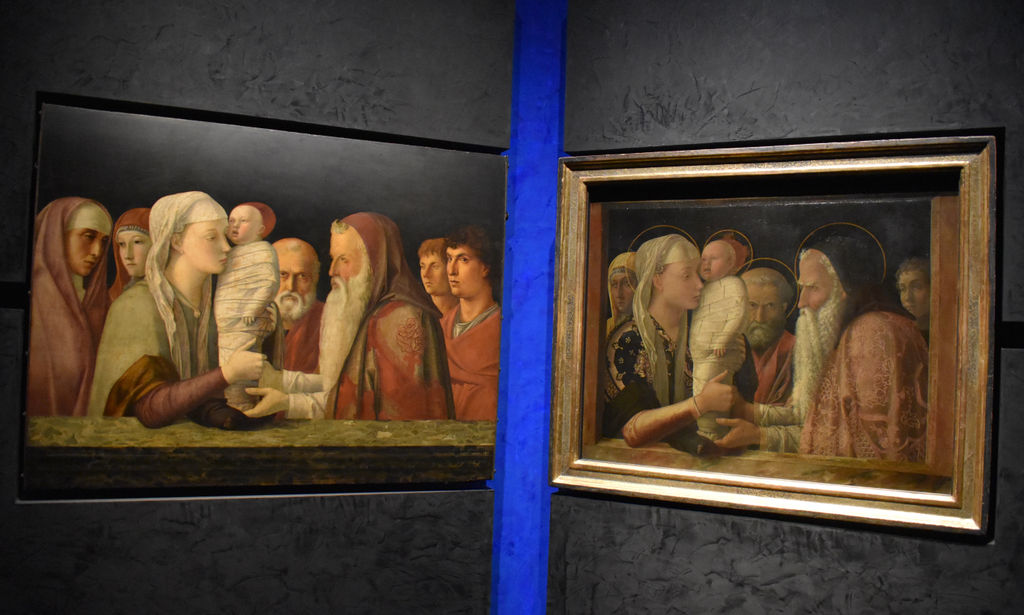
Mantegna built his scene into the opening of a fictive marble frame. It surrounds the group at the top and sides, as well as below. The cushion under the infant seems to project across its lower member towards the viewer. The painted border belongs to the illusion, distinct from the surrounding physical frame visible in photographs of the exhibited canvas. Azurite identified in the Berlin picture suggests that the background, dark today, was once blue. That would have made the opening resemble a window onto the sky. Neville Rowley of the Gemäldegalerie compares the device to the framed depth and intimate relation of mother and child in Donatello's marble Pazzi Madonna. Rowley also contrasts the painting with Giotto's full-length Presentation in Padua. Mantegna brought the half-length format associated with devotional figures to a story ordinarily told through full-length actors in an architectural setting. Bellini inherited that close viewpoint. [5] [6]
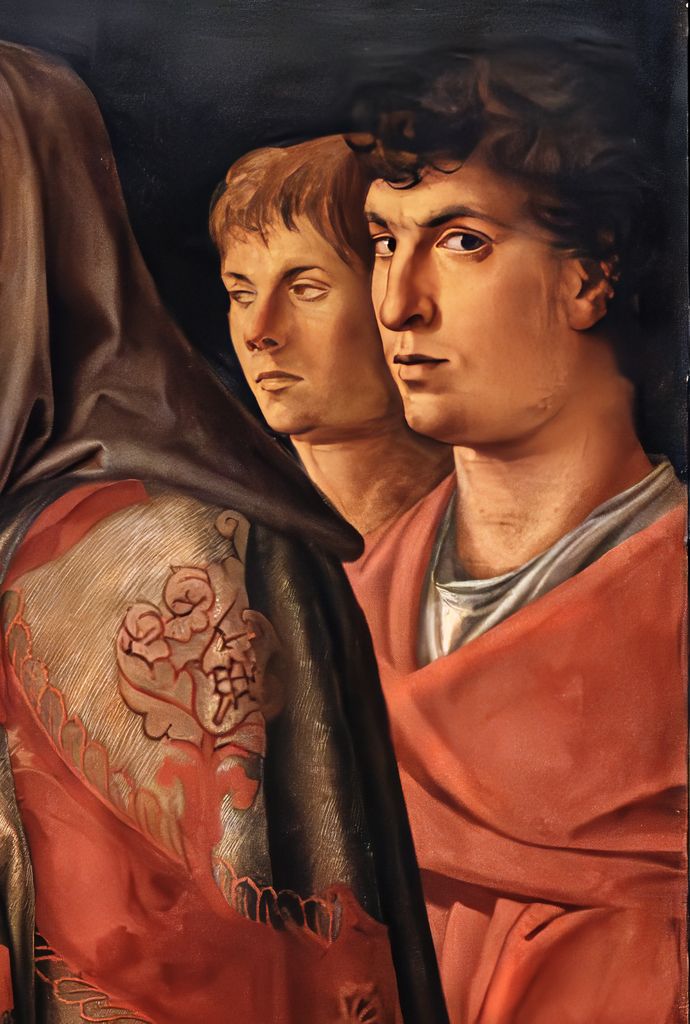
In the Venice panel, the lower stone surface stretches the entire width. Pale strokes catch the light along the top, and the face below falls into shadow. Blass-Simmen reads some of the thickest light strokes as reflections on the marble. The small cushion remains behind this edge, reducing the impression that the baby projects into the viewer's space. At either end, the dark background continues to the outer edge, and the extra figures fill the space opened by the disappearance of the painted uprights. At the left, one woman looks towards the exchange and the next looks off to the left. At the right, the two men's faces overlap, with the outer figure lifting his eyes towards the viewer. There are now several ways to look into or out of the group. Bellini also sets aside the fine gold halo rings visible in the Berlin painting today. Technical research dates the surviving narrow rings to a later intervention in the Berlin canvas's history. [5] [6] [7]
Look at the elder's beard and mantle in both paintings. Mantegna picks out individual curling hairs and gives the textile pattern an even intricacy. Bellini massed the silvery beard into longer, softer passages of light and made the mantle's ornament change as it runs across the folds. Reds recur in Joseph's clothing, Simeon's mantle, the young man's clothing at the right and the little cap behind the infant's head. The repetitions help draw the outer figures into the group even where their eyes wander beyond it. Brigit Blass-Simmen points to the broken, sometimes raised touches of paint in the mantle and ledge and records a fingerprint impression below Mary's ring finger. Such small traces of handling are easier to miss than the repeated silhouettes. Mantegna built his highlights with parallel strokes in tempera. Blass-Simmen describes transparent layers in Bellini's oil paint that let him vary the strength of the shadow, as in the sewn edge of Simeon's hood. In 1504 Lorenzo da Pavia wrote to Isabella d'Este praising Mantegna's powers of invention and Bellini's handling of colour. The two versions show how the painters could arrive at different effects while keeping much of the drawing in common. [4] [6] [7]
How the outlines were transferred
Blass-Simmen first tested the relationship by superimposing outlines from a reproduction of Mantegna's painting on a reproduction of Bellini's. The Berlin conservation team then had a new outline traced at actual size from Mantegna's picture onto transparent film. Set over Bellini's original in Venice, it aligned with the essential contours of the shared group. The match in scale and position makes a full-size working drawing, also called a cartoon, the convincing intermediary. The modern film was a means of testing that conclusion. The original drawing and the circumstances of its passage between the two painters are unknown. Mantegna's marriage to Nicolosia Bellini in 1453 gives a family context for such access. [5] [6] [7]
The Venetian panel itself preserves a clue to the method. Under raking light, which casts small shadows across a painted surface, incised lines are visible in the area of Mary's white veil. Blass-Simmen interprets these as traces of a stylus run over the drawing to press the outlines into the soft ground. Pouncing, in which powder was sifted through holes pricked in a drawing, was another means of transfer. The incisions are positive evidence for the stylus here. Infrared reflectography also reveals fine modelling strokes beneath Bellini's paint. The character of that underdrawing, compared with Bellini's other works, is one reason scholars place the painting in the early to mid 1470s. [4] [6] [7]
Changes below the surface of Mantegna's picture clarify which version came first. X-radiography shows that he moved Mary's head closer to the child. Infrared imaging reveals an earlier design for Simeon's head, with a small cap, visible ear and curls where the finished picture shows a fuller head covering. Bellini followed the resulting contours of Mantegna's finished composition. He also made revisions of his own. Blass-Simmen's Venice catalogue illustrates a pentimento, or change made during painting, in the profile of Bellini's Simeon. At the forehead and nose, adjustments soften the near-vertical line of Mantegna's outline and bring the profile towards Mary and the child. The transfer established where the principal figures would sit. Bellini still worked out the precise shape of the old man's face on the panel. [5] [6] [7] [8]
Who might the witnesses be?
The Querini's museum guide records one set of proposals. It names Nicolosia Bellini and Anna as possible models for the left-hand women, Giovanni Bellini and Andrea Mantegna as possible models for the right-hand men, and suggests Jacopo Bellini for the figure of Joseph or Simeon. Another account from the foundation proposes Giovanni's wife Ginevra among the women and Gentile Bellini as an alternative to Mantegna among the men. Anna in the proposed family group is distinct from the aged prophetess in Luke. The outward-looking man at the far right has often been called a self-portrait of Giovanni. Rowley points out that the man differs substantially from known likenesses of the painter. These suggestions depend on resemblances, family relationships and the character of the arrangement. There is no documented identification of the individual sitters. [4] [5] [9]
The Berlin painting has its own portrait tradition. The man on the right has been identified as Mantegna by comparison with a likeness in the Ovetari Chapel in Padua, and the woman on the left has been proposed as his wife Nicolosia. An allusion to their 1453 wedding or a first child has been suggested for the picture as a whole. Bellini's reuse of the arrangement does not establish the occasion for either commission. The enlarged group in Venice gives the devotional event the air of a family gathering even while the names remain open. [5] [8]
Restoration and the modern comparison
The Venetian panel is recorded in a Querini inventory of 1809 as a Mantegna. The Querini guide dates the first attribution to Giovanni Bellini to 1916 and records a later inscription naming Mantegna on the back, perhaps from the eighteenth century. Thick repaint had also complicated judgements about the work. The foundation tentatively connects one nineteenth-century intervention with Placido or Paolo Fabris. Mauro Pelliccioli documented heavy overpainting in 1946 and subsequently removed much of it. Some passages had already suffered paint loss, and the surface retains evidence of different stages in its history. The 2018 London loan notice listed egg tempera, while the published exhibition records and the comparative study identify the medium as oil. The wooden support is consistent across these accounts. [1] [4] [5] [6] [9] [10]
The works were brought together in Venice from 21 March to 1 July 2018, in an exhibition organised by the Querini Stampalia and the Gemäldegalerie with scientific collaboration from the National Gallery in London. Mario Botta displayed them on converging surfaces so that visitors could take in both paintings from one position. The reciprocal loans made it possible to exhibit the pair again in the wider London exhibition from 1 October 2018 to 27 January 2019 and in Berlin from 1 March to 30 June 2019. In the installation photograph from Venice, the broad unbroken ledge identifies Bellini at left. Mantegna at right can be picked out by the painted marble border inside the physical gold frame. [1] [11] [12]
The name Presentation at the Temple also appears on related works. Berlin's Bellini workshop example, inventory 36, is a poplar panel from about 1490–1500. The Berlin catalogue connects it to the repetition of the composition from a drawing in Bellini's workshop. Its conservation history includes the removal of protective paper patches applied around the Second World War. The Kunsthistorisches Museum's Vienna panel, inventory GG 117, has a bare rather than swaddled child and an oval outline. The Querini painting is the rectangular Venetian panel with seven figures, a swaddled child and the deep band of stone below the hands. [1] [8] [13] [14]
Annotated Details from Presentation at the Temple at the Querini Stampalia
Numbered overview and cropped details also licensed under CC BY-SA 4.0. Photograph Didier Descouens via Wikimedia Commons. Image source. CC BY-SA 4.0.
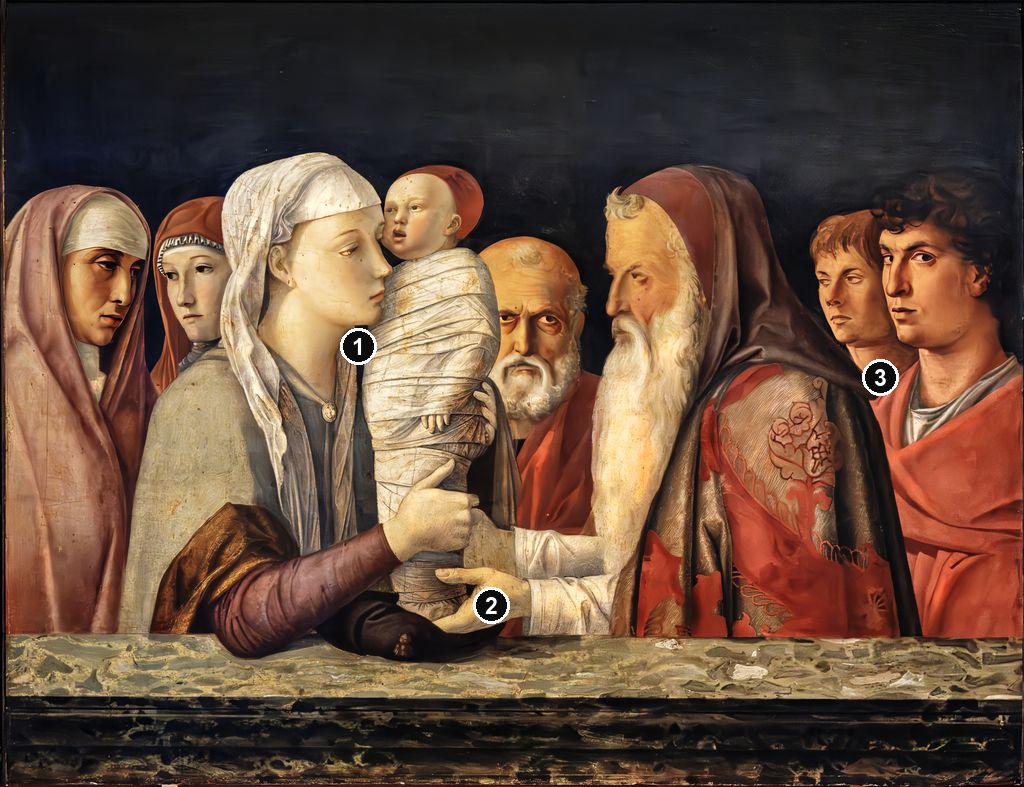
Details from PRESENTATION AT THE TEMPLE AT THE QUERINI STAMPALIA
The witnesses form a line behind the railing. The details follow the hands, faces and narrowing gaps around the child.
Mary and the infant
The bright, tightly wrapped Child and Mary’s headdress stand against the dark background. Their profiles turn into the space occupied by the waiting priest.
Hands above the parapet
The hands gather just above the ledge. Movement across the marble band is followed through turned fingers and the sleeves around them.
The witnesses at right
The figures on the right raise their faces out of the dark. Nearness to the priest and Child changes how each enters the group.
Related reading
Artworks directory
Discussion
Look again at the images and ideas explored in Presentation at the Temple by Giovanni Bellini. These editorial prompts invite your observations.
Reader Insights
How do the added witnesses change the movement towards Simeon?
What becomes clearer when you compare the Bellini and Mantegna paintings side by side?
What physical evidence allows specialists to distinguish a transferred design from a later change?
Join the Conversation
Share a detail, comparison or question about Presentation at the Temple by Giovanni Bellini below.
References
- National Gallery, London, Annual Review 2018–19, Mantegna and Bellini exhibition and paired object captions View source.
- Fondazione Querini Stampalia, Giovanni Bellini's Masterpiece View source.
- Gospel of Luke 2:21–39, United States Conference of Catholic Bishops View source.
- Fondazione Querini Stampalia, Giovanni Bellini, Presentazione di Gesù al Tempio, 1475 ca. View source.
- Gemäldegalerie, Andrea Mantegna, Die Darbringung Christi im Tempel, no. 29, with Neville Rowley's catalogue essay View source.
- Brigit Blass-Simmen, Die Künstlerbeziehung Andrea Mantegna und Giovanni Bellini, Berliner Wissenschaftliche Gesellschaft, pp. 9–27 View source.
- Brigit Blass-Simmen, Un cartone, due dipinti, 2018 Venice exhibition catalogue chapter View source.
- Gemäldegalerie, Paintings by Andrea Mantegna, Giovanni Bellini and Their Circles, comparative technical analysis and conservation View source.
- Fondazione Querini Stampalia, Italian museum guide, Presentazione di Gesù al Tempio entry View source.
- National Gallery, London, Mantegna and Bellini immunity from seizure notice, Bellini loan X9732 View source.
- Fondazione Querini Stampalia, Two Masterpieces Compared, 2018 Venice exhibition dossier View source.
- Gemäldegalerie, Mantegna and Bellini, 2019 Berlin wall texts, Presentation in the Temple View source.
- Gemäldegalerie, Workshop of Giovanni Bellini, Darbringung Christi im Tempel, no. 36 View source.
- Kunsthistorisches Museum, Vienna, institutional photograph and object identification for GG 117, archived by Wikimedia Commons View source.