 by Tom Gurney
Tom Gurney BSc (Hons) is an art history expert with over 20 years experience
Email: tomgurney1@gmail.com / Phone: +44 7429 011000
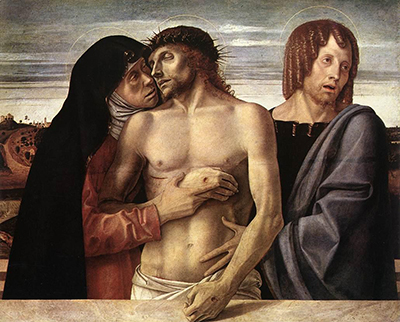
Pietà at the Pinacoteca di Brera
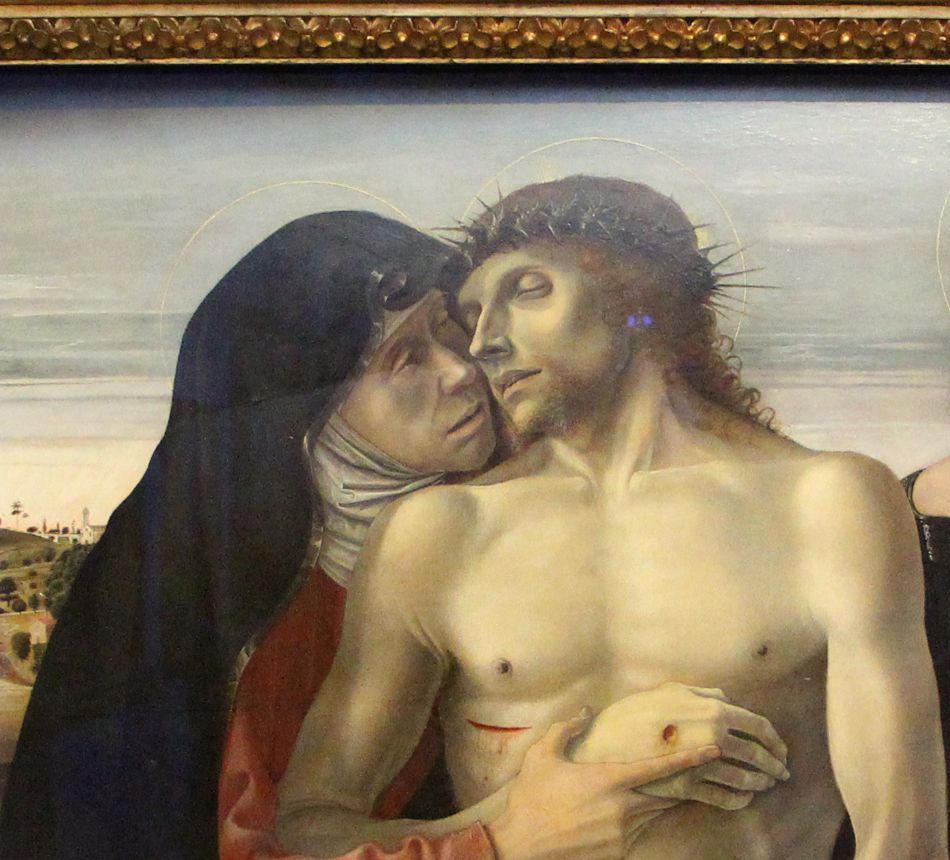
Mary holds her son's wounded hand against his chest in Giovanni Bellini's Pietà. Her brow almost touches his. On the other side of the body, John turns away with his mouth open, keeping one hand against Christ's waist. A Latin couplet beneath the three figures suggests that the picture itself could weep. Bellini puts his name on the same slip of painted paper. [1] [2]
This is the Pietà in Milan's Pinacoteca di Brera, inventory 228, a tempera on panel measuring 86 × 107 cm. It belongs to the 1460s. Brera gives about 1460 in its technical entry and 1465–70 in the English collection essay. The signature names Bellini, and the couplet supplies no year. [1]
At a Glance
- ArtistGiovanni Bellini
- DateAbout 1460–70, with estimates differing
- MediumTempera on panel
- LocationPinacoteca di Brera, Milan
The work in Bellini’s career
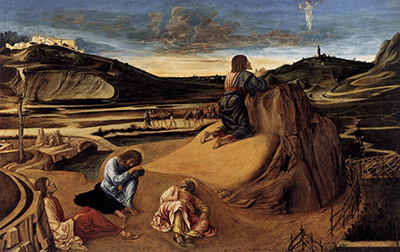
The Agony in the Garden
c. 1458–60Presentation at the Temple
c. 1475Pietà at the Pinacoteca di Brera
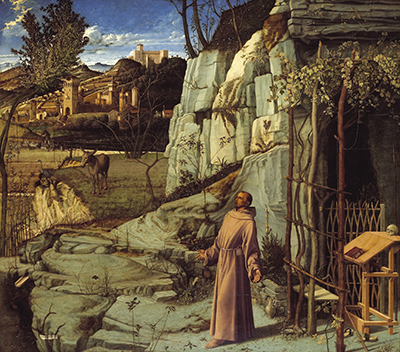
About 1460–70, with estimates differingSt. Francis in the Desert
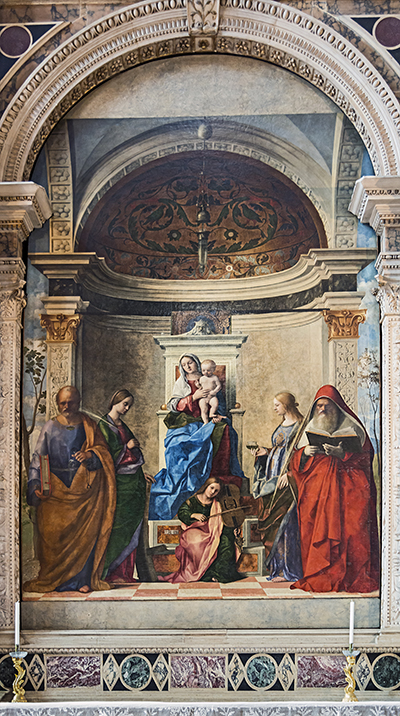
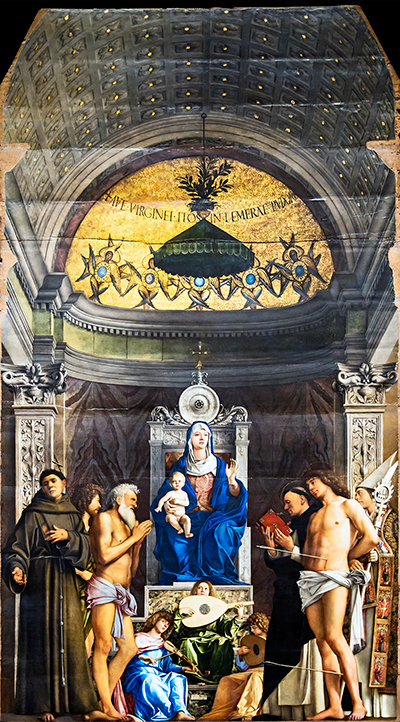
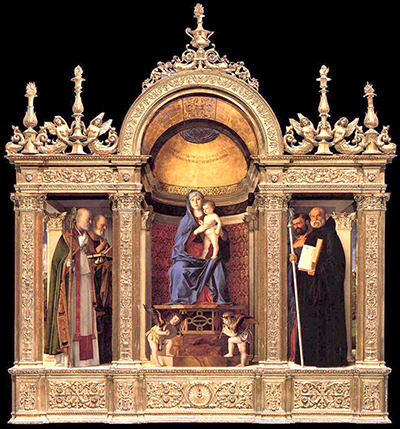
Late 1470sFrari Triptych
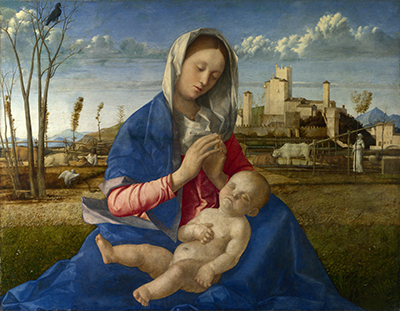
1488Madonna of the Meadow
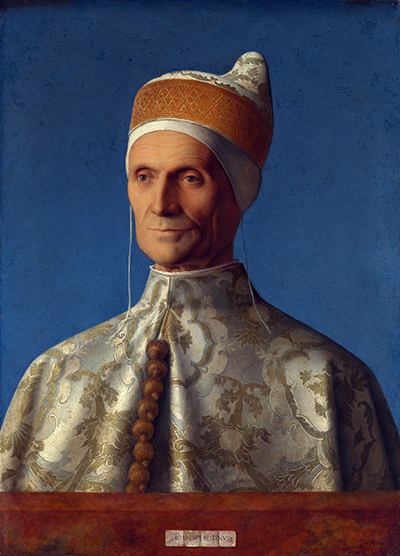
c. 1500–05Doge Leonardo Loredan
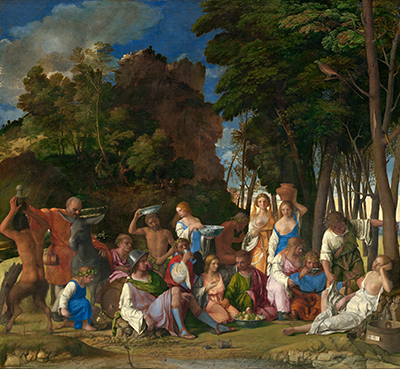
c. 1501–02The Feast of the Gods
Bellini’s signed date 1514What the hands tell us
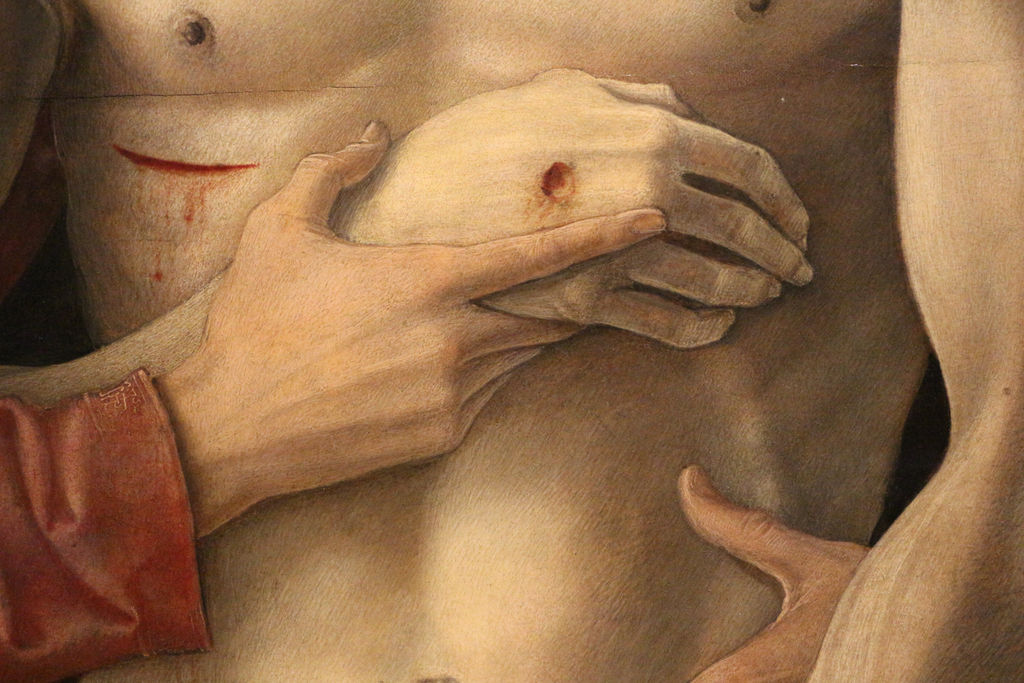
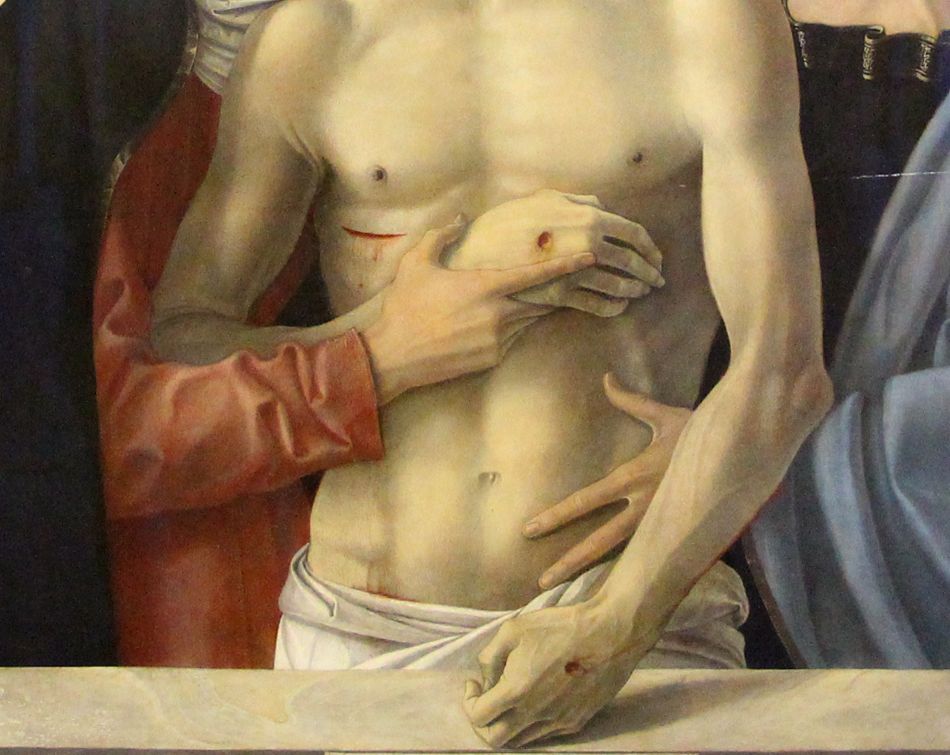
Start with Mary's hand, emerging from a red sleeve and spread across her son's fingers. She cups Christ's right hand from below, leaving the dark nail wound in view. His other arm drops almost the whole length of the painting. Follow it down to the left hand, where the curled fingers meet the stone rim of the tomb. There is a wound on that hand too. The distance between them tells us how much of the body's pose depends on Mary. One arm stays across his chest because she holds it there. The other has dropped to the nearest surface that will bear it. [1] [2]
One of John's hands is visible under the hanging arm, his fingers splayed across Christ's side. At that point, the lines of three bodies meet within a few inches of painted surface. Where Mary holds the hand, the long shape of her thumb and the pressure of her fingers make the gesture intimate. John's comparatively open grip suggests the effort of keeping a body upright. Christ's ribcage, the shallow cut of the wound in his side and the veins and tendons of the hanging arm are all carefully described. Bellini brings the wounds very close to the viewer by placing them where the living make contact. [1] [2]
The faces play out the same difference. Mary can scarcely bring herself nearer. Her eyes remain on Christ's face, and the white of her headcloth catches the light where his cheek meets the deep blue of her mantle. Sarah Dunant, writing for Brera, draws attention to the physical likeness between mother and son. The line of Mary's face echoes his at the very moment when her expression and his closed eyes mark the distance between them. John's head has already turned to the right. His parted lips and raised, reddened eyes give the silence of the panel the suggestion of a sound. [1] [2]
The tomb and the open country
The three half-length figures fill most of the broad panel. Christ wears the crown of thorns, yet there is no cross behind him. With his eyes shut and his body held upright at the tomb, one figure recalls several moments of the Passion. The wounds recall the Crucifixion, the mourners the grief after it, and the stone edge the burial to come. The art historian Norman Land reads the panel as an image for reflection on these events, gathered together in a single view. An important precedent was the Byzantine imago pietatis, an image of the dead Christ that was familiar in Venice through icons. In 2014 Brera exhibited a small fourteenth-century panel from Florence's Museo Horne, showing Christ with the grieving Virgin, to make that tradition visible. [2] [3]
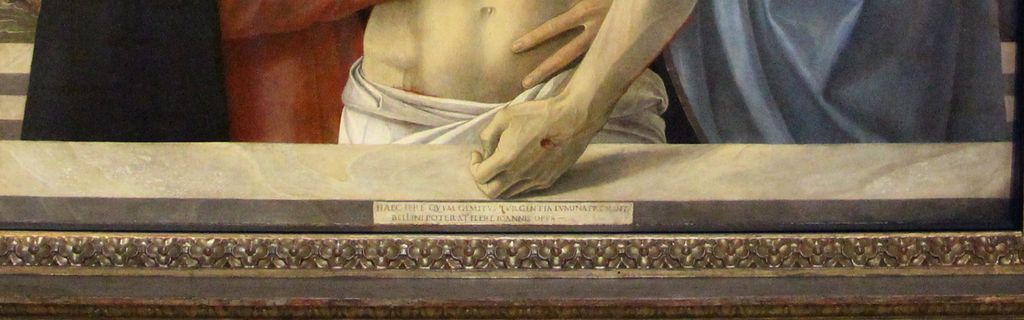
The horizontal edge of the tomb cuts off the group at waist height and runs almost the full width of the image. Its upper surface is broad enough to take Christ's hand. Across its front hangs the painted paper with Bellini's couplet. The hand and the slip are close to the bottom of the panel, which makes them feel particularly near to someone standing in front of it. Beyond the figures the scale changes abruptly. A road winds uphill at the far left, where Brera's audio guide identifies a castle and a church. Lower down, water swirls around a bare tree. The strip of open country is narrow, but following the road or stream gives the eye a long way to travel before it returns to the figures. [1] [4]
Brera draws attention to the sharp outlines and sculptural weight that Bellini learned from his brother-in-law Andrea Mantegna. You can see them in the silhouette of the crown and in the edges of John's folded mantle. Daylight also matters. The blue folds turn softly into shadow, and the thin bands of cloud carry the eye behind all three heads. Brera's guide reads the sky as evening. The landscape and figures share its cool light, even where the folds and silhouettes remain strongly defined. Mantegna's own Lamentation over the Dead Christ, also at Brera, offers a useful comparison. It places the viewer at Christ's feet and lets the foreshortened body lead into pictorial depth. In Bellini's Pietà, the tomb runs across the viewer's path and the mourners stand almost level across the field of vision. Both painters bring the wounds near, in Mantegna through the soles of the feet and in Bellini through the hand laid on the sill. [1] [4] [5]
Why the painting says it could weep
The cartellino, a painted slip of paper, carries two lines of Latin. In the reading published by Marzia Pontone, they are HAEC FERE QUUM GEMITUS TURGENTIA LUMINA PROMANT / BELLINI POTERAT FLERE IOANNIS OPUS. The sense is roughly “When these swollen eyes almost give voice to groans, Giovanni Bellini's work could weep.” The Latin syntax has invited different translations. What remains clear is that the work, opus, is given the capacity to cry and its maker is named in the third person. [2] [6]
Bellini's inscription reworks a phrase from Propertius's Elegies 1.21. In the ancient poem a dying soldier addresses a comrade who is getting away. He asks why the man turns his swollen eyes at the sound of his groans, and tells him what to say about his death. The poem's swollen eyes and groan have been carried over into a scene where a mother and a disciple mourn Christ. The borrowed words draw attention to John's turned head. They can also send the eye back to Mary, whose face is so close to Christ's that their profiles almost meet. A viewer who has already registered the tension of those faces can read the couplet as a claim for what paint can make a person feel. [2] [6] [7]
The classical allusion also opens a question about the people around Bellini. Pontone proposes Raffaele Zovenzoni, a humanist connected with the painter, as a possible author of the couplet. The attribution remains conjectural. For its 2014 exhibition Brera borrowed a 1453 manuscript of Propertius from Venice's Biblioteca Marciana. The first printed edition of the elegies appeared in Venice in 1472, after the period in which Brera places the painting. The manuscript shows how the verse could already be circulating in northern Italy. The identity of the patron and the place for which the panel was first made remain unknown. Its broad format and carefully placed inscription reward close viewing, whether a visitor can read the Latin or responds first to the gestures above it. [3] [4] [6]
From the Sampieri collection to the Brera
By the end of the eighteenth century, the Pietà belonged to the Sampieri family of Bologna. In 1801, Gaetano Tambroni recorded the painting in the fourth room of the family collection. His inventory mentioned a horizontal crack and damage to the mantles of Mary and John. It also noted a carved, gilded frame. The painting passed into the private share of the 1811 Sampieri purchase made by Eugène de Beauharnais, Viceroy of Italy. Six other pictures from the gallery went to Brera through a state purchase. Beauharnais gave the Bellini to Brera on 21 August 1811. [4] [8] [9]
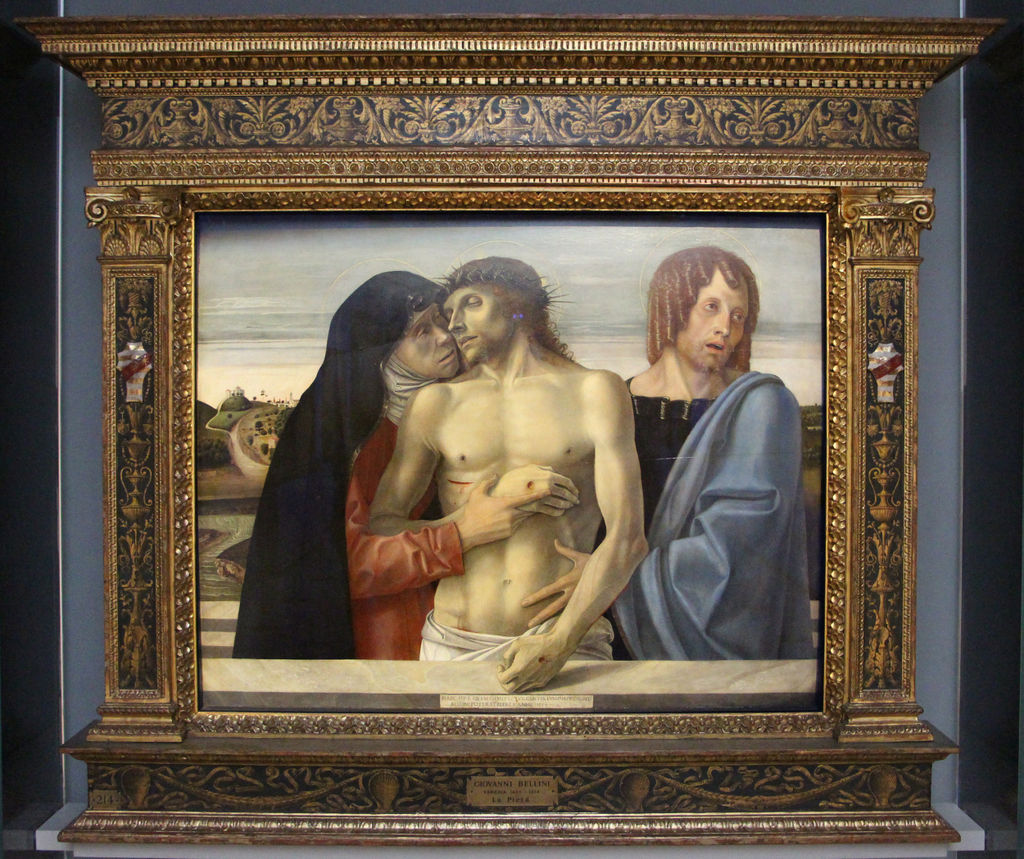
The panel reached the museum without its frame and was given a simple surround. The ornate frame seen today is a later addition, made in Siena in 1902–03 by the workshop of Giovacchino Corsi and sons. Its gilded festoon, decorated side supports and projecting top imitate a Renaissance architectural frame. The conservators found a small ridge of preparation at the perimeter of the panel, indicating that it originally had a frame in place when the ground was applied. That physical clue is modest compared with the imposing gold surround a visitor sees today. The painted stone and the paper label inside the picture are Bellini's own ways of giving it an edge. [10] [11]
What the restoration revealed
The support consists of two horizontal poplar boards with two layers of a white ground made from plaster and glue. Infrared images revealed a dark brush drawing that sets out the folds, facial features and contours. In places Bellini used thinner strokes laid diagonally to work out the shading beneath the paint. Small strokes lying alongside one another build up the paint above, which Brera identifies as predominantly egg tempera. The detailed image of Mary's hand shows how this patient handling models a thumb or knuckle without losing the firm outline of the gesture. Analysis also showed that Bellini used different blues for the mourners. Mary's mantle contains azurite, while John's contains lapis lazuli with lead white. The original halos were applied in shell gold. Earlier treatments took away almost all of that gilding, and the halos were redone in the nineteenth century. [11]
The panel's condition has a long history. In 1863 the painter and restorer Giuseppe Molteni cleaned and retouched parts of the picture, including Christ's face and side, Mary's clothing and the sky. The carpenter Giuseppe Draghini took the boards apart, straightened and rejoined them and fitted new crosspieces. Over time the wood was further weakened, and its movement was restricted by that earlier work. By 2010 cracks and distortion threatened the paint, while aged coatings made it difficult to see the forms and colours clearly. [11]
Between November 2010 and December 2012 Brera's restorers fitted a support that lets the wood move and retain its slight natural curvature. They removed altered varnishes and selected areas of overpaint in stages. Their treatment report describes removing retouching where sound original paint survived underneath and retaining old oil repairs where the paint beneath had been worn away or lost. The frame was adjusted to accommodate the changed curvature. The work was carried out by Paola Borghese, Andrea Carini and Sara Scatragli under the direction of Mariolina Olivari. In 2014 Brera brought together several of Bellini's treatments of the theme, including the Rimini and Vatican panels. The organisers drew attention to how the cool palette of the Milan painting differed from the saturated colour and gold of the Venetian icon tradition. They closed the exhibition with Bellini's Madonna del magistrato da Mar, reading the sleeping infant's dropped arm as an anticipation of his death. Seen in that company, the weight of the adult Christ's hanging hand at Brera makes the resemblance between a mother's two acts of care especially striking. [3] [11] [12]
Other Pietàs by Bellini
In another Milan collection, the Museo Poldi Pezzoli's Imago Pietatis shows Christ alone. Its narrower composition leaves more of the landscape visible and uses the receding sides of the tomb to draw the gaze towards the horizon. In the tall panel at Venice's Museo Correr, inventory cl. I, 39, two angels support Christ in front of a landscape. Both comparisons help identify what is distinctive about the Brera painting. Bellini allocates much of its width to two people who grieve in visibly different ways, and gives the central place below them to the verse. [13] [14]
The title Pietà is also used for the Rimini painting displayed at New York's Morgan Library & Museum in 2026. That exhibition followed treatment of a panel from the Museo della Città in which four angels attend Christ. [15]
The Vatican Lamentation provides another close comparison of gesture. It was the upper panel of Bellini's Pesaro altarpiece, and in the Vatican's reading Mary Magdalene holds Christ's hand to anoint it for burial. Mary at Brera draws the wounded hand close to his chest. Her fingers stay there while John looks away, and the unheld hand lies above the couplet on the tomb. [16]
Annotated Details from Pietà at the Pinacoteca di Brera
Numbered overview and cropped details also licensed under CC BY-SA 4.0. Photograph Francesco Bini via Wikimedia Commons. Image source. CC BY-SA 4.0.
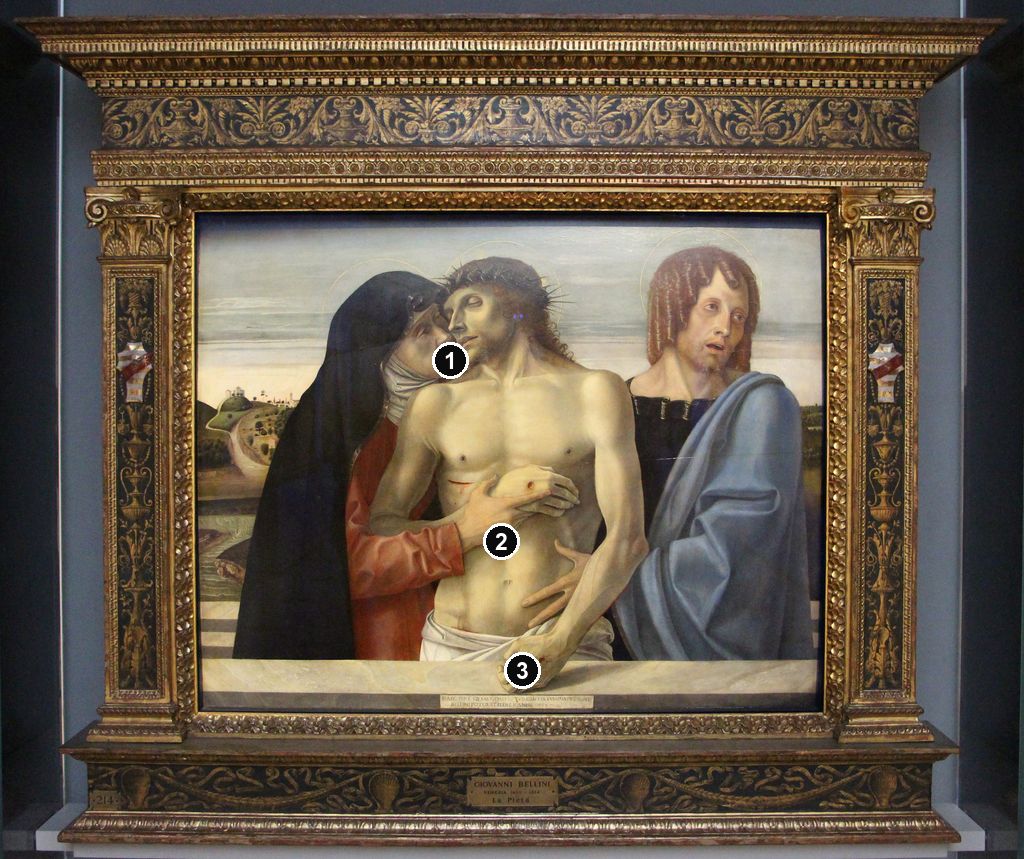
Details from PIETÀ AT THE PINACOTECA DI BRERA
Follow touch from the faces to the lower edge of the painted panel.
Mary and Christ
Mary’s forehead comes close to Christ’s. The tilt of his neck brings their profiles together against the light behind them.
The hands at Christ’s chest
Part of Mary’s red sleeve can be seen beneath the hand supporting Christ. The wound on his own hand is set against the pale torso.
The parapet and inscription
A stone ledge separates the figures from the viewer. The text occupies the pale band below their hands.
Related reading
Artworks directory
Discussion
Look again at the images and ideas explored in The Dead Christ Supported by the Virgin Mary and St John the Evangelist. These editorial prompts invite your observations.
Reader Insights
How do the hands connect the three figures across the picture?
What does the Latin inscription ask of someone standing in front of the painting?
Where do Mary and John look, and how does that guide your attention?
Join the Conversation
Share a detail, comparison or question about The Dead Christ Supported by the Virgin Mary and St John the Evangelist below.
References
- Pinacoteca di Brera, Pietà, inventory 228, collection record and Sarah Dunant label View source.
- Norman Land, The Voice of Art in Giovanni Bellini's “Pietà” in Milan, 1995, pp. 14–17 View source.
- Pinacoteca di Brera, Giovanni Bellini. La nascita della pittura devozionale umanistica, 2014 exhibition dossier View source.
- Pinacoteca di Brera, 10 Masterpieces for You, audio guide, stop 02 View source.
- Pinacoteca di Brera, Andrea Mantegna, Lamentation over the Dead Christ View source.
- Marzia Pontone, Giovanni Bellini e Raffaele Zovenzoni, 2014, pp. 91–95 View source.
- Propertius, Elegies 1.21, Latin text edited by P. Fedeli View source.
- Marinella Pigozzi, La collezione Sampieri, 2018, pp. 43–44 and note 11 View source.
- Monica Preti-Hamard, La collection de peintures italiennes d’Eugène de Beauharnais, p. 137 View source.
- Pinacoteca di Brera, Le cornici a Brera, Giovanni Bellini, Pietà View source.
- Pinacoteca di Brera, Pietà, technique and conservation report View source.
- Paola Borghese, Andrea Carini and Sara Scatragli, Il restauro della Pietà di Bellini alla Pinacoteca di Brera, 2014, pp. 133–134 View source.
- Museo Poldi Pezzoli, Imago Pietatis, inventory 1587 View source.
- Giovanni Bellini. Dall’icona alla storia, catalogue entry 6, Il Cristo in Pietà sorretto da due angeli, Museo Correr View source.
- Morgan Library & Museum, Giovanni Bellini’s “Pietà” Restored and Pietro Perugino’s “Man of Sorrows”, 2026 and Staatliche Museen zu Berlin, Mantegna and Bellini checklist, Rimini panel View source 1. View source 2.
- Fabrizio Biferali, Vatican Museums, The Lamentation over the Dead Christ by Giovanni Bellini, technical notes View source.