 by Tom Gurney
Tom Gurney BSc (Hons) is an art history expert with over 20 years experience
Email: tomgurney1@gmail.com / Phone: +44 7429 011000
The early Transfiguration in Venice
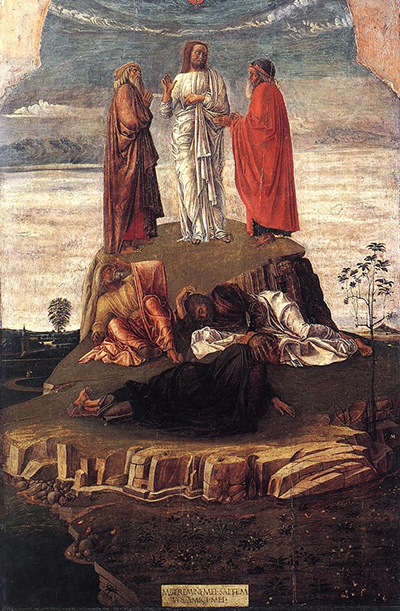
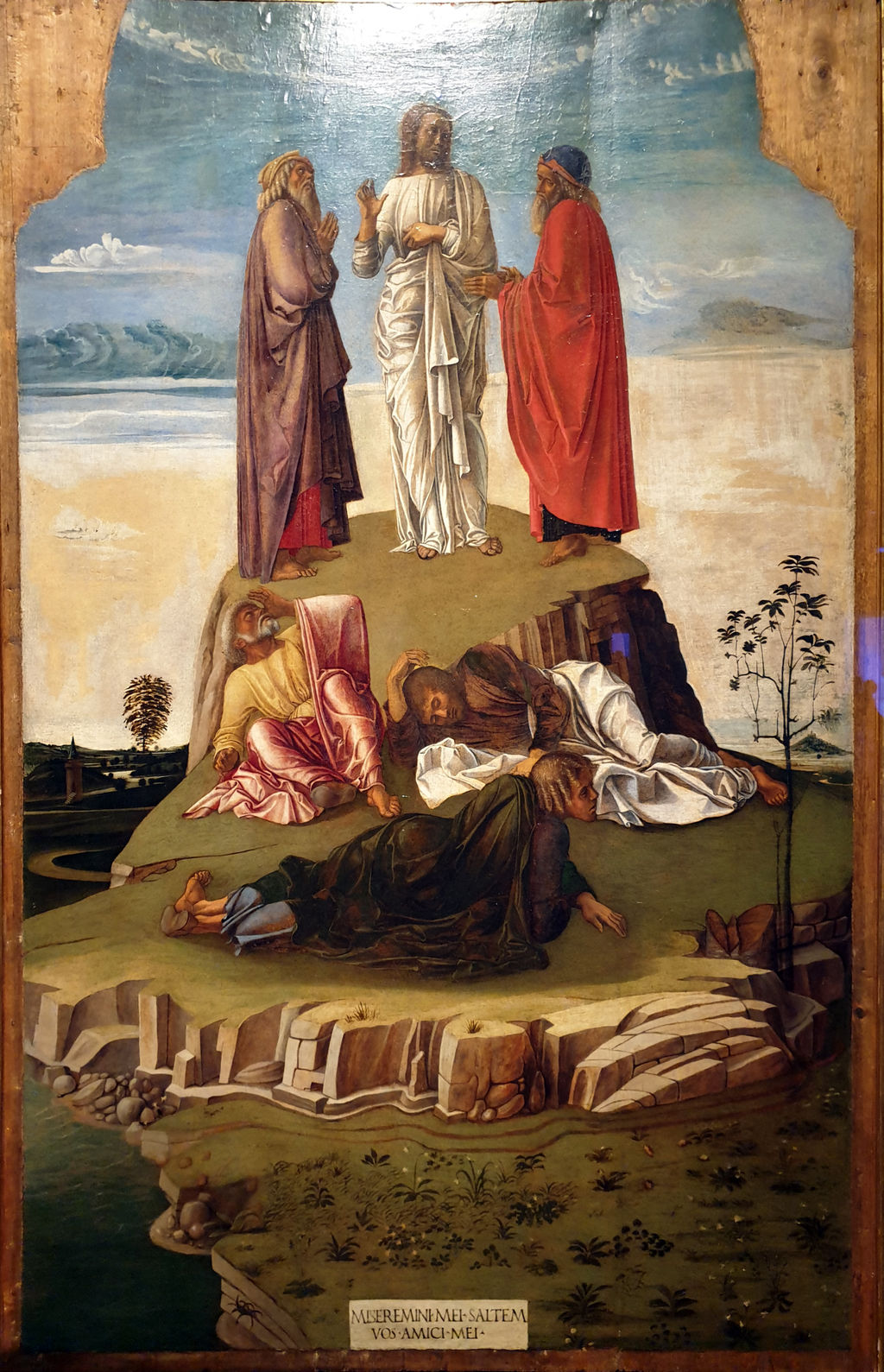
In Giovanni Bellini’s Transfiguration at the Museo Correr in Venice, Christ stands in a luminous white robe on a shelf of rock. Moses and Elijah stand beside him. Three apostles rest or twist on the grassy slope below, suspended between sleep and astonishment. The two groups are close enough that the back of one apostle nearly touches the rock beneath the prophets’ feet. Yet the steep ledges give the figures above a stillness that the bodies below seem unable to recover. Bellini painted this upright panel early in his career. He returned to the subject in the much wider picture now in Naples. [1] [2] [3]
At a Glance
- ArtistGiovanni Bellini
- DateAbout 1458–60 in the joint exhibition catalogue
- MediumEgg tempera and oil on panel, as catalogued for the joint exhibition
- LocationMuseo Correr, Venice
The work in Bellini’s career
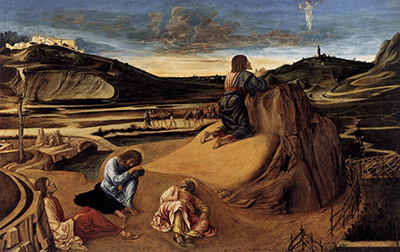
The Agony in the Garden
c. 1458–60Presentation at the Temple
c. 1475The early Transfiguration in Venice
About 1458–60 in the joint exhibition catalogueSt. Francis in the Desert
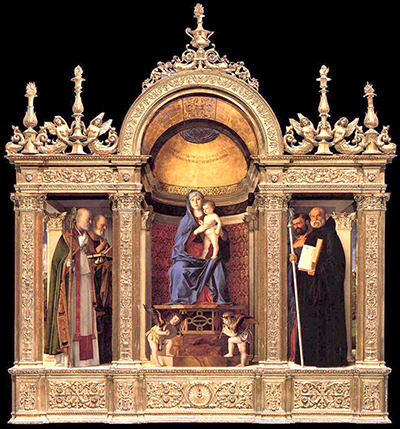
Late 1470sFrari Triptych
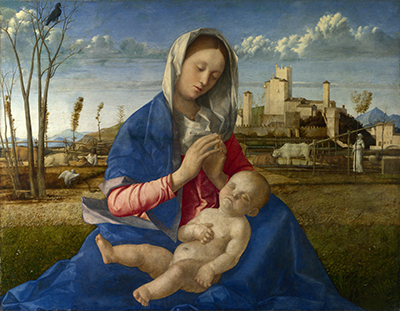
1488Madonna of the Meadow
c. 1500–05Doge Leonardo Loredan
c. 1501–02The Feast of the Gods
Bellini’s signed date 1514Christ and the three witnesses
Peter, James and John climb a mountain with Christ in the accounts of Matthew, Mark and Luke. Christian tradition identifies it as Mount Tabor. Christ’s appearance changes, his clothes become dazzling, and two figures from Israel’s past, Moses and Elijah, appear beside him. A voice from a cloud declares Christ to be God’s Son. Luke gives the scene a particular connection with what lies ahead. The prophets speak about what Christ will accomplish at Jerusalem, and the apostles, heavy with sleep, see his glory when they become fully awake. In Matthew they fall in fear on hearing the voice. In Mark, on the way down the mountain, Christ tells them to keep what they have seen to themselves until he has risen from the dead. [3] [4] [5] [6]
Bellini’s arrangement has older precedents. In Duccio’s early fourteenth-century panel for the Siena Cathedral Maestà, the two prophets flank Christ on a rocky height while the disciples recoil beneath him. The National Gallery traces that type to Byzantium. Where Duccio streaks Christ’s clothes with gold and gathers the disciples into a common recoil, Bellini uses white folds against coloured robes and divides the witnesses’ attention. [1] [22]
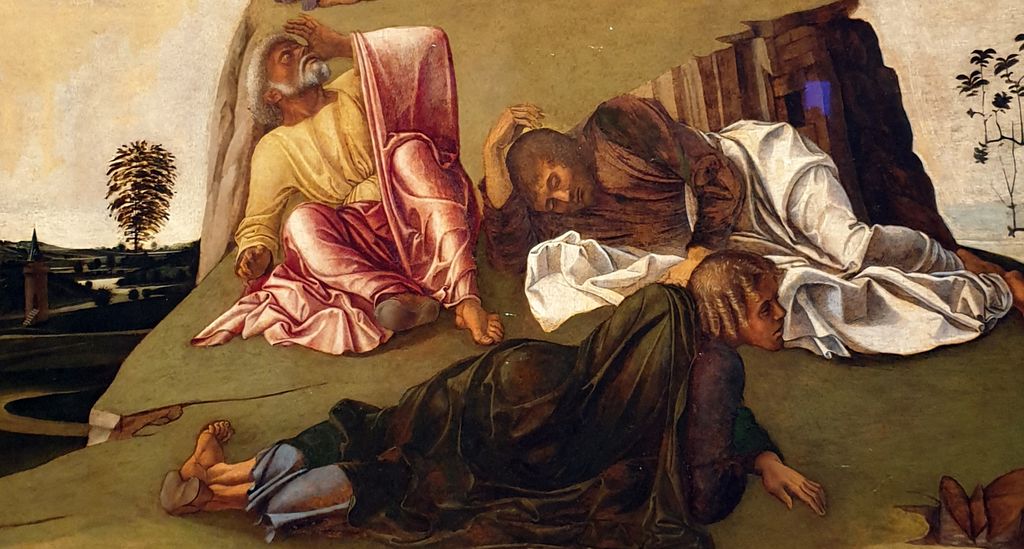
Bellini gives the three witnesses distinct responses. The grey-bearded man in yellow and rose at the left throws back his head. Behind him, another apostle’s cheek sinks towards his arm, his lower body wrapped in white fabric. The nearest figure pushes his palm into the grass, brings his weight onto his hip and turns his head almost sideways. The art historian Norbert Huse identifies the first as Peter, looking up, the second as James, scarcely awake, and the third as John, turning away after seeing the vision. Huse’s reading allows several moments from the story to unfold together. The men share the same patch of ground, yet their bodies register different stages of waking and seeing. [1] [7]
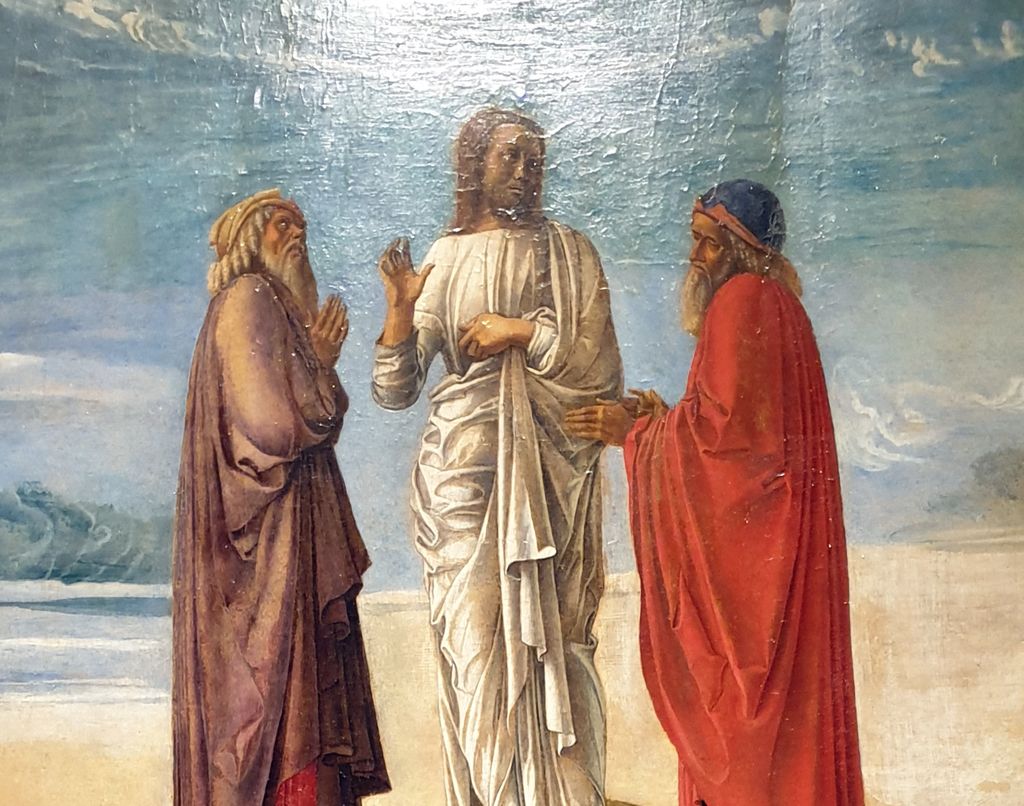
Above them, Christ lifts one hand and gathers his robe in the other. One prophet brings his hands together and the other reaches towards Christ. The parallel upright attitudes make their small gestures easy to follow. The folds of Christ’s robe hang close to the legs before breaking sharply at the feet. Pale highlights change direction around the knees and along the doubled fabric held at his waist. The impression of brilliance depends on those changes of tone and on the green ledge and coloured robes around him. Christ’s feet remain firmly planted on the summit as the disciples below struggle to steady themselves. [1] [3]
Rock shelves and a distant horizon
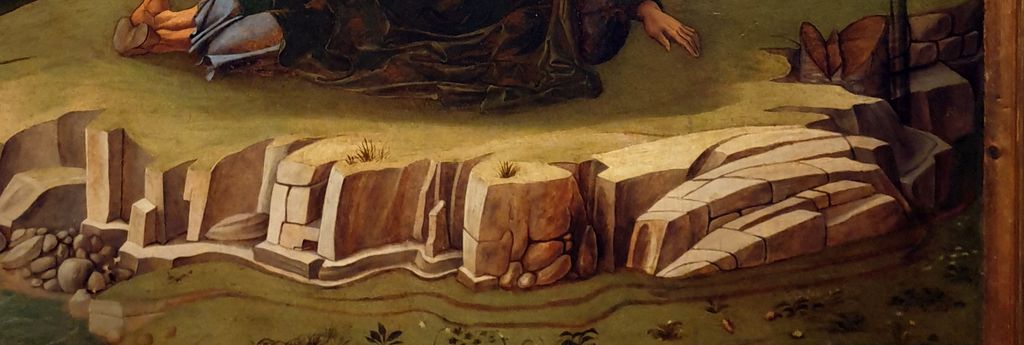
Bellini builds the hill out of separate ledges. The one under Christ is flat across the top and drops abruptly along its exposed face. Beneath the apostles, a longer band of pale stone crosses almost the whole picture. Some blocks stand up like broken steps, while flatter layers slant beneath the tree at the right. The angles of the rock find echoes in the bunched clothes and folded limbs above. A strip of soil, small plants and rounded stones below the ledge give the eye a way back into the terrain. The mount can be read as three places in succession, from the bank in the foreground through the apostles’ slope to the top where the encounter takes place. [1]
The far distance works on another scale. A winding dark strip and a small tower on the left give way to pale land and cloud. The ground around the figures has hard edges, while the light behind them makes the distant contours hard to place. This difference gives the summit real height. The eye can measure it against land that seems to go on beyond the limits of the picture. In the Agony in the Garden now in London, Bellini also sets Christ above three drowsy companions among sharply defined rocks. There the dawning sky picks out the clouds and the approaching party gives the landscape a direction in time. In Venice the abrupt rise of the rock leads straight to the vision, while the distant country stays quiet. [1] [8]
Those carved-looking forms help explain why the Correr panel was long taken for a work by Andrea Mantegna, Bellini’s brother-in-law. The two artists’ versions of the Agony in the Garden make the affinities particularly clear in the stone ledges and the precise folds of the costumes. The resemblance between their work is only part of the history of the rocks. Hazel Weston notes that a bank of rock much like Bellini’s ledge beneath the apostles occurs behind the cross in his Correr Crucifixion. A similar formation also appears in a disputed drawing of the Descent into Limbo. Mauro Lucco took Bellini to have drawn on the Paris sheet, which he assigned to Mantegna. Weston argued that the motif was already Bellini’s and pointed to similar rock steps in drawings by Jacopo Bellini and paintings by the Vivarini. The comparison shows how a feature built for one story could serve another and why resemblance alone gives only a limited basis for dating the painting. [2] [7] [8] [9] [10]
The plea at the foot of the mountain
At the very bottom of the panel, where the ground comes closest to the viewer, a small painted slip carries the Latin words Miseremini mei saltem vos amici mei. They come from Job 19:21 and ask his friends to have pity on him. In the same chapter, Job goes on to say that his vindicator lives and that he will see him for himself. The Latin scriptural tradition was read as a profession of faith in resurrection. Marzia Pontone reads the words as an allusion to Christ’s death and recalls the prayer in the Garden of Gethsemane. The words on the slip bring the voice of someone in pain into a picture of Christ’s glory. They also give a reader standing before the painting a different role from that of the startled apostles. The viewer can pause over a plea which the figures up the mountain never turn to read. [11] [12] [23]
Huse also reads the fresh growth near the stump as an allusion to resurrection. The detail is close to the direction of the nearest apostle’s turn, so the eye can follow his reaction into the landscape. The hope invoked by Job’s plea and the promise implied by the new growth both fit Luke’s account of the journey still to come and Mark’s reference to rising from the dead. The inscription has also prompted questions about the painting’s first setting. A photographic catalogue records a traditional association with the Venetian church of San Salvatore, while the London loan record traces ownership back to Teodoro Correr before 1830. The original commission remains uncertain. The Museo di Capodimonte has drawn attention to the spread of the Western feast of the Transfiguration under Callixtus III following the Christian victory over Ottoman forces at Belgrade in 1456. That is context for the subject’s currency around mid-century. The range of dates proposed for the panel leaves its relationship to the feast open. [1] [3] [6] [7] [11] [12] [13]
The panel and its paint
The Museo Correr’s civic catalogue records the painting as Cl. I n. 0027, dates it to about 1453–55 and describes it as oil on wood. The National Gallery and the Gemäldegalerie put it at about 1458–60 for their joint exhibition on Mantegna and Bellini and described the medium as egg tempera and oil on panel. Their listed measurements are 133 × 90.3 cm, close to the civic catalogue’s 134 × 90.5 cm. The Fondazione Zeri agrees with the loan measurements and gives a wider date range of about 1457–65. Capodimonte describes the Venice panel as tempera on wood from about 1460. The Correr’s published conservation report and an older photograph record give a narrower width of 68 cm. The sources leave the reason for the different widths unresolved. The different dates make the most sense as estimates for an early work, with the civic record and the loan records each tied to the same inventory. [1] [2] [3] [13] [14] [15] [16]
The painting has also changed physically. Huse describes a panel cut down at the top and suggests that the missing area may once have represented the cloud from which the voice was heard. The shaped edges of the painted field survive high at either side. In the Correr’s 1991–92 restoration campaign, conservator Sabina Vedovello recorded the poplar support, earlier changes to the wooden cradle on the back and problems with adhesion between layers. The conservators returned to the painting several times during the campaign. A later technical survey by Jeongmu Yang cites the campaign findings and lists linseed oil in samples from green grass and sky. That evidence places oil in specific parts of the early work. The binder used in the white robe, and the full sequence of paint layers, require evidence from those passages. [7] [16] [17]
Bellini’s later approaches to the subject
Bellini’s Transfiguration of Christ at Capodimonte is a broad oil painting that the Louvre and Capodimonte date to about 1478–79. In Naples the prophets and Christ stand in a lower, open landscape, with a fence and a signature slip at the front. The sky, field and distant buildings extend far to either side of the sacred group. In Naples the small written slip bears Bellini’s name, while its counterpart near the bottom of the Venice panel voices Job’s appeal. Capodimonte’s scientific study examined the head and figure of Christ in the Naples work. In Venice the ascent, abrupt exposed rock and partly waking witnesses still carry much of the story. [3] [11] [18] [19]
Two much smaller pieces at the Gallerie dell’Accademia in Venice preserve a head of Christ and a signed cartouche beside a tree. They entered the collection as a gift from Girolamo Contarini in 1838. [24] In 1899 the Accademia director Giulio Cantalamessa reported that the pieces had been glued back to back and concluded that they had come from another painting of the Transfiguration. Italy’s national heritage catalogue gives an Ascension as another possibility. The two fragments retain features associated with Bellini’s treatments of the subject, among them the white garment and a shoot beside the tree. The steep hillside, apostles and plea from Job identify the earlier panel at the Correr. [20] [21]
Annotated Details from Transfiguration at the Museo Correr
Numbered overview and cropped details. Photograph Anagoria via Wikimedia Commons. Image source. Public Domain Mark 1.0.
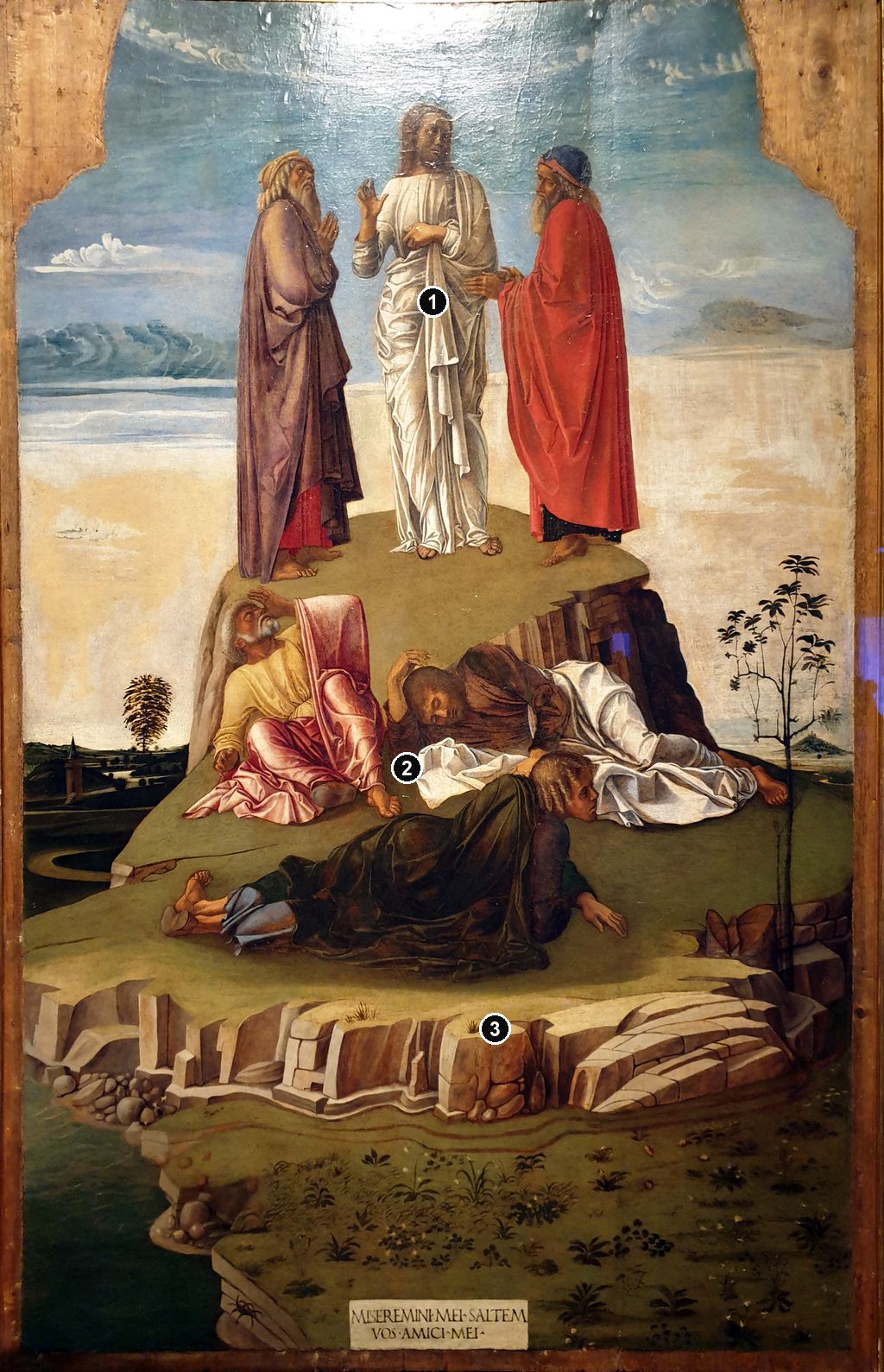
Details from TRANSFIGURATION AT THE MUSEO CORRER
Follow the tall panel from the elevated figures to the strata of rock beneath the disciples.
Christ and the prophets
Christ’s bright robe divides the group standing along the summit. The figures rise against the pale sky so that the edges of their garments remain legible.
The disciples on the incline
The three responses take shape across the incline. The bodies overlap, turn and lean while the standing group remains comparatively still.
Strata of the rock
Alternating dark channels and pale bands turn the ground into a ledge. They give the diagonal crossing the painting a visible edge.
Related reading
Artworks directory
Discussion
Look again at the images and ideas explored in Transfiguration by Giovanni Bellini (Museo Correr). These editorial prompts invite your observations.
Reader Insights
How does the narrow panel shape the movement from the rocky shelf to the summit?
Which details help distinguish this early panel from the wide Naples painting?
Which disciple’s pose gives you the strongest sense of the height of the summit?
Join the Conversation
Share a detail, comparison or question about Transfiguration by Giovanni Bellini (Museo Correr) below.
References
- National Gallery, London, Mantegna and Bellini loan record, entry X9743 View source.
- Fondazione Musei Civici di Venezia, civic catalogue, Trasfigurazione di Cristo View source.
- Museo e Real Bosco di Capodimonte, Il restauro della Trasfigurazione di Giovanni Bellini. Tavole a confronto View source.
- Luke 9:28–36, USCCB View source.
- Matthew 17:1–9, USCCB View source.
- Mark 9:2–10, USCCB View source.
- Norbert Huse, Studien zu Giovanni Bellini, pp. 5–6, 1972 View source.
- National Gallery, London, Giovanni Bellini’s The Agony in the Garden View source.
- National Gallery, London, Andrea Mantegna’s The Agony in the Garden View source.
- Hazel Weston, Christ’s Descent into Limbo at the Bristol City Art Gallery and Museum, pp. 62–65, 2010 View source.
- Istituto Nazionale di Studi sul Rinascimento, photographic index and inscriptions for the Correr and Capodimonte Transfigurations View source.
- Job 19:21–27 and notes on the Latin tradition, USCCB View source.
- Istituto Nazionale di Studi sul Rinascimento, Correr Transfiguration, photographic subject record View source.
- Gemäldegalerie, Berlin, Mantegna und Bellini exhibition checklist View source.
- Fondazione Federico Zeri, Correr Trasfigurazione object catalogue View source.
- Sabina Vedovello, L’intervento di restauro, Correr conservation campaign published in 1993 View source.
- Jeongmu Yang, Giovanni Bellini: Experience and Experiment in Venetian Painting, table 6 and list of abbreviations, 1998 View source.
- Musée du Louvre, Naples à Paris, Capodimonte Transfiguration dossier View source.
- Laurence de Viguerie and colleagues, imaging of the Capodimonte Transfiguration, Heritage Science, 2023 View source.
- Punta della Dogana, Slip of the Tongue, Head of Christ and Scroll exhibition entry View source.
- Italian national heritage catalogue, Cartiglio, Gallerie dell’Accademia View source.
- National Gallery, London, Duccio’s The Transfiguration, NG1330 View source.
- Marzia Pontone, Giovanni Bellini e Raffaele Zovenzoni, pp. 90–91 View source.
- Gallerie dell’Accademia di Venezia, Testa di Cristo e cartiglio View source.