 by Tom Gurney
Tom Gurney BSc (Hons) is an art history expert with over 20 years experience
Email: tomgurney1@gmail.com / Phone: +44 7429 011000
Madonna of the Meadow
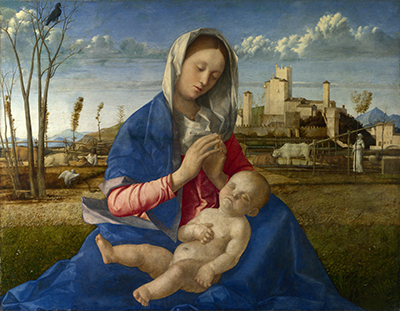
The infant Christ is asleep. Mary bows her head and brings her hands together above him, while beyond her cattle stir, people tend the fields and a white bird lifts its wings at a snake. Giovanni Bellini gives the mother and child the largest shapes and the strongest colours, then fills the country around them with small things worth looking at. That balance between outward activity and inward attention makes the Madonna del Prato, or Madonna of the Meadow, one of his most absorbing devotional paintings. [1]
The National Gallery in London dates the painting to about 1500–05 and catalogues it as NG599. It measures 66.5 × 85.1 cm in the Gallery’s current record. Bellini painted it on wood, and the picture now rests on a composite board. The Italian title is easy to confuse with Raphael’s Madonna in the Meadow in Vienna, a separate work in which the young Christ and Saint John the Baptist share a small cross. In Bellini’s meadow the sleeping child and his mother have the foreground to themselves. [1] [2]
At a Glance
- ArtistGiovanni Bellini
- DateProbably about 1500–05
- CollectionNational Gallery, London
- Catalogue numberNG599
- Current supportComposite board; originally painted on wood
The work in Bellini’s career
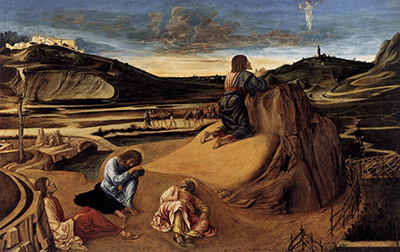
The Agony in the Garden
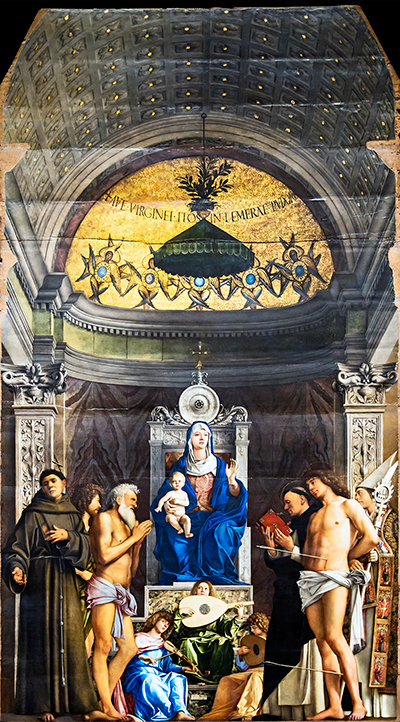
c. 1458–60Presentation at the Temple
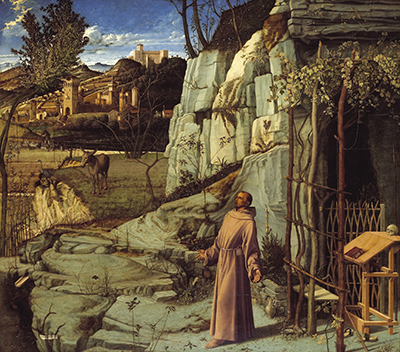
c. 1475St. Francis in the Desert
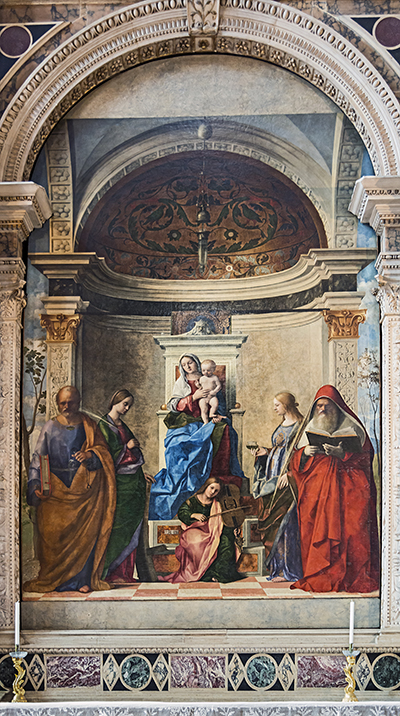
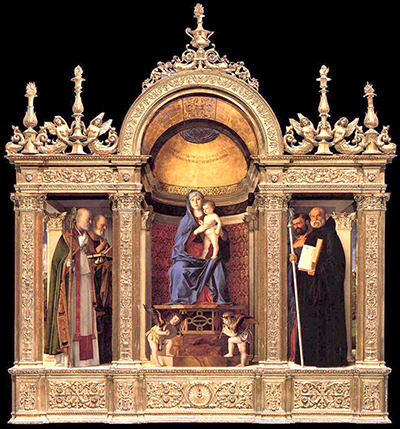
Late 1470sFrari Triptych
1488Madonna of the Meadow
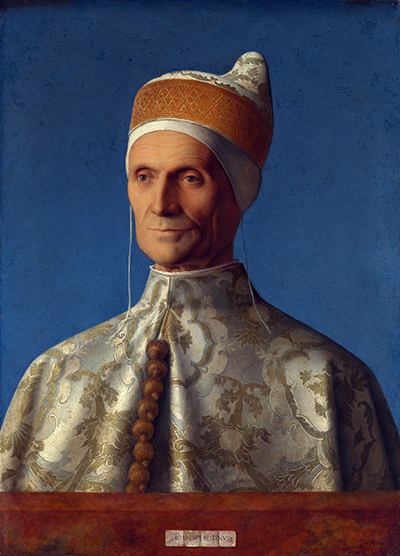
c. 1500–05Doge Leonardo Loredan
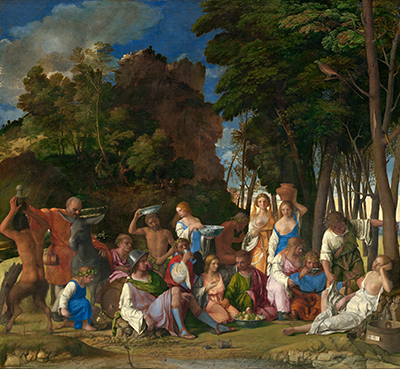
c. 1501–02The Feast of the Gods
Bellini’s signed date 1514Mary’s prayer and the sleeping Christ
Mary sits at ground level with her knees hidden by the blue mantle. Her shoulders slope out from the pale veil, and the folds of the cloak broaden towards the lower corners. Her figure takes on the shape of a triangle, with a slight shift at the top where her head inclines towards the child. The absence of a throne is part of an established image type, the Madonna of Humility, in which Mary sits on or close to the ground. Bellini uses that low seat to give the child a wide, sloping lap and the viewer a sense of being close to the same patch of earth. [1] [3]
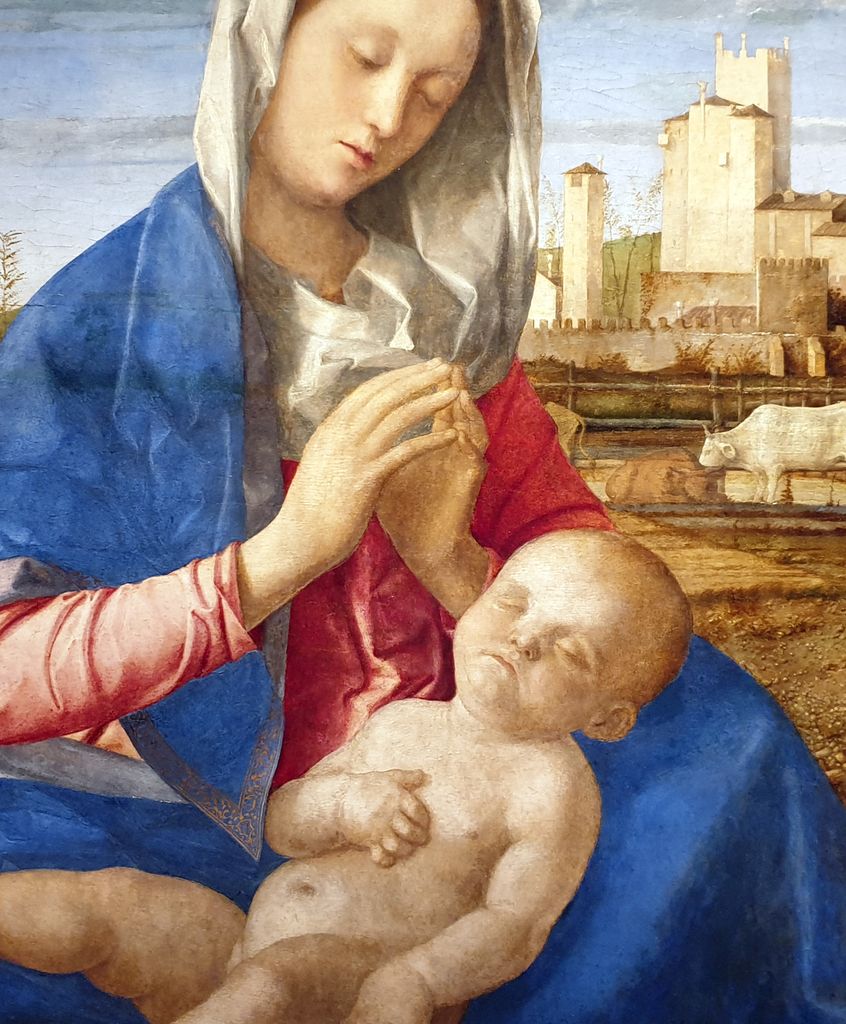
Look at the small space between the fingers and palms. Mary’s fingertips meet, but the hands remain gently cupped, almost repeating the oval of her face. One forearm crosses the picture on the diagonal and catches the light along its pink sleeve. Her eyes follow the same downward movement. The bend of the head, the meeting of the hands and the lowering of her gaze direct attention to a child who has no awareness of being watched. His sleep gives her the interval in which to pray. [1]
The child’s body is angled across the folds. His head tips towards one shoulder, the near arm falls by his side and his feet come to rest at different heights. There is the familiar weight of a child who has gone limp in sleep. The arrangement also recalls a Pietà, in which Mary supports the body of Christ after the Crucifixion. The likeness depends on the way the body lies across her knees, and the lowered eyelids let the same pose suggest two different moments in Christ’s life. Mary’s quiet devotion belongs to the present scene. For a viewer who recognises the later image of mourning, the sight of her child at rest also carries knowledge of what lies ahead. [1]
The meadow and its small events
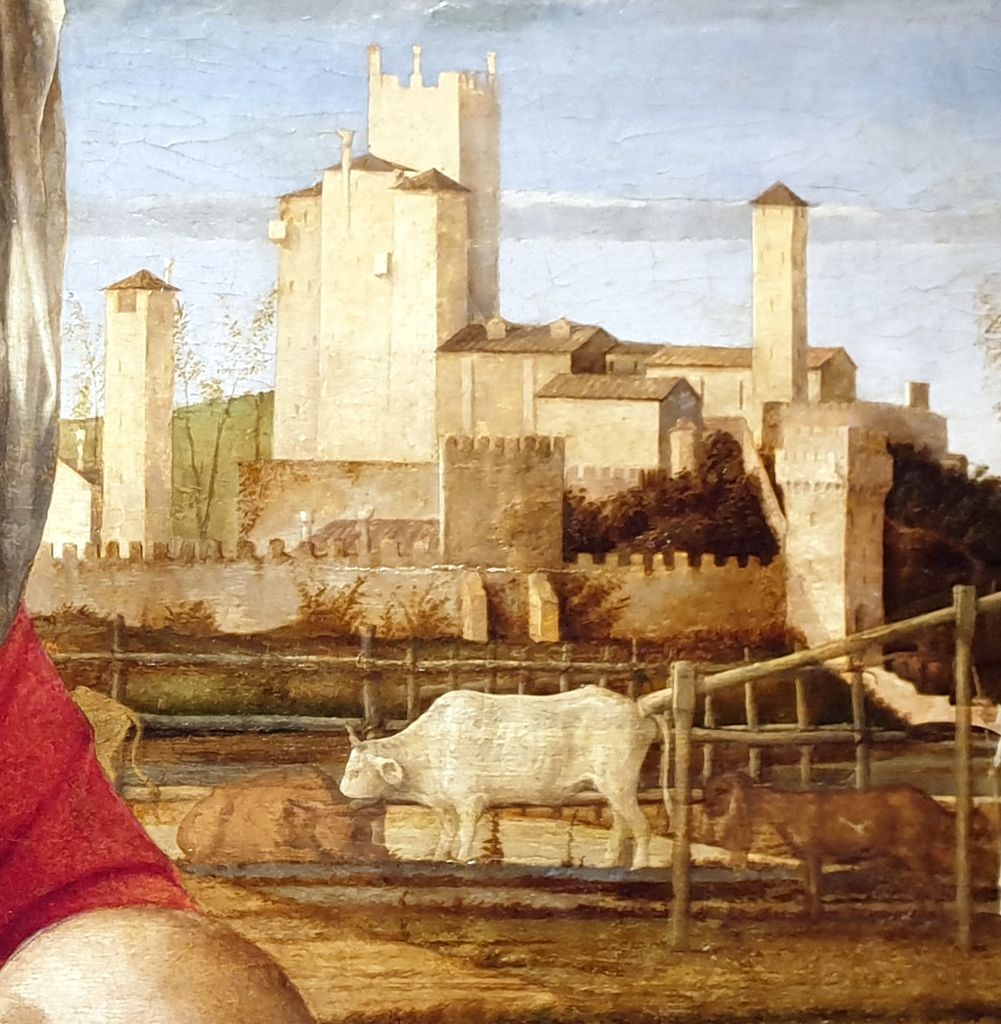
The ground closest to Mary is rough with close grass, low leaves and scattered light touches. Beyond it a paler strip of land runs behind her, then fences divide the holdings farther back. The rails on either side of the blue cloak help the eye measure distance where the large figure interrupts the view. Beyond the enclosures rise the town’s walls and square towers. Farther away still, the blue hills have fewer distinct edges. Bellini makes the country feel deep by varying what the eye can make out at each distance, from the ground almost within reach to buildings in clear sunlight and then to mountains softened by the air. [1]
On the viewer’s right a pale ox stands within a fenced area, its body lit almost as brightly as the walls above it. Other cattle rest or crowd close together. A figure in pale clothing stands by the fence at the far right, while across the picture another person sits low among the animals. These people have their own place in the landscape and make no visible approach to the Virgin. The enclosures, paths and guarded settlement imply a countryside where people live and work. That familiarity brings the scene of prayer into a world a viewer could recognise. [1]
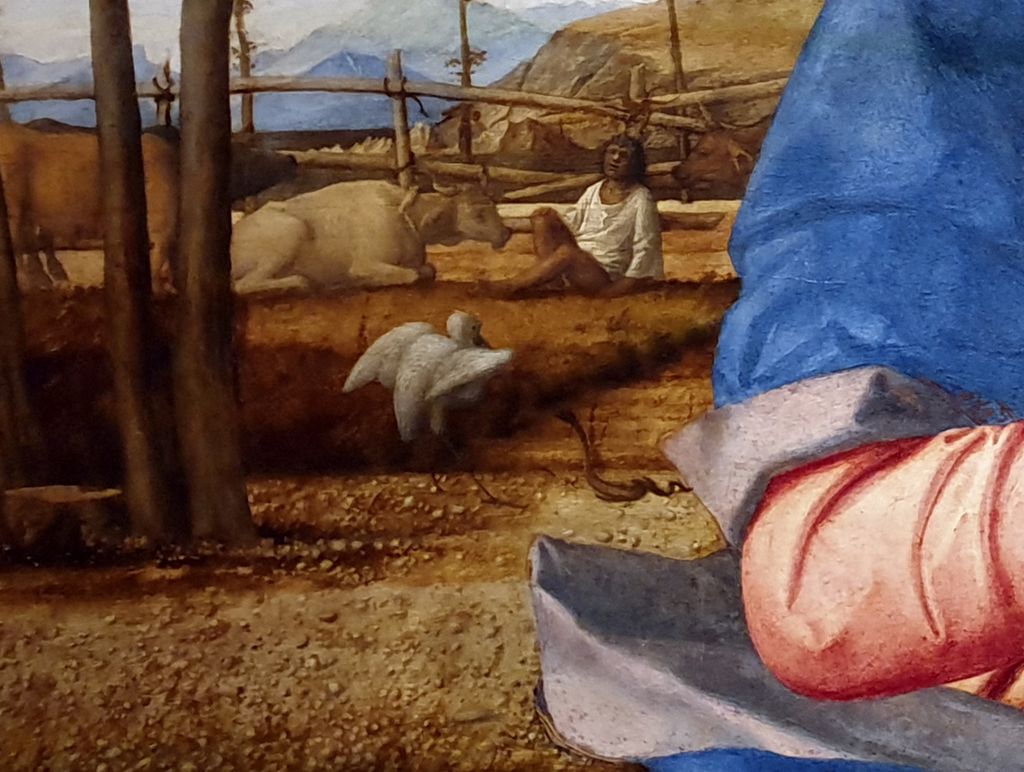
Some of the liveliest incidents occupy very little of the painted surface. A snake and a light-coloured bird are easy to miss on the viewer’s left. The bird’s half-open wings mark a sudden action below the still, dark bird that the National Gallery identifies as a vulture. Its perch is high in a bare tree, almost at the top of the picture. Across the meadow there are quieter movements in the tilt of a thin tree, the lowering of an animal’s head and the formation and dispersal suggested by the clouds. When the eye returns to Mary, the constancy of her pose has become more apparent. [1]
The fortress has prompted a proposal that Bellini depicted Feltre and that the setting relates to a local religious institution. That identification has been argued in print, but the National Gallery leaves the original patron unknown. The visible buildings can carry the sense of a town in the Venetian mainland countryside without settling the question of where the picture was commissioned. Comparisons with its walls may inform the geographical reading. A documented commission would answer a different question. [1] [4]
Spring, danger and renewal
Sunlight catches the warm sleeve and the pale cloth near Mary’s neck, then reappears in the distance on the buildings. Above those buildings, the clouds have bright tops and grey undersides, and higher up they thin enough to leave stretches of blue. New foliage on the slender trees and the clarity of the light suggest spring to the National Gallery. The tree at the left edge has still to come into leaf. It gives the scene the unevenness of an actual change of season, when signs of new growth appear beside land and branches that look wintry. The National Gallery suggests that Bellini’s attention to passing light may owe something to northern European paintings by artists such as Jan van Eyck and Dirk Bouts, whose work offered Venetian painters examples of how daylight changes the appearance of different surfaces. [1]
That uneven season gives the painting some of its religious force. The bird above the bare branches can suggest death, while the green shoots point to a renewal already under way. Set beside the sleeping child’s resemblance to Christ in a Pietà, the seasonal change allows an association with Easter and the Resurrection. The bare tree survives in the picture alongside signs of new growth, just as the child’s ordinary sleep can suggest his death. The country gives that double reading a visible form. [1]
In 1950 the art historian Edgar Wind proposed a connection to Virgil’s Georgics. He had come across a passage about the best time to plant vines, where the arrival of a white bird hostile to snakes marks the onset of spring. The parallel is suggestive in a picture so attentive to weather and growth. The National Gallery also raises the possibility that the encounter represents a struggle between good and evil. [1] [5]
The scene works as a small incident in its own right. Its two creatures occupy a few inches of an inhabited meadow. Their abrupt movement interrupts that corner of the scene, yet the landscape continues around them. The possibility of a literary or religious allusion adds weight to an incident that shares the meadow with the child’s sleep and Mary’s prayer. [1]
Two ways of painting a landscape Madonna
Bellini returned to the Virgin and Child with a landscape behind them in the picture known as the Dudley Madonna. The Alte Pinakothek catalogues it as Mary with Child in a Landscape, about 1508, and records it as a private loan. Its upright format holds the figures closer together. Mary and the child look directly out, and the museum draws attention to her left hand, which appears to cup his right foot but stops just short of touching it. That small interval works with the direct gazes to make a viewer conscious of standing before the pair. [6]
In the London painting the corresponding interval is between Mary’s hands and the sleeping child beneath them. Both faces incline away from the viewer and the open horizontal format gives the country greater room on either side. Looking proceeds at a different pace. The eye can leave the pair to follow the small events in the meadow, then come back to a mother who has kept her attention on her child throughout. The two paintings suggest how much Bellini could change the experience of an image for devotion through the direction of a gaze, a hand held near a foot, or extra space beside a shoulder. [1] [6]
From Faenza to London
The National Gallery acquired the picture in 1858 through Achille Farina of Faenza. The art historian Andrea Fabbri has published correspondence in which the Gallery’s director, Charles Eastlake, described the acquisition to his colleague Ralph Wornum. Farina helped arrange the transaction and brought the packed painting to Livorno, where it went into the care of the British consul. Eastlake’s correspondence indicates that the owner behind the sale wished to stay unnamed. Faenza is a documented point on the route to London. The preceding history of the panel remains less clear. [1] [7]
Eastlake had travelled with the Italian connoisseur Giovanni Battista Cavalcaselle, who particularly admired the painted child. Eastlake was already considering repair when he wrote about the purchase. He reported a partial horizontal split in the wood and singled out the child as a difficult passage to treat because of the quality of the painting there. The letter records trouble in the support as early as 1858 and establishes that the figure posed a separate problem for someone charged with preserving it. [7]
What the transfer and paint samples tell us
A painted panel comprises the wood, a preparatory layer called the ground and the layers that make up the picture. Changing the support means separating the surviving image layers from the old backing and giving them a different one. It is a more radical intervention than cleaning a varnish or filling a local chip. In a study of Bellini’s technique, J. Yang, citing the conservator Helmut Ruhemann’s account, describes a transfer to canvas in 1949 that exposed the underside of the paint film when the gesso was removed. The National Gallery’s present record identifies composite board as the support for NG599, in agreement with the synthetic panel listed in a later technical study and in the 2019 Berlin exhibition checklist. The sources establish the original wood and the present board. The relationship between the reported canvas stage and the board remains unclear. [1] [8] [9] [10]
The difficulty of preserving the picture also involved the preparation beneath its colours. In their study of an altarpiece by Cima da Conegliano, National Gallery conservators Jill Dunkerton and Ashok Roy refer back to earlier research on flaking in Bellini and workshop panels, naming the Madonna of the Meadow among the examples. Their discussion points to the structure and composition of the preparatory layers as relevant to problems that can arise within the paint and ground, in addition to the split in the wood recorded by Eastlake. The short technical reference gives no basis for assigning every mark visible today to the transfer. [7] [11]
Laboratory results give a small but telling glimpse of Bellini’s working materials. John Mills and Raymond White reported egg in two samples from the painting. One was a colourless priming above the ground, in which they suspected a trace of oil, and the other a blue underpaint, for which they also queried the presence of oil. These findings apply to the sampled layers. The collection’s broad classification of the picture as oil and this evidence of egg in preparatory paint can coexist, since successive layers could be made with different binders. A later Technical Bulletin study singles out the gradual transitions between light and shadow in Mary’s drapery. The precise distribution of the binders elsewhere in the picture remains open. [1] [8] [12]
The picture’s condition calls for care when judging small variations in colour or surface. The arrangement that gives those colours their force remains clear. From the bright cuff, follow the sleeve to the fingertips, then down to the child. Pull back far enough to take in the clouds, the flanks of the cattle and the stone walls. The same light picks out the things that hold still and the ones that can move, from the towers to the folds of the pink sleeve. [1] [8]
Annotated Details from Madonna of the Meadow
Numbered overview and cropped details. Photograph Anagoria via Wikimedia Commons. Image source. Public Domain Mark 1.0.
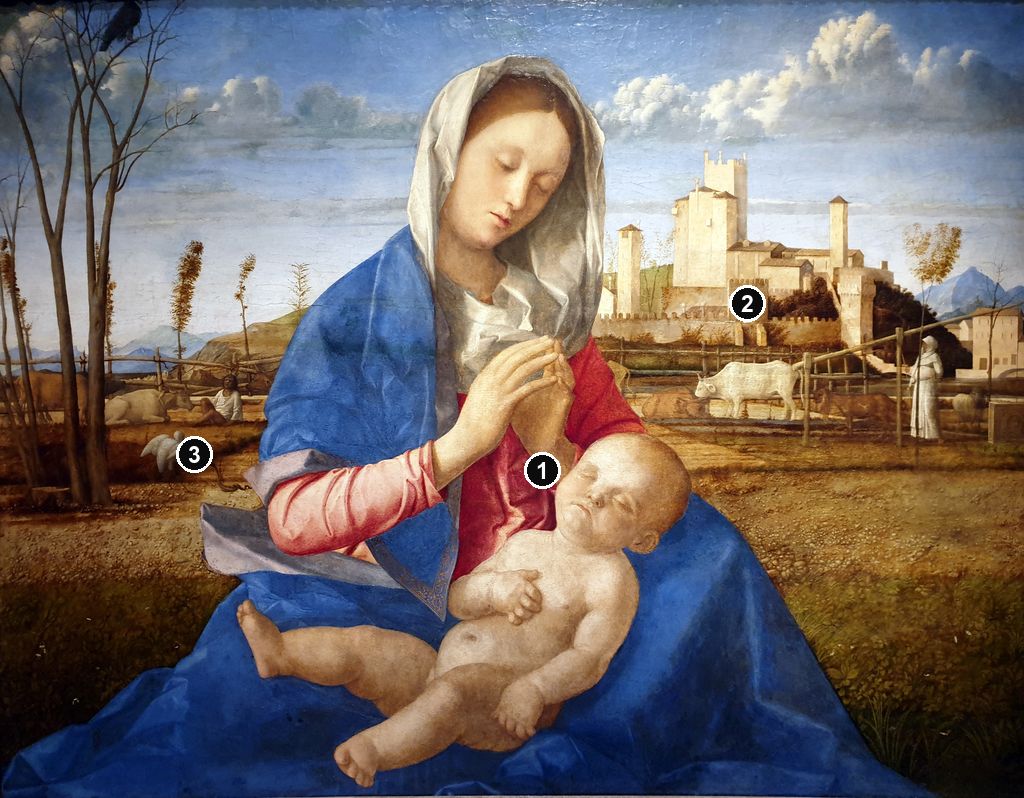
Details from MADONNA OF THE MEADOW
Compare the large devotional figures with the small landscape elements around them.
Mary and the sleeping child
Mary joins her hands just above the child's head. The child rests across a wide spread of blue cloak, with his body angled towards the foreground.
Buildings beyond the meadow
Walls, towers, roofs and a fence give the distant landscape several planes. Light falls across the stone while figures continue with their work below.
The bird and snake
Small figures and animals are scattered around the painting. The pale bird against the foreground grass is one of the details that rewards close viewing.
Related reading
Artworks directory
Discussion
Look again at the images and ideas explored in Madonna del Prato by Giovanni Bellini. These editorial prompts invite your observations.
Reader Insights
Which details in the meadow affect your reading of the sleeping child?
What questions does the painting’s transfer raise about its appearance today?
Which details make the sleeping child part of the open landscape?
Join the Conversation
Share a detail, comparison or question about Madonna del Prato by Giovanni Bellini below.
References
- The National Gallery, Giovanni Bellini, Madonna of the Meadow (NG599), collection record and in-depth entry View source.
- Kunsthistorisches Museum, Ausgleich und Harmonie, on Raphael’s Madonna im Grünen View source.
- The National Gallery, Andrea Previtali, The Virgin and Child adored by Two Angels (NG3111), on the Madonna of Humility View source.
- Christoph Fikenscher, ‘Il paesaggio e la disattivazione del territorio’, inTrasformazione 5, no. 2 (2016), pp. 166–175, on the proposed Feltre setting View source.
- Jaynie Anderson, ‘Edgar Wind and Giovanni Bellini’s “Feast of the Gods”: An Iconographic “Enfant Terrible”’, The Edgar Wind Journal 2 (2022), p. 27, transcribing Wind’s 1950 letter to Kenneth Clark View source.
- Bayerische Staatsgemäldesammlungen, Giovanni Bellini, Maria mit Kind in einer Landschaft (L 2863) View source.
- Andrea Fabbri, ‘Una storia di depauperamento del patrimonio artistico faentino: la vendita della Madonna del prato di Giovanni Bellini alla National Gallery di Londra’, Romagna arte e storia 127 (2024) View source.
- Jill Dunkerton and Marika Spring, ‘Titian’s Painting Technique to c. 1540’, National Gallery Technical Bulletin 34 (2013), p. 8 and fig. 7 View source.
- Staatliche Museen zu Berlin, Mantegna und Bellini, exhibition checklist (2019) View source.
- J. Yang, Giovanni Bellini: Experience and Experiment in Venetian Painting, c. 1460–1516 (doctoral thesis, 1998), p. 151, n. 14, citing Ruhemann View source.
- Jill Dunkerton and Ashok Roy, ‘The Technique and Restoration of Cima’s “The Incredulity of S. Thomas”’, National Gallery Technical Bulletin 10 (1986), p. 24, notes 8 and 10 View source.
- John Mills and Raymond White, ‘Analyses of Paint Media’, National Gallery Technical Bulletin 1 (1977), pp. 57–59, NG599 in table 1 View source.