 by Tom Gurney
Tom Gurney BSc (Hons) is an art history expert with over 20 years experience
Email: tomgurney1@gmail.com / Phone: +44 7429 011000
The Virgin above eight saints
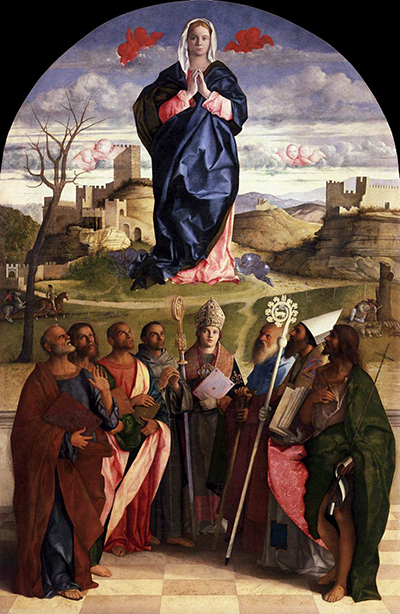
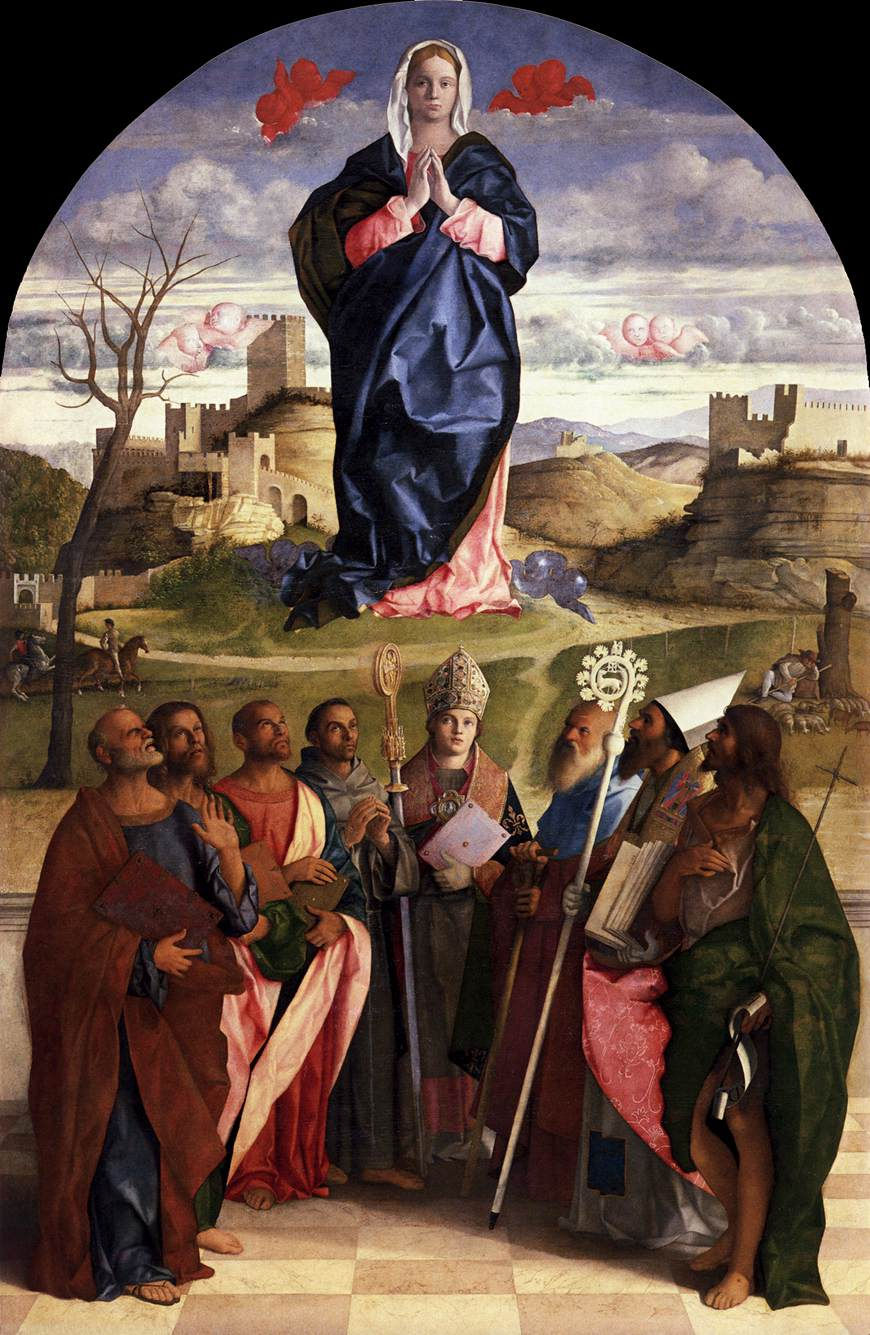
In Giovanni Bellini’s Virgin in Glory with Saints, eight men stand on a tiled pavement while Mary appears high above them, hands joined in prayer. Between the pavement and the clouds lie fortified hills, a winding road and people going about their lives. The large, round-topped oil painting on wood was made for Santa Maria degli Angeli, a church attached to a convent of Augustinian nuns on the Venetian island of Murano. Often called the Madonna in Glory with Eight Saints or the Assumption of the Virgin, the Fondazione Zeri and Venetian Heritage date it to around 1510–15, although recent research has proposed an earlier date. It later moved to San Pietro Martire on the same island and has undergone several periods of conservation. [1] [2] [3] [4]
At a Glance
- ArtistGiovanni Bellini, with workshop participation proposed
- DateAbout 1510–15 in Venetian Heritage; an earlier dating has been proposed
- MediumOil on wood
- Collection or historic siteFormerly Santa Maria degli Angeli, later San Pietro Martire, Murano
The work in Bellini’s career
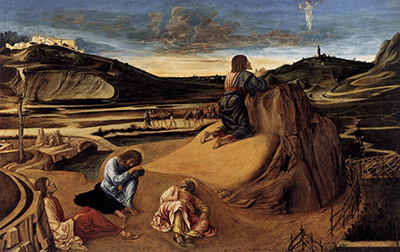
The Agony in the Garden
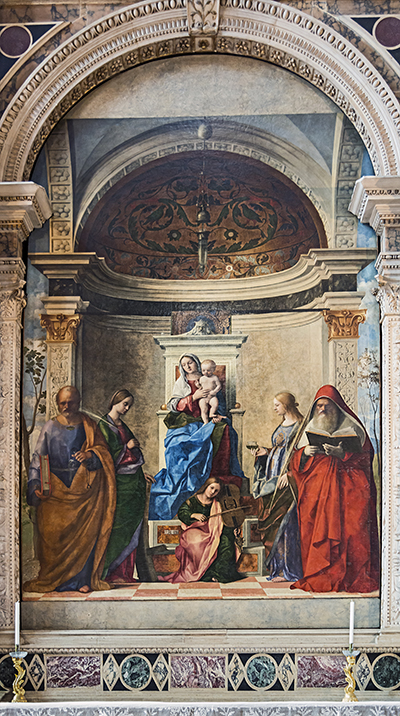
c. 1458–60Presentation at the Temple
c. 1475The Virgin above eight saints
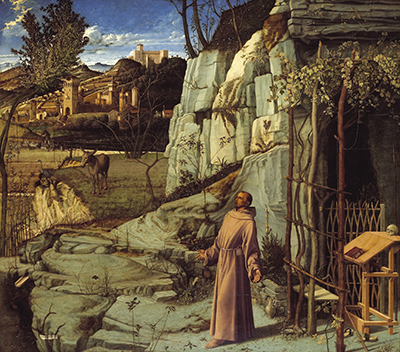
About 1510–15 in Venetian Heritage; an earlier dating has been proposedSt. Francis in the Desert
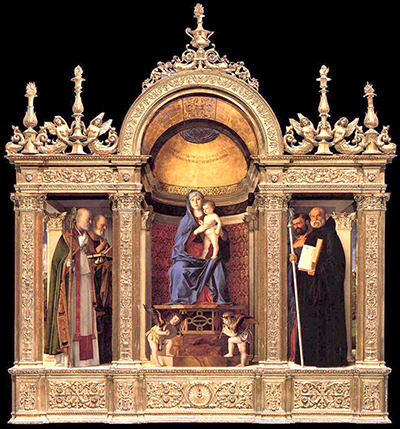
Late 1470sFrari Triptych
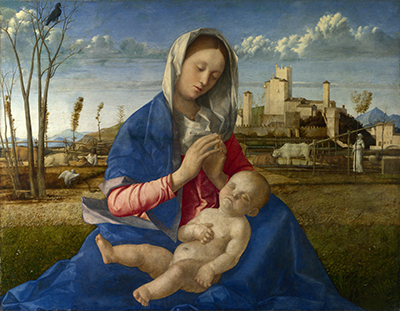
1488Madonna of the Meadow
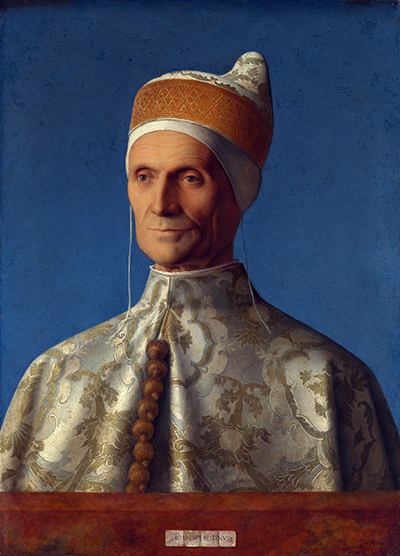
c. 1500–05Doge Leonardo Loredan
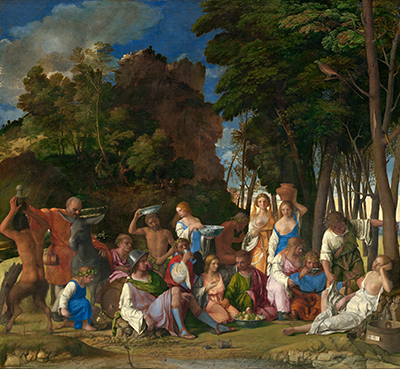
c. 1501–02The Feast of the Gods
Bellini’s signed date 1514From the pavement to the clouds
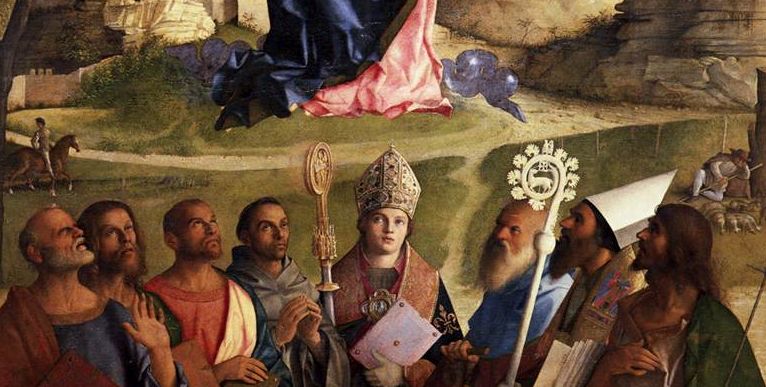
At the bottom of the panel, the tile joints run beneath sandalled and bare feet. The pavement places the group close to the viewer, as though it began immediately beyond the altar. A low wall behind the saints separates that orderly foreground from the fields. In the middle distance the paths curve around hills and disappear behind defences. Two fortified sites sit on opposite sides of the Virgin, with a lower gap between them that opens onto blue hills. The eye can travel a long way into the landscape and still come back to Mary. The dark sweep of her mantle stands out against the pale horizon, and the pink fabric that emerges from beneath it has much the same warmth as the lighter garments below.
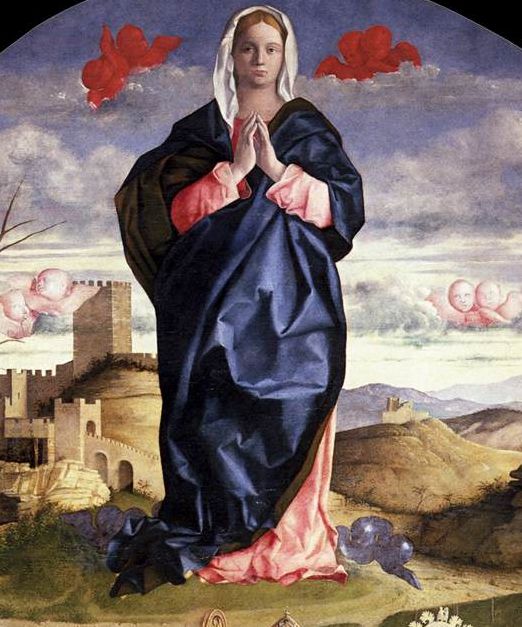
The painting changes pace as the eye rises. The saints press close enough for their books, sleeves and staffs to overlap. Around Mary, broad intervals of cloud separate the winged heads. Those beside her face appear as patches of strong red, while lower down some are pale pink or almost the dusky blue of the sky. Her mantle takes up much of the central space, but her head is small enough to leave a clear arc of sky above it. She holds her palms together at chest height, and the folds of the mantle turn sharply across her body. Those angles give a sense of weight to a figure suspended above the land. The upright bishop immediately beneath her helps carry the centre line down into the group.
A bare tree rises on the left just inside the curve of the panel. Its branches reach into the pale strip of sky, and riders pass below it at a scale that makes the saints seem especially near. On the other side, a figure bends by a flock. Ermanna Panizon includes the altarpiece in her study of the appearance of shepherds in Bellini’s religious landscapes. She observes that such distant figures often carry on with their occupations independently of the sacred event. Here the eye can pass from the intense attention of the saints to the daily work going on a little way behind them. The ordinary country makes the apparition seem all the closer. [5]
Who are the eight saints?
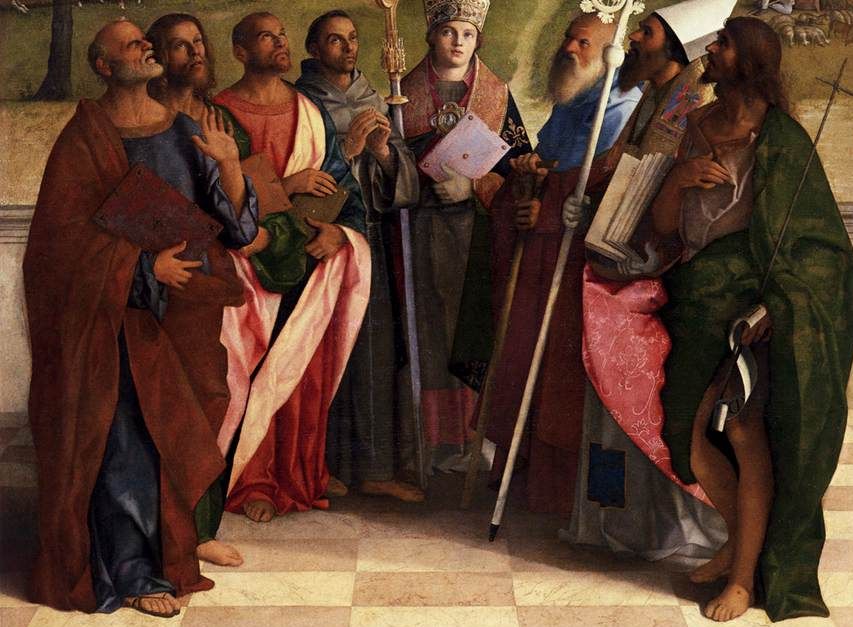
The Fondazione Federico Zeri and the Civico Archivio Fotografico in Milan identify the saints as Peter, John the Evangelist, Mark, Francis of Assisi, Louis of Toulouse, Anthony Abbot, Augustine and John the Baptist. Start in the middle, where the youthful Louis wears a splendid mitre and holds a closed book in front of his chest. Francis at his side wears the plain grey habit of his order, a change in texture from the bishop’s decorated vestments. The bearded ascetic beside Louis is Anthony Abbot. Beyond him are Augustine, in a paler mitre, and the Baptist, whose thin cross and rough tunic are still legible at the right edge. A second bishop in the group matters in this setting. Augustine was the figure through whose rule the nuns of Santa Maria degli Angeli understood their religious community. [2] [3] [6]
The group allows for different ways of attending to what happens above. Heads at the left turn up in succession. Several faces on the right are seen obliquely or in profile, and the near-frontal Louis steadies the composition. Bound books, badges of office and signs of an ascetic life share the same space. Their presence also shapes the meaning of the conventional title Assumption. Among the witnesses are Francis and Louis, who lived many centuries after the Virgin. The tiled foreground serves as a place of assembly for saints from several centuries. Their attention shows a person standing at the altar where to look. Bellini gives the Virgin’s appearance a stillness that allows the eye to linger over the picture at its own pace. [2] [6]
Two Bellinis at Santa Maria degli Angeli
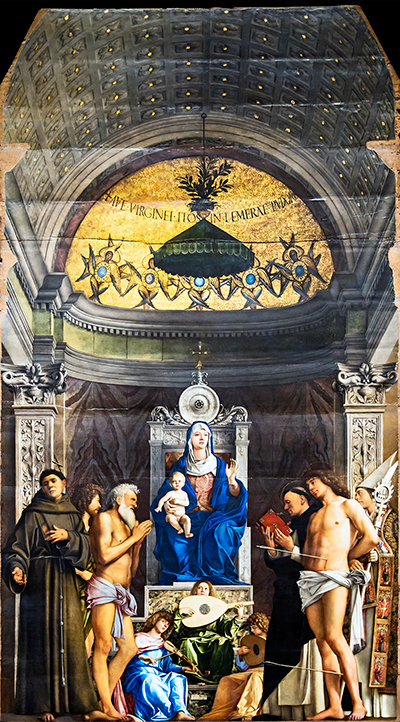
The monastery’s nuns worshipped in a church substantially rebuilt by the end of the fifteenth century. The doge Agostino Barbarigo helped support the monastery in this period, and two of his daughters were nuns there. His will of 1501 assigned the large canvas that Bellini had painted in 1488 to the high altar. In that picture, now known as the Barbarigo Altarpiece, the doge kneels before an enthroned Virgin and Child. Saints Mark and Augustine help present him. The canvas is broad enough to lay out the encounter from side to side, with music-making angels at the throne. In the tall panel, Mark and Augustine belong to a larger company and the space directly beneath Mary is occupied by the youthful bishop Louis. The vertical interval between the Virgin and the saints sets the terms of their encounter. [3] [4]
The original placement of Virgin in Glory matters because both paintings subsequently became associated with San Pietro Martire. A 2017 exhibition essay published by the Gallerie dell’Accademia connects the panel with the high altar at Santa Maria degli Angeli. More recent archival work by Emanuele Castoldi assigns the 1488 canvas to that altar and includes the Virgin in Glory among the first paintings made expressly for the new church’s side altars. In his University of Verona research, Castoldi also proposes that Andriana di Lorenzo Michiel, sister of the cardinal Giovanni Michiel, may have commissioned it. The proposed patron is a hypothesis. The surviving evidence for the doge’s bequest is specific to his votive canvas. [3] [4] [7]
The date and the workshop
The Fondazione Zeri and Venetian Heritage both place the panel around 1510–15. Castoldi proposes 1502–04 on historical and stylistic grounds. That earlier dating changes the relationship to Lorenzo Lotto’s 1506 altarpiece at Asolo, where Mary appears above Anthony Abbot and Louis of Toulouse, two of the same saints. Both paintings set the Virgin against open sky and admit a view of the country below. Lotto gives her two witnesses to address. The Murano altarpiece sets her above a crowd and leaves more room for each saint to register the apparition in his own way. The resemblance is close enough that Marco Tittarelli describes the Murano composition as a model for Lotto. The still-debated dating of the panel makes the direction of any borrowing harder to establish than the visual connection. [1] [2] [4] [8]
Bellini approached the relationship between Mary and the saints differently in his signed and dated San Zaccaria Altarpiece of 1505. There the Virgin and Child sit within a painted apse, and the saints occupy the same sheltered space as the throne. At Murano the saintly assembly and the Virgin are linked across an open landscape. Titian’s Assumption, unveiled at the Frari in 1518, offers another way to make a tall altarpiece work at church scale. There the apostles’ reaching bodies and the sweep of the cloud carry the action upwards. The Murano painting relies much more on the brief upward turns of heads, the central figure’s poised stillness and the clear air around her. A smaller Assumption by Palma Vecchio, for which he was paid in 1513, builds the encounter around one visible action. Mary loosens the belt of her dress, invoking the legend that she gave it to Thomas as proof of her ascent. [9] [10] [11]
The painting’s attribution varied even when it could be seen in the church. Bernard Berenson listed it under Marco Basaiti, while a French-language supplement to the Anderson photographic catalogue in 1921 offered a detail under Bellini’s name. An early Alinari print catalogued in Milan carries Bellini’s name with a question mark. [6] [12] [13]
Venetian Heritage gives the work to Giovanni Bellini, the 2017 Accademia exhibition essay names Bellini and collaborators, and the University of Hamburg’s photographic archive describes it as a product of the Bellini workshop. These descriptions differ in how much of the work they assign to Bellini. The pronounced differences between the small figures in the distance, the densely clothed saints and the isolated Virgin can all be observed in the picture. Assigning any of those passages to a particular painter would require further evidence. [1] [7] [12] [14]
From Murano to the conservation studio
During the Napoleonic suppressions, the contents of Santa Maria degli Angeli were dispersed from 1806. The panel moved to nearby San Pietro Martire, where an Alinari photograph documented by Milan’s civic archive places it around the beginning of the twentieth century. Chronic damp in the church harmed the paint surface. In the 1980s the panel was taken to the Gallerie dell’Accademia in Venice and kept lying flat in its storage and laboratory facilities. That is a documented period in the museum’s care. [1] [6]
On 6 October 2016 the city of Venice recorded the presentation of the restored panel at the Museo Diocesano for Luce su Giovanni Bellini, an initiative marking five centuries since Bellini’s death. A further conservation campaign began in March 2018 with the Opificio delle Pietre Dure in Florence, under the direction of Venice’s heritage authority and with funding from Venetian Heritage. The project account describes a paint layer that responds badly to changes in humidity and climate, possibly because of weakness at the interface between the wood and the paint. The possibility matters because caring for the surface depends partly on what lies beneath it and on the conditions in which the large wooden support will eventually be displayed. The project is listed as ongoing, and Castoldi’s recent published study locates the panel at the Opificio. Its two Murano churches, the Accademia facilities and the temporary diocesan exhibition each belong to a different stage of its history. [1] [3] [15] [16]
Annotated Details from Virgin in Glory with Eight Saints
Numbered overview and cropped details. Photograph Web Gallery of Art reproduction via Wikimedia Commons. Image source. Public Domain Mark 1.0.
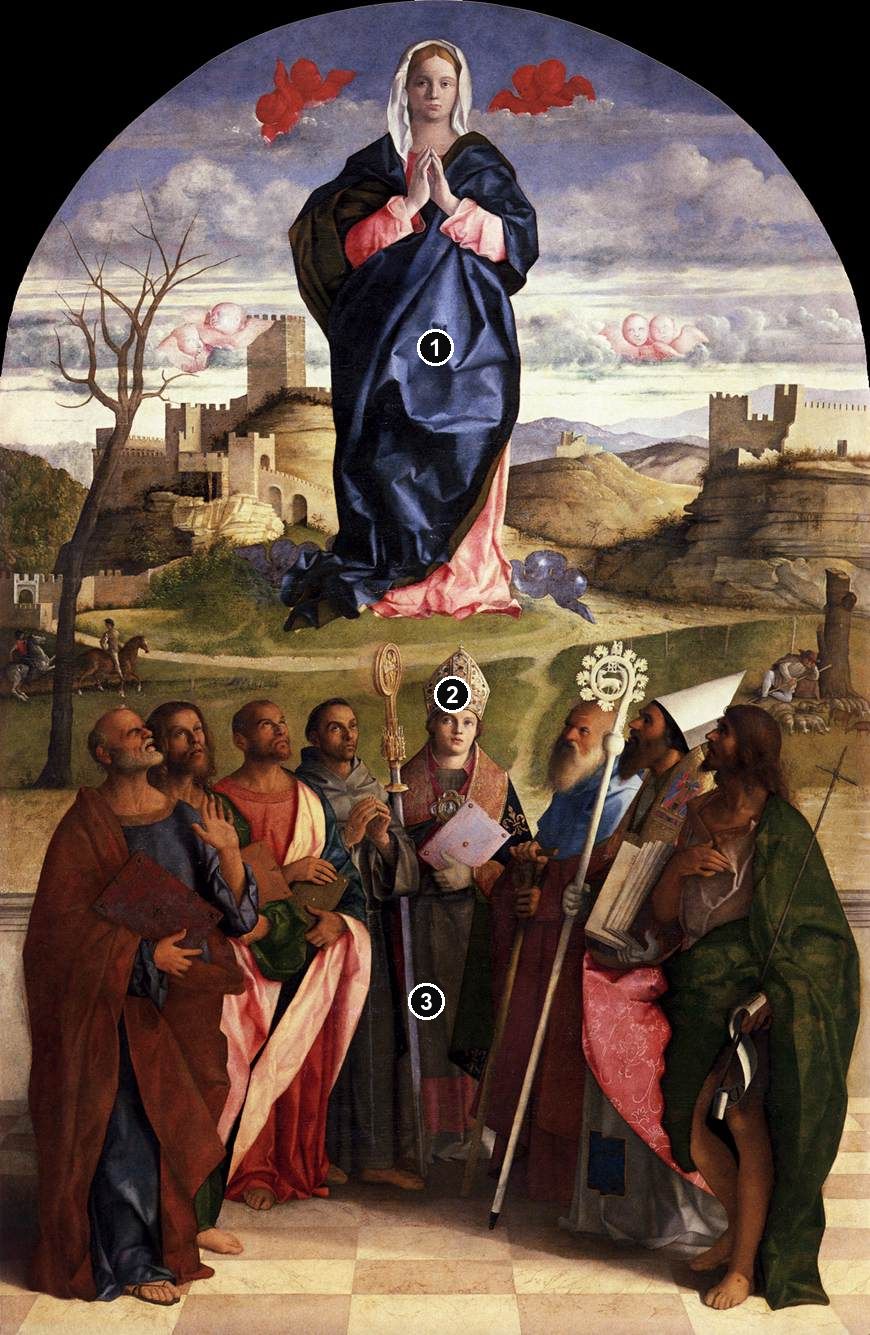
Details from VIRGIN IN GLORY WITH EIGHT SAINTS
The vertical picture separates the Virgin’s appearance from the gathering of saints across the foreground.
The Virgin among clouds
The Virgin’s dark blue gathers into one long shape. Small figures and cloud forms spread around the upper part of the panel.
The horizon between the registers
Water and low buildings cross between the two groups. Their diminished scale sets off the saints closest to the viewer.
The saints in the foreground
The gathered figures can be followed from the bright vestments on the left to the deeper reds and greens at the right.
Related reading
Artworks directory
Discussion
Look again at the images and ideas explored in Virgin in Glory with Saints. These editorial prompts invite your observations.
Reader Insights
How does the tiled pavement establish a relationship between the saints and the viewer?
How does the original convent setting help explain the choice of saints?
How does the strip of landscape connect the saints to the appearance above them?
Join the Conversation
Share a detail, comparison or question about Virgin in Glory with Saints below.
References
- Venetian Heritage, conservation project for Madonna in Glory with Eight Saints. View source.
- Fondazione Federico Zeri, University of Bologna, work record 25811 and associated Anderson photograph. View source.
- Emanuele Castoldi, Un’inedita ‘cappella Barbarigo’ o del presbiterio di Santa Maria degli Angeli di Murano, pp. 37–51, especially p. 43 and note 20. View source.
- Emanuele Castoldi, Santa Maria degli Angeli di Murano: storia, arte, architettura (1400–1537), University of Verona, public doctoral abstract, 2025. View source.
- Ermanna Panizon, La malinconia nelle immagini pastorali del Rinascimento veneto, 2018, introductory discussion and note 3. View source.
- Civico Archivio Fotografico di Milano, Alinari photograph RI 17839, SIRBeC record. View source.
- Claudia Caramanna, Veronese per Santa Maria degli Angeli a Murano, Gallerie dell’Accademia exhibition essay, 2017. View source.
- Marco Tittarelli, I cinquecento anni della Pala Gozzi di Tiziano, pp. 320–21, fig. 4 and note 9. View source.
- Chorus Venezia, Madonna in trono con santi, San Zaccaria, 1505. View source.
- Save Venice, Titian’s Assumption of the Virgin in the Basilica dei Frari, conservation and history. View source.
- Italian national heritage catalogue, Palma Vecchio’s Assumption of the Virgin, record 0500401191. View source.
- Bernard Berenson, The Venetian Painters of the Renaissance, index entry under Marco Basaiti, Project Gutenberg transcription. View source.
- Anderson photographic catalogue supplement, 1921, entry 22499, digitised by the Kunsthistorisches Institut in Florenz. View source.
- University of Hamburg, Kunstgeschichtliches Seminar photographic archive, Maria Himmelfahrt in der Diskussion. View source.
- Comune di Venezia, presentation of Luce su Giovanni Bellini and exhibition at the Museo Diocesano, 6 October 2016. View source.
- Opificio delle Pietre Dure, Luisa Gusmeroli, conservation staff profile and treatment credits. View source.