 by Tom Gurney
Tom Gurney BSc (Hons) is an art history expert with over 20 years experience
Email: tomgurney1@gmail.com / Phone: +44 7429 011000
The altarpiece in San Zaccaria
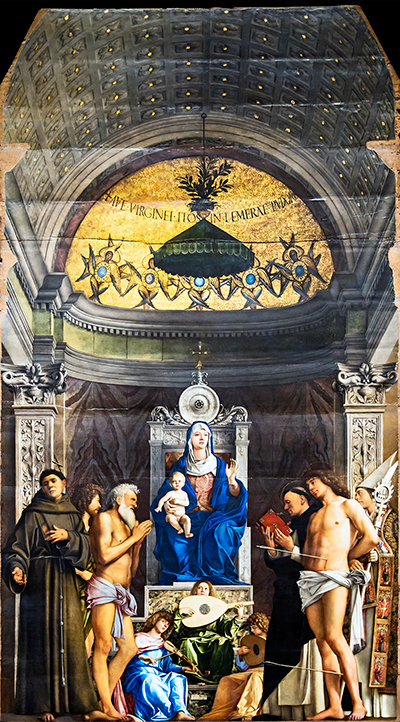
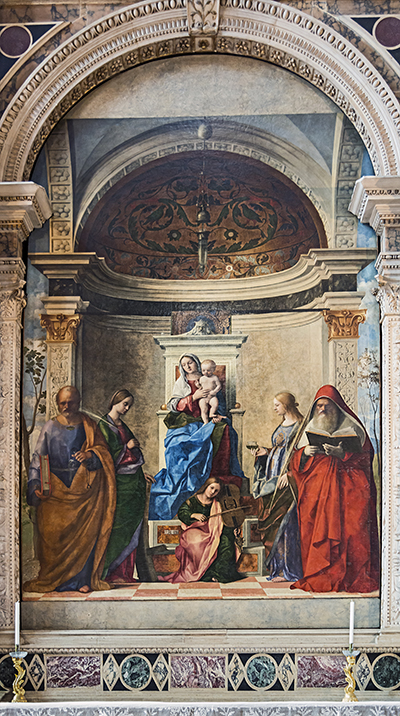
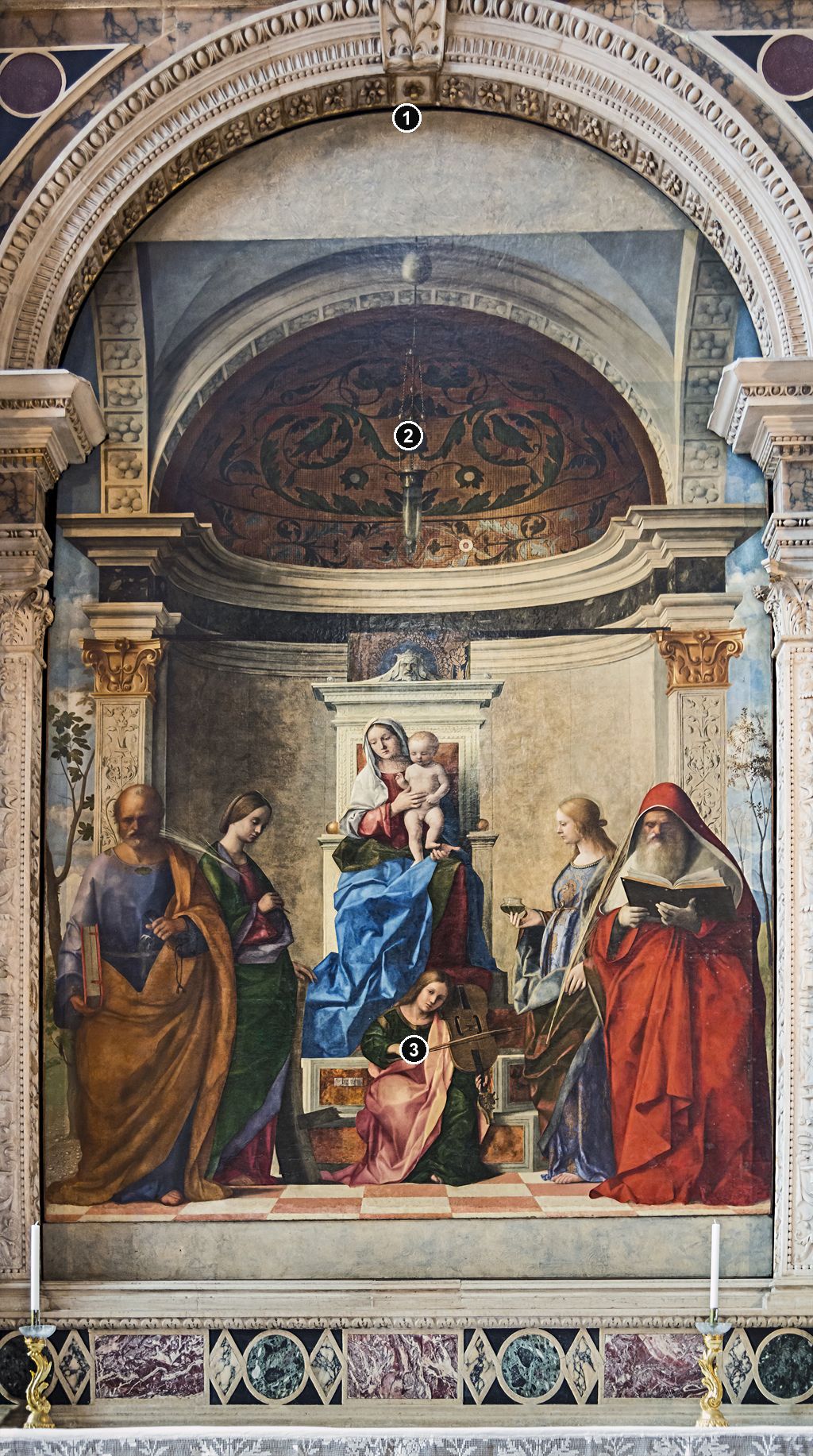
Giovanni Bellini signed and dated the San Zaccaria Altarpiece in 1505 on a small painted slip of paper at the foot of the Virgin’s throne. To see the whole work, look beyond the edge of the painting. At the second altar on the left in the church of San Zaccaria in Venice, a carved stone arch makes way for another arch that Bellini painted. Real columns, mouldings and marble lead into an imagined chapel where the Virgin and Child sit among four saints and an angel plays a bowed instrument. The picture was made for this altar and is back there today after an enforced stay in Paris. [1] [2] [3]
The painting bears the Latin signature Joannes Bellinus and the date MCCCCCV. The little slip, called a cartellino, sits low on the steps, to the viewer’s left of the angel. It places the painter’s name inside the fiction of the chapel, in a spot that can easily escape notice between the marble facing and the musician’s sleeve. The central figure carries no such label. The Virgin’s height, the canopy above her and the blue of her mantle establish her place as soon as the viewer looks up. [1] [2]
At a Glance
- ArtistGiovanni Bellini
- Inscribed date1505
- LocationChurch of San Zaccaria, Venice
- SubjectEnthroned Virgin and Child with four saints and a musician angel
The work in Bellini’s career
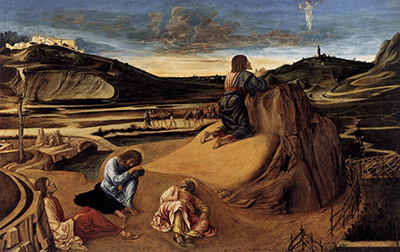
The Agony in the Garden
c. 1458–60Presentation at the Temple
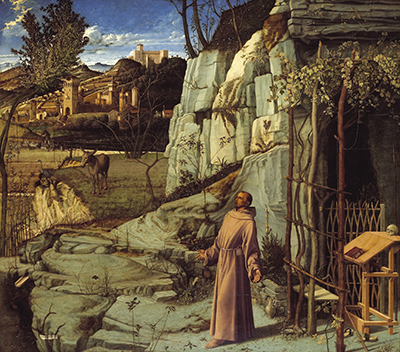
c. 1475St. Francis in the Desert
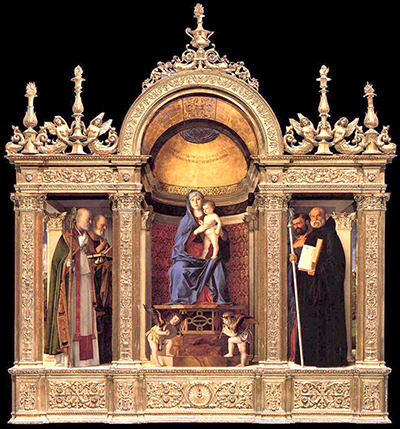
Late 1470sFrari Triptych
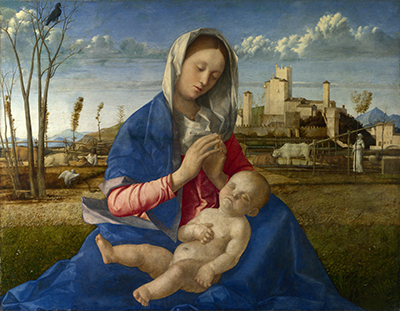
1488Madonna of the Meadow
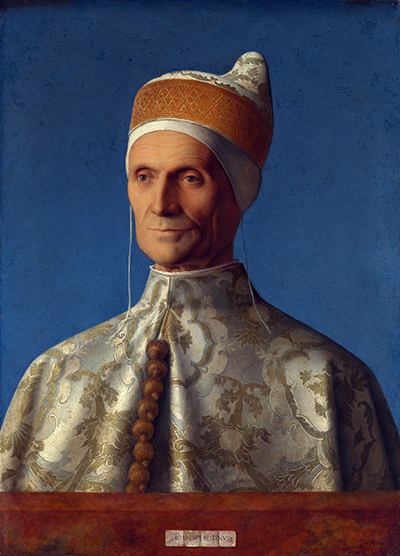
c. 1500–05Doge Leonardo Loredan
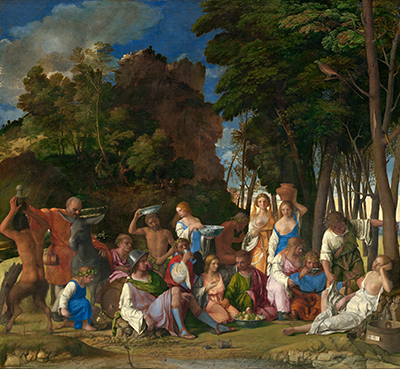
c. 1501–02The Feast of the Gods
Bellini’s signed date 1514Where the church becomes part of the painting
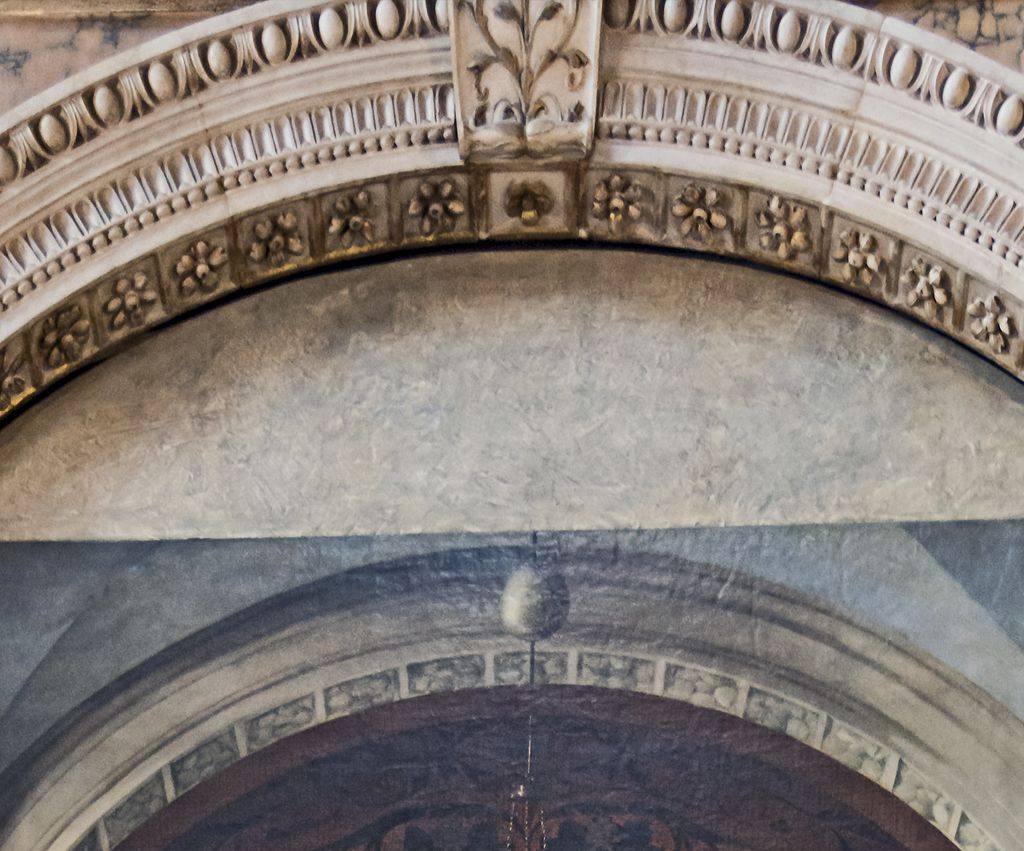
Begin at one of the pale carved capitals of the real altar and follow the mouldings towards the centre. A similar sequence appears within the picture, beginning with the painted arch and the richly decorated uprights. The eye moves from stone that projects into the church to marble surfaces that recede in paint. The real altar table is beneath both. At the bottom of the scene, the red and pale floor tiles establish a level for the saints’ feet, while the steps carry the eye back and upward into the space of the throne. An image cropped to the paint surface loses the first part of this movement. [1] [4]
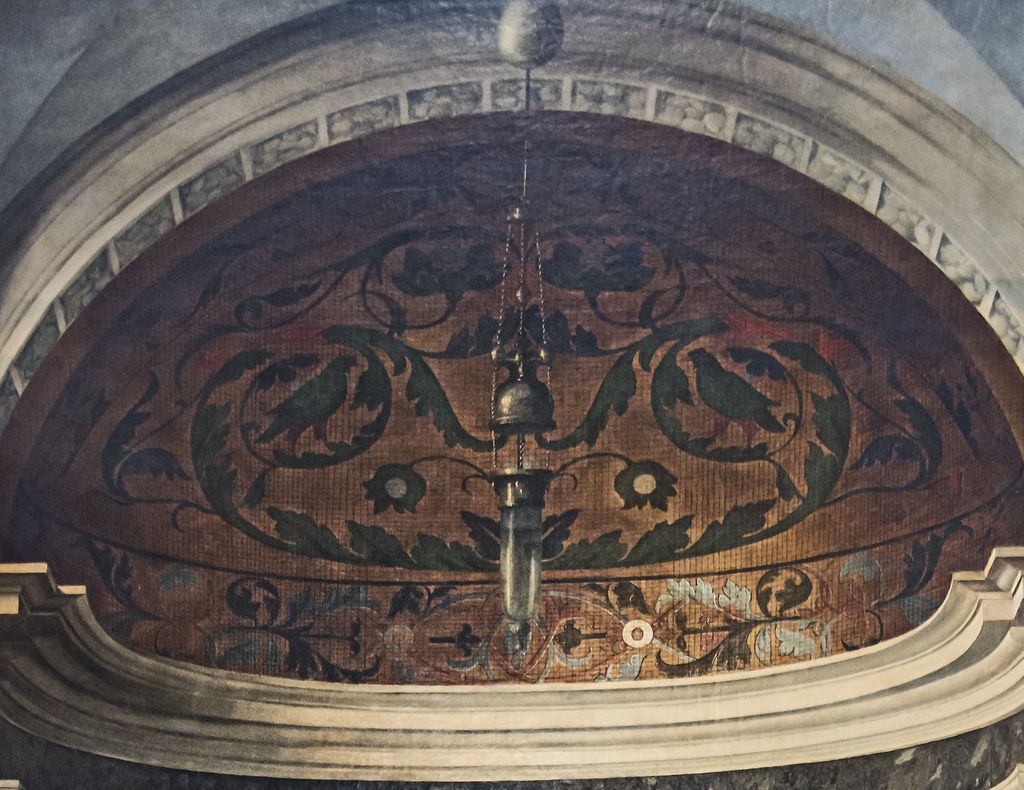
The painted chapel is built in successive layers. Decorated supports give way to a deep curving cornice and the half-dome of the apse. Above the enthroned Virgin, dark leafy scrolls spread across a warm mosaic field. Its curve gathers up the symmetry of the figures below. A real stone surface and a painted one can be similar in outline yet behave very differently in the light. The stone casts its own shadow, while the highlights and shadows Bellini put on his cornice stay in place as the light in the church changes. The illusion depends on how readily the eye accepts the two together. [1] [4]
Chorus, the association for the churches of the Venetian Patriarchate, locates the convergence of the main perspective lines around the musician’s head. The angel sits close to the threshold of the scene, where the relatively low viewpoint allows the undersides of the painted mouldings to remain visible. Art historian Ikumi Kita proposes a more complex reading of the perspective. In her reconstruction, different sets of receding lines imply two viewing heights. She relates them to the experience of standing and kneeling before an altar in worship. The hypothesis gives a practical reason to consider the picture from more than one level, even though the painter’s intentions cannot be recovered directly from the geometry. [1] [5]
The Virgin, the saints and the musician
The painting is a sacra conversazione, or sacred conversation, in which Mary and the Christ Child occupy a common space with saints who lived at different times. Their association is devotional. Bellini gives each a different way of inhabiting the shared space. Mary bows her head and supports the Child across the waist. He shifts his weight and lifts one foot, a detail that Chorus reads as an allusion to the Resurrection. High on the throne there is a small sculpted face, which Chorus identifies as King David, the biblical ancestor of Christ. The intimate turn of mother and child stays legible even under an imposing architectural canopy. [1] [4]
On the viewer’s left, Saint Peter carries keys and a closed book. His ochre cloak swings in broad folds around a darker blue garment. Across the throne, Saint Jerome, in a red mantle, bends over an open volume. Peter’s keys mark his office, while Jerome’s reading evokes his labour as a biblical scholar. The large blocks of ochre and red also lead the eye inwards. Peter and Jerome stand nearer the lower edge than the two women, creating a shallow gap into which the throne and the angel fit. The alternation of books open and shut, hands active and still, and faces turned through different angles keeps the arrangement from becoming a row of matching figures. [1] [2] [4]
Saint Catherine of Alexandria stands just inside Peter. Look low, where a segment of her broken wheel appears beside the steps. She also carries a martyr’s palm. On the right, the fair-haired woman turns towards the throne and holds up a small vessel, with a palm angled across the group. The Fondazione Federico Zeri and the Istituto Nazionale di Studi sul Rinascimento catalogue her as Saint Lucy. Technical researchers Gianluca Poldi and Giovanni Carlo Federico Villa call her Saint Ursula. Chorus lists Ursula, Mary of Bethany and Saint Agatha as possibilities. The outline and sheen of the vessel are easier to see than any feature that would settle the name. Saint Lucy is therefore a conventional identification, with a genuine question about the attribute. [1] [2] [6] [7]
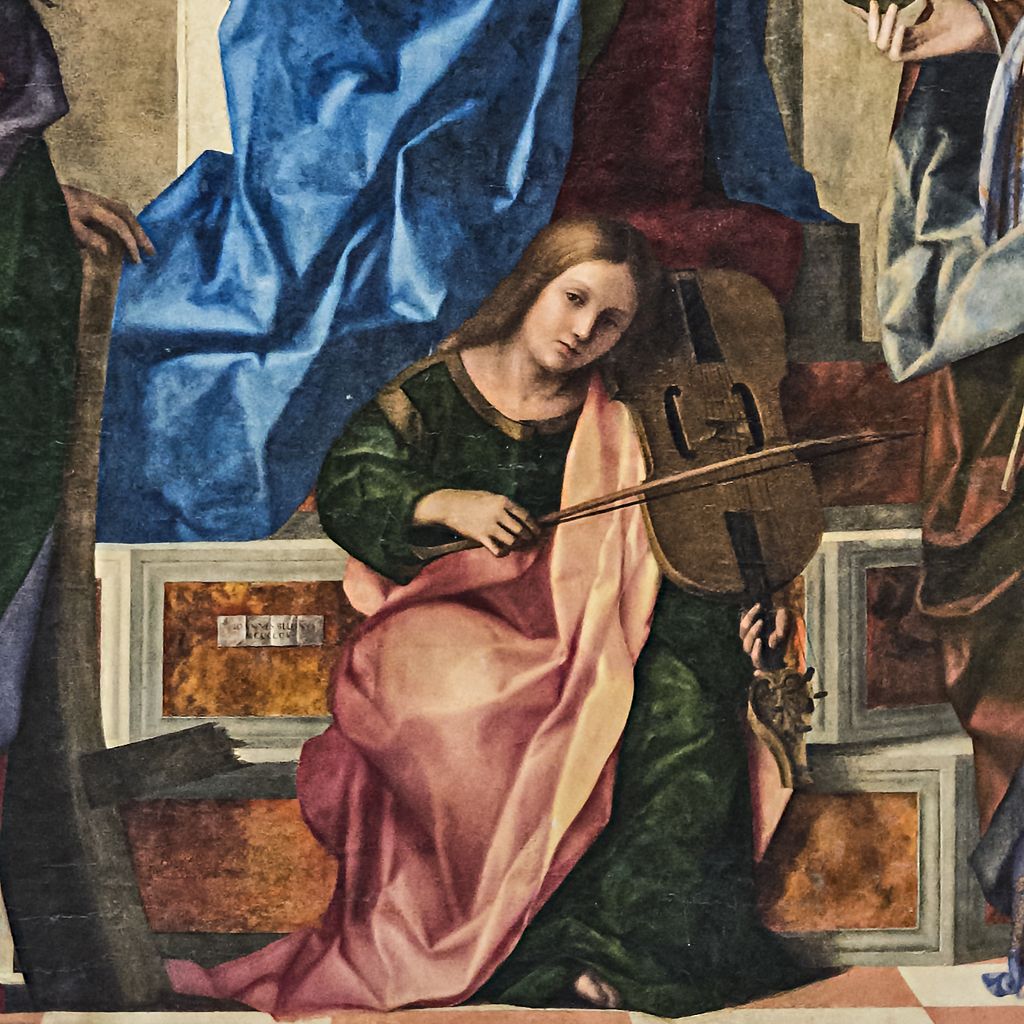
At the bottom of the throne an angel draws a bow across a lira da braccio, a Renaissance stringed instrument. The bow cuts diagonally across the upright throne and the near-horizontal join of the steps. The player’s head tilts towards the instrument, and the long fold of rose-coloured cloth drops towards the tiles. The small action is the most plainly timed event in the scene. The book in Jerome’s hands might remain open indefinitely, but the bow is in the middle of a stroke. Positioned between the level of the congregation and that of the Child, the musician gives a viewer a place to dwell before looking further up. [1] [4]
Landscape, light and the painted surface
The most conspicuous departures from a closed chapel are two narrow openings at the left and right. Pale sky and vegetation appear beside the ornamented supports. The openings are easy to miss if the eye goes straight to the Virgin, yet they change the character of the stone interior. A leafy branch on the left and finer branches on the right give the edges a different depth from the crisper vertical architecture. Scholar Hans Aurenhammer situates these glimpses within a Venetian tradition in which built space generally kept its primacy over landscape in large sacred conversations. At San Zaccaria Bellini gives the glimpses room to make a difference while keeping the figures within the shelter of the apse. [1] [8]
The light changes as it crosses the group. Peter’s face and the stone behind him are relatively dusky, while the Child’s shoulder, the Virgin’s veil and the folds of her blue mantle hold passages of clearer light. Jerome’s hood frames a shadowed face over the pale edges of the open book. The darker zones keep the illuminated parts of the painting from appearing evenly washed. Jeongmu Yang draws attention to the impression of natural light falling from the upper left and relates the effect to the picture’s position in the church. Chorus suggests that Giorgione’s Castelfranco Altarpiece may have stimulated Bellini’s use of a natural setting. The paintings make a productive comparison even with the direction of influence uncertain. At San Zaccaria the landscape registers as something outside a still-dominant architecture. [1] [8] [9] [10]
Up close the apparent softness coexists with carefully marked differences of substance. The light along the vessel’s lip is small and sharp. The palms and the strings are slender lines, while faces turn into shadow over broader intervals. Poldi and Villa include infrared details of Mary’s face, her hands, the right-hand saint’s hand and Peter’s cloak in their examination. The physical evidence is more varied than the overall calm suggests. In the right-hand saint’s garment, Poldi draws attention to small, scattered applications of lead white that enliven the surface. Bellini could bring figures into the same atmosphere while giving a textile, a face and a carved surface different sorts of edges. [2]
The convent and the question of the commission
San Zaccaria was home to a Benedictine community whose nuns helped pay for and administer works of art. Gary M. Radke’s study of the fifteenth-century convent draws together accounts, chronicles, liturgical books and inscriptions. Those records show the nuns acting on commissions and putting significant resources into them, even where outside donors or public support contributed. The picture’s scale, fixed place and carefully coordinated architecture all make sense in an institution accustomed to organising complex projects. The commission for the altarpiece nevertheless remains uncertain. The signature identifies the painter and year, and the fit of picture and altar helps establish the intended site. Funding and choice of saints require different evidence. [1] [11]
Carlo Ridolfi discussed the work in Le maraviglie dell’arte, published in 1648. He praised the panel. The later tradition connecting it with the memory of the Venetian patrician Pietro Cappello is usually traced to that account. His account belongs to the seventeenth-century history of the painting’s reputation, written well over a century after its date. The Cappello story poses a chronological problem if read as a commission to commemorate a dead man. The Pietro Cappello associated with the story was still recorded in Venetian political life at the election of Andrea Gritti in 1523. Ridolfi’s account and the later evidence leave the identity of the commissioner, and who chose the particular saints, open. [4] [12] [13]
The chapel of San Tarasio, in the older part of the same church complex, gives a sense of the artistic setting in which the nuns operated. There, among surviving frescoes and carved frames, large fifteenth-century polyptychs divide their saints into separate compartments. Their date and location help explain the significance of Bellini’s solution in the newer church. Here a single picture and its architectural surround organise bodies and gestures into a common scene, even as the elaborate frame and simulated mosaic carry forward the richness of the earlier furnishings. [1] [14]
The church also had a prominent civic life. An etching of 1766 in the Rijksmuseum depicts the doge and his entourage at San Zaccaria on Easter Sunday, when the procession came from San Marco for vespers. It gives a later view of the church’s ceremonial role and shows the façade through which visitors reached the interior. Its subject and date belong to the later history of the site. [21]
The journey to Paris and the return to Venice
French forces took the altarpiece in 1797 during the Napoleonic requisitions. An early French exhibition notice, published in the year VII of the Republic, mentions a major Bellini newly acquired from San Zaccaria. It says the condition of the picture prevented its inclusion in the provisional exhibition. A later illustration and description in the Annales du musée documents the picture’s presence in the Paris collection. That writer even proposed that the book-holding figure now identified as Jerome was a pope named Zachary, a sign of how differently the painting could be interpreted in Paris. Accounts give 1815 or 1816 for the return. In the picture’s absence, a Madonna and Child with Saints by Palma Vecchio served at the altar. Chorus records that this substitute moved to the chapel of Sant’Atanasio in 1817. [3] [4] [9] [15] [16] [22]
The move altered the physical object. Originally an oil painting on wood, it was transferred to canvas in Paris. Poldi and Villa describe the transferred canvas as subsequently applied to a panel, which helps explain why the present church record’s short medium field gives only oil on panel. Chorus also records that the upper part of the depicted vault was cut away in the nineteenth century. Sources describe losses at the lower edge as well. The upper loss is especially legible today. An ostrich egg hangs at the top of the surviving image, with the visible part of the suspended arrangement running down towards the lamp in front of the mosaic. Chorus reads the egg as a sign of Mary’s virginity. Its apparent detachment from the section of architecture above belongs to the picture’s altered state. The egg also invites comparison with Piero della Francesca’s Montefeltro Altarpiece in the Brera, where the surviving shell vault shows the attachment from which the egg is suspended. The Brera relates Piero’s motif to both the Virgin’s miraculous maternity and the Montefeltro family’s heraldry. The analogy helps recover a visual relationship lost at San Zaccaria, while the two settings give the motif different associations. [1] [2] [4] [9] [23]
The return began another chapter in the painting’s conservation. Documents studied by Sara Filippin record a dispute in 1851 about the difficulty of seeing it. The Venetian Academy’s painting commission blamed coloured glazing for reducing and tinting the light, while the church authorities blamed varnish applied in Paris. The church also pointed to its accommodation of Felice Schiavoni, who had been allowed to copy the altarpiece for the Russian emperor in a more convenient location. The painting went to the Academy for restoration in 1852, and the records trace Alberto Andrea Tagliapietra’s treatment and its reinstallation the following year. The changing windows and varnish give a concrete reason for caution about how Renaissance viewers would have experienced Bellini’s painted light. [17]
Twentieth-century work added another layer of documentation. Chiara Guadagnini’s research into the restorer Antonio Lazzarin records his estimate in 1971, commissioned by the Venetian heritage authority, and the use of stratigraphic samples and colour photography in the preparations. Yang dates modern restoration to 1976. These studies help separate the intervention in Venice from the earlier transfer away from the original wood. In front of the painting, the difference between the present marble surround and the altered edges of the image is part of what can now be seen. [9] [18]
San Giobbe, the Frari and the San Zaccaria setting
The altarpiece also gave other painters a composition they could adapt. The Pushkin State Museum’s catalogue traces the motif of its Madonna and Child in a Niche back to San Zaccaria and cites Francesco Vecellio’s use of it for an altarpiece in Belluno. The Hermitage identifies a relationship with both Bellini’s painting and Giorgione’s Castelfranco Altarpiece in Boccaccio Boccaccino’s altarpiece for San Giuliano. These comparisons concern the transmission of a design. The setting at San Zaccaria still lets a visitor see how closely that design could be bound to the material of one church. [24] [25]
The San Giobbe Altarpiece is the closest earlier comparison for an enthroned Virgin, music-making angels and an illusionistic apse. The Gallerie dell’Accademia, where it is now housed, dates it between 1478 and the later 1480s and records that its stone surround remains at San Giobbe. Its six saints and three angels make the interior denser. San Zaccaria uses four saints and one player, admits daylight and glimpses of landscape through the sides, and can still be seen over its intended altar. These differences matter when comparing the two works in photographs, where the relationship to each church can disappear. [1] [8] [9] [19]
The Frari Triptych of 1488 offers a third arrangement. In the sacristy of Santa Maria Gloriosa dei Frari, its monumental wooden frame divides the panels even as the painted architectural forms tie them together. There, Bellini works with both the divisions of a triptych and the suggestion of shared space. At San Zaccaria the carved frame works chiefly at the outer edge, where the painted arch folds the viewer’s attention into a single scene. The easiest place to test the effect is below the musician. Follow the tiles and the steps up through the blue mantle and then look sideways, to where real stone gives way to Bellini’s painted light. [1] [4] [20]
Annotated Details from San Zaccaria Altarpiece
Numbered overview and cropped details also licensed under CC BY-SA 4.0. Photograph Didier Descouens via Wikimedia Commons. Image source. CC BY-SA 4.0.
Details from SAN ZACCARIA ALTARPIECE
The details keep the real framing architecture and the space Bellini painted in view.
The outer arch
The patterned stone arch belongs to the church. The darker curved opening visible below it introduces the architecture painted inside the picture.
The painted apse
The vault is patterned like a mosaic. Its sweep over the figures makes the shallow support appear to open into a room.
The musician below the throne
The angel bends over an instrument at the foot of the throne. The low position makes the figure a bridge between the standing saints and the space immediately in front of the altar.
Related reading
Artworks directory
Discussion
Look again at the images and ideas explored in San Zaccaria Altarpiece by Giovanni Bellini. These editorial prompts invite your observations.
Reader Insights
Where does the physical stone frame end and Bellini’s painted architecture begin?
How does the angel’s position change the scale of the figures above?
How does the musician establish the scale of the chamber around the saints?
Join the Conversation
Share a detail, comparison or question about San Zaccaria Altarpiece by Giovanni Bellini below.
References
- Chorus, “Madonna Enthroned with Saints”, artwork and location record View source.
- Gianluca Poldi and Giovanni Carlo Federico Villa, Indagando Bellini, pp. 102–109 and the discussion of lead white View source.
- Bianca Carraro, “Le spoliazioni napoleoniche a Venezia”, University of Padua repository abstract View source.
- Ika Matyjaszkiewicz, “Human – Absolute – Painting”, Series Byzantina 12, pp. 66–69 View source.
- Ikumi Kita, conference abstract on spatial representation in the San Zaccaria Altarpiece, Japan Art History Society View source.
- Fondazione Federico Zeri, University of Bologna, artwork record 27425 View source.
- Istituto Nazionale di Studi sul Rinascimento, detail of the right-hand female saint, Fototeca record View source.
- Hans Aurenhammer, study of architecture and landscape in Venetian altarpieces, Heidelberg University Library View source.
- Jeongmu Yang, Giovanni Bellini: Experience and Experiment in Venetian Painting, University College London, ch. 6 View source.
- Terisio Pignatti, “Bellini, Giovanni, detto Giambellino”, Dizionario Biografico degli Italiani View source.
- Gary M. Radke, “Nuns and Their Art: The Case of San Zaccaria in Renaissance Venice”, Renaissance Quarterly 54 (2001), pp. 430–459 View source.
- Carlo Ridolfi, Le maraviglie dell’arte, part I, “Vita di Giovanni Bellino”, first published 1648 View source.
- Gino Benzoni, “Gritti, Andrea”, Dizionario Biografico degli Italiani, on the election of 1523 View source.
- Chorus, Museum and Crypt of San Zaccaria, San Tarasio Chapel and polyptychs View source.
- Muséum Central des Arts, Notice des principaux tableaux recueillis en Italie, year VII, entry 9 and note View source.
- Charles-Paul Landon, Annales du musée et de l’école moderne des beaux-arts, vol. 15, plate 10 and notice View source.
- Sara Filippin, University of Padua, analysis and transcription of Venetian archival documents A.32–A.34 View source.
- Chiara Guadagnini, University of Padua, research on Antonio Lazzarin, p. 13, n. 24 View source.
- Gallerie dell’Accademia di Venezia, San Giobbe Altarpiece, collection record View source.
- Basilica dei Frari, research and conservation project for Bellini’s 1488 triptych View source.
- Rijksmuseum, Giovanni Battista Brustoloni, the Doge and his entourage at San Zaccaria on Easter Sunday, 1766 View source.
- Chorus, Palma Vecchio’s “Madonna and Child with Saints”, substitute altarpiece View source.
- Pinacoteca di Brera, Piero della Francesca’s Montefeltro Altarpiece, collection record View source.
- Pushkin State Museum of Fine Arts, “Madonna and Child in a Niche”, Italian painting catalogue View source.
- State Hermitage Museum, catalogue entry on Boccaccio Boccaccino View source.