 by Tom Gurney
Tom Gurney BSc (Hons) is an art history expert with over 20 years experience
Email: tomgurney1@gmail.com / Phone: +44 7429 011000
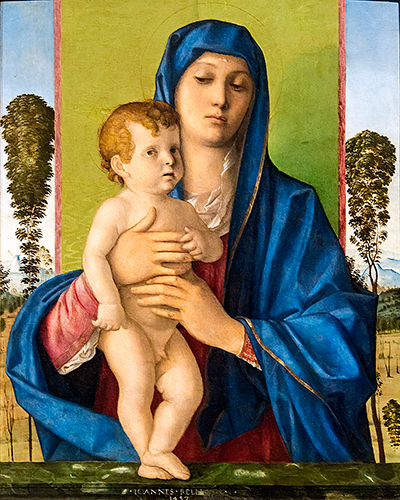
The Madonna degli Alberetti
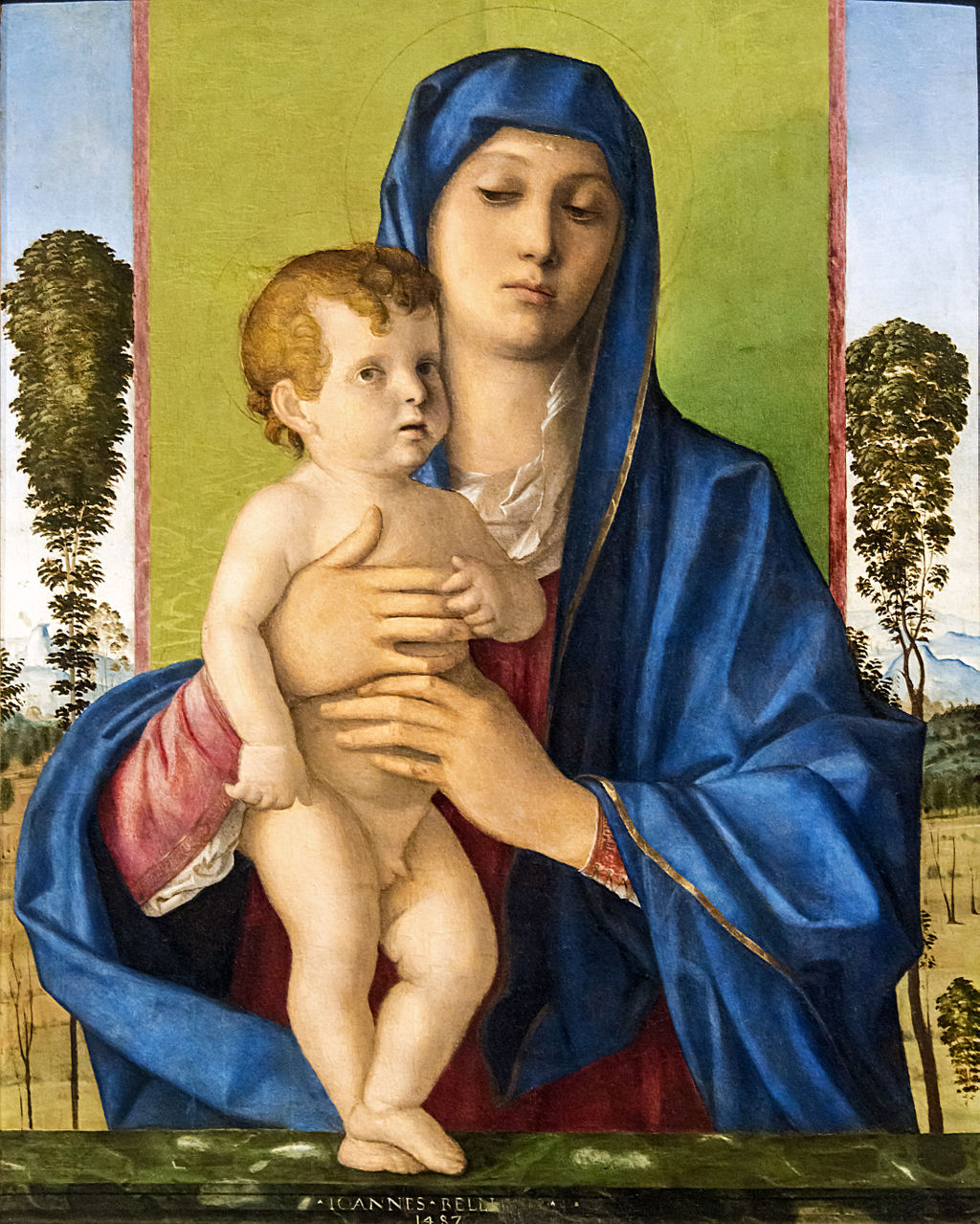
Two slender poplars rise on either side of a green hanging in Giovanni Bellini’s Madonna of the Small Trees. In front of it the Virgin steadies Christ as he stands on the rim of a painted marble ledge. The child is awake, with one hand curled round his mother’s fingers. Mary lowers her eyes towards him. Behind them, the trees stand about as far apart as the narrow views to either side will allow. They give this particular Madonna and Child its Italian name, Madonna degli alberetti. [1]
The picture is in the Gallerie dell’Accademia in Venice, where it is catalogue number 596. Bellini’s name and the year 1487 appear on the green parapet just beneath the child’s feet. The museum lists the panel as 71 × 58 cm, while the Italian national heritage catalogue and the Fondazione Zeri list it as 74 × 58 cm. The heritage record describes the technique as oil on wood. The two poplars, the green cloth and the dated inscription together identify the picture when the dimensions or the English rendering of its title vary. [1] [2] [3]
At a Glance
- ArtistGiovanni Bellini
- Date1487
- MediumOil on panel
- LocationGallerie dell’Accademia, Venice
The work in Bellini’s career
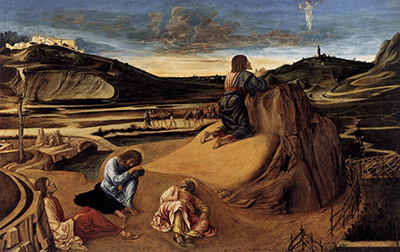
The Agony in the Garden
c. 1458–60Presentation at the Temple
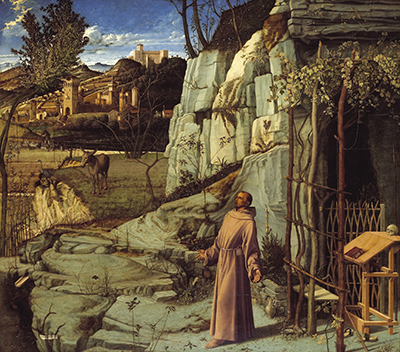
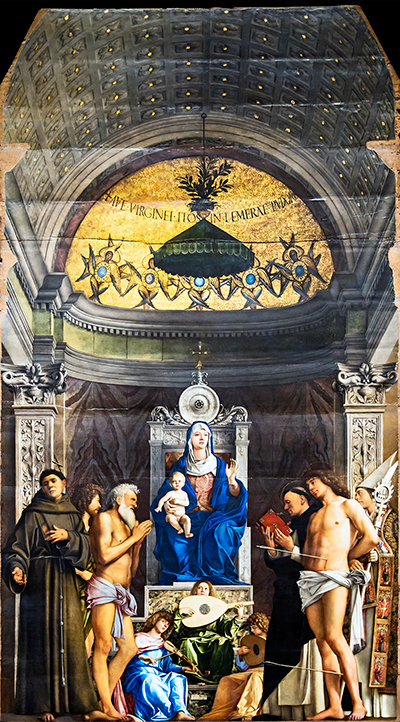
c. 1475St. Francis in the Desert
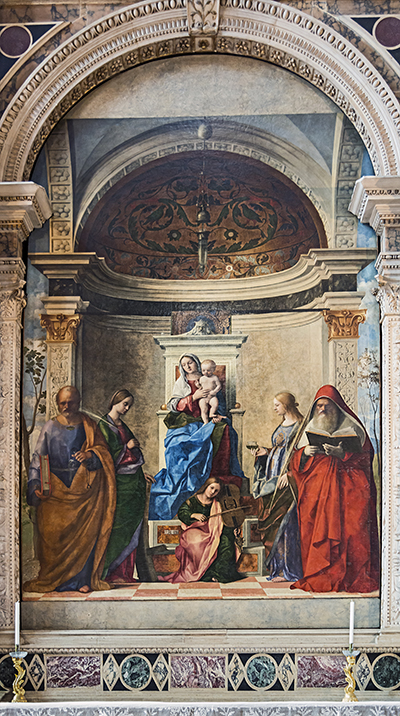
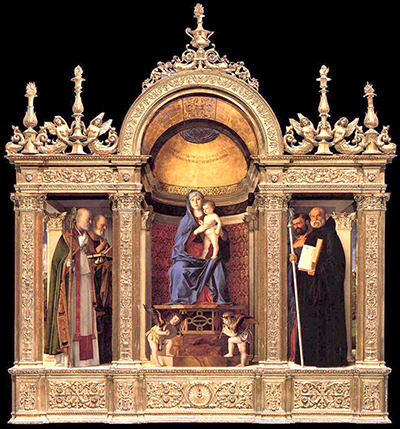
Late 1470sFrari Triptych
1488Madonna of the Meadow
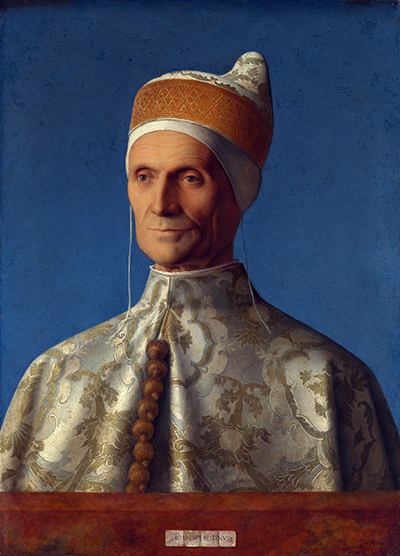
c. 1500–05Doge Leonardo Loredan
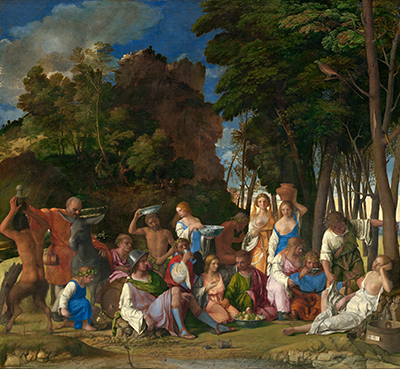
c. 1501–02The Feast of the Gods
Bellini’s signed date 1514The green hanging and the country beyond
The cloth drops from the top edge behind the Virgin’s head and shoulders. Its narrow red borders run straight past the treetops. The change from the warm green to the pale sky is abrupt, giving the figures a strong central backdrop and leaving the countryside in two slim openings. The hanging has a dignity associated with a cloth of honour, a textile set behind a figure of high standing. Here it also behaves like a piece of fabric held close to the body. The Accademia draws attention to the shadow Mary casts on it, which makes the distance between her and the cloth possible to read. [1]
The trees seem symmetrical from a distance. Up close, the taller crown on the viewer’s left fills most of its opening and reaches higher than the one on the right. Small gaps break the masses of foliage. Below them, darker ground gives way to pale hills and the snowy heights described by the Accademia. The two openings interrupt the view of what can be read as one continuous country. Bellini lets the eye move from the fabric and its shadow to light coming through the leaves, then to the light that softens the distant ridges. The museum reads the warmth and the glimmers in the foliage as the effect of a setting sun. [1]
The contrast in scale makes those views feel farther away still. Mary’s blue cloak takes up nearly the whole width lower down, spilling into the space in front of the trees. Its jutting fold at the viewer’s right nearly touches the edge of the panel. The cloth has divided the sky into two openings, but Mary’s outline breaks across their inner borders. It is possible to register the trees as a pair while following quite different shapes and intervals along each side. The order of the setting gives the smallest movements in the foreground, especially the child’s grip, room to register. [1]
The child’s stance and the painted ledge
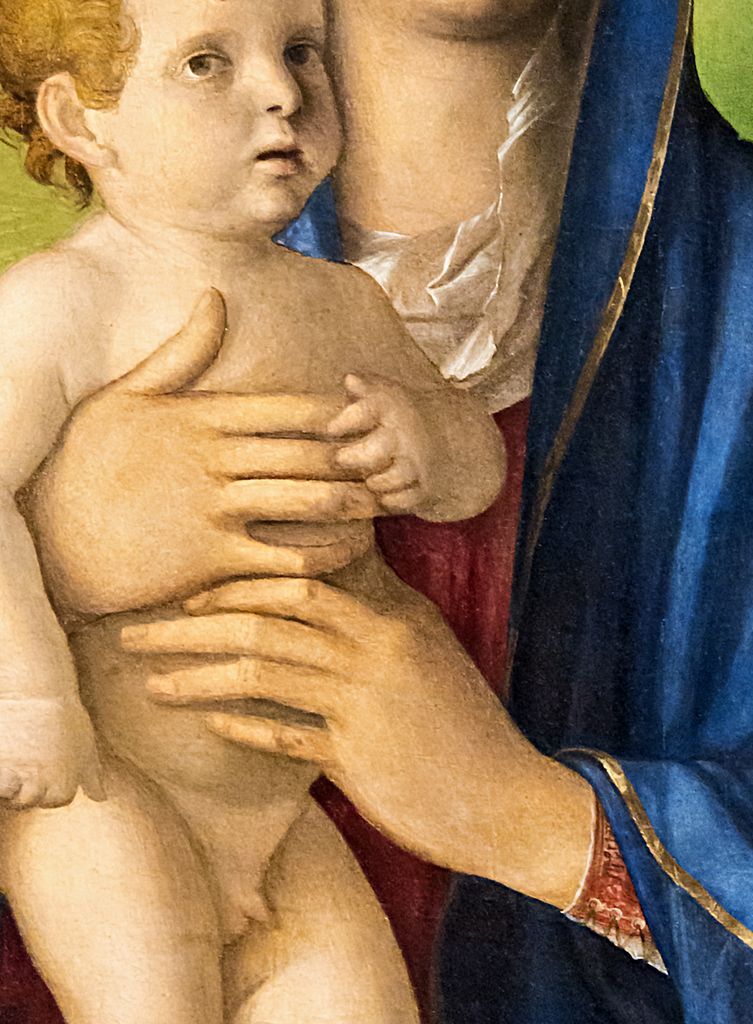
Bellini brings the gaze down from two closely spaced faces through a cluster of hands. One of Mary’s hands reaches round the child’s chest. The other stretches across his lower body, the pale fingers turning slightly with its curve. The child lightly closes a hand over hers, with his free arm hanging beside the red sleeve. The broad sweep of the blue mantle around them makes the two supporting gestures easy to see. There is a similar delicacy at Mary’s throat, where narrow marks of white paint let the viewer sense the skin and garment through the thin veil. [1] [4]
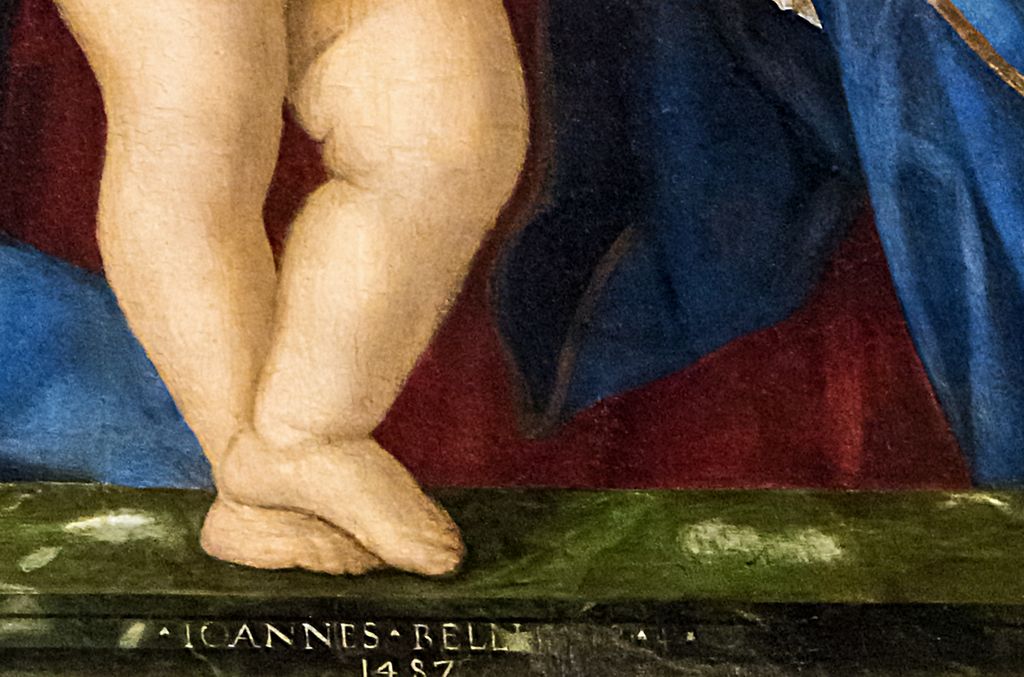
At the bottom, the child’s feet overlap on the parapet. The ledge has a top on which they can rest and a front on which Bellini can paint an inscription. It gives the standing figure a physical foothold, while the veined green stone across the foreground marks the edge between the sacred pair and the viewer. The national catalogue compares the crossed feet to those of the adult Christ on the cross. That reading gains force from how close the feet are to the viewer and how clearly they stand out against the stone. The support Mary provides makes the pose equally convincing as the posture of a small child. [1] [2]
The trees have attracted related readings. The national catalogue raises a possible echo of the Song of Songs and a possible reference to the Old and New Testaments in the contrast of living trees and dry growth. In his account of the Accademia’s Bellini conservation exhibition, Giorgio Tagliaferro reads the poplars as signs of mourning, in keeping with his interpretation of Bellini’s devotional landscapes as recalling Christ’s Passion. These are different ways of accounting for a pair of realistic trees around a sacred group. The repeated greenery and the crossed feet are visible. The reason Bellini chose these particular trees remains open. [2] [5]
What the date and the restored surface tell us
The inscription recorded by the national catalogue reads IOANNES BELLINVS P. / 1487. The P abbreviates pinxit, Latin for ‘painted it’. Its position means the name belongs to the picture’s foreground architecture. The child stands just above it, and the letters follow the ledge where a real inscription might be placed. The date also supplies a firm point of comparison for works assigned to the 1480s on other grounds. Bellini’s earlier Portrait of Joerg Fugger in Pasadena had a dated inscription of 1474 on its reverse. The Norton Simon Museum records that the inscription ceased to be visible following an early twentieth-century restoration. The 1487 panel retains its date on the painted face. [1] [2] [6]
The work entered the Accademia as a gift from Girolamo Contarini in 1838. It was one of 188 paintings in the gift, part of a period in which private Venetian collections substantially enlarged the museum’s holdings. The picture’s portable panel and face-to-face scale suit close devotional viewing. The known accession history supplies a collector and a museum date, while the individual who first commissioned it and the place where it was first used remain uncertain. [1] [2] [7]
The surface has changed since it left Bellini’s workshop. In her study of infrared examination, Maria Pastorino describes a single poplar board with a ground prepared from gesso and glue. She records treatments in the nineteenth century, in 1901 and in 1947. Examination ahead of the 1997 treatment revealed how aggressively the surface had been cleaned in the past. The X-radiograph showed abrasion in Mary’s face, where some of the paint that had modelled the flesh had been lost. The 1997 treatment addressed discoloured varnish and older overpainting. Her veil was better preserved. The difference matters when looking closely at how Bellini made skin and cloth visible. Surviving white strokes convey the veil’s translucency, while abrasion complicates any attempt to reconstruct the original transitions in the flesh. [4]
In the same study, digital infrared images reveal a detailed drawing below the paint, with slanting hatch marks used to set out shaded areas. They also register details around the child’s eye that the older infrared photographs had missed. What looks effortless on the surface can therefore be compared with deliberate planning underneath it. A fine hatch used to establish the shaded turn of a face does a different job from a thin stroke of white that suggests a fold in the veil. Looking at the underdrawing and at the surviving surface together makes both decisions easier to appreciate. [4]
How Bellini and his workshop reused the design
The Accademia identifies a reuse of the figure cartoon in its Madonna and Child with Saints Paul and George, dated around 1490. A cartoon is a full-size working drawing from which a design can be transferred. In the wider panel, the two saints flank the familiar central pair. The stance of the child and Mary’s way of supporting him carry across to a picture that has room for two more half-length figures. The Accademia describes this format as a sacra conversazione, a gathering of sacred figures in one setting. The link is between the designs for Mary and Christ, and the addition of the saints changes the relationships visible around them. [1] [4] [8]
The art historian Grażyna Bastek has proposed that an assistant painted the familiar central group in the wider Venetian picture and that Bellini painted the saints. The Accademia singles out the more individualised face of Saint George and suggests it may represent the patron. Even where the design was shared, preparing the figure outlines and painting the finished picture were separate decisions. Bastek’s proposal explains how a recognisable group could be combined with a figure whose face called for a fresh likeness. The division of work remains a scholarly attribution. [8] [9]
The Madonna and Child at Wawel Royal Castle in Kraków offers a different kind of comparison. Wawel catalogues its panel as Giovanni Bellini and workshop, after 1487. It is signed and repeats the figures closely. There is one slender tree on the left, whereas Venice has one on each side. The shift is small enough to leave the figures immediately recognisable and large enough to change the balance of the background. Comparing the two lets the viewer see what a workshop could hold steady and what could be varied. The signature and the resemblance establish a close relationship, while Wawel’s attribution leaves room for collaborators in the painting of its panel. [10]
The Alzano Madonna at the Accademia Carrara in Bergamo is a related design with a green hanging and an inscribed foreground barrier. In Bergamo the ledge is reddish brown, a pear has been set on it, and Bellini’s signature appears on a painted paper slip. The Lombardy catalogue proposes about 1485–87 and includes the dated Venice panel among the works used for comparison. These details show Bellini arranging similar elements around another figure group. The estimated date and compositional likeness give a basis for comparison while leaving the exact order in which the two designs took shape open. [3] [11]
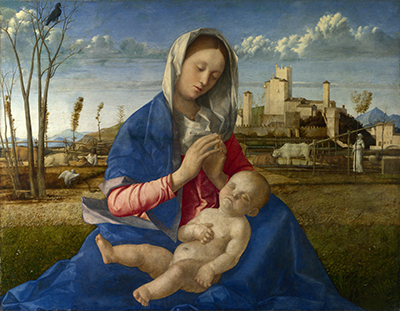
Bellini’s later Madonnas give the same subject very different proportions. In London’s Madonna del Prato, about 1500–05, the child sleeps across the lap of Mary, who sits low within a wide country view. In Detroit’s Madonna and Child, dated 1509 on the book at the bottom, the standing child blesses and a green curtain again brings the group towards the viewer. A broad landscape spreads round the figures in both of those wider pictures. The theologian Dietrich Korsch reads the narrow views in Madonna of the Small Trees as a particularly compressed version of Bellini’s landscape setting. The two openings still give a sense of distance, while the painted ledge and the closeness of the hands keep the standing child within reach of the eye. [1] [12] [13] [14]
Annotated Details from Madonna degli Alberetti in Venice
Numbered overview and cropped details also licensed under CC BY-SA 4.0. Photograph Didier Descouens via Wikimedia Commons. Image source. CC BY-SA 4.0.
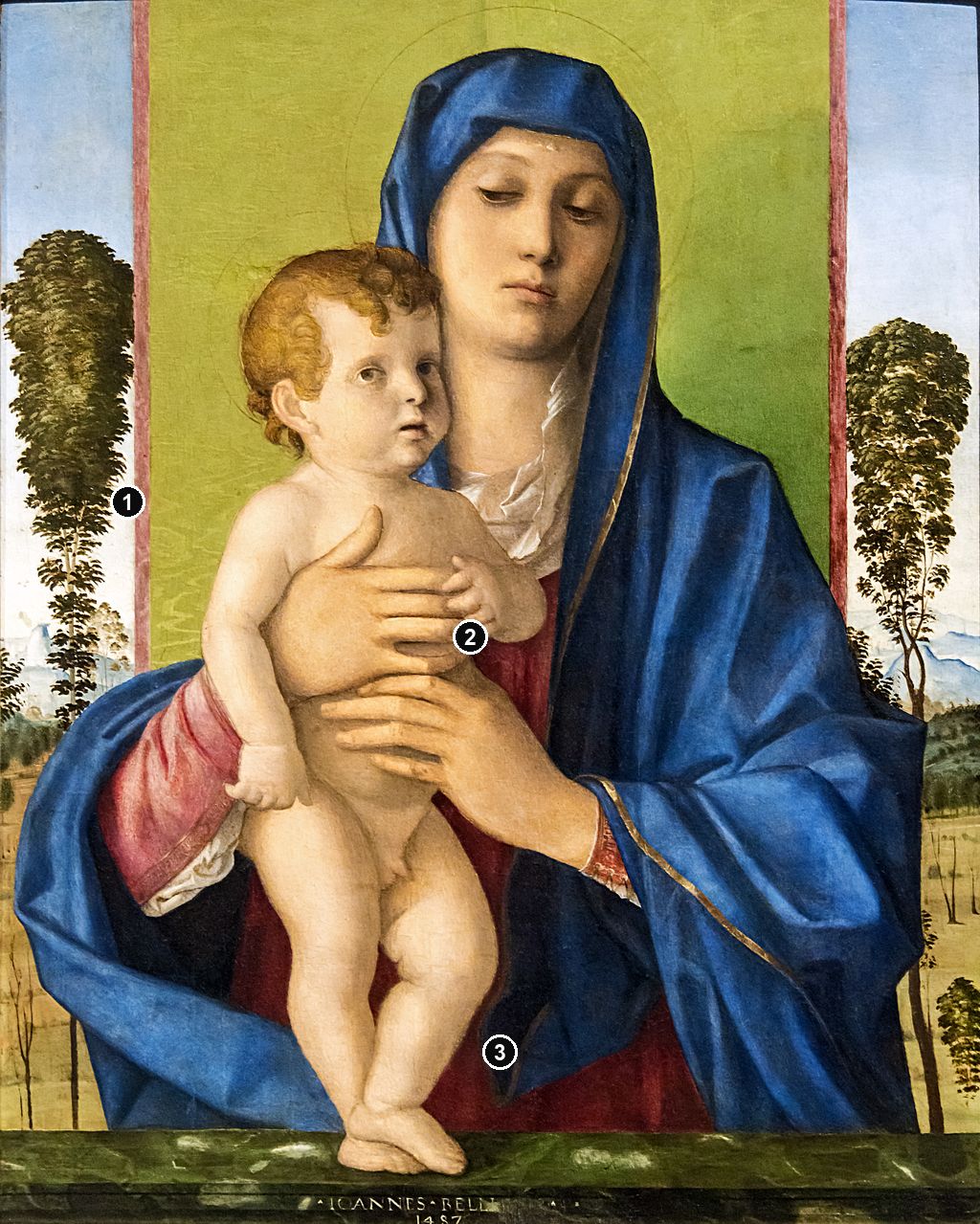
Details from MADONNA DEGLI ALBERETTI IN VENICE
Look at the two narrow strips of landscape, Mary’s hands and the parapet in front of the Child.
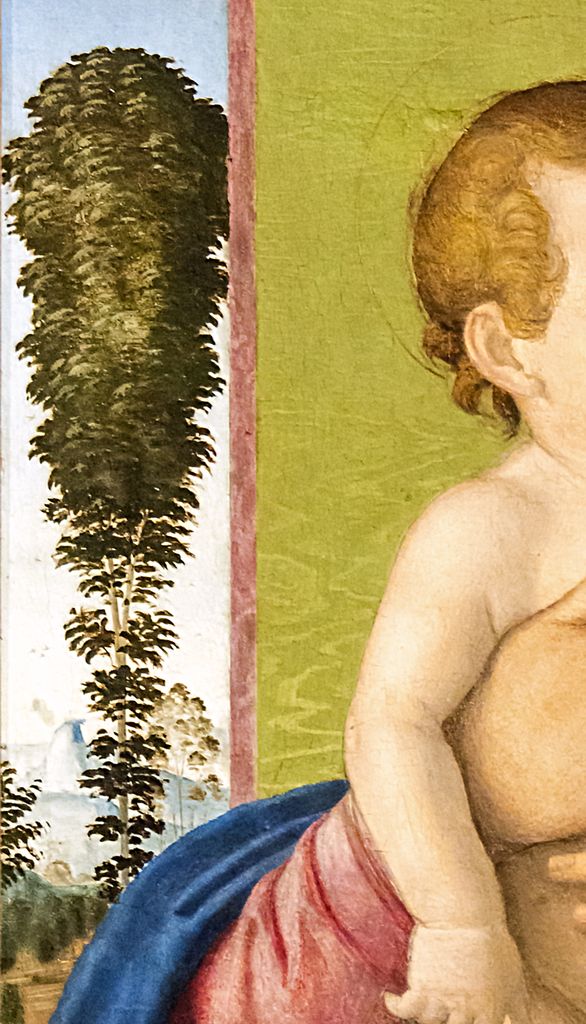
A tree to the side of the cloth
The columns of foliage rise in the narrow opening between the curtain and the picture edge. Their vertical shape echoes the hanging cloth.
The Child and the supporting hands
The Child’s body turns and leans against the Virgin. The two hands support him at different heights, making a gentle diagonal across the green behind them.
Feet, parapet and signature
The Child’s feet rest on the lower ledge, a zone of polished green and grey paint. Bellini’s painted name runs just below.
Related reading
Artworks directory
Discussion
Look again at the images and ideas explored in Madonna of the Small Trees by Giovanni Bellini. These editorial prompts invite your observations.
Reader Insights
How do the two narrow views of landscape change the space around the figures?
Where is the child’s stance repeated or varied in the related paintings?
How do the two trees balance the turn of the child’s body?
Join the Conversation
Share a detail, comparison or question about Madonna of the Small Trees by Giovanni Bellini below.
References
- Gallerie dell’Accademia di Venezia, Madonna col Bambino (detta Madonna degli alberetti), catalogue 596 View source.
- Ministero della Cultura, Catalogo generale dei Beni Culturali, Madonna con Bambino, 0500447533, inventory 596 View source.
- Fondazione Federico Zeri, Madonna con Bambino (Madonna degli Alberetti), record 24694 View source.
- Maria Pastorino, L’evoluzione della Riflettografia infrarossa attraverso lo studio dell’opera di Giovanni Bellini, Università di Genova, 2021, §3.3.1, pp. 39–40 and figs. 70–76 View source.
- Giorgio Tagliaferro, ‘Bellini: il colore ritrovato’, La Rivista di Engramma, November 2000 View source.
- Norton Simon Museum, Portrait of Joerg Fugger, M.1969.13.P View source.
- Gallerie dell’Accademia di Venezia, La storia della collezione, on the Contarini gift View source.
- Gallerie dell’Accademia di Venezia, Madonna col Bambino tra i santi Paolo e Giorgio, catalogue 610 View source.
- Grażyna Bastek, ‘Instrukcje dla fałszerza’, in Problematyka autentyczności dzieł sztuki na polskim rynku, Warsaw, 2012, pp. 153–155 View source.
- Zamek Królewski na Wawelu, Mistrzowie włoskiego renesansu. Bellini. Tycjan. Bassano, Madonna z Dzieciątkiem, inventory 10475 View source.
- Lombardia Beni Culturali, Madonna di Alzano, SIRBeC record C0050-00958, Accademia Carrara 58MR00020 View source.
- The National Gallery, Madonna of the Meadow, NG599 View source.
- Detroit Institute of Arts, Madonna and Child, 28.115 View source.
- Dietrich Korsch, Erfüllte Gegenwart, pp. 37–39, 52–53 and fig. 14, on Bellini’s devotional variations View source.