 by Tom Gurney
Tom Gurney BSc (Hons) is an art history expert with over 20 years experience
Email: tomgurney1@gmail.com / Phone: +44 7429 011000
The Detroit Madonna and Child
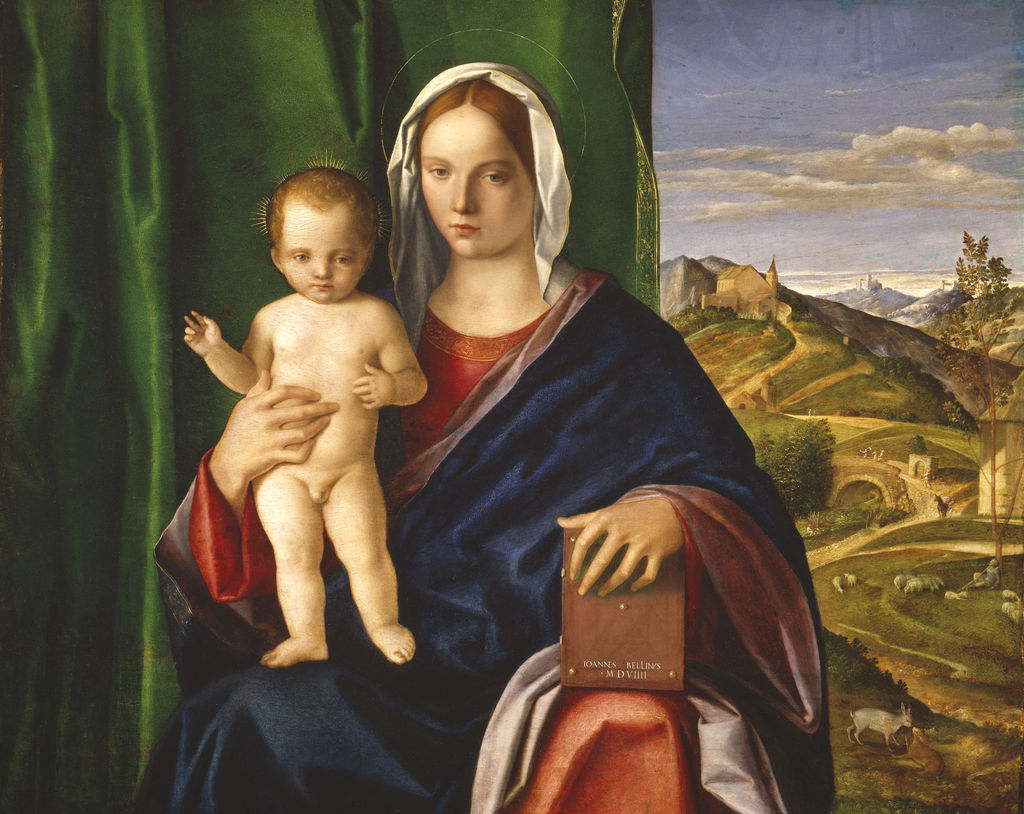
In the Detroit Institute of Arts' Madonna and Child, the Christ Child raises his right hand in blessing while Mary steadies him with one hand and holds a closed book with the other. A green curtain sets the two figures apart from a landscape of roads, buildings and grazing sheep. Look down at the cover of the book and there is another surprise. Its two lines of lettering give the painter's Latinised name and the year 1509. The museum catalogues the work as Giovanni Bellini, oil on wood panel, 84.8 × 106 cm unframed, accession 28.115. Those details distinguish it from the many paintings that share its title. [1]
At a Glance
- ArtistGiovanni Bellini, according to the DIA
- Date1509
- MediumOil on panel
- LocationDetroit Institute of Arts
The work in Bellini’s career
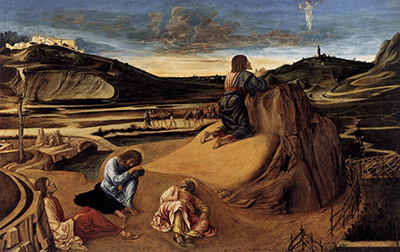
The Agony in the Garden
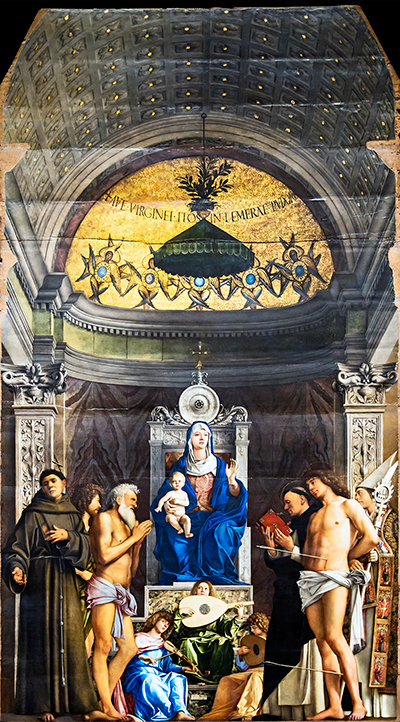
c. 1458–60Presentation at the Temple
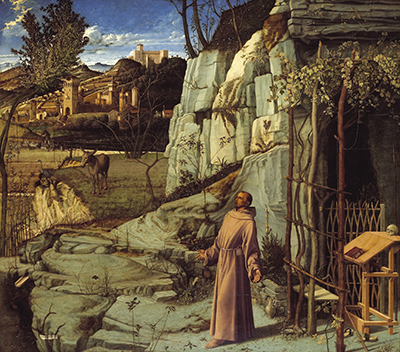
c. 1475St. Francis in the Desert
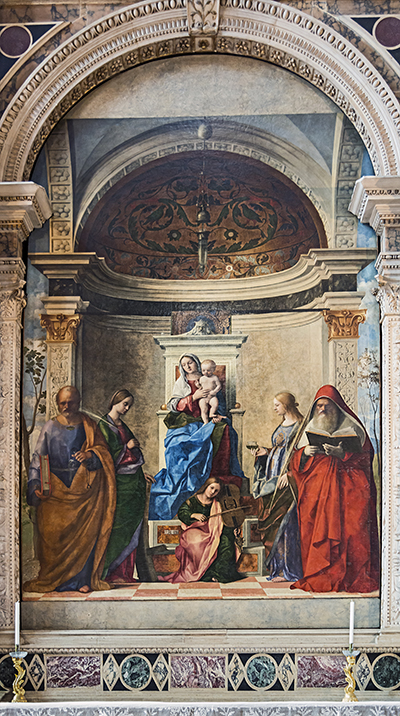
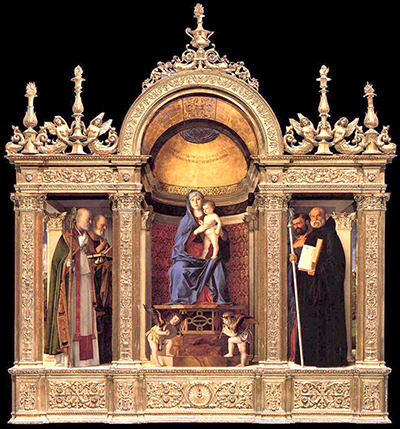
Late 1470sFrari Triptych
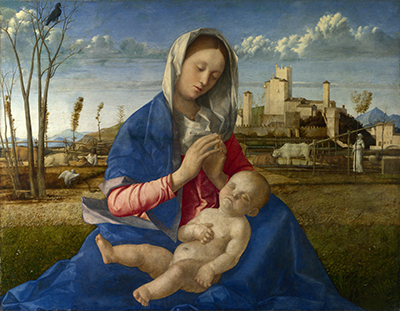
1488Madonna of the Meadow
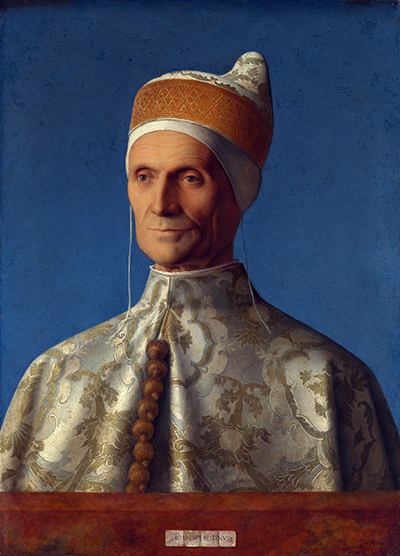
c. 1500–05Doge Leonardo Loredan
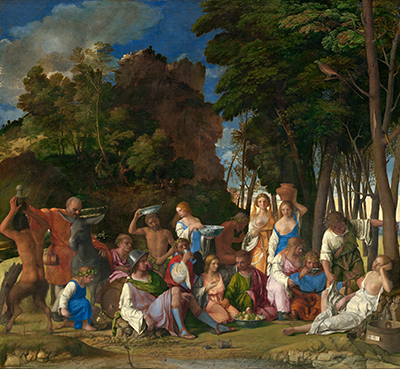
c. 1501–02The Feast of the Gods
Bellini’s signed date 1514The Child's raised hand
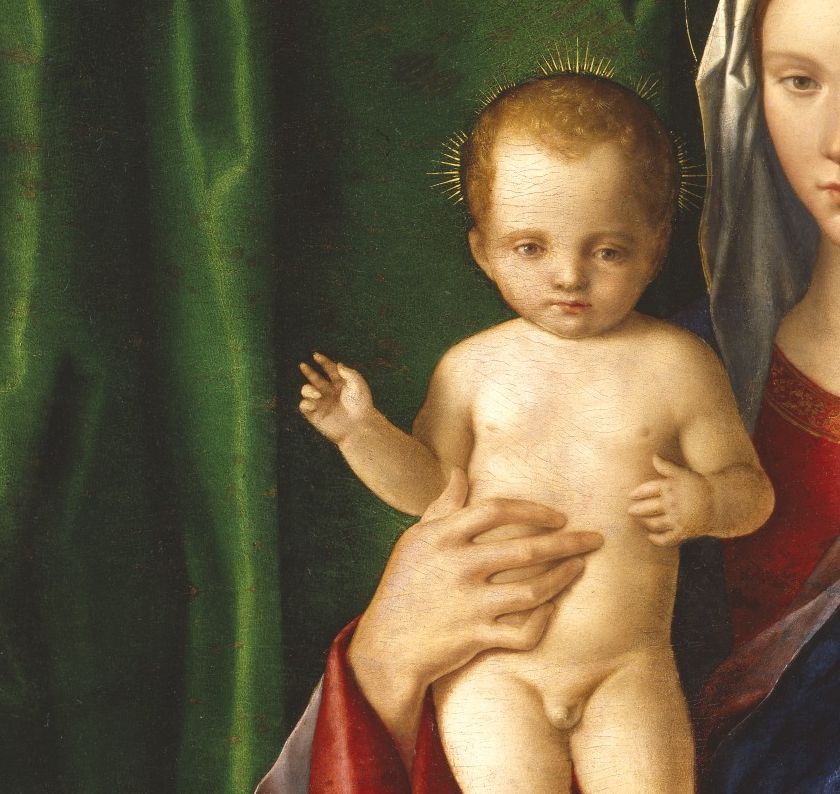
The gesture is easy to see because the Child's hand extends into a clear stretch of green. His other hand curls inward towards his body. Mary supports him at the waist, and one foot appears to find purchase on the folds of her blue mantle while the other hangs forward. A thin circle surrounds Mary's head and short rays radiate from the Child's. These fine marks leave the faces free of the heavy discs that would otherwise fill the space between them. The raised hand makes this deliberately staged presentation of Christ legible even at a distance. [1]
In 1928, writing about the newly acquired painting, the Detroit museum's director Wilhelm R. Valentiner singled out the frontal pose of mother and Child. He saw in it a survival of the formal relationship between worshipper and sacred figure familiar from medieval altarpieces. He also questioned how securely the Child actually stands. The folds give his feet somewhere plausible to rest, yet the uneven position of the two feet makes him seem poised to move forward. His blessing gains force from the combination. The gesture addresses the viewer, even as his balance still depends on Mary's supporting hand. [2]
The book on Mary's knee
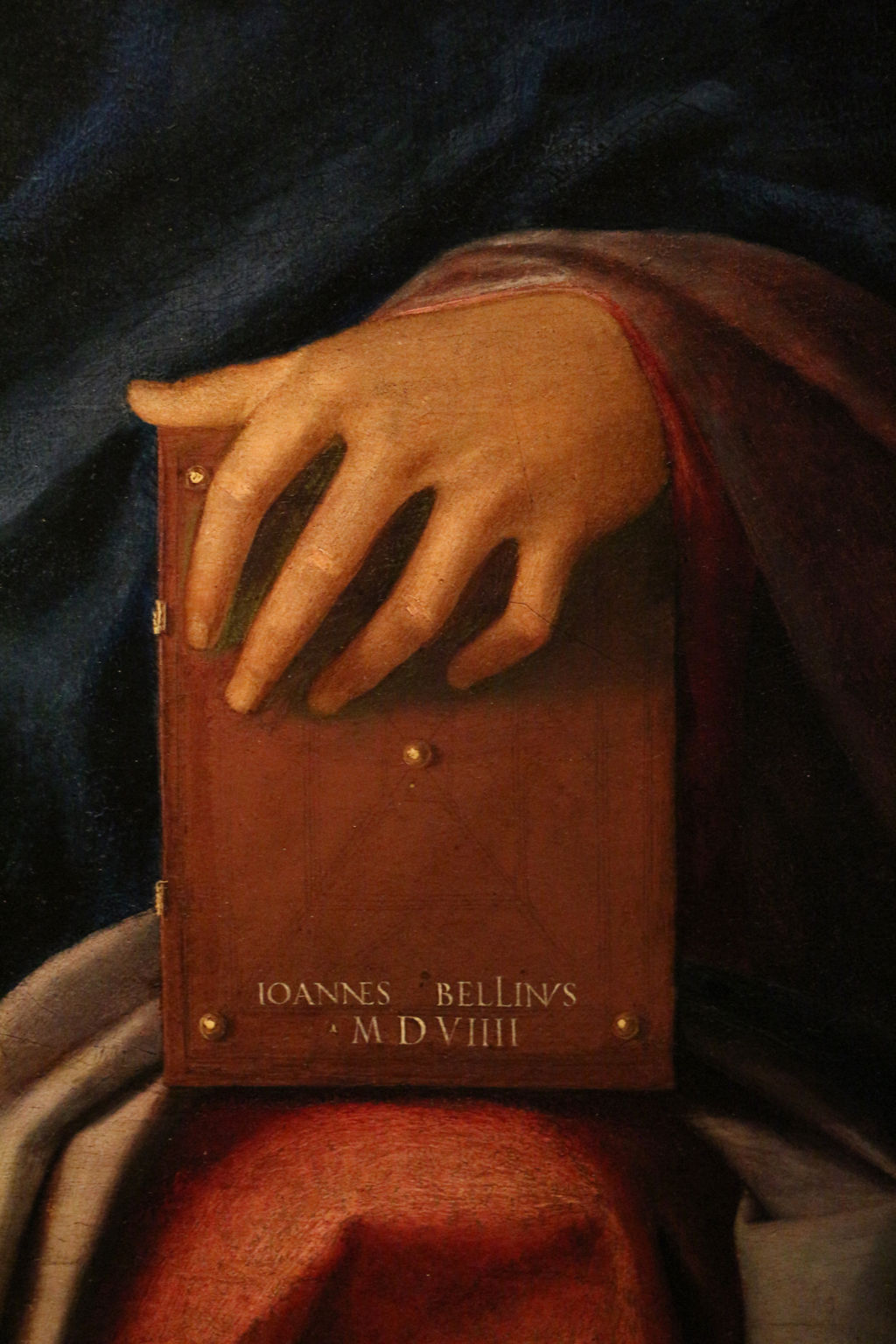
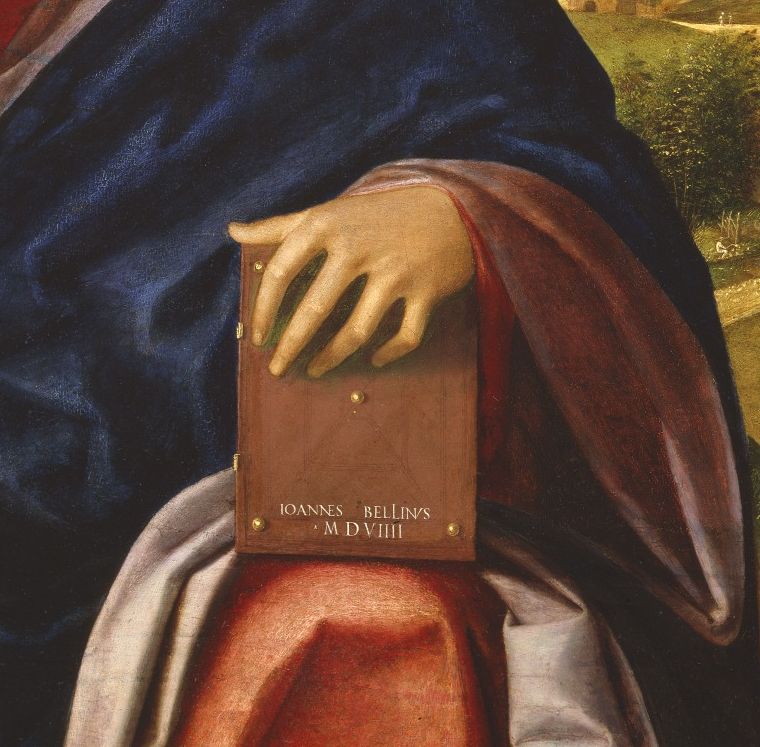
The book stands almost upright on the red fabric over Mary's left knee. Her thumb reaches across the book's top corner and her fingers fall over its cover. Small gold-coloured fittings and the shadows beneath her fingers help make the cover look like a solid surface. Valentiner saw a compositional purpose here. The book and the upright Child mark an intermediate plane between the forward reach of Mary's knees and the recession of her upper body. Their positions give weight to opposite sides of the figure group. The dark blue mantle connects them and the white veil draws the eye up to Mary's face. [1] [2]
The cover is also where the picture records its making. The museum transcribes the inscription as JOANNES BELLINVS / MDVIIII. The first letter appears as a straight I in the detail photograph. The date adds one thousand, five hundred, five and four ones, giving 1509. Marco Tagliapietra's study of Venetian painters' signatures describes gold-coloured writing on the back cover and prints MDVIII, with one fewer stroke. That shorter reading also appears in Christie's 2013 appraisal of Detroit's collection. The detail photograph shows four strokes after the V, in agreement with the museum's date. A viewer can read the date and name on the outer cover while the pages remain closed. The scene leaves the book's text to the imagination. [1] [3] [4] [5]
The green curtain and the land beyond
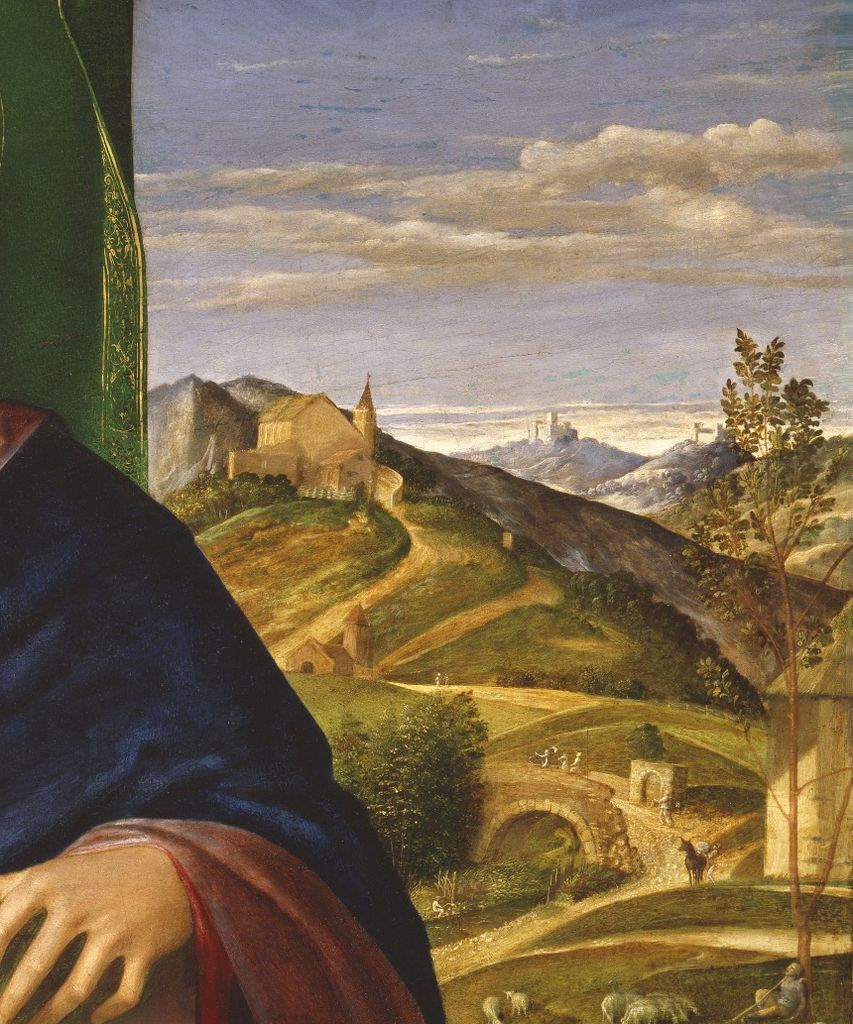
Broad green folds occupy roughly two thirds of the painting. The curtain's narrow patterned edge gives the eye a vertical line to follow before it opens onto sky and hills. The Detroit Institute of Arts reads the textile as creating the impression of an interior shared with the worshipper. There is little furniture to confirm a particular room. Much of the sense of enclosure comes from the curtain's expanse and the way it receives the outlines of the figures. Mary's mantle partly overlaps the opening at the right, so the view appears behind her rather than alongside her on a separate plane. [1]
A road climbs towards a church-like building with a pointed tower. Closer to the foreground, a stone bridge carries small figures across an arch and sheep graze beneath a tree. Two long-eared animals face one another at the lower right. These details slow the eye as it moves from the large figures to the distant ridges. In the foreground a single hand is large enough to study finger by finger. In the landscape an entire journey can be suggested by a bend in the road and the space between a figure and the next building. Valentiner treated colour as a means of organising these distances, from the strong green and blue around the figures to the paler sky and hills. [1] [2]
How much did Bellini paint himself?
The Detroit Institute of Arts credits Giovanni Bellini. Valentiner argued for the master's own hand when the panel entered the collection, and Edoardo Arslan later treated it as a securely attributed work in his study of Bellini's late drapery. The current museum record also preserves the disagreement in its bibliography. Luitpold Dussler assigned the picture to Bellini's workshop in 1935. Rona Goffen listed it as Bellini and workshop in 1989. Christie's used the latter formulation in its 2013 financial appraisal and cited Anchise Tempestini's proposal that Bellini supplied the idea and an assistant executed it. These judgements concern the making of the same signed Detroit panel. The inscription supplies a name and date, while the extent of Bellini's direct work remains a matter of attribution. [1] [2] [4] [6]
A comparison with the Madonna and Child dated 1510 at the Pinacoteca di Brera in Milan shows why the two paintings have often been discussed together. In both, Mary's large mantle gives her figure much of its scale and solidity. In the Milan painting the landscape extends behind her on both sides, and the painter's name and date appear on a stone at lower left. Brera catalogues its painting as oil on canvas, inventory 298. It reports that infrared examination during its 1987 restoration revealed only a slight preparatory sketch beneath the paint. That technical finding belongs to the Milan painting. Arslan compared both works as evidence of Bellini's move towards broader drapery, a comparison that can be tested by following the long folds over Mary's shoulder and lap in Detroit. [3] [6] [7]
From Venice to Detroit
The Detroit museum lists the Venetian Mocenigo family as the original commissioners and records the picture with the family until 1815. There is more specific documentary evidence for its later presence at San Polo. Historians Massimo Favilla and Ruggero Rugolo identify the Detroit painting with an entry in Giovanni Maria Sasso's 1799 inventory and valuation of the Palazzo Corner collection. Sasso listed it as item 325 in a gallery on the first floor and valued it at thirty Venetian zecchini. The entry describes the Virgin and Child, names Bellini, notes the signature and gives the year 1509. Francesco Aglietti's account, published in 1815, likewise describes a dated panel of the seated Virgin in a landscape in the Mocenigo house at San Polo, the former Corner palace. These records help establish where the picture was centuries after it was painted. The museum's account gives the commission to the family collectively, and the evidence published here leaves the original individual patron and intended room open. [1] [8]
By the mid nineteenth century the panel belonged to the Duchesse de Berry and was at the Palazzo Vendramin Calergi in Venice. It appeared as lot 15 at her Paris auction at the Hôtel Drouot on 19 April 1865. The Detroit provenance leaves open whether the Marquis de Podénas bought it on her behalf or for her son, the Comte de Chambord. The picture subsequently returned to the duchess and passed through Bourbon family ownership, including to Don Jaime de Bourbon. The museum acquired it from the Vicomte de Canson in 1928. Its published record lists a city purchase and a later appearance in the 1953 Bellini exhibition at the Palazzo Ducale in Venice. [1] [2]
The Madonna with cherubim in Indianapolis
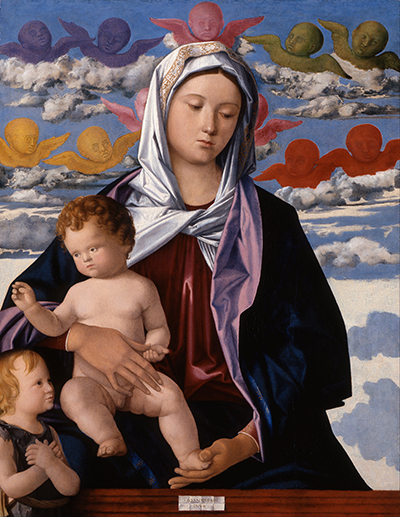
The Madonna and Child with St. John the Baptist in the Clowes Collection at the Indianapolis Museum of Art at Newfields is a separate painting. Newfields catalogues it as Giovanni Bellini and Workshop, about 1490–1500, egg tempera and oil on poplar panel, accession 2000.341. It is upright in format, with the young Baptist joining Mary and Christ and multicoloured winged cherubim forming an arc around Mary's head. Its signature appears on a painted paper label at the parapet. The museum's study also proposes that an assistant painted the Baptist, drawing on differences in how the paint was applied. That evidence comes from the Indianapolis panel. In Detroit, the two-figure grouping, green curtain, open view to the right and date on the book provide a different set of clues for identifying the work. [1] [9]
Annotated Details from Madonna and Child in Detroit
Numbered overview and cropped details. Photograph Detroit Institute of Arts via Wikimedia Commons. Image source. Public Domain Mark 1.0.
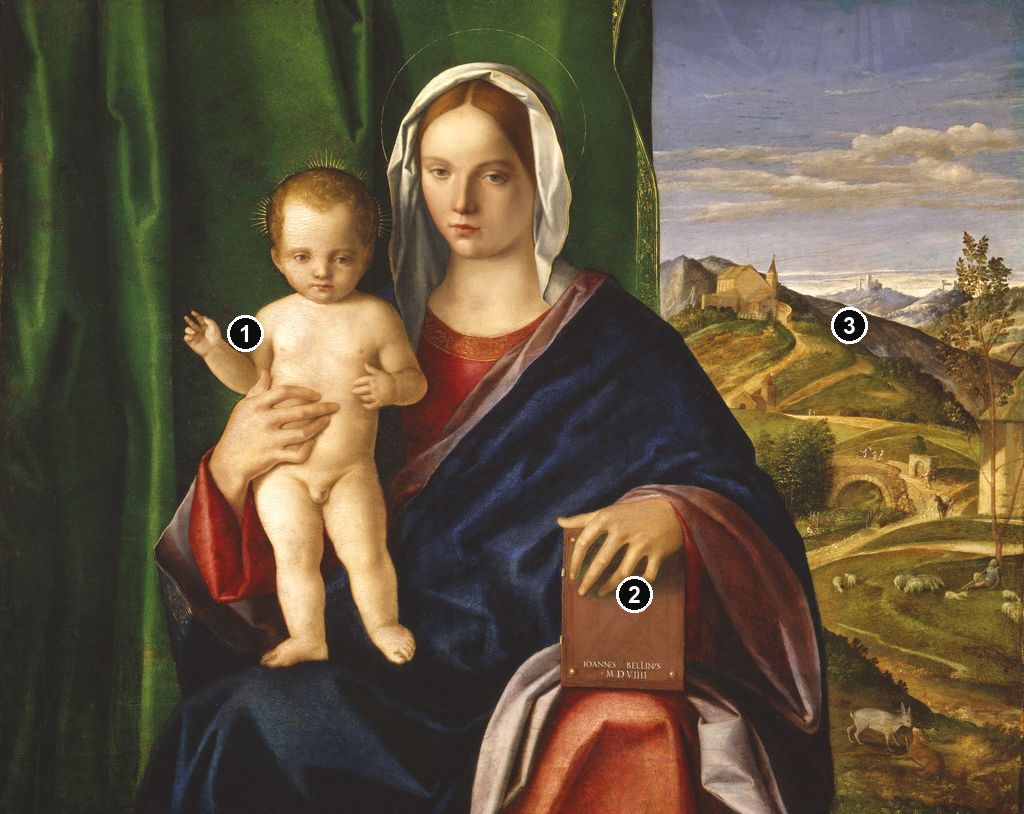
Details from MADONNA AND CHILD IN DETROIT
The Child’s lifted hand, the Virgin’s book and the distant hill give the eye three places to stop.
The Child’s raised hand
The Child lifts one hand into the dark green field of the curtain. The gesture remains legible where a change of colour would have interrupted it.
Mary’s hand and the book
One of Mary’s hands rests gently at the top of the book, with the fingers extended one below another. The exposed cover interrupts the folds of her mantle.
The view beyond the curtain
The fold of the curtain marks a sharp division between the figures and the hills. Roads, buildings and changing colours carry the eye into the distance.
Related reading
Artworks directory
Discussion
Look again at the images and ideas explored in Madonna and Child (Detroit) by Giovanni Bellini. These editorial prompts invite your observations.
Reader Insights
What does the green curtain reveal or conceal as you look from the Child to the hills?
What does the painted book help establish about the work?
Which details best distinguish the Detroit panel from the Indianapolis comparison?
Join the Conversation
Share a detail, comparison or question about Madonna and Child (Detroit) by Giovanni Bellini below.
References
- Detroit Institute of Arts, Madonna and Child, accession 28.115 View source.
- Wilhelm R. Valentiner, “Giovanni Bellini's Madonna and Child,” Bulletin of the Detroit Institute of Arts, vol. 10, no. 2 (1928), pp. 18–22 View source.
- Marco Tagliapietra, La firma di scuola veneziana dal XIV° al XVI° secolo, Università Ca' Foscari Venezia, catalogue entries 31–32, pp. 601–602 View source.
- Christie's, Fair Market Value for Financial Planning, City of Detroit (2013), no. 239, accession 28.115 View source.
- Wikimedia Commons, photograph of the painted book and inscription in Detroit's Madonna and Child View source.
- Edoardo Arslan, “Studi belliniani,” Bollettino d'Arte (1962), pp. 54–56 View source.
- Pinacoteca di Brera, Madonna con il Bambino (1510), inventory 298 View source.
- Massimo Favilla and Ruggero Rugolo, “Gli apparati decorativi di palazzo Corner dal Seicento all'Ottocento,” in Palazzo Corner Mocenigo a Venezia (2019), pp. 154–55 and appendix p. 204, doc. 3.1, no. 325 View source.
- Andrea Golden, Madonna and Child with St. John the Baptist, Masterpieces from the Clowes Collection, Indianapolis Museum of Art at Newfields View source.