 by Tom Gurney
Tom Gurney BSc (Hons) is an art history expert with over 20 years experience
Email: tomgurney1@gmail.com / Phone: +44 7429 011000
The Dominican altar at San Zanipolo
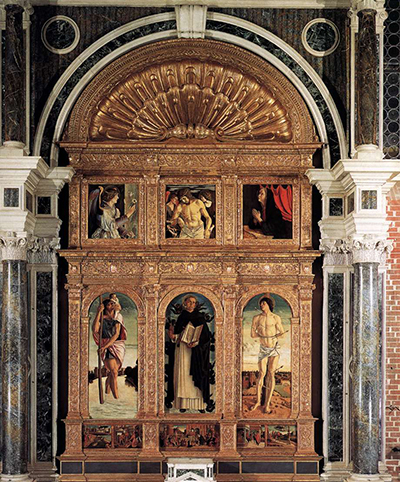
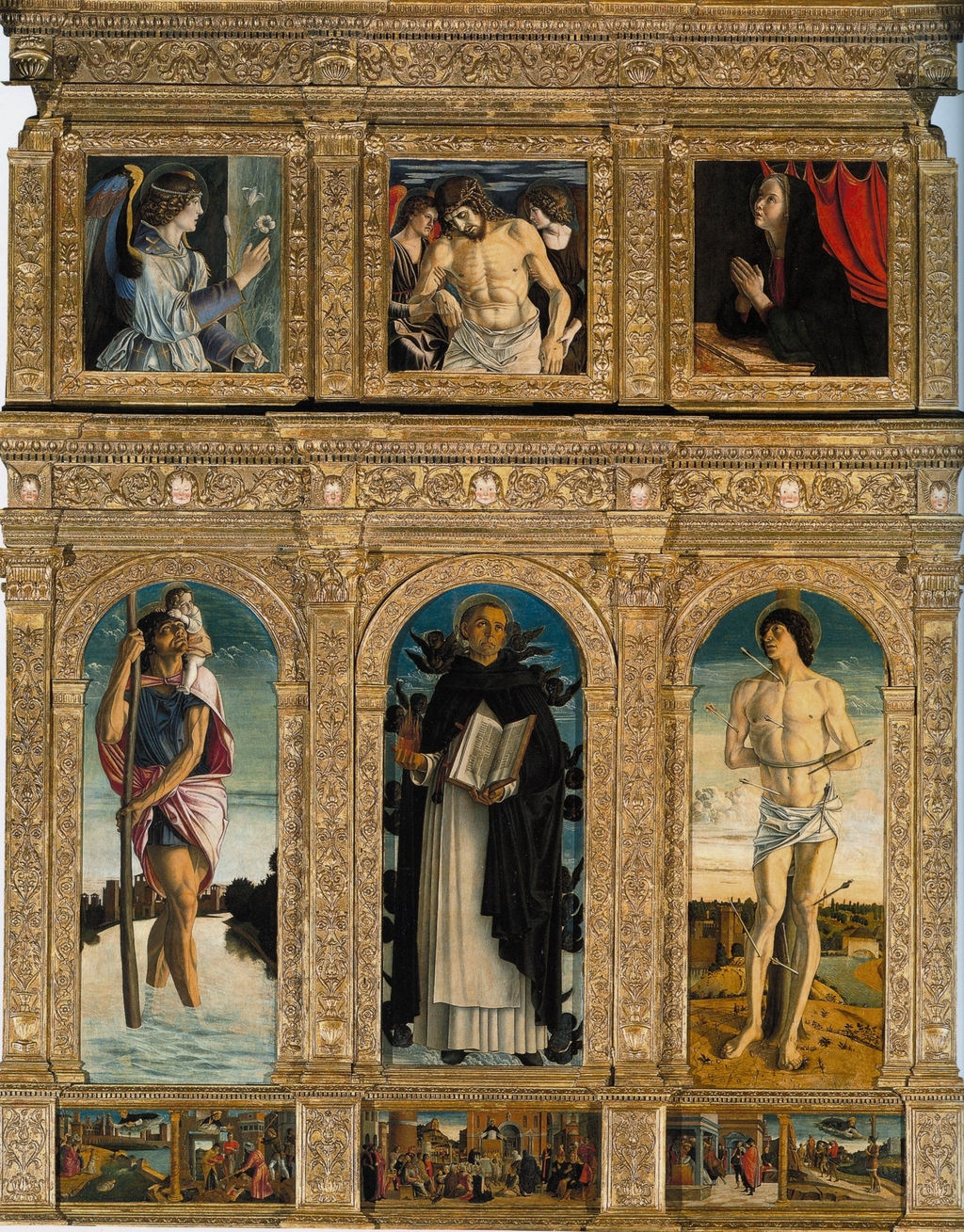
At the second altar on the right in Venice’s Basilica dei Santi Giovanni e Paolo, Saint Christopher wades through a river with the Christ Child on his shoulder. The current passes over his feet and the end of his staff. Directly beneath him, in a scene small enough to miss from the aisle, people gather by another river as Saint Vincent Ferrer comes to the aid of a drowning girl. Water links the towering figure to a story told in miniature. That pairing is one of the ways Giovanni Bellini holds his Saint Vincent Ferrer Altarpiece together across the divisions of its gilded frame. [1] [2] [3] [4]
Bellini painted the work in tempera on wood in the 1460s for the altar dedicated to the Dominican preacher Vincent Ferrer. The basilica, known in Venice as San Zanipolo, still houses it at that altar. Three standing saints occupy the tallest tier. The Annunciation and the dead Christ fill the three openings above, while five miracles unfold in the predella, the painted strip at the foot of the frame. The figures can be recognised from some distance, while the stories reward a closer view. [1] [2] [3] [9]
At a Glance
- ArtistGiovanni Bellini
- DateAbout the 1460s
- MediumTempera on panel
- LocationSanti Giovanni e Paolo, Venice
The work in Bellini’s career
The Agony in the Garden
c. 1458–60Presentation at the Temple
c. 1475The Dominican altar at San Zanipolo
About the 1460sSt. Francis in the Desert
Late 1470sFrari Triptych
1488Madonna of the Meadow
c. 1500–05Doge Leonardo Loredan
c. 1501–02The Feast of the Gods
Bellini’s signed date 1514An altar for a Venetian confraternity
Vincent Ferrer was a Valencian Dominican who became widely known as a preacher. He died in 1419 and was canonised in 1455. In Venice the lay confraternity dedicated to him had already drawn up its statutes by 1450. One provision put the altar at the centre of a public act of succession. When a new head of the confraternity took office, he was to receive the position before the altar with a cross in his hand. The provision shows what the altar was intended to do for the group before Bellini’s paintings can be placed there with any confidence. In 1458, the Council of Ten permitted the confraternity to erect a building of its own. [2] [5] [6]
The choice of saints also mattered to worshippers outside the confraternity. Sebastian, shown on the right with arrows in his body, was invoked against plague. Peter Humfrey linked the choice of the two attendant saints to the Venetian epidemic of 1464, an interpretation discussed by Louise Marshall in her research on Venetian plague devotion. The episode offers a plausible reason for commissioning the paintings at that moment. The confraternity’s plans for an altar were already older, and the surviving evidence for its construction cannot date the painting to the year of the outbreak. [2] [5] [7] [8]
Three saints under the open sky
The middle tier gives each saint a tall round-headed opening. Christopher braces his weight against his staff as the child balances on his shoulders. Tilted back, the giant’s head catches light under the chin and across his cheek. Sebastian’s bare body turns against the upright trunk to which he is bound. The arrows point in several directions, making it possible to register the angle of an arm or the twist of a torso even from below. Behind the two figures, distant buildings and water give a sense of scale to the bodies that almost fill the arches. [2] [3] [4] [8]
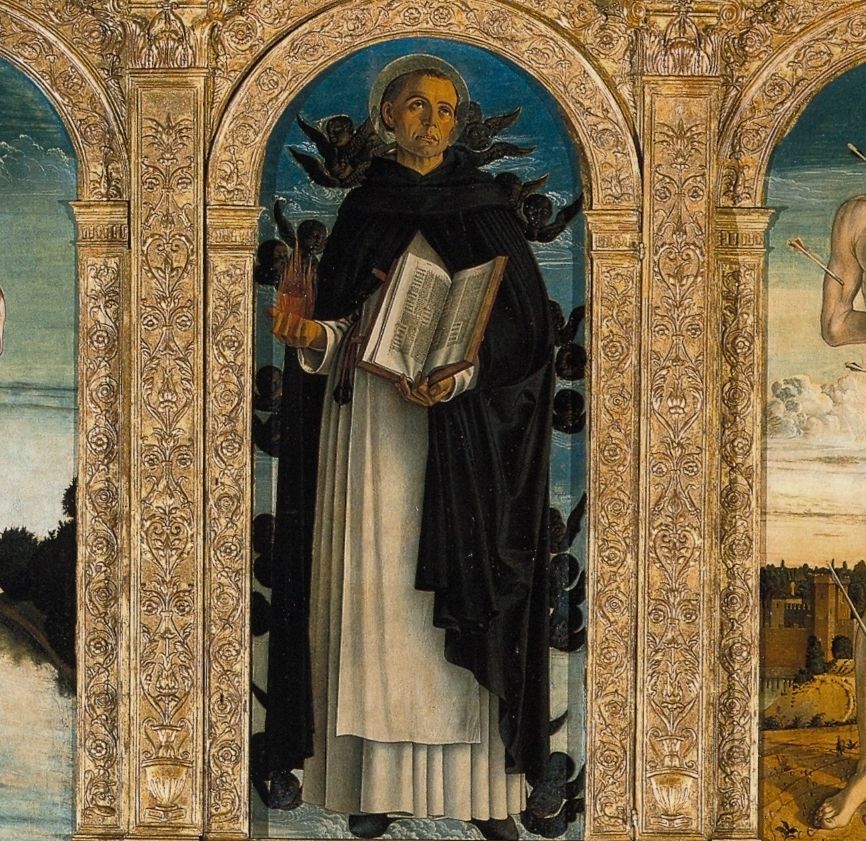
Vincent stands between them in a white Dominican habit and black cloak. He turns his face upwards and holds an open book against his body, with a flame rising above his free hand. Dark winged heads gather around him against the blue. While the other saints have their feet in a landscape, Vincent appears on cloud. The book and flame supply the attributes of the preacher that the central scene below will put into action in front of a crowd. [2] [3] [7] [9]
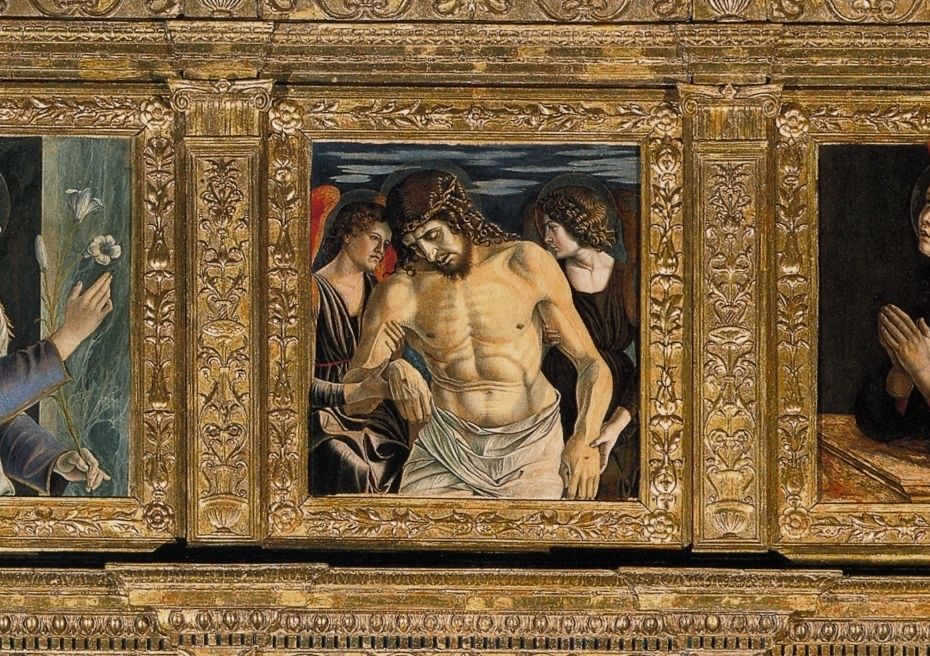
The upper tier gives the viewer another reason to look across the columns. Gabriel enters from the left with a lily. On the right, Mary presses her hands together and looks up from a book, with a red curtain gathered behind her. The herald and the Virgin never occupy the same panel. Between them two angels hold the dead Christ upright, supporting the weight that his dropping head and arms make visible. In this arrangement the Annunciation introduces the Incarnation, and the central image shows the human body Christ took on after it has suffered. The open book below and Mary’s book above take up so little space beside the faces and hands, but they give two points of entry into the act of receiving and transmitting a sacred message. [2] [3] [4] [9] [10]
The five miracles in the predella
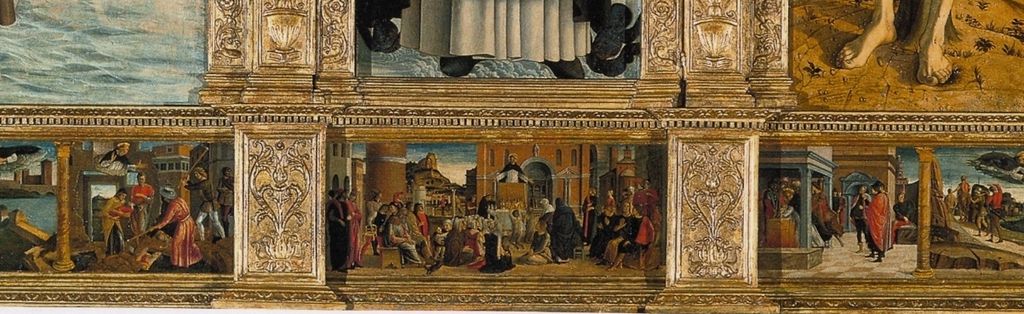
On the left, Vincent intervenes at a river and again at the scene of a collapsed building. A bridge and the buildings behind it locate the rescue in a populated place. The rubble then brings the action down among people on the ground. At the right are the episodes of the infant in danger and the bound captive. The first has been read as a rescue from a fire and as the restoration of the child to life. At the far end, Vincent appears above the scene as the captive stands tied to a tree. The upright trunk echoes the one behind Sebastian immediately overhead, while the river at the opposite end reprises Christopher’s crossing. [2] [4] [10]
In the middle, Vincent addresses an audience in a square. The preacher is raised above the listeners, and the crowd gathers below his outstretched arms. The precise miracle has been read in different ways. Antonio Mazzotta identifies the sermon as the episode of a guilty couple, and W. R. Rearick connects it to a story about the power of Vincent’s words over two condemned people. Susannah Rutherglen’s account describes the raising of two dead. The visible point of agreement is the emphasis on preaching. The monumental saint above offers the book to the viewer. At the foot of the altar the saint makes a public address, and the people taking it in are given almost as much room as the miracle itself. [2] [3] [4] [10]
The five episodes are distributed across three openings. Mazzotta cites the discovery during conservation that the predella is painted on a single long support. The frame gives the impression of three separate little pictures even though the narrative belongs to one continuous piece of wood. Look closely at the columns painted within the left and right openings. They divide neighbouring events at the smaller scale, much as the carved uprights divide the stories beneath the three saints. [2] [3] [4]
What the dates and attributions rest on
An early account of payment for work on the altar survives in Gino Fogolari’s transcription. It carries the date 6 January 1464, which Mazzotta suggests may be January 1465 by modern reckoning, since the Venetian year began in March. The record itself is untraced and the wording concerns work on the altar generally. Humfrey places the polyptych around 1465. Mazzotta argues for about 1464, while other scholars have dated it closer to 1470. The range reflects the difference between dating the building works and dating the paintings that went into them. [2] [5] [7] [8] [10]
An unusual piece of evidence brings the argument back to Christopher’s feet. Infrared reflectography during conservation showed that the feet and staff were painted before the thin layers that describe the water. Rearick and Mazzotta compare this effect with the treatment of the river in Antonio Vivarini’s altarpiece for Pesaro, which is signed and dated 1464. If Vivarini took the idea from Bellini, Christopher must have been painted by then. The proposal depends on which image lies behind the other, but it shows why a detail at the base of a picture can carry more weight in the dating debate than a general likeness of style. [2] [4]
The basilica presents the altarpiece as Bellini’s, and Francesco Sansovino already named him as its painter in 1581. Mazzotta found a further early attribution in Pietro Antonio Pacifico’s 1697 guide to Venice. The chief question of authorship concerns the small scenes. Rearick accepted the six large paintings as Bellini’s and assigned the predella to the Paduan miniaturist Lauro Padovano. Mazzotta argues for Bellini throughout, pointing to the way the episodes correspond to the large saints. The comparison with a predella from Santa Maria della Carità depicting Drusiana and Saint John the Evangelist has less force as evidence for Lauro today, since that predella itself has been exhibited as Bellini’s. The painter of every part of the San Zanipolo predella remains a matter of judgment. [1] [2] [4] [11]
The gilded frame and the stone surround
The painted work is set in a carved and gilded wooden frame, which sits inside a later stone surround. Mazzotta dates the marble setting to 1523. In Mattia Vinco’s account, the change was part of a wider refashioning of the church’s side altars in stone. Rearick reports that examination during restoration supported an early date for much of the wooden frame, whose precise date remains disputed. Its round arches and bands of classical ornament give the six large paintings two different types of opening and set a distinct scale for the small scenes at their feet. [2] [3] [4] [12]
Above the painted tiers was once a panel showing God the Father. Church and state records studied by Andrea Maronese describe repairs in the 1770s. The head of the confraternity requested permission to remove the panels for treatment, and they were put back in 1777. The changed setting could no longer accommodate the crowning picture. It was taken to the confraternity’s meeting hall and later disappeared. The crest now visible above the paintings belongs to the changes made around the time of that removal. [2] [4] [13]
The 1993–95 conservation campaign addressed the paintings, wooden frame and marble altar. Rearick records the paintings’ return on 7 October 1994, within that wider campaign. He describes losses around Christ’s hair and several candle burns on Saint Vincent alongside a generally well-preserved painted surface. The same investigation that brought Christopher’s water effects into focus also made it possible to study drawings on the backs of the tall saints. Their authorship remains open. The change in scale that Bellini’s design asks of its audience is still visible from the aisle, from a giant striding through a river to the people waiting for help at the water’s edge. [2] [4] [14]
Annotated Details from Saint Vincent Ferrer Altarpiece
Numbered overview and cropped details. Photograph Faithful reproduction via Wikimedia Commons, sourced there to AiWaz. Image source. Public Domain Mark 1.0.
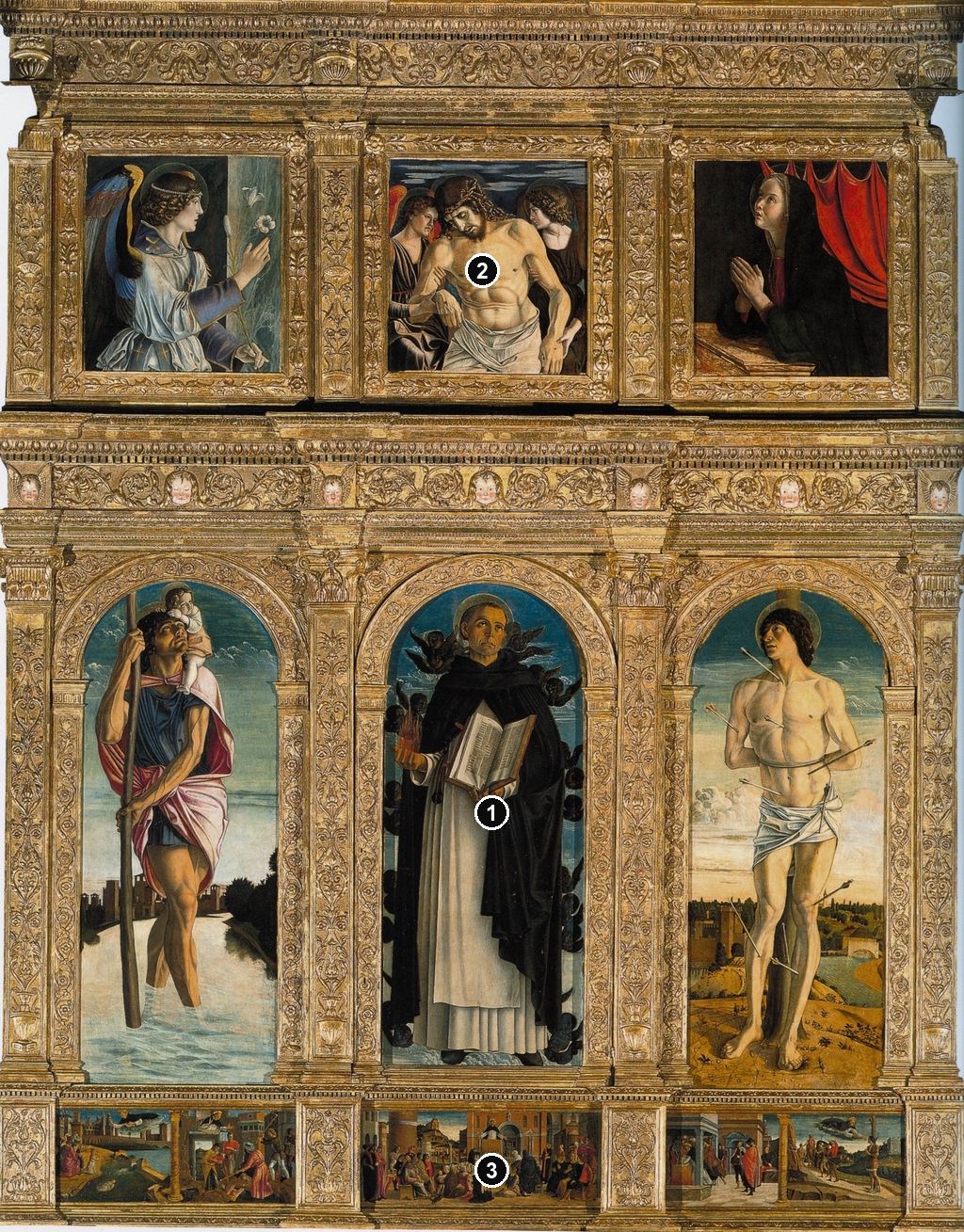
Details from SAINT VINCENT FERRER ALTARPIECE
Read the three levels of the polyptych, moving among its saints, the upper Passion and Annunciation figures, and the scenes below.
The central saint
Vincent’s dark habit and open book distinguish him in the middle compartment. The flanking saints each have their own painted space.
The upper central panel
The dead Christ supported by angels occupies the upper centre. The Annunciation figures appear in the compartments to either side.
The narrative scenes below
The small landscapes and groups of people below the standing saints turn the broad categories of a saint’s life into individual episodes.
Related reading
Artworks directory
Discussion
Look again at the images and ideas explored in Saint Vincent Ferrer Altarpiece by Giovanni Bellini. These editorial prompts invite your observations.
Reader Insights
How do the river scenes connect Saint Christopher to the predella below?
What changes when you follow the carved divisions across the painting tier by tier?
How do the two Annunciation panels change your reading of the Dead Christ between them?
Join the Conversation
Share a detail, comparison or question about Saint Vincent Ferrer Altarpiece by Giovanni Bellini below.
References
- Basilica dei Santi Giovanni e Paolo, Art View source.
- Antonio Mazzotta, “Reflections on the Date and Impact of Giovanni Bellini’s Saint Vincent Ferrer Polyptych,” Colnaghi Studies Journal 3 (2018), pp. 112–125 View source.
- Istituto Nazionale di Studi sul Rinascimento, photographic subject record for the San Zanipolo polyptych View source.
- W. R. Rearick, “Restoration of Polyptych of Saint Vincent Ferrer in Santi Giovanni e Paolo,” Save Venice Conservation Archives View source.
- Peter Humfrey, “Competitive Devotions,” The Art Bulletin 70 (1988), pp. 401–423 View source.
- José A. Ortiz García, “Santidad y sanidad: San Vicente Ferrer abogado contra la pestilencia,” in A la luz de Roma, especially pp. 163 and 172–174 View source.
- Louise Marshall, “St. Roch and the Angel in Renaissance Art,” Studies in Iconography 41 (2020), especially note 32 View source.
- Terisio Pignatti, “Bellini, Giovanni, detto Giambellino,” Dizionario Biografico degli Italiani View source.
- Alessandro Frati, “Polittico di San Vincenzo Ferrer,” Vocazioni 5 (2014), pp. 70–73 View source.
- Susannah Rutherglen, “‘Trésors de l’Église’: Giovanni Bellini et le polyptyque à Venise au début de la Renaissance” View source.
- Staatliche Museen zu Berlin, Mantegna and Bellini exhibition wall texts, “Fragmente” View source.
- Mattia Vinco, “Frammenti innovativi. Le prime pale d’altare di Giovanni Bellini a Venezia,” especially pp. 70–73 View source.
- Andrea Maronese, Gli ispettori alle “pubbliche pitture” della Repubblica di Venezia, University of Udine, especially pp. 38–39 View source.
- Insula, Chronological catalogue of conservation projects, 1993–1995 entry for the San Zanipolo polyptych View source.