 by Tom Gurney
Tom Gurney BSc (Hons) is an art history expert with over 20 years experience
Email: tomgurney1@gmail.com / Phone: +44 7429 011000
From a Venetian church to the Accademia
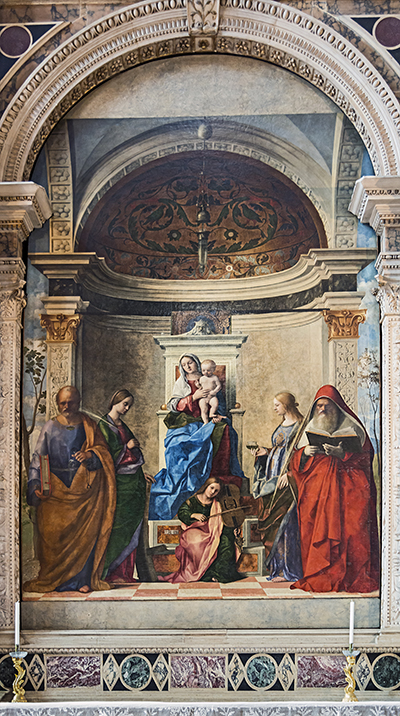
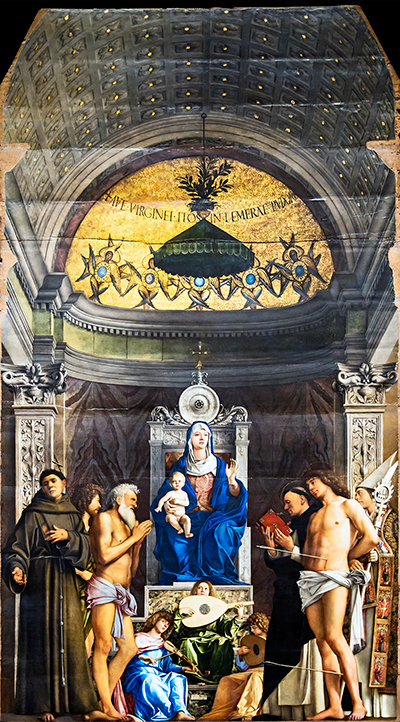
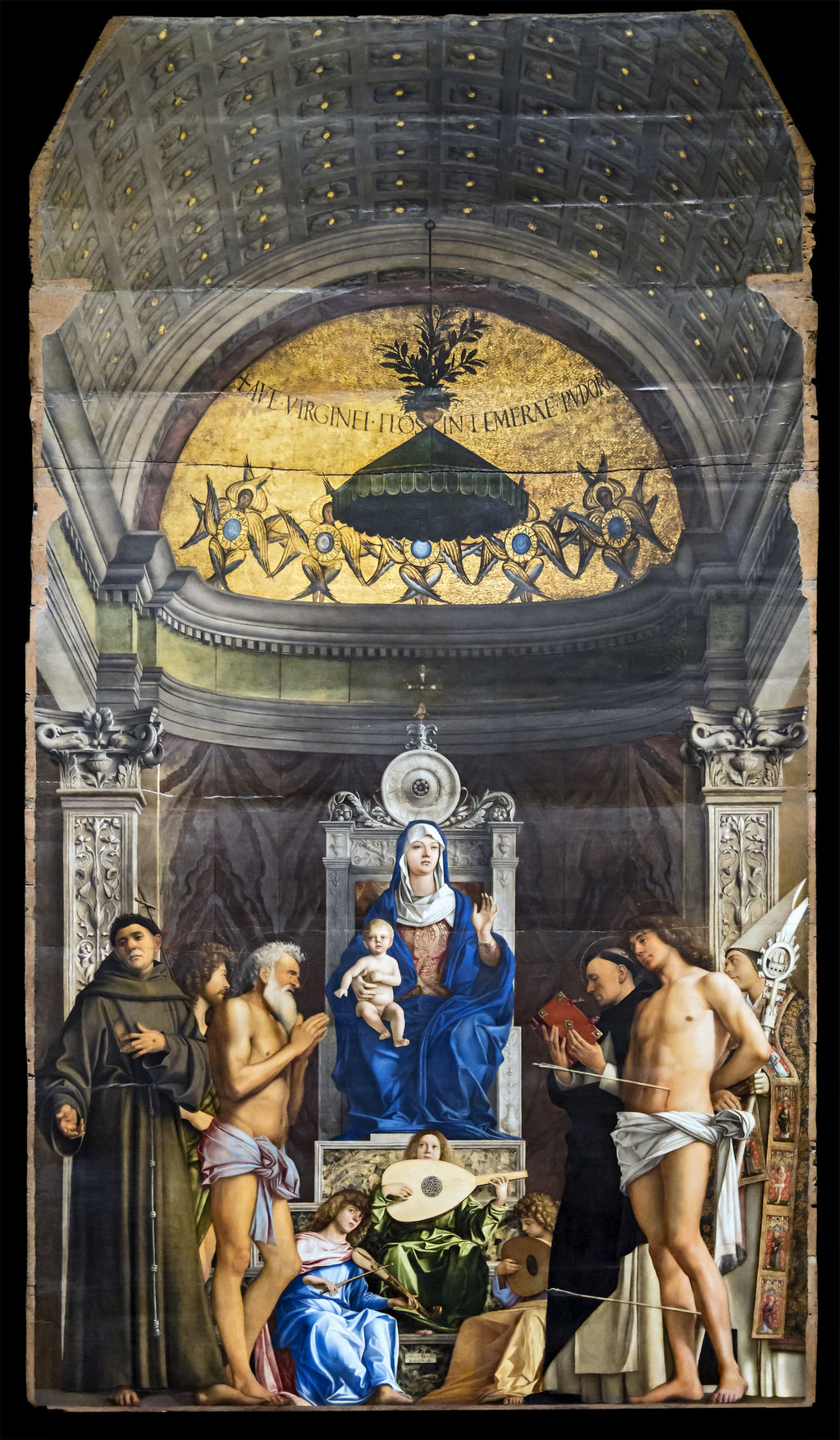
Giovanni Bellini painted the San Giobbe Altarpiece for the second altar on the right in the Venetian church of San Giobbe. Its six saints and three musical angels occupy an imagined chapel around the Virgin and Child. In the church, the carved stonework round the picture continued into the architecture Bellini painted, suggesting that a solid wall opened onto a vaulted room. The painting, executed in oil on a wooden panel, is now catalogue 38 at the Gallerie dell’Accademia in Venice. The marble altar and its architectural frame survive, with alterations, at San Giobbe. The museum dates the painting between 1478 and the late 1480s. [1] [2] [7]
At a Glance
- ArtistGiovanni Bellini
- DateProbably the 1480s
- MediumOil on panel
- LocationGallerie dell’Accademia, Venice
The work in Bellini’s career
The Agony in the Garden
c. 1458–60Presentation at the Temple
c. 1475From a Venetian church to the Accademia
Probably the 1480sSt. Francis in the Desert
Late 1470sFrari Triptych
1488Madonna of the Meadow
c. 1500–05Doge Leonardo Loredan
c. 1501–02The Feast of the Gods
Bellini’s signed date 1514A chapel painted into the wall
The painted architecture is easiest to follow from the edges inwards. Flat pilasters rise at either side to carry a horizontal band of mouldings. Above, the square recesses in a barrel vault diminish as they approach the rounded apse. Below, the throne steps project into the company of saints. Bellini assigns different kinds of light to these surfaces. Small warm highlights pick out the mosaic at the back, whereas light spreads broadly across the skin of Job and Sebastian near the front. The depth comes as much from the differences between those surfaces as from the recession of the coffers. [1] [2] [3]
The stone frame, generally attributed to Pietro Lombardo and his workshop, supplied the start of that recession. Carlo Corsato compared the panel’s margins with the church stonework and found unpainted profiles corresponding to the stone projections, down to the curved outlines at the capitals. Gilded floral carving on the underside of the real arch corresponded to the floral detail of the painted coffers. Even the joins of the wood helped organise the illusion. Corsato notes that a particularly wide plank accommodates the whole painted entablature, where the upright architecture gives way to the vault. These correspondences suggest close coordination between painter and stoneworkers. Corsato proposes that the frame was already in position when the painting was completed. [2]
The setting explains the unusual amount of space above the figures. The altar backed onto the friars’ cloister, where a chapel could scarcely have been built out from the nave wall. Across the church stood the real Martini Chapel with its decorated vault. Seiko Hoshi reads Bellini’s painted room in relation to that chapel and to the actual presbytery. From the nave, the large vault gave the fictive space a scale comparable to the church’s built spaces. Corsato’s reconstruction places the horizon near the level of the real pilaster bases and relates it to the eye level of a priest officiating at the altar. The same reconstructed height gives new force to Francis’s outward turn. Approaching from the choir, the friars would have encountered the figure of their founder looking towards them. [2] [3]
The Gallerie dell’Accademia catalogues the panel at 471 × 292 cm. Corsato’s study reports a surviving height of about 453 cm and a width of about 263 cm, with an original height of approximately 530 cm. Those figures come from a study of the surviving boards, the stone opening and a record of the panel’s measurements in Venetian units in 1815. An early museum interior painted by Giuseppe Borsato shows, in Corsato’s reading, that the upper vault had already been shortened by 1822. Corsato also proposes that a plank was lost along the bottom and that it carried a painted step. In that reconstruction, the saints’ feet originally stood above the projecting base of the real frame, where someone looking up from the nave could still have seen them. The precise appearance of the lost wood remains a reconstruction. [1] [2]
The friars, the patrons and the date
Before the church was built, the site in Cannaregio held an oratory dedicated to Job and an adjoining hospice. The Observant Franciscan friars took charge in 1428, and Bernardino of Siena preached in the oratory in 1443. When the rebuilt church was consecrated in 1493, it bore the names of both Job and Bernardino. [3] [19]
Doge Cristoforo Moro had supported the rebuilding and provided for his burial in the main chapel, where Bernardino was honoured. Rona Goffen argued that Bellini gave Job a fictive high altar within the nave after the saint had effectively lost precedence at the actual high altar. Goffen proposed the local confraternity, the Scuola di San Giobbe, as the probable patron. Hoshi also allows for a wealthy supporter working with the confraternity. Moro’s documented role in the church building establishes the setting for that discussion, while the identity of the person or group that paid Bellini remains open. [2] [3] [4]
The broad date range reflects several kinds of evidence. Bellini put his name on the throne step and gave no year. Goffen proposed around 1478, while Hoshi suggested 1478–83 in relation to the building campaign. Corsato’s proposal that the frame went up around 1480 would allow completion by 1483, the confraternity’s centenary in his account. Venetian Heritage gives circa 1487. Late fifteenth-century notices by the humanist Marcantonio Sabellico and the Venetian writer Marin Sanudo show that the work was already known and admired early in its history. They establish the painting’s early reputation and leave its year of completion open. [1] [2] [3] [4] [5] [6]
The saints and the musicians
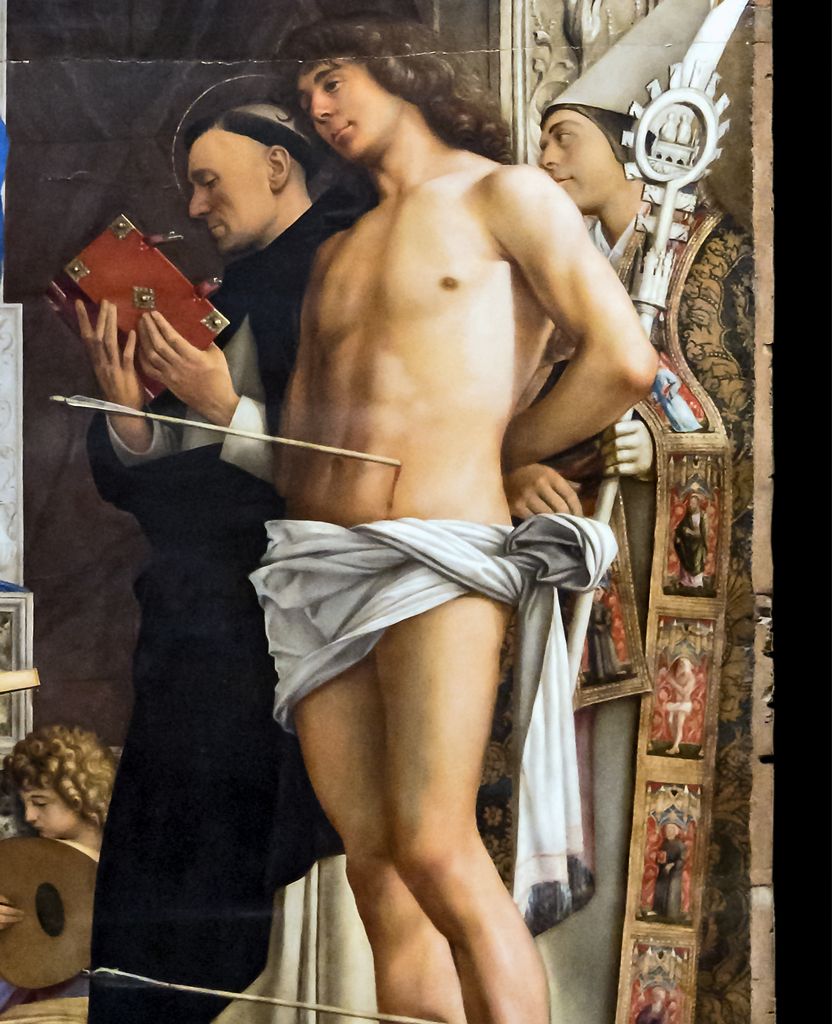
On the viewer’s left are Francis of Assisi, John the Baptist and Job. Francis in his friar’s habit turns outward and raises one hand. John stands further back, and the elderly, bare-chested Job prays beside the throne. Across from them, Dominic attends to his book, Sebastian stands with the arrows of his martyrdom, and Louis of Toulouse wears a bishop’s mitre and richly patterned vestments. Francis and Louis, both Franciscans, stand at the outside of the gathering. Their clothing ranges from a plain habit to elaborate episcopal dress. All six figures share one floor and one surrounding architecture. This kind of grouping is called a sacra conversazione, or sacred conversation. Here the exchange is carried by glances, posture and the arrangement of bodies around the throne. [1] [3] [7]
Job and Sebastian stand out because their exposed flesh catches the light. Job’s patient endurance of suffering and Sebastian’s survival of the archers’ attack made both relevant to prayers for protection from plague. Historian Michele Lodone connects the pairing with the severe Venetian epidemic of 1478. A viewer could have understood Job and Sebastian as intercessors during an outbreak. The case for a specific plague commission or a vow made during that epidemic rests on interpretation. Job is also the church’s title saint, and his placement near the Child can be read in that local devotional context. Hoshi sees the Child’s gesture and Job’s clasped hands as part of an exchange about redemption, with the Child’s other hand at his own side suggesting the future wound of the Passion. At an altar where Mass was celebrated, the same figures could speak to both sickness and salvation. [3] [4] [7] [19]
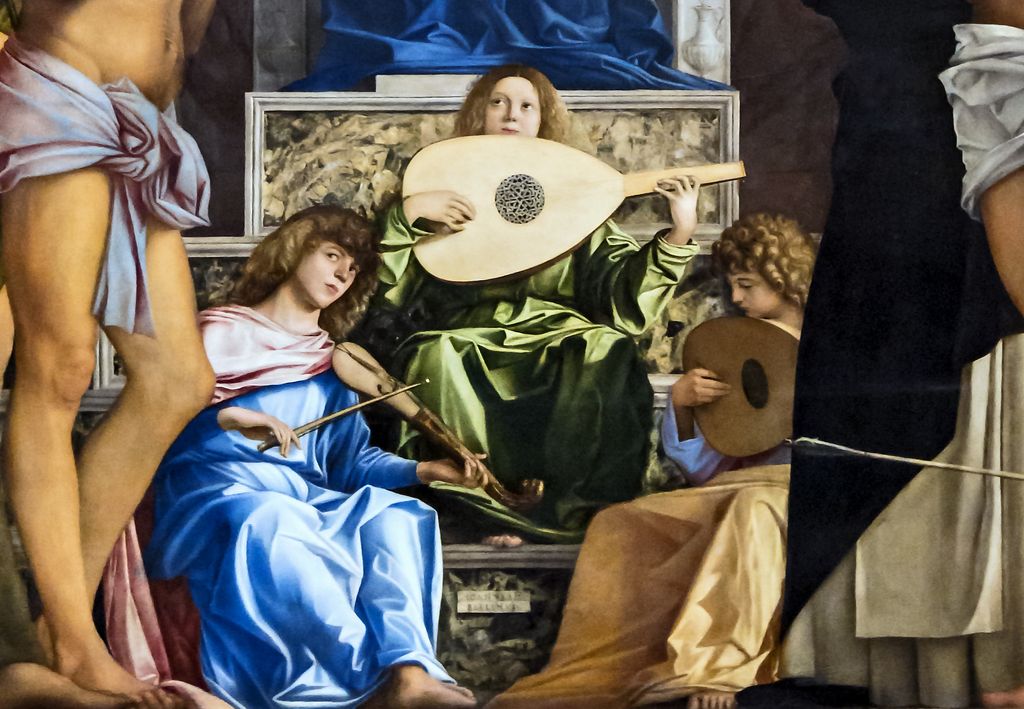
The three angels below the Virgin occupy different steps and create a triangle in miniature. The lower left angel draws a bow across a small stringed instrument identified as a rebec. The other two hold lutes. One looks up, following the height of the throne, while another bends towards the strings. Their directions have invited different readings. Hoshi asks where the upward glances would have led a viewer standing in the church and proposes a relationship to the chancel. The glances and playing hands also offer something visible at the scale of the painting itself, a set of quiet gestures across the wide space between the standing saints. [3] [7]
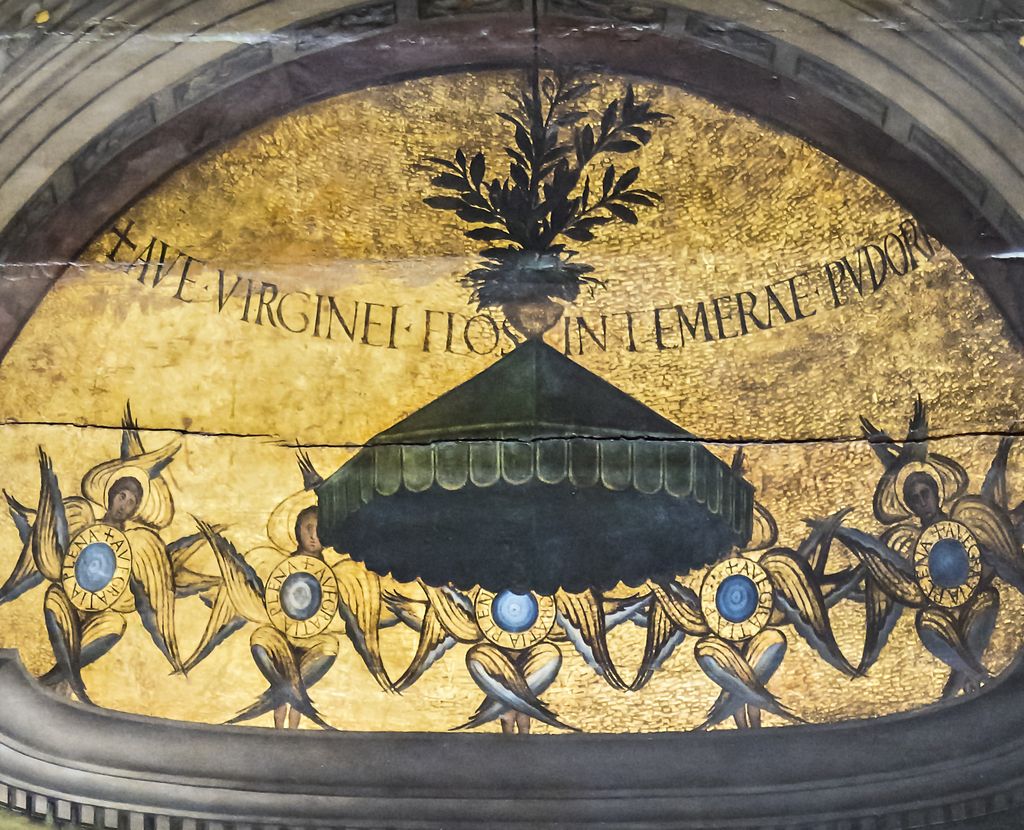
Mary’s seat rises on narrow steps and is marked out by a canopy. Her open palm faces out, while the Child turns across her lap towards the group on the left. Further up, the painted mosaic carries the greeting Ave gratia plena, “Hail, full of grace”, associated with the Annunciation. The gold recalls the mosaic interiors of San Marco, as do the coloured surfaces of the painted marble. Goffen linked this imagery more specifically with the altar of Bernardino at San Marco, also endowed by Moro. Emanuele Lugli approaches the painting through Bonaventure’s account of how looking can lead to contemplation, a text he connects to the intellectual life of Observant Franciscans. His reading shifts attention from which church the room resembles to how Bellini guides the eye from the figures below towards the mosaic above. [3] [4] [7] [8]
How other painters used Bellini’s design
Vittore Carpaccio had the example immediately to hand. His signed and dated Presentation of Jesus in the Temple of 1510 was made for the third altar on the right at San Giobbe. The Accademia points out his reuse of the hanging lamp, pyramid of figures, musical angels and connection between the real frame and the pictured building. Carpaccio put those devices to work in a narrative about the presentation of the infant Jesus to Simeon. The two paintings, both now in the Accademia’s collection, show how artists could give neighbouring altars a related appearance while telling different stories. [9]
A smaller borrowing travelled much further. The Open University identifies a quotation of one of Bellini’s lute-playing angels in the foreground of Albrecht Dürer’s Feast of the Rose Garlands. Dürer painted it in Venice in 1506 for the city’s German merchants and their chapel at San Bartolomeo di Rialto. The composition is now in the National Gallery Prague. Its musician shows how an individual motif from Bellini’s monumental painting could circulate apart from the chapel illusion that gave it its first setting. [10] [11]
What conservation reveals about the painting
The Accademia dates the move into its collection to 1815 and records restoration by Giuseppe Baldissini in 1817. Its chronology gives 1812 for removal from the church. Corsato cites an October 1815 record of taking down at least part of the stonework to extract the panel and uses 1815 for the removal. The accounts converge on the transfer year, and the dated record shows how closely installation and conservation were bound up with the frame. Once the panel was out, the altar table was reassembled on a smaller scale and parts of the church stonework were reset. In his 1877 guide to the Accademia, John Ruskin complained that the altarpiece hung against the light and that the angels could scarcely be seen. His criticism gives a sense of what the move changed for viewers. A picture designed for one kind of encounter had acquired another set of sightlines in the gallery. [1] [2] [7]
The panel’s thirteen surviving boards run horizontally. The museum describes butt-joined poplar boards secured with wooden pins, with better-quality wood in the lower five, where the figures are concentrated. A gesso-and-glue preparation smooths the wood, and a thin layer containing lead white lies between the ground and the image. The Accademia reports relatively simple pigment mixtures in the passages examined, describing strokes that can contain up to three pigments. The label ‘oil on panel’ describes the work in broad terms. Earlier analyses of the binders, reported by Elena Sara Saeed and colleagues, suggest a combination of oil and tempera. Older partial infrared examination, discussed by Corsato, revealed revisions to Job’s right arm and the head of Dominic. In the area above Louis, the underdrawing traces the bit of pilaster one can actually see, showing the economy with which Bellini plotted the architecture around the figure. [2] [12] [20]
The wooden structure has long been the main conservation problem. Warping and cracking can strain the thin painted layers and cause them to lift. Nineteenth-century interventions replaced the original rear bracing with a new system. The museum’s account of the 1994 treatment records removal of numerous screws that had held rear battens against the panel, alongside cleaning, reduction of some older overpaint, and reintegration in areas including the lower parts of the figures. In a separate engineering study, researchers built a replica based on the San Giobbe panel. They tested whether a laser could detect the small differences in vibration produced by raised or detached paint as the replica was stimulated by sound. Their results describe the replica and suggest a means of detecting damage without touching a painted surface. [1] [2] [13]
The latest Accademia project began in 2026. The museum made a temporary conservation workshop in Room II, with a purpose-built structure for supporting the painting during treatment. Its published account describes diagnostic study, including earlier samples, that identified the preparatory layers and traces of earlier restorations and made details of the underdrawing legible. The project partner, Venetian Heritage, sets out the planned sequence from structural stabilisation to checks of paint adhesion and selective surface cleaning. The plan calls for selective removal of altered varnish, retouches and old fills where appropriate, followed by a final varnish. The museum scheduled a September closure for the second phase and advertised guided visits to the workshop later that month. Its collection record continued to list the panel as under restoration in November 2026. [1] [6] [12] [14] [15] [16]
San Giobbe, the Frari and San Zaccaria
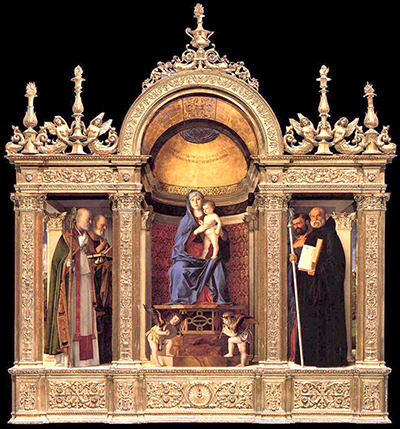
Bellini’s signed and dated Frari Triptych of 1488 was made for a different Franciscan church. It preserves a monumental wooden frame and three distinct fields across which Bellini carries a related architectural design. At San Giobbe the room is continuous, and the immediate transition at the sides is from carved stone to painted architecture. In the later San Zaccaria Altarpiece of 1505, the Virgin also sits beneath a vaulted interior, but four saints and a single musician occupy a space open to daylight and landscape at the sides. The San Zaccaria work remains in its own Venetian church. San Giobbe’s panel and altar are in separate places, and its closed, mosaic-lined chapel makes fullest sense when the two surviving parts are considered together. [2] [5] [17] [18]
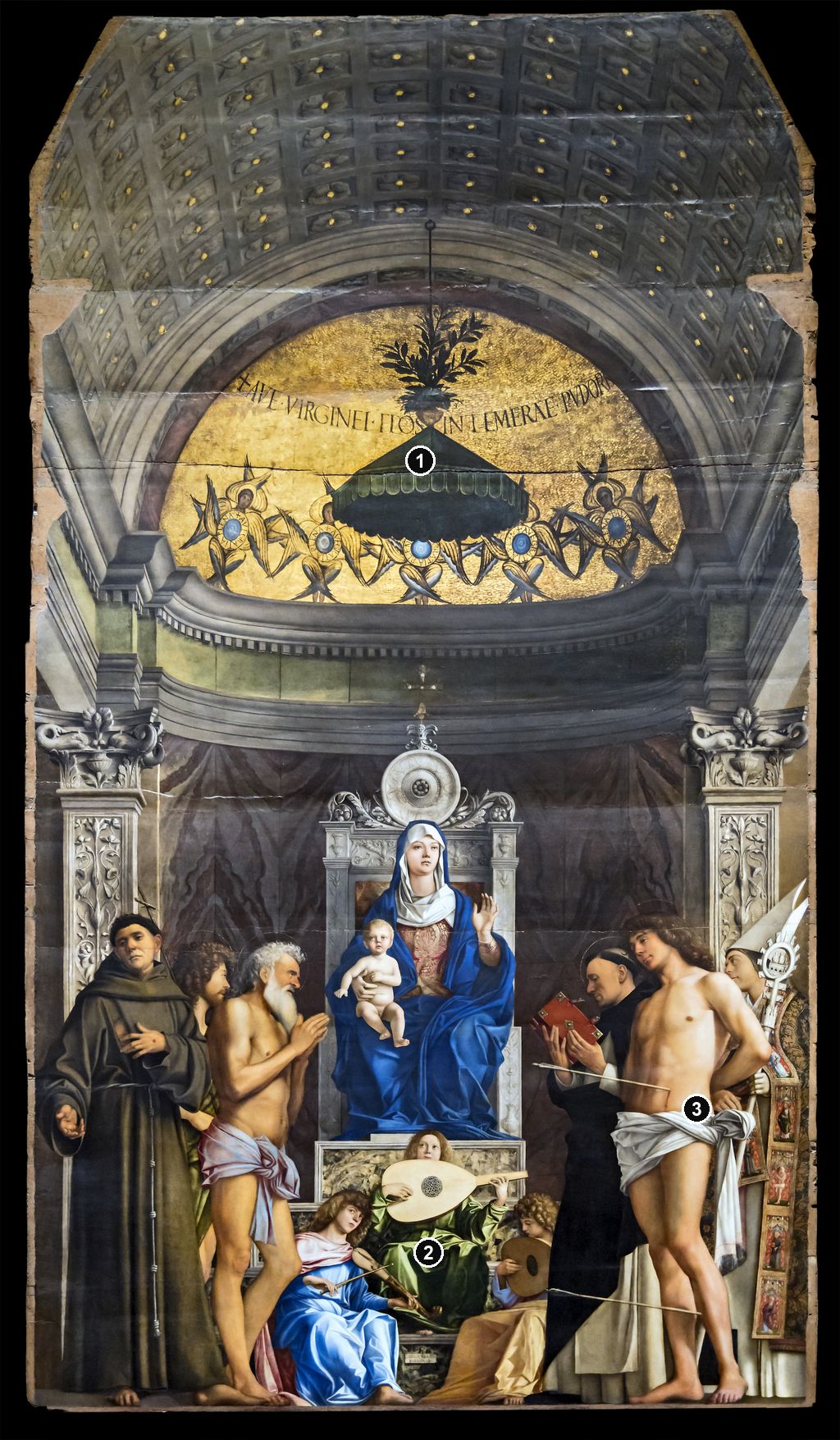
Annotated Details from San Giobbe Altarpiece
Numbered overview and cropped details also licensed under CC BY-SA 4.0. Photograph Didier Descouens via Wikimedia Commons. Image source. CC BY-SA 4.0.
Details from SAN GIOBBE ALTARPIECE
Follow the painted interior down from the gold vault to the figures closest to the altar.
The gold half-dome
The curving vault and gold ornament lead towards the centre of the painting above the Virgin and Child.
The angel musicians
The clustered players occupy the low steps immediately below the throne. Their colour and instruments draw the eye down the centre line.
The figure of Sebastian
The almost unclothed figure to the right stands against shaded architecture. He makes a strong vertical counterpart to the figures across the throne.
Related reading
Artworks directory
Discussion
Look again at the images and ideas explored in San Giobbe Altarpiece by Giovanni Bellini. These editorial prompts invite your observations.
Reader Insights
Where does the actual frame give way to Bellini’s imagined chapel?
Which details make the gathered saints feel as though they share the angels’ space?
What does the inscription in the apse add to the scene seen from below?
Join the Conversation
Share a detail, comparison or question about San Giobbe Altarpiece by Giovanni Bellini below.
References
- Gallerie dell’Accademia di Venezia, San Giobbe Altarpiece, catalogue 38 and conservation chronology View source.
- Carlo Corsato, “Measurements and the Original Setting of Giovanni Bellini’s San Giobbe Altarpiece”, pp. 102–17 View source.
- Seiko Hoshi, “Logic in Church Decoration: Church of San Giobbe in Venice in the Late Fifteenth Century”, Keio University View source.
- Rona Goffen, “Bellini, S. Giobbe, and Altar Egos”, Artibus et Historiae View source.
- Seiko Hoshi, “A Quantitative Analysis of the Venetian Altarpieces”, Keio University View source.
- Venetian Heritage, San Giobbe Altarpiece conservation project View source.
- Terence Dawson, “Giovanni Bellini, the San Giobbe Altarpiece, and the imitatio Christi”, Jung Journal View source.
- Emanuele Lugli, “The Collapse of Representational Planes”, Kunsthistorisches Institut in Florenz, p. 128 View source.
- Gallerie dell’Accademia di Venezia, Vittore Carpaccio’s Presentation of Jesus in the Temple View source.
- The Open University, “Two Devotional Paintings”, Art in Renaissance Venice View source.
- National Gallery Prague, The Feast of the Rose Garlands through Five Centuries View source.
- Gallerie dell’Accademia di Venezia, San Giobbe conservation and technical findings View source.
- Elena Sara Saeed and colleagues, “Non-Destructive Diagnostics of Timber Altarpieces”, COMPDYN 2025 View source.
- Italian Ministry of Culture, temporary San Giobbe conservation workshop and support structure View source.
- Gallerie dell’Accademia di Venezia, temporary Room II closure for the second conservation phase View source.
- Gallerie dell’Accademia di Venezia, European Heritage Days programme of 27 September 2026 View source.
- Michael Douglas-Scott, “The Pesaro Triptych by Giovanni Bellini in the Frari, Venice”, Artibus et Historiae View source.
- Venezia Unica, San Zaccaria and Bellini’s 1505 altarpiece View source.
- Michele Lodone, “San Giobbe nell’Italia del Rinascimento. Le dimensioni di una devozione”, pp. 38–39 View source.
- Elena Sara Saeed and colleagues, “Study of the Dynamic Behaviour of a Timber Altarpiece Using Laser Vibrometers”, 2023, p. 92 View source.