 by Tom Gurney
Tom Gurney BSc (Hons) is an art history expert with over 20 years experience
Email: tomgurney1@gmail.com / Phone: +44 7429 011000
A Venetian confraternity’s Alexandria
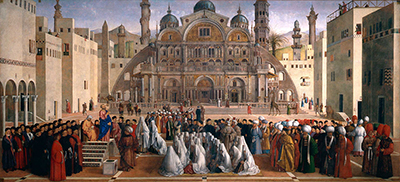
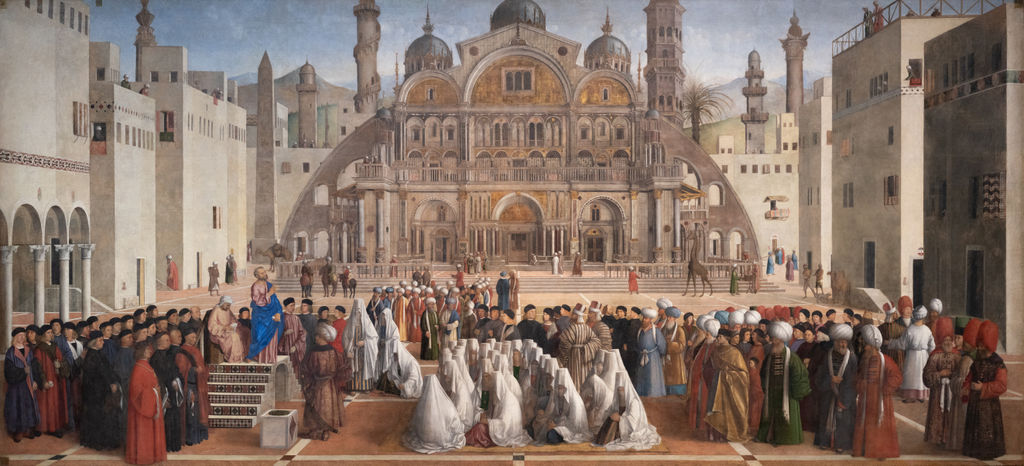
St Mark stands on a low platform at the left of an immense square. Beyond the people gathered to hear him, a basilica fills the centre of the canvas. Its domes and arches evoke St Mark’s in Venice, while an obelisk, minarets and a giraffe place the story across the Mediterranean. Gentile Bellini began St Mark Preaching in Alexandria for a Venetian confraternity in 1504. Giovanni Bellini finished it after Gentile’s death in 1507. The Pinacoteca di Brera in Milan catalogues the oil on canvas under both names, dates it 1504–07 and records its dimensions as 347 × 770 centimetres. [1]
At a Glance
- ArtistGentile Bellini and Giovanni Bellini
- DateBegun in the early 1500s, completed after 1507
- MediumPaint on canvas
- LocationPinacoteca di Brera, Milan
The work in Bellini’s career
The Agony in the Garden
c. 1458–60Presentation at the Temple
c. 1475A Venetian confraternity’s Alexandria
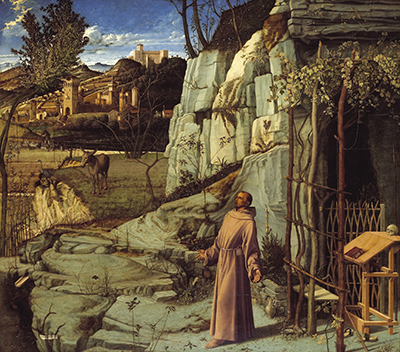
Begun in the early 1500s, completed after 1507St. Francis in the Desert
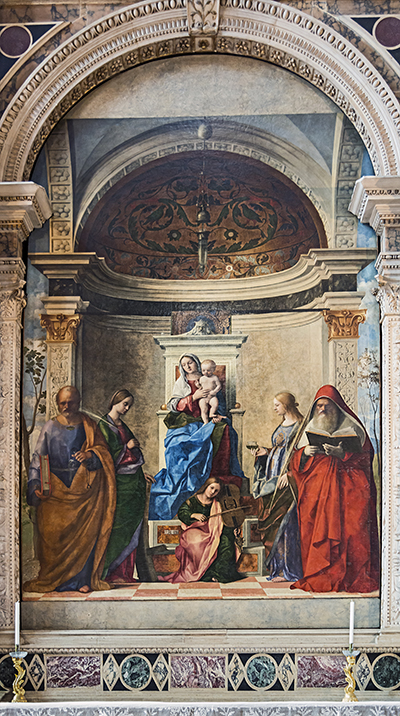
Late 1470sFrari Triptych
1488Madonna of the Meadow
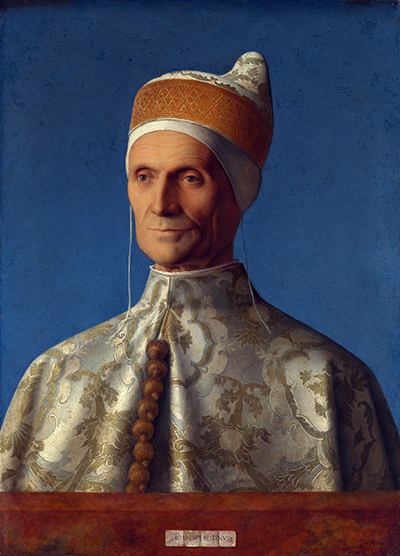
c. 1500–05Doge Leonardo Loredan
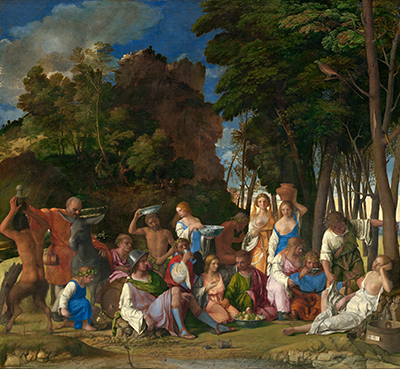
c. 1501–02The Feast of the Gods
Bellini’s signed date 1514A painting for the Scuola Grande di San Marco
The canvas was made for the Sala dell’Albergo of the Scuola Grande di San Marco, a lay religious confraternity named for Venice’s patron saint. The Albergo was the meeting and reception room of the Scuola’s governing officers. The confraternity lost its building and much of its decoration in a fire in 1485. In 1492 the Bellini painters, both members, offered to help decorate the rebuilt premises. The Scuola accepted Gentile’s proposal for the room in 1504. Its head, Marco Pellegrini, also commissioned the room’s coffered ceiling. Gentile served as his deputy, so the painter had a place in the institution whose members would appear on the canvas. [2] [3] [4] [5]
In Christian tradition, Mark brought the Gospel to Alexandria and was martyred there. Venice claimed a special connection with him through the story of two Venetian merchants who carried his relics home from Alexandria in 828. His tomb became the focus of the Venetian basilica. By depicting the preaching for the Scuola, Gentile could show the beginnings of the saint’s ministry in the city from which Venice traced its claim to his relics. The confraternity also planned a separate Martyrdom of St Mark. Gentile undertook to paint it in 1505. A later agreement commissioned Giovanni in 1515, and Vittore Belliniano completed that canvas after Giovanni’s death. It is now in the Gallerie dell’Accademia in Venice. [4] [5] [6] [7]
A sermon staged across a square
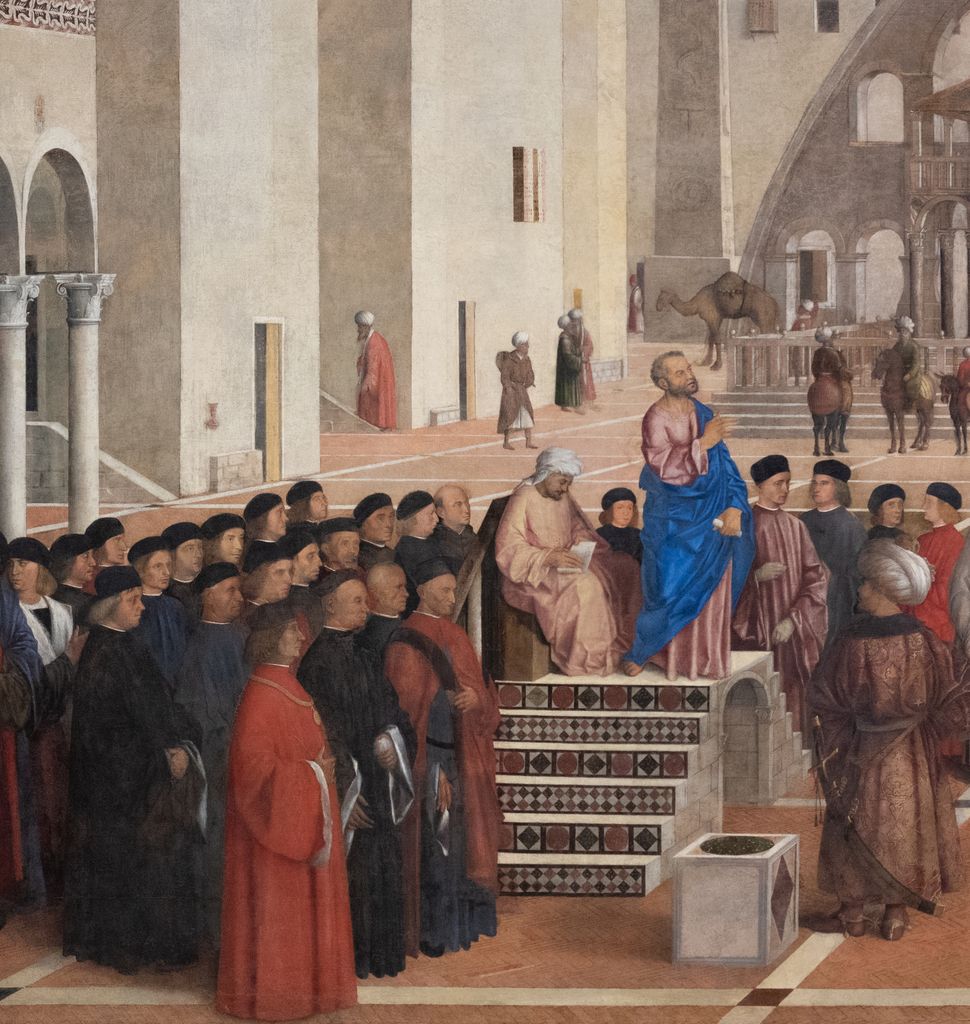
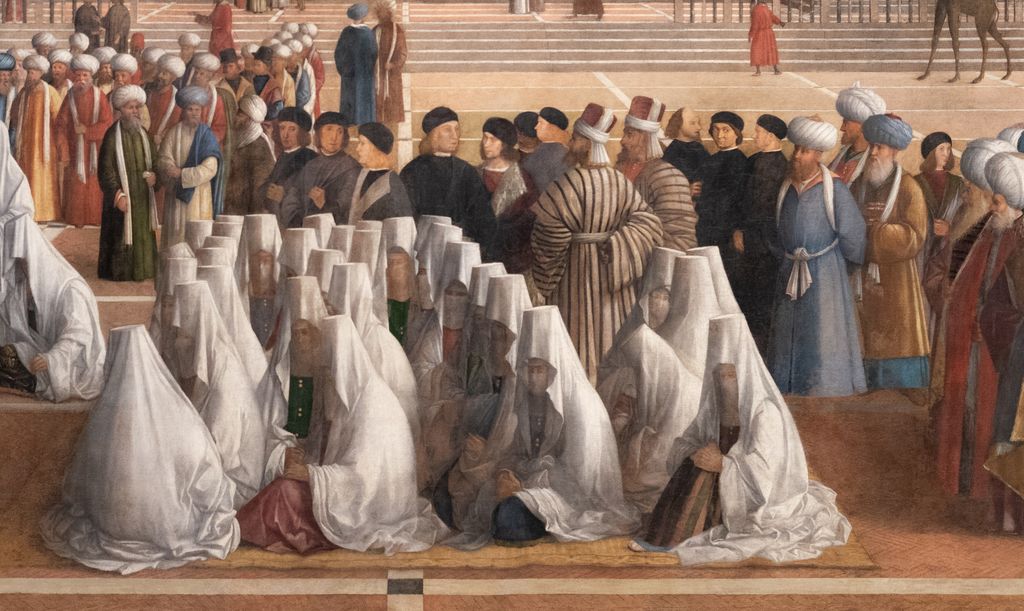
The saint’s raised hand directs attention towards the people in front of him. A writer sits close by, recording his words. The white veils of the seated and kneeling women form a broad band low in the picture, then the robes and headgear of the standing audience draw the eye across to the right. Behind Mark, the dark caps and clothes of Venetian confraternity members give another group a distinct profile. The listeners make an irregular line across the width of the canvas. Behind them, isolated figures cross the open paving, leaving room to see the steps, doorways and walls that define the square. Its breadth allows the sermon, the movement of the city and the fine distinctions among faces and clothes to register in a single view. [1] [5] [8]
A comparison with Gentile Bellini’s Procession in Piazza San Marco of 1496 shows what the painter could do with that expansive format. The earlier canvas served a different confraternity, the Scuola Grande di San Giovanni Evangelista, and depicts a miracle associated with a relic of the True Cross. There, the long line of the procession and the actual Venetian basilica set the scale of the episode. The Preaching uses a related arrangement, with the main action to one side and a building closing the view. Here the familiar setting has been reassembled for the story of a different city. The decision to place Mark to the left gives the crowd and its surroundings unusual weight for a picture of a sermon. [1] [9] [10]
Which Alexandria did the Bellinis paint?
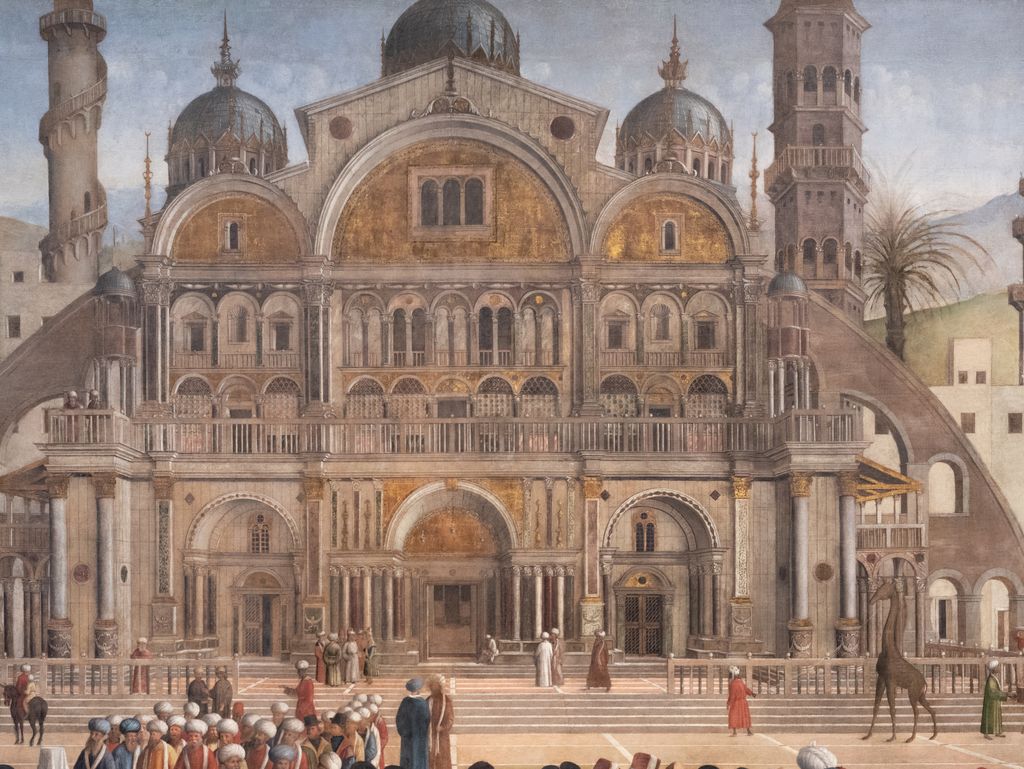
The basilica sits at the top of broad steps. Its arched openings, decorative surfaces and domes recall the Venetian church, while buttresses and minarets have invited comparisons with Hagia Sophia in Constantinople. Writing in 1550, Giorgio Vasari identified the building as Hagia Sophia and praised the perspective that allowed the painter to show so much of it. Lorenzo Pericolo also traces parallels with the façade of the Scuola Grande di San Marco and discusses the relevance of San Vitale in Ravenna. In the painted building, the buttresses help shape passages beside the central façade and do not follow Hagia Sophia’s structure exactly. Brera’s audio guide points to a small figure at the main entrance apparently removing his shoes. With a minaret nearby, that gesture makes the building legible as a mosque as well as a place that recalls the Venetians’ church. [1] [8] [10] [17]
Other elements refer more directly to Egypt. Nevine Rateb compares the obelisk at the left and the isolated column beside the basilica to landmarks known to travellers in Alexandria. The column has been linked to the late Roman monument commonly called Pompey’s Pillar. Rateb also compares the tower with an outer stair to the minaret of the Ibn Tulun mosque in Cairo. These identifications draw on different kinds of evidence. The column evokes a monument associated with the city named in the title, while the stair tower suggests how an architectural form from elsewhere in Egypt could be borrowed for the setting. The result has the specificity of a place assembled from recognisable fragments. It contains details from several places and periods, including the painters’ own. The smaller buildings give that mixture a domestic scale. Carpets hang from windows, and a round-arched portico opens at the far left beneath a wall with bands of ornament. [8] [10] [11]
Clothes, portraits and contact with the eastern Mediterranean
Gentile had travelled to the Ottoman court in 1479 on behalf of Venice. His portrait of Sultan Mehmet II, dated 1480 and now in the National Gallery’s collection, is a separate work from that encounter. Rateb compares the headgear of the sword-bearing man close to Mark’s platform to the sultan’s, identifying the figure as Ottoman. Her study distinguishes it from forms of Mamluk headgear elsewhere in the same crowd. At the far right, several men wear high rounded caps that Rateb relates to headgear worn by Mamluk dignitaries. Venice traded with both the Mamluk and Ottoman worlds. The costumes in the picture bring those distinct societies into the same square. [6] [11] [12]
The white veils also have their own history in the scholarship. Alan Chong and Wibke Joswig have compared a standing woman in the painting with a pen drawing now at the Louvre. The Louvre catalogues that sheet as a copy after Gentile and records arguments for Gentile’s authorship. Its relation to the painted woman raises the possibility that a study of dress associated with Constantinople could be adapted for a crowd in Alexandria. Neither the drawing nor the comparison establishes a name or place of origin for the painted listener. [18] [19]
Individual names are harder to establish. The red-robed man wearing a gold chain near the Venetian group is generally identified as Gentile, whom Mehmet II honoured with a gold chain and medallion. The identification of the sitter leaves open which Bellini painted him. Gabriele Matino also questions the traditional identification of a different red-cloaked man near the platform as Marco Pellegrini. Comparing the painting with a likeness in a confraternity register from 1497, he suggests that Pellegrini may instead be the soberly dressed figure immediately to the left of Gentile. Matino presents that identification as provisional. The name matters because of Pellegrini’s role in securing the commission, while the organisation of the Venetian group already makes visible the status of the officers who gathered in the room. [5] [6]
Venetian dealings with Alexandria gave the setting an immediacy for the Scuola’s members. As recently as 1502 the Venetian envoy Benedetto Sanudo had visited the city and presented gifts to a Mamluk official there. Rateb reads the crowded but orderly square in light of such commercial and diplomatic relations. Brera’s audio guide calls attention to the same armed man near Mark as a possible sign of the danger that will lead to the saint’s death. The placid appearance of the square can accommodate that threat. The blade is easy to miss amid the bright clothes and the many people attending to their own affairs. [6] [8] [11]
Gentile’s will and the work of completion
Gentile’s will of 19 February 1507 asked Giovanni to finish the Preaching. In Ursula Schmitt’s account of the documents, the Scuola was to pay Giovanni for the work, and completing it would also earn him a book of drawings by Jacopo Bellini. If Giovanni did not fulfil the request, the book was to go to Gentile’s wife. Giovanni declared his willingness to proceed on 7 March. Pericolo identifies the Jacopo album in the British Museum as a likely candidate for the volume mentioned in the will, with the identification still open. The book mattered to the completion of the commission as a family possession and as a collection of designs of the kind that had shaped the painters’ practice. [4] [10]
The records establish who began and finished the painting. The paint itself gives a more complicated account of the work between those points. Brera gives Gentile the overall design and tentatively attributes the sharply characterised confraternity portraits on the left to Giovanni. Pericolo also credits Giovanni with changing the buildings along the sides of the square, while leaving the main basilica substantially as Gentile conceived it. There were changes to individuals, too. Infrared examination disclosed an earlier book beneath the scroll on which the seated scribe writes. The change is visible in the technical record, and it is harder to assign its design and execution to a particular painter. [1] [10] [13]
The canvas also preserves decisions made at the scale of a brushstroke. Antonietta Gallone and Olga Piccolo found azurite beneath a layer rich in lapis lazuli in a sample from Mark’s blue mantle. A sample of blue sky yielded azurite bound with egg and a thin upper layer that included lapis lazuli and red lake. Such local findings show how the painters obtained different effects from related blue pigments. The researchers also found that some samples from buildings had a more fluid second application over a layer with a similar mixture. They considered Giovanni’s completion a possible explanation for that change. Samples and infrared views cover selected areas, and the authors distinguish observations about layers and revisions from their proposals about the painter responsible. Gallone and Piccolo also argue for some involvement by Giovanni at the planning stage. The documented handover took place in 1507, while the precise stage of completion at that point remains open. [1] [13]
From the Albergo to Brera
The painting was selected for Brera when the Scuola’s collection was dispersed under Napoleonic rule. Gallone and Piccolo cite records of its assignment to the Milan gallery in February 1809. After its removal, damaged areas and earlier repairs complicated later conservation. A modern intervention removed yellowed varnish and old retouching, recovering passages of original paint, while technical examination helped record some forms obscured below the surface. A reproduction in the Sala dell’Albergo now gives a sense of the canvas’s place in its original setting. The original is Brera inventory 160. [1] [13] [14]
The Preaching belongs among several different Venetian treatments of Mark’s time in Alexandria. Cima da Conegliano’s earlier Healing of Anianus in Berlin shows Mark treating an injured cobbler. It was made for a separate group of paintings for the chapel of the Luccan silk workers in Venice. Berlin’s catalogue associates a different Sermon of St Mark, by Lattanzio da Rimini and known from a drawing, with that earlier series. In a later canvas for the Scuola Grande di San Marco, Giovanni Mansueti depicted Mark baptising Anianus, with the rite set well back among figures and buildings. The Bellinis give their own episode a distinctive balance. The preacher stands near the viewer and off centre, so the crowd that hears him and the city where he speaks take up much of the room. [1] [15] [16]
Annotated Details from Saint Mark Preaching in Alexandria at Brera
Numbered overview and cropped details. Photograph Faithful reproduction shared on Wikimedia Commons. Image source. CC0 1.0.
Details from SAINT MARK PREACHING IN ALEXANDRIA AT BRERA
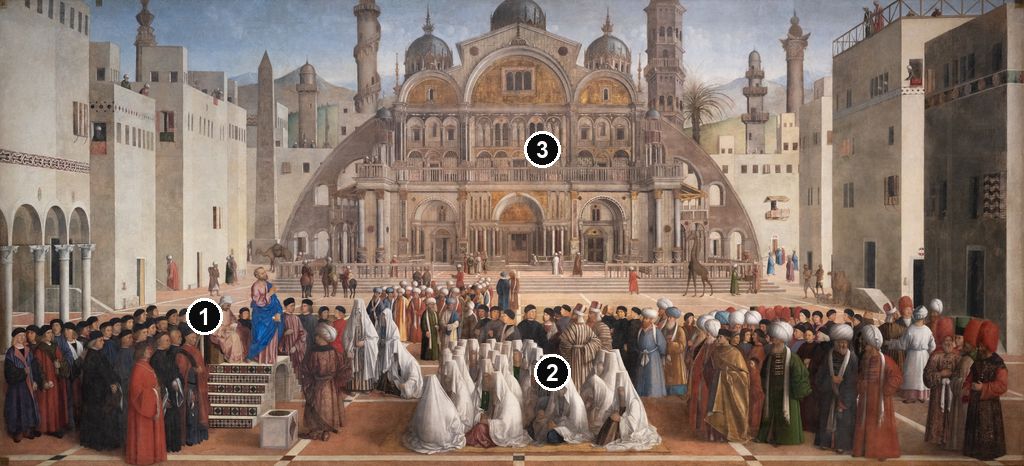
Read the painting from the preacher at the left across the crowd and the broad architectural background.
The preacher’s platform
Mark is elevated at the left above a row of steps. The platform gives him a place at the edge of the crowd and a clear view across the square.
White drapery in the crowd
Robes and veils catch the light in the centre of the foreground. The figures’ positions carry the eye from the speaker to the listeners.
The domes and the façade
Domes, arches and tall, narrow features form a backdrop that extends well above the crowd. The architectural space is built from forms that would be recognised from different places.
Related reading
Artworks directory
Discussion
Look again at the images and ideas explored in St Mark Preaching in Alexandria by Gentile and Giovanni Bellini. These editorial prompts invite your observations.
Reader Insights
What makes the square legible as a place even when its buildings draw on different cities?
Which evidence tells us how the commission passed between the brothers?
How does the position of the listeners shape the space between the preacher and the buildings?
Join the Conversation
Share a detail, comparison or question about St Mark Preaching in Alexandria by Gentile and Giovanni Bellini below.
References
- Pinacoteca di Brera, St. Mark Preaching in Alexandria, inv. 160 View source.
- Scuola Grande di San Marco, institutional history and the fire of 1485 View source.
- Scuola Grande di San Marco and Save Venice, Incontri Belliniani, account of the 1492 proposal View source.
- Ursula Schmitt, “Bellini, Gentile,” Dizionario Biografico degli Italiani View source.
- Gabriele Matino, “Identità e rappresentazione. I ritratti di gruppo dei cittadini originari della Scuola Grande di San Marco, 1504–35,” Venezia Cinquecento 49, pp. 5–63 View source.
- Elizabeth Marwell, Trinita Kennedy and Stefano Carboni, “Venice and the Islamic World,” Metropolitan Museum of Art View source.
- Gallerie dell’Accademia, Martirio di san Marco View source.
- Pinacoteca di Brera, Spanish audio guide, “La predicación de San Marcos en Alejandría” View source.
- Gallerie dell’Accademia, Gentile Bellini’s Processione in piazza San Marco View source.
- Lorenzo Pericolo, “Incorporating the Middle Ages: The Bellini and the ‘Greek’ and ‘German’ Architecture of Medieval Venice” View source.
- Nevine Rateb, “Saint Mark Preaching in Alexandria: A New Perspective,” Mamlūk Studies Review 26, 2023, pp. 71–96 View source.
- National Gallery, London, Gentile Bellini’s The Sultan Mehmet II, NG3099 View source.
- Antonietta Gallone and Olga Piccolo, “La Predica di San Marco ad Alessandria d’Egitto di Gentile e Giovanni Bellini: nuovi contributi dalle indagini tecniche,” Arte Lombarda 146–148, 2006, pp. 73–93 View source.
- Scuola Grande di San Marco, Schola II, no. 3, 2023, notice on the Sala dell’Albergo reproduction View source.
- Gemäldegalerie, Staatliche Museen zu Berlin, Cima da Conegliano’s Healing of Anianus by St Mark View source.
- Pinacoteca di Brera, Giovanni Mansueti’s San Marco battezza Aniano, inv. 210 View source.
- Giorgio Vasari, “Iacopo, Giovanni e Gentile Bellini,” from the 1550 edition of the Lives View source.
- Musée du Louvre, Femme drapée, en costume oriental, de face, INV 4654 View source.
- Wibke Joswig, “Gentile Bellini’s Turkish Drawings as Mobile Fantasies” View source.