


 by Tom Gurney
Tom Gurney BSc (Hons) is an art history expert with over 20 years experience
Published on June 19, 2020 / Updated on November 6, 2025
Email: tomgurney1@gmail.com / Phone: +44 7429 011000
The Prophet Jonah by Michelangelo
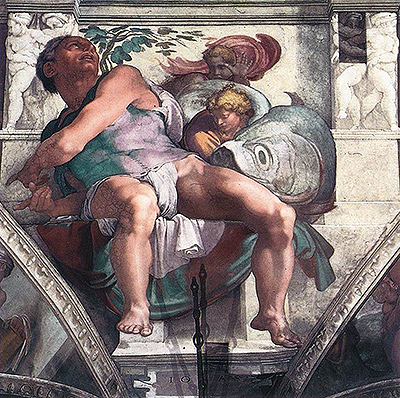
Above the Sistine Chapel altar, Michelangelo’s Jonah leans backward so forcefully that his throne seems barely capable of holding him. His naked upper body twists upward, arms extend behind and face turns toward a vision beyond the painted frame. Beside him, the enormous head of a fish identifies the prophet whose escape from the sea became, in Christian interpretation, a sign of death and resurrection.[6]
Jonah occupies the end opposite Zechariah above the entrance.[1] Their contrast governs the vault: the aged Zechariah bends into a book, while the youthful Jonah opens away from text into bodily revelation. Because Michelangelo later painted The Last Judgement on the altar wall beneath, Jonah’s position acquired an even more powerful relation to resurrection and final things, although the ceiling figure predates that later fresco.[4]
How should Jonah's altar placement and sign-of-Jonah typology be used? The Vatican source supports Jonah's above-the-altar placement, and Matthew 12 supports Christian typology. Neither source proves a technical execution order, hidden programme or image-use clearance, so this route keeps Jonah distinct from Noah scenes and from the later Last Judgment wall.
At a Glance
- FigureThe Prophet Jonah, labelled IONAS
- Artist and mediumMichelangelo Buonarroti; fresco
- LocationAbove the altar end of the Sistine Chapel ceiling[1]
- Opposite figureZechariah above the entrance
- Campaign framePainted for Julius II during the 1508–1512 vault project[2]
- EnsembleOne of seven prophets alternating with five sibyls[1]
- Principal attributeA great fish beside the throne
- Defining poseTorso arched backward, head raised and arms extended behind
- CompanionsTwo attendants clustered above and behind the fish
- Christian typologyThe “sign of Jonah” connects his three days with Christ’s death and resurrection[6]
- Identity cautionJonah is a prophet, not one of the Noah figures in the central Genesis stories
- Chronology cautionHis prominent altar position does not make him part of The Last Judgement campaign
Contents
- Jonah in the Biblical Story
- Nineveh, Mercy and the Resistant Prophet
- The Great Fish
- The Sign of Jonah
- A Body Leaning Beyond Its Seat
- The Upturned Face
- Arms Drawn Behind
- The Exposed Torso
- Legs and Feet as Counterweight
- Garment and Gourd Vines
- The Two Attendants
- The Tablet IONAS
- Jonah and Zechariah at the Two Ends
- Jonah After Jeremiah
- Not One of the Noah Scenes
- Above the Altar and The Last Judgement
- Campaign and Working Evidence
- Looking Up from the Altar End
- Restoration and Material Surface
- Why Jonah Matters
- Artist Up Close
Jonah in the Biblical Story
The Book of Jonah tells of a prophet commanded to go to Nineveh who instead flees by ship. A storm leads to his being cast into the sea and swallowed by a great fish; after prayer and deliverance, he preaches, the city repents and Jonah struggles with divine mercy.[7]
The narrative combines refusal, death-like confinement, rescue, successful prophecy and resentment. Jonah is neither a simple hero nor merely the man with a whale.
Michelangelo does not illustrate ship, sailors, Nineveh or gourd episode. Fish and prophet condense identity.
The upward pose shifts attention from narrative detail to Jonah’s typological role inside Christian salvation history.
Nineveh, Mercy and the Resistant Prophet
Jonah’s deliverance is not the book’s conclusion. He preaches to Nineveh, the city repents and God withholds destruction. Jonah reacts with anger, revealing how reluctantly he accepts mercy extended beyond his own community.[7]
This aftermath complicates the heroic reading suggested by physical grandeur. The prophet is saved and effective, yet morally resistant.
The plant episode teaches him through shade gained and lost. His concern for the plant is set against divine concern for a great city.[7]
Michelangelo’s vines and upward attention can evoke this wider story without illustrating the dialogue literally. Fish and foliage together keep deliverance, anger and mercy within the figure’s identity.
Typology does not erase character. Jonah can signify resurrection in Christian interpretation while remaining the difficult prophet of his own book.
The Great Fish
The fish’s head occupies the space beside Jonah, mouth open and eye visible. Its scale makes it unmistakable even though the biblical text does not specify a whale.[7]
“Great fish” is therefore the most accurate description. Familiar whale language belongs to later popular retelling and translation traditions.
The creature functions as attribute and compressed history. One head evokes storm, swallowing, confinement and deliverance.
Its rounded volume also counterbalances Jonah’s extended body, filling the side of a throne otherwise torn open by his backward arch.
The fish looks almost sculptural, its head wedged beside attendants and prophet. Yet its size is pictorially selective: enough of the creature appears for identification, not a complete zoological body.
This partial presence mirrors the compressed narrative. Michelangelo supplies what memory needs—the open mouth and massive head—while architecture conceals the rest.
The Sign of Jonah
In Matthew, Jesus compares Jonah’s three days and nights in the fish with the Son of Man’s time in the heart of the earth.[6] Christian tradition therefore read Jonah as a type of Christ’s death and resurrection.
This connection explains his exceptional prominence above the altar. Liturgical sacrifice below and typological deliverance above enter a powerful vertical relation.
The ceiling predates Michelangelo’s Last Judgement, but the later altar-wall fresco placed resurrection and judgment beneath a prophet already associated with return from death.[4]
Historical order should remain clear: Jonah was not designed as a figure inside the 1530s–1540s wall composition, even though the two works now interact.
A Body Leaning Beyond Its Seat
Jonah’s pelvis remains on the throne while torso arcs backward and diagonally. One shoulder rises, head tips and arms reach behind.
The pose feels almost impossible because weight seems to leave the seat. Spread legs and feet below provide the counterforce preventing collapse.
Michelangelo distributes the arch across abdomen, ribs, shoulders and neck. It is not a simple bent back but a chain of changing directions.
Prophetic revelation becomes a bodily opening toward the ceiling’s highest space.
The Upturned Face
Jonah’s face angles sharply upward, mouth slightly open and eyes directed beyond the niche. Unlike Zechariah, he does not look at book, attendant or observer.
The gaze creates an unseen object of revelation. Empty painted space acquires force because the prophet responds to it.
His expression can suggest astonishment, recognition or inspired attention. It should not be assigned a literal vision absent from the fresco.
The head completes the bodily arc: what begins in grounded feet ends in sight projected upward.
Arms Drawn Behind
Both arms extend backward and down along the seat, hands joining or approaching behind Jonah’s body. Their position opens chest and abdomen fully.
This is the opposite of Jeremiah’s enclosure. Nothing shields Jonah’s torso.
The arms also create leverage. By pressing or reaching behind, they help explain how the body sustains its arch.
Anatomy serves both physical plausibility and theological expression: revelation is openness under tension.
The Exposed Torso
Jonah’s upper body is largely nude beneath a sleeveless garment. Chest, abdomen and shoulders carry the twisting strain.
Exposure separates him from the heavily clothed reading prophets. The body itself becomes the medium of prophecy.
Nudity should not be confused with vulnerability alone. Here it permits the clearest possible statement of expansion and breath.
Michelangelo’s anatomical knowledge turns typological significance into felt muscular action without reducing sacred meaning to physique.
Legs and Feet as Counterweight
Jonah’s thighs open broadly, with knees projecting toward the viewer. One foot presses on the ledge while the other hangs or reaches differently into space.
Their asymmetry stabilises the upper twist. The body’s centre of gravity remains contested but credible.
The legs also enlarge his silhouette at the altar end, making him capable of holding the visual termination of the long vault.
From below, their powerful spread may register before the upturned facial expression.
Garment and Gourd Vines
Green-blue fabric wraps Jonah’s lower body and crosses parts of the torso, while pale cloth appears near the waist. Above and behind, leafy vines evoke the plant in Jonah’s story.[7]
The book recounts a plant that gives shade and then withers, becoming part of God’s lesson about mercy. The foliage can therefore extend Jonah’s identity beyond the fish episode.
Care is still required. Individual leaves should not be catalogued botanically without supporting evidence.
Fabric and vegetation soften the throne’s pale architecture while preserving the prophet’s exposed core.
The Two Attendants
Two smaller figures cluster behind Jonah and above the fish. One older or draped figure raises a hand near the head; a younger curly-haired companion looks downward.
Their compressed poses fill the recess created by the prophet’s arch and the fish’s mass.
They may respond to Jonah’s revelation, but no exact dialogue or personal identities are provided in the institutional ensemble source.[1]
Their presence makes the altar-end figure a group while leaving Jonah psychologically directed beyond them.
The Tablet IONAS
The name tablet beneath the ledge uses the Latin form IONAS. Modern English uses Jonah.
The inscription confirms identity even before the fish is interpreted. Attribute and name reinforce one another.
Roman lettering integrates the Hebrew prophet into Michelangelo’s classicising fictive architecture.
The tablet is partly affected by the real and painted structures around the altar end, reminding observers that identification occurs within architecture.
Jonah and Zechariah at the Two Ends
Zechariah above the entrance is aged, covered and absorbed in a book. Jonah above the altar is youthful, exposed and looking upward.[1]
One bends forward; the other backward. One closes around writing; the other opens toward vision.
Their opposition gives the prophetic company a long-range structure not visible in isolated reproductions.
It also frames a visitor’s movement. Entry passes beneath reading; approach to altar culminates beneath revelation and typological resurrection.
Jonah After Jeremiah
Within the final part of the prophetic sequence, Jeremiah’s bowed grief gives way to Jonah’s backward expansion.
The two bodies form inverse responses to knowledge. Jeremiah supports his descending head; Jonah sends his face upward.
Neither pose should be reduced to despair versus joy. Jonah’s biblical story includes anger and resistance, while Jeremiah’s book includes hope.[7]
The visual contrast concerns orientation, not a complete summary of character.
Not One of the Noah Scenes
Jonah’s name can be confused with Noah because both are prophetic biblical figures associated with water and survival. They belong to different books and pictorial systems.
The central Genesis panels include Noah’s sacrifice, the Flood and drunkenness.[3] Jonah sits outside them among later prophets.
His fish is not Noah’s ark, and his deliverance from the sea is not an episode of Genesis.
Keeping these identities separate preserves the ceiling’s layered chronology.
Above the Altar and The Last Judgement
Jonah was painted during the 1508–1512 ceiling campaign.[2] The Last Judgement appeared on the altar wall decades later under a different papal commission.[4]
The two now form one visual field. Jonah’s resurrection typology speaks powerfully to bodies rising, falling and being judged below.
That present relation is historically cumulative. Michelangelo could adapt the later wall to an existing ceiling whose altar-end prophet already carried meaning.
Authorship across two campaigns does not erase their chronological distinction.
Campaign and Working Evidence
The Vatican records the ceiling contract, staged progress and 1512 completion.[2] Jonah belongs securely to this campaign.
His altar prominence and formal complexity do not by themselves provide an exact working date. Fresco execution included surrounding figures and architecture.
Nor should the later wall fresco be used to date or explain every initial ceiling decision retrospectively.
Evidence is strongest when original campaign and later spatial interaction are both preserved.
Looking Up from the Altar End
Jonah’s position makes viewpoint unusually important. Seen from below, his backward arch can appear to bridge the curved vault and vertical altar wall.
Smarthistory emphasises the ceiling’s height and the demands of upward viewing.[5] Jonah exploits those conditions more dramatically than a comfortable frontal photograph suggests.
A close crop clarifies fish, attendants and anatomy but removes the end-axis with Zechariah and the relation to the altar.
Whole-chapel orientation is therefore essential to the figure’s meaning.
Restoration and Material Surface
The chapel history frames the modern conservation through which Jonah’s colours and modelling are seen today.[4]
Surface cracking is visible across torso and fish in close images. It records material age rather than deliberate anatomy.
Digital reproduction can change the green garment, skin tone and fish’s grey mass substantially.
Stable analysis depends on pose, attribute, inscription and location across these variations.
Why Jonah Matters
Jonah matters because his body terminates the vault with revelation rather than reading. Michelangelo makes the altar end an act of opening.
He matters because fish, gourd and inscription compress a complex prophetic story without turning the throne into narrative illustration.
Most importantly, Christian typology and architectural position reinforce one another. A prophet delivered from the deep leans above the place where death and resurrection are liturgically and pictorially invoked.
His biblical resistance to mercy keeps that typology from becoming a flat emblem. Monumental revelation coexists with a story of reluctant human understanding.
Artist Up Close
Michelangelo makes theology inseparable from leverage. Jonah’s feet and arms keep him on the throne while his torso escapes its ordinary axis. The body feels caught between falling backward and rising into vision. That instability is the figure’s power: resurrection is not represented as a calm label, but as an orientation strong enough to reorganise every limb.
Frequently Asked Questions
Discussion
What seems most important in Michelangelo's Jonah: the above-the-altar placement, the sign-of-Jonah typology, or the way the figure frames the Genesis scenes without becoming one of them?
Reader Insights
How does Jonah's location shape the way the ceiling is read?
How should scriptural typology guide interpretation without becoming a hidden-code claim?
How does Jonah frame the Genesis scenes while staying separate from the Noah narratives?
Join the Conversation
Compare Jonah's altar placement, typological role and relationship to the Genesis scenes while keeping the route focused on Michelangelo's painted ceiling figure.
References
- Vatican Museums, Sibyls and Prophets”:, View source.
- Vatican Museums, Sistine Chapel Ceiling”:, View source.
- Vatican Museums, Central Stories”:, View source.
- Vatican Museums, Sistine Chapel History”:, View source.
- Smarthistory, Michelangelo, Ceiling of the Sistine Chapel”:, View source.
- United States Conference of Catholic Bishops, Matthew, Chapter 12”:, View source.
- United States Conference of Catholic Bishops, Jonah, Chapter 1”:, View source.