

 by Tom Gurney
Tom Gurney BSc (Hons) is an art history expert with over 20 years experience
Published on June 19, 2020 / Updated on November 6, 2025
Email: tomgurney1@gmail.com / Phone: +44 7429 011000
Michelangelo’s Madonna of Bruges
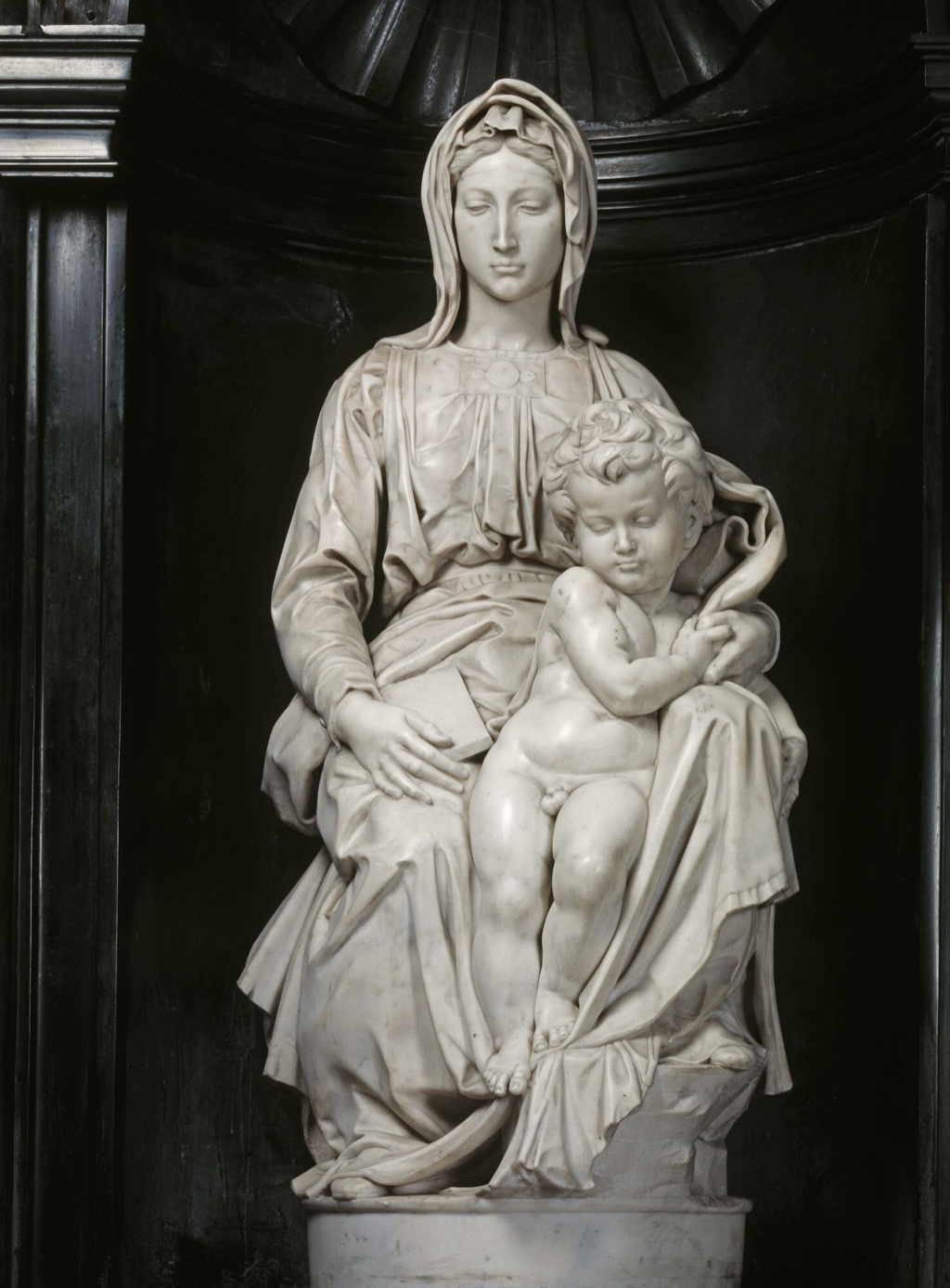
Michelangelo’s Madonna of Bruges is a marble sculpture of the Virgin Mary and the Christ Child made about 1503–1505. Mary sits upright while the nude child moves forward from her lap, supported by her hand and by the folds of her clothing. The sculpture belongs to the Church of Our Lady in Bruges and is displayed in the church’s museum section under the management of Musea Brugge.[1]
Its quiet appearance conceals an unusually mobile history. The sculpture travelled from Italy to Bruges during Michelangelo’s lifetime, was given to the church in 1514, was removed to Paris in 1794 and returned in 1816, then was seized again by German forces in 1944. It was recovered through the Allied monuments programme and returned to Bruges in 1945.[1]
That history does not turn the work into a relic of wartime adventure alone. The first task is to look closely: at the child’s step, Mary’s restraining but gentle hand, the closed book, the difference between polished bodies and rough stone, and the way an intimate subject is organised for public devotional viewing.
At a Glance
- ArtistMichelangelo Buonarroti
- WorkMadonna and Child, commonly called the Madonna of Bruges
- Date1503–1505 in the current Musea Brugge catalogue
- SubjectThe Virgin Mary with the Christ Child
- MediumMarble; the holding institution’s Dutch catalogue specifies white Carrara marble.[2]
- Dimensions130 × 63.5 × 63 cm in the current collection record
- Inventory numberOLV.0001.VI
- OwnerChurch of Our Lady, Bruges
- ManagerMusea Brugge
- Current locationO.L.V.-kerk Museum, Bruges.[3]
- Acquisition historyAcquired through the Mouscron family and given to the church in 1514.[4]
- Original purposeUnresolved; two current Musea Brugge records disagree over the Piccolomini-altar theory
- Movement historyRemoved to Paris in 1794 and returned in 1816; seized in 1944 and returned in 1945, with the Altaussee extraction separately documented in July.[5]
- AccessibilityThe current museum provides a tactile station interpreting the marble and altar setting.[6]
- Career contextA scholarly museum catalogue places Michelangelo’s sculpture within a practice governed by disegno across media.[7]
- Comparison anchorsThe contemporary David, earlier Vatican Pietà, separate painted Manchester Madonna and secure Piccolomini-altar saints remain distinct comparison works or programmes.[8][9][10][11]
- Conservation recordThe cited institutional accounts do not establish a recent object-specific treatment campaign
Contents
- The sculpture in Bruges
- Mary and the moving child
- The closed book, drapery and rough stone
- Date and place in Michelangelo’s early career
- How the sculpture reached Bruges
- The unresolved Piccolomini-altar question
- A Florentine marble in a Bruges church
- Removal to Paris and return
- Theft in 1944 and recovery from Altaussee
- Ownership, display and conservation limits
- The Madonna in Michelangelo’s wider work
- Artist Up Close
The sculpture in Bruges
The current collection title is simply Madonna and Child. “Madonna of Bruges” distinguishes this sculpture from Michelangelo’s other images of Mary and from the vast Madonna tradition of Renaissance art. The place-name records where the work acquired its long public identity, not where it was carved.
Musea Brugge dates the group to 1503–1505 and records its dimensions as 130 centimetres high, 63.5 centimetres wide and 63 centimetres deep.[1] An older Bruges city-archive description gives a height of 128 centimetres.[4] The difference is a reason to follow the current holding record, not to combine measurements into an invented distinction between sculpture and base.
The group is nearly life-size without being monumental in the manner of David. Mary is seated, yet the vertical arrangement of her torso and the child’s body gives the sculpture an upward emphasis. The child does not rest passively across her lap. He stands and turns, pressing into the folds at her side as if beginning a movement away.
The sculpture remains in the Church of Our Lady, where it belongs to the church rather than to a detached state collection. Musea Brugge manages it and presents it within the O.L.V.-kerk Museum alongside the church’s other historical and artistic holdings.[1][3]
This setting matters. The sculpture is still encountered within a religious building, but its present museum conditions are also part of the experience. Altar, barriers, glazing, changing light and the surrounding church affect the relationship between devotional object and protected masterpiece.
Mary and the moving child
The child’s movement is the composition’s central event. Musea Brugge describes him as a frontal, nude toddler separating himself from his mother’s lap.[2] His torso twists, his legs descend and his hands gather or press against the cloth at Mary’s side. The body is not simply displayed; it appears to negotiate its own weight.
Mary does not lock him into a symmetrical embrace. Her left hand holds his hand while her right rests near a closed book.[2][4] The gestures give the child both support and space. He is joined to her by touch and cloth, yet his direction suggests the beginning of independent movement.
That balance is more precise than a claim that mother and child are emotionally “disconnected.” Their faces do not turn toward one another, but contact continues through hands, drapery and bodily support. Michelangelo makes relation visible without relying on exchanged glances.
Mary’s stillness is also relative. Her knees sit at different heights, the folds across her lap change direction and her fingers open around the book.[2] She presents a stable vertical axis, but the drapery prevents that stability from becoming rigid. The child’s turn activates the whole lower half of the group.
The figures’ lowered eyes resist a simple address to the spectator. Mary’s serious expression can support devotional interpretations concerning the child’s future, but no cited document records a sentence Michelangelo intended viewers to hear in her silence. Formal description should come before psychology.
The composition is strongly frontal because of its devotional and architectural use. Even so, the child’s projection from Mary’s body, the meeting of his legs with the lower forms and the stone’s continuation around the group become clearer from side and three-quarter viewpoints.
The closed book, drapery and rough stone
The closed book is one of the sculpture’s quietest but most important objects. The Bruges city-archive description records it in Mary’s right hand.[4] It may invite associations with scripture, prophecy or contemplation, yet its contents are not visible. Naming a specific biblical passage would go beyond the object.
The book also has a compositional role. Its compact geometry steadies one side of Mary’s body while the child expands outward on the other. Her fingers do not clamp around it uniformly; the small spaces between them keep the gesture alive.[2]
Drapery carries movement across the stone. Folds descend from Mary’s head and shoulders, spread over her torso and lap, and bunch where the child steps forward. The holding institution draws attention to the way his movement presses into her garment.[2] Cloth is not background decoration: it mediates between two bodies and turns the child’s weight into visible tension.
Mary is extensively clothed while the child is nude. The contrast differentiates age, role and surface. Broad folds frame the smaller body, whose limbs and torso are exposed to light more directly. The polished skin and layered fabric emerge from the same marble, making material unity coexist with visual difference.
The group also preserves a contrast between finished passages and rough stone. The Bruges archive describes Mary as seated on an unworked rock rather than an ornate throne.[4] The current collection text likewise contrasts the polished group with a roughly treated lower element.[2] This roughness should not be confused with the radical unfinished state of the Rondanini Pietà. Here it works within an otherwise highly resolved sculpture.
Lighting can exaggerate or suppress these differences. Bright frontal illumination flattens folds; strong side light deepens them. At close range, hands and fabric dominate; from farther back, the church and base restore the group’s devotional scale.
Date and place in Michelangelo’s early career
The current holding record uses 1503–1505.[1] Older summaries often use 1501–1504, partly because the work is placed among Michelangelo’s intensive Florentine projects after his return from Rome. Its beginning is not fixed to one exact day or surviving contract.
Michelangelo had completed the Vatican Pietà shortly before this period and was carving David in Florence from 1501 to 1504.[8][9] The Madonna of Bruges belongs near those works chronologically, but it is neither a reduced David nor a second Pietà. Its scale, subject, intended viewing conditions and relation between figures are distinct.
The Metropolitan Museum of Art’s Michelangelo catalogue describes disegno as both drawing and conceptual design, central to the artist’s work across media.[7] That broad principle helps explain why drawings matter to the study of the sculpture, but it does not authenticate every sheet of a seated Virgin and Child as a direct preparatory study.
Drawings of related Madonna subjects have sometimes been associated with the marble. Similar subject matter or an upright child is not sufficient to make a particular sheet preparatory; that relationship requires an exact object record and scholarly attribution.[7]
The sculpture is also described by Musea Brugge as the first of only a few Michelangelo works to leave Italy during his lifetime.[2] That careful wording is preferable to the popular claim that it is his only sculpture outside Italy. The secure historical point is early export during the artist’s life.
How the sculpture reached Bruges
The sculpture’s transfer north connects Florence to the commercial world of Bruges. Musea Brugge’s visitor account says that the Bruges merchant family Moucron, based in Italy, bought the marble from Michelangelo and shipped it to Bruges.[3] The collection record uses the spelling Mouscron, while Italianised historical references may use Moscheroni.
The current object record says that the Mouscron couple gave the sculpture to the Church of Our Lady in 1514 on condition that it remain there permanently.[1] A Bruges city-archive description identifies the merchant as Jan Mouscron, then living in Florence.[4] These records establish the family connection and the 1514 church gift.
The cited records do not establish every detail in later retellings. Variant personal names, an exact sale year and price, and a particular merchant biography remain outside the secure institutional account.
The move gave the sculpture a durable civic and devotional identity. A marble conceived and carved in Italy became part of a Bruges church, received a place-name and entered the religious memory of another city. “Northern reception” begins with this history of possession, gift and worship, not with a claim that the sculpture instantly transformed Netherlandish art.
The 1514 condition that the sculpture remain in the church gives later removals particular force. Both the French and German seizures broke a locally recorded promise of permanence. Its returns were therefore restorations of place as well as transfers of ownership.
The unresolved Piccolomini-altar question
The sculpture’s original destination is not secure enough for a single declarative answer. Musea Brugge’s English visitor account says it was originally designed for the Piccolomini altar in Siena Cathedral.[3] Its current Dutch collection record says that this long-held theory was decisively refuted several years ago.[2]
Because these two pages from the same institution conflict, the prudent conclusion is not to choose one silently. The Piccolomini connection belongs in the history of interpretation, while the original commission remains unresolved in this account.
Siena Cathedral does securely preserve Michelangelo’s Saints Peter, Paul, Pius and Augustine for the Piccolomini altar.[11] That documented association explains why scholars compared the Madonna of Bruges with the Sienese programme. It does not, by itself, prove that the Bruges group occupied or was intended for its central niche.
The present sculpture is larger and more spatially complex than a simple label “Piccolomini Madonna” would imply. Any reconstruction needs the altar’s measurements, contract language, chronology and the proposed figure’s intended sightline. Without those controls, a digital mock-up could turn a discarded theory into apparent fact.
The alternative is not to assume that the Mouscron family commissioned the sculpture from its first blow. Acquisition from Michelangelo and an original commission are different events. The holding authority supports purchase and shipment; it does not resolve whether the block began for another destination or without a fixed site.
A Florentine marble in a Bruges church
The sculpture arrived in a city with its own rich traditions of religious art, trade and patronage. The Church of Our Lady is a major brick-Gothic building whose museum section also includes the tombs of Mary of Burgundy and Charles the Bold and a Passion triptych by Bernard van Orley.[3]
That environment should not be reduced to a backdrop for an imported Italian celebrity. The Madonna entered an existing culture of Marian devotion and elite commemoration. Its church setting connects the intimate mother-and-child subject to worship, burial, memory and civic identity.
At the same time, the sculpture would have appeared materially distinctive. White marble, extensive polish and a nearly freestanding group differ from the coloured surfaces, painted panels, metalwork and architectural sculpture around it. The contrast does not make the object “more Renaissance” than Bruges art; it shows two artistic economies meeting in one space.
Later writers have often made the work’s export into a story of Michelangelo’s international fame. The transfer certainly shows that merchants operating between Bruges and Italy could acquire an ambitious Florentine marble. It does not reveal how every early viewer responded or prove immediate widespread influence.
The name Madonna of Bruges now makes the city inseparable from the object. The sculpture’s biography after 1514 is not an appendix to its carving. Placement, removal, return and changing display have shaped what generations could see and what the work meant locally.
Removal to Paris and return
The first documented seizure occurred in 1794 during the French Revolutionary period. Musea Brugge records that the sculpture was taken to Paris.[1] It returned only after Napoleon’s defeat at Waterloo, in 1816.[1][2]
This chronology is more precise than saying simply that “French forces stole it and returned it about two decades later.” It separates the removal, the change in European power and the physical return. The year 1815 marks Waterloo; the holding institution gives 1816 for the sculpture’s return.
The event also demonstrates that a work can remain legally and symbolically tied to one place while physically absent. The sculpture’s owner did not change in the modern collection record: it belongs to the Church of Our Lady and is managed by Musea Brugge.[1] Removal to Paris belongs to displacement history, not a normal museum acquisition sequence.
The cited records do not identify the sculpture’s exact Paris display, transport method, treatment or condition before and after the journey. Those parts of the episode remain open.
Theft in 1944 and recovery from Altaussee
The second seizure is unusually well documented by the holding institution. On the night of 6–7 September 1944, German soldiers wrapped the sculpture in a mattress and removed it from the church with eleven valuable paintings.[1] The operation took place as German forces withdrew from Bruges.
Musea Brugge connects the removal with Hitler’s planned museum at Linz and records that the sculpture was hidden with thousands of objects in the Altaussee salt mine in Austria. The collection record gives 16 May 1945 for the Allied monuments team’s discovery of the site.[1]
Discovery, removal from the mine and return were not one event. The Monuments Men and Women Foundation’s photo archive dates the extraction of the Bruges Madonna to 10 July 1945. It says George Stout devised a pulley to lift the sculpture onto a salt cart and credits the accompanying photograph to the United States National Archives and Records Administration.[5]
The works recovered from Altaussee were gathered in Munich. The Madonna then travelled to Brussels, where it was temporarily exhibited at the Museum of Fine Arts, before ceremonies marked its return. Musea Brugge says it moved permanently back to the Church of Our Lady in November 1945.[1][2]
This sequence supports a compelling account without embellishment:
- seizure in Bruges on 6–7 September 1944;
- ncealment at Altaussee;
- lied discovery in May 1945;
- cumented extraction in July;
- ocessing through Munich;
- mporary exhibition in Brussels;
- turn to Bruges in November.
The history should not be compressed into a cinematic rescue scene or credited to one person alone. The holding record speaks of the Monuments Men collectively; the photographic archive identifies George Stout’s role in the mine extraction.[1][5]
Archival photographs make the recovery tangible, but a wrapped object is not self-identifying. The Monuments Men and Women Foundation connects a documented salt-cart extraction photograph with George Stout and 10 July 1945.[5]
Ownership, display and conservation limits
The Church of Our Lady owns the sculpture; Musea Brugge manages it.[1] The distinction matters because the work is both an ecclesiastical possession and a museum-presented object. Its current home is not merely “a museum in Bruges” but the O.L.V.-kerk Museum within the church.
The visitor record presents Michelangelo’s marble as the museum section’s principal highlight and places it within the church’s wider artistic environment.[3] Musea Brugge also provides a tactile station for visitors with visual impairments, using material and an altar model to communicate aspects of the work and setting.[6]
Those records establish current access and interpretation, not a detailed conservation history. They do not describe a recent object-specific cleaning, structural intervention, laser scan or scientific campaign. Restoration of the church interior is a separate matter.
Security glazing, barriers and lighting affect close viewing. Reflections, colour shifts and losses of surface detail can arise from the display conditions rather than the marble itself.
The Madonna in Michelangelo’s wider work
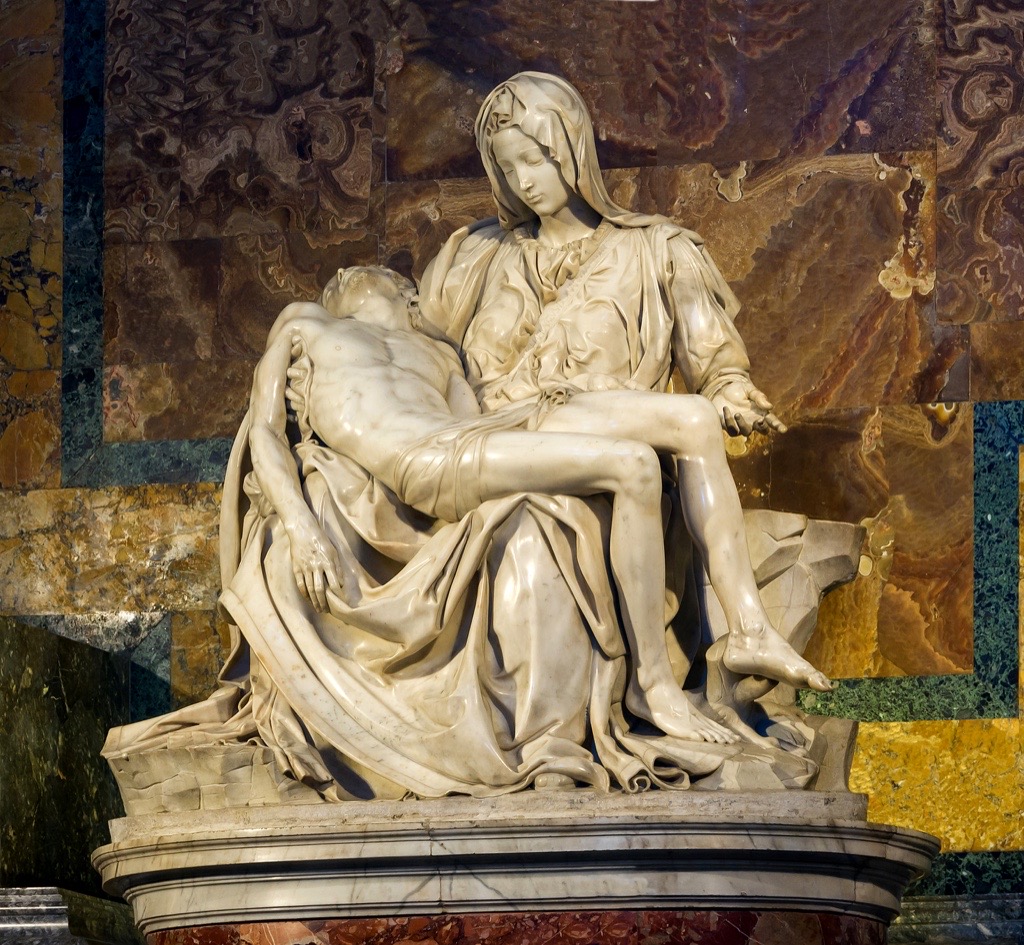
The Madonna of Bruges stands between several familiar Michelangelo works without merging with any of them. The Vatican Pietà presents Mary with the dead adult Christ across her lap; the Bruges group presents mother and living child at the moment of movement away.[9] Shared youthfulness, lowered gaze and elaborate drapery do not make the subjects identical.
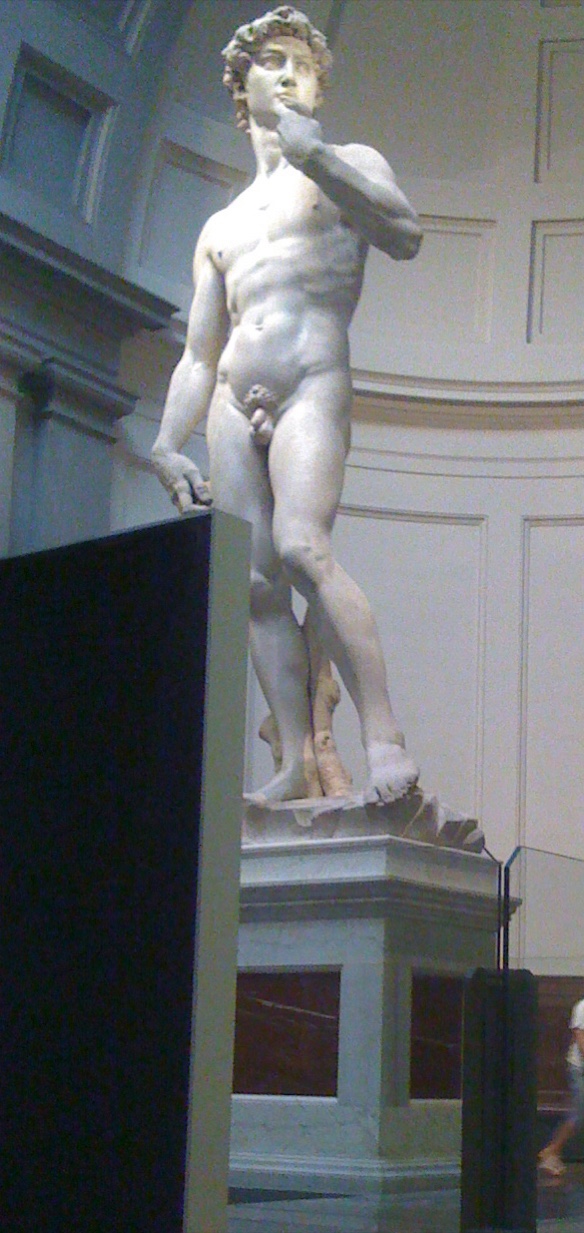
David was carved during an overlapping Florentine period, but its civic scale, nude adult body and original outdoor destination differ sharply from the church-bound mother-and-child group.[8] Comparison is most useful for carving, finish and chronology, not for implying one common programme.
Michelangelo also returned to the Madonna and Child in relief sculpture, drawings and painting. The unfinished Manchester Madonna places Mary, Christ, the young Baptist and angels within a painted composition and includes an open book.[10] Its medium, figure group and unfinished state distinguish it from the polished Bruges marble.
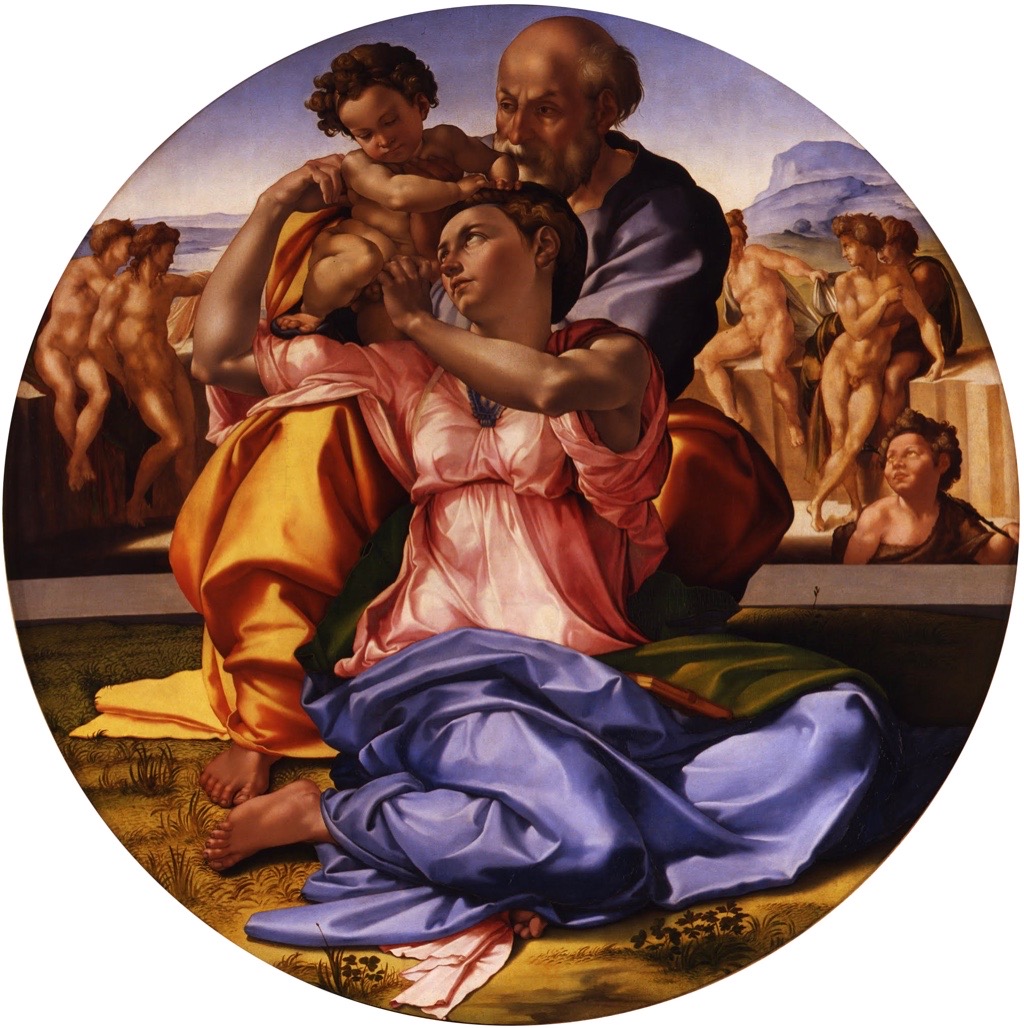
The Taddei Tondo, Pitti Tondo, Madonna of the Stairs and Medici Madonna offer further comparisons in format, date and movement. They are independent works rather than stages of one fixed design, just as a related sketch need not directly prepare a surviving sculpture.
What the Bruges work contributes is a poised threshold. The child is neither enthroned nor asleep, and Mary neither enfolds him completely nor releases him. Their hands remain joined as his body moves outward. The sculpture’s later history repeats that tension on a larger scale: repeatedly displaced, it remained bound to the church that received it in 1514.
Artist Up Close
The Madonna of Bruges shows Michelangelo using stillness to prepare movement. Mary’s upright body is composed as an architectural centre, but the child’s step carries the sacred group toward the viewer’s space. Her hand connects protection with release.
The sculpture also demonstrates the reach of Michelangelo’s reputation while he was still young. A Florentine marble crossed the Alps during his lifetime and acquired a durable identity in a Bruges church. Its later wartime journeys were extraordinary, but the first journey had already made it an unusually international Renaissance work.
Frequently Asked Questions
Discussion
Use these questions to distinguish visible form, documented history and unresolved interpretation.
Reader Insights
How do hands and drapery keep Mary and Christ connected while the child moves away?
How should a public account present the conflicting Piccolomini claims on the holding institution’s own pages?
Why is the distinction between discovery, extraction and return important in the 1945 history?
Join the Conversation
Share an evidence-led reading and identify which source, viewpoint or archival record supports it.
References
- Musea Brugge, Marble Sculpture, Madonna and Child, View source.
- Musea Brugge, Beeld van marmer, Madonna met Kind, View source.
- Musea Brugge, O.L.V.-kerk Museum (Museum of the Church of Our Lady), View source.
- Erfgoed Brugge / Stadsarchief Brugge, De Madonna met het Kind in de Onze-Lieve-Vrouwekerk, View source.
- Monuments Men and Women Foundation, The Archives: Photos — Bruges Madonna, View source.
- Musea Brugge, Visitors with Visual Impairments, View source.
- Metropolitan Museum of Art, Michelangelo: Divine Draftsman and Designer, View source.
- Galleria dell’Accademia di Firenze, David by Michelangelo, View source.
- Papal Basilicas / Holy See, Michelangelo’s Pietà, View source.
- National Gallery, London, The Virgin and Child with Saint John and Angels (The Manchester Madonna), View source.
- Opera della Metropolitana di Siena, The Cathedral, View source.