


 by Tom Gurney
Tom Gurney BSc (Hons) is an art history expert with over 20 years experience
Published on June 19, 2020 / Updated on November 6, 2025
Email: tomgurney1@gmail.com / Phone: +44 7429 011000
Michelangelo's Lost Sleeping Cupid
Michelangelo's Sleeping Cupid no longer survives, but its early life is one of the most revealing stories in Renaissance art. Carved in the mid-1490s, the marble was treated to look ancient and sold in Rome as an antiquity. When Cardinal Raffaele Riario discovered the deception, he demanded his money back. The scandal did not end Michelangelo's career. It helped bring his extraordinary ability to Roman attention.
The figure later entered the collections surrounding Isabella d'Este at Mantua, where it could be displayed beside an ancient sleeping Cupid attributed to Praxiteles. It passed with the Gonzaga collection to Charles I of England and probably disappeared in the 1698 fire at Whitehall Palace.[1][2]
The loss encourages fantasy, but the work should not be rebuilt from every later sleeping child. Documents, early biographies and copies preserve a subject, reputation and itinerary more securely than a precise appearance. The Sleeping Cupid matters not as a blank waiting for rediscovery, but as evidence of Renaissance competition with antiquity, the risks of the art market and the unstable line between imitation and fraud.
At a Glance
- ArtistMichelangelo Buonarroti
- TitleSleeping Cupid
- DateAbout 1496
- MediumMarble
- StatusLost
- SubjectThe child god Cupid asleep, probably resting on a lion skin
- Special treatmentArtificially aged so it could be presented as an ancient sculpture
- First saleSold through an intermediary in Rome to Cardinal Raffaele Riario as an antiquity
- ExposureRiario discovered it was modern and demanded repayment
- Later ownerIsabella d'Este by 1502
- English transferAcquired with the Gonzaga collections by Charles I
- Likely fateOften thought to have been destroyed in the Whitehall Palace fire of 1698, though final identification is not absolutely secure
- Do not confuse withThe standing marble Cupid at the Metropolitan Museum of Art
Contents
- Sleeping Eros in Antiquity
- Michelangelo in Florence after the Medici
- How a New Marble Was Made to Look Old
- The Sale to Cardinal Riario
- Jacopo Galli and the Roman Network
- Isabella d'Este and the Mantuan Display
- What Might the Sculpture Have Looked Like?
- The Lion Skin and the Power of Love
- From Mantua to Charles I
- The Whitehall Fire and the Meaning of “Lost”
- Copies, Echoes and Cultural Afterlife
- Why the Sleeping Cupid Matters
Sleeping Eros in Antiquity
The image of Eros or Cupid asleep was established in ancient sculpture. A divine child lies disarmed, his power temporarily suspended. Wings, bow or quiver identify the god even when sleep has made him harmless.
The subject carried several meanings. Sleep could offer a playful pause in desire: love is dangerous when awake but briefly peaceful now. In funerary contexts, a sleeping child could soften the image of death, presenting it as rest. The type therefore moved between decorative delight and profound loss.[1][3]
Renaissance collectors encountered ancient examples and recognised the theme through texts, fragments and restored sculpture. A newly carved Cupid could enter a visual field already filled with admired antiquities. Success depended on understanding not only a child's body but the conventions by which ancient artists made sleep visible.
Michelangelo's choice was strategic. A sleeping figure does not require a dramatic public action. It invites close inspection of relaxed anatomy, flesh against support and the fine boundary between living rest and carved stillness. Marble is tested against softness.
The subject also made antiquing plausible. Collectors expected sleeping Cupids among ancient remains. A modern work that looked aged could be inserted into an existing category rather than inventing an unknown masterpiece.
Michelangelo in Florence after the Medici
Michelangelo's position in the mid-1490s was gifted but unstable. Lorenzo de' Medici had died in 1492, political upheaval drove the Medici from Florence in 1494, and the young sculptor moved between Florence, Bologna and other opportunities.
He had already absorbed antique sculpture in the Medici garden and demonstrated extraordinary relief carving. Yet a reputation in Florence did not guarantee commissions or access in Rome. The Sleeping Cupid emerged at this transitional moment.
According to the best-known accounts, Lorenzo di Pierfrancesco de' Medici or market intermediaries encouraged the work to be treated as ancient because it would sell for more. Details differ among sources, and responsibility for the deception should not be assigned too neatly. Michelangelo carved the object; another party handled or arranged the Roman sale; artificial ageing connected them.
The story is often told as proof of youthful mischief. It also reveals economic reality. Ancient sculpture commanded prestige and high prices. A modern artist might earn less for matching antiquity than a dealer could earn by erasing his name.
Michelangelo's anonymous success was therefore double-edged. The carving demonstrated mastery precisely by suppressing authorship. Exposure converted that suppression into fame.
How a New Marble Was Made to Look Old
Early accounts say the Cupid was buried or otherwise stained and abraded to simulate age. The exact process is not recoverable. Earth, moisture, dirt, surface damage and deliberate treatment could reduce the brightness of fresh marble and create the appearance of excavation.
Artificial ageing had to be convincing at several levels. Surface alone was not enough if anatomy, tool work or iconography looked modern. The sculptor needed to imitate an ancient artistic language while the dealer supplied an ancient history.
Michelangelo's training made that possible. He knew classical fragments directly and understood how ancient bodies differed from contemporary devotional carving. Imitation was central to Renaissance education: artists copied in order to absorb, rival and surpass admired models.
The deception changed emulation into market fraud because the modern origin was concealed in sale. That distinction matters. A work “in the antique manner” honours a source openly; an antiqued work sold as excavated material creates false provenance.
The Sleeping Cupid became famous because those categories collided. Its artistic achievement was real, while the market identity was false. Later admirers could praise Michelangelo for equalling antiquity even as Riario objected to being cheated.
The Sale to Cardinal Riario
The dealer Baldassare del Milanese sold the sculpture in Rome to Cardinal Raffaele Riario, a major collector of antiquities. Riario believed he was buying an ancient work. After learning it was modern, he demanded the return of his money.[2][4]
Accounts vary in the amount Michelangelo received and the profit retained by intermediaries. The inequality is significant even without exact sums: the work's value rose when represented as ancient, but the artist did not necessarily receive that enhanced price.
Riario's reaction was not simply aesthetic rejection. The marble had been good enough to purchase. His grievance concerned authenticity and transaction. The same physical object changed value when its date changed.
The episode exposes a paradox in collecting. Renaissance patrons celebrated living artists for reviving antiquity, yet the prestige of an ancient original could exceed an equally skilful modern work. Michelangelo succeeded in the artistic test and failed the provenance test.
Riario's demand did not erase his interest in the sculptor. The affair brought Michelangelo's name into Roman circles and is associated with the invitation or opportunity that drew him to Rome in 1496. There he soon received the commission for Bacchus and, later, the Vatican Pietà.
Fraud and career opportunity should not be romanticised into a guaranteed plan. Michelangelo could not know that exposure would lead to triumph. The result depended on patrons deciding that the ability to deceive the eye was worth employing honestly.
Jacopo Galli and the Roman Network
Jacopo Galli became an important protector and intermediary for Michelangelo in Rome. His garden displayed the marble Bacchus, and his household later recorded the standing figure now identified as the Met's Cupid.
The Sleeping Cupid moved through this same world of bankers, dealers, cardinals and collectors, which is one reason the two Cupid stories are easily confused. They must remain separate. One slept, was antiqued, exposed and later went to Mantua. The other stood with a quiver, was recorded as Apollo in Galli's house and survives in New York.
Galli's support demonstrates the positive function of intermediaries. Dealers could manipulate prices and identities, but knowledgeable patrons also matched artists with commissions, guaranteed agreements and displayed work.
Michelangelo's early Roman career cannot be reduced to solitary genius confronting marble. It relied on networks able to convert a sensational object into sustained opportunity.
Isabella d'Este and the Mantuan Display
By 1502 the Sleeping Cupid had entered the collection of Isabella d'Este, Marchioness of Mantua, one of the most exacting patrons and collectors of the Renaissance.[1] The chain involved the turbulent politics and exchanges around Cesare Borgia and Guidobaldo da Montefeltro.
At Mantua, the sculpture could be displayed beside an ancient sleeping Cupid attributed to Praxiteles.[1] This pairing transformed the work's fraudulent beginning into a deliberate comparison between modern and ancient.
Isabella valued such contests. Her collection brought rare antiquities, contemporary paintings, mythological subjects and learned interpretation into controlled spaces. Michelangelo's authorship was now an advantage, not a secret.
The juxtaposition raised a question central to Renaissance art: could a modern sculptor equal or surpass antiquity? Viewers could compare bodies, surfaces, emotional effect and the credibility of sleep. Even if attribution to Praxiteles was itself traditional rather than secure, the ancient name supplied the standard.
The display also gave the Sleeping Cupid a stable, prestigious identity. A sculpture sold falsely as ancient became precious as proof of modern achievement.
What Might the Sculpture Have Looked Like?
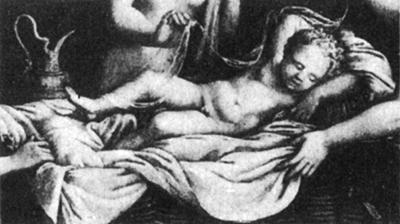
Sources identify the subject and later traditions associate the figure with a lion skin. The child probably reclined rather than sat upright, since most ancient sleeping-Eros types lie on side or back and later echoes of Michelangelo's work follow that pattern.[1]
Beyond this, reconstruction becomes uncertain. The position of limbs, direction of head, presence of bow, quiver or wings, degree of nudity and exact support cannot be combined with confidence from different derivatives.
An image by Tintoretto has been proposed as recording the lost figure, and a seventeenth-century Royal Collection drawing shows several sleeping Cupids, at least one possibly related to Michelangelo.[1] Copies and echoes demonstrate influence, but they may reverse, adapt or combine sources.
No later work should be illustrated or captioned as though it were a photograph of the marble. The safest reconstruction is verbal and limited: a sleeping child god, probably reclined on a lion skin, convincing enough as an antique to deceive a sophisticated buyer.
This restraint preserves the difference between identity and appearance. We know who carved the lost work more securely than we know its precise pose.
The Lion Skin and the Power of Love
A lion skin beneath Cupid evokes Hercules, who wore the skin of the Nemean lion after his first labour. The tiny god of love resting on the hero's attribute can suggest that desire conquers strength or that even love sleeps after victory.
The motif also provides texture. Soft child flesh meets the carved pelt, while curls and claws contrast with relaxed limbs. Such material variation would allow Michelangelo to demonstrate virtuosity within one marble.
In a funerary reading, the lion skin can complicate peaceful sleep with heroic death. In a courtly setting, it invites witty interpretation. Renaissance viewers enjoyed subjects that combined sensuous form with learned paradox.
We should not assume a single fixed message. Ancient examples, Michelangelo's sculpture and later derivatives could shift meaning with setting. At Riario's, the primary claim may have been antiquity; at Isabella's, rivalry with an ancient master; elsewhere, the disarming of love.
From Mantua to Charles I
The Gonzaga collection's financial and political decline led to major sales in the seventeenth century. Charles I of England acquired celebrated portions, bringing Italian Renaissance art and antiquities into the royal collection.[1][2]
Michelangelo's Cupid was among the works associated with this transfer. Its journey from Florence to Rome, Mantua and England maps changing centres of collecting power.
Charles I's collection was dispersed after his execution in 1649, but many works were later recovered for the monarchy. The exact tracking of a small marble through inventories, sales and restorations is difficult, especially when titles and attributions vary.
The sculpture is often said to have remained at Whitehall Palace and to have been destroyed in the great fire of 1698.[2] This is a plausible and widely repeated fate, not a witnessed identification of fragments.
No securely accepted remnant has reappeared. Claims of rediscovery would need to reconcile dimensions, material, early provenance, iconography and the work's seventeenth-century history.
The Whitehall Fire and the Meaning of “Lost”
On 4 January 1698, fire devastated much of Whitehall Palace. Works, furnishings, records and architectural contexts were destroyed or dispersed. The Sleeping Cupid may have vanished in that catastrophe.
“Probably destroyed” and “certainly burned” are not interchangeable. A portable object could have been moved earlier, misidentified, sold or rescued. Incomplete inventories leave alternatives open.
At the same time, declaring every lost masterpiece potentially alive can encourage weak attributions. The absence of proof of destruction is not evidence that a candidate survives. A credible rediscovery needs positive continuity.
For the manuscript, lost status is productive. It shifts attention from connoisseurial inspection to documentary method. Ownership, reputation and copying become the surviving work's outline.
Copies, Echoes and Cultural Afterlife
Michelangelo's Cupid helped revive the sleeping god as a Renaissance subject.[1] Painters and sculptors returned to the child at rest, adapting him for mythological scenes, fountains, tombs and private collections.
The Met's early-sixteenth-century Venetian bronze Sleeping Cupid demonstrates this afterlife but is not a copy or the lost marble.[1] It sits upright on an orb and formed part of a fountain apparatus, using water and humour to subvert peaceful sleep.
Caravaggio's Sleeping Cupid of 1608 offers another powerful transformation. His painted child is heavy, darkened and almost disturbingly still, intensifying the relation between sleep and death. It belongs to the theme's history rather than serving as a reconstruction.
Such works tell us why Michelangelo's sculpture mattered even when they do not tell us exactly how it looked. It made an ancient type newly competitive and placed the modern artist inside a narrative of surpassing the past.
Why the Sleeping Cupid Matters
The lost sculpture matters because it made authenticity visible as a Renaissance problem. Michelangelo's carving was admired when considered ancient, resented when exposed as modern and celebrated when modern mastery became the point.
Its history reveals several economies at once: the monetary premium on antiquity, the dealer's control of provenance, the patron's desire for distinction and the young artist's need for opportunity. Genius did not circulate outside markets; it was produced through them.
The work also helped propel Michelangelo toward Rome, where his career changed decisively. Its path through Riario, Galli and Isabella d'Este links scandal with patronage and private collecting.
Finally, its loss clarifies responsible reconstruction. Documents can recover actions and owners; copies can recover influence; neither gives a complete marble body back. The Sleeping Cupid survives as a network of consequences—and that network is rich enough.
Frequently Asked Questions
Discussion
What details, sources or comparisons stand out to you in Sleeping Cupid?
Reader Insights
Which formal detail changes how the work reads?
Which documented source or collection history feels most useful?
Which related Michelangelo work should readers compare next?
Join the Conversation
Add a source-led observation, comparison or question for other readers.
References
- Metropolitan Museum of Art, Sleeping Cupid,” object record 201375, contextual discussion and bibliography:, View source.
- British Museum, Michelangelo sculpting the Sleeping Cupid,” print record 1856,0712.1043 and curatorial history:, View source.
- Metropolitan Museum of Art, Sleeping Eros,” exhibition research:, View source.
- *The Art Bulletin*, The Lost Sleeping Cupid of Michelangelo,” 39, no. 4 (1957):, View source.