


 by Tom Gurney
Tom Gurney BSc (Hons) is an art history expert with over 20 years experience
Published on June 19, 2020 / Updated on November 6, 2025
Email: tomgurney1@gmail.com / Phone: +44 7429 011000
Saint Petronius
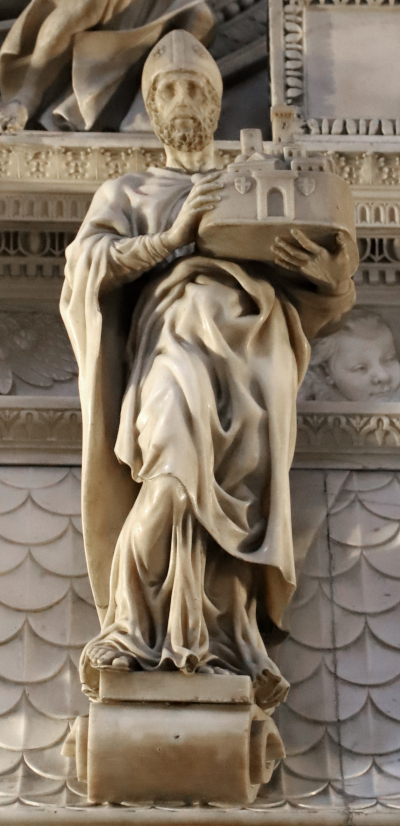
Saint Petronius carries Bologna in both hands. Towers and walls rise from the miniature city while its bishop bends slightly beneath the gift. At only sixty-four centimetres high, Michelangelo's marble was made to stand high on the shrine of Saint Dominic, where the model and the deep folds of the cope had to remain legible from below.
The young Michelangelo worked on the figure in Bologna in 1494–1495, when he was not yet twenty. But Saint Petronius is not a wholly independent block begun without precedent. The Italian state catalogue records early testimony that Michelangelo worked on the saint's draperies, completing a marble started by Niccolò dell'Arca.[1]
That layered authorship is essential. The sculpture reveals Michelangelo not as an isolated prodigy but as a newcomer entering an unfinished civic and devotional monument. He had to read another sculptor's work, satisfy an inherited programme and make a small figure hold its place among several generations of carving.
At a Glance
- ArtistMichelangelo Buonarroti, completing work begun by Niccolò dell'Arca
- TitleSaint Petronius
- Date1494–1495; Italian state catalogue records 1494
- MaterialWhite Carrara marble
- HeightApproximately 64 centimetres
- Current locationArca di San Domenico, Basilica of San Domenico, Bologna
- SubjectPetronius, fifth-century bishop and patron saint of Bologna
- AttributesBishop's mitre and cope; model of Bologna held in both hands
- Viewing conditionHigh within the shrine's crowning structure, designed to be read from below
- Authorship cautionMichelangelo completed an already begun figure rather than necessarily originating every part
Contents
- Who Was Saint Petronius?
- Michelangelo Arrives in Bologna
- The Arca di San Domenico
- Completing Niccolò dell'Arca's Figure
- The Bishop and His City
- Designed for a Viewer Below
- Bologna's Sculptural Lessons
- City Model as Sculpture Within Sculpture
- Petronius Elsewhere in Bologna
- Material, Wear and Visibility
- How to Look at Saint Petronius
- Why Saint Petronius Matters
Who Was Saint Petronius?
Petronius was bishop of Bologna in the fifth century and became the city's principal patron. Historical evidence for his life is limited, while later hagiography enlarged his role as builder, protector and civic founder.[2]
In art, episcopal dress identifies his office and a model of Bologna identifies his city. The model is not a scale survey of the streets in 1494. It is an attribute: the city offered to divine protection and held through its saint.
That iconography links spiritual and civic identity. Petronius does not merely belong to a church; he represents Bologna as a community. The viewer recognises towers before reading an inscription.
Michelangelo's choice—or inherited obligation—to make the model heavy and conspicuous gives the saint an active role. He does not display a weightless symbol. He bears the city.
Michelangelo Arrives in Bologna
In autumn 1494, political crisis pushed Michelangelo out of Florence. Charles VIII of France was advancing into Italy, Medici rule collapsed, and the Savonarolan republic emerged. Michelangelo travelled briefly through Venice before reaching Bologna.[1]
His position there was precarious. According to early biographies, failure to obtain a required token or seal brought him into difficulty at the city gate. The Bolognese nobleman Giovan Francesco Aldrovandi offered protection and introduced him to local patrons.
Aldrovandi's household also exposed Michelangelo to literature. Condivi and Vasari describe him reading Dante and other Tuscan authors aloud to his host. Whether every anecdotal detail is exact, the Bologna stay joined survival, patronage and intellectual exchange.
Work on the Arca di San Domenico gave the young Florentine a prestigious local commission. He made or completed Saint Petronius, Saint Proculus and a kneeling candle-bearing angel. The group should be studied together but not treated as a single freestanding ensemble: each figure answers a different position and inherited context.
The Arca di San Domenico
The Arca is the shrine containing the remains of Saint Dominic, founder of the Dominican Order. Its history began long before Michelangelo. Nicola Pisano and his workshop created the great narrative sarcophagus in the thirteenth century. Niccolò dell'Arca later developed an elaborate crowning structure commissioned in 1469 and installed in 1473.[1]
The monument remained incomplete. Niccolò may have resumed work before his death in 1494, leaving several small figures unfinished or absent. Michelangelo entered this continuing project, not a blank site.
Later artists added further elements, including Alfonso Lombardi's reliefs and other sixteenth-century work. The shrine now compresses several centuries of making around one sacred body.
This chronology changes how Saint Petronius should be judged. The figure had to cooperate with sculpture in different styles and scales. Originality lay partly in adaptation.
The monument's religious function also matters. These were not collectibles made for close inspection. They participated in a shrine approached by worshippers, pilgrims and Dominican ceremony.
Completing Niccolò dell'Arca's Figure
The Italian state catalogue cites old reports that Michelangelo worked “in the clothes” of Saint Petronius, suggesting he finished a figure Niccolò had begun.[1] The phrase does not map every passage to one hand, but it prevents simple authorship.
Niccolò may have established the block, pose, head or principal masses before Michelangelo refined the drapery and completed the object. Without a technical map, assigning specific folds by eye remains speculative.
Completion is a demanding form of creation. The second sculptor cannot choose any pose; irreversible stone has already narrowed the possibilities. He must understand what remains, correct where material permits and conceal discontinuity enough for the figure to function.
Michelangelo's later reputation encourages viewers to search for signs that he overwhelmed the predecessor. A more useful question is how successfully the completed saint belongs to the Arca. The work's unity may be the achievement, not evidence that only one hand touched it.
Museum labels often require a principal artist. Public prose can be more exact: Saint Petronius is accepted as a Michelangelo work whose marble was begun by Niccolò dell'Arca.
The Bishop and His City
Petronius stands frontally, mitred and bearded. A large cope falls around the body and closes below the neck with an oval clasp. The right knee advances beneath the cloth.[1]
The city model occupies his left side but is held by both hands. This asymmetrical burden activates the figure. The cope's folds descend around and beneath the architecture, joining living body and civic attribute.
At high placement, small detail can vanish. The model's towers need strong silhouettes; the saint's head needs a clear mitre; folds need depth to catch shadow. Michelangelo's handling responds to optical distance rather than offering uniformly delicate finish.
The advanced knee prevents the heavy vestment from becoming a cone. Pressure travels upward, making the bishop seem to step or brace.
His face is contained. The civic patron does not perform ecstatic emotion. He offers steadiness suitable to the literal and symbolic responsibility in his hands.
Designed for a Viewer Below
Ellen Longsworth's study of the Bologna sculptures emphasises Michelangelo's sensitivity to the beholder and to site-imposed conditions.[3] This is especially important for a statuette displayed above normal eye level.
Foreshortening can make an upright figure appear compressed. A sculptor may enlarge or clarify the head, project the knees and cut deep under forms so that the lower viewer receives a coherent body.
Photographs taken level with Saint Petronius are invaluable for detail but change that relationship. They can make the city model dominate or reveal surfaces no ordinary worshipper could see.
The best interpretation combines views. Close images show carving; a view of the entire Arca explains decisions. The object is not misproportioned if it appears different from a privileged camera angle. Its primary audience stood below.
Michelangelo would later manipulate optical viewing on vastly greater scales in the David and Sistine Chapel. Bologna provided an early, constrained lesson: a body is made for a position, not for an abstract neutral eye.
Bologna's Sculptural Lessons
The young artist encountered important local precedents. Jacopo della Quercia's sculpture at San Petronio and his reliefs offered bodies and drapery with a force different from Florentine refinement. Niccolò dell'Arca's own figures combined emotional intensity with sharp, complex folds.
Ferrarese painting visible in Bologna—by artists such as Francesco del Cossa and Ercole de' Roberti—has also been invoked to explain the hard, energetic rhythms of Michelangelo's early Bolognese work.
Influence should not become a list of names applied after the fact. It is visible when local forms solve local problems: dense cloth made legible at distance, compact figures charged within architecture, faces simplified without becoming blank.
Michelangelo did not arrive as a complete master who merely exported Florence. He learned from a city whose sculpture had its own distinguished history.
That recognition makes the leap to the Roman Pietà more intelligible. The Bologna figures added experience of finish, devotional setting and multiple sculptural languages before Michelangelo undertook life-size marble in Rome.
City Model as Sculpture Within Sculpture
The miniature Bologna is an artwork inside the artwork. Its towers must read as buildings while remaining structurally joined to saint and drapery. Thin projections would be vulnerable; complete topographical accuracy would create visual noise.
Its scale also performs hierarchy. Petronius is not a giant invading a literal city. Sacred protection is expressed by making urban space small enough to carry.
City models were common attributes of patron saints and donors. They could commemorate foundation, protection or dedication. Viewers familiar with Bologna's towers would recognise a civic likeness without demanding an exact map.
Michelangelo uses the model to complicate the body's balance. The saint's hands and gaze relate to something outside himself. Even at tiny scale, sculpture becomes relational rather than a closed anatomy study.
Petronius Elsewhere in Bologna
Michelangelo's viewers already knew other images of the city's patron. Jacopo della Quercia had carved a monumental Saint Petronius for the great civic basilica dedicated to him, and local visual tradition repeatedly joined the bishop to Bologna.[3]
Comparison helps define the Arca figure's task. On a façade or portal, Petronius can address the city at architectural scale. On Dominic's shrine, he is one protecting presence within a dense sacred company. Michelangelo compresses civic identity without allowing it to overwhelm the Dominican monument.
The relationship also shows how an artist learns iconography. The mitre and city model were not Michelangelo's private invention. His creativity lies in redistributing familiar signs through weight and drapery.
Bologna's patron appearing on another saint's reliquary creates a local bridge. Petronius welcomes Dominic's universal order into the civic body; the shrine, in return, places Bologna within the Dominican sacred world. The sculpture's model of the city makes that exchange visible.
Material, Wear and Visibility
Carrara marble joins Petronius materially to the other pale figures of the crown, but centuries of dust, cleaning and changing illumination affect how passages read. Deep undercut folds retain darkness; projecting details on the city model are more vulnerable to abrasion.
The high site has protected the sculpture from casual touch while making conservation and photography difficult. Scaffolding or elevated access can reveal tool marks invisible from the floor. Such examination is important for distinguishing Niccolò's begun work from Michelangelo's completion, though visual difference alone cannot always assign a chisel.
Lighting has interpretive consequences. Strong modern spotlights can turn folds into dramatic stripes, while diffuse church light unifies them. The primary design had to survive variable candles, daylight and distance rather than a controlled museum beam.
How to Look at Saint Petronius
First find the figure within the whole Arca. Its scale and height explain the strength of the silhouette.
Identify mitre, clasp and city model before looking for facial detail. These make the saint readable.
Follow the advanced knee beneath the cope. Notice how bodily motion survives heavy cloth.
Compare the city model's verticals with the cascading folds. Architecture and garment create different kinds of order.
Finally remember the two hands. Rather than trying to identify “Michelangelo folds” one by one, look for the completed agreement between Niccolò's inherited marble and Michelangelo's intervention.
Why Saint Petronius Matters
The figure matters because it catches Michelangelo learning through completion. He was required to enter another sculptor's material decisions and another city's sacred identity.
It also shows that small scale is not minor ambition. The saint carries a complex civic symbol, occupies a difficult viewpoint and participates in one of Bologna's most revered monuments.
Later biography often moves quickly from Medici Florence to the Roman Pietà. Saint Petronius slows that story. In Bologna, Michelangelo learned that sculpture belongs to predecessors, buildings, rituals and viewers before it belongs to a famous name.
That lesson remained durable throughout his career.
Frequently Asked Questions
Discussion
What details, sources or comparisons stand out to you in St Petronius?
Reader Insights
Which formal detail changes how the work reads?
Which documented source or collection history feels most useful?
Which related Michelangelo work should readers compare next?
Join the Conversation
Add a source-led observation, comparison or question for other readers.
References
- Catalogo Generale dei Beni Culturali, San Petronio,” national catalogue 0800024755:, View source.
- Basilica di San Petronio, history of Saint Petronius and the basilica:, View source.
- Ellen L. Longsworth, Michelangelo and the Eye of the Beholder: The Early Bologna Sculptures,” Artibus et Historiae 23, no. 45 (2002):, View source.
- Fondazione Federico Zeri, Buonarroti Michelangelo, San Petronio”:, View source.