

 by Tom Gurney
Tom Gurney BSc (Hons) is an art history expert with over 20 years experience
Published on June 19, 2020 / Updated on August 21, 2026
Email: tomgurney1@gmail.com / Phone: +44 7429 011000
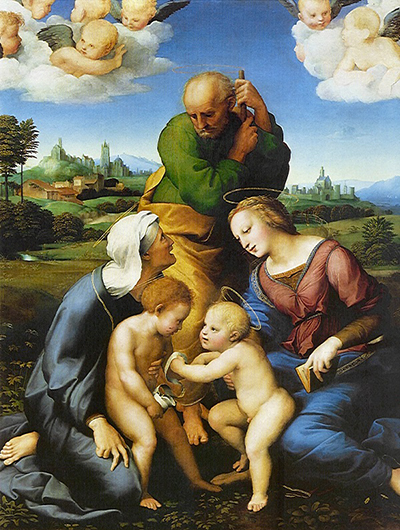
Raphael's Canigiani Holy Family turns five figures into a pyramid of care. Mary and Elizabeth sit with Christ and the young John the Baptist, while Joseph stands behind them like a shepherd guarding his flock. Looks, hands and a prophetic scroll bind the family more firmly than the geometry that contains it.[1][2]
The Alte Pinakothek dates the poplar panel to about 1505–06. A probable commission connects it with the 1507 marriage of the Florentine cloth merchant Domenico Canigiani and Lucrezia Frescobaldi. The subject of generations gathered around two children suited a new household, but the scroll announcing the Lamb of God gives familial promise a Passion-centred future.[2][3]
For nearly two centuries, viewers saw the composition without its full sky. Eight angels had been overpainted after their heads were damaged in an eighteenth-century treatment. Conservation in 1983 recovered them, restoring a crucial balance between the dense earthly pyramid and the open heavenly field.[1][2]
At a Glance
- ArtistRaphael
- TitleThe Canigiani Holy Family
- Dateabout 1505–06 in the current collection record
- Mediumoil on poplar panel
- Dimensions131 × 107 cm
- FiguresMary, Christ, Joseph, Elizabeth and young John the Baptist
- Heavenly figureseight angels in two cloud groups
- Distinctive structurea tall pyramidal family group
- Signature
RAPHAEL . VRBINASon Mary's neckline - Probable commissionDomenico Canigiani, perhaps for his 1507 marriage to Lucrezia Frescobaldi
- Medici Tribuna displayby 1589
- Düsseldorf collectionfrom 1697
- Angels overpaintedafter damage during a 1755 treatment
- Angels recovered1983
- Munich acquisition1806 from the Düsseldorf Gallery
- Current locationAlte Pinakothek, Munich, Room IV
- Inventory number476
Contents
- Five figures in one pyramid
- Mary at the centre of the family
- Christ and the young Baptist
- Elizabeth and the maternal double
- Joseph as shepherd and summit
- The scroll and the Lamb of God
- A meeting outside the canonical Gospels
- Eight angels above
- Landscape and northern architecture
- Leonardo's Saint Anne and Michelangelo's Doni Tondo
Five figures in one pyramid
The group rises in stages. The children occupy the lowest, most active zone. Mary and Elizabeth form the broad middle, and Joseph completes the summit behind them.[1][2]
This pyramid gives the panel immediate order. A viewer can grasp the family as a single unit before identifying each person.
Yet the geometry is comparatively strict. Without internal movement, it might make the figures seem arranged rather than alive.
Raphael answers with interpersonal behaviour. Heads turn at different angles, hands support children, and gazes cross between generations.[1]
The Alte Pinakothek emphasises this contrast: formal outer structure contains informal relations within.[1]
The pyramid is therefore not merely a Renaissance formula. It becomes a social diagram in which every level depends upon another.
Joseph's high position protects; the women create stability; the children generate prophetic action. Geometry and family role reinforce one another.
Mary at the centre of the family
Mary sits near the centre, supporting Christ while attending to the encounter with John.
Her body supplies one side of the broad lower pyramid. Drapery helps connect the child's exposed flesh to the larger group.
She is neither enthroned queen nor isolated mother. Elizabeth and Joseph share the field, giving sacred maternity a multigenerational context.
Mary's hands perform care rather than ceremony. Christ can reach and respond because she controls his balance.
Her face participates in the chain of looks that makes the panel natural despite its formal design.[1]
The neckline of her garment carries Raphael's signature, RAPHAEL . VRBINAS.[3] Placing the name on clothing integrates authorship into the represented world.
The phrase identifies him proudly as Raphael of Urbino while he worked in Florence. Geographic self-definition becomes part of the sacred figure's costume.
Christ and the young Baptist
Christ and John meet as children, an episode not narrated in the canonical Gospels.[2][3]
Later devotional traditions imagined the families encountering one another after the Holy Family's return from Egypt, when John was living in the desert with Elizabeth.[2]
Raphael makes the meeting physically immediate. The boys reach across the lower centre while the adults support them.
John presents a scroll carrying his prophetic role. Christ grasps or approaches the text that identifies him as the Lamb of God.[3]
The children can appear to play, but the scroll turns play toward future sacrifice.
Their small bodies create movement within the stable pyramid. Legs, arms and paper produce diagonals across the base.
As in Raphael's strongest sacred childhood images, theology travels through credible social behaviour rather than interrupting it.
Elizabeth and the maternal double
Elizabeth supports the young Baptist opposite Mary. The two women create a maternal pair around the children.
Their ages differ, introducing time and kinship into the composition. Elizabeth's older presence complements Mary's youth.
Each mother enables her child to enter the central exchange. The children do not float independently; their prophetic relation is physically sustained by adults.
Elizabeth also widens the family beyond the nuclear trio of Mary, Joseph and Christ. The painting becomes a sacred kinship group.
Her gaze contributes to the interlocking network praised by the museum.[1] Attention travels through bodies rather than radiating only from Christ.
The doubling of mothers allows Raphael to balance the panel without simple mirror symmetry. Their postures answer each other while remaining distinct.
Family intimacy becomes a compositional resource on a scale larger than a two-figure Madonna.
Joseph as shepherd and summit
Joseph stands behind the women and children. The Pinakothek compares him to a shepherd protecting his flock.[2]
His elevated position makes him the pyramid's apex, yet he does not dominate emotionally.
The guardian role depends on watchfulness. Joseph encloses the family from behind while allowing the children's meeting to remain central.
His standing body also gives vertical force. Without him, the composition would spread laterally around seated mothers.
Staff and posture may reinforce the shepherd comparison, but the effect is primarily relational: one older figure watches over the whole group.
Joseph's placement creates depth. He occupies a more distant plane while his head remains connected to the women's inclinations below.
Raphael makes authority protective rather than commanding. The summit of the pyramid belongs to care.
The scroll and the Lamb of God
John's prophetic words identify Christ as the Lamb of God. The Pinakothek's institutional account describes Jesus grasping the scripture with that announcement.[3]
The scroll gives written form to a future declaration. John will speak publicly as an adult; here his mission appears in the hands of children.
The Lamb title points simultaneously to innocence and sacrificial death. It therefore suits a family image shadowed by the Passion.
Paper bridges the space between Christ and John. It is a physical object that both can touch and a text whose meaning exceeds their childhood moment.
Adults around them appear to understand different aspects of the exchange. Viewers bring Gospel knowledge that completes the sign.
The scroll also adds a pale, linear accent against flesh and drapery. Writing becomes part of geometry.
Raphael centres prophecy without allowing it to overpower tenderness.
A meeting outside the canonical Gospels
The childhood encounter between Jesus and John does not appear in the four canonical Gospel accounts.[2]
Its popularity came from later narratives and devotional imagination. Florence, where John was the patron saint, had particular reason to welcome images of his early relation to Christ.[2]
The distinction matters. The painting expresses a meaningful Christian tradition without illustrating a biblical verse as though it described this exact gathering.
Apocryphal narrative allowed artists to bring together the Holy Family, Elizabeth and the Baptist within a tender domestic scene.
It also gave John's adult recognition of Christ a childhood prehistory. The scroll makes future preaching present before speech.
Raphael's composition does not require viewers to reconstruct every stage of travel from Egypt. Its primary concern is relational and prophetic.
Historical accuracy begins by naming the tradition correctly rather than diminishing its devotional importance.
Eight angels above
Two groups of angels float in clouds across the upper field. There are eight figures in all.[2][3]
They expand the family gathering into a heavenly witness. Earthly kinship below is balanced by celestial community above.
The angels also solve a formal problem. The tall pyramid might otherwise press upward into empty sky. Cloud groups distribute visual weight near the corners and around Joseph's summit.[1]
Their smaller scale establishes distance while their gestures keep the upper field active.
Because the angels were hidden for generations, many influential viewers understood the painting through a substantially altered balance.
Their recovery in 1983 did more than add charming details. It restored an essential relation between dense figures and open heaven.[1][2]
The present composition asks to be read vertically from children's scroll through Joseph to angels in cloud.
Landscape and northern architecture
The family stands or sits within an open landscape. Distant architecture helps place the sacred episode beyond contemporary Florence.
The Pinakothek's research account notes that Raphael drew on northern European architectural forms, part of a Florentine interest in Netherlandish painting.[3]
Such buildings could suggest a foreign setting appropriate to a family returning from Egypt without claiming geographic precision.
Landscape also prevents the five-person pyramid from becoming a studio arrangement against blank ground.
Atmospheric distance gives the tightly interwoven bodies room to breathe. The eye can pass from near flesh and fabric toward small structures and sky.
Raphael learned from northern art not only motifs but ways of making sacred history inhabit detailed worlds.
He integrates those elements into a central Italian design governed by human scale and pyramidal unity.
Leonardo's Saint Anne and Michelangelo's Doni Tondo
The Pinakothek relates Raphael's group to Leonardo's Virgin and Child with Saint Anne and Michelangelo's Doni Tondo.[2]
Leonardo provided a powerful example of generations interlocked through leaning bodies, gaze and touch. His group treats kinship as a continuous compositional organism.
Michelangelo's tondo offered monumental, sculptural bodies and a densely packed Holy Family capable of filling its field.
Raphael adapts both challenges to five principal figures in a vertical rectangle. His group is more numerous, yet its emotional relations remain clearly readable.
He does not reproduce Leonardo's atmosphere or Michelangelo's muscular tension wholesale. His own emphasis falls on social articulation.
Every figure has a place within the pyramid and a specific relation within the family.
Influence becomes synthesis: interlocking generations, strong bodies and Raphael's lucid behaviour share one structure.
A likely wedding commission
Domenico Canigiani was a wealthy Florentine cloth merchant and Medici supporter. In 1507 he married Lucrezia Frescobaldi.[2]
The Pinakothek proposes that he probably commissioned the painting for that occasion and for the private chapel of his palace in Via de' Bardi.[2]
The family subject suits a marriage, carrying hopes for continuity, piety and the joining of households.
Yet the current object record dates the work about 1505–06.[1] These two institutional strands should be held together rather than forced into false exactness.
The wedding context is probable, not a surviving contract quoted word for word. The panel may have been conceived around the years leading to the marriage.
Its substantial 131-centimetre height suits a private chapel more than a portable bedroom panel.[1]
Sacred kinship could meet dynastic aspiration without becoming a literal portrait of the Canigiani family.
Scale and the private chapel
At 131 centimetres high, the panel is substantially larger than Raphael's portable two-figure Madonnas.[1] Its five-person group, open landscape and angel-filled sky need that expanded field.
A private chapel did not mean a tiny object. It meant a controlled household setting in which family members, guests and clergy could approach an altar at comparatively close range.
The painting answers both conditions. Its pyramid has enough force to command a chapel, while signature, scroll, glances and children's hands reward nearer attention.
Wedding association and sacred function could therefore coexist without turning the panel into domestic decoration. The Canigiani household would have encountered an image of kinship ordered toward sacrifice and heavenly witness.
Later Tribuna display changed the emphasis from household devotion to masterpiece, but the panel's scale still preserves the ambition of its probable first room.
Its dimensions let earthly and heavenly families remain distinct without breaking their shared vertical order.
Raphael of Urbino in Florence
The signature RAPHAEL . VRBINAS declares the artist's origin in Urbino.[3]
Raphael had worked in Florence only from 1504 and would leave for Rome in 1508. The signature asserts identity within a city of formidable masters.
It also differentiates origin from artistic assimilation. He could learn from Leonardo and Michelangelo without presenting himself as Florentine.
The panel's synthesis displays what movement between centres made possible: Umbrian clarity, Florentine bodily complexity and an Urbinate artist's independent ambition.
Signing Mary's neckline brings the claim unusually close to the sacred centre.
The name is neither a modern label nor a collector's mark. It belongs to the painted fiction and survives as direct evidence of authorship.
Raphael's geographic pride accompanies a work designed for a Florentine merchant household.
From Canigiani ownership to the Medici Tribuna
The painting later entered the Medici collection. By the celebrations for the 1589 marriage of Ferdinando I de' Medici and Christina of Lorraine, it was displayed in the Uffizi Tribuna.[2]
The move transformed a probable family-chapel altarpiece into a dynastic masterpiece.
The Tribuna gathered exceptional works within a concentrated octagonal room. Raphael's family group could be studied as art as well as venerated as a sacred image.
Andrea del Sarto had probably encountered the panel earlier in the Canigiani palace and adapted aspects of it for his own Holy Family.[2]
Influence and collecting therefore began before the work left Florence.
The Medici phase also prepared its later movement north through a dynastic gift.
Düsseldorf and a dynastic gift
In 1697 Cosimo III, Grand Duke of Tuscany, gave the painting to his son-in-law Johann Wilhelm II, Elector Palatine.[3]
It entered the Düsseldorf Residence and Gallery, becoming an important Raphael in a northern European princely collection.
The transfer linked Medici and Palatine dynasties through art. A painting probably made for one marriage moved again through another family's alliance.
Düsseldorf gave the work one of its older collection identities. Some historical sources called it the Düsseldorf Madonna.
The new setting also exposed the panel to a consequential restoration history.
Its move demonstrates how sacred family imagery could operate within diplomacy, inheritance and princely representation far from Florence.
The damaged and hidden angels
In 1755 the French restorer François-Louis Collins worked on the painting. The Pinakothek reports that the angels' heads were damaged, after which the upper section was overpainted.[3]
The alteration removed all eight angels from ordinary sight. Clouds and sky replaced a populated heavenly register.
For later viewers, the family pyramid appeared more isolated and perhaps more purely classical.
The loss also changed balance. Upper corner groups that answered the dense figures below no longer performed their compositional role.[1]
Overpainting can be historically revealing even when it obscures original work. It records a moment when concealment seemed preferable to displaying damage.
The decision shaped reproductions, scholarship and artistic responses for more than two centuries.
Recovery in 1983
The Alte Pinakothek restored the painting in 1983 to mark the five-hundredth anniversary of Raphael's birth.[2]
Conservators removed the later sky overpaint and recovered the two groups of eight angels.[1][2]
The treatment changed the public image of a famous work. Viewers who thought they knew the composition encountered a fuller vertical design.
Not every recovered passage could be pristine after earlier damage. Conservation revealed surviving Raphael while respecting the material consequences of 1755.
The angels' return also affected interpretation. Heaven again participates in the family's earthly meeting.
Friedrich Overbeck and generations of nineteenth-century admirers had studied a version without them.[2] Their understanding of Raphael was based on an altered object.
The 1983 treatment demonstrates why condition history belongs to art history, not only to laboratory record.
From Düsseldorf to Munich
In 1806 the painting reached Munich as part of the Düsseldorf Gallery collection.[1][3]
It became the first major Raphael associated with the future Pinakothek tradition and an important reference for German admiration of the artist.[2]
When the Alte Pinakothek was founded, Raphael served as a central model for the museum's Renaissance identity.
The panel now belongs to the Bayerische Staatsgemäldesammlungen and is displayed in Room IV under inventory 476.[1]
Its Munich history includes both the long period without angels and their modern recovery.
Visitors therefore encounter not only a Florentine Holy Family but an object that helped define Raphael for German collecting and Romantic art.
How to look at the Canigiani Holy Family
Begin with Christ and John at the base. Find the scroll and follow its prophecy through their hands.
Move outward to Mary and Elizabeth, noticing how each mother makes the children's encounter possible.
Travel upward to Joseph, the guarding summit of the pyramid.
Then look beyond him to the eight angels. Imagine how the composition appeared when that entire heavenly register was covered.
Find Raphael's name on Mary's neckline.
Finally, compare strict geometry with individual behaviour. The pyramid remains formal; the family within it remains alive.
Why the painting matters
The Canigiani Holy Family is one of Raphael's most ambitious Florentine solutions to multigenerational sacred relation. Five bodies form a strong pyramid without losing distinct ages, roles or emotions.
Its probable wedding context adds social resonance while the apocryphal childhood meeting and Lamb-of-God scroll keep the page grounded in devotional meaning.
The signature records Raphael's Urbinate identity at the height of his Florentine synthesis.
The angels' concealment and recovery reveal how dramatically later treatment can rewrite composition. The work admired in nineteenth-century Munich was not visually the same work seen after 1983.
Raphael's design survives as both family and history: bound internally by looks, carried externally through Canigiani, Medici, Düsseldorf and Munich worlds.
Artist Up Close
Look for RAPHAEL . VRBINAS along Mary's neckline.
Notice how the children's scroll forms a low horizontal within the tall pyramid.
Then count the angels in the clouds. Their eight recovered bodies restore the balance Raphael planned above Joseph.
Frequently Asked Questions
RAPHAEL . VRBINAS appears on Mary's neckline.[3]Discussion
What detail most changes how you read Canigiani Holy Family?
Reader Insights
Which source detail gives the page its strongest anchor?
Which visual or historical distinction should readers keep in mind?
How does this page change the wider picture of Raphael's career?
Join the Conversation
Share your reading below.
References
- Bayerische Staatsgemäldesammlungen, “The Canigiani Holy Family,” Alte Pinakothek inventory 476. View source.
- Alte Pinakothek, “Raffael 1520–2020: The Canigiani Holy Family,” institutional research feature. View source.
- Bayerische Staatsgemäldesammlungen, “The Holy Family,” institutional Google Arts & Culture feature. View source.