

 by Tom Gurney
Tom Gurney BSc (Hons) is an art history expert with over 20 years experience
Published on June 19, 2020 / Updated on August 21, 2026
Email: tomgurney1@gmail.com / Phone: +44 7429 011000
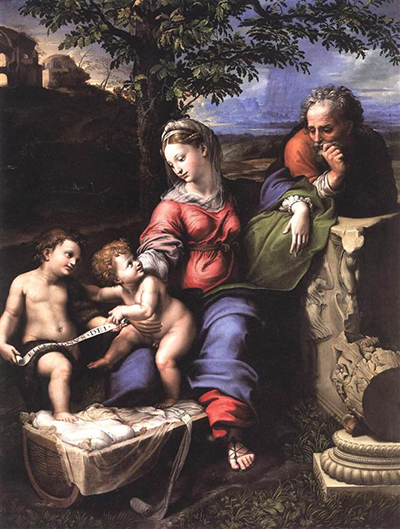
The Holy Family under an Oak Tree places sacred childhood beside the material remains of ancient Rome. Joseph leans against a classical ruin. Mary supports Christ as he receives a scroll from the young John the Baptist. An oak rises behind the group, separating their bodies from an expansive landscape and the ruins of the Baths of Caracalla at the left.[1]
Painted between 1518 and 1520, the panel belongs to Raphael's final years and to the collaborative practice of his Roman workshop. The Museo del Prado credits both Raphael and Giulio Romano. Raphael drew the composition and probably made an initial painted sketch; Giulio retouched and completed it.[1]
That division is not a flaw to hide. It is central to the object. Raphael had become the organiser of an exceptionally productive workshop, and authorship could pass through design, first execution, supervision and completion. The painting should neither be reduced to “workshop of Raphael” nor described as though every visible passage came from Raphael alone.
At a Glance
- ArtistsRaphael and Giulio Romano
- TitleThe Holy Family under an Oak Tree
- Date1518–20
- Mediumoil on panel
- Dimensions144 × 110 cm
- FiguresMary, Christ Child, Saint Joseph and young John the Baptist
- Central text
Ecce Agnus Deion John's scroll - Naming featurethe oak tree behind the figures
- Ancient settingruins of the Baths of Caracalla at the left
- Compositiondiagonal rather than pyramidal
- Authorshipdesigned and probably begun by Raphael; retouched and finished by Giulio Romano
- Gift to Philip IVNiccolò Ludovisi, 1640
- Recorded at El Escorial1667
- Current locationMuseo Nacional del Prado, Madrid
- Inventory numberP000303
Contents
- The oak as name and structure
- Joseph leaning on a classical ruin
- Mary and the child on her lap
- John offers Ecce Agnus Dei
- A diagonal instead of a pyramid
- The Baths of Caracalla
- Landscape and changing light
- Scale and the late devotional panel
- Raphael's design
- Giulio Romano's completion
The oak as name and structure
The tall oak gives the painting its familiar title. It is not a small botanical attribute held by a figure but a major vertical within the landscape.[1]
Its trunk rises behind the sacred group and helps separate the family from distant space.
The tree performs several compositional jobs. It anchors the figures, balances the classical ruin and interrupts the horizon so the bodies do not dissolve into scenery.
Oak can carry associations of strength, endurance and Christian steadfastness, but the Prado's account uses the tree primarily to identify and organise the object. Specific symbolic claims should not outrun that evidence.
Its natural growth also contrasts with broken masonry. Living trunk and ancient ruin frame a family whose child brings a new sacred dispensation.
Branches spread above the group, making a canopy that is organic rather than ceremonial.
The title teaches viewers to find the tree first, but its greater importance lies in how it turns landscape into structure.
Joseph leaning on a classical ruin
Saint Joseph occupies the side of the group and leans upon a fragment of ancient architecture.[1]
The pose gives him watchful ease. He is present as guardian, observing Mary and the children's exchange rather than intervening.
His support is broken stone, a material connection to the Roman past represented across the landscape.
The contact creates a historical contrast. Joseph's living body rests on the remains of an older world while Christ receives a prophecy of sacrificial redemption.
Raphael and Giulio do not make the ruin a separate antiquarian study. It belongs to Joseph's posture and to the composition's diagonal movement.
His gaze carries attention inward toward Mary. The classical fragment points spatially outward toward the larger ruins at the left.
Joseph therefore mediates between sacred family and ancient setting, between human observation and architectural memory.
Mary and the child on her lap
Mary sits with Christ on her lap. Her body supplies the stable centre from which the child can turn toward John.[1]
She does not dominate through frontal enthronement. Her role is physical and relational: she supports movement toward the scroll.
Christ's pale body is set against stronger clothing and landscape colour, making the small gesture of receiving text legible.
Mary's gaze and posture connect Joseph behind, John before and child upon her. She is the hinge of the diagonal family arrangement.
The late date brings a more complex treatment of light than Raphael's early Madonnas. Illumination can model flesh strongly while leaving other passages in deeper shadow.[1]
Maternal calm contains knowledge of what John's words mean. The family's intimacy is organised around a future sacrifice.
John offers Ecce Agnus Dei
The young John holds a scroll inscribed Ecce Agnus Dei: “Behold the Lamb of God.”[1]
The phrase belongs to his adult recognition of Christ and identifies Jesus as the sacrificial Lamb.
In the painting, prophecy becomes an exchange between children. John offers the written words, and Christ receives them.
Paper bridges the bodily interval. The text carries an adult theological statement while small hands make it tangible.
The Passion appears without a literal lamb, cross or wound. Language supplies the sign.
John's act also gives direction to the diagonal group. His body and scroll lead toward Christ, whose response returns attention to Mary.
The scroll makes the family scene more than affectionate gathering. It names the identity around which every relationship is organised.
A diagonal instead of a pyramid
Many of Raphael's Florentine Madonna groups depend on a broad pyramid. The Prado explicitly distinguishes this late work: its figures form a diagonal.[1]
Movement travels from Joseph and the ruin through Mary and Christ toward John, rather than rising symmetrically to a central apex.
That directional arrangement suits a scene of offering. John's scroll enters from one side and draws Christ's attention across Mary's lap.
The diagonal also integrates the group more actively with landscape. Figures do not sit as a self-contained geometric island.
Contrasting light strengthens the effect. Illuminated bodies emerge against darker passages, making depth and direction more dramatic.[1]
The change should not be treated as a rejection of Raphael's earlier harmony. It is a later way of making harmony responsive to narrative motion.
Balance remains, but it is achieved through opposing weights rather than near-symmetrical stability.
The Baths of Caracalla
The Prado identifies the ancient structures at the left as ruins of the Baths of Caracalla.[1]
These immense Roman baths were among the most striking remains available to artists in Raphael's city.
Their inclusion locates the sacred episode within an imagined landscape shaped by antiquity. Biblical family and imperial ruin share a world even though they belong to different historical times.
Raphael was deeply involved in studying and protecting ancient Rome during his final years. The ruins therefore reflect more than decorative taste.
They also serve Christian historical interpretation. The old monumental order is broken, while the child at the centre embodies redemption.
Yet the painting does not present antiquity only as defeated. The ruins retain grandeur and give the landscape architectural depth.
Ancient Rome becomes a visual resource through which a Christian family scene gains scale and memory.
Landscape and changing light
The setting extends far beyond oak and ruins. Terrain, vegetation, architecture and sky create a broad late-Raphael environment.[1]
The Prado compares the painting with The Pearl in the importance given to landscape and in its interest in contrasting light.[1]
That relation should remain specific. The two compositions group their figures differently, and the Oak family has its own diagonal logic.
Light does not fall evenly across every form. Brighter bodies and darker surroundings create depth and emotional emphasis.
The oak trunk supplies a strong near silhouette against more distant atmosphere.
Ruins at one side and open landscape elsewhere balance human history with natural continuity.
The family is intimate but not enclosed. Their prophetic exchange takes place within a world stretching through time and space.
Scale and the late devotional panel
At 144 centimetres high, the Oak Holy Family is considerably larger than Raphael's hand-sized Florentine devotional panels.[1]
The expanded field changes how intimacy works. Viewers can still follow the children's scroll and Mary's support, but Joseph, oak, ruins and landscape acquire nearly equal visual authority.
The format allows full or substantial bodies to occupy space rather than being compressed into a half-length encounter. It also makes the Caracalla setting readable as history, not a miniature ornament at the horizon.
From farther away, oak and diagonal group establish the composition. Closer inspection reveals the written prophecy and differences of hand within the collaborative surface.
The panel thus operates between domestic sacred image and monumental Roman landscape. Its size gives the late workshop room to connect family behaviour with an ancient world.
Raphael's design
The Prado credits Raphael with drawing the composition.[1] Design established the positions, gestures and overall relation of figures to oak, ruin and landscape.
He probably also made a first painted sketch on the panel.[1]
This role is more substantial than providing a vague idea. The diagonal structure, John's offering and Joseph's placement are the intellectual architecture of the work.
Raphael's late workshop depended on such transferable invention. A coherent design could guide assistants while remaining recognisably his.
The distinction between drawing and painting also helps explain why authorship should be described in layers.
An artist may govern composition without executing every final surface. In a large Roman studio, that was a normal method of production rather than an exceptional lapse.
The object preserves Raphael's authorship through conception and beginning, not through a claim of solitary labour.
Giulio Romano's completion
Giulio Romano retouched and finished the panel.[1]
He was Raphael's leading pupil and one of the most capable interpreters of his late designs. Completion required more than filling empty areas; it demanded understanding how figures, light and landscape were meant to cohere.
The Prado lists Giulio alongside Raphael as an author. That institutional formula should govern the page.
“Retouched” also suggests work across existing passages, not merely execution of one isolated corner.
Giulio's contribution belongs to the visible painting now in Madrid. Removing his name in pursuit of a simpler master label would make the object less accurate.
At the same time, crediting Giulio does not erase Raphael's design and likely first painted stage.
The panel is a collaboration whose hierarchy can be described without pretending it was an equal co-invention or a solitary autograph.
Raphael's Roman workshop in 1518–20
By his final years, Raphael directed papal frescoes, architecture, antiquarian study, tapestry and panel commissions. Workshop organisation was essential.
Assistants such as Giulio Romano and Gianfrancesco Penni translated designs across media and scale.
The Oak Holy Family demonstrates how a portable panel could emerge from that environment. It combines a highly controlled master design with another artist's substantial execution.[1]
The method also complicates modern expectations that a masterpiece should be made by one pair of hands.
Renaissance value could reside in invention, supervision and the authorised capacity of a workshop to realise a master's conception.
Raphael's early death in 1520 made these boundaries even more consequential. Designs and unfinished works had to continue through pupils.
This panel stands near that threshold, completed within the living practice of the studio rather than centuries later.
A late work beside The Pearl
The Prado notes similarities with The Holy Family, or The Pearl, another late Raphael composition in Madrid.[1]
Both give landscape unusual importance and explore contrasts of illumination.
Their figure structures differ. The Pearl retains a denser, more pyramidal family organisation, while the Oak panel moves diagonally.[1]
The comparison reveals variation inside the late workshop. Shared interests did not produce one repeatable formula.
Oak, ruin, scroll and Joseph's lean give this panel a distinctive sequence of looking.
Using The Pearl as context is valuable only when the Oak work's independent identity remains visible.
The comparison shows Raphael's late experimentation with how family groups occupy historical landscape.
Niccolò Ludovisi and Philip IV
In 1640 Niccolò Ludovisi gave the painting to Philip IV of Spain.[1]
The gift transferred a celebrated Roman work into the Spanish royal collection during the reign of one of Europe's greatest painting patrons.
Ludovisi belonged to a powerful Roman princely family, and artistic gifts could reinforce political and dynastic relations.
The panel's Raphael connection made it particularly desirable even though its execution involved Giulio Romano.
Once in Spain, the work entered a collecting culture that valued Raphael and his school alongside Venetian and Flemish masters.
The gift date gives the provenance a secure early modern anchor.
El Escorial and the Royal Collection
The painting is recorded at the Monastery of El Escorial in 1667.[1]
There, sacred subject and royal possession met within a monastic palace complex created by Philip II.
Later records place it in the royal collection and at the Palacio de la Moncloa before its museum life.[1]
Movement among royal sites altered audience and hanging context but kept the work within Spanish dynastic ownership.
The Prado inherited that history. Inventory P000303 identifies the original panel, distinct from later prints and copies of the same composition.
Its present museum setting allows the collaborative attribution to be stated more precisely than older labels that might simply say Raphael or Giulio Romano.
How to look at the Holy Family under an Oak Tree
Begin with John's scroll and read Ecce Agnus Dei as the theological centre.
Follow the diagonal through Christ and Mary toward Joseph leaning on ancient stone.
Move upward along the oak trunk, then outward to the landscape.
Find the Baths of Caracalla at the left and compare broken architecture with living tree.
Notice where light brightens flesh and where shadow deepens the setting.
Finally, hold the authorship layers together: Raphael designed and probably began; Giulio retouched and finished.
Why the painting matters
The Oak Holy Family shows Raphael's late art operating through a workshop at full maturity. Its design is unmistakably deliberate, but its surface belongs to collaboration.
The panel replaces the closed Florentine pyramid with diagonal movement through a Roman landscape of living tree and ancient ruin.
John's scroll makes the Passion textual, while Joseph's watchfulness and Mary's support keep prophecy within family behaviour.
Its Ludovisi gift and El Escorial history explain how a Roman workshop panel became a Spanish royal treasure and, eventually, a Prado object whose shared authorship can be named openly.
Artist Up Close
Look at Joseph's contact with the classical ruin. Human support and historical fragment meet at one edge.
Notice how the oak divides near bodies from far landscape without functioning like a flat backdrop.
Then trace John's scroll into Christ's hands. The written prophecy drives the diagonal composition.
Frequently Asked Questions
Ecce Agnus Dei, “Behold the Lamb of God,” referring to Christ's sacrificial Passion.[1]Discussion
What detail most changes how you read Raphael and Giulio Romano's Holy Family under an Oak Tree?
Reader Insights
Which source detail gives the page its strongest anchor?
Which visual or historical distinction should readers keep in mind?
How does this page change the wider picture of Raphael's career?
Join the Conversation
Share your reading below.
References
- Museo Nacional del Prado, “The Holy Family under an Oak Tree,” inventory P000303. View source.