

 by Tom Gurney
Tom Gurney BSc (Hons) is an art history expert with over 20 years experience
Published on June 19, 2020 / Updated on August 21, 2026
Email: tomgurney1@gmail.com / Phone: +44 7429 011000
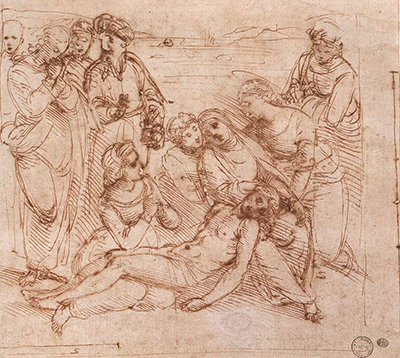
Before Raphael made Christ's burial into a procession in the Baglioni Deposition, he imagined grief gathered around a still body. The Louvre drawing known as Lamentation over the Dead Christ brings mourners into a dense horizontal group. Christ is supported close to the ground; the Virgin bends toward him; Mary Magdalene attends to his body; standing figures close the scene around them.[1]
The sheet is not a reduced copy of the Galleria Borghese panel. It is an early project for that altarpiece, preserving an organising idea Raphael later abandoned.[1][2] The difference makes it precious. A finished painting shows decisions after alternatives have disappeared. This drawing shows an alternative strong enough to be worked through in pen, black chalk and stylus before movement to the tomb replaced mourning at rest.
At 33.5 by 39.7 centimetres, the page is broad enough to hold a multi-figure sacred history yet remains an object for the hand and close eye.[1] Its lines do several jobs at once: testing placement, describing bodies, deepening shadows and giving emotion a visible tempo.
At a Glance
- ArtistRaphael
- TitleLamentation over the Dead Christ
- Object typepreparatory composition drawing
- Projectfirst design for the main panel of the Baglioni Altarpiece
- Relation to finished workan early Lamentation concept, not the final carrying scene
- Mediumpen and brown ink over stylus and black-chalk preparation
- Dimensions33.5 × 39.7 cm
- Support conditionfully laid down
- Inventory numberINV 3865 recto
- CollectionDépartement des Arts graphiques, Musée du Louvre
- Display statusavailable by appointment in the graphic-arts study room
Contents
- One sheet, one exact identity
- Christ as a horizontal centre
- The Virgin and the pressure of closeness
- Mary Magdalene and a figure that travelled
- Stylus, black chalk and brown ink
- From gathered mourning to a carrying scene
- Drawing for a memorial altarpiece
- The sheet as a museum object
- How to look at the Louvre Lamentation
- Why the drawing matters
One sheet, one exact identity
The title can easily lead to confusion because Raphael's finished Baglioni panel is also called the Deposition, Entombment or Carrying of Christ to the Tomb. The Louvre record is precise: INV 3865 recto is a drawing, and it belongs to the first project for the principal panel now in the Galleria Borghese.[1]
Medium establishes the first boundary. This is not oil on wood but pen and brown ink on paper, with preparatory work made by stylus and black chalk.[1] Its scale is less than a quarter of the finished panel's height. Every comparison should begin by respecting those material facts.
The second boundary is compositional. The painted Christ is raised and carried toward a grotto. Here the dead body remains the centre of a mourning assembly. The figures gather rather than travel. Raphael is solving intimacy, overlap and collective sorrow before he decides to make physical transport the principal action.
The third boundary is chronological function. “First project” does not mean a casual first mark. The sheet is sustained and coherent. It records a developed phase within a longer sequence, not the instant when the commission first entered Raphael's mind.
Christ as a horizontal centre
Christ's body creates the main axis. Its horizontality supplies a base around which heads, arms and folded bodies rise. The composition is organised by proximity: mourners press inward because grief has no lateral destination yet.
The body must still be supported, but support here belongs to lament rather than travel. Hands raise the head and torso enough to make Christ visible. The pose exposes the weight of death while allowing loved figures to touch him closely.
Raphael avoids isolating the corpse against empty ground. Limbs and drapery overlap it, creating a web of contact. That density differs from the finished panel, where bright flesh cuts through an open procession and landscape.
The eye nevertheless finds Christ first. The broad pale interval of the paper within his body contrasts with darker accumulations of ink around the mourners. Hatching becomes a tonal frame. The unpainted support supplies light where the final picture would use flesh colour.
The horizontal body also resists the page's upright figures. Standing mourners create vertical accents, but none can restore Christ to their condition. The tension between living verticals and dead horizontal gives the drawing its grave stability.
The Virgin and the pressure of closeness
The Virgin bends toward her son within the group. Her grief is expressed by the shrinking of distance. Unlike the final panel, where she faints apart from Christ and must be held by other women, this design keeps maternal sorrow close to the body.[1][2]
That change is central to the history of the project. In the drawing, proximity creates one emotional centre. In the painting, Raphael divides the event: Christ is carried in front, while Mary collapses behind. The later solution enlarges space and narrative time but sacrifices the immediate enclosure seen here.
Raphael tests how many bodies can approach without erasing one another. Heads occupy different levels. Arms cross through openings. Drapery creates boundaries where contours would otherwise merge.
The Virgin's place also helps stabilise the dead Christ. Her relation is both spiritual and compositional: maternal mourning gives meaning to the body while her bent form contributes to the enclosing arc.
The sheet therefore makes grief centripetal. Everything draws toward Christ. There is no tomb opening to pull the procession away and no distant Calvary to map a completed journey.
Mary Magdalene and a figure that travelled
Mary Magdalene occupies a distinct place near Christ, her body and gesture joining intimate sorrow to the larger assembly. The Louvre catalogue records an unusual afterlife for this motif: Timoteo Viti used the Magdalene figure for a Noli me tangere with saints at the Oratory of Sant'Angelo Minore in Cagli.[1]
This reuse demonstrates how drawings could circulate as stores of invention. A figure designed for one sacred narrative might be adapted by another artist for a different encounter. The borrowing does not turn the Louvre sheet into a workshop pattern book, but it shows that individual solutions could outlive the project that generated them.
The Magdalene also links early and final ideas. In the painted Deposition, she remains beside Christ and takes his hand while the body is carried.[2] Raphael changes the whole action but preserves her role as the mourner whose physical contact bridges death and living attachment.
Comparison reveals adaptation rather than repetition. A figure suited to a compressed Lamentation must move differently when following bearers across uneven ground. The persistence of the relationship matters more than exact identity of pose.
Stylus, black chalk and brown ink
The Louvre lists three working means: stylus, black chalk, and pen with brown ink.[1] They belong to different degrees of visibility and commitment.
A stylus can score or lightly guide the paper without laying down strong colour. Black chalk provides soft, revisable construction. Brown ink asserts edges and shadow with greater decisiveness. The finished appearance therefore sits over quieter stages that remain partly recoverable.
Raphael does not use pen only to outline. Short parallel strokes build shade; longer sweeps establish drapery; darkened junctions separate overlapping bodies. Hatching models mass while clarifying which limb passes before another.
Line density also carries emotion. Calm areas permit the paper to breathe. Accumulated strokes around faces, folds and supporting hands intensify pressure. The drawing can feel agitated without losing the overall order of its group.
Corrections should be read as thinking, not failure. A composition study exists to test relations before expensive wood, ground and pigment receive them. The coexistence of preparatory traces and firmer ink lets viewers see judgement in layers.
From gathered mourning to a carrying scene
The Louvre identifies this drawing with the first design for the Baglioni main panel.[1] The later development is unusually visible because many related sheets survive. The Uffizi describes a sequence moving from traditional Lamentation toward the dynamic transport of Christ.[3]
That shift altered nearly every structural question. A group gathered around Christ can form an enclosing pyramid or oval. A carrying scene needs a path, bearers under load, changing ground and a destination. The body remains horizontal, but it becomes directional.
Emotion changes too. Here mourning concentrates around access to Christ. In the painting, Magdalene tries to maintain contact while the body is taken away; the Virgin's swoon forms a second group. Separation becomes part of sorrow.
The Metropolitan Museum calls the 1507 Baglioni painting Raphael's most significant work before Rome and emphasises the drawings as evidence of disciplined storytelling.[4] INV 3865 matters within that story because it proves that the climactic final narrative was chosen, not inevitable.
Raphael did not merely animate a few limbs. He replaced the project's organising verb: mourn became carry. The Louvre sheet allows that conceptual change to be seen with unusual clarity.
Drawing for a memorial altarpiece
Atalanta Baglioni commissioned the finished altarpiece for the chapel where her murdered son Grifonetto was buried.[2] It is tempting to make every gesture on the Louvre sheet a coded record of her personal grief. The evidence does not justify that level of certainty.
The patronal context does make the subject of maternal and communal mourning especially resonant. A close Lamentation could have served a funeral chapel powerfully. Raphael's decision to abandon it therefore cannot be explained simply as correction of a weak idea.
The later carrying scene offered different possibilities: burial as process, doubled collapse of Christ and Mary, and a larger field in which Calvary and tomb could coexist. It made private bereavement part of a more expansive sacred history.
The Louvre design remains a serious answer to the commission. Its compactness imagines grief as shared contact. The painted answer imagines grief as separation, duty and motion. Both are responsive to memorial devotion; Raphael ultimately chose the one with greater narrative tension.
The sheet as a museum object
INV 3865 recto belongs to the Louvre's Département des Arts graphiques and can be consulted by appointment rather than remaining on continuous display.[1] Limited display protects works on paper from cumulative exposure to light.
The sheet is fully laid down, meaning its paper is adhered to another support.[1] A nineteenth-century mount is preserved separately. These physical facts affect what can be studied on the back and how the page has been handled across its later life.
The Louvre catalogue links the object with a long collecting history through names including Pierre-Jean Mariette, Count Moriz von Fries, Sir Thomas Lawrence, William II of the Netherlands and Samuel Woodburn.[1] Without reconstructing a sequence the record does not fully state on the page, the associations still show how an artist's working study became a prized autonomous object.
In a study room, its scale restores intimacy lost in reproduction. Pen pressure, changes in direction and the difference between chalk and ink become legible. What looks like a brown image on a screen becomes layered labour on vulnerable paper.
How to look at the Louvre Lamentation
Find Christ's horizontal body first, then trace the arc made by the mourners around him.
Separate faint preparation from darker pen. Ask which decisions are being proposed and which are being reinforced.
Locate Magdalene and imagine the problem Raphael would face when preserving her contact in a moving procession.
Finally, compare the page's edges with the group. Grief is compressed inward; almost no surrounding world competes with the body.
Why the drawing matters
The Louvre Lamentation preserves a rejected architecture of feeling. Its mourners share access to Christ in a compact field, an idea coherent enough to have become the Baglioni Altarpiece but ultimately transformed.
It demonstrates that Raphael's narrative power came through revision. The famous transport scene was created by challenging a successful first solution, not by polishing a predetermined design.
As a paper object, the drawing also makes thought material. Stylus, chalk, ink and hatching preserve different moments of attention within the same surface.
Artist Up Close
Look where dark ink accumulates around a pale limb. The paper itself supplies the body's light.
Follow Magdalene from this gathered scene toward her later place beside the moving Christ.
Then study the spaces between heads. Raphael composes a crowd by shaping intervals as carefully as faces.
Frequently Asked Questions
Discussion
What detail most changes how you read Lamentation over the Dead Christ: Raphael's Louvre Study?
Reader Insights
Which source detail gives the page its strongest anchor?
Which visual or historical distinction should readers keep in mind?
How does this page change the wider picture of Raphael's career?
Join the Conversation
Share your reading below.
References
- Musée du Louvre, Département des Arts graphiques, “Lamentation sur le Christ mort,” INV 3865 recto. View source.
- Galleria Borghese Collection, “Deposition (The Carrying of the Dead Christ to the Sepulchre),” inventory 369. View source.
- Gallerie degli Uffizi, Progetto Euploos, “Studio compositivo per la Deposizione,” 538 E recto. View source.
- Metropolitan Museum of Art, “Raphael: Sublime Poetry — Composing Monumental Paintings.” View source.