

 by Tom Gurney
Tom Gurney BSc (Hons) is an art history expert with over 20 years experience
Published on June 19, 2020 / Updated on August 21, 2026
Email: tomgurney1@gmail.com / Phone: +44 7429 011000
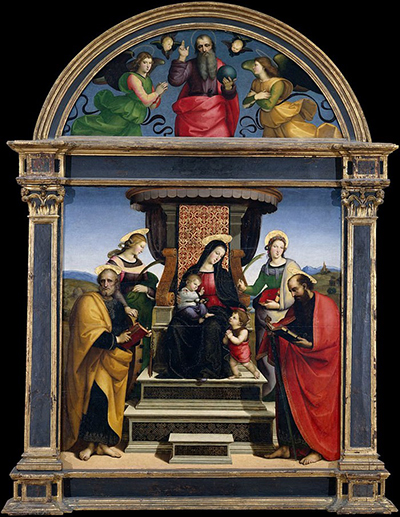
Raphael's Madonna and Child Enthroned with Saints was made for looking upward, outward and downward. At its centre, Mary sits high upon a throne with the elaborately dressed Christ Child on her lap. Saints stand and kneel around them. Above, in a separate lunette, God the Father holds a globe and blesses between angels and seraphim. Originally, smaller episodes from Christ's Passion and two Franciscan saints ran along the base. The surviving ensemble therefore joined celestial authority, a sacred gathering and narrative history in one many-part design.[1][2]
The painting is often called the Colonna Altarpiece, after one of its later owners, but that name can conceal its first life. Raphael painted it about 1504–05 for the Franciscan convent of Sant'Antonio in Perugia, probably for the inner church reserved to its nuns. The commission places a young artist at a point of transition: still working through the ordered devotional language of Umbria, yet already responding to the more massive bodies and animated ideas he encountered in Florentine art.[1][2]
Today the Metropolitan Museum of Art owns the principal panel and lunette. The predella was separated in the seventeenth century and is dispersed among four collections. What looks like one imposing museum picture is thus both a major surviving object and the centre of an absent whole.
At a Glance
- ArtistRaphael
- TitleMadonna and Child Enthroned with Saints
- Alternative namethe Colonna Altarpiece
- Dateabout 1504; commissioned about 1504–05
- Mediumoil and gold on wood
- Main panel, overall172.4 × 172.4 cm
- Main panel, painted surface169.5 × 168.9 cm
- Lunette, overall74.9 × 180 cm
- Lunette, painted surface64.8 × 171.5 cm
- Original destinationthe Franciscan convent of Sant'Antonio, Perugia
- Principal figuresVirgin and Christ Child, young John the Baptist, Saints Peter, Catherine and Paul, and a second female martyr whose identity remains disputed; God the Father, angels and seraphim above
- Original lower registerthree Passion scenes flanked by Saint Francis of Assisi and Saint Anthony of Padua
- Separationthe predella was detached and dispersed in the seventeenth century
- Present collectionMetropolitan Museum of Art, New York
- Object number16.30ab
- CreditGift of J. Pierpont Morgan, 1916
Contents
- An altarpiece for the inner church
- The Virgin, Child and throne
- Saints around the throne
- Conservative order and Florentine weight
- The lunette above
- What the missing predella contained
- Dismemberment and reconstruction
- Drawing, design and uneven execution
- Oil, gold and the original church effect
- From Sant'Antonio to the Colonna name
An altarpiece for the inner church
Sant'Antonio was a Franciscan convent whose church contained a section set aside for the nuns. The Met identifies this inner church as the intended position of Raphael's work.[1] That fact changes how the picture should be understood. It was not conceived as an independent gallery panel or an unrestricted view for a passing public. It addressed a defined religious community through a familiar sacred hierarchy.
The enthroned Virgin belonged naturally to such a setting. Her elevation establishes her as Queen of Heaven and, as the Met's audio commentary suggests, as a throne of wisdom rather than merely a ruler seated in power.[1] Christ occupies her lap at the meeting point of the principal vertical and horizontal axes. The surrounding saints translate heavenly intercession into recognisable human presences.
The patrons may also have shaped unusual details. The Christ Child is elaborately clothed at a time when an undressed infant had become common in Italian painting. The Met says the nuns may have insisted on this conservative feature.[1] The qualification matters. No surviving clause proves that they dictated it, and the museum's audio account warns against assuming that a convent was necessarily static or hostile to innovation. The clothing is evidence of a conservative choice; its exact cause remains a reasoned possibility.
That balance between prescribed tradition and artistic change gives the work much of its interest. Raphael did not simply escape an old formula. He made a coherent sacred image from elements that moved at different historical speeds.
The Virgin, Child and throne
Mary sits frontally beneath an arched canopy, her body and the throne fixing the picture's central axis. The architectural setting is shallow and emphatic. It holds the group near the front of the panel rather than opening into the kind of broad landscape that carries many of Raphael's small Madonnas.
Christ stands or braces himself upon her lap. His dress makes him appear less like a naked baby caught in domestic play and more like the small, conscious centre of a formal assembly. One hand rises toward his mother, while Mary's hands secure his body. Their contact gives warmth to a composition governed by rank.
Gold remains visible in the halos and decorative elements. The Met records the medium as oil and gold on wood, a combination that links newly subtle modelling with the precious surface expected of an altarpiece.[1] Oil allows shifts of flesh, fabric and shadow; gold preserves the sacred distinction of the figures. Neither belongs to a simple story in which Renaissance naturalism replaces medieval splendour. Both work together.
The throne also directs movement beyond the central pair. Its steps and base descend toward the kneeling saints, while its upright structure answers the lunette above. The Virgin and Child occupy the hinge between earthbound worship and divine blessing.
Saints around the throne
Four principal saints gather around Mary and Christ, while the young John the Baptist stands on the throne step. Saints Peter and Paul occupy the sides, their broad bodies giving the group physical gravity. Catherine and a second female martyr kneel nearer the centre. The combination joins apostolic founders, Christ's forerunner and revered female saints, creating a community wider than the convent while remaining meaningful to its occupants.[2]
The female saints carry palms, signs of martyrdom. Catherine is secure, but the other woman is not. An early description called her Cecilia; later scholars have proposed Lucy, Dorothea or Barbara, and the National Gallery's catalogue favours Dorothea while the Met's public commentary calls her Lucy.[1][2] The uncertainty is informative. Without a decisive attribute, a saint's name can remain open even when her role as a female martyr is clear.
What is secure is the relevance of female martyrs to the nuns. The palms make witness and endurance visible. These women do not appear as minor decorations around a male theological core. Their kneeling bodies occupy the immediate devotional zone below the Virgin, where the convent's viewers could understand sanctity through gendered exemplars of faith.
Peter and Paul provide a different kind of presence. Their heavy draperies and weighty forms resist the flatter, more delicate rhythm associated with some Umbrian painting. The Met relates this increased mass to the progressive style of Leonardo da Vinci and Fra Bartolomeo, whose work Raphael had begun to study in Florence.[1] Influence here is not quotation. It is a change in how bodies claim space.
Conservative order and Florentine weight
The principal panel is deliberately stable. Figures are arranged symmetrically around a central throne, and its sacred hierarchy can be read immediately. That continuity with Perugian practice suited an altarpiece intended for repeated devotion.
Within this order, however, Raphael enlarged the bodily authority of the male saints. Peter and Paul seem capable of displacing air. Their heads, shoulders and drapery folds have a density that looks ahead to the artist's Florentine development.[1][2]
The coexistence is more revealing than a contest between old and new. The clothed infant does not cancel Raphael's interest in substantial form, and the Florentine response does not dissolve the convent's visual expectations. An ambitious young painter demonstrates that invention can operate inside a fixed religious type.
The altarpiece therefore catches transition as a working condition. Raphael's career was not divided by a clean door between an Umbrian beginning and a Florentine revelation. Ideas crossed geography unevenly. An established main-panel scheme could contain newly forceful saints, while a more freely handled upper panel could test recent lessons with greater confidence.
The lunette above
The lunette depicts God the Father holding a globe and raising his hand in blessing. Two angels and two seraphim accompany him.[1] Its curved field completes the altarpiece vertically and places divine authority above the enthroned mother and child.
The globe names universal rule without requiring an elaborate narrative. God blesses from a space of cloud and gold, while the angels turn the upper compartment into a responsive chorus. The semicircular format gathers their movement toward the middle.
The lunette is a distinct physical panel, not merely the top of a square painting. Its overall dimensions are 74.9 by 180 centimetres, compared with 172.4 centimetres square for the main panel.[1] Even in the Met, where the two elements remain together, their join records the construction of a multipart object.
Keith Christiansen has argued that Raphael had more freedom in the lunette than in the central panel. He sees its figures as a particularly clear place to observe what the artist absorbed from Florence.[4] Whether or not every difference can be assigned to patronal restraint below, the contrast is visible: the upper bodies turn and float with a suppleness distinct from the formal gathering around the throne.
Looking from the clothed child to God the Father's blessing also creates a theological line. The incarnation below belongs within the divine order above. The globe, blessing hand, halos and throne make power visible at different scales.
What the missing predella contained
The original base comprised three narrative scenes from Christ's final days, flanked by standing Franciscan saints. From left to right in the Met's reconstruction were Saint Francis of Assisi, The Agony in the Garden, The Procession to Calvary, Pietà and Saint Anthony of Padua.[2][3]
That sequence expanded the still gathering above into time. Christ's childhood presence on Mary's lap was read against prayer before arrest, the burden of the cross and lamentation after death. The predella did not merely support the larger panels structurally; it completed their devotional meaning.
The two standing friars identified the religious order and dedication of the convent. Francis marked the community's foundation, while Anthony corresponded to Sant'Antonio's patron saint. Their narrow panels occupied the bases of the original frame's columns, joining painted holiness to the architecture of the object.[2]
The Met owns The Agony in the Garden, a panel measuring only 24.1 by 28.9 centimetres. Christ prays as the apostles sleep, and an angel offers the cup he asks might pass from him.[3] A careful landscape and varied sleeping poses show how much visual attention Raphael gave to a scene far below eye level.
The other components are elsewhere: The Procession to Calvary is in the National Gallery, London; the Pietà is in the Isabella Stewart Gardner Museum, Boston; and Saints Francis and Anthony are in Dulwich Picture Gallery. Their dispersed locations should not be confused with the Met object's present dimensions.
Dismemberment and reconstruction
The predella was separated from the principal panels around 1663. Its components then followed independent paths through collections and markets.[2] This was not an unusual fate for altarpieces. Changes of taste, architecture and ownership could turn a designed ensemble into pictures valued separately by subject and attribution.
Separation changes perception. Without the lower register, the New York panels can appear to be a self-contained enthroned Madonna crowned by a lunette. Reconstruction restores the Passion sequence, the Franciscan identities and the original frame's downward reach.
In 2006 the Met reunited the main panel and lunette with all five predella components for the first time since their separation. The exhibition also brought together preparatory material and nearby works, allowing viewers to see the altarpiece as a design problem rather than a single famous surface.[2]
Reconstruction is evidence-based but not the same as physical restoration. The panels retain their separate owners, and the original architectural frame has not simply returned intact. A diagram or temporary exhibition can make historical relations legible without pretending the losses have disappeared.
Drawing, design and uneven execution
Raphael's preparation survives in unusually useful fragments. The 2006 study identified a drawing for the landscape background and a preparatory design connected with a predella scene as the paper works most directly tied to the ensemble.[2]
The predella also shows variation. The Met Bulletin notes differences of scale and style among its small scenes and says the standing Franciscan saints may have been executed by a collaborator working from Raphael's designs.[2] Such caution belongs to those components; it does not justify describing the main panel and lunette as generally uncertain.
The ensemble nevertheless emerged from an artistic environment in which designing and making were not always identical acts. Raphael learned in workshops, used inherited figure types and adapted familiar altarpiece structures. His originality lay partly in how he coordinated these resources.
The Agony demonstrates that even a small subordinate panel could contain searching observation. The sleeping apostles form different bodily answers to fatigue, while Christ's alert solitude distinguishes his acceptance of suffering. The main panel answers with ceremonial stillness. Across registers, pace changes without coherence being lost.
Oil, gold and the original church effect
Oil and gold would have behaved differently under church light. Gold could catch illumination in halos and ornaments, while layered colour created bodies and textiles that seemed to occupy space.[1]
The altarpiece's original height also mattered. A viewer did not meet every component straight on at museum eye level. The predella sat low, the enthroned group rose above it and the curved blessing panel completed the ascent. Details changed with distance.
From farther away, the large symmetry and gold distinctions made sacred rank readable. Nearer, viewers could identify palms, books, hands and the narrative episodes at the base. Repeated convent use allowed meaning to accumulate through familiarity.
The modern museum isolates the painted surfaces more clearly and permits close inspection, but it cannot reproduce the inner church, the original frame or the religious routines around the work. Historical imagination should begin from those differences rather than treating the gallery as a neutral continuation.
From Sant'Antonio to the Colonna name
After the nuns sold the altarpiece, its principal elements passed through prestigious collections. Owners included Queen Christina of Sweden, the Colonna family in Rome, the duc d'Orléans in France and the kings of Naples and the Two Sicilies.[2][4]
The familiar “Colonna Altarpiece” name comes from that later Roman ownership, not from the commission. It is useful because scholars and museums use it to identify the dispersed ensemble. Yet Sant'Antonio Altarpiece better recalls the Franciscan women and place for which Raphael painted it.
Both names therefore reveal history. One points backward to function; the other records a powerful collector and the object's afterlife. The Met's title, Madonna and Child Enthroned with Saints, describes the principal panel without claiming to contain every component.
The path through elite collections also changed the work's status. An altarpiece made for communal devotion became a highly sought work by Raphael, valued for authorship and rarity as much as sacred use.
J. Pierpont Morgan and New York
J. Pierpont Morgan acquired the principal panels in 1901, reportedly paying two million French francs. The purchase generated international publicity and brought the last major Raphael altarpiece then in private hands across the Atlantic.[2][4]
The price belongs to the history of collecting, not to the picture's original meaning. It shows how Raphael's reputation, the object's provenance and its scale combined in the modern art market.
Morgan's son gave the work to the Metropolitan Museum in 1916, where it entered the European Paintings collection as object 16.30ab.[1][2] The two-part object number reflects the principal panel and lunette.
Its New York presence also makes the dismemberment especially visible. The Met can display its own Agony nearby, publish a reconstruction and occasionally seek loans, but the whole remains international. The altarpiece now exists as material fragments joined by research and memory.
How to look at the painting
Begin with the dressed Christ Child and ask how costume changes the tone from domestic infancy to formal sacred presence.
Move outward to the kneeling female saints and their palms, then to the standing apostles whose heavier bodies register Raphael's changing visual language.
Follow the throne upward into the lunette. Compare the main panel's stability with the angels' freer turns around God the Father.
Then imagine the missing descent: three small Passion stories and two Franciscan saints below the square panel. The reconstruction turns a static assembly into a history that runs from incarnation toward sacrifice.
Finally, notice the join between the panels. It is a reminder that an altarpiece is architecture, painting and devotional sequence at once.
Why the altarpiece matters
Madonna and Child Enthroned with Saints preserves a young Raphael negotiating several demands at once. He had to answer a Franciscan women's community, sustain a traditional sacred hierarchy, coordinate multiple compartments and develop a more forceful figure style.
The work also makes the instability of artistic objects visible. Its title changed with ownership, its base was dispersed, and its church function gave way to collection fame. Yet research can recover many of those lost relations.
Rather than serving as a simple milestone on the road to Florence or Rome, it shows transition being made within a real commission. Raphael's new ambitions did not arrive after tradition ended. They became persuasive because he could place them inside forms that patrons recognised.
Artist Up Close
First, inspect Christ's richly worked clothing. It marks the convent commission's conservative character without proving who requested every detail.
Next, compare the mass of Peter and Paul with the more delicate rhythms of the kneeling figures. Raphael is varying bodily presence within a symmetrical plan.
Then look to the lunette's angels. Their turning poses reveal greater freedom than the solemn central assembly.
Finally, mentally restore the predella. The missing scenes change the meaning of the child above by carrying his life forward to the Passion.
Frequently Asked Questions
Discussion
What detail most changes how you read Madonna and Child Enthroned with Saints?
Reader Insights
Which source detail gives the page its strongest anchor?
Which visual or historical distinction should readers keep in mind?
How does this page change the wider picture of Raphael's career?
Join the Conversation
Share your reading below.
References
- The Metropolitan Museum of Art, “Madonna and Child Enthroned with Saints,” object 16.30ab. View source.
- Linda Wolk-Simon, Raphael at the Metropolitan: The Colonna Altarpiece, Metropolitan Museum of Art Bulletin 63, no. 4, 2006. View source.
- The Metropolitan Museum of Art, “The Agony in the Garden,” object 32.130.1. View source.
- Keith Christiansen, “How Exactly Do You Dismantle a Raphael Altarpiece?”, Metropolitan Museum of Art, 26 March 2018. View source.