

 by Tom Gurney
Tom Gurney BSc (Hons) is an art history expert with over 20 years experience
Published on June 19, 2020 / Updated on August 21, 2026
Email: tomgurney1@gmail.com / Phone: +44 7429 011000
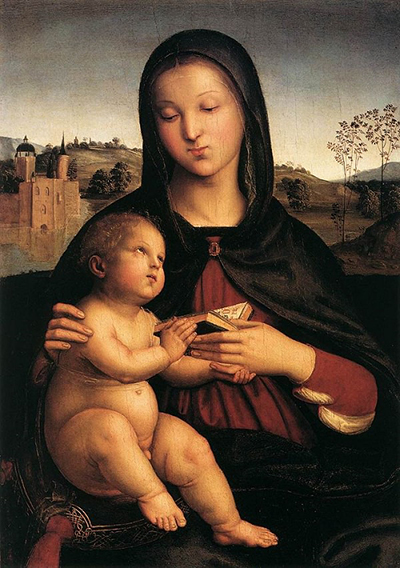
Raphael's Madonna and Child with Book turns reading into prophecy. Mary supports Christ beneath the deep blue arch of her mantle. Their hands meet around an open volume whose text introduces Nones, the ninth hour of the canonical offices. That hour commemorates Christ's Crucifixion and death. The child looks upward as though contemplating the sacrifice named on the page.[1]
Painted around 1502–03, when Raphael was about nineteen, the panel belongs to the beginning of his independent career. Its figures are serene and geometrically ordered, but the book prevents beauty from becoming empty ideal. Mother and child do not merely pose beside scripture; their touching hands make it the centre of a shared meditation.[1][2]
The painting is now in the Norton Simon Museum in Pasadena. Its current record marks it on view and identifies it as the only Raphael painting in a public collection on the West Coast of the United States.[1][2]
At a Glance
- ArtistRaphael
- TitleMadonna and Child with Book
- Dateabout 1502–03
- Mediumoil on panel
- Dimensions55.2 × 40 cm
- Figuresthe Virgin Mary and Christ Child
- Central objectan open devotional book
- Textual referenceNones, the ninth canonical hour
- Liturgical meaningcommemoration of Christ's Crucifixion and death
- Distinctive formMary's deep blue mantle creates an arch around Christ and the book
- First recorded sale in current provenanceThomas Townend, London, 1883, catalogued as Francia
- Acquired by Norton Simon Art Foundation1972
- Current locationNorton Simon Museum, Pasadena
- Accession numberM.1972.2.P
- Display notecurrent museum record marks the painting on view
Contents
- A young artist and a mature meditation
- The blue mantle as an arch
- A lucid pyramid
- Mother and child around a book
- What is Nones?
- Christ looks toward heaven
- Mary's knowledge and restraint
- Hands that frame the page
- A meditation piece
- Early Raphael and Perugian clarity
A young artist and a mature meditation
Raphael was born in 1483, so the date around 1502–03 places him near the age of nineteen.[1] The work's composure is remarkable for an artist still at the threshold of his career.
The painting does not depend on complicated narrative, multiple saints or elaborate architecture. Its intellectual weight is concentrated in two bodies and one book.
Early date should not be confused with incomplete ability. Raphael had grown within the artistic culture of Urbino and Umbria and was already capable of organising a panel with extraordinary lucidity.
The geometric faces and calm outlines reflect an idealising language associated with central Italian painting. Yet small bodily relations keep that ideal alive.
Christ leans into Mary. Her mantle encloses him. Their fingers converge on the page.
The young artist's achievement lies in making theological knowledge inseparable from physical care.
The blue mantle as an arch
The Norton Simon Museum describes Mary's deep blue silhouette as an arch enclosing Christ and framing the book.[1]
This comparison is more than poetic. The mantle rises along both sides of the child and curves over or around the central group.
Blue fabric performs the work that architecture might otherwise do. It creates a sacred interior without columns or masonry.
The arch has emotional force as well. Mary shelters Christ within clothing that belongs to her own body.
At the lower centre, the mantle guides attention toward the open pages. Protection and reading occupy the same enclosure.
The colour also establishes hierarchy. Deep blue surrounds lighter flesh and pale paper, making the child and text immediately legible.
Raphael turns drapery into structure. The garment does not simply decorate Mary; it defines the space in which Incarnation and foreknowledge meet.
A lucid pyramid
The composition is organised as a pyramid. Mary's head forms the summit, while her body and mantle broaden toward the base.[1]
Christ occupies the centre rather than sitting as a separate form beside her. The book anchors the lower part of the group.
Pyramidal order gives stability, but the figures are not rigid. Heads incline, hands approach and the child's eyes move upward.
Raphael's geometry is therefore relational. The triangle emerges because Mary encloses, Christ leans and both attend to the book.
The museum also notes geometric idealisation in faces and bodies.[1] Curves are clarified and proportions harmonised without erasing human contact.
Such lucidity suits devotion. A viewer can grasp the overall unity quickly, then examine how it is made.
The pyramid makes sacred order visible; small gestures give that order emotional consequence.
Mother and child around a book
The open volume lies between Mary and Christ. It is not held at the edge as a generic sign of literacy.[1]
Mary presents or supports it while the child's hand approaches. Their fingers make a frame within the larger blue frame of the mantle.
The arrangement joins three kinds of contact: Mary's body supports Christ, her mantle surrounds him, and their hands meet around written text.
Reading becomes shared even though Christ's gaze is not fixed on the page. The child's upward look suggests that he understands beyond ordinary sight.
Mary's attention remains quieter. Her role is to hold both child and book within one stable composition.
The volume introduces a pause. Pages are open, but the scene is not about rapid action. It invites sustained contemplation of a single liturgical idea.
Raphael makes a painted devotional object depict devotional practice within itself.
What is Nones?
The inscription introduces Nones, or None, one of the canonical hours recited daily in monastic communities.[1]
Its name refers to the ninth hour in the ancient division of the day, conventionally associated with mid-afternoon.
Christian devotion connected that hour with Christ's death on the cross. The museum therefore interprets the text as commemorating the Crucifixion and death.[1]
The book does not merely predict suffering in a general way. It locates sacred memory within the measured recurrence of the day.
Every return of the ninth hour could reactivate the Passion for a religious reader. Raphael compresses that liturgical rhythm into a permanent image.
A painted page differs from a legible service book used over time, but it can call that practice to mind continuously. The panel does not advance from one office to the next. It holds Nones in permanent readiness, allowing any hour of viewing to become an imaginative return to the ninth.
That suspension helps explain the figures' calm. They inhabit neither hurried reading nor unfolding historical action. The book fixes attention at the point where daily prayer, remembered death and promised redemption meet.
Mary and Christ appear before the historical Crucifixion, yet the text already remembers it. Sacred time lets infancy, future event and repeated commemoration coexist.
The page is thus a hinge between narrative time and devotional time.
Christ looks toward heaven
Christ turns his eyes upward rather than looking directly at the book or viewer.[1]
The museum reads the gaze as contemplation of his own sacrifice as Redeemer. The book supplies the subject of that upward thought.
Raphael gives a young child an expression of spiritual awareness without making his body adult.
The direction of the eyes also extends the composition beyond its visible top. Mary's mantle encloses the body, but Christ's attention passes beyond the human frame.
His hand remains near the page. Sight rises while touch stays with the written prophecy.
This division prevents the book from becoming a simple reading lesson. Christ does not need to decipher its words in an ordinary way; his identity gives him knowledge of their fulfilment.
The upward gaze is the panel's principal movement from earthly support toward divine purpose.
Mary's knowledge and restraint
Mary's composure differs from Christ's upward attention. She holds the scene together rather than dramatising its meaning.
Her mantle, hands and body create security around both child and text.
The book implies that she understands the future Passion. Yet Raphael does not give her theatrical grief.
Restraint preserves the devotional image's balance. Sorrow remains latent inside serenity.
Mary's low, enclosing posture also prevents Christ's gaze from detaching him completely from childhood. He contemplates sacrifice while still held by his mother.
The painting depends on this tension. Foreknowledge is spiritually immense and physically intimate.
Raphael makes Mary's silence active. She sustains the conditions in which prophecy can be contemplated.
Hands that frame the page
The touching hands place the book at the exact centre of attention.[1]
Fingers approach the pale surface from different directions, creating a small geometry of their own.
Mary's hand is steady and functional. Christ's is smaller and more exploratory.
Their difference makes the relationship credible. Adult guidance and childhood response coexist without reducing either figure to a symbol.
The hands also connect flesh to written word. Scripture is not an abstract authority floating outside human experience; it is held, touched and contemplated.
Because the painting is only 55.2 centimetres high, this central contact remains suited to near inspection.[1]
The viewer's eye follows the same path as devotional reading: toward the page, then through it to the Passion.
A meditation piece
The Norton Simon Museum explicitly calls the work a meditation piece.[1]
That description explains why the painting's calm should not be mistaken for decorative sweetness.
A meditation image provides focus. It does not need to narrate every episode when one object can sustain extended thought.
Here the book opens from the daily office toward Crucifixion, redemption, maternal knowledge and sacred time.
The small panel could support repeated return. Its geometry is immediately intelligible, while its temporal structure grows through contemplation.
Raphael's Madonnas were highly desired partly because they joined beauty to such spiritual usability.[1]
The image rewards affection but directs it beyond the pleasant appearance of mother and child.
Early Raphael and Perugian clarity
The date around 1502–03 places the painting before Raphael's sustained Florentine encounter with Leonardo and Michelangelo.[1]
Its clear contours, symmetrical calm and idealised faces belong to the central Italian artistic world in which he matured.
Perugino's influence is relevant to that world, but the panel should not be reduced to a master's formula. Raphael already coordinates mantle, hands and text with distinctive economy.
The space is less atmospheric than his later landscape Madonnas. Meaning depends on direct figural order.
That difference makes the page valuable within Raphael's career. It shows how his gift for synthesis existed before the famous Florentine pyramids and Roman monuments.
Later works would increase bodily complexity, but the governing concern remains recognisable: relationships must be lucid at first glance and deepen under attention.
The Madonna and Child with Book is an early statement of that principle.
No known first patron
The current museum record does not identify the original commissioner.[1]
The scale and devotional subject suit private possession, but they cannot name a particular owner, monastery or household.
The inscription's relation to monastic offices does not prove that the panel was commissioned for a monastic setting. Lay devotion also drew upon canonical prayer.
It is responsible to distinguish likely function from documented provenance. The picture was made to sustain contemplation; exactly who first used it remains unknown.
The absence of a patron's identity gives the painting no less historical value. It simply places greater weight on the object itself.
Book, pigment, panel and composition preserve evidence where archives do not.
An 1883 sale as Francia
The museum's recorded provenance begins with Thomas Townend. At a Christie's sale in London on 14 July 1883, the panel was catalogued as a work by Francia and bought in rather than sold.[1]
That attribution is a significant part of its history. The painting now identified as Raphael did not pass through every modern moment under his name.
Francia was a respected Bolognese painter whose serene religious style could appear close to central Italian ideals. The old label records the uncertainties of nineteenth-century connoisseurship.
The panel passed through the Townend, Bullen and Wheler families before descending to John Hall and his heirs.[1]
Provenance here is not a straight sequence of celebrated galleries. It includes inheritance, an unsuccessful sale and changing authorship.
Those facts make the eventual museum identity more precise.
Spink, Wildenstein and Norton Simon
The heirs of John Hall transferred the painting into the London art market through Marshall Spink.[1]
Wildenstein & Co. held it by June 1952, again through Spink. The work remained with the dealer until its sale in 1972 to the Norton Simon Art Foundation.[1]
Norton Simon built a collection designed to bring major European art to Southern California. Raphael's early devotional panel became one of its defining Renaissance works.
The museum's 2020 anniversary account describes it as the only painting by Raphael in a public collection on the American West Coast.[2]
Its Pasadena setting gives a small Umbrian devotional image an international modern audience far from the culture in which canonical hours shaped daily life.
Accession number M.1972.2.P records the acquisition within the Foundation's collection.[1]
How to look at Madonna and Child with Book
Begin with the outline of Mary's blue mantle. Follow it until the cloth becomes an arch around Christ.
Move inward to the hands touching near the open book.
Look for the inscription and remember that it refers to Nones, the hour commemorating Christ's death.
Follow Christ's gaze upward, away from the page, and ask how text becomes contemplation.
Compare the broad pyramid of Mary's body with the smaller frame made by fingers around paper.
Finally, consider scale. The work's spiritual argument unfolds on a panel suitable for close, repeated viewing.
Why the painting matters
The Madonna and Child with Book gives liturgical time a human centre. A daily hour of prayer becomes a page held between mother and child.
Its geometric order is not an end in itself. The blue arch shelters Christ and focuses attention on the text that foretells his death.
The work also reveals Raphael's remarkable early maturity. Around nineteen, he could make ideal beauty serve a precise devotional purpose without overloading the panel.
Its changing attribution and journey to Pasadena add another history: a Raphael once catalogued as Francia became the only publicly held painting by the artist on the American West Coast.[1][2]
Artist Up Close
Look at the small points where Mary's and Christ's fingers approach the page.
Notice how the blue mantle frames both body and book rather than only outlining Mary.
Then follow Christ's eyes upward. The most important object is held below, but its meaning lies beyond the panel.
Frequently Asked Questions
Discussion
What detail most changes how you read Madonna and Child with Book?
Reader Insights
Which source detail gives the page its strongest anchor?
Which visual or historical distinction should readers keep in mind?
How does this page change the wider picture of Raphael's career?
Join the Conversation
Share your reading below.
References
- Norton Simon Museum, “Madonna and Child with Book,” accession M.1972.2.P. View source.
- Norton Simon Museum, “Raphael 2020: A Spotlight on Madonna and Child with Book,” institutional anniversary feature. View source.