

 by Tom Gurney
Tom Gurney BSc (Hons) is an art history expert with over 20 years experience
Published on June 19, 2020 / Updated on August 21, 2026
Email: tomgurney1@gmail.com / Phone: +44 7429 011000
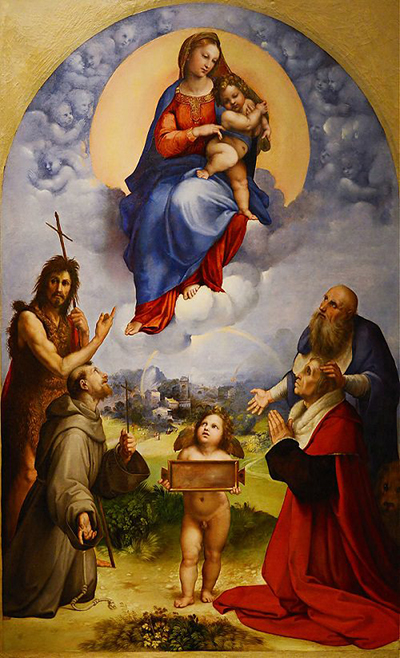
Raphael's Madonna of Foligno joins a private act of gratitude to a public vision. High above, the Virgin sits within a radiant circle of cloud and cherubim, holding the Christ Child. Below, Saint John the Baptist points upward, Saint Francis kneels, Saint Jerome presents the kneeling donor Sigismondo de' Conti, and a small angel holds an empty tablet. Between them, a distant town is struck or illuminated by a brilliant descending light.[1]
Commissioned in 1511 for the high altar of Santa Maria in Aracoeli in Rome, the work commemorated the Virgin's protection of Sigismondo's house in Foligno after it was struck by lightning.[1] Raphael did not paint a literal report of damaged architecture. He converted thanksgiving into an altarpiece in which earth, atmosphere and heaven answer one another. The donor remains a specific, ageing man, yet his prayer enters a structure broad enough to include saints, worshippers and the landscape itself.
The painting is also an object transformed by travel. It moved from Rome to Foligno in 1565, was taken to France under the Treaty of Tolentino in 1797, had its paint layer transferred from wood to canvas in Paris, and returned to Rome in 1816.[1][3] Its familiar title comes not from the church for which Raphael made it but from the city where it spent more than two centuries.
At a Glance
- ArtistRaphael
- Date1511–12
- Original mediumoil on wood panel; paint layer later transferred to canvas
- Dimensions308 × 198 cm
- Patron and donorSigismondo de' Conti
- Original locationhigh altar of Santa Maria in Aracoeli, Rome
- Later historic locationMonastery of Sant'Anna delle Contesse, Foligno
- Principal figuresVirgin Mary, Christ Child, Saint John the Baptist, Saint Francis, Saint Jerome, Sigismondo de' Conti and a small angel
- Votive subjectthanksgiving for the preservation of Sigismondo's house after a lightning strike
- Paris removal1797, following the Treaty of Tolentino
- Return to Rome1816
- Current locationPinacoteca Vaticana, Vatican Museums
- Inventory numberMV.40329.0.0
Contents
- A Roman altarpiece born from a personal vow
- Two realms held in a single atmosphere
- The Virgin and Child in glory
- A heaven made from cloud and faces
- Saint John the Baptist: the pointing witness
- Saint Francis and the church community
- Saint Jerome presents Sigismondo de' Conti
- The small angel and the blank tablet
- The town, the flash and the story of protection
- Colour, light and the Roman transformation
A Roman altarpiece born from a personal vow
Sigismondo de' Conti was a humanist from Foligno who served in the papal world and knew Raphael's work in Julius II's apartments. The British Museum describes the Madonna of Foligno as Raphael's first Roman altarpiece and places its commission around 1511, when the artist was working in the Stanza di Eliodoro.[5] This was therefore not a provincial continuation of his earlier Umbrian manner. It was a major sacred work made amid the artistic and political demands of papal Rome.
The intended site mattered. Santa Maria in Aracoeli was a Franciscan church, and Saint Francis kneels prominently at the lower left.[1] The altarpiece had to speak both for one donor and within the devotional identity of the religious community. Raphael achieves that balance by giving Sigismondo an unmistakably individual profile while making his act of prayer part of a larger communion.
Votive images are often described as transactions: danger occurs, aid is requested, deliverance follows and an offering fulfils the vow. Raphael preserves that sequence without turning the panel into an illustrated contract. The lightning event is reduced in scale and placed deep in the landscape. Sigismondo's survival is registered through presence—he kneels alive before the Virgin—rather than through a crowded scene of disaster.
The empty tablet held by the angel might have carried a record of the favour or vow, but no inscription occupies it.[1] The absence keeps the painting open. A known commission grounds the work in Sigismondo's history, while the blank surface allows thanksgiving to exceed one name and event.
Two realms held in a single atmosphere
The composition divides clearly between heaven and earth, but it does not split into two unrelated pictures. Mary and Christ occupy an elevated circular glory. Four adults and the angel stand or kneel below. A broad band of landscape opens between the two groups, and gestures cross the intervals.
Saint John supplies the most explicit connection. His raised arm directs attention from the earthly gathering to the Virgin and Child. Saint Jerome's presenting hand moves from the donor toward the same centre. Francis looks and prays upward. The angel stands on the central axis beneath the glory, its blank tablet answering the cloud-borne group above.
Light provides another bridge. The heavenly disc is gold and luminous, yet the distant landscape also flares with radiance. Cloud is not confined to a remote paradise; atmosphere passes behind the saints and over the town. Raphael gives the lower world enough depth to feel inhabitable while bathing it in effects that respond to the vision.
The distinction remains meaningful. Human figures occupy ground, wear heavy garments and turn through measurable space. Mary has no throne fixed to architecture. She rests in cloud among barely embodied cherubim. The painting's power comes from making these realms different but communicative: heaven becomes visible, earth becomes receptive and the donor's prayer crosses their boundary.
The Virgin and Child in glory
Mary sits above the assembly, her body turned slightly while her face lowers toward the world beneath. The Christ Child lies energetically across her lap rather than sitting as a miniature ruler. His twisting movement activates the upper group and complicates the calm circular form of the glory.
Mother and Child are intimate without becoming domestic. Mary's arms secure the Child, but their scale and elevation make them a public vision. The bare infant body asserts physical incarnation inside an atmosphere of gold and cloud. Raphael holds vulnerability and majesty together.
The Virgin's mantle creates a broad colour mass that can be read from a distant nave. Its folds support the Child's diagonal body and stabilise her seated pose even though no solid throne is visible. The image therefore offers the authority of an enthroned Madonna while replacing architecture with radiance.
Mary's downward attention is crucial. She does not withdraw into an exchange only with her son. Her position answers the saints and donor below. The altarpiece makes intercession spatial: prayer rises through gesture, and the Virgin's presence descends through gaze, light and scale.
A heaven made from cloud and faces
The upper glory appears at first as a brilliant atmospheric ring. Closer inspection reveals cherubic faces embedded in it.[1][3] Raphael allows the material of cloud to become a multitude. Heaven is populated without the need to arrange rows of fully bodied angels around a throne.
This device gives the central pair both isolation and company. Mary and Christ remain immediately legible against light, while countless witnesses emerge at the edge of perception. Faces approach visibility and dissolve again into brightness.
The circular field also counters the tall rectangle of the altarpiece. Its arc gathers the upper half and focuses sight on the two bodies. Below, the saints form a wider, more irregular human assembly. Geometry distinguishes celestial unity from earthly variety without making either inert.
The gold is not flat ornament detached from nature. It meets blues, greys and illuminated cloud, so radiance seems to alter atmosphere. The result is visionary precisely because Raphael begins with visible things—vapour, colour, reflected light—and pushes them beyond ordinary weather.
Saint John the Baptist: the pointing witness
At the lower left, John the Baptist stands in animal skin, his exposed limbs and rough garment contrasting with the fuller robes of the other adults.[1] His identity as the forerunner makes his gesture more than a compositional arrow. In Christian tradition, John recognises and announces Christ.
Raphael turns that function into bodily address. John's arm rises toward the glory while his torso remains among the earthly figures. He belongs to the lower register but directs vision out of it. The force of the diagonal helps the large composition remain intelligible from a distance.
John also looks beyond a private exchange between Sigismondo and Mary. His gesture can include everyone before the altar. A donor portrait might otherwise close around the patron's privilege; the Baptist makes the revelation public.
The cross-staff associates John's witness with Christ's future sacrifice. It introduces a thin, hard vertical among flesh, cloud and drapery. That austere object prevents the luminous vision from becoming only an image of celestial splendour. The Child is recognised within a history that leads toward suffering and redemption.
Saint Francis and the church community
Francis kneels before John, turning upward with an intensity different from the donor's contained prayer. He represents the Franciscan community of Santa Maria in Aracoeli, the church for whose high altar the painting was made.[1]
His placement close to the spectator gives institutional identity a human form. Francis does not appear as a distant founder sealed into history. His kneeling body models the devotional posture that worshippers could adopt before the altar.
The saint's plain habit contrasts with Jerome's cardinal-like vestments and with the refined clothing of the donor. Raphael uses costume to articulate different lives within the Church: renunciation, learned authority and lay or courtly service. All three remain subordinate to the Virgin and Child.
Francis also balances Sigismondo across the central angel. Both kneel, but they are not mirror images. The patron appears in profile and is formally presented; Francis opens more directly toward the vision. Personal gratitude and communal devotion thus occupy corresponding but distinct places.
Saint Jerome presents Sigismondo de' Conti
On the right, Saint Jerome stands behind the donor in red vestments, one hand associated with Sigismondo and the other participating in the movement toward Mary.[1] His role is that of patron saint and intermediary: he introduces the living man to the sacred presence.
Jerome's red provides a strong chromatic anchor opposite John's exposed body and Francis's subdued habit. His mass helps contain the right edge, while the donor's smaller kneeling form opens the centre. Raphael uses hierarchy of scale and position without erasing portrait individuality.
Sigismondo is shown in strict profile, an elderly face marked by time rather than idealised into saintly youth. The specificity matters because the painting answers a particular life. His clasped or prayerful bearing remains controlled. He does not perform the terror of the lightning strike; he appears after danger, in sustained gratitude.
The patron's gaze rises along a chain of mediation. Jerome presents him, John identifies the heavenly Child, and Mary looks toward the world below. The donor is privileged by proximity but not by direct ownership of the vision. Saints, church and congregation surround his act.
Raphael thereby negotiates the social fact of patronage. Sigismondo paid for an altarpiece connected with his burial and memory, yet the finished work could not function as a private monument alone. By placing his portrait within a network of gesture rather than at the centre, Raphael makes commemoration compatible with public worship.
The small angel and the blank tablet
The child angel at the lower centre is easy to overlook beside the large saints, but it occupies the compositional hinge. It stands beneath Mary and Christ, between the two kneeling figures, and holds a framed tablet known as a tabula ansata.[1]
The tablet contains no text. The Vatican Museums suggests that it was probably intended to recall the Virgin's fulfilment of the vow.[1] Whether an inscription was planned and never applied, deliberately omitted or once present cannot be settled merely by looking. Its current blankness must be treated as the work's visible fact.
That blank surface performs several functions. It gives the crowded lower half a pale interval. It recalls the conventions of dedicatory or commemorative inscription. It also makes absence conspicuous: the object asks to be read, yet withholds words.
The angel's youth answers the Christ Child above while its grounded body belongs with the earthly group. Like John's finger, it joins registers. Unlike John, it does so quietly, through central placement and the expectant object it carries.
The town, the flash and the story of protection
Deep in the centre lies a small settlement beneath an extraordinary light. The Vatican Museums identifies the landscape as recalling the event behind the commission: Sigismondo gave thanks after the Virgin saved his Foligno house when lightning struck it.[1] The bright descending or exploding form has consequently been described in many ways, including lightning, a fireball or a meteor-like phenomenon.
The safest reading begins with the documented votive story rather than trying to diagnose a sixteenth-century weather event from painted form. Raphael shows concentrated celestial light directed toward a building or settlement. That image makes danger and protection visible at the scale required by the larger altarpiece.
Its smallness is purposeful. If the foreground saints enacted the accident, fear would dominate. Instead, the event is held at a distance, already absorbed into landscape and memory. Sigismondo kneels safely in the present of thanksgiving while the background preserves the cause.
The illumination also creates pictorial depth. Brightness near the horizon draws the eye through the opening between figures. Darker foreground bodies become a frame for air, buildings and cloud. The eye moves from the angel's tablet into the town and then upward to the golden glory.
The relationship between natural and supernatural light remains deliberately fluid. Lightning belongs to weather, but the votive context understands survival as Marian protection. Raphael does not separate these into competing explanations. He paints an observable burst of light inside a sacred composition, allowing physical event and providential meaning to coexist.
The landscape is therefore not decorative relief from monumental figures. It is the narrative core in compressed form. It explains why this donor is present, why a tablet is held and why the Virgin appears in glory. A few centimetres of distant paint carry the temporal past on which the entire act of gratitude depends.
Colour, light and the Roman transformation
The Madonna of Foligno is built from strong colour zones: Mary's blue and red, Jerome's intense vestments, Francis's earth-toned habit, John's skin and fur, and the golden upper atmosphere. These contrasts make the large altarpiece readable while avoiding the rigid isolation of separate figures.
Light softens the boundaries. Reflections circulate through cloud, flesh and fabric, while the landscape opens into a luminous distance. The British Museum connects the unusual blue paper and soft black chalk of Raphael's surviving study with his search for atmospheric colour and light in the finished work.[5]
That drawing also suggests a Roman artist looking beyond the balanced clarity of his earlier Madonnas. The museum notes possible attention to Venetian painting and drawing, particularly in the luminous atmosphere.[5] Such a connection is best understood as artistic exchange, not as a claim that colour replaced design. Raphael's line remains decisive, but it now constructs bodies meant to live inside changing light.
The painting's scale intensifies the achievement. Subtle atmospheric transitions must coexist with silhouettes strong enough for a high altar. Raphael gives the Virgin a clear central mass, the saints emphatic gestures and the landscape a delicacy reserved for closer approach.
Colour also carries hierarchy without following a simple code. Gold distinguishes glory, but red moves through both heavenly and earthly clothing. Blue gives Mary prominence and appears elsewhere in moderated forms. The entire painting participates in one chromatic world even as light separates its registers.
The surviving study for Mother and Child
A black-chalk drawing on light blue paper in the British Museum records Raphael's preparation for the Virgin and Child.[5] It measures 400 by 266 millimetres, large enough for sustained modelling yet far smaller than the painted figures.
The sheet concentrates on the upper pair rather than the whole altarpiece. Mary sits slightly turned and looks down while holding the Child. Soft chalk builds volume through atmosphere rather than defining every contour with an unbroken hard line. The blue paper acts as a middle tone from which darkness and implied light can develop.
Comparison with the painting shows drawing as investigation, not a miniature contract. Raphael studies weight, embrace and the diagonal activity of the infant before those bodies enter the golden cloud and the larger network of saints. The emotional relation of Mother and Child is solved through repeated attention to how one body supports another.
The sheet also guards against the myth that harmonious composition appeared effortlessly. A monumental vision begins with a close problem: the turn of Mary's torso, the reach of the Child and the distribution of weight across a lap. Raphael's grandeur is made from such exact bodily decisions.
Because this is the only preparatory drawing securely connected with the altarpiece in the British Museum's account, it cannot reconstruct every stage.[5] It does, however, preserve the transition between thought and painted presence more directly than later copies or verbal descriptions.
Raphael, workshop and the landscape question
Raphael's Roman practice depended increasingly on collaboration, but responsibility must be discussed object by object. A 2011 Vatican Museums essay proposed that the luminous landscape in the Madonna of Foligno was painted by Dosso Dossi, then active in Rome, within Raphael's organised workshop practice.[4]
That attribution is a scholarly judgement rather than a label visible on the surface. It should not be inflated into a claim that the altarpiece ceases to be Raphael's design. The composition, principal figures and integration of landscape with gesture remain governed by the whole conception.
The proposal is valuable because the landscape does possess a specialised brilliance. Its small architecture, atmospheric reflections and concentrated flash demand a different scale of handling from the monumental saints. Collaboration could allow Raphael to coordinate distinct strengths without surrendering authorship in the Renaissance workshop sense.
It also makes the painting a richer record of Rome's artistic exchanges. Raphael was not working in isolation from other Italian traditions. The altarpiece's union of lucid design and saturated, atmospheric light could emerge through observation, competition and carefully directed assistance.
Viewers need not decide the attribution by eye before responding to the landscape. The responsible conclusion is bounded: a Vatican scholar has argued for Dosso's participation, while the Vatican catalogue identifies the altarpiece under Raphael's name.[2][4] Both the master conception and the possibility of specialist collaboration belong to its history.
From Aracoeli to Foligno
The work's original destination was the high altar of Santa Maria in Aracoeli in Rome.[1][2] Its present title can therefore mislead anyone who assumes it was designed for a church in Foligno. The city enters through the patron's origin, the commemorated house and, later, the painting's physical relocation.
In 1565 the altarpiece passed to the church of Sant'Anna at the Monastery of the Contesse in Foligno.[1][2] A Vatican essay explains that Sigismondo's niece, an abbess, took it there when the Aracoeli sanctuary and altar were substantially altered.[4] The move preserved a family and civic connection while changing the institutional audience.
More than two centuries in Foligno fixed the name by which the painting is now known. Titles of old master works often condense later ownership, site or popular memory rather than reproduce an original contract. Here the title is historically meaningful, but it belongs to the object's biography after completion.
The distinction clarifies the iconography. Francis is present because the Roman destination was Franciscan, not because Raphael was illustrating the city of Foligno. Sigismondo's profile belongs to the patron's memorial needs. The distant settlement refers to the votive event. Site, donor and story overlap, but they are not identical.
Seizure, Paris and transfer from panel to canvas
In 1797 the painting was removed to France following the Treaty of Tolentino.[1][2] This displacement formed part of the Napoleonic concentration of major Italian works in Paris. An altarpiece shaped for worship and family memory became both a trophy and a museum object.
Its support then changed fundamentally. Raphael had painted on wood, as the Vatican catalogue records.[2] In Paris, conservators detached the paint-bearing layers from the panel and attached them to canvas.[3][4] Conservation literature dates François-Toussaint Hacquin's transfer to 1801.[6]
Such an operation is far more radical than moving a canvas onto a new stretcher. The painted and preparatory layers had to be secured, separated from their structural wood, given a new backing and made to function on fabric. The intervention preserved an endangered image according to the knowledge and priorities of its period, but it also removed an irreplaceable part of Raphael's original object.
The history resists an easy verdict. Without the transfer, deterioration in the panel might have threatened the paint. With it, evidence embedded in the original ground and support was altered or lost. Modern viewers encounter Raphael's surface through the consequences of an early museum-age conservation decision.
The Getty Conservation Institute's proceedings place the Madonna of Foligno within the history of panel-to-canvas transfer and identify it as one of Hacquin's major examples.[6] This wider context matters. The treatment was not an eccentric accident performed without theory; it belonged to an established European effort to make vulnerable paintings stable, transportable and displayable.
Yet the vocabulary should remain precise. The painting was not copied onto canvas. Its original paint layer was transferred. Nor was canvas Raphael's chosen support. The current object combines sixteenth-century paint with a support structure created through later conservation.
Return to Rome and the Vatican Pinacoteca
The altarpiece returned from France in 1816 and entered the Vatican collection.[1][2] The online catalogue separately records 1820 as its acquisition period within the Pinacoteca of Pius VII, a distinction that reflects the stages by which a returned work could be received and catalogued.[2]
Today it is displayed in Room VIII of the Pinacoteca Vaticana under inventory number MV.40329.0.0.[2] Museum display cannot reproduce either the Aracoeli high altar or the long residence in Foligno, but it permits the work's celestial and earthly registers to be studied at sustained close range.
Its present identity holds several places at once. Rome supplied the original commission and now houses the painting again. Foligno gave the work its enduring title. Paris changed its material body. Each place left evidence, even though Raphael designed the altarpiece for only one of them.
How to look at the Madonna of Foligno
Begin with Sigismondo's profile and follow Jerome's presenting gesture. Cross the blank tablet to Francis, then rise along John's pointing arm.
Let the gold circle gather Mary and the Child before looking into its edge for cherubic faces. Notice how the Child's diagonal energy disturbs the serenity of the round glory.
Return to the opening between the saints. Find the town and the concentrated flash, then compare this earthly light with the radiance above.
Finally, remember the support. The surface began on a monumental wood panel and now rests on canvas. Material history lies beneath every visible figure.
Why the painting matters
The Madonna of Foligno makes one man's gratitude into a public structure of intercession. Portrait, saints, landscape and celestial vision remain distinct, yet gesture and light make them answer one another.
It marks Raphael's Roman expansion of the altarpiece into atmospheric drama. Monumental figures retain clarity while cloud, gold and distant weather produce a world in transformation.
Its travels also expose the double history of preservation. Removal severed the work from its altar, and transfer sacrificed the original panel, yet those interventions helped deliver the painted surface to the present. The masterpiece is both Raphael's image and a record of what later institutions did to keep, possess and understand it.
Artist Up Close
Look first at the blank tablet, the place where language is expected but absent.
Then compare two pointers: John's raised arm publicly announces the vision, while Jerome's hand privately presents the donor.
End in the distant town. The smallest narrative element explains the largest celestial display.
Frequently Asked Questions
Discussion
What detail most changes how you read The Madonna of Foligno?
Reader Insights
Which source detail gives the page its strongest anchor?
Which visual or historical distinction should readers keep in mind?
How does this page change the wider picture of Raphael's career?
Join the Conversation
Share your reading below.
References
- Vatican Museums, “Raffaello Sanzio, Madonna of Foligno,” Pinacoteca Vaticana object essay. View source.
- Vatican Museums Online Catalogue, “Pala d'altare: Madonna di Foligno,” MV.40329.0.0. View source.
- Vatican Museums and Eni, exhibition and conservation resource for the Madonna di Foligno. View source.
- Arnold Nesselrath, Vatican Museums, “Splendore celeste: Raffaello, Dürer e Grünewald dipingono la Madonna,” 2011. View source.
- British Museum, “The Virgin and Child, study for the Madonna di Foligno,” museum number 1900,0824.107. View source.
- Getty Conservation Institute, The Structural Conservation of Panel Paintings: Proceedings of a Symposium, historical discussion of panel-to-canvas transfer. View source.