

 by Tom Gurney
Tom Gurney BSc (Hons) is an art history expert with over 20 years experience
Published on June 19, 2020 / Updated on August 21, 2026
Email: tomgurney1@gmail.com / Phone: +44 7429 011000
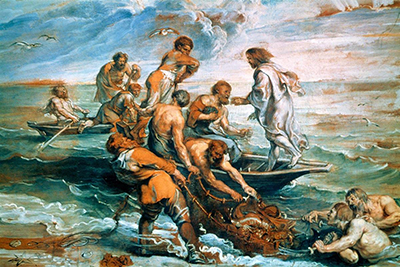
Raphael's Miraculous Draught of Fishes holds abundance and instability in one immense design. Two fishing boats sit perilously low in the water beneath a catch too heavy for one crew. Men haul the breaking nets while Simon Peter kneels before Christ, already understanding that the miracle concerns more than fish. On the shore, tall birds establish a foreground from which the viewer looks across the lake toward a calling that will change ordinary labour into apostleship.[1][4]
The work is a full-scale tapestry cartoon painted on joined sheets of paper about 1515–16. It belongs to the Royal Collection and has been on loan at the Victoria and Albert Museum since 1865. It is not the tapestry woven for the Sistine Chapel: that textile reversed the composition, added borders and translated painted paper into wool, silk and metal thread.[1][2][3]
At a Glance
- Artist/designerRaphael, with workshop collaboration
- TitleThe Miraculous Draught of Fishes; the Royal Collection uses “Draft”
- Dateabout 1515–16
- Object typefull-scale cartoon for a tapestry
- Mediumbodycolour over charcoal on many sheets of paper mounted on canvas
- Dimensionsapproximately 3.2 × 3.9 metres
- SubjectLuke 5:1–11, the miraculous catch and calling of Simon Peter
- PatronPope Leo X
- Intended destination of tapestrylower wall of the Sistine Chapel
- Cartoon ownerRoyal Collection
- Present displayRaphael Court, Victoria and Albert Museum, London
- Related woven objectVatican tapestry made in Pieter van Aelst's Brussels workshop
Contents
- A cartoon, not the tapestry
- Luke 5: nets at breaking point
- Christ and Peter
- The fishermen and the weight of abundance
- Two boats, one event
- Calling before certainty
- Bodycolour, charcoal and monumental paper
- Designed for the spectator below
- Copies and the education of artists
- Water, horizon and scale
A cartoon, not the tapestry
The English word “cartoon” can make the object sound informal or comic. In Renaissance workshop language, cartone means large paper. A tapestry cartoon gives the composition at full scale so that weavers can translate it into thread.[2][3]
Raphael's sheet is consequently both a working design and a monumental painting on paper. It was assembled from many pieces because no single sheet could approach its size. Broad colour, decisive contours and legible gestures had to remain useful at the loom and powerful from the floor of a vast chapel.[1]
The woven tapestry is a separate object. Low-warp manufacture reversed the cartoon's orientation. Fibre changed colour transitions and surface; silk and metal thread reflected light; an elaborate border extended the Medici and papal programme beyond the biblical scene.[2]
Modern display reverses their original hierarchy. The cartoon was once a means toward the textile; its extraordinary survival now makes it one of the best-known works in the cycle. The tapestry remains the object commissioned for the chapel, while the cartoon preserves Raphael's painted invention and evidence of its making.
Luke 5: nets at breaking point
In Luke's account, Jesus teaches from Simon's boat, then tells him to put out into deep water and lower the nets. Simon answers that the fishermen have worked all night without success, but obeys. The catch is so great that the nets begin to tear and partners in another boat come to help; both boats begin to sink.[4]
Simon Peter falls at Jesus's knees and asks him to depart because he is sinful. Jesus tells him not to fear and promises that from then on he will catch people. Simon, James and John bring their boats ashore, leave everything and follow him.[4]
Raphael condenses these stages. The men are still struggling with fish, but Peter has already moved from amazement to recognition. The design does not divide work, miracle and calling into separate frames. Bodies performing different moments make the spiritual sequence simultaneous.
This compression gives Peter's kneeling special weight. He turns away from the overflowing nets at the instant other men remain absorbed by them. Abundance has become a sign, and the first apostle is the person able to read it.
Christ and Peter
Christ sits in the smaller boat with Peter and another apostolic figure. His composure contrasts with the fishermen's exertion. The miracle does not require a theatrical gesture of force; the impossible catch around him proves authority.[1]
Peter kneels with hands raised or joined, his body compressed by the boat's narrow space. Raphael makes humility physically precarious. The apostle must balance devotion within a vessel already burdened by abundance.
Their exchange is intimate despite the design's scale. Christ's calm orientation answers Peter's urgency, creating a spiritual centre slightly apart from the labour. Viewers understand that the future Church begins not in triumph but in recognition of insufficiency.
The Sistine destination intensified this meaning. Peter's calling appeared in the pope's chapel, where claims of apostolic succession gave the episode institutional force. Leo X's tapestry cycle traced authority back to a fisherman who first kneels.[2][3]
The fishermen and the weight of abundance
The neighbouring boat is crowded with men hauling a net swollen with fish. Muscles, bent backs and braced legs make the miracle measurable through effort. Raphael represents supernatural abundance by showing ordinary bodies reach their limits.
The boats themselves become expressive. Their low position in the water communicates risk before individual fish are counted. The composition depends on a paradox: the gift is so great it threatens the vessels receiving it.[1][4]
Cooperation answers that danger. Simon's partners come because one crew cannot manage the catch. The scene therefore prepares communal apostleship as well as Peter's individual calling. Recognition belongs to Peter, but the work of receiving abundance requires many hands.
The nets create a flexible architecture between boats, water and bodies. Their lines gather fish while visually connecting separate crews. What appears at first as a detail of fishing equipment becomes the design's image of relation.
Two boats, one event
Luke specifies that Simon's partners in the other boat are summoned when the first crew cannot contain the catch.[4] Raphael uses the second vessel to make help visible. The miracle does not simply fill a boat; it creates a demand that crosses the water between crews.
The boats differ in narrative function. Christ and Peter occupy the vessel of recognition, where the apostle kneels. The other concentrates physical labour as fishermen pull against the net. Neither is secondary: spiritual interpretation and collective effort form complementary halves of response.
Their small size relative to the figures intensifies danger. These are not grand ships capable of absorbing any cargo. Gunwales lie close to the surface, bodies crowd limited floors and every shift of weight matters. Raphael designs instability without making the boats visually incoherent.
The connecting net also prevents the gap between vessels from becoming empty water. Its curve records invisible weight and distributes tension. Hands at either end make cooperation a physical circuit, while fish caught within it give abundance a dense material centre.
For the tapestry, this structure offered strong diagonals and repeated lines that weavers could translate. Nets are difficult because their pattern must remain legible without overpowering bodies. Raphael makes mesh both descriptive and compositional, a transparent form capable of carrying force.
Calling before certainty
Peter's response includes fear. He does not receive abundance as proof of personal success; he recognises distance between himself and Christ and asks the Lord to depart.[4] Raphael's kneeling captures the humility preceding the assurance “Do not be afraid.”
This makes the scene more than a celebration of plentiful fishing. The catch exposes human limits twice: first the fishermen work through the night and catch nothing, then the miraculous result exceeds their ability to manage it. Failure and success both destabilise self-sufficiency.
Christ's call redefines skill rather than despising it. Peter, James and John know boats, weather, nets and cooperative labour. Their future mission will require endurance, judgement and work with others. The metaphor of catching people transforms their existing world into a language for a new vocation.[4]
Raphael keeps the shore within sight, which gives the final decision—bringing boats to land and leaving everything—an implied destination. The cartoon does not show the men walking away. It asks viewers to hold the astonishing value of the catch against the greater value of following.
In a chapel dedicated to papal worship, Peter's uncertainty mattered. Papal authority was traced to an apostle called through grace, not to a ruler born complete. Leo X's magnificent tapestry begins institutional history with a fisherman overwhelmed in a sinking boat.
Bodycolour, charcoal and monumental paper
The Royal Collection describes the cartoon as bodycolour over charcoal on many paper sheets mounted on canvas.[1] Charcoal allowed the design to be established and adjusted; opaque colour gave weavers information about mass, light and relationships. Neither material was chosen for the permanence of fresco or oil on panel.
At full scale, paper behaves architecturally. Joins interrupt the field, gravity pulls on supports and large passages must be coordinated across separate sheets. The cartoon's apparent unity is a technical construction before it is a compositional achievement.
Raphael's painted handling varies with purpose. Faces and hands require enough definition to carry expression; broad draperies and landscape need clarity at distance; water and sky create continuous fields across joins. The design balances information useful to weavers with the economy of a working object.
Charcoal underdrawing remains important even where colour covers it. Infrared recording can reveal planning, reinforcement or change not obvious at the surface.[2][5] Such evidence helps distinguish Raphael's invention process from later restoration and damage.
Mounting on canvas belongs to the cartoon's survival and display history rather than to its first identity as loose paper prepared for manufacture. Modern viewers encounter a composite object in which Renaissance materials and later support decisions remain inseparable.
Designed for the spectator below
The tapestry was intended for the Sistine Chapel's lower wall zone, but “lower” does not mean domestic eye-level display. The vast interior, ceremonial furniture and surrounding frescoes demanded forms readable across distance and among many competing images.[2]
Raphael responds with monumental bodies and a shallow band of action. The fishermen are not miniatures lost in a wide landscape. Their bends, pulls and kneeling create silhouettes strong enough to register before individual features are examined.
The foreground shore places birds near the spectator's imagined space, while the boats sit farther out yet remain enormous. This deliberate inconsistency of scale serves comprehension. Naturalistic depth yields to narrative visibility.
Textile would intensify the relation. Woven figures possess a soft, light-responsive surface, and gold or silver in surrounding borders could catch ceremonial illumination. Spectators moving through the chapel would not see a single stable photographic image.
The V&A's Raphael Court approximates the chapel's area remarkably closely, although it is a museum gallery with different light, wall relationships and ritual use.[2] The setting helps recover bodily scale while preserving the difference between a paper cartoon displayed alone and a tapestry activated within a papal cycle.
Copies and the education of artists
Once the cartoons entered royal display, they became models for generations of artists. Full-scale copies supported new tapestry production, while prints reduced and circulated the designs. Study could occur through direct viewing, tracing or reproductive images.[2]
This educational history had costs. Pinning tracing paper and following outlines with hard tools damaged surfaces. The same demand that spread Raphael's compositional authority endangered the object carrying it.[2]
Copies nevertheless reveal how the cartoon's identity changed. A design made for Brussels became an academy of figure grouping, gesture and narrative clarity. Students could learn from the relation of Peter to Christ or the counterweight of fishermen without needing to commission a tapestry.
The cartoon's fame also encouraged cropped details and independent studies. Such fragments can sharpen attention to a head or bird but weaken the essential structure of two boats joined by weight. Raphael's invention is relational; its parts derive force from the complete field.
Modern digital recording continues the educational role with less physical contact. Zoomable colour, infrared and surface data allow viewers to approach paper fibres and joins while the original remains protected.[2]
Water, horizon and scale
Raphael lowers the distant shoreline and gives water a broad horizontal reach. This openness isolates the boats, making their human drama legible against an uncluttered field. The lake is calm enough to support clarity even while the catch makes the vessels unstable.
Landscape does not merely decorate Scripture. Distance separates the event from the town and turns ordinary work into an encounter at the threshold between inhabited shore and deep water. Christ's earlier instruction to put out into the deep acquires spatial force.[4]
The low horizon also suits a tapestry intended for the chapel's lower walls. Monumental figures could meet the spectator at human level rather than vanish beneath dense scenery. Open water gives coloured thread and broad silhouette room to speak.
Seen in the V&A, the cartoon's size restores some of this bodily relation. A reproduction that fits the design onto a screen can make two boats appear delicate; in person, the figures approach or exceed the spectator's scale.
The birds on shore
Three tall water birds occupy the foreground. Their long necks and legs establish the shore nearest the viewer and create a striking counter-rhythm to fishermen bent over nets.[1]
They have attracted symbolic interpretations, sometimes connected with vigilance, appetite or Christian allegory. Such possibilities should be approached carefully unless supported by a precise contemporary source. Raphael first uses the birds to solve compositional problems: they measure depth, animate an otherwise empty bank and redirect attention toward the boats.
Their detachment from human crisis also matters. The natural world continues at the edge of miracle. Birds watch or feed according to their own rhythms while apostleship begins across the water.
In the tapestry, species and plumage would be recreated through thread rather than painted bodycolour. Their strong silhouettes help them survive that translation, demonstrating how observation and decorative clarity can reinforce one another.
Designing for reversal
Pieter van Aelst's Brussels workshop used low-warp looms, which produced the tapestry in reverse from the cartoon placed beneath the warp.[2] Raphael had to anticipate that change. The design's left-to-right movement in paper would return differently on the chapel wall.
Reversal affects more than orientation. Christ's relation to the direction of reading, the boats' visual sequence and the foreground birds all change. Comparing cartoon and tapestry reveals a Renaissance designer thinking in two images at once.
The weaving process also reconstructed Raphael's modelling through discrete threads. The painter could soften colour across paper; the weaver used dyed fibre, hatching and metal highlights. Clear bodily actions mattered because subtle painterly transitions could not be transferred unchanged.
The tapestry's border was not part of the surviving cartoon field. It enlarged the complete object and added patronal meaning. A borderless reproduction of the cartoon cannot stand in for the textile as Leo X's audience saw it.
Paper, strips and survival
The cartoon is made from joined paper sheets and was later cut into vertical strips, probably for handling and use in Brussels. By the time Charles I acquired the surviving cartoons in 1623, the strips were separate. They were reassembled for display at Hampton Court in 1697.[2]
These cuts are production history, not accidental vandalism. Tapestry making temporarily required a monumental composition to become manageable sections. Rejoining transformed a workshop object into a royal picture.
The surface also bears evidence of copying, tracing, abrasion and restoration. Earlier viewers could pin paper over cartoons and trace their outlines, practices that spread Raphael's forms while damaging the originals.[2]
Modern high-resolution colour, infrared and three-dimensional recording helps researchers study construction and underdrawing without repeated contact. The cartoon's survival is inseparable from conservation because immense paper objects remain sensitive to light, movement and environment.[2][5]
From Brussels to the Vatican
The cartoon travelled from Raphael's Roman workshop to Brussels, where the tapestry was woven, then the completed textile returned to Rome. Seven hangings were displayed in the Sistine Chapel on 26 December 1519; the full group arrived by December 1521.[2]
This international journey makes the object a product of connected workshops. Raphael supplied invention and painted direction; Brussels artisans supplied textile knowledge; papal officials and installers restored the woven image to architectural purpose.
The cartoon remained useful after the Vatican commission. Further sets could be woven, and the surviving sheets eventually served the Mortlake manufactory after Charles I bought them. The same composition acquired new borders, materials and patrons.[2][3]
Its present custody records another institutional partnership. The Royal Collection owns the cartoon; the V&A displays and cares for it on long-term loan. The wording matters because location does not erase ownership.[1][3]
How to look at the Miraculous Draught
Begin with Peter. Follow his kneeling body toward Christ, then turn back to the men still hauling fish. That movement reconstructs the passage from miracle to recognition.
Look at the boats' waterlines and the net between them. Raphael makes weight visible through sinking, bending and cooperation rather than through a catalogue of fish.
Use the birds to locate your own shore. They create a foreground outside the boats and make the spectator a witness across water.
Finally, inspect joins and vertical divisions. The material object remembers its journey from painted sheets to loom, royal collection and museum wall.
Why the cartoon matters
The Miraculous Draught of Fishes turns a call to discipleship into a drama of labour. The fishermen's expertise fails through emptiness, then reaches its limit through abundance. Peter recognises that both failure and success require a new relation to Christ.
The design also makes Raphael's clarity technical. Gesture had to survive monumental scale, cutting, travel, reversal and weaving. Its emotional directness is the result of planning across media.
As a surviving cartoon, the work preserves a stage normally lost when the finished tapestry enters history. It allows viewers to meet Raphael's composition before thread transformed it and to understand preparation as an art in its own right.
Its importance also lies in the way abundance becomes vocation. The fish are neither background attribute nor simple promise of material prosperity. Their impossible number interrupts expert routine, requires communal aid and produces Peter's recognition. Raphael makes meaning emerge through the practical consequences of weight.
The object carries a second abundance of its own: paper sheets, charcoal decisions, painted passages, cut strips, repairs, copies and technical records. Each layer shows a different community receiving Raphael's design. The fishermen struggle to hold the catch; later institutions struggle to preserve the cartoon. In both histories, value exceeds what one set of hands can manage alone.
That parallel should not be forced into allegory, but it clarifies why material history belongs in the public account. The Miraculous Draught is about an event in Luke, a design for tapestry and a survivor whose present visibility depends on cooperation across five centuries.
Its scale makes that layered history physically present. The spectator cannot take in every seam, bird, face and net at once; looking becomes another form of coordinated attention.
Artist Up Close
Notice that Peter stops working before the other fishermen. His kneeling is the visual act that converts an extraordinary catch into apostolic calling.
Compare Christ's stillness with the net's tension. Authority is calm; response spreads through effort, sinking boats and raised hands.
Then examine the paper surface. Seams and cuts do not weaken the image's identity. They record the industrial process the cartoon was made to serve.
Frequently Asked Questions
Discussion
What detail most changes how you read The Miraculous Draught of Fishes?
Reader Insights
Which source detail gives the page its strongest anchor?
Which visual or historical distinction should readers keep in mind?
How does this page change the wider picture of Raphael's career?
Join the Conversation
Share your reading below.
References
- Royal Collection Trust, “The Miraculous Draft of Fishes,” RCIN 912944, exact object record. View source.
- Victoria and Albert Museum, “The Story of the Raphael Cartoons,” commission, manufacture and survival history. View source.
- Victoria and Albert Museum, “The Raphael Cartoons,” collection introduction. View source.
- Luke 5:1–11, miraculous catch and calling of the fishermen. View source.
- National Gallery, London, “Studying Raphael,” institutional research hub. View source.