

 by Tom Gurney
Tom Gurney BSc (Hons) is an art history expert with over 20 years experience
Published on June 19, 2020 / Updated on August 21, 2026
Email: tomgurney1@gmail.com / Phone: +44 7429 011000
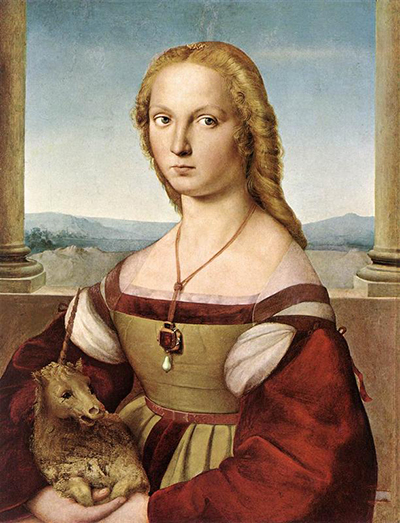
Raphael's Lady with a Unicorn looks serene, but the painting is the result of repeated transformation. The young woman now holds a small unicorn, symbol of chastity. X-rays have revealed a dog beneath it, and until 1936 later additions turned the portrait into Saint Catherine of Alexandria with a spiked wheel and heavy mantle.[1]
The object's material history is just as dramatic. During the 1930s treatment, its paint was removed from the original panel, transferred to canvas and attached to a new support before overpainting was taken away.[1]
Even the sitter remains unknown. Maddalena Doni has been proposed, especially as a bride-to-be, but the Galleria Borghese presents this as a hypothesis among several. The portrait can communicate chastity, fidelity and marriage without yielding one documented name.
At a Glance
- ArtistRaphael
- Museum titleLady with Unicorn
- Dategenerally about 1506; proposed dates range approximately from 1504 to 1509
- CollectionGalleria Borghese, Rome
- Inventory371
- LocationRoom 9, Dido Room
- Dimensions67 × 56 cm
- Original mediumoil on panel
- Present material statepaint transferred from the original panel to canvas and mounted on a new wooden support
- Sitterunknown
- Current attributeunicorn, traditionally associated with chastity
- Earlier hidden attributedog, associated with marital fidelity
- Later overpainted identitySaint Catherine of Alexandria with wheel and mantle, removed in the 1930s
Contents
- A young woman in a loggia
- The three-quarter portrait
- Leonardo and the Mona Lisa
- The unknown sitter
- Was she Maddalena Doni?
- Costume and rank
- The necklace
- The veil and hair
- The unicorn
- Chastity and betrothal
A young woman in a loggia
The sitter appears behind a low parapet, with columns framing a distant landscape.[1]
Architecture creates a shallow threshold between her and the outdoor world. The parapet stabilises the lower edge while the columns open a view rather than closing a wall.
Her body turns slightly, but her position remains symmetrical and composed.
The setting balances public presentation with cultivated retreat.
The three-quarter portrait
Raphael shows more than profile and less than full frontal view.
The torso turns gently while the head faces the spectator more directly. This creates volume and allows both hands to participate in the composition.
The pose belongs to innovations Raphael studied in Leonardo's Florentine portraiture.[1]
It makes the sitter feel spatially present without sacrificing formal control.
Leonardo and the Mona Lisa
The loggia, landscape, folded hands and three-quarter turn invite comparison with Leonardo's Mona Lisa.[1]
Raphael did not duplicate Leonardo's sitter or atmospheric effects. His columns are more explicit, the young woman more symmetrically placed and her costume more sharply described.
The relationship shows study becoming adaptation.
Raphael learned a new portrait structure and adjusted it to different social and symbolic demands.
The unknown sitter
No secure early document names the woman.[1]
Her youth, fashionable clothing and expensive jewellery indicate elite representation. The attribute in her lap suggests virtue important to marriage or betrothal.
These qualities define a role shared by many possible sitters.
They should not be converted into one identity solely because another portrait offers a familiar name.
Was she Maddalena Doni?
Some scholars, especially Anna Coliva, have proposed Maddalena Doni as a bride-to-be.[1]
The hypothesis could explain the symbols of chastity or fidelity and would place the work near Raphael's Florentine relationship with the Doni family. It also affects dating, moving the painting toward 1504–05.
The secure Uffizi portrait of Maddalena provides a valuable comparison, but differences in features and chronology leave room for debate.[3]
The Galleria Borghese does not present the identification as established fact.[1]
Costume and rank
The sitter wears a fitted bodice with a broad neckline, light green fabric and dark red velvet sleeves.[1]
Contrasting colour distinguishes structure: the bodice contains the torso, while heavy sleeves widen the arms. Fine borders, gold fastenings and carefully arranged hair add refinement.
The dress is not neutral clothing recorded by chance.
It constructs youth, wealth and marriageability for viewers.
The necklace
A gold chain supports a pendant with a large red stone and drop pearl.[1]
The jewel rests at the centre of the chest, reinforcing the portrait's vertical axis. Gold, ruby or garnet, and pearl combine monetary value with associations of virtue and purity.
Light catches each material differently.
The pendant becomes both status object and compositional anchor.
The veil and hair
A light veil covers the shoulders while the hair is arranged around the face and braided.
Gold details secure the hairstyle without competing with the pendant. Soft strands temper the strict symmetry of costume and architecture.
The veil contributes modesty and delicacy.
Its transparency also gives Raphael another surface through which to demonstrate controlled light.
The unicorn
The small creature sits across the woman's lap, enclosed by her arms.
In medieval and Renaissance traditions, a unicorn could be captured by a virgin and became an attribute of chastity. Its presence frames the sitter as sexually pure.[1]
The animal is not a naturalistic zoological portrait. Compact scale and heraldic clarity make it a symbolic participant.
It transforms an elite likeness into a statement about virtue.
Chastity and betrothal
Chastity had particular force in the representation of an unmarried or newly betrothed woman.
Families valued sexual honour as part of dynastic alliance, inheritance and reputation. A unicorn could advertise the quality expected in a bride.
That symbolic logic supports a marriage-related purpose without identifying the specific wedding.
The portrait offers a social ideal through an individual body.
The dog beneath the unicorn
X-radiography revealed that the creature was first a dog before becoming a unicorn.[1]
Dogs commonly signified fidelity, especially in marital imagery. The change may represent a revised emphasis from faithfulness to virginity or a new stage in the portrait's use.
It is not certain who ordered or painted every alteration.
Technical evidence establishes sequence more securely than motive.
Why change a dog to a unicorn?
One possibility is a shift in marriage timing: fidelity suits a wife, chastity a bride-to-be. Another is that the animal was revised to make the image more unusual or allegorical.
The painting's incomplete early history prevents a definitive answer.
The change nevertheless shows that attributes were active decisions, not permanent labels attached automatically to a sitter.
Identity could be rewritten while the face remained.
From portrait to Saint Catherine
Later overpainting transformed the woman into Saint Catherine of Alexandria.[1]
A heavy mantle covered her shoulders, and a spiked wheel replaced or obscured the creature. The wheel referred to the instrument intended for Catherine's martyrdom.
This intervention changed the genre from secular female portrait to sacred image.
It also protected and concealed Raphael's earlier composition beneath another history.
Why create a saint?
The motive is undocumented.
A later owner may have wanted a devotional image, found an unidentified woman's portrait less useful or sought to align it with a collection category. Sacred transformation could also alter the perceived propriety of the exposed neckline and jewellery.
Whatever the reason, the addition demonstrates how ownership can reshape meaning materially.
The same face was asked to embody another identity.
The 1833 inventory
The painting is first securely confirmed in the Borghese Collection's fideicommissary inventory of 1833.[1]
It was then described as Saint Catherine of the Wheel and attributed to the school of Perugino. The record accurately reflects its visible state at that time, not the hidden portrait.
Earlier Aldobrandini provenance has been proposed but remains uncertain because descriptions and dimensions do not align conclusively.[1]
The secure history begins later than the painting itself.
A changing attribution
Before restoration, the work was assigned variously to Perugino's school, Francesco Granacci, Ghirlandaio and Andrea del Sarto.[1]
Later paint obscured Raphael's design and handling, making comparison difficult. Giovanni Morelli connected it with a Louvre drawing; Roberto Longhi argued decisively for Raphael in 1927.[1]
Attribution changed as scholars reconstructed the earlier image.
The history shows how condition can conceal authorship as effectively as a false signature can invent it.
Roberto Longhi's intervention
Longhi proposed that Raphael painted the original portrait and that another artist added the Saint Catherine transformation.[1]
His attribution preceded the full physical revelation of the unicorn, demonstrating the power of visual analysis when used carefully.
Restoration and X-rays then supplied material evidence that altered the debate.
Connoisseurship and science worked sequentially rather than as rival methods.
The 1930s treatment
The campaign of 1934–36 was extraordinarily invasive by current standards.[1]
Conservators fixed the paint, removed it from the original wooden panel, transferred it to canvas and placed it on a new support. They then used a scalpel to remove later layers and expose the unicorn portrait.[1]
The work recovered an earlier image while losing its original panel.
Revelation and irreversible material change occurred together.
The destroyed original panel
Wood support carries information about construction, tool marks, joins, ground and workshop method.
Destroying it removed evidence that cannot be replaced by the new mount. The paint film survived, but its relationship to the original material object changed permanently.
This fact should not be hidden behind the excitement of “discovering a Raphael.”
The current painting is authentic historic paint in a radically altered support system.
Removing the overpaint
Taking away the Saint Catherine layers revealed the unicorn and restored the landscape and original silhouette.[1]
Removal required judgments about which paint belonged to which period. Boundaries can be thin, damaged and visually ambiguous.
The operation produced the image familiar today, but no treatment simply travels backward to a pristine moment.
Residues, losses and past abrasion remain part of the surface.
The 1960 X-rays
Further examination by the Istituto Centrale del Restauro in 1959–60 revealed the dog beneath the unicorn.[1]
This discovery added another layer to a history already thought recovered. It showed that Raphael's portrait had changed even before the Saint Catherine disguise.
Conservation can therefore produce new questions after an apparent solution.
The “original” is not always one single, uncomplicated state.
Recent imaging
The Borghese catalogue records XRF mapping, multispectral examination and other diagnostics through 2019.[1]
These methods map elements and reveal underdrawing without removing paint. They have identified degraded original material, residues of later layers and reference lines used to position the slightly turned figure symmetrically.[1]
Technical study now aims to understand the surface non-invasively.
It also clarifies what the 1930s treatment changed or left behind.
The underdrawing
Imaging reveals guide lines that helped Raphael centre the sitter while turning her torso.[1]
Symmetry here is constructed, not accidental. Vertical and horizontal references organise the head, shoulders and hands despite the three-quarter pose.
The underdrawing also contributes to the delicate facial modelling beneath thin colour layers.
Raphael's calm result rests on measured preparation.
The Louvre drawing
A drawing in the Louvre, inventory 3882 recto, has long been connected with the painting.[2]
It shows a woman in three-quarter view with crossed arms and reflects close study of Leonardo's portrait innovations. Some scholars regard it as preparatory for the Borghese panel; others treat it as an independent exploration.[1][2]
The relation is strong but not self-explanatory.
A shared pose can belong to a sequence without one sheet mapping directly onto one painting.
Landscape and distance
Muted hills extend between the two columns.[1]
Atmospheric colour makes distant forms paler and less distinct. This recession contrasts with the crisp jewellery and velvet close to the viewer.
The landscape gives the sitter a world beyond the parapet while preserving her dominance.
It also strengthens the comparison with Leonardo's half-length female portraits.
Painting as a layered object
At least three major iconographic states can be distinguished: woman with dog, woman with unicorn and Saint Catherine with wheel.
Materially, the work has also passed from original panel to transferred paint on canvas and a new support.
These sequences do not make the painting inauthentic. They make its identity historical rather than static.
The object survives through both early revision and modern intervention.
Which state should a museum show?
The present display privileges the unicorn portrait over the later Saint Catherine and the earlier dog beneath it.
That decision is understandable because the unicorn state preserves the form attributed to Raphael most completely and cannot coexist visibly with the mantle and wheel. Yet the X-ray dog remains historically real even though it is not exposed.
Museum interpretation must therefore make invisible layers intellectually present. Technical images and clear chronology prevent the selected visible state from becoming the only acknowledged one.
Recovery and loss in the same treatment
The 1930s campaign is often celebrated for recovering Raphael's portrait from later additions.[1]
It also destroyed the original wooden support and risked the paint during transfer. These results cannot be sorted into a simple success or failure.
The intervention gave modern viewers the unicorn and removed material evidence beneath the painted surface.
Its mixed outcome is one of the strongest reasons to document conservation choices and favour less invasive study today.
Why Lady with a Unicorn matters
The portrait captures Raphael learning from Leonardo while establishing his own clarity.
Three-quarter turn, parapet, columns and landscape create depth; costume and jewel establish rank; the animal adds a compressed language of female virtue. The sitter remains present without surrendering her name.
Its later transformations make it equally important to conservation history. A dog became a unicorn, a woman became a saint, and restoration made her a woman again while destroying the original panel.[1]
The painting asks a difficult but productive question: which state is the work? The best answer is not one moment isolated from all others. Lady with a Unicorn is Raphael's early portrait as revised, concealed, materially transferred, partially recovered and continuously re-examined.
Artist Up Close
Begin with the animal, then remember that X-rays show a dog beneath the unicorn.[1]
Trace the woman's arms around it and compare their stable enclosure with the slight turn of her shoulders.
Look at the green bodice, red velvet sleeves, gold chain, red stone and pearl. Each material receives a different kind of light.
Find the parapet and flanking columns, then follow the landscape into atmospheric distance.
Finally, imagine the Saint Catherine mantle and wheel once covering this composition. The current view is also the result of subtraction.
Frequently Asked Questions
Discussion
What detail most changes how you read Portrait of a Lady with a Unicorn?
Reader Insights
Which source detail gives the page its strongest anchor?
Which visual or historical distinction should readers keep in mind?
How does this page change the wider picture of Raphael's career?
Join the Conversation
Share your reading below.
References
- Galleria Borghese, “Lady with Unicorn,” inventory 371, catalogue entry by Marina Minozzi, June 2024 View source.
- Musée du Louvre, “Femme en buste, de trois quarts vers la gauche, les bras croisés,” INV 3882 recto View source.
- Uffizi Galleries, “Portrait of Maddalena Doni,” inventory 1912 no. 59 View source.