

 by Tom Gurney
Tom Gurney BSc (Hons) is an art history expert with over 20 years experience
Published on June 19, 2020 / Updated on August 21, 2026
Email: tomgurney1@gmail.com / Phone: +44 7429 011000
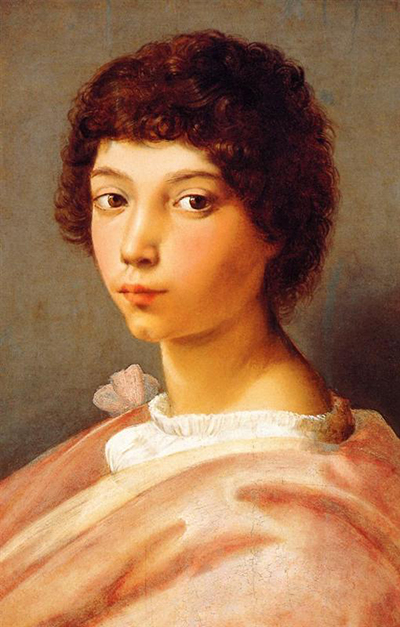
Raphael's Portrait of a Young Man cannot presently be stood before. The panel disappeared amid Nazi looting during the Second World War and has never been recovered. What survives publicly is a dispersed body of evidence: black-and-white photographs, painted copies, prints, descriptions, collection records and the empty place it left in Kraków.
The young man turns toward us in fur-edged clothing, one shoulder exposed by a loose white shirt. His direct gaze and fashionable black cap helped generations identify him as Raphael himself. Other names have been proposed, and even the attribution has been debated. Loss freezes those disagreements. The original surface cannot be re-examined with the technical methods that have transformed the study of other Raphael portraits.[1][2]
This page is therefore about more than a vanished masterpiece. It asks how responsibly to look at an absent object, how reproduction preserves and distorts knowledge, and why wartime theft must remain central rather than becoming a romantic “mystery.”
At a Glance
- Traditional artistRaphael
- TitlePortrait of a Young Man
- Former collectionPrinces Czartoryski Museum, Kraków
- Present statusmissing and unrecovered after Second World War looting
- Date proposalswithin Raphael's Roman years, with published suggestions ranging from 1512 to 1519
- Mediumoil on wooden panel
- Dimensionsnot now verifiable; historical publications give differing measurements around 72–75 × 56–59 cm
- Sitterunknown
- Famous identificationRaphael self-portrait, disputed
- Other proposed sittersFederico Gonzaga and Francesco Maria della Rovere
- Important early reproductionengraving by Paulus Pontius, c.1623–48
- Czartoryski acquisitionbought in Italy around 1800–01 by Prince Adam Jerzy Czartoryski
- Wartime evidenceevacuated to Sieniawa in August 1939, seized after German occupation and included in the 1940 Nazi catalogue of confiscated art as no.141
- Last secure statusmoved through the German-controlled system of looted art; precise final disappearance remains unresolved
- Restitution statusstill sought as one of Poland's most significant wartime cultural losses
Contents
- A painting known through absence
- Why the published dimensions vary
- What the surviving image shows
- The turn
- The uncovered shoulder
- Fur, shirt and cap
- The direct gaze
- Was this Raphael?
- Comparing the secure Uffizi self-portrait
- Federico Gonzaga and Francesco Maria della Rovere
A painting known through absence
Writing about a lost work begins with a different hierarchy from writing about one in a gallery. The original object must be distinguished from every image after it.
A photograph preserves tonal relations but not reliable colour, scale or surface. An engraving translates paint into line and reverses or edits details according to process. A copy can retain colour yet introduce another painter's decisions.
These witnesses are not worthless. Together they make the composition unusually well known. They simply cannot answer every question that direct examination might settle.
Why the published dimensions vary
Historical sources do not agree perfectly about the panel's height and width. Figures around 72–75 centimetres high and 56–59 centimetres wide circulate in catalogues.
Such differences can arise from whether a recorder included a painted edge, later addition or visible opening, from conversion between old units and metric measure, or from simple repetition of an earlier error. With the object missing, no current museum team can resolve the discrepancy by measurement.
The variation is small enough that the composition remains recognisable but large enough to matter in authentication. Any rediscovered candidate would need its physical edges and construction examined, not merely compared with a rounded number in a popular source.
What the surviving image shows
The sitter appears at roughly half length, turned so that torso and face move in different directions. A dark cap covers much of his hair. A broad fur border and white shirt frame the upper body, with one shoulder exposed.
His hand occupies the foreground near a parapet or ledge. Beyond him lies a landscape, though surviving monochrome photographs flatten much of its atmospheric relation to the figure.
The pose combines informality and command. Loose clothing suggests interrupted privacy, while the outward gaze is fully composed for portrait address.
The turn
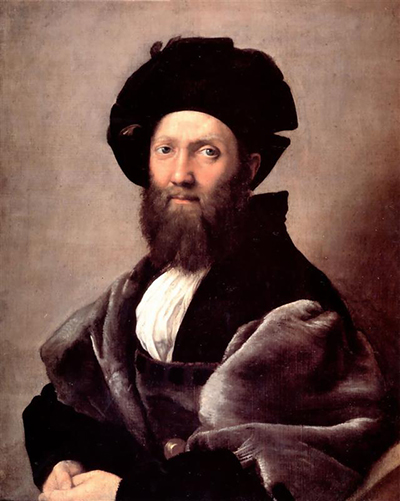
Like Bindo Altoviti, the young man appears to look back toward the viewer. Yet the lost portrait organises the body differently.
The opened shirt and broad sleeve create a more expansive, almost sculptural sweep across the foreground. Head, shoulder and arm do not simply settle inside an upright oval; they form a sequence of counter-directions.
This dynamism helped make the work persuasive as a late self-image. Raphael's Roman figures often achieve repose without eliminating movement.
The uncovered shoulder
One of the most remembered features is the exposed shoulder between white fabric and fur-trimmed garment. It gives the portrait an ease unusual in formal male likenesses.
The opening might reflect fashionable dress, studio informality or an idealising convention. It need not mean the sitter was literally interrupted while dressing.
Its pictorial effect is certain. Pale skin joins face and hand across the dark costume, creating a rhythm that reproductions can still communicate even when colour is lost.
Fur, shirt and cap
The dark cap gives the head a firm boundary. Fur adds social cost and tactile depth; the white shirt loosens the silhouette and catches light.
Together, these materials make status legible without a badge of office. The young man is wealthy or cultivated enough to command fine clothing but relaxed enough not to display it ceremonially.
Printed reproductions convert fur, cloth and flesh into different kinds of hatching. Their survival lets us follow the design while reminding us how much painted texture has disappeared from view.
The direct gaze
The eyes look outward with a confidence that has encouraged biographical projection. If the sitter is Raphael, viewers see an artist at the height of Roman success. If he is a prince, the same look becomes dynastic assurance.
Neither interpretation is contained in the pupils. Expression cannot choose among identities proposed on other grounds.
The gaze's power is formal. It completes the body's turn and makes an absent original seem uncannily reciprocal even in a photograph.
Was this Raphael?
The self-portrait identification has a long history. The early Pontius engraving labels the figure “Raphael of Urbino,” showing that the belief circulated by the seventeenth century.[3]
Later writers found resemblance to Raphael's other images and treated the relaxed, beautiful sitter as an artist rather than a court official. The Royal Collection nevertheless states that both authorship and identity remain matters of dispute.[3]
A traditional name can be historically important without becoming proof. The safest title remains Portrait of a Young Man.
Comparing the secure Uffizi self-portrait
Raphael's recognised Uffizi self-portrait shows a younger man in dark working clothes, with a simpler bust-length format. The face offers a legitimate comparison, but portraits made years apart can vary through age, angle, restoration and intended role.
Resemblance is especially difficult to evaluate when one of the objects survives only in reproductive form. Photographic contrast may sharpen or suppress features.
The comparison keeps the self-portrait proposal alive. It does not make it conclusive.
Federico Gonzaga and Francesco Maria della Rovere
Other proposals name Federico Gonzaga or Francesco Maria della Rovere. Both belonged to the network of Italian courts connected with Raphael's career.[3]
Francesco Maria has also been proposed for the Uffizi Young Man with an Apple, which is a separate painting. Repetition of the same candidate across two unidentified sitters does not link the objects.
Without secure provenance to a commission or a diagnostic comparison, the alternatives remain reminders of the social field Raphael served, not recovered identities.
Is it certainly by Raphael?
The painting entered modern fame under Raphael's name and continues to be treated by the Kraków museum as his lost work.[2] The Royal Collection's scholarly description uses more cautious language for a print “after a work attributed to Raphael.”[3]
This difference reflects the difficulty created by disappearance. Brushwork, underdrawing, support and pigments cannot be investigated directly. Old photographs are powerful for composition but weak for attribution at the microscopic level.
It is reasonable to retain Raphael in the title while making the scholarly limit visible.
The date problem
Published dates range widely within the 1510s. The Royal Collection notes suggestions from 1512 to 1519.[3]
The later end suits the portrait's bodily freedom and relation to Raphael's mature Roman likenesses. Earlier dates have been argued through costume and comparison.
No current measurement or technical campaign can narrow the range. A broad Roman-period date is more honest than a single unsupported year.
Early ownership and Giulio Romano
A Royal Collection record reports that the provenance may reach Giulio Romano, Raphael's close assistant, probably soon after Raphael's death.[4]
If correct, that ownership would strengthen connection with Raphael's immediate circle. It might also help explain why early reproductive knowledge survived.
The phrasing must remain conditional. Provenance reconstructed over centuries often contains gaps, and a celebrated name can attract later assumptions.
The Pontius engraving
Paulus Pontius made the earliest known print of the composition around 1623–48. The plate records the belief that the image represented Raphael and may reflect a time when the painting was associated with Anthony van Dyck.[3]
An engraving is not a neutral photograph. Pontius chose line density, simplified colour and worked within conventions of reproductive portraiture.
Yet the print proves that the composition was esteemed and recognisable centuries before modern mass reproduction. It is now also part of the evidence by which a stolen object might be identified.
Copies as witnesses
Painted copies survive in several collections, including an example held by Canterbury Museums and Galleries.[5]
A copy can preserve broad colour choices unavailable in the famous black-and-white photograph. It may also alter those colours, soften features or regularise anatomy according to another hand.
Comparing copies reveals both consensus and variation. Where several agree, confidence in a compositional feature increases; where they diverge, the original's appearance remains open.
The limits of colour memory
The best-known pre-war photograph is monochrome. Painted copies suggest the likely relation of dark clothing, pale shirt, flesh and landscape, but they do not agree with the authority of the lost surface.
Colour is especially vulnerable in transmission. A copyist may adjust a hue to available pigments; varnish can yellow; photography can compress values; printed books can introduce further shifts.
Descriptions should therefore avoid announcing an exact shade as though sampled from Raphael's panel. Broad colour families may be recoverable, while saturation, temperature and subtle transitions remain among the painting's missing evidence.
Prince Adam Jerzy Czartoryski's purchase
Prince Adam Jerzy Czartoryski bought the painting in Italy around 1800–01 while travelling in Europe. It joined the collection created by his mother, Princess Izabella Czartoryska, at Puławy.[1][4]
The family collection joined European art with a project of Polish cultural memory. In the Gothic House, the portrait became one of its most celebrated foreign works.
Acquisition did not merely move a Renaissance panel. It gave the image a new national and educational significance.
One of the “Great Three”
Alongside Leonardo's Lady with an Ermine and Rembrandt's Landscape with the Good Samaritan, the Raphael was known as one of the Czartoryski collection's “Great Three.”[1]
The grouping made very different works stand for the international reach and quality of Poland's museum culture.
Its later destruction through dispersal was therefore not only a loss of market value. It attacked a carefully built cultural institution and the public memory attached to it.
Hidden after the November Uprising
The Czartoryski family's political role made the Puławy holdings vulnerable after the 1830–31 November Uprising. Valuable works were concealed, moved by trusted caretakers and eventually taken through family estates to Paris.[1]
The portrait survived this nineteenth-century danger. Its mobility became part of a pattern in which political upheaval repeatedly threatened the collection.
That earlier rescue makes the 1939 loss more painful, but it should not be treated as inevitable fate. Different agents made different choices in each crisis.
The attempted sale of 1850–52
Financial pressure led Prince Adam Jerzy to consider selling the portrait. It was sent to London in 1850 and then Berlin for appraisal, but no buyer was found; it returned to Paris in 1852.[1]
This episode reminds us that celebrated collection identities are historical constructions. The panel might easily have entered a different museum or private house.
Its return kept the emerging Czartoryski ensemble intact and eventually allowed the picture to become a public treasure in Kraków.
Arrival in Kraków
Władysław Czartoryski established the family museum in Kraków, and the Raphael, Leonardo and Rembrandt reached it in 1882. They remained publicly displayed for roughly three decades.[1]
During the First World War the most valuable objects were deposited for safety in Dresden. Securing their return proved difficult, and the portrait came back to Kraków only in 1922.[1]
The work had already survived war-related displacement before the German invasion of Poland in 1939.
Evacuation to Sieniawa
As another war approached, museum director Marian Kukiel developed a plan to protect the collection. The most prized works left Kraków in late August 1939 and were hidden in an outbuilding at the Czartoryski estate in Sieniawa.[1]
German forces arrived in mid-September. On 18 September the estate caretaker reported that the hiding place had been plundered.[1]
Evacuation should not be blamed for the theft. It was a reasoned protective response to invasion; the criminal act was the seizure of cultural property.
Nazi confiscation
The portrait entered the organised machinery of Nazi looting. German officials and agents competed over seized works, while administrative catalogues converted theft into bureaucratic possession.
In 1940 it appeared as number 141 in Sichergestellte Kunstwerke im General Gouvernement, the catalogue of works confiscated in the occupied General Government.[1]
Such documentation is double-edged. It records criminal control, but it also supplies evidence for restitution claims and later reconstruction of movements.
Berlin, Lower Silesia and the last traces
The detailed Polish government history follows the picture through wartime transfers and disputes several simplified stories about its final location. By the closing phase of the war, evidence places the problem in the network of deposits in Lower Silesia.[1]
Professor Günther Grundmann recorded shipments evacuated from Morawa and Cieplice in early 1945. The Raphael was not listed among the works he sent onward to Coburg, nor did it appear in the later return from deposits associated with Hans Frank.[1]
The careful conclusion is that the painting disappeared while still in Lower Silesia. Exactly how, when and by whose hand remains unknown.
Why “last seen with Hans Frank” is too simple
Popular accounts often compress the ending into a single dramatic image: Governor-General Hans Frank fled with the portrait, and it vanished from his residence.
Frank and his administration were central beneficiaries of looting, but surviving transport records do not make every last movement certain. The absence of the panel from recovered shipments is evidence, not a complete itinerary.
Precision matters because restitution depends on reconstructing custody, not repeating the most cinematic version.
Was the painting burned?
There is no credible evidence that the portrait was destroyed by fire. The Polish government account explicitly describes such beliefs as speculation unsupported by archival documentation.[1]
Fictional representations have shown it burning, and rumours periodically claim it sits in a bank vault. Neither kind of story establishes location.
Until physical evidence appears, the correct status is missing—not destroyed, found or secretly recovered.
Post-war searches
Polish officials, Allied investigators, museum specialists, lawyers and members of the Czartoryski family pursued leads after 1945. Suspects were questioned and records collected in several countries, but no inquiry recovered the panel.[1]
Searches extended across Europe and later to the United States and Australia. A widely circulated 2012 report claiming discovery in a bank safe was rapidly denied by Polish authorities.[1]
The persistence of false announcements shows how fame generates noise. Every claim must be tested against the exact object, provenance and physical evidence.
Restitution rather than treasure hunting
The painting is sometimes described as the world's most valuable missing picture. Monetary superlatives can obscure the legal and ethical issue.
This is a work stolen from a Polish collection under occupation. Recovery would not create a prize for a finder or a neutral object for sale; it would activate claims for return.
The National Museum in Kraków continues to identify it among the Czartoryski holdings not recovered after the war.[2]
Public memory in Kraków
The lost portrait remains part of the Czartoryski Museum's identity even though it cannot be displayed as an object. Its absence sits beside works that did return, above all Leonardo's Lady with an Ermine and Rembrandt's landscape.[2]
This contrast gives loss a concrete scale. The picture was not an isolated commodity that vanished from an unknown owner; it belonged to a collection whose buildings, histories and other paintings survive.
Remembering it within Kraków also resists displacement by the international fame of Raphael's name. The story ends, provisionally, not with the artist or the thief but with the institution entitled to recovery.
How could it be authenticated if found?
Any candidate would need comparison with historical dimensions, panel structure, old photographs, damage patterns, x-radiographs if available, copies and documented labels or marks.
Scientific analysis could examine wood, ground and pigments for compatibility with early sixteenth-century practice. Connoisseurship would assess design and handling. Provenance research would trace custody after 1939.
No single resemblance would be enough. The portrait's fame makes it especially vulnerable to copies, deliberate fakes and mistaken hopes.
The absent surface
The most important art-historical loss is Raphael's paint itself. Reproductions preserve design but cannot reveal the full modulation of skin, weave of fur, translucency of shadow or revisions beneath the surface.
Technical examination might clarify whether the original support matched Raphael's Roman practice and whether underdrawing belongs to his hand or studio.
Attribution and identity remain unusually dependent on older judgement because the object cannot participate in current research.
Absence should not become fantasy
Missing masterpieces attract imagined discoveries because the desired ending is so powerful. A private vault, an inherited country house or an unlabelled museum store all make satisfying plots.
Real recovery work is slower. It depends on object databases, customs and auction scrutiny, archival comparison, cooperation among states and careful response to leads that mostly prove false.
The distinction is ethical as well as practical. Fantasy centres excitement for outsiders; provenance research centres the dispossessed collection and the evidence needed for return.
Why the image still matters
Even absent, the young man's pose contributed to the history of Raphael's self-image. Prints circulated it, books reproduced it and viewers used it to imagine the artist as elegant, self-aware and courtly.
That cultural afterlife is real even if the sitter is someone else. A disputed portrait can shape the public face of an artist for centuries.
The missing panel therefore survives in two histories at once: a Renaissance likeness and a modern icon of cultural loss.
Artist Up Close
What can still be attributed to Raphael's invention is the striking coordination of exposure and control. The shirt slips from one shoulder, but the gaze remains steady. The body turns, yet the hand and parapet stabilise it. Fur declares rank while informality weakens ceremonial distance.
Those relationships can be studied through prints and photographs. Their exact painted force cannot. The gap should become part of looking rather than be filled with imaginary colour and touch.
If the portrait is recovered, Raphael scholarship could change quickly: support, technique, condition and attribution would all become newly testable. Until then, responsible admiration includes acknowledging the limits created by theft.
Frequently Asked Questions
Discussion
What detail most changes how you read Lost Czartoryski Portrait of a Young Man?
Reader Insights
Which source detail gives the page its strongest anchor?
Which visual or historical distinction should readers keep in mind?
How does this page change the wider picture of Raphael's career?
Join the Conversation
Share your reading below.
References
- Polish Ministry of Culture and National Heritage, “Portrait of a Young Man—The Story of a Lost Painting,” Lost Art Database View source.
- National Museum in Kraków, “MNK Czartoryski Museum,” collection history View source.
- Royal Collection Trust, “Portrait of a Young Man,” engraving by Paulus Pontius, RCIN 852038 View source.
- Royal Collection Trust, “A Portrait of a Young Man, Once Thought to Be a Self-Portrait of Raphael,” engraving by François Girard, RCIN 850033 View source.
- Canterbury Museums and Galleries, “Copy of a Portrait of a Young Man after Raphael,” collection article View source.