

 by Tom Gurney
Tom Gurney BSc (Hons) is an art history expert with over 20 years experience
Published on June 19, 2020 / Updated on August 21, 2026
Email: tomgurney1@gmail.com / Phone: +44 7429 011000
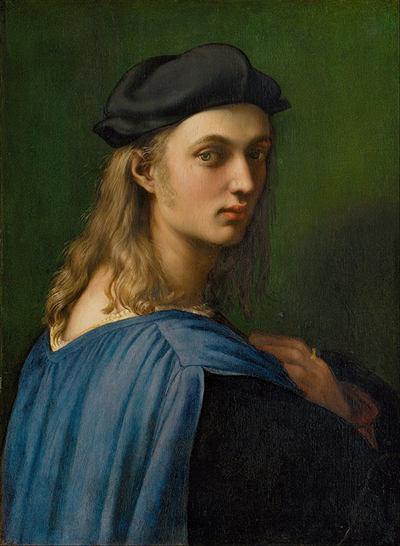
Raphael's Portrait of Bindo Altoviti begins with a turn. A young man has his back partly toward us, then looks over his shoulder as though our arrival has interrupted him. Long blond hair brushes a blue garment; a black cap tips across the crown; one hand rises near the heart. The green field behind him offers neither room nor landscape. Everything depends on the sitter's movement and the speed with which Raphael converts it into attention.
The man is Bindo Altoviti, a Roman-born banker from a Florentine family. He commissioned the painting at about the age of twenty-four. Knowledge of his later wealth, patronage and political danger can make the likeness seem prophetic. Yet Raphael painted no middle-aged financier or Medici opponent. He painted a beautiful young client at the threshold of an exceptionally public life.[1]
That distinction matters. The portrait is not memorable because it tells us what Bindo would become. It is memorable because it makes poised incompletion—turning, looking, about to speak or move—into a durable form of presence.
At a Glance
- ArtistRaphael
- TitleBindo Altoviti
- Dateabout 1515
- CollectionNational Gallery of Art, Washington
- Accession number1943.4.33
- Mediumoil on panel
- Dimensions59.7 × 43.8 cm
- SitterBindo Altoviti (1491–1557)
- Approximate age of sittertwenty-four
- Original ownershipcommissioned by Altoviti and inherited in his family
- Distinctive featuresbackward turn, long blond hair, green eyes, raised hand and emerald-green ground
- Important condition pointa later treatment removed most of the original wooden support and transferred the painted layer to a modern backing
- Acquisitiongift of the Samuel H. Kress Collection to the National Gallery of Art in 1943
Contents
- Who was Bindo Altoviti?
- A banker who chose an unusual pose
- Annotated Details
- The movement over the shoulder
- The direct gaze
- Hair as form and status
- The black cap
- Blue, black and white
- The hand near the heart
- The ring
- An emerald field without a setting
Who was Bindo Altoviti?
Bindo was born in Rome in 1491 into a family whose identity and commercial connections were Florentine. Banking placed him close to the institutions that powered sixteenth-century Rome: papal government, international credit and the movement of wealth among courts.
His career eventually made him much more than a prosperous merchant. He became a conspicuous collector and patron, employing major artists and cultivating a public identity across painting, sculpture and architecture. Raphael's likeness belongs near the beginning of that story. Later portraits by Francesco Salviati and Benvenuto Cellini show Bindo at very different ages and in different media.[2][3]
The youthful image should therefore be read forward with care. It records a man who possessed the means and judgement to approach Raphael, but it does not compress four later decades into his expression.
A banker who chose an unusual pose
Most financial portraits do not announce their subject through money. Bindo has no ledger, coins or writing desk. Raphael offers no architectural sign of a palace and no view of commercial Rome.
Instead, distinction resides in dress, grooming, jewellery and comportment. The sitter's refinement tells viewers that he belongs within elite culture. His turn makes that refinement feel alive rather than displayed like inventory.
Commissioning such a likeness was itself an act of status. Raphael was then the leading painter of papal Rome, responsible for monumental Vatican projects as well as portraits. Bindo's choice linked private appearance to the artist whose figures were remaking the public image of the city.
Annotated Details from Portrait of Bindo Altoviti
The annotated view keeps the whole work in sight while isolating six details that reward close looking: expression, gesture, fabric, setting and the way Raphael moves attention through the image.
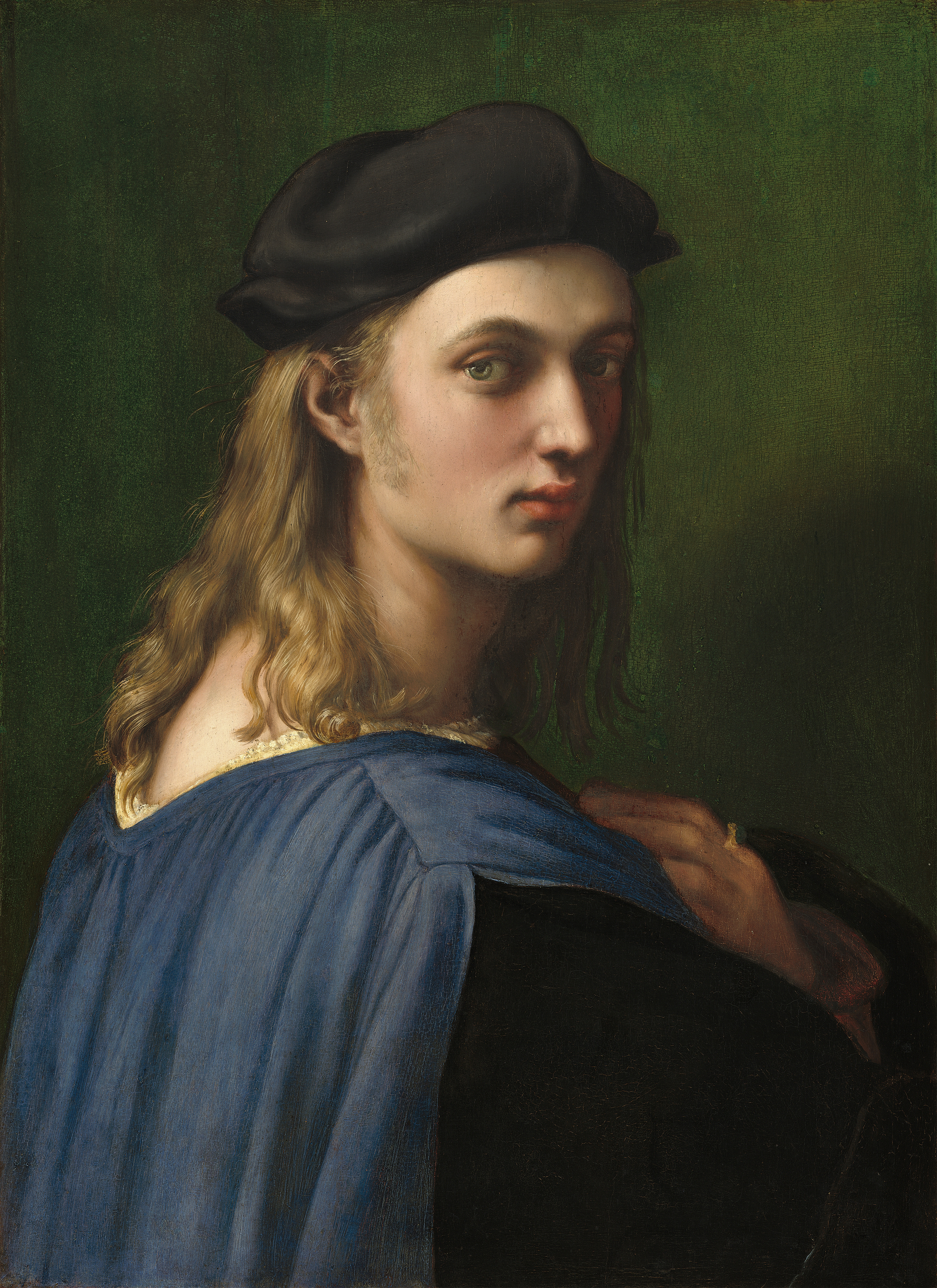
Details from PORTRAIT OF BINDO ALTOVITI
Close looking highlights visible details in the work while keeping image-source and rights notes with the page evidence.
Turned face
The head turns back across the shoulder, making the portrait feel caught between retreat and address.
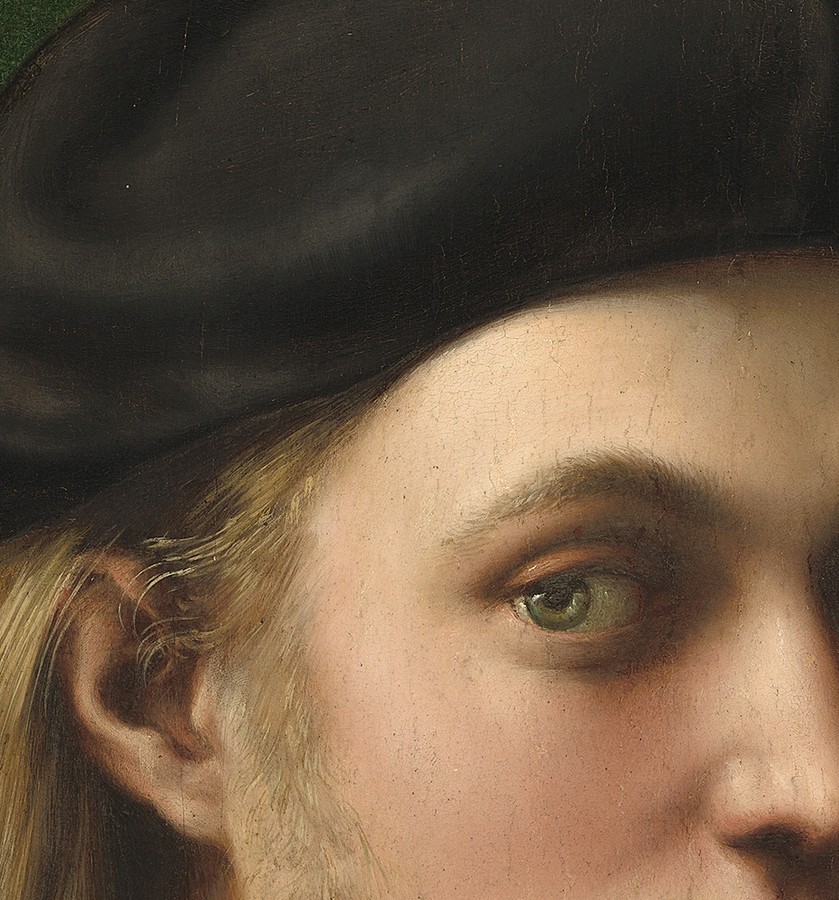
Soft cap and blond hair
The dark cap and loose blond hair frame the face without turning the sitter into a formal court emblem.
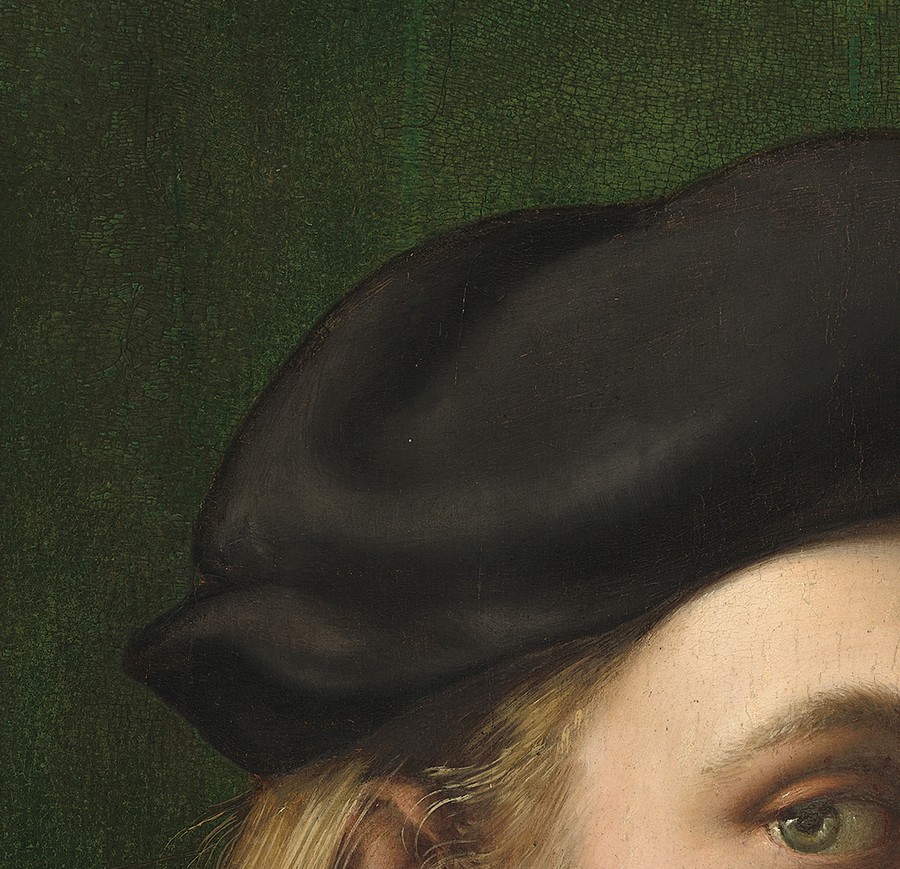
Blue mantle
The blue mantle carries much of the picture's colour weight and turns the body into a broad diagonal.
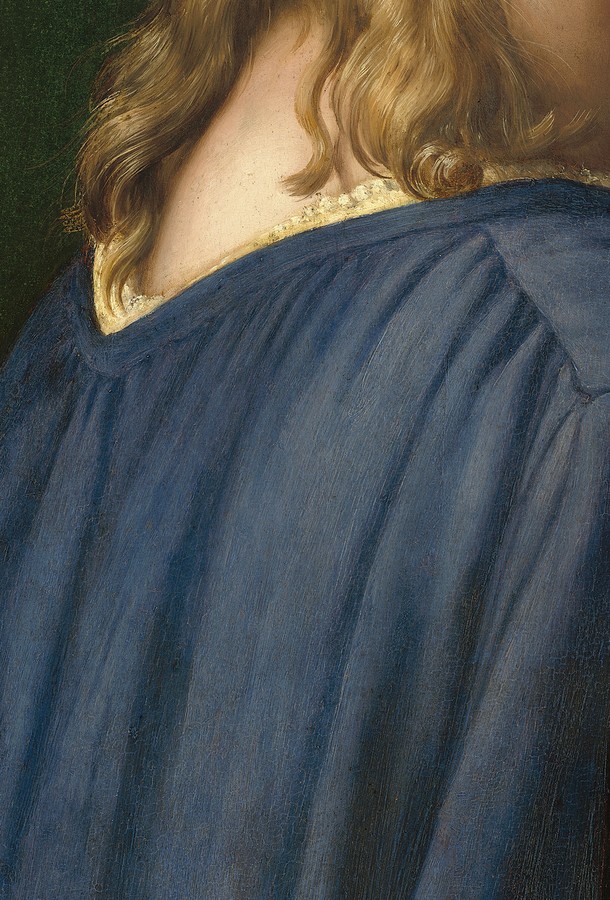
Hand at the shoulder
The hand at the shoulder reinforces the backward turn and keeps the sitter's gesture close to the body.
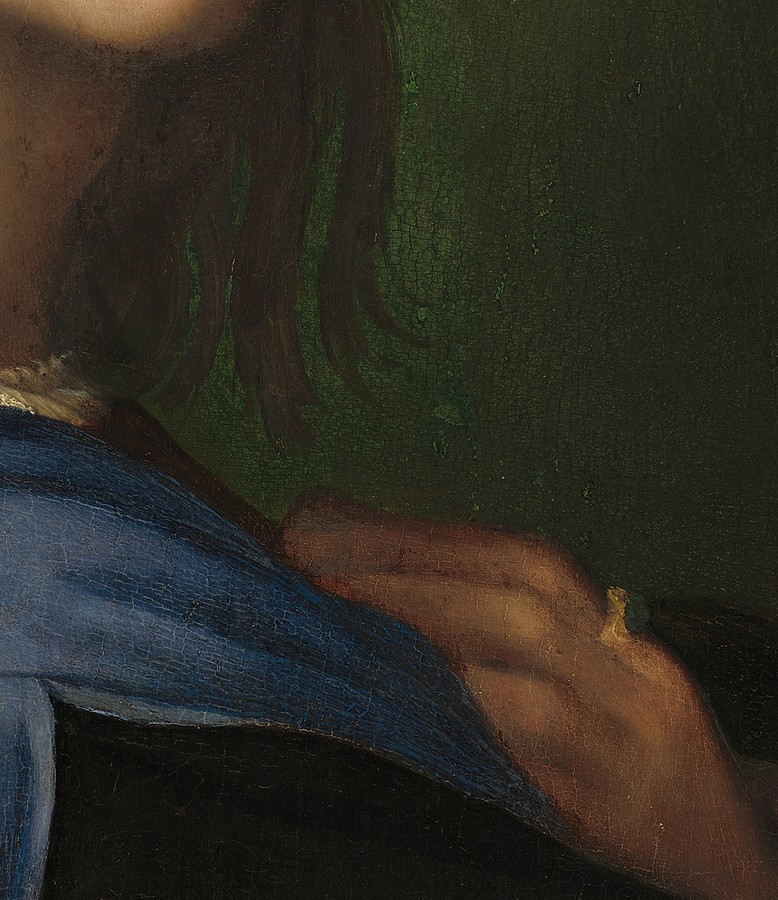
Dark sleeve and torso
The dark sleeve absorbs light, setting off the brighter flesh and blue fabric around it.
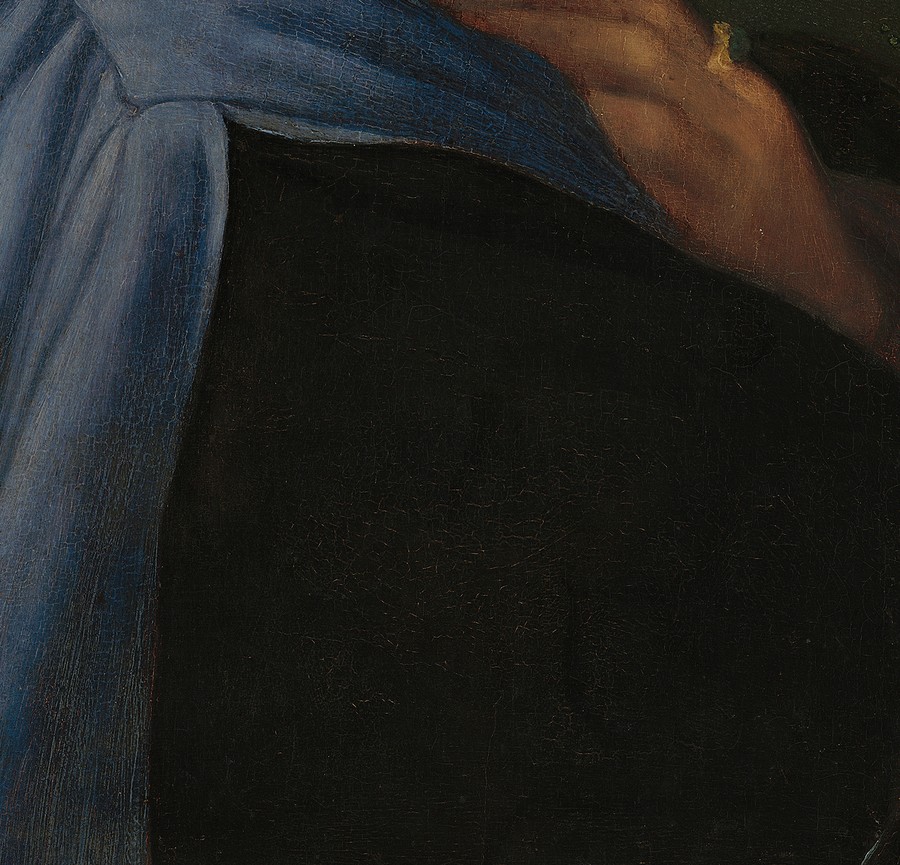
Green ground
The green background is quiet but active, sharpening the silhouette of cap, hair and shoulder.
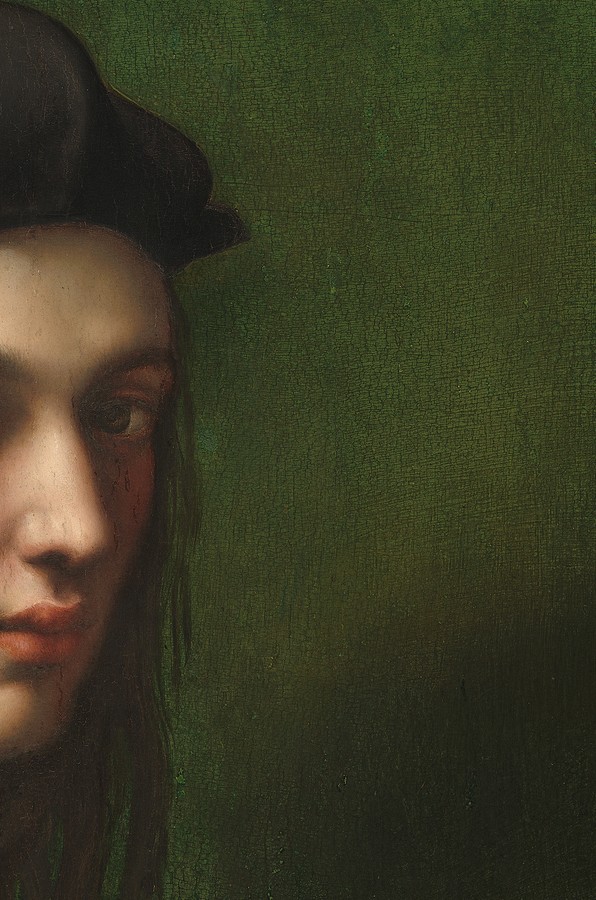
The movement over the shoulder
Bindo's head and upper body do not face in the same direction. The torso moves away while the face returns. That counter-motion winds the figure within a very shallow space.
Raphael has not caught a random instant. The pose is controlled: the shoulder creates a broad diagonal, the neck mediates the twist, and the eyes complete it. But it retains the persuasive fiction that the sitter has just responded to someone beyond the painted surface.
The result differs from a frontal state image. Bindo seems accessible because he reacts. At the same time, we do not know what preceded the turn, so the painting keeps part of its event outside our reach.
The direct gaze
His pale green eyes look toward the viewer with remarkable steadiness. They do not strain in the direction of the body's movement; the face settles even as the pose remains active.
That combination produces the portrait's peculiar intimacy. The turn suggests haste, while the gaze suspends time. We are made to feel both an encounter and a prolonged inspection.
Raphael does not exaggerate the eyes. Their force comes from placement against the nearly unbroken green and from the surrounding fall of pale hair.
Hair as form and status
Bindo's long blond hair is one of the first things viewers remember. It divides into soft strands, passes over the ear and rests along the collar and shoulder.
Hair here is not a decorative addition to an already complete head. It shapes the silhouette. Its descending lines slow the turn and join face to garment.
The care invested in its arrangement belongs to fashionable self-presentation. Yet Raphael avoids turning each strand into a separate display of skill. Light moves across grouped locks, making abundance coherent.
The black cap
A loose dark cap closes the top of the composition. Its plainness concentrates attention on the face and hair.
Because it leans with the head, the cap also participates in movement. It is a compact, asymmetrical accent above the long downward rhythms.
Later viewers sometimes found Bindo's appearance close to the ideal image of a young artist. The cap and hair help explain that response. Nothing in the object, however, requires the sitter to become Raphael in disguise: the secure title identifies Altoviti, who commissioned and owned it.[1]
Blue, black and white
The blue garment opens over the near shoulder. Beneath it, a dark sleeve pushes forward, while a narrow white ruffle brightens the neckline.
These colour zones clarify the twist. Blue marks the mass of the torso; black projects the arm; white separates skin from clothing. The arrangement is luxurious without depending on dense pattern.
Raphael gives the blue surface changing weight. It appears cooler and firmer near the shoulder, then folds into shadow. The colour attracts the eye but does not compete with Bindo's face.
The hand near the heart
Only one hand is prominently visible. It rises across the lower right of the image toward the chest, with the index finger carrying a gold ring set with a green stone.[1]
The gesture is open to several descriptions: Bindo may be adjusting his clothing, drawing a hand toward himself or holding it in a courtly movement. Raphael supplies no narrative answer.
Its value lies partly in its incompletion. Like the turn, it makes still paint feel transitional. Hand and face also address the viewer differently: the eyes establish contact, while the fingers preserve private motion.
The ring
The ring is small but strategically placed. Gold and green catch light near the hand, repeating the background in miniature.
Jewellery signals resources and refinement, yet the ring is not isolated as a merchant's attribute. It belongs to gesture. The hand would lose some of its visual precision without the bright setting on the finger.
It is tempting to assign the stone an exact emblematic meaning. The painting offers too little evidence for certainty. Its sure functions are material and pictorial: it marks wealth, focuses the fingers and echoes the surrounding colour.
An emerald field without a setting
The background is a saturated green with no furniture, wall joint, curtain or window. It removes Bindo from a describable location.
That absence is active. Against a detailed room, his turn might appear to answer an event inside the picture. Against green, the cause seems to occupy our space.
The field also intensifies colour relationships. Blond hair warms against it; pale skin advances; blue remains distinct; the ring's stone finds a distant counterpart. Raphael makes a seemingly simple ground carry the portrait's atmosphere.
Beauty and the male portrait
The painting does not treat male beauty as a distraction from seriousness. Smooth skin, full lips, fine hair and elegant clothes constitute Bindo's authority at this point in his life.
This is not the heavily furnished gravitas of an older officeholder. Youthful allure becomes a form of social command. Raphael allows the sitter to be graceful without making him fragile and self-aware without making him vain.
The picture's fame has sometimes encouraged viewers to treat beauty as a clue to concealed identity. It is more productive to recognise it as part of portraiture's task: the commissioned likeness fashioned how a named young man wished to endure.
A Roman portrait at intimate scale
The panel is under sixty centimetres high. Its impact does not come from monumental size.
Raphael brings Bindo close by enlarging head, shoulder and hand within the available field. Cropping denies the body room to recede. The viewer meets him at the distance of conversation.
This concentration connects the portrait to Raphael's Roman achievement without making it a reduced fresco. Monumental design appears as control of silhouette, direction and colour rather than physical scale.
What the portrait does not show
Bindo's profession, houses, associates and possessions are all absent. So are explicit family arms.
The omissions protect the likeness from a single occupational reading. A banker could be presented as a cultivated individual, not merely as the personification of credit.
They also leave later biography outside the frame. The painting survives changes in Bindo's fortunes because it never pretends to explain them.
The older Bindo painted by Salviati
Around 1545, Francesco Salviati painted Bindo in oil on marble. The Metropolitan Museum of Art describes that portrait as made at the height of his career and notes that Raphael had recorded him in youth.[2]
The later image presents accumulated status through a different material and visual language. Marble makes the support itself prestigious and durable. The sitter is no longer the long-haired youth whose turning body fills a small green field.
Seen together, the paintings do not expose a true self beneath a former mask. They show portraiture changing with age, ambition, setting and artistic purpose.
Cellini's bronze bust
Benvenuto Cellini modelled Bindo in 1549 as a bronze bust, now at the Isabella Stewart Gardner Museum. The format gives the mature patron a sculptural presence that can be approached across real space.[3]
Bronze replaces Raphael's coloured surfaces with mass, contour and reflected light. It also makes the sitter's later authority feel physically armoured.
The three major likenesses—Raphael's youth, Salviati's middle age and Cellini's bronze—form an exceptional record. Their differences warn against looking at the first as though all later Bindo already existed inside it.
Patronage as a life strategy
Bindo's artistic commissions helped construct memory while he lived. They also placed him in relationships with creators whose reputations could outlast political circumstances.
This was not simply vanity. In Renaissance elite culture, portraits, chapels, palaces and collections made family continuity and public standing visible. A banker whose influence depended on networks had particular reason to command persuasive forms of presence.
Raphael's painting is the most intimate of those surviving presences. Its lack of official accessories gives it an immediacy the later works could not merely repeat.
Politics after the portrait
Bindo's later opposition to Medici power transformed his position. By the 1550s, conflict with Duke Cosimo I made him a rebel in Florentine eyes and exposed property and family standing to political pressure.[2]
That history gives the portrait retrospective poignancy. The young man belonged to a Florentine family, lived at the centre of Roman finance and eventually found family identity entangled with state power.
But no tightened mouth or turning shoulder should be claimed as foreknowledge. The value of historical context is to enlarge the life around the picture, not to convert appearance into prediction.
A support radically altered
The National Gallery of Art catalogues the work as oil on panel.[1] A recent Metropolitan Museum exhibition record adds an important qualification: the original wooden panel, presumed to have been poplar, was shaved away, the painted layer was placed on Masonite and the structure was cradled.[4]
Such treatment reflects an earlier era of structural intervention, when removing a damaged or unstable support could seem the best way to preserve an image. It also means today's object is materially unlike the panel Raphael and Bindo knew.
The painting remains the same historic work, but not an untouched object. Its unusually direct surface has survived through a drastic change behind that surface.
From the Altoviti family to Bavaria
The portrait remained with Bindo and descended through the Altoviti family in Rome and Florence. In November 1808 it was sold through Johann Metzger to Ludwig I of Bavaria and entered the Alte Pinakothek in Munich.[1]
This long family ownership strengthens the sitter identification and preserves a link to commission. The nineteenth-century move changed the picture from dynastic possession into a celebrated royal-gallery work.
It also placed an intimate Roman likeness inside a much broader public history of European collecting.
The twentieth-century passage to Washington
In September 1938 the painting was traded from Munich to the London dealer Agnew. It passed the following month to Duveen Brothers, was sold in 1940 to the Samuel H. Kress Foundation and was given to the National Gallery of Art in 1943.[1]
That compressed sequence contrasts sharply with centuries in the Altoviti family. It brought the portrait into an American national collection during a period when Kress and other buyers were reshaping the display of European painting in the United States.
The Washington setting is now central to the work's modern fame, but the provenance remains part of what viewers see: a privately commissioned image transformed into a public masterwork.
Why the painting still feels sudden
Many portraits establish permanence through immobility. Bindo's establishes it by preserving a change of direction.
Raphael balances two incompatible impressions. The sitter will continue turning after this moment, yet he has looked at us for five hundred years. The plain field denies any clock or event that might settle the contradiction.
That is why reproductions cannot exhaust the picture. Its design is instantly recognisable, but sustained looking keeps reopening the relation among shoulder, face, hand and gaze.
Artist Up Close
Raphael painted Bindo after mastering several kinds of public image in Rome. In papal portraits he could make office and bodily vulnerability share a chair; in portraits of humanists he could turn conversation and restraint into visual qualities. Here he set himself a different problem: how to give an elegant young patron historical weight without aging him prematurely or surrounding him with possessions.
His solution is kinetic. The backward glance makes attention visible, and the raised hand prevents the lower half from becoming inert. Colour then holds the action together. Green isolates, blue anchors, black advances and pale hair carries light around the face.
Nothing depends on a grand anecdote. Raphael's intelligence lies in recognising that a portrait can feel consequential before a life has acquired its famous events. Bindo does not have to perform the banker, collector or exile. He only has to occupy the act of being seen.
Frequently Asked Questions
Discussion
What detail most changes how you read Portrait of Bindo Altoviti?
Reader Insights
Which source detail gives the page its strongest anchor?
Which visual or historical distinction should readers keep in mind?
How does this page change the wider picture of Raphael's career?
Join the Conversation
Share your reading below.
References
- National Gallery of Art, Washington, “Bindo Altoviti,” object record, provenance and exhibition history View source.
- Metropolitan Museum of Art, “Bindo Altoviti (1491–1557),” Francesco Salviati, object record View source.
- Isabella Stewart Gardner Museum, “Bindo Altoviti,” Benvenuto Cellini, collection record View source.
- Metropolitan Museum of Art, “Portrait of Bindo Altoviti,” Raphael, exhibition object record View source.