

 by Tom Gurney
Tom Gurney BSc (Hons) is an art history expert with over 20 years experience
Published on June 19, 2020 / Updated on August 21, 2026
Email: tomgurney1@gmail.com / Phone: +44 7429 011000
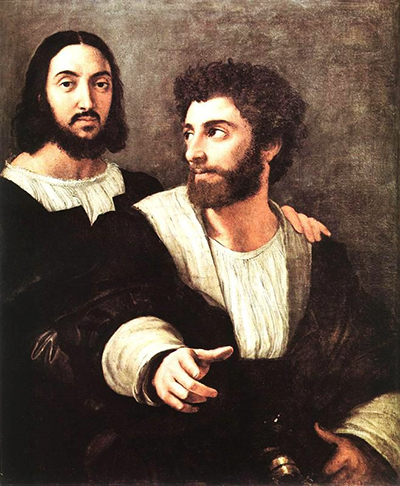
Two men occupy nearly the same dark space in Raphael's Self-Portrait with a Friend. The man in front turns outward and points; the man behind places a hand on his shoulder. Both look toward the viewer. Their bodies overlap so completely that identity is expressed not by separate settings or attributes but by contact.
The rear figure is generally recognised as Raphael. His companion is often identified as Giulio Romano, the gifted assistant who became a major painter and architect after Raphael's death. The Prado endorsed that reading in its Late Raphael exhibition, while the Royal Collection notes that the friend's identity remains disputed.[2][3]
The uncertainty should remain in the title. What is secure is more important than a forced name: around 1519–20, Raphael portrayed himself through relationship. He is artist, friend, mentor and quiet second presence all at once.
At a Glance
- ArtistRaphael
- Louvre titlePortrait of the Artist with a Friend
- Common English titleSelf-Portrait with a Friend
- Dategenerally about 1519–20; Louvre record gives the broader first quarter of the sixteenth century
- CollectionMusée du Louvre, Paris
- InventoryINV 614; MR 435
- Mediumoil on canvas
- Dimensions99 × 83 cm
- Figure behindRaphael
- Figure in frontunidentified; Giulio Romano is the leading modern proposal
- Earlier descriptive identitythe “fencing master,” among other suggestions
- Key gestureRaphael's hand rests on the companion's shoulder
- Provenanceperhaps in Francis I's collection; documented in the French royal collection under Louis XIII by 1625
- Late-career significanceoften considered Raphael's final portrait, though not documented as such
Contents
- Which man is Raphael?
- Who is the friend?
- Giulio Romano as the leading candidate
- The “fencing master” tradition
- A double portrait without equal spacing
- The hand on the shoulder
- The friend's pointing hand
- Four eyes, two addresses
- The viewer as a third presence
- Dark clothing
Which man is Raphael?
Raphael stands behind and to the viewer's left, his face appearing above the companion's shoulder. The identification depends on comparison with his recognised self-images and has long been treated as the secure half of the double portrait.[3]
His dark cap, long face and calm gaze resemble the Uffizi self-portrait, though age and format have changed. Here he is no longer alone against a plain field.
Raphael's position is conceptually striking. The famous artist yields the foreground to another man and identifies himself by touch.
Who is the friend?
The companion has never acquired a universally secure name. Historical descriptions called him a fencing master, and various individuals from Raphael's circle have been proposed.[3]
Giulio Romano is now the most compelling candidate. The Prado presented the work as Self-Portrait with Giulio Romano and read it as a commemoration of their near-parental professional bond.[2]
The Louvre's more cautious “friend” preserves the evidentiary limit. A strong identification need not be turned into an unquestioned fact.
Giulio Romano as the leading candidate
Giulio became one of Raphael's closest collaborators in Rome. He helped realise ambitious designs, absorbed responsibility within the busy studio and later developed an independent career in Mantua.
If he is the foreground figure, the picture records more than personal affection. It shows knowledge passing through a workshop whose collective labour was already larger than one artist's hands.
The portrait would then look both backward and forward: Raphael acknowledges a trusted companion while Giulio faces the public space he would soon enter without him.
The “fencing master” tradition
The companion's pointing hand and assertive turn encouraged earlier viewers to assign him a practical identity, often a fencing instructor. Such titles can arise when gesture survives but name does not.
Nothing in the Louvre record confirms profession.[1] Pointing can organise conversation, direct attention or simply animate a portrait.
The old label remains part of reception. It is not strong enough to outweigh the network, date and resemblance supporting Giulio.
A double portrait without equal spacing
Many paired likenesses give each sitter a distinct half. Raphael instead stacks the men in depth.
The front figure occupies more body and extends the active hand. Raphael's head is fully visible, but most of his torso is hidden. Their outlines overlap rather than balance as mirror images.
This unequal arrangement does not diminish the artist. It lets his presence be communicated through protection and relation rather than through size.
The hand on the shoulder
Raphael's right hand settles on his friend's left shoulder. Fingers curve around dark fabric with a pressure that feels gentle but definite.
Touch is the painting's central statement. It can signify affection, introduction, possession of shared attention or a mentor's endorsement.
No single verbal formula exhausts it. The gesture works because it belongs simultaneously to private contact and public presentation: Raphael touches the man while showing him to us.
The friend's pointing hand
The foreground sitter gestures toward something outside or below the visible field. His index finger directs attention away from the two faces.
Where Raphael's hand connects, the companion's hand opens the image. One gesture is inward and relational; the other is outward and indicative.
Their opposition gives the portrait narrative energy without supplying a story. We seem to have entered a conversation whose subject remains beyond the frame.
Four eyes, two addresses
Both men look outward, but their gazes do not feel identical. The friend appears more immediate because his body turns and hand acts. Raphael's look is quieter, emerging from behind.
The viewer becomes the point at which their different orientations meet. We may be the person being addressed, the object being indicated or a witness to their bond.
That ambiguity keeps the double portrait from becoming a static record of friendship.
The viewer as a third presence
The gestures imply someone or something beyond the painted pair. Because both men look outward, the viewer occupies that unseen zone almost immediately.
This does not turn us into their intimate acquaintance. It creates a structural role: our attention completes the triangle begun by touch and pointing.
Raphael had long understood how grouped figures could organise a spectator's place. Here he compresses that monumental intelligence into portrait scale. The result feels conversational even though no word, object or setting explains the exchange.
Dark clothing
Black and deep brown fabrics merge the two torsos into a broad field. Narrow passages of white shirt separate necks and hands from the surrounding darkness.
Raphael does not use contrasting costumes to distinguish status. Similarity of dress makes the men appear members of the same cultivated world.
Subtle differences in fold and light preserve individual bodies inside the shared mass.
A background that refuses distraction
The setting is dark and minimally descriptive. There is no view of Rome, no studio equipment and no architectural rank.
Suppressing place makes the gestures carry more responsibility. Shoulder, hand and gaze are the picture's architecture.
It also protects the relationship from anecdote. Viewers cannot decide whether this is a workshop, palace or private room; the men remain the whole event.
Canvas as a late portrait support
The Louvre catalogues the work as oil on canvas, not a panel later transferred to fabric.[1] The Prado associated Raphael's late portraits of friends with particularly accomplished exploitation of canvas.[2]
Canvas permits a direct, supple handling different from the hard preparation of a wooden panel. Dark passages can be built with breadth while faces and hands receive concentrated light.
The material suits the painting's intimacy. Surface appears less enamelled than some early portraits and more responsive to shadow.
About 1519–20
The Louvre's public record uses a very broad date, 1500–25, corresponding to the first quarter of the century.[1] Specialist accounts usually narrow the picture to around 1519–20, and the Prado dated it within those years.[2]
The later date fits Raphael's mature style and the proposed Giulio relationship. It also places the work close to Raphael's death on 6 April 1520.
Approximation remains essential. No inscription calls the picture his final portrait.
Was it Raphael's last portrait?
The Prado described it as probably the last portrait Raphael painted and called it an artistic testament.[2]
“Probably” carries the historical weight. Late dating and relational subject make the idea persuasive, but chronology among undated portraits cannot establish a final sequence beyond doubt.
The painting does not need to be literally last to express culmination. Raphael's public identity, friendships and studio responsibility converge within it.
Self-portraiture as relationship
The Uffizi self-portrait asks what Raphael looks like. This canvas asks who Raphael is beside another person.
He does not show himself with brush, palette, drawing or architecture. Professional identity is encoded through the companion, especially if that man is Giulio.
Raphael's self-image becomes social. Mastery includes recognising, touching and perhaps presenting someone who shares the work.
Friendship in Raphael's portraits
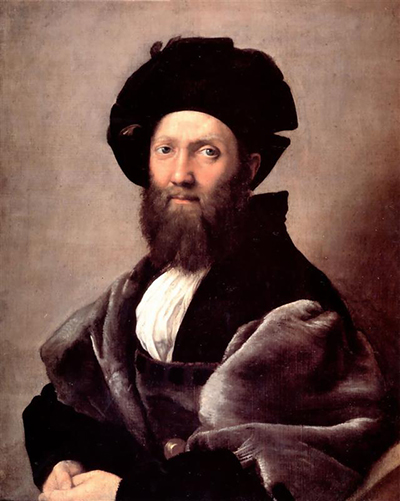
Raphael painted several men within circles of humanist and courtly friendship. Baldassare Castiglione appears with quiet intimacy; Andrea Navagero and Agostino Beazzano share one panel; the lost double portrait form itself could commemorate association.
This work goes further by including the artist. He does not stand outside the network as observer.
Portraiture becomes an exchange among peers and protégés, not simply a service delivered to rank.
Mentor and successor
If the companion is Giulio, Raphael's hand can be read as endorsement. The younger artist occupies the front and makes the active gesture; the older master steadies him from behind.
It would be too neat to call this a formal transfer of authority. Raphael was thirty-six or thirty-seven, not staging a planned retirement, and his death was unexpected.
Yet the composition gained retrospective force. Giulio did continue major designs and carried Raphael's Roman language into new settings after 1520.
Age and authority
Raphael died at thirty-seven, so the apparent mentor was himself still young. His authority came less from age than from the extraordinary position he had built in Rome and the range of responsibilities concentrated in his studio.
That fact sharpens the portrait. The rear figure is not an elderly master ceremonially blessing a distant generation. The two men belong to overlapping working lives.
If Giulio is present, their relation combines hierarchy with proximity. Similar clothes and shared space make them colleagues even as Raphael's hand suggests guidance.
The problem of the workshop myth
Raphael's large studio is sometimes described as either proof of organisational genius or a source of diluted quality. The double portrait encourages a less mechanical view.
Collaboration depended on people linked through training, trust and ambition. Assistants were not anonymous tools; some developed powerful styles and careers.
Touch makes that human structure visible. It does not tell us how every commission was divided, but it challenges the idea of a solitary master surrounded only by hands.
Who painted the canvas?
The Louvre attributes the painting to Raphael.[1] The Prado's close study found no detectable workshop assistance in this group of late friendship portraits and praised their painterly execution.[2]
That conclusion matters because a portrait potentially showing Giulio need not be painted by Giulio. Subject identity and authorship are separate questions.
The canvas may celebrate collaboration while remaining Raphael's own act of painting.
A quasi-paternal bond
The Prado called Raphael's relation to Giulio quasi-paternal.[2] The phrase conveys training, protection and unusual closeness despite the men's uncertain age gap.
It should not be literalised. Raphael had no role as Giulio's father, and documents do not make every emotional dimension accessible.
The shoulder gesture supports an image of care. Beyond that, the painting is more eloquent than a reconstructed private conversation.
Raphael at the rear
Western habits of reading the foreground as primary can make Raphael seem secondary in his own self-portrait. The apparent surrender is part of the invention.
From behind, his hand and gaze control how the companion is introduced. He becomes the source of connection rather than the largest object.
This is an unusually confident form of self-representation. Fame does not require occupying every available inch.
The friend at the front
The companion turns with a physical immediacy that makes him seem to have just responded. His face is closer and his pointing hand breaks the lower stillness.
If Giulio, he is not represented as a deferential pupil. He is the active agent of the encounter.
Raphael's support and the friend's autonomy coexist. That balance helps explain the painting's continuing emotional force.
Entry into the French royal collection
The Louvre records possible ownership by Francis I and secure documentation under Louis XIII in 1625, when Cassiano dal Pozzo mentioned the painting.[1]
It remained part of the old French Crown collection and eventually entered the Louvre. Early royal ownership helped secure its visibility and status.
The provenance is not complete enough to identify the original recipient or commission. The double portrait's first destination remains unknown.
Reproductive afterlife
Engravings disseminated the composition beyond the royal collection. A 1729 plate by Nicolas de Larmessin reversed the image and labelled Raphael, while acknowledging the second man without resolving him.[3]
Reversal changes handedness and spatial sequence, reminding viewers that prints transform as they preserve.
Such copies also stabilised the belief that the rear man was Raphael long before modern exhibition catalogues debated Giulio.
What the painting does not prove
The intimacy of touch has prompted strong emotional reactions. It should not be used to infer a modern category of private relationship without evidence.
Nor does the image serve as a signed succession document. It contains no name, date or explanation of the gesture.
Historical restraint does not weaken the portrait. It protects the remarkable fact we can see: two men chose or permitted closeness to define their public appearance.
Artist Up Close
Raphael constructs the picture from crossings. The friend's turning body crosses Raphael's torso; Raphael's hand crosses the shoulder; the pointing arm sends attention outward; four eyes return it. Darkness makes these paths visible through flesh and narrow white cloth.
The composition is inventive because it feels unforced. A complex hierarchy—artist and companion, rear and front, touch and indication—appears like a momentary human exchange held with quiet psychological and material force.
Near the end of his life, Raphael did not need an emblem of genius. He represented achievement as the ability to stand behind another person without disappearing.
Frequently Asked Questions
Discussion
What detail most changes how you read Self-Portrait with a Friend?
Reader Insights
Which source detail gives the page its strongest anchor?
Which visual or historical distinction should readers keep in mind?
How does this page change the wider picture of Raphael's career?
Join the Conversation
Share your reading below.
References
- Musée du Louvre, “Portrait de l'artiste avec un ami,” collection record, INV 614 View source.
- Museo Nacional del Prado, “Late Raphael,” exhibition research and catalogue list, 2012 View source.
- Royal Collection Trust, “Self-Portrait of Raphael with Another Man,” engraving by Nicolas de Larmessin III, RCIN 850078 View source.