

 by Tom Gurney
Tom Gurney BSc (Hons) is an art history expert with over 20 years experience
Published on June 19, 2020 / Updated on August 21, 2026
Email: tomgurney1@gmail.com / Phone: +44 7429 011000
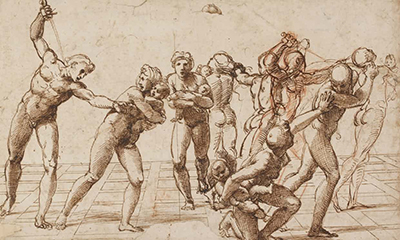
Raphael's Study for The Massacre of the Innocents is a drawing made to move. Pen and brown ink define a crowd of mothers, children and attackers over earlier red chalk. Tiny pricked holes follow much of the design, evidence that its outlines were transferred onward. The destination was not a known painting but Marcantonio Raimondi's engraving, an image designed for multiplication.[1]
The distinction changes how the sheet should be viewed. It is neither an unfinished illustration nor a softer version of a famous print. Raphael uses paper to coordinate bodies under extreme pressure, tests additions after part of the composition is already ready for transfer, and gives an engraver the structure from which a public image can be cut into copper.
The biblical subject is horrific: Herod orders the killing of Bethlehem's young boys. Looking closely at design must never make the represented violence merely a display of beautiful anatomy.
At a Glance
- ArtistRaphael
- Museum title/typedrawing; print study for The Massacre of the Innocents
- Dateabout 1510–14; the Metropolitan Museum loan record uses about 1510–12
- CollectionBritish Museum, London
- Museum number1860,0414.446
- Mediumpen and brown ink over red chalk, pricked for transfer
- Dimensions231 × 374 mm
- Subject sourceMatthew 2:16–18
- Immediate purposedevelopment and transfer of a composition for an engraving
- EngraverMarcantonio Raimondi after Raphael
- Print dateabout 1511–12
- Key process evidencepricked ink design; unpricked red-chalk additions at right; added infant head above
- Essential cautionit is not a finished painting, a tapestry cartoon or the engraved plate
Contents
- The biblical subject
- Why this subject tests composition
- The exact British Museum sheet
- Ink over red chalk
- Pricked for transfer
- Changes after transfer preparation
- Why many figures are nude
- Mothers shielding children
- Soldiers in motion
- The central crossing
The biblical subject
In Matthew's Gospel, Herod learns of the birth of a potential “king of the Jews” and orders male children in and around Bethlehem aged two and under to be killed.
The event fulfils a lamentation associated with Rachel weeping for her children. Christian art treated the victims as the first martyrs for Christ.
Raphael chooses no distant royal command. He concentrates on immediate collision: soldiers and caregivers struggle over living bodies.
Why this subject tests composition
A massacre risks visual incoherence. Many figures move in opposed directions, while every gesture carries urgent emotional meaning.
Raphael has to distinguish pursuit, defence, escape and loss without reducing the scene to separate anecdotes. Large diagonals drive across smaller knots of action.
The study turns chaos into readability. That formal achievement makes the violence more, not less, legible.
The exact British Museum sheet
The page concerns British Museum 1860,0414.446. The museum classifies it as a drawing and print study, made by Raphael in pen and brown ink over red chalk and pricked for transfer.[1]
The Metropolitan Museum displayed the same object on loan as Composition Sketch for the Massacre of the Innocents, confirming collection, number and technique while dating it about 1510–12.[2]
Different public titles refer to one sheet. Registration number keeps identity secure.
Ink over red chalk
Red chalk allowed Raphael to search, adjust and place forms. Brown ink then gave selected contours greater decisiveness.
The visible combination records stages rather than a simple outline later coloured in. Some ideas receive firm ink; others remain provisional.
Because chalk and ink respond differently to pressure and correction, the sheet preserves the changing confidence of the design.
Pricked for transfer
Tiny holes follow much of the completed composition. Dusting charcoal through them could repeat contours on another surface.[1]
The pricks mean the drawing was used, not only preserved for admiration. They physically connect Raphael's invention to the next stage.
Transfer may also reverse or mediate a design depending on the intermediate procedures and engraving plate. Paper, counterproof and copper belong to a sequence rather than isolated masterpieces.
Changes after transfer preparation
Raphael continued thinking after much of the sheet was pricked. At the right he added an executioner and victim in red chalk; these figures were not pricked and did not survive into later development.[3]
Above the main scene he tested an infant's head, later used for the dead child in the engraved foreground.[3]
The sheet therefore preserves both rejection and adoption. A study can move forward in uneven zones.
Why many figures are nude
Raphael often studied bodies without final clothing so that weight, torque and contact could be understood directly.
Here nudity exposes the mechanics of violence: a torso twists because a limb is pulled; a mother braces because another force opposes her; a soldier's stride transfers weight.
The finished print could add or clarify drapery. The drawing's anatomical state belongs to construction, not to a claim that the biblical event occurred unclothed.
Mothers shielding children
Several women close their bodies around infants, creating compact defensive shapes against open attacking limbs.
Protection is visible as geometry. Curved backs and enclosing arms oppose weapons, reaching hands and forward strides.
Raphael's control of line makes vulnerability bodily. The children are not abstract symbols of innocence; they are small weights being held, pulled or lost.
Soldiers in motion
The attackers do not form one impersonal wall. Their bodies lunge, pivot and reach from different positions.
This variation prevents a repeated soldier motif from flattening the horror. It also distributes force across the width of the sheet.
The artists' study of muscular action serves narrative power. Admiring anatomical knowledge should not detach it from who suffers that knowledge in the scene.
The central crossing
Raphael builds the composition around intersecting movements rather than a single calm protagonist. Bodies pass before and behind one another; limbs create visual bridges.
Gaps are as important as masses. Small openings around arms and heads prevent the crowd from becoming unreadable.
The print would translate these separations into engraved light and shadow, making the drawing's spatial discipline essential.
Marcantonio Raimondi
Marcantonio was Raphael's most consequential print collaborator. He converted designs into engraved lines that could yield many impressions.
The British Museum and National Gallery of Art identify surviving prints as Marcantonio after Raphael.[4][5]
“After” does not mean inferior copy. It describes a division: Raphael supplied invention; Marcantonio cut and printed its copper-plate realisation.
A design conceived for reproduction
No finished Raphael painting is known behind this composition. The drawing belongs to the early collaboration with Marcantonio and to an image intended for print.[6]
This matters because art history often assumes a hierarchy with painting first and print second. Here engraved circulation is the destination.
Raphael could invent with multiplication in mind, using line, crowd structure and reproducible contour as primary conditions.
Versions with and without the fir tree
Marcantonio's Massacre survives in two principal compositional versions commonly distinguished by the presence or absence of a fir tree. Museums catalogue individual impressions with this difference explicit.[4]
The relationship among drawing, versions and states is complex. One sheet cannot be made the exact final model for every printed variation.
The British Museum study belongs within development, not at a falsely simple point labelled “the original of all prints.”
The engraved city
The completed engraving expands the action within an urban setting. The National Gallery of Art describes a paved space crowded with mothers, infants and soldiers, with a bridge beyond.[5]
Architecture and distance give the violence a civic stage, while engraved hatching supplies tone unavailable in the study's open paper.
Comparison reveals what Marcantonio and the design process added, omitted and stabilised.
Rome around 1511
Raphael was then engaged with the Vatican apartments, building figures at monumental scale. Michelangelo was painting the Sistine ceiling nearby.
The Cleveland Museum places the engraving within this environment of powerful twisting bodies.[7]
Influence should not be reduced to copied poses. Rome intensified competition over how the human figure could carry narrative, theology and public fame.
A violent image for broad circulation
An engraving could travel into collections, workshops and albums far from Rome. Its biblical terror became available to artists and viewers who would never see the Vatican rooms.
Multiplication changes ethics as well as fame. The suffering of mothers and children becomes repeatable, collectable and discussable through crafted line.
Raphael and Marcantonio make the scene compelling without providing emotional comfort.
Related drawings
Other studies connected to the Massacre survive in Vienna, Budapest and Windsor. Royal Collection records document six related drawings while stating that no painting is known.[6]
These sheets examine different figures or stages. They are not fragments of the British Museum object.
The design family shows Raphael distributing thought across paper rather than solving the complete image on one sheet.
Photographs are not drawings
The Royal Collection contains nineteenth-century photographs of related sheets, including an albumen print after the British Museum drawing.[6]
Such records are valuable evidence for collecting and the historical appearance of originals. They remain photographic objects made centuries later.
Object type matters: Raphael drawing, photograph after drawing, engraved impression and tapestry-related facsimile each has a separate material history.
The later tapestry tradition
Raphael's Massacre composition also influenced tapestry imagery, including material associated with the Scuola Nuova series. These later adaptations belong to another production chain.
They should not be called the destination of British Museum 1860,0414.446. The immediate relationship is with Marcantonio's engraving.
Keeping the strands separate makes the extraordinary mobility of Raphael's invention easier to understand.
Acquisition by the British Museum
The museum number begins with 1860, recording acquisition in that year within the British Museum's system.[1]
Registration numbers are more than administrative detail. They distinguish one drawing from similarly titled works and link it to curatorial history.
For a composition with many copies and related sheets, exact numbering is essential evidence.
Looking without aestheticising atrocity
The drawing's beauty of line can create discomfort. The subject should create discomfort.
Formal analysis is still necessary because composition determines how violence is communicated. But admiration should not turn a dead child into only a clever diagonal or a mother's resistance into elegant curvature.
Raphael's achievement lies in making organised form bear emotional disorder without neutralising it.
Artist Up Close
Look at the tiny pricks before looking for finish. They show a design crossing from Raphael's sheet into another process.
Then compare the inked crowd with red-chalk additions. Some bodies had reached transfer; others were still being tried or abandoned. The paper contains different times at once.
Finally, remember Marcantonio. Raphael's drawing becomes fully intelligible when invention is understood as collaborative and intended to circulate.
Frequently Asked Questions
Discussion
What detail most changes how you read Study for The Massacre of the Innocents?
Reader Insights
Which source detail gives the page its strongest anchor?
Which visual or historical distinction should readers keep in mind?
How does this page change the wider picture of Raphael's career?
Join the Conversation
Share your reading below.
References
- British Museum, “Drawing; Print Study,” Raphael, The Massacre of the Innocents, 1860,0414.446 View source.
- Metropolitan Museum of Art, “Composition Sketch for the Massacre of the Innocents,” British Museum loan, 1860,0414.446 View source.
- Web Gallery of Art, “Study for the Engraving The Massacre of the Innocents,” object commentary View source.
- British Museum, “The Massacre of the Innocents,” engraving by Marcantonio Raimondi after Raphael, H,1.19 View source.
- National Gallery of Art, Washington, “The Massacre of the Innocents,” Marcantonio Raimondi after Raphael, 1975.54.1 View source.
- Royal Collection Trust, “Studies for the Massacre of the Innocents,” Raphael Collection records View source.
- Cleveland Museum of Art, “The Massacre of the Innocents (Without the Fir Tree),” 1964.23 View source.