

 by Tom Gurney
Tom Gurney BSc (Hons) is an art history expert with over 20 years experience
Published on June 19, 2020 / Updated on July 26, 2026
Email: tomgurney1@gmail.com / Phone: +44 7429 011000
Girl Reading a Letter at an Open Window by Johannes Vermeer: Introduction
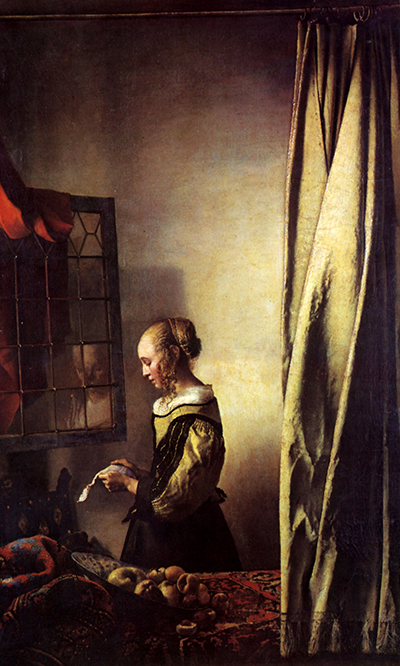
Johannes Vermeer’s Girl Reading a Letter at an Open Window is one of the most important restoration stories in his surviving work. For generations, the painting was known as an image of a young woman reading against a largely blank wall. Today, after major conservation work in Dresden, the current composition includes a large painting of Cupid on the back wall, revealing a more explicit visual argument about love, sincerity and deception.
The Staatliche Kunstsammlungen Dresden records the work as Brieflesendes Mädchen am offenen Fenster, by Johannes Vermeer, about 1657-1659, oil on canvas, 83 by 64.5 cm, in the Gemäldegalerie Alte Meister, inventory number Gal.-Nr. 1336. [1] The restored painting is essential to any serious account of Vermeer because it changes how viewers understand the early letter interiors.
At a Glance
- ArtistJohannes Vermeer
- TitleGirl Reading a Letter at an Open Window
- SKD titleBrieflesendes Mädchen am offenen Fenster
- DateAbout 1657-1659
- MediumOil on canvas
- CollectionGemäldegalerie Alte Meister, Staatliche Kunstsammlungen Dresden
- Inventory numberGal.-Nr. 1336
- Key themesLetter reading, open window, restoration, Cupid, sincerity, early interiors
Contents
- Introduction
- At a Glance
- What the Painting Shows
- The Restored Cupid
- How the Restoration Happened
- Cupid, Masks and Love
- The Open Window
- Curtain, Table and Foreground
- An Early Letter Interior
- Relation to Later Vermeer
- Attribution and Rediscovery
- Place in Vermeer’s Work
What the Painting Shows
The painting shows a young woman standing beside an open window, absorbed in reading a letter. A table with a carpet and fruit occupies the foreground. A green curtain hangs at the right, partly separating the viewer from the scene. Behind the woman, the restored composition reveals a large painting of Cupid on the wall.
The woman is enclosed by stillness. Her body is turned toward the window, but her attention is fixed on the letter. The open window reflects her face and brings light into the room. The foreground table and curtain slow the viewer’s approach, making the act of reading feel private.
The painting’s drama lies in concentration. Nothing visibly happens beyond reading, yet the room feels changed by the presence of the letter. The sender is absent, but the letter makes that person active inside the scene.
The Restored Cupid
The central modern fact about this painting is the restored Cupid image. SKD’s restoration research showed that the Cupid painting on the back wall had been overpainted after Vermeer’s death. The museum’s conservation project removed the later overpaint and returned the painting to a state closer to how it left Vermeer’s studio. [2]
This changed the public meaning of the work. The older blank-wall version created a quieter and more ambiguous scene. The restored version gives the room an emphatic image of love. Cupid stands behind the reader as a visual key, but not a simplistic explanation.
The restoration should not make interpretation crude. The letter is now more clearly connected to love, but the painting still withholds the letter’s contents, the sender’s identity and the woman’s emotional response. Vermeer gives a stronger symbolic context without turning the scene into an illustrated story.
How the Restoration Happened
SKD reports that a 1979 X-ray showed the overpainted picture-within-a-picture of Cupid on the rear wall. Later research re-examined the evidence through X-rays, infrared reflectance spectroscopy, microscopy, colour samples, backing canvas and restoration history. A full-surface X-ray fluorescence scan in 2017, supported by the Rijksmuseum, confirmed the findings. [2]
The restoration project began in 2017. SKD decided in early 2018 to remove the overpaint after concluding that it was not by Vermeer and had been applied significantly after his death. Conservator Christoph Schölzel led the restoration. [2]
This matters because the restoration was not a cosmetic preference. It was based on technical and historical evidence about the painting’s material history. The result was not a modern invention of a more dramatic Vermeer, but the recovery of a composition hidden for more than two and a half centuries.
Cupid, Masks and Love
The restored picture-within-a-picture shows Cupid with bow, arrows and two masks. SKD links the masks to the idea of sincere love overcoming deception or hypocrisy. [2] This makes the painting much more explicit within Vermeer’s letter imagery.
Even so, the Cupid should be handled carefully. It supports a love-letter interpretation, but it does not tell us the content of the letter. It creates a symbolic atmosphere rather than a complete narrative.
The masks are especially important because they complicate the idea of love. They suggest not only affection, but also truth and falsehood, appearance and sincerity. The young woman’s stillness therefore sits beneath a moral and emotional emblem.
The Open Window
The open window is one of the painting’s most powerful devices. It admits light, creates reflection and connects the private room to the world outside. The woman stands near that threshold, but she does not look outward. Her attention remains on the letter.
This gives the window a double role. It opens the room physically, while the letter opens it emotionally. The sender is elsewhere, but the message has crossed distance and entered the interior.
The reflected face in the window adds another layer. The woman is present in the room and doubled in glass. Vermeer uses reflection not as a trick, but as a way to make inward attention visible.
Curtain, Table and Foreground
The green curtain at the right and the table in the foreground are essential to the painting’s sense of privacy. They create a threshold between viewer and reader. We are allowed to see the scene, but we are not fully admitted to it.
The carpet and fruit also slow the eye. Before reaching the woman, the viewer must pass across surfaces, folds and objects. Vermeer turns looking into an act of approach.
The Rijksmuseum’s Vermeer exhibition materials note that Vermeer added the green curtain over a large wine glass in a later stage. [3] That detail is useful because it shows the painting as a process of revision. Vermeer did not simply record a room; he adjusted the composition to control how the viewer enters it.
An Early Letter Interior
The painting belongs to Vermeer’s early development of the letter theme. It comes before the later variations in which women read, write, receive or discuss letters in more complex social interiors.
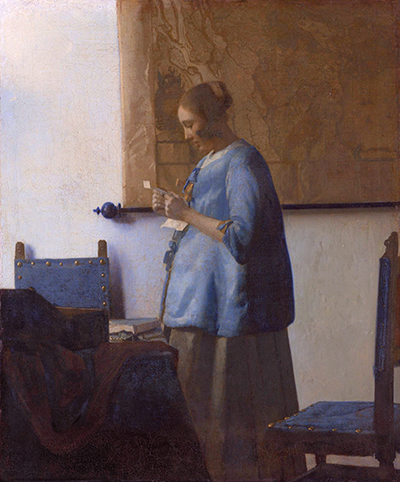
In Girl Reading a Letter at an Open Window, the reader is alone. The emotional pressure comes from the absent sender and the symbolic Cupid behind her. In Woman in Blue Reading a Letter, the reader is more inward and atmospheric. In The Love Letter, a maid and doorway turn privacy into theatre. In Lady Writing a Letter with her Maid, writing becomes a social act involving waiting and dispatch.
The Dresden painting is therefore a foundation work for Vermeer’s letter scenes. It establishes the letter as an object that can fill a room with unseen presence.
Relation to Later Vermeer
The painting also helps explain Vermeer’s movement from narrative genre painting toward quieter interiors. There is still a strong symbolic element here, especially after the Cupid restoration, but the visible action remains minimal. A woman reads. Light enters. A curtain hangs. Fruit rests on a table.
That restraint is already recognisably Vermeer. Instead of multiplying figures or gestures, he builds meaning through placement, reflection, light and silence. The restored Cupid strengthens the iconography, but the painting’s power still depends on the reader’s absorption.
This balance between symbol and stillness would become one of Vermeer’s defining achievements.
Attribution and Rediscovery
The painting’s history also belongs to the broader story of Vermeer’s rediscovery and attribution. SKD’s record connects the work to Dresden’s collection history, including acquisition in Paris in 1742 for Saxon Prince Elector Friedrich Augustus II. [2]
Like several Vermeer paintings, its modern identity was shaped by changing attribution and conservation history. The restoration added another layer: not a new attribution, but a new understanding of what the painting itself contains.
This makes the page important for the later legacy and rediscovery route. Vermeer’s reputation has not been built only by biography and connoisseurship; it has also been shaped by technical research, conservation and institutional stewardship.
Place in Vermeer’s Work
Girl Reading a Letter at an Open Window is one of the essential early letter paintings. It links the intimate reader to the later letter writers, messengers and music scenes. It also gives Vermeer’s oeuvre one of its strongest conservation narratives.
The restored Cupid means that the painting can no longer be treated simply as a quiet blank-wall interior. It is still quiet, but the quiet now contains a visible emblem of love and truth. That combination is exactly what makes the painting so important.
It shows Vermeer at a turning point: still close to emblematic genre painting, but already moving toward the controlled, silent interiors that would define his mature art.
Frequently Asked Questions
The painting is in the Gemäldegalerie Alte Meister, Staatliche Kunstsammlungen Dresden. [1]
SKD dates the painting to about 1657-1659. [1]
Conservation research showed that the Cupid image on the back wall had been overpainted after Vermeer’s death. SKD removed the later overpaint during the restoration project. [2]
Cupid strongly supports a love-letter interpretation, but the painting still does not reveal the letter’s contents or the sender’s identity.
The restored Cupid-state composition should be treated as the current version of the painting. The blank-wall version is relevant only when discussing the painting’s restoration history.
Discussion
What feels most revealing about Girl Reading a Letter at an Open Window: Vermeer's handling of light, the silence of the scene, the object details, the attribution history, or the way the painting fits within Dutch Golden Age art?
Reader Insights
Vermeer rewards slow attention. Begin with the main action, then move outward to light, edges, objects and the quiet spaces that hold the composition together.
Many of these paintings are small, but their meanings open through Delft, collecting history, technical study and comparison with related Dutch interiors.
Pair this article with the biography and one neighbouring Vermeer work to see how subject, light and attention shift across the artist's compact oeuvre.
Join the Conversation
Have a thought or observation about Girl Reading a Letter at an Open Window? Share it below. Thoughtful responses may be added to this section as the Vermeer pages develop.
References
- Staatliche Kunstsammlungen Dresden, Online Collection, Brieflesendes Mädchen am offenen Fenster, Gal.-Nr. 1336.
- Staatliche Kunstsammlungen Dresden, “Revealing Cupid: Restoration of Vermeer’s ‘Girl Reading a Letter at an Open Window’ completed,” 24 August 2021.
- Rijksmuseum, Vermeer exhibition materials on technique and revision.