

 by Tom Gurney
Tom Gurney BSc (Hons) is an art history expert with over 20 years experience
Published on June 19, 2020 / Updated on July 26, 2026
Email: tomgurney1@gmail.com / Phone: +44 7429 011000
Girl with the Red Hat by Johannes Vermeer: Introduction
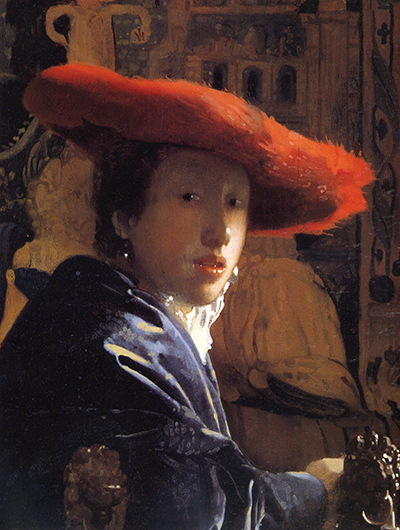
Johannes Vermeer’s Girl with the Red Hat is one of his smallest and most startling paintings. A young woman turns toward the viewer from a dark, patterned background. Her red hat is vivid, her blue robe catches the light, and highlights flicker across her face, lips, eyes and chair. The encounter is immediate, but the painting remains mysterious.
The National Gallery of Art in Washington records Girl with the Red Hat as a painting by Johannes Vermeer, about 1669, on panel, object number 60. [1] The painting is especially important because it shows Vermeer working at a very small scale and on a panel support rather than the canvas more typical of his accepted works.
At a Glance
- ArtistJohannes Vermeer
- TitleGirl with the Red Hat
- DateAbout 1669
- SupportPanel
- CollectionNational Gallery of Art, Washington
- Object number60
- Key themesTronie, costume, colour, gaze, technical revision, small scale
Contents
- Introduction
- At a Glance
- What the Painting Shows
- A Small Painting with a Strong Presence
- Panel, Scale and Experiment
- The Red Hat and Blue Robe
- Chair, Tapestry and Background
- Painted Over Another Image
- Technique and Revision
- Relation to Girl with a Pearl Earring
- Attribution and the Problem of Similar Works
- Forensic Comparison
- Place in Vermeer’s Work
Forensic Comparison: Vermeer, Studio and the Problem of Similar Paintings
Some Vermeer questions begin with a simple visual problem: two works look related, but the evidence does not support the same conclusion for both. Girl with the Red Hat and Girl with a Flute are both small, close-up images of a young woman in unusual costume. Both are in the National Gallery of Art in Washington. Both belong to the world of Vermeer’s late tronies, where expression, costume, light and painted presence matter more than portrait identity.
Yet the museum does not present them in the same way. Girl with the Red Hat is catalogued as a work by Johannes Vermeer. Girl with a Flute is currently catalogued as Studio of Johannes Vermeer. That distinction is the reason this comparison matters.
1. Current Attribution
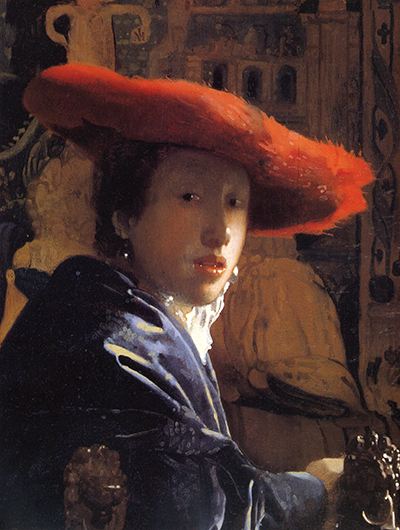
Girl with the Red Hat: the National Gallery of Art presents the painting as by Johannes Vermeer, about 1669. [1]
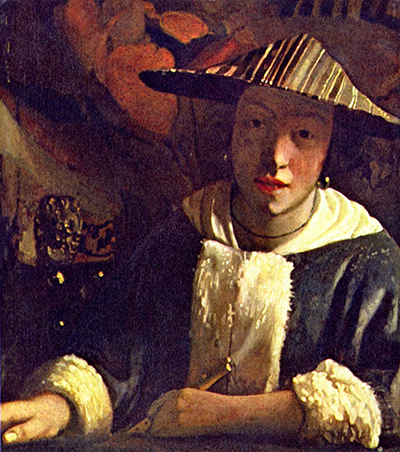
Girl with a Flute: the museum currently presents the painting as Studio of Johannes Vermeer, not as a straightforward autograph Vermeer. [3]
An attribution is not decided by resemblance alone. The closer two works appear, the more carefully differences in execution, support, revision and technical evidence need to be weighed.
2. Support and Scale
Both paintings are small works on panel, which already makes them unusual within Vermeer’s accepted oeuvre, where canvas is more common. That shared format helps explain why the two works have often been discussed together.
The shared support does not settle authorship. It creates the right conditions for comparison, but the comparison still has to ask how each painting was made and how confidently that process can be connected to Vermeer himself.
3. Presence and Handling
Girl with the Red Hat has a compressed force. The red hat, blue robe, bright collar and glittering highlights create a sharp, immediate encounter. The figure’s turn toward the viewer feels deliberate and theatrical.
Girl with a Flute is closely related in type, but NGA scholarship treats its execution as weaker and less secure. The issue is not whether the painting knows Vermeer’s language. The issue is whether it speaks that language with Vermeer’s own command.
4. Technical Evidence
NGA technical research is especially important for Girl with the Red Hat. Imaging has shown that Vermeer painted it over a partially completed portrait of a man after rotating the panel. [2]
For Girl with a Flute, the technical and stylistic evidence has led the NGA toward a studio attribution. The painting uses seventeenth-century materials and relates closely to Vermeer’s work, but the museum’s current position is more cautious.
What the Comparison Teaches
The comparison prevents two opposite mistakes. The first is treating every Vermeer-like work as a Vermeer. The second is treating disputed or studio works as irrelevant. Girl with a Flute still matters because it helps explain how Vermeer’s manner could be understood, repeated or approximated around him.
Look first at the shared format: two small panel paintings, both close to the viewer, both built around costume and direct presence. Then look for the differences. Which painting feels more controlled in its highlights? Which figure occupies space more convincingly? Where does the handling feel deliberate, and where does it feel dependent on a known Vermeer type?
The question is not whether the paintings are connected. They are. The question is what kind of connection the evidence supports.
What the Painting Shows
The girl is seated close to the picture plane, turned toward the viewer with her lips slightly parted. She wears a striking red hat and a blue garment, with light catching the edges of fabric, face and jewellery. The background includes a tapestry-like surface and the finials of a chair. The space is shallow and compressed.
Like Girl with a Pearl Earring, the work is best approached as a tronie rather than a conventional portrait. A tronie is not primarily the likeness of a known sitter. It is a study of expression, costume, character or pictorial effect. Vermeer uses the girl’s face and costume to create a charged visual encounter rather than a biography.
The red hat dominates the image, but it does not simply decorate the figure. Its broad shape alters the scale of the head and intensifies the forward pull of the face. The blue robe, dark background and bright highlights make the red feel even more theatrical.
A Small Painting with a Strong Presence
The painting’s size is part of its force. Vermeer brings the figure close, crops the space tightly and uses strong contrasts of light and colour. The result is an image that feels larger than its physical dimensions. The girl’s gaze is direct, but not easily readable. She seems to acknowledge the viewer without fully entering our world.
This ambiguity is typical of Vermeer’s strongest single-figure works. The viewer is given presence, not explanation. The painting’s drama lies in the moment of turning, the glitter of light and the uncertainty of the figure’s expression.
Panel, Scale and Experiment
The panel support is one of the painting’s most important facts. Vermeer usually painted on canvas, so a small work on panel immediately stands apart within his accepted oeuvre. [1] The support contributes to the painting’s technical interest and to its history of scholarly discussion.
The tiny scale encourages compression. The figure is close, the background is shallow and the colour contrasts are intense. Vermeer does not create a spacious interior. He creates a concentrated encounter with face, hat, robe, chair and light.
This experimental quality helps explain why the painting feels so different from Girl with a Pearl Earring. Both are close single-figure studies, but Girl with the Red Hat is more abrupt and surface-driven. It seems to test how much presence can be produced from a very small panel.
The Red Hat and Blue Robe
The red hat is the painting’s obvious visual anchor, but its function is structural as well as decorative. It broadens the head, changes the silhouette and gives the figure theatrical force. Against the darker background, the red becomes a field of energy.
The blue robe works differently. It catches light in cooler, sharper passages and gives the lower part of the figure a luminous counterweight. The relation between red and blue makes the painting one of Vermeer’s boldest small colour statements.
The white cravat or collar helps separate face and robe, while the highlights on the lips and eyes sharpen the encounter. Vermeer builds the image from contrasts: red against dark, blue against shadow, wet highlights against soft modelling, direct gaze against uncertain identity.
Chair, Tapestry and Background
The chair finials and tapestry-like background are not incidental. They place the figure in a shallow but richly textured space. The background is not a fully described room; it is a patterned field that makes the face and hat project forward.
This compressed setting differs from Vermeer’s larger interiors, where walls, maps, windows and tables establish a measured room. In Girl with the Red Hat, space is more ambiguous. The figure seems almost pressed toward the viewer by pattern and shadow.
That pressure increases the painting’s immediacy. The viewer does not observe a domestic action from a distance. The viewer encounters a figure staged almost entirely for looking.
Painted Over Another Image
NGA technical research showing that Vermeer painted over a partially completed portrait of a man after rotating the panel 180 degrees is central to the painting’s modern importance. [2] It reveals an unusually direct act of transformation. A support that once held one image became the ground for another.
This evidence gives the work a different kind of vitality. It was not only invented; it was reinvented. The final image carries no obvious narrative of the earlier portrait, but the technical history shows Vermeer working pragmatically and experimentally.
The discovery also supports a broader point about Vermeer’s perfection. His paintings can look inevitable, but they often involve revision, adjustment and rethinking. Girl with the Red Hat is a compact example of that process.
Technique and Revision
Technical study has made Girl with the Red Hat especially important. National Gallery of Art research has shown that Vermeer painted the work over a partially completed portrait of a man after rotating the panel. [2] That discovery reveals the painting as a transformation rather than a straightforward beginning-to-end invention.
The surface also shows Vermeer’s interest in optical effects. Bright highlights punctuate the eyes, lips, jewellery and chair. Some passages are crisp, while others remain soft or broadly handled. This alternation between sharpness and blur gives the figure a vivid, unstable presence.
The panel support matters too. It separates the work from many of Vermeer’s better-known canvas paintings and has played a role in discussions of attribution, technique and workshop practice. The National Gallery of Art currently presents Girl with the Red Hat as by Vermeer, which distinguishes it from Girl with a Flute, now presented by the same museum as “Studio of Johannes Vermeer.” [3]
Relation to Girl with a Pearl Earring
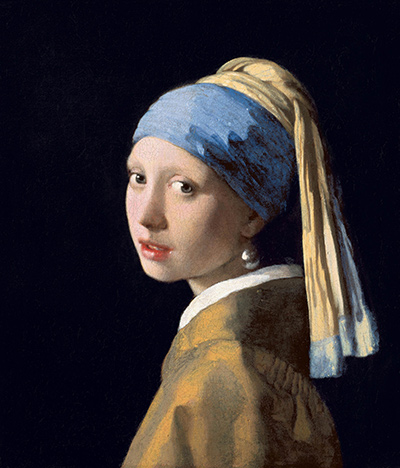
Girl with the Red Hat naturally invites comparison with Girl with a Pearl Earring. Both show a young woman in exoticising costume, close to the viewer, with strong light effects and uncertain identity. Both belong to the tronie tradition. But the mood is different.
Girl with a Pearl Earring is smoother, quieter and more iconic. Girl with the Red Hat is sharper, more experimental and more compressed. Its red, blue and dark tones create a stronger sense of theatrical immediacy. If the Mauritshuis painting is a whispered encounter, the Washington painting is a flash.
Attribution and the Problem of Similar Works
The painting also helps explain why Vermeer attribution requires care. Girl with the Red Hat and Girl with a Flute are close in scale, support and type, but they do not currently have the same status at the National Gallery of Art. The NGA presents Girl with the Red Hat as Vermeer and Girl with a Flute as studio. [1] [3]
That distinction should be preserved. Similarity is not the same as authorship. Technical evidence, handling, materials and connoisseurship all matter. Girl with the Red Hat can therefore serve as a useful point of comparison for attribution-risk pages, but it should not be blurred with them.
The comparison is especially useful because it shows how responsible attribution language should work. Visual relationship and scholarly debate can be acknowledged without implying that all similar works have equal status. Girl with the Red Hat is currently presented by the NGA as Vermeer; Girl with a Flute is not.
Place in Vermeer’s Work
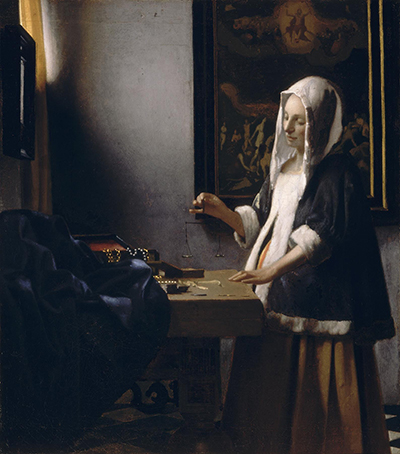
Girl with the Red Hat belongs to Vermeer’s late fascination with close figures, costume, light and viewer address. It links to Girl with a Pearl Earring, A Lady Writing and Woman Holding a Balance through its attention to face, fabric, pearls and private encounter. It also belongs in the technical story of Vermeer’s revisions and experiments.
The painting is small, but it is not minor. It shows Vermeer’s ability to make a compact image feel vivid, uncertain and visually audacious.
It also adds an important sharper note to Vermeer’s single-figure works. If Girl with a Pearl Earring is smooth, poised and iconic, Girl with the Red Hat is more electric. It prevents Vermeer’s tronies and close figure studies from seeming all of one mood.
Frequently Asked Questions
Girl with the Red Hat is in the National Gallery of Art in Washington. [1]
The National Gallery of Art currently presents Girl with the Red Hat as a work by Johannes Vermeer. [1]
It is better understood as a tronie, a study of costume, expression or pictorial character, rather than a portrait of a securely identified sitter.
Discussion
What feels most revealing about Girl with the Red Hat: Vermeer's handling of light, the silence of the scene, the object details, the attribution history, or the way the painting fits within Dutch Golden Age art?
Reader Insights
Vermeer rewards slow attention. Begin with the main action, then move outward to light, edges, objects and the quiet spaces that hold the composition together.
Many of these paintings are small, but their meanings open through Delft, collecting history, technical study and comparison with related Dutch interiors.
Pair this article with the biography and one neighbouring Vermeer work to see how subject, light and attention shift across the artist's compact oeuvre.
Join the Conversation
Have a thought or observation about Girl with the Red Hat? Share it below. Thoughtful responses may be added to this section as the Vermeer pages develop.
References
- National Gallery of Art, Girl with the Red Hat, object 60.
- National Gallery of Art, technical research on Girl with the Red Hat.
- National Gallery of Art, Girl with a Flute, object 1237.