

 by Tom Gurney
Tom Gurney BSc (Hons) is an art history expert with over 20 years experience
Published on June 19, 2020 / Updated on July 26, 2026
Email: tomgurney1@gmail.com / Phone: +44 7429 011000
A Lady Writing by Johannes Vermeer: Introduction
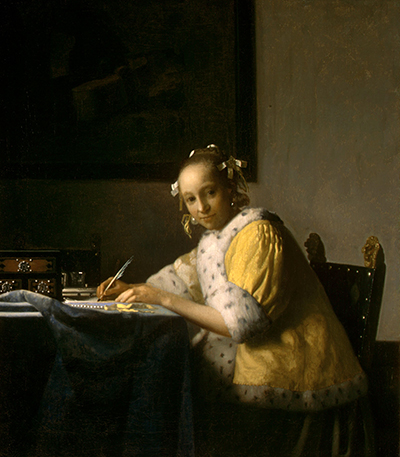
Johannes Vermeer’s A Lady Writing is one of his most direct images of private communication. A young woman sits at a table, quill in hand, and looks toward the viewer as if interrupted in the act of writing. She wears a yellow jacket trimmed with pale fur, pearls at her ears and hair, and a calm expression that gives away very little.
The National Gallery of Art in Washington records the painting as A Lady Writing, about 1665, oil on canvas, 45 by 39.9 cm, accession number 1962.10.1. [1] It is one of Vermeer’s finest letter paintings, but unlike Woman in Blue Reading a Letter or The Love Letter, it does not show the contents or even the direction of the message. The drama is the act of writing itself.
At a Glance
- ArtistJohannes Vermeer
- TitleA Lady Writing
- DateAbout 1665
- MediumOil on canvas
- Dimensions45 x 39.9 cm
- CollectionNational Gallery of Art, Washington
- Accession number1962.10.1
- Key themesLetter writing, interruption, gaze, yellow jacket, pearls, private communication
Contents
- Introduction
- At a Glance
- What the Painting Shows
- Writing and Interruption
- The Yellow Jacket
- Pearls, Light and Surface
- Portrait or Genre Painting?
- The Viewer as Interruption
- The Writing Table
- Technical Revision and the Quill
- The Yellow Jacket Across Vermeer’s Work
- Place in Vermeer’s Work
What the Painting Shows
The woman sits behind a table covered with objects associated with writing and display. She holds a quill in her right hand. A sheet of paper lies before her. On the table are a jewellery box, ribbons or cords, and other small objects. Her yellow jacket catches the light, while the background remains plain and controlled.
The most striking feature is her gaze. She turns toward the viewer, but not with surprise or alarm. Her look is composed, almost conversational. Vermeer creates the sensation that the viewer has entered the room at a delicate moment, yet the woman keeps control of the encounter.
This makes the painting different from many narrative letter scenes. There is no messenger, no visible recipient and no obvious emotional crisis. The letter exists as an act, not as a story the viewer can decode. The woman’s attention is divided between page and viewer, privacy and social presence.
Writing and Interruption
Letter writing was one of Vermeer’s great themes. In his paintings, letters can suggest love, absence, secrecy, social exchange or uncertainty. A Lady Writing is especially subtle because it shows the writer before the message is complete. We are not asked to read the letter. We are asked to consider the person writing it.
The interruption is carefully balanced. If the woman looked startled, the painting would become anecdotal. If she ignored the viewer, it would become a more closed image of concentration. Instead, Vermeer holds the moment between those states. The woman acknowledges being seen, but she does not surrender her privacy.
The quill is essential to this balance. National Gallery of Art technical material records that infrared imaging revealed an earlier, more vertical position for the quill. [2] Vermeer refined the gesture, and the final angle helps connect hand, paper and viewer. The act of writing remains active, even though the scene is still.
The Yellow Jacket
The yellow jacket is one of the painting’s most memorable elements. The National Gallery of Art notes that a similar jacket appears in several Vermeer paintings and that such a garment was listed in his household inventory. [1] The fur trim may imitate ermine rather than be real ermine, a useful reminder that Vermeer’s luxury effects are often pictorial and social rather than straightforward documentary evidence.
The jacket also ties the painting to other Vermeer interiors. Yellow appears in Woman with a Pearl Necklace, The Love Letter and related works. Vermeer uses it to catch light, define the figure and create a warm contrast with the cool wall and pearls.
The garment is not merely costume. It helps the woman occupy the room. Its colour and texture make her presence stronger, while the dark table and pale wall control the surrounding space.
Pearls, Light and Surface
Pearls recur throughout Vermeer’s work, and in A Lady Writing they help define the sitter’s social world. They are small but visually active, catching points of light near the face and hair. Like the jewellery box on the table, they suggest refinement, value and display.
Vermeer does not make these objects shout. The painting’s luxury is quiet. Light moves across surfaces with restraint: jacket, skin, paper, pearls, table and wall. The effect is intimate rather than ostentatious.
Technical study has also emphasised Vermeer’s layered handling of yellow pigments and highlights in the painting. [2] Such details matter because the image depends on minute adjustments of colour and surface. The woman’s presence is built through paint as much as through pose.
Portrait or Genre Painting?
A Lady Writing sits between portrait and genre painting. The figure is close, frontal and individualised enough to feel portrait-like, but she is not securely identified. The painting is better understood as an interior scene built around writing, social presence and controlled intimacy.
This ambiguity is part of Vermeer’s achievement. He gives the woman enough individuality to hold the viewer, but not enough biographical information to turn the work into a documented portrait. The result is a painting about encounter: a viewer, a writer, a letter and a room held in balance.
The Viewer as Interruption
The painting’s power depends on the viewer’s implied arrival. The woman has not turned away from writing entirely, but she has paused enough to meet our gaze. This creates a social exchange without giving it a story. We do not know whether we are welcome, expected or intrusive.
Vermeer controls that ambiguity through posture and expression. The woman’s look is calm, not startled. Her hand remains near the page. The quill still belongs to the act of writing. The interruption is therefore delicate rather than dramatic.
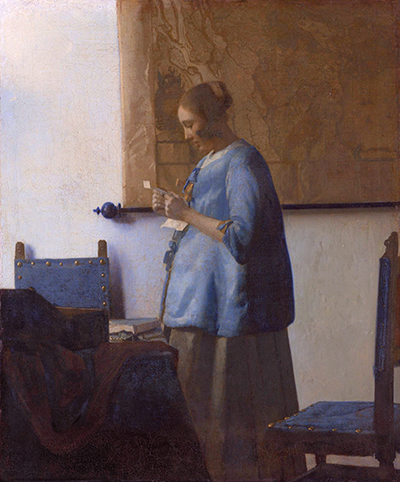
This is different from Woman in Blue Reading a Letter, where the woman remains enclosed in private attention. In A Lady Writing, the figure opens the scene toward us while keeping the letter itself private. Vermeer allows access to the writer, but not to the message.
The Writing Table
The table is more than a support for objects. It creates a boundary between the viewer and the woman. Paper, box, ribbons or cords and jewellery-like details form a small zone of social refinement. The viewer is close, but not inside the woman’s space.
This table barrier is a recurring Vermeer device. It slows access and makes looking feel structured. In A Lady Writing, the barrier also protects the letter. We can see the act of writing, but not the content. The painting’s privacy is preserved by composition.
The objects also reinforce the painting’s balance between communication and display. The woman writes, but she is also dressed and adorned. Pearls, yellow jacket and table objects create a world of status and presentation, while the quill and paper introduce private intention.
Technical Revision and the Quill
The NGA’s infrared evidence for an earlier, more vertical quill position is especially useful because it shows Vermeer refining a small but important gesture. [2] The final quill angle makes the writing action feel quieter and more integrated with the woman’s pose.
This is characteristic of Vermeer’s mature method. A minor adjustment can change the whole psychological temperature of a picture. If the quill were too upright, the gesture might feel more emphatic. In its final position, the hand remains active but restrained.
The technical evidence also reminds us that Vermeer’s apparent naturalness was constructed. The painting feels spontaneous because the interruption is so delicately balanced, but that balance was achieved through revision.
The Yellow Jacket Across Vermeer’s Work
The NGA notes that a similar yellow jacket appears in several Vermeer paintings and was listed in his household inventory. [1] This is one of the strongest object links between his painted interiors and his documented domestic world. It should still be handled carefully: the garment’s presence in the inventory does not identify the sitter, nor does it prove that every painted jacket is the same object.
What it does show is Vermeer’s ability to reuse domestic material as pictorial architecture. The yellow jacket gives warmth, status and light-bearing surface. It also connects A Lady Writing to paintings such as Woman with a Pearl Necklace and The Love Letter, where yellow garments help define the room’s colour structure.
The possible imitation ermine trim is also revealing. [1] Vermeer’s luxury can be both real and theatrical. The jacket may signal elegance without being a simple record of aristocratic wealth. It belongs to the space between domestic object, costume and painted effect.
Place in Vermeer’s Work
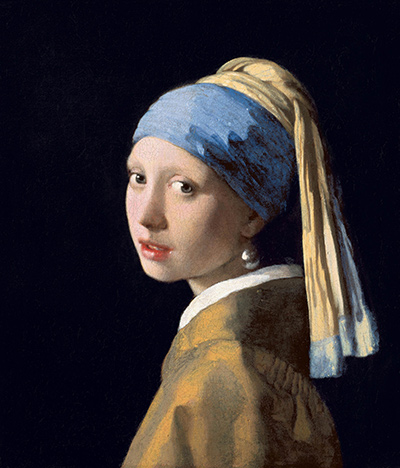
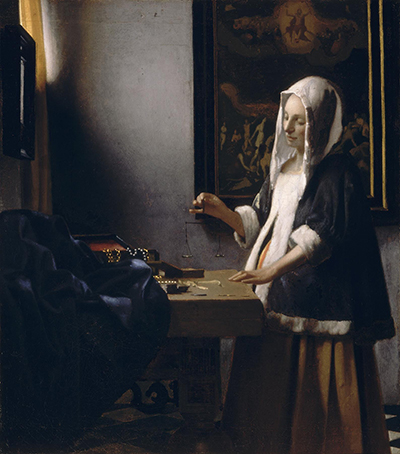
A Lady Writing belongs with Vermeer’s letter paintings, including Woman in Blue Reading a Letter, The Love Letter, Girl Reading a Letter at an Open Window and Lady Writing a Letter with her Maid. It also connects with Girl with the Red Hat through direct gaze and with Woman Holding a Balance through pearls, inwardness and controlled light.
The painting is important because it shows how little Vermeer needs to create psychological tension. A quill, a glance and a sheet of paper are enough.
It also helps widen the letter group. Some Vermeer letter paintings focus on reading, others on delivery or accompaniment by a maid. A Lady Writing focuses on authorship. The woman is not only receiving a message; she is making one.
Frequently Asked Questions
A Lady Writing is in the National Gallery of Art in Washington. [1]
The National Gallery of Art dates the painting to about 1665. [1]
The sitter is not securely identified. The painting should not be treated as a confirmed portrait of Vermeer’s wife or any named individual.
The yellow jacket appears in several Vermeer paintings and helps connect the work to his wider treatment of costume, light and domestic interiors. [1]
Discussion
What feels most revealing about A Lady Writing: Vermeer's handling of light, the silence of the scene, the object details, the attribution history, or the way the painting fits within Dutch Golden Age art?
Reader Insights
Vermeer rewards slow attention. Begin with the main action, then move outward to light, edges, objects and the quiet spaces that hold the composition together.
Many of these paintings are small, but their meanings open through Delft, collecting history, technical study and comparison with related Dutch interiors.
Pair this article with the biography and one neighbouring Vermeer work to see how subject, light and attention shift across the artist's compact oeuvre.
Join the Conversation
Have a thought or observation about A Lady Writing? Share it below. Thoughtful responses may be added to this section as the Vermeer pages develop.
References
- National Gallery of Art, A Lady Writing, 1962.10.1.
- National Gallery of Art, technical material on Vermeer’s revisions and paint handling.