

 by Tom Gurney
Tom Gurney BSc (Hons) is an art history expert with over 20 years experience
Published on June 19, 2020 / Updated on July 26, 2026
Email: tomgurney1@gmail.com / Phone: +44 7429 011000
View of Delft by Johannes Vermeer: Introduction
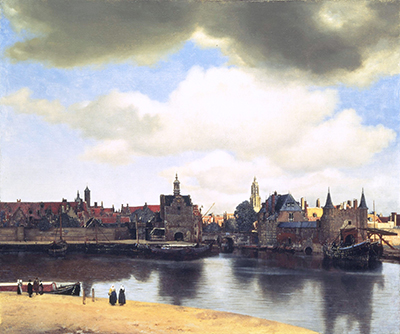
Johannes Vermeer’s View of Delft is one of the great cityscapes of the seventeenth century. Delft appears from across the water, under a wide sky, with gates, towers, roofs, reflections and boats held in a remarkable balance of light and shadow. The painting is calm, but it is not passive. Vermeer turns the city into an image of atmosphere, memory and civic identity.
The Mauritshuis records View of Delft as a painting by Johannes Vermeer, about 1660-1661, oil on canvas, 96.5 by 115.7 cm, inventory number 92. [1] The museum describes it as the most celebrated cityscape in seventeenth-century Dutch art and identifies the view as Delft seen from the southeast, with the Kolk in the foreground. [1]
At a Glance
- ArtistJohannes Vermeer
- TitleView of Delft
- DateAbout 1660-1661
- MediumOil on canvas
- Dimensions96.5 x 115.7 cm
- CollectionMauritshuis, The Hague
- Inventory number92
- Key themesDelft, cityscape, light, water, reflection, topography, reception
Contents
- Introduction
- At a Glance
- Annotated Close Reading
- What the Painting Shows
- Delft and Topography
- The City from Across the Water
- Horizontal Bands and Measured Space
- Morning Light and Weather
- Paint Surface and Sparkling Detail
- Civic Identity Without Display
- Light, Water and Sky
- Gates, Towers and Recognition
- Manipulated Topography
Annotated Details from View of Delft
These annotated details trace the picture's drama of weather, water, city gates, reflections and small figures, showing how Vermeer turns Delft into a study of light and place.
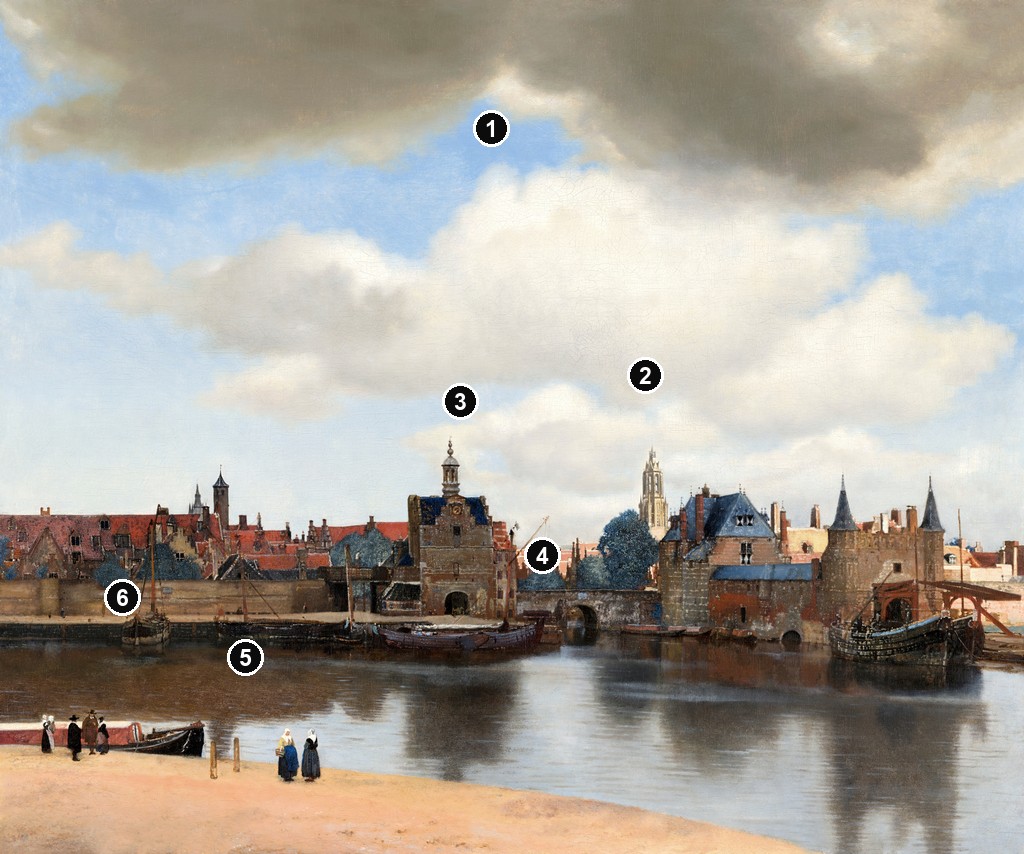
Details from VIEW OF DELFT
Close looking shows that the cityscape's stillness depends on changing light, careful bands of space and lively touches of paint.
The dark cloud bank
The cloud bank controls the whole cityscape. Light and shadow across Delft depend on this temporary weather condition.
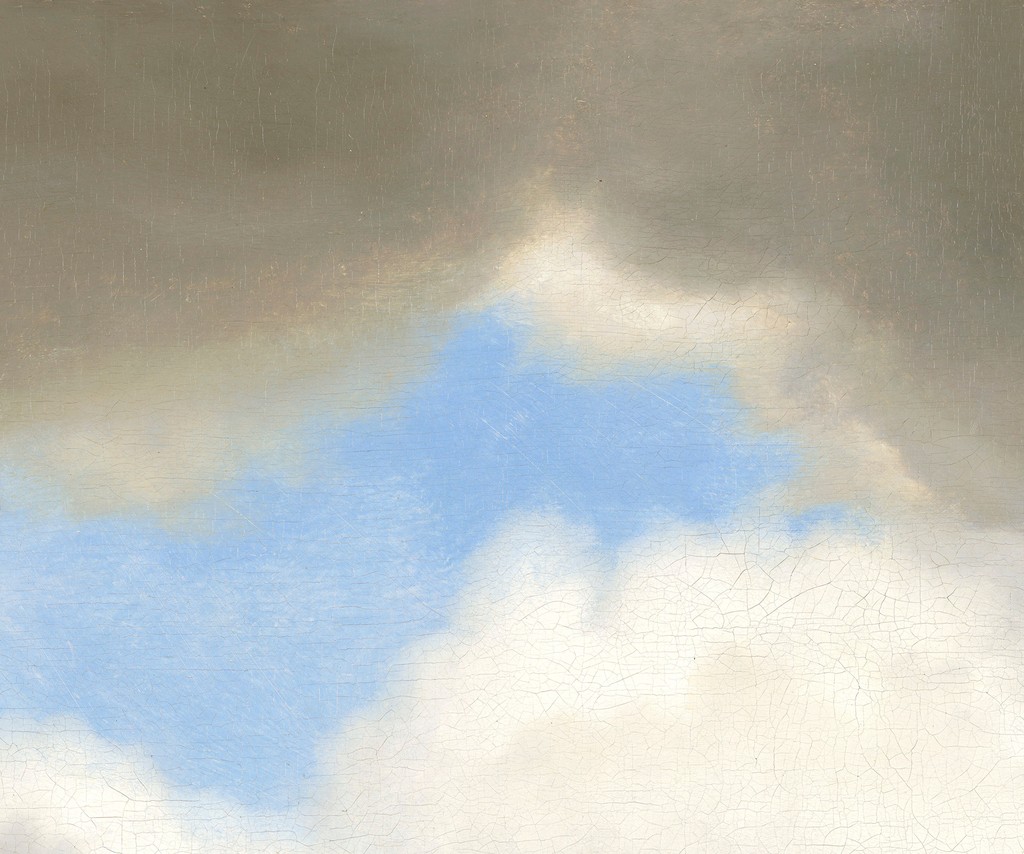
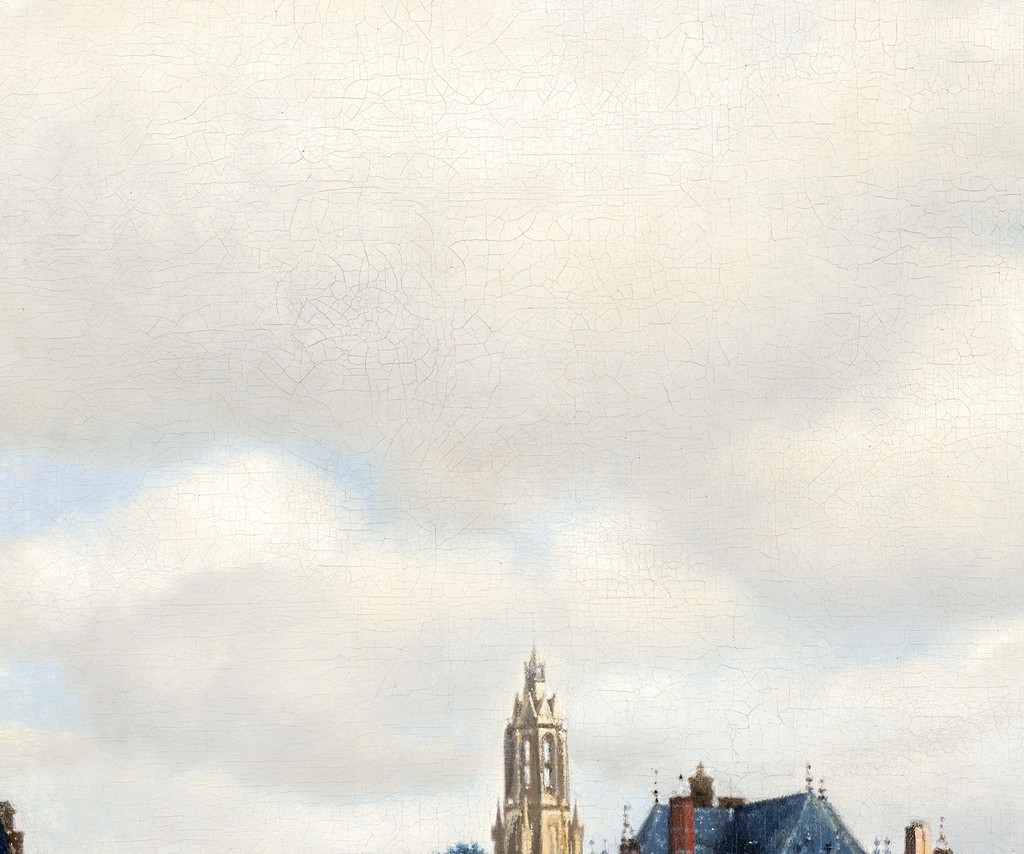
The illuminated tower
The sunlit tower draws the eye into the skyline. It gives the city a focal point without turning the view into a simple architectural inventory.
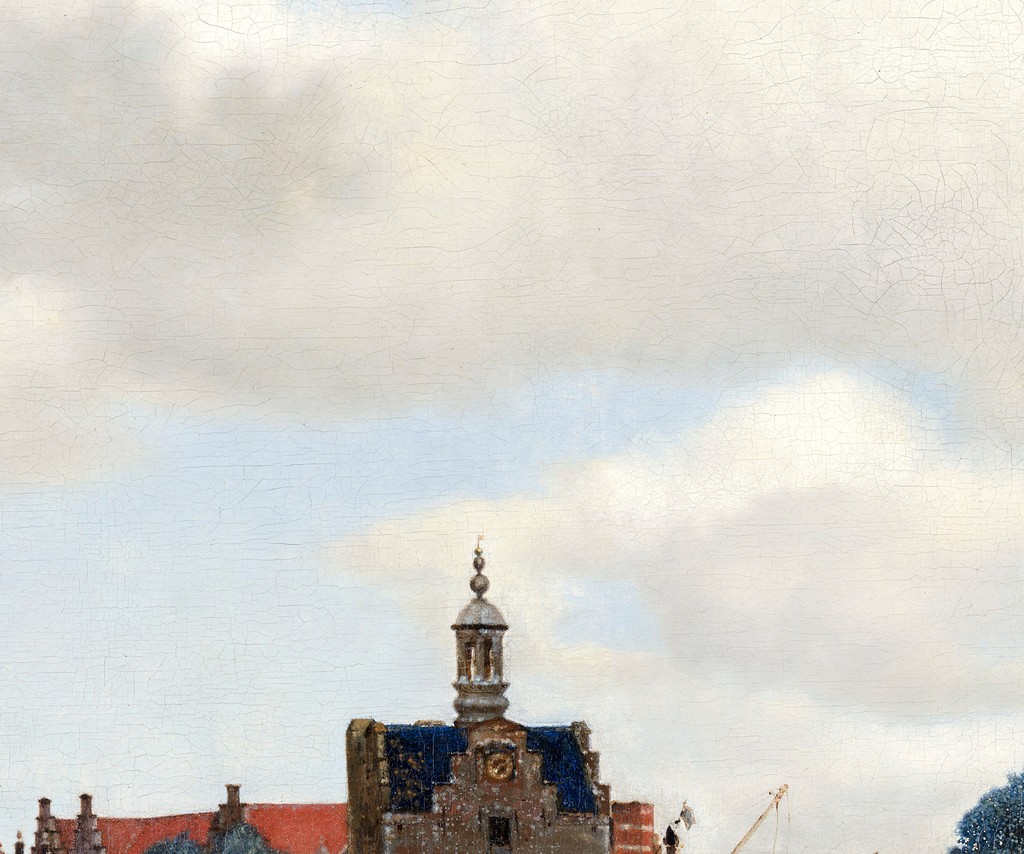
The city gates
The darker gates and walls create mass beneath the sky. Vermeer balances civic detail with broad tonal design.
Reflections in the water
The water doubles the city while softening it. Reflections make the painting feel still, but never inert.
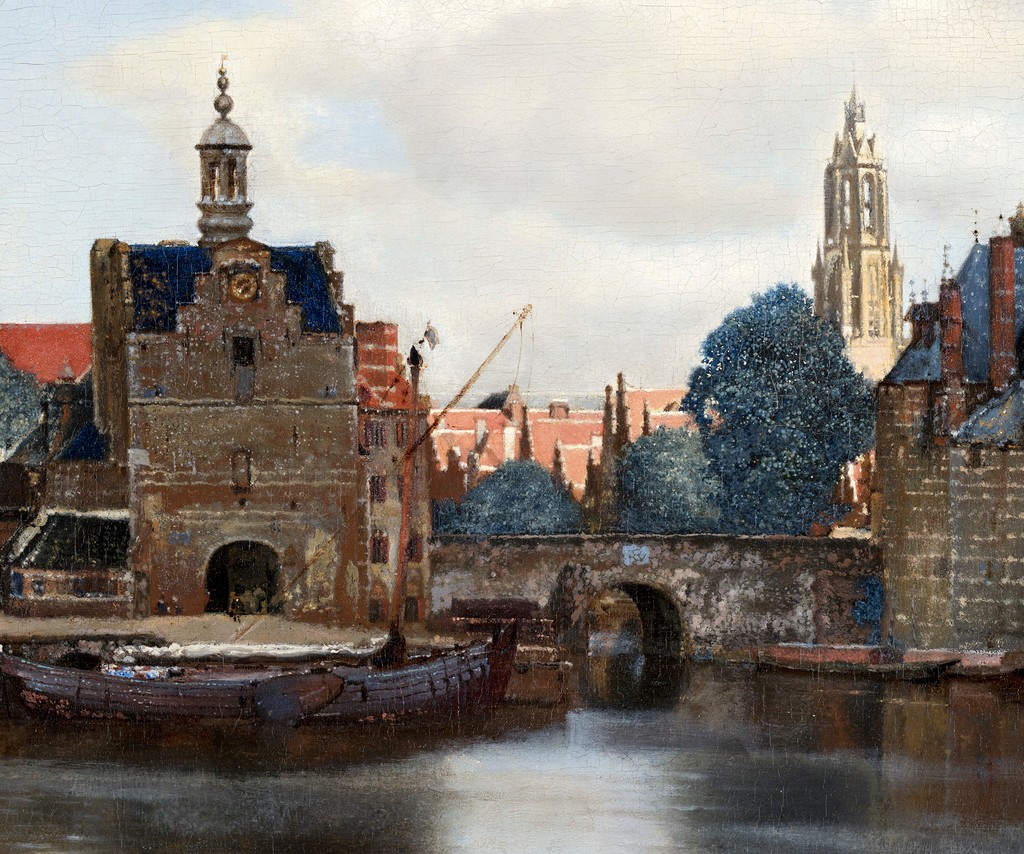
Small figures on the shore
The small figures establish scale and quiet human presence. They keep the scene inhabited without making it narrative.
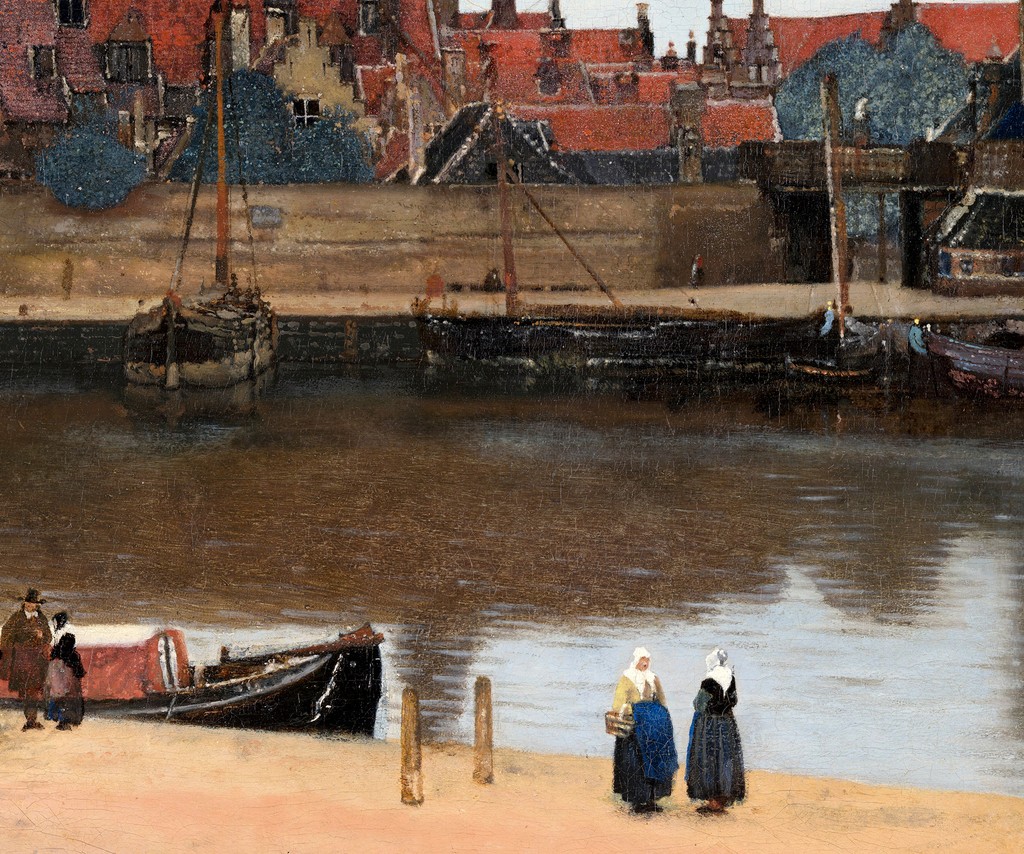
Boats at the near bank
The boats and bank form a calm foreground threshold. They slow the viewer before the eye crosses the water to the city.
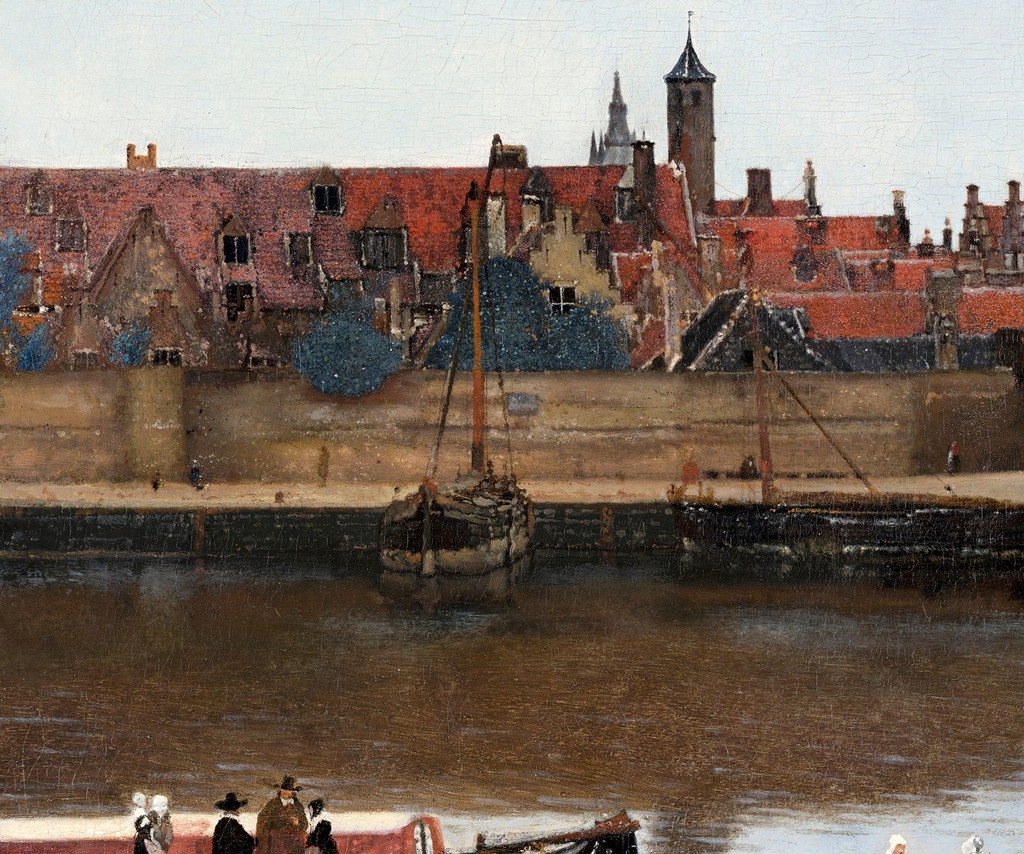
What the Painting Shows
The painting shows Delft from across water. The city is seen from the southeast, with the Schiedam and Rotterdam gates and the tower of the Nieuwe Kerk among the identifiable features. [1] Boats and figures occupy the foreground, but the city itself is the main subject. It stretches horizontally under a large sky, reflected in the still water below.
The composition is built from bands: foreground water and shore, darkened city wall and gates, sunlit architecture, and sky. These bands give the painting its calm order. Yet the scene is full of variation. Clouds cast shadows. Light catches parts of the city. Reflections blur the boundary between built form and water.
Vermeer does not paint Delft as a busy urban panorama. He reduces movement and gives the city a suspended quality. The result is not a simple record of buildings. It is a constructed vision of place.
Delft and Topography
View of Delft is deeply tied to real geography, but Vermeer’s image is not a mechanical topographic survey. The Mauritshuis identifies major features of the city, while also supporting the idea that Vermeer manipulated the view for pictorial effect. [1] This balance matters. The painting is recognisably Delft, but it is Delft reorganised by art.
The city’s profile is controlled by the contrast between shadow and light. The Nieuwe Kerk tower is illuminated, while other areas remain in shade. The gates and walls anchor the lower band of the city, and the water doubles parts of the scene through reflection. Vermeer makes topography serve atmosphere.
This is one of the reasons the painting feels so authoritative. It does not merely show where Delft was. It gives the city a mood: still, luminous, reserved and slightly distant.
The City from Across the Water
The viewpoint is essential. Delft is not shown from inside its streets but from across the water, with the Kolk in the foreground. [1] This distance turns the city into an object of contemplation. The viewer is close enough to recognise gates, towers and walls, but far enough away for the city to become a unified silhouette.
Water changes the experience of place. It separates viewer and city, slows the eye and creates a second, unstable version of Delft through reflection. The city is present, but it is not immediately reachable. That slight distance gives the painting much of its emotional character.
The foreground figures and boats help scale the scene without turning it into a busy harbour picture. Vermeer includes signs of human activity, but he subordinates them to the city, sky and light. Delft is inhabited, yet the painting’s main subject is the atmosphere around the city rather than anecdote.
Horizontal Bands and Measured Space
The painting is built from strong horizontal zones: water, shore, city wall, sunlit architecture and sky. This structure gives the picture its calm. The eye moves across the canvas rather than being pulled into a dramatic diagonal or crowded foreground.
Within that calm structure, Vermeer introduces carefully controlled variety. Dark clouds press down from above. Sunlight strikes the Nieuwe Kerk tower and parts of the city. Reflections move downward into the water. The scene is stable and changing at the same time.
This is one reason View of Delft can feel larger than a topographical record. Vermeer organises the city as a sequence of light-bearing surfaces. The horizontal design gives the view authority, while the weather keeps it alive.
Morning Light and Weather
Mauritshuis catalogue material supports discussion of late spring or summer morning light, along with the contrast between dark cloud and areas of sunlight. [1] That weather effect is not incidental. It is the painting’s engine. Delft appears through a temporary condition of light.
The city is not evenly displayed. Parts are withheld in shade while others are clarified. This selective illumination makes the view feel observed rather than invented, but it also gives Vermeer great compositional control. He can direct attention through light while preserving the impression of natural weather.
The illuminated tower of the Nieuwe Kerk is especially important. It rises as one of the city’s identifying features, but Vermeer also makes it a visual accent. It catches the eye without breaking the calm of the whole. The city’s religious, civic and topographical identity is therefore carried by light as much as by outline.
Paint Surface and Sparkling Detail
The painting’s quiet mood depends on lively handling. Mauritshuis and Rijksmuseum materials support discussion of small sparkling touches on water and boats. [1] [2] These points of paint create a sense of reflected light without making the surface fussy.
This is a key Vermeer effect. From a distance, the scene appears unified and still. Close looking reveals small active marks that keep water, boats and architecture from becoming inert. The city is calm, but the paint is never dead.
The reflective passages are particularly delicate because they must suggest form without hard description. Vermeer lets colours soften and stretch in the water. Reflection becomes a second kind of representation: not the city itself, but the city altered by light, distance and movement.
Civic Identity Without Display
Many city views celebrate commerce, construction, shipping or civic pride through activity and detail. View of Delft is more restrained. It certainly dignifies Delft, but it does not do so through spectacle. There is no triumphal procession, no crowded market, no packed harbour and no emphatic civic emblem dominating the scene.
Instead, Vermeer presents the city as stable, luminous and self-contained. That restraint may be why the painting has such lasting force. It does not shout Delft’s importance. It lets the city gather authority through silence, weather and balance.
This makes the painting personal as well as civic. Delft was Vermeer’s city, and his surviving city views suggest a deep seriousness about place. The painting is not a biography in landscape form, but it does connect the artist’s pictorial intelligence to the urban world in which he lived.
Light, Water and Sky
The sky occupies a large part of the canvas and determines the painting’s emotional temperature. Clouds darken some areas while allowing sunlight to strike others. The city is not evenly lit. It emerges through changing weather.
The water is just as important. It reflects the city, but not with mirror-like precision. Forms soften, colours spread and verticals tremble. This reflective surface helps slow the scene down. The viewer experiences Delft through distance and light before reading its architecture.
Vermeer’s handling of highlights adds life without disturbing the stillness. Mauritshuis materials support discussion of sparkling dots on water and boats, and Rijksmuseum exhibition texts similarly emphasise Vermeer’s use of dotted light effects in city and water passages. [1] [2] These details keep the image from becoming static. The city is quiet, but the paint is alert.
Gates, Towers and Recognition
The identifiable architecture matters because it prevents the painting from becoming a purely imaginary city. The Mauritshuis identifies the Schiedam and Rotterdam gates and the tower of the Nieuwe Kerk among the principal features. [1] These anchors allow the viewer to recognise Delft as a real place, even while Vermeer modifies and organises the view for pictorial effect.
The gates are especially important because they form the city’s edge. They stand between water and urban space, between outside and inside. Vermeer’s viewpoint from across the water makes that threshold visible. The city is approached but not entered.
The Nieuwe Kerk tower gives the skyline a vertical accent within the horizontal design. Its illumination is not only descriptive; it is compositional. Vermeer uses light to give one part of the city a heightened presence while keeping the whole view balanced.
This combination of recognisable detail and pictorial control is central to the painting’s authority. The viewer trusts the image as Delft, but the painting’s power comes from Vermeer’s shaping of Delft rather than from topography alone.
Manipulated Topography
The fact that Vermeer takes liberties with the actual view should not be treated as a weakness. It is one of the reasons View of Delft works so well. A perfectly mechanical record might have been useful as documentation, but Vermeer’s painting aims at a more concentrated kind of truth.
Rijksmuseum exhibition material supports the idea that Vermeer structures the view through horizontal bands and light-dark effects rather than simply copying a city profile. [2] This is consistent with his practice elsewhere. In interiors, he adjusts rooms, objects and light to produce a more forceful image. In View of Delft, he does the same with a city.
The manipulated view also clarifies the difference between topographical accuracy and pictorial authority. A painting can be recognisable without being neutral. Vermeer’s Delft is a real city transformed by distance, weather, water and design.
The Silence of the City
One of the most striking aspects of View of Delft is how little noise it seems to contain. Boats, figures and buildings are present, but the painting does not feel busy. There is no obvious narrative event. The city appears almost to pause beneath the clouds.
This silence is not emptiness. It allows the viewer to sense atmosphere before incident. The eye moves slowly across water, wall, gates, roofs, tower and sky. Vermeer’s reduction of action gives the city a contemplative force.
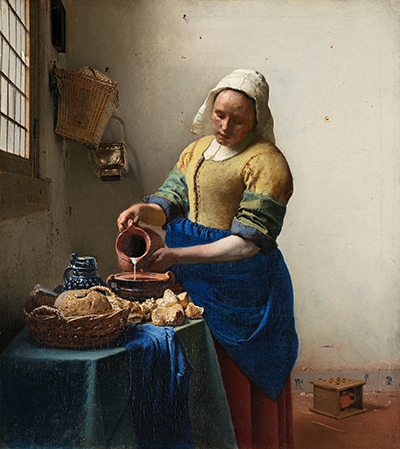
That quiet is also what links View of Delft to Vermeer’s interiors. In a room, he can make a woman reading a letter or pouring milk feel suspended. Here, he makes a whole city feel suspended. The subject is larger, but the emotional method is related.
Provenance and Institutional Life
The Mauritshuis provenance route connects the painting to probable Van Ruijven, De Knuijt and Dissius ownership, the Dissius sale of 1696, later family ownership, the 1822 Stinstra sale and purchase for the Mauritshuis. [1] This route places View of Delft inside the same broader Vermeer collecting history that shapes several other major works.
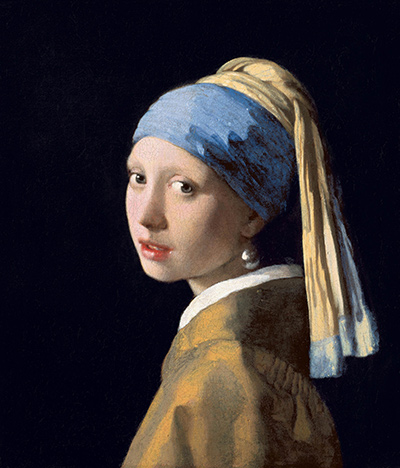
Its museum life is especially important because the painting has become almost inseparable from the Mauritshuis. Alongside Girl with a Pearl Earring, it is one of the institution’s central Vermeer images. That modern visibility has helped make Delft itself part of Vermeer’s public identity.
The painting’s institutional fame should not obscure its original local subject. It was not a generic city view that later became associated with Delft. It is Delft, seen through Vermeer’s deliberate arrangement of light, weather and distance.
Delft as Memory
The painting’s force partly comes from the way it makes Delft feel remembered as well as observed. The view is specific enough to be topographical, but the still water, broad sky and restrained activity give it a reflective quality. The city seems to exist in a moment held apart from ordinary movement.
This is not nostalgia in a simple sense. Vermeer was painting a living city, not a vanished one. Yet the distance across the water and the careful balance of light make the scene feel like an image of memory before memory has become loss. The city is present, but already transformed by looking.
That quality helps explain why the painting has had such strong later reception. Viewers have repeatedly found in it more than urban description. It seems to offer a complete experience of place: recognisable, atmospheric, quiet and emotionally reserved.
Scale and Public Weight
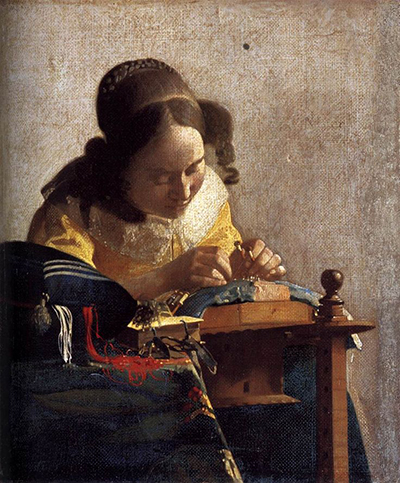
At 96.5 by 115.7 cm, View of Delft is large by Vermeer’s standards. [1] That size matters. It gives the city a public weight that differs from the compact intensity of The Lacemaker or Girl with a Pearl Earring. The viewer stands before a broad field of sky, water and architecture.
The scale also allows Vermeer to balance detail and breadth. Individual features can be recognised, but the painting never becomes a list of buildings. Its size supports a slow, panoramic act of looking while preserving the stillness associated with Vermeer’s smaller works.
This is why View of Delft can stand among Vermeer’s major works. It expands Vermeer without contradicting him. The subject is civic, but the method is still controlled, silent and exact.
Why It Is Not Just a City View
Calling the work a cityscape is accurate, but incomplete. Many city views describe buildings, trade, civic pride or urban expansion. Vermeer’s painting does something more inward. It turns the city into a study of light and perception.
The difference lies in the absence of narrative pressure. The boats and figures do not become the subject. The gates and tower do not become a civic emblem in isolation. The sky does not become a weather study detached from the city. Everything works together to create one suspended vision.
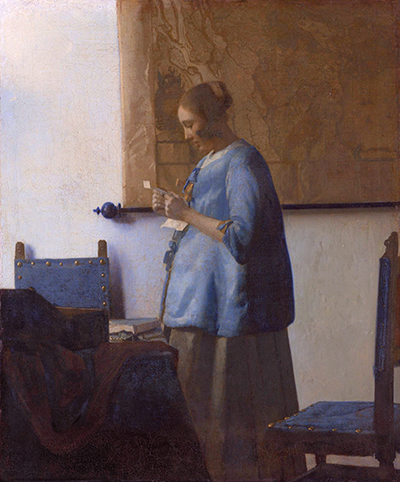
For that reason, View of Delft belongs with Vermeer’s interiors as much as with Dutch cityscape tradition. It asks the same kind of attention that The Milkmaid asks of a stream of milk or Woman in Blue Reading a Letter asks of a hidden message. The scale changes, but the demand for slow looking remains.
How to Look at View of Delft
A useful way to look at the painting is to begin with the sky rather than the buildings. The clouds determine where light falls and where the city remains in shadow. From there, the eye can move down to the illuminated tower, the darker gates, the water and the reflections.
The reflections should be read slowly. They are not simple mirror images. They soften the architecture and turn the city into colour and movement. The water makes Delft appear both solid and unstable.
Close looking also reveals how much life Vermeer creates through small accents. The dotted highlights on boats and water are modest, but they prevent the broad horizontal design from becoming inert. From a distance, the painting is calm; up close, the surface is active.
Finally, the viewer should return to the distance between foreground and city. That distance is emotional as well as spatial. Delft is visible, recognisable and withheld. Vermeer’s city is close enough to belong to memory, but far enough away to become an image.
A Rare Cityscape in Vermeer’s Oeuvre
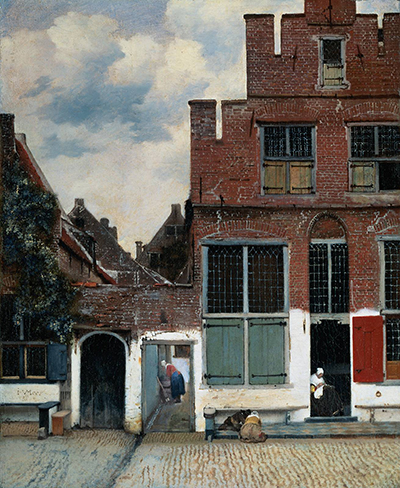
Vermeer is best known for interiors, but View of Delft and The Little Street show that his relation to place was just as serious. The two paintings approach Delft at different scales. The Little Street focuses on domestic architecture, brick, threshold and everyday life. View of Delft pulls back to the city as a whole.
Together they show that Vermeer did not need figures or domestic narrative to create intensity. He could make a facade or a skyline carry the same stillness that appears in his rooms.
View of Delft also differs from many Dutch city views by its quiet concentration. It is not crowded with ships, market activity or civic display. Its grandeur is atmospheric rather than ceremonial.
Reception and Modern Fame
The painting became central to Vermeer’s modern reputation. Théophile Thoré-Bürger admired Vermeer in the nineteenth century and helped bring his work back into wider attention. View of Delft also gained literary fame through Marcel Proust, who associated it with intense, almost revelatory looking.
That reception history is important, but it should not replace the painting itself. The reason writers and critics returned to View of Delft is that Vermeer made the city feel both specific and unreachable. It is a real place, but it appears across water, light and time.
Proust’s reception matters because it records a modern viewer experiencing the painting as more than a city view. It became an image of concentrated perception. That should be handled without letting literature overtake art history. The painting was already powerful before its literary afterlife; the later response helps show how strongly Vermeer’s quiet image could work on modern imagination.
Place in Vermeer’s Work
View of Delft is essential because it expands the idea of Vermeer beyond rooms and women at windows. It shows the same discipline of light, composition and silence applied to a city. The painting connects naturally to Vermeer’s biography, to Delft’s civic history and to the broader Dutch Golden Age tradition of city views.
It also belongs beside The Little Street. One painting gives Delft as public skyline; the other gives Delft as domestic surface. Both show that Vermeer’s art begins with place, but does not end as documentation.
The work also belongs beside Vermeer’s map interiors. In those paintings, maps bring the wider world into a room. In View of Delft, Vermeer reverses the relation: the city itself becomes the field of representation. The painting is both a view and an argument about how place can be transformed by light.
It is also essential for balancing Vermeer’s oeuvre. Without View of Delft, Vermeer can seem too narrowly defined by private interiors. This painting proves that his art of stillness could operate at civic scale.
Frequently Asked Questions
View of Delft is in the Mauritshuis in The Hague. [1]
The Mauritshuis dates the painting to about 1660-1661. [1]
The Mauritshuis identifies the view as Delft from the southeast, with the Kolk in the foreground and the Schiedam and Rotterdam gates among the visible features. [1]
It is important because Vermeer turns a recognisable city view into an exceptionally balanced study of light, water, atmosphere and place.
Discussion
What feels most revealing about View of Delft: Vermeer's handling of light, the silence of the scene, the object details, the attribution history, or the way the painting fits within Dutch Golden Age art?
Reader Insights
Vermeer rewards slow attention. Begin with the main action, then move outward to light, edges, objects and the quiet spaces that hold the composition together.
Many of these paintings are small, but their meanings open through Delft, collecting history, technical study and comparison with related Dutch interiors.
Pair this article with the biography and one neighbouring Vermeer work to see how subject, light and attention shift across the artist's compact oeuvre.
Join the Conversation
Have a thought or observation about View of Delft? Share it below. Thoughtful responses may be added to this section as the Vermeer pages develop.
References
- Mauritshuis, View of Delft, inventory 92.
- Rijksmuseum, Vermeer exhibition materials on Delft views and light effects.