

 by Tom Gurney
Tom Gurney BSc (Hons) is an art history expert with over 20 years experience
Published on June 19, 2020 / Updated on July 26, 2026
Email: tomgurney1@gmail.com / Phone: +44 7429 011000
The Lacemaker by Johannes Vermeer: Introduction
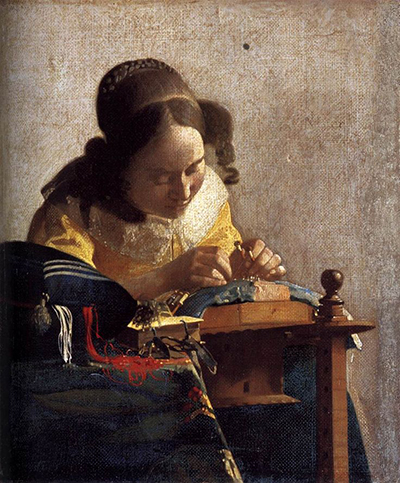
Johannes Vermeer’s The Lacemaker is one of his smallest paintings and one of his most intense. A young woman bends over her work, absorbed in the delicate making of lace. Threads, cushion, hands, book and clothing are compressed into a small field of colour and concentration. Nothing dramatic happens, yet the act of looking becomes almost physical.
The Louvre records the painting as La Dentellière, dated 1669/1670, by Johannes Vermeer. It is oil on canvas mounted on wood, 24 by 21 cm, inventory number MI 1448. [1] Its small scale is central to its effect. Vermeer does not enlarge the world of lacemaking; he draws the viewer into it.
At a Glance
- ArtistJohannes Vermeer
- TitleThe Lacemaker / La Dentellière
- Date1669/1670
- MediumOil on canvas mounted on wood
- Dimensions24 x 21 cm
- CollectionMusée du Louvre, Paris
- Inventory numberMI 1448
- Key themesLacemaking, concentration, domestic virtue, close looking, thread, focus
Contents
- Introduction
- At a Glance
- What the Painting Shows
- A Painting About Focus
- Domestic Virtue Without Simplicity
- The Smallest World
- Thread, Blur and Near Vision
- Book, Cushion and Hands
- Signature, Support and Object Status
- Colour and Composition
- Place in Vermeer’s Work
- Frequently Asked Questions
What the Painting Shows
The lacemaker sits close to the picture plane, leaning over her work. Her head is lowered, her hands are active, and her attention is completely absorbed. The foreground contains threads and a sewing cushion, painted with a remarkable mixture of clarity and blur. A book or pattern lies nearby. The composition is tight, leaving little space around the figure.
The Louvre describes the lacemaking motif in relation to domestic virtue and moral or religious associations, while also warning against unsupported claims that the sitter was Vermeer’s wife or a professional lacemaker. [1] That caution is useful. The painting is not valuable because it identifies a specific woman or documents a trade in a straightforward way. It is valuable because Vermeer makes concentration visible.
The viewer looks down toward a world of hand, thread and attention. The woman’s face is present, but her work matters more than her identity. Vermeer shows the act of making as an inward state.
A Painting About Focus
The Lacemaker is often discussed as a painting about focus, and rightly so. Some details are sharp, while others dissolve into coloured softness. The foreground threads, especially the red and white passages, do not read like a tidy inventory of objects. They feel close to the eye, almost too close to be fully resolved.
This alternation between clarity and blur is one of Vermeer’s most subtle achievements. It creates the sensation of vision adjusting itself. The viewer’s eye tries to settle on the threads, the fingers, the face and the surface of the table, but the painting keeps shifting between precision and softness.
That effect suits the subject. Lacemaking requires intense attention to small movements. Vermeer makes the viewer share that concentrated scale. The painting does not simply depict a woman making lace; it makes looking feel like lacemaking.
Domestic Virtue Without Simplicity
In seventeenth-century Dutch culture, lacemaking could be associated with female diligence, domestic order and virtue. The Louvre’s description supports that route, while also keeping the interpretation careful. [1] Vermeer uses those associations, but the painting should not be flattened into a moral lesson.
The young woman is not presented as an emblem first and a person second. Her absorption is too particular. The slight bend of the head, the relation between hands and work, and the warm yellow of her clothing give the image human presence. The moral associations remain in the background; the visual experience is immediate.
The painting’s intimacy also matters. At 24 by 21 cm, it asks for close viewing. Its scale matches its subject. A large painting about lacemaking might become theatrical or descriptive. Vermeer’s small format makes the viewer approach the work almost as carefully as the lacemaker approaches her thread.
The Smallest World
The scale of The Lacemaker is not a secondary fact. At only 24 by 21 cm, it is among the most compact works in Vermeer’s accepted oeuvre. [1] That smallness changes the relationship between viewer and subject. The painting cannot be taken in as a broad room or narrative stage. It pulls the viewer close to the work surface, almost into the lacemaker’s own zone of concentration.
This intimacy suits the subject. Lacemaking is a practice of repeated small movements, fine material and sustained attention. Vermeer does not describe the craft as a manual diagram. He gives its mental and visual pressure. The young woman’s lowered head, compressed hands and narrowed field of action make the picture feel like a study of focus itself.
The small format also prevents the painting from becoming sentimental. The lacemaker is not placed in a decorative household scene with many accessories. There is no elaborate room to admire. Vermeer keeps the viewer near the labour, the thread and the tension between clarity and blur.
Thread, Blur and Near Vision
The loose threads in the foreground are among the boldest passages in the painting. They are not carefully separated strand by strand. Instead, Vermeer lets red and pale forms spill forward with unusual softness. The effect can feel almost optical: the nearest elements are too close to resolve fully, while the main act of work remains tightly concentrated.
This handling should not be treated as unfinished or careless. It is part of the painting’s intelligence. The blurred threads make the viewer aware of the limits of vision. Looking closely does not always produce more certainty. Sometimes closeness makes things dissolve.
That effect parallels the labour being shown. Lacemaking depends on minute distinctions, but the painting does not turn those distinctions into a technical manual. Vermeer is interested in the experience of concentration: the narrowed attention, the softened periphery and the bodily stillness required by precise handwork.
Book, Cushion and Hands
The book or pattern near the lacemaker is important because it connects handwork with order. Lace is not made by random improvisation. It requires pattern, repetition and control. Vermeer places this discipline near the woman’s hands, allowing the act of making to appear both practical and contemplative.
The cushion and threads create the painting’s working centre. They are the objects through which attention becomes visible. The hands do not perform a grand gesture; they are small, close and purposeful. Vermeer’s refusal of drama is exactly what gives the scene force.
The face is secondary but not irrelevant. The woman’s lowered gaze tells us that her attention is wholly inside the work. She does not look out, pause, flirt or invite interpretation. The painting’s inwardness depends on that refusal of outward address.
Signature, Support and Object Status
The Louvre records the work as oil on canvas mounted on wood and notes a signature at the upper right, I Meer, with the first two letters interlaced. [1] These details matter because the painting’s small, concentrated presence can make it feel almost like a private object. It is not simply a window onto a domestic scene. It is a carefully made panel-like object whose material history and support form part of its museum identity.
The Louvre provenance route also connects the painting to the broader history of Vermeer collecting: Van Ruijven, De Knuijt, Magdalena van Ruijven, Jacob Dissius, the 1696 Amsterdam sale, later Dutch and Parisian owners, and Louvre acquisition in 1870. [1] That history places this small image within the larger survival pattern of Vermeer’s work.
Its presence in Paris also matters for reception. The Lacemaker became one of the works through which writers and museum visitors encountered Vermeer’s art. The painting’s scale made it easy to describe as intimate, but its intensity resists being treated as merely charming.
Colour and Composition
The composition is simple but highly compressed. The woman’s yellow garment, white collar and reddish threads create the central colour structure. The background is pale and unobtrusive, allowing the figure and work materials to dominate. The light comes from the right, unusually for Vermeer, whose interiors often rely on left-side illumination.
The downward angle of the woman’s head and hands creates a closed circuit of attention. Nothing pulls her out of the work. The viewer is drawn into the same circuit, moving from face to fingers to thread and back again.
Vermeer’s handling of the foreground threads is especially bold. They are not meticulously separated. Their looseness helps create depth and immediacy, as if the nearest elements fall outside perfect focus. That painterly freedom is one reason the work feels so modern despite its small size and domestic subject.
Place in Vermeer’s Work
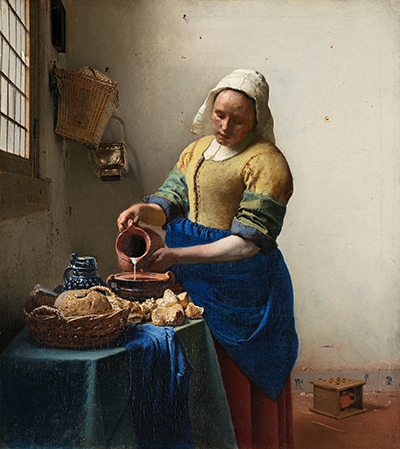
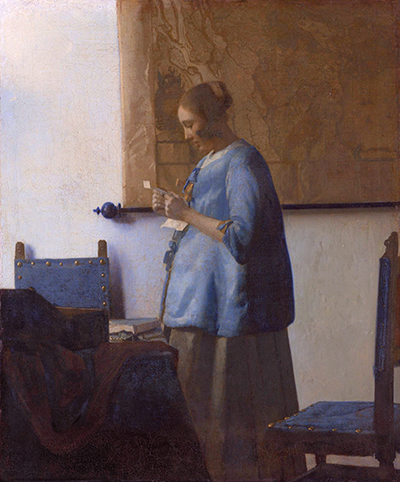
The Lacemaker belongs with Vermeer’s late images of concentrated activity. It relates to The Milkmaid through domestic labour and to A Lady Writing through private absorption. It also connects to Woman in Blue Reading a Letter, where inward attention becomes the main subject.
Yet The Lacemaker is more compressed than any of those paintings. It removes the spacious room and leaves the act of making. The result is one of Vermeer’s purest studies of attention.
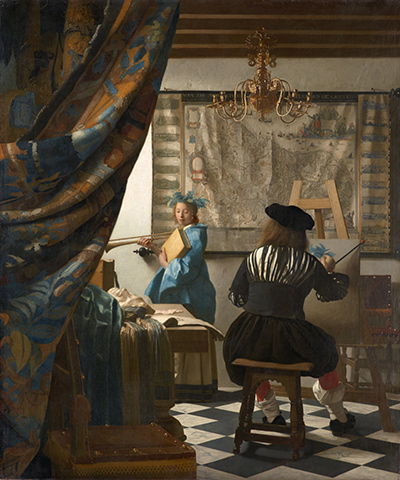
It also provides an important counterweight to the larger allegorical and scientific works. Beside The Art of Painting, The Geographer or The Astronomer, this painting shows Vermeer’s ability to make a tiny domestic task carry serious pictorial weight. Knowledge, art and labour all become forms of disciplined attention.
Frequently Asked Questions
The Lacemaker is in the Musée du Louvre in Paris. [1]
The Louvre records the title as La Dentellière. [1]
The Louvre dates the painting to 1669/1670. [1]
The Louvre notes that there is no proof the sitter is Vermeer’s wife or a professional lacemaker. [1]
Discussion
What feels most revealing about The Lacemaker: Vermeer's handling of light, the silence of the scene, the object details, the attribution history, or the way the painting fits within Dutch Golden Age art?
Reader Insights
Vermeer rewards slow attention. Begin with the main action, then move outward to light, edges, objects and the quiet spaces that hold the composition together.
Many of these paintings are small, but their meanings open through Delft, collecting history, technical study and comparison with related Dutch interiors.
Pair this article with the biography and one neighbouring Vermeer work to see how subject, light and attention shift across the artist's compact oeuvre.
Join the Conversation
Have a thought or observation about The Lacemaker? Share it below. Thoughtful responses may be added to this section as the Vermeer pages develop.
References
- Louvre Collections, La Dentellière, MI 1448.