

 by Tom Gurney
Tom Gurney BSc (Hons) is an art history expert with over 20 years experience
Published on June 19, 2020 / Updated on July 26, 2026
Email: tomgurney1@gmail.com / Phone: +44 7429 011000
Girl with a Flute and the Vermeer Attribution Problem: Introduction
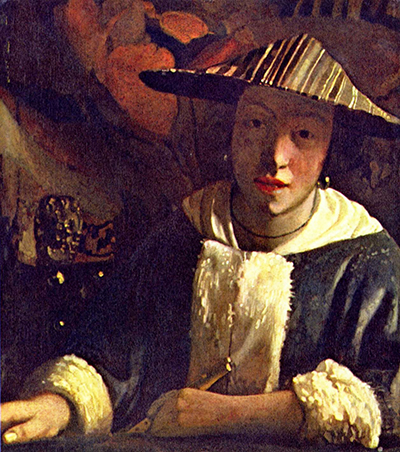
Girl with a Flute is one of the most useful cautionary works in the Vermeer story. It looks close enough to Vermeer to demand attention, but current institutional attribution does not place it securely in his own hand. The painting therefore belongs less to the list of accepted Vermeers than to the history of how those lists are made.
The National Gallery of Art in Washington records the painting as Studio of Johannes Vermeer, dated about 1669/1675, oil on panel, with Vermeer named as a related artist rather than as the current artist. [1] That wording is central. It means the work remains connected to Vermeer’s artistic world, but should not be introduced as a straightforward autograph painting by him.
At a Glance
- Current attributionStudio of Johannes Vermeer
- Related artistJohannes Vermeer
- TitleGirl with a Flute
- DateAbout 1669/1675
- MediumOil on panel
- CollectionNational Gallery of Art, Washington
- Accession number1942.9.98
- Key themesStudio practice, attribution, tronie, technical evidence, Vermeer’s late style
Contents
- Introduction
- At a Glance
- Why This Painting Matters
- What the Painting Shows
- Studio of Vermeer, Not Vermeer
- The Comparison with Girl with the Red Hat
- Handling and Quality
- Materials and Technical Evidence
- Vermeer’s Studio Question
- Tronie, Costume and Performance
- Why Attribution Language Should Stay Visible
- Place in the Vermeer Story
Why This Painting Matters
The painting matters because it sits close to the boundary of Vermeer’s accepted oeuvre. It is not a random follower’s work with only a loose resemblance. It is a small panel painting of a young woman in fanciful costume, turned toward the viewer, with a strongly Vermeer-like concern for light, presence and surface effect. Its closest point of comparison is Girl with the Red Hat, also in the National Gallery of Art.
That closeness makes the current attribution more instructive, not less. Girl with a Flute shows how art historians, conservators and museums distinguish between relationship and authorship. A painting may belong to Vermeer’s orbit, echo his types, use similar materials and depend on his inventions, while still falling short of the evidence needed for a full attribution.
For a compact artist like Vermeer, this is especially important. His surviving output is small, and adding or removing one work changes the shape of the whole catalogue. Attribution caution is therefore not pedantry. It is part of responsible writing about the artist.
What the Painting Shows
The painting presents a young woman seen close to the picture plane. She wears an unusual hat and holds a flute. Her face turns toward the viewer, and the format recalls Vermeer’s late tronies: studies of character, costume and pictorial effect rather than portraits of securely identified sitters.
The flute gives the painting a different emphasis from Girl with the Red Hat. It introduces music, courtship and performance into an image type otherwise built around costume and gaze. Like several of Vermeer’s accepted works, it suggests sound without telling a complete story. The sitter’s identity, the imagined listener and the exact social situation remain unresolved.
The shallow composition also matters. Vermeer’s larger interiors often lead the eye through rooms, tables, maps, windows and walls. Here the space is compressed. The viewer is asked to study face, costume, instrument and painted handling at close range. That closeness intensifies the attribution problem because it exposes the quality of execution.
Studio of Vermeer, Not Vermeer
The phrase Studio of Johannes Vermeer should be read carefully. It does not mean the painting has no connection to Vermeer. It means the National Gallery of Art’s current position is that the work is more likely to have been produced by someone associated with Vermeer’s practice than by Vermeer himself. [1]
That distinction protects both sides of the evidence. The painting can remain historically useful because it tells us something about Vermeer’s immediate artistic environment, the circulation of his motifs and the possibility of studio participation or emulation. At the same time, it should not be allowed to inflate the accepted Vermeer catalogue.
This is the right tone for the painting. The work should not be dismissed as worthless, and it should not be promoted as a lost masterpiece. Its value is precisely that it shows how uncertain evidence is handled.
The Comparison with Girl with the Red Hat
The comparison with Girl with the Red Hat is unavoidable. Both are small panel paintings in the National Gallery of Art. Both show a young woman close to the viewer, dressed in unusual costume, with light catching face and accessories. Both belong to the tronie tradition and to the late phase of Vermeer-related painting.
But the museum does not present them in the same way. Girl with the Red Hat is catalogued as a work by Johannes Vermeer. Girl with a Flute is catalogued as Studio of Johannes Vermeer. [1] [2]
This difference gives the pair unusual teaching value. Visual resemblance is the beginning of the question, not the answer. The viewer may notice shared scale, shared format and shared mood, but attribution depends on execution, technical evidence, materials, revision and comparison with secure works. The more similar two paintings appear, the more carefully those differences have to be examined.
Handling and Quality
NGA scholarship describes Girl with a Flute as closely related to Girl with the Red Hat, but as falling short of Vermeer’s standards. [3] That is a serious judgment because it moves beyond subject matter. The issue is not whether the painting uses a Vermeer-like formula. It does. The issue is whether the handling reaches the level expected from Vermeer himself.
This kind of judgment can be difficult for general readers because it often depends on small differences: the control of edges, the authority of highlights, the coherence of light, the modelling of the face, the relation between costume and body, and the way painted marks hold together at close range. In an accepted Vermeer, even passages that look soft or blurred usually contribute to a controlled pictorial effect. In a studio or follower work, similar effects may appear understood but not fully mastered.
That is why dramatic language is unhelpful. The point is not to stage a simple contest between “real” and “fake.” The better question is whether the painting demonstrates Vermeer’s own decision-making or a dependent knowledge of his style.
Materials and Technical Evidence
The painting’s materials and technique are part of the attribution story. NGA scholarship has noted that the work uses seventeenth-century materials and shows awareness of Vermeer’s unusual pigments and distinctive highlights, but that the execution does not display the same level of skill and control. [3]
This matters because a historical date alone cannot prove authorship. A painting can be old, Dutch, technically connected to the right period and still not be by Vermeer. Technical evidence has to be read alongside handling and artistic judgment.
The support also matters. Like Girl with the Red Hat, Girl with a Flute is painted on panel. That shared format strengthens the reason for comparison, but it does not settle the attribution. It places the work in the right neighbourhood; it does not identify the painter.
Vermeer’s Studio Question
Vermeer has often been imagined as an isolated artist working alone in Delft, but attribution debates complicate that picture. If a painting is described as studio rather than autograph, it raises questions about who could have worked around Vermeer, how his methods were transmitted, and whether his small artistic world was less solitary than the surviving documents suggest.
The National Gallery of Art’s current classification of Girl with a Flute makes the painting important for that reason. It does not create a fully documented Vermeer workshop in the way one might discuss a large Rubens studio. The evidence is more cautious than that. But it does open a serious question about studio association, imitation and artistic proximity.
For readers, this is a useful correction to the myth of Vermeer as a completely sealed genius. His paintings are rare, but their forms could be studied, repeated and approximated. Girl with a Flute helps show that the Vermeer image-world did not exist only inside the accepted masterpieces.
Tronie, Costume and Performance
The painting also belongs to the tronie tradition. A tronie is not primarily a named portrait. It is a study of expression, type, costume or pictorial character. In Girl with a Flute, the unusual hat, the instrument and the close format all support that reading.
This matters because the painting does not need a named sitter to have meaning. Its subject is performance: the performance of music, the performance of costume, and the performance of looking. The flute suggests sound, but the image remains silent. The young woman’s presence is direct, but her situation is unexplained.
These qualities connect the work to Vermeer’s accepted tronies and single-figure studies. They also explain why the painting could be persuasive for so long. It participates in a genuine Vermeer mode, even if current scholarship does not assign it to Vermeer’s own hand.
Why Attribution Language Should Stay Visible
Attribution warnings can feel awkward, but here they are necessary. Without a visible warning, readers may assume that every Vermeer-related painting discussed here is an accepted work by Vermeer. That would be misleading.
The better approach is to make the uncertainty part of the discussion. Girl with a Flute is valuable because it helps explain the limits of attribution, not because it can be forced into the accepted catalogue. It gives readers a clear case study in studio relationship, technical evidence and the difference between resemblance and authorship.
That also protects the stronger pages. Girl with the Red Hat can be presented confidently according to NGA’s current attribution, while Girl with a Flute can be discussed with the caution it requires. The two pages should support one another without collapsing their different statuses.
Place in the Vermeer Story
This work functions best as an attribution-history subject. It belongs near Girl with the Red Hat, Vermeer’s biography, the paintings catalogue and the wider story of Vermeer’s legacy and rediscovery. It should not sit among the artist’s accepted masterpieces without qualification.
It also supports the planned Forensic Comparison feature on Girl with the Red Hat. That comparison can use the two NGA works to show readers how similar paintings can lead to different attribution outcomes. The comparison is visual; this article is explanatory.
The distinction matters. A comparison feature helps the reader look. This article helps the reader understand why the museum’s wording matters.
Frequently Asked Questions
The National Gallery of Art currently presents Girl with a Flute as Studio of Johannes Vermeer, not as an accepted painting by Vermeer. [1]
It is closely related to Vermeer’s late tronie type and especially to Girl with the Red Hat. The NGA also lists Vermeer as a related artist, while giving the current attribution to his studio. [1] [2]
No. “Studio of Johannes Vermeer” is not the same as “fake.” The current attribution indicates a historical work connected to Vermeer’s artistic environment, but not securely by Vermeer himself.
Both works are small panel paintings in the National Gallery of Art and are closely related in format and type. The comparison helps explain why visual similarity alone is not enough for attribution.
It should not be included without qualification. If listed, it should be clearly marked as Studio of Johannes Vermeer or as an attribution-history/studio work, following the museum’s current wording.
Discussion
What feels most revealing about Girl with a Flute and the Vermeer Attribution Problem: Vermeer's handling of light, the silence of the scene, the object details, the attribution history, or the way the painting fits within Dutch Golden Age art?
Reader Insights
Vermeer rewards slow attention. Begin with the main action, then move outward to light, edges, objects and the quiet spaces that hold the composition together.
Many of these paintings are small, but their meanings open through Delft, collecting history, technical study and comparison with related Dutch interiors.
Pair this article with the biography and one neighbouring Vermeer work to see how subject, light and attention shift across the artist's compact oeuvre.
Join the Conversation
Have a thought or observation about Girl with a Flute and the Vermeer Attribution Problem? Share it below. Thoughtful responses may be added to this section as the Vermeer pages develop.
References
- National Gallery of Art, Girl with a Flute, object 1237.
- National Gallery of Art, Girl with the Red Hat, object 60.
- National Gallery of Art, Dutch Paintings of the Seventeenth Century: Girl with a Flute, c. 1669/1675.
- National Gallery of Art, Reconsidering Vermeer’s Perfectionism.