

 by Tom Gurney
Tom Gurney BSc (Hons) is an art history expert with over 20 years experience
Published on June 19, 2020 / Updated on July 26, 2026
Email: tomgurney1@gmail.com / Phone: +44 7429 011000
Officer and Laughing Girl by Johannes Vermeer: Introduction
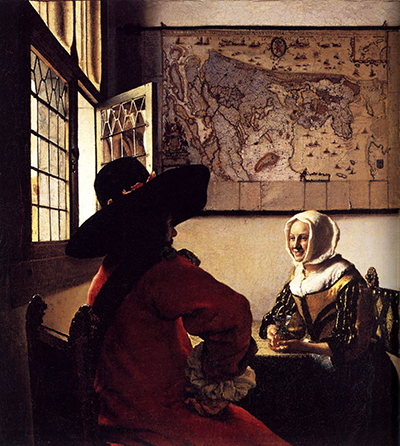
Johannes Vermeer’s Officer and Laughing Girl is one of his most striking early interiors. A soldier sits with his back to the viewer, his broad hat and red coat dominating the foreground. Across the table, a young woman smiles in bright light. Behind her, a map hangs on the wall. The scene looks simple, but Vermeer turns it into a study of scale, courtship, perspective and guarded social exchange.
The Frick Collection records the painting as Officer and Laughing Girl, by Johannes Vermeer, about 1657, oil on canvas, 19 7/8 by 18 1/8 inches, with accession number 1911.1.127. [1] It belongs to the moment when Vermeer was developing the interior language that would define much of his mature work.
At a Glance
- ArtistJohannes Vermeer
- TitleOfficer and Laughing Girl
- DateAbout 1657
- MediumOil on canvas
- CollectionFrick Collection, New York
- Accession number1911.1.127
- Key themesCourtship, perspective, maps, light, scale, camera-obscura caution
Contents
- Introduction
- At a Glance
- What the Painting Shows
- The Officer as Repoussoir
- The Laughing Girl
- Courtship Without a Clear Story
- The Map on the Wall
- Perspective and the Open Window
- Camera-Obscura Caution
- Relation to The Glass of Wine
- Relation to The Milkmaid and Early Interiors
- Place in Vermeer’s Work
What the Painting Shows
The scene is arranged around two figures at a table. The officer sits close to the viewer, turned away from us. His dark hat, red coat and strong silhouette make him feel large and near. The young woman sits farther back, facing him and the light. She holds a glass and smiles, but Vermeer does not explain the exact nature of the exchange.
The contrast between the two figures is central. The officer is visually dominant but psychologically closed. We see his back, not his expression. The young woman is smaller in scale but more accessible. Her face is lit, her smile is visible and her body is turned into the room.
This is not a crowded tavern scene or a broad comic anecdote. Vermeer removes noise and reduces the episode to a tense meeting between two people. The viewer is close enough to feel present, but not close enough to know what has been said.
The Officer as Repoussoir
The officer functions as a repoussoir figure: a large foreground form that pushes the viewer’s eye into the space beyond. His hat and shoulder block part of the scene, creating the sensation that we are looking past him toward the woman.
This device makes the painting unusually dramatic for Vermeer. In many of his later interiors, the viewer is held at a measured distance. Here, the foreground is abrupt. The officer’s scale is almost startling. He appears much larger than the woman, not because he is more important as a character, but because Vermeer places him very close to us.
That distortion of scale is one of the painting’s key effects. It turns a small interior into a spatial experiment. The viewer is made aware of nearness and distance, foreground and background, bodily presence and visual obstruction.
The Laughing Girl
The young woman’s smile gives the painting its emotional charge. It is open enough to suggest pleasure, but not so explicit that the scene becomes easy to read. She may be amused, flirtatious, polite, cautious or socially skilled. Vermeer leaves all of those possibilities in play.
Her position in the light is important. The window at the left illuminates her face and upper body, making her the psychological centre of the painting even though the officer occupies more physical space. The light does not simply describe her appearance. It makes her response the focus of the scene.
The glass in her hand adds another layer. Wine or drink appears in several Dutch courtship and social-interior paintings, where it can imply hospitality, sociability, seduction or moral risk. Vermeer keeps the meaning controlled. The glass helps define the social situation without turning the painting into a moral lecture.
Courtship Without a Clear Story
The painting belongs to a wider Dutch genre tradition of courtship scenes. Soldiers, young women, drink, open windows and domestic interiors were familiar ingredients in seventeenth-century painting. Vermeer uses those ingredients but resists a simple narrative.
The officer may be courting the woman. The woman may be encouraging him, tolerating him or managing the encounter. The viewer cannot know. That uncertainty is one reason the painting remains compelling. Vermeer gives enough evidence for interpretation but withholds the conclusion.
Compared with more overtly comic genre paintings, Officer and Laughing Girl is restrained. There is no obvious disorder, no broad gesture, no exaggerated expression. The drama is built from distance, light and the angled relation between two figures.
The Map on the Wall
The map behind the woman is not a neutral decoration. Maps recur in Vermeer’s work, where they often expand the psychological and social reach of a small room. They suggest geography, commerce, travel, knowledge and the wider Dutch world beyond the interior.
In this painting, the map also helps structure the surface. Its rectangular form gives the wall weight and scale. It frames the woman’s head and makes the room feel more specific. The social encounter is therefore set against an image of territory and worldly reach.
The map also sharpens the contrast between exterior and interior. The room is intimate, but the map points outward. A conversation between two figures becomes part of a larger culture of travel, military service, trade and Dutch self-understanding.
Perspective and the Open Window
The left side of the painting is organised around the window and the incoming light. The window is not only a light source; it is also a spatial device. It defines the edge of the room and helps establish the diagonal relation between officer, table and woman.
Vermeer’s perspective is unusually assertive here. The officer’s large foreground scale, the receding table and the bright background figure create a strong depth effect. The viewer feels pulled into the room while being blocked by the officer’s body.
This makes the painting a useful early example of Vermeer’s interest in controlled interior space. Later works would become quieter and more balanced, but this painting already shows him testing how geometry, light and figure placement could shape the viewer’s experience.
Camera-Obscura Caution
The painting is often discussed in relation to optical effects because of its dramatic foreground scale and spatial compression. The Rijksmuseum’s Vermeer exhibition materials treat Officer and Laughing Girl as a case where Vermeer may have studied a close-up perspective effect optically, but this should be phrased cautiously. [2]
It is not responsible to claim that the painting proves the use of a camera obscura. The safer point is that Vermeer was interested in visual effects associated with perception: enlargement, recession, focus, light and the difference between how space is constructed and how it is seen.
That caution matters across Vermeer’s work. Optical tools may help explain some effects, but they should not be used as a shortcut that replaces Vermeer’s artistic judgment. In Officer and Laughing Girl, the spatial drama is not merely technical. It is also social and psychological.
Relation to The Glass of Wine
The painting connects naturally with The Glass of Wine. Both works involve a man, a young woman, drink and a courtship-like interior. But Officer and Laughing Girl is more compressed and more dependent on the foreground figure. The officer’s back blocks the scene and makes the viewer’s access partial.
The Glass of Wine gives more space to architecture, window imagery and moral suggestion. Officer and Laughing Girl concentrates more sharply on the encounter. The woman’s smile, the soldier’s unseen face and the map behind them are enough to create tension.
Together, the works show Vermeer refining a social subject. He is not simply repeating a popular theme. He is testing how little narrative is needed before a room begins to feel charged.
Relation to The Milkmaid and Early Interiors
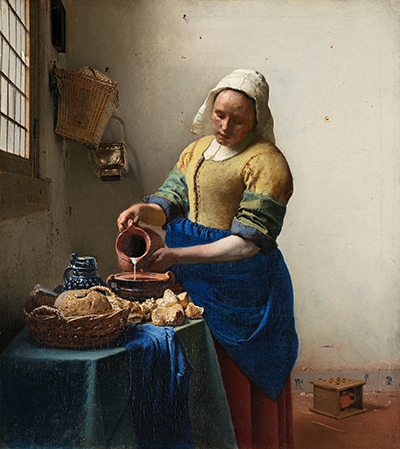
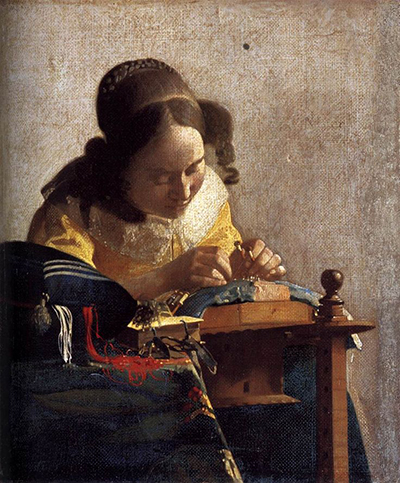
The painting also belongs near The Milkmaid in Vermeer’s development. Both works show his growing command of interior light and figure placement in the late 1650s. But their moods differ sharply. The Milkmaid turns labour into concentration. Officer and Laughing Girl turns sociability into ambiguity.
The comparison is useful because it prevents a narrow view of early Vermeer. He was not moving in one straight line toward silent domesticity. He was experimenting with different types of interior encounter: service, courtship, music, letters, maps and solitary attention.
Place in Vermeer’s Work
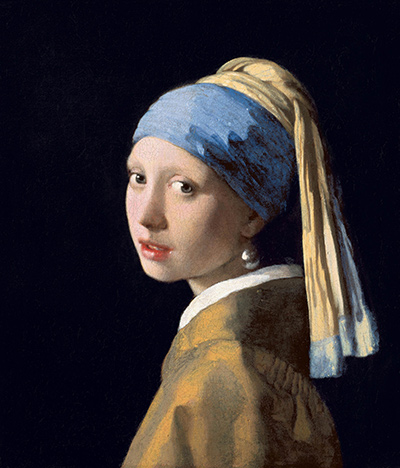
Officer and Laughing Girl is a high-value Vermeer page because it joins several major themes: maps, courtship, optical perspective, early interiors and the relation between viewer and room. It is not as famous as Girl with a Pearl Earring or The Milkmaid, but it explains how Vermeer’s interior art developed.
The painting also gives Vermeer’s interiors a stronger social register. Vermeer is often associated with stillness, but this work is socially alert. It captures a moment of exchange without resolving it into a story.
That balance is one of Vermeer’s great strengths. He can make a small room feel full of possible meanings while leaving the visible action almost minimal.
Frequently Asked Questions
Officer and Laughing Girl is in the Frick Collection in New York. [1]
The Frick Collection dates the painting to about 1657. [1]
The painting shows a soldier and a young woman at a table, probably in a courtship or sociable exchange. Vermeer leaves the exact narrative unresolved.
He is placed very close to the viewer and functions as a repoussoir figure, pushing the eye into the room and making the woman appear farther away.
No. The painting has optical and perspective effects that invite discussion, but it should not be treated as proof of a device. The safer interpretation is that Vermeer was interested in how space and perception could be organised pictorially.
Discussion
What feels most revealing about Officer and Laughing Girl: Vermeer's handling of light, the silence of the scene, the object details, the attribution history, or the way the painting fits within Dutch Golden Age art?
Reader Insights
Vermeer rewards slow attention. Begin with the main action, then move outward to light, edges, objects and the quiet spaces that hold the composition together.
Many of these paintings are small, but their meanings open through Delft, collecting history, technical study and comparison with related Dutch interiors.
Pair this article with the biography and one neighbouring Vermeer work to see how subject, light and attention shift across the artist's compact oeuvre.
Join the Conversation
Have a thought or observation about Officer and Laughing Girl? Share it below. Thoughtful responses may be added to this section as the Vermeer pages develop.
References
- Frick Collection, Officer and Laughing Girl, object record.
- Rijksmuseum, Vermeer exhibition materials on perspective and optical effects.
- Vermeer technical and map-scholarship notes.