

 by Tom Gurney
Tom Gurney BSc (Hons) is an art history expert with over 20 years experience
Published on June 19, 2020 / Updated on August 29, 2026
Email: tomgurney1@gmail.com / Phone: +44 7429 011000
A Landscape Returns after Two Centuries
In April 2026, a large watercolour by the twenty-three-year-old J. M. W. Turner went on public display at Gainsborough's House in Sudbury. Abergavenny Bridge had apparently not been exhibited since it appeared at the Royal Academy in 1799. Its return, as part of Gainsborough, Turner and Constable: Inventing Landscape, brings an important early work back into view after an absence of more than two centuries.[1]
The sheet is ambitious in size. It measures 509 by 718 millimetres and is worked in pencil and watercolour. Christie's records a signature, “Turner,” and another signature with the title on the backing: “Abergavenny Bridge/Monmouthshire/W Turner.”[2] The inscription matters because different versions were long confused with views of Llangollen. It fixes the subject as the bridge over the River Usk near Abergavenny in Monmouthshire and supports the fuller historical title, Abergavenny Bridge, Monmouthshire: Clearing Up after a Showery Day.
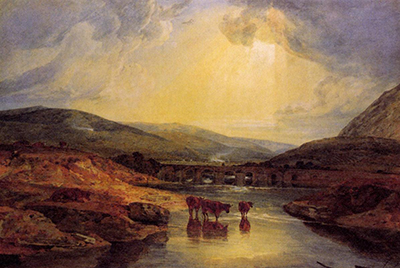
The scene is broad, low and open. Cattle stand in shallow water across the foreground. Dark riverbanks enter from both sides and guide the eye toward a many-arched bridge in the middle distance. Beyond it, hills overlap beneath a sky that is still crowded with rain cloud but pierced by warm light. The gold opening above and behind the bridge catches the river, so architecture, water and weather join at the centre rather than competing for attention. Nothing suggests a neat interval after rain. The atmosphere is changing while it is being seen.
That transitional condition gives the work more than documentary value. Turner certainly records a crossing, a river and a valley encountered during his Welsh travels. Yet the subject is not the bridge isolated as an antiquarian specimen. The solid masonry occupies a narrow strip inside a much larger field of moving air, reflected brightness and retreating shadow. A local landmark becomes the measure of a passing meteorological event.
The 2026 exhibition identifies this private watercolour as the work shown at the Royal Academy in 1799.[1] Earlier scholarship was more cautious. When the sheet reappeared, Christie's argued that its scale, signature, backing inscription and possible association with Sir Thomas Lawrence strongly suggested that it was the exhibited version, but the sale record retained a question mark before the Royal Academy entry.[2] That difference in wording should not be hidden. It reveals how an attribution develops as an object returns, is compared with records and re-enters public study.
The strongest account therefore begins with both confidence and qualification. This is securely a large signed Abergavenny composition by Turner. It is now presented by Gainsborough's House as the 1799 Royal Academy watercolour. Documentary and material clues make that identity persuasive, while gaps in its ownership history prevent every step from being reconstructed. The uncertainty is not a flaw in the work. It is part of the remarkable story by which an image once made for public attention almost disappeared from it.
At a Glance
- ArtistJoseph Mallord William Turner
- TitleAbergavenny Bridge, Monmouthshire
- Full historical titleClearing Up after a Showery Day
- Date1799
- MediumPencil and watercolour
- Dimensions509 × 718 mm
- OwnershipPrivate collection
- Current displayGainsborough's House, 2026
- Royal AcademyProbably no. 326, 1799
- Backing inscriptionAbergavenny Bridge / Monmouthshire / W Turner
Contents
- A Landscape Returns after Two Centuries
- Which Abergavenny Bridge?
- The Pencil Beginning
- Seven Wet Weeks through Wales
- Cattle in the Shallow Usk
- Bridge, Banks and Valley
- Clearing after a Shower
- Watercolour on an Ambitious Scale
- The V&A's Wider Version
- The Faded Tate Watercolour
Which Abergavenny Bridge?
The title appears simple, but several related Turner works survive or are recorded. Their separation is essential. The large private sheet is not the same object as the finished watercolour in the Victoria and Albert Museum, nor is either identical to two studies in Tate's Turner Bequest. A further finished version, once associated with Abel Buckley and earlier sales, is now untraced.[2]
The V&A owns A Bridge over the Usk, accession 978-1900. Its alternate title connects it directly with Abergavenny and with the phrase “clearing up after a showery day.” The museum dates it broadly to the 1790s and records it as watercolour by Turner, given through the Henry Vaughan bequest in 1900.[3][4] It is a separate, wider composition whose extended bridge and valley can be studied in the museum's high-resolution image.[5]
Dimensions have themselves contributed to confusion. Andrew Wilton's catalogue was reported with lateral measurements too large for the known proportions. Christie's cites the V&A's 1980 British watercolour catalogue for the more plausible size of 412 by 633 millimetres, while current machine-readable museum data retains a conflicting width.[2][4] That discrepancy does not change the visual distinction: the private sheet at 509 by 718 millimetres is taller, larger and differently proportioned.
Tate D01496, titled Abergavenny: The Usk Bridge, is smaller by another order of magnitude. It is a graphite sketch measuring roughly 135 by 95 millimetres in the Dynevor Castle Sketchbook.[6] The drawing continues onto D01497, because Turner used the opening and followed the view across the adjoining leaf.[7] This compact record belongs to the journey of 1798 and supplied essential topographical material, but it is not a reduced finished picture.
Tate D01669 is more deceptive because it is a watercolour and has often been discussed under the tentative title ?Abergavenny Bridge. Dated 1798 and measuring 292 by 362 millimetres, it belongs to the Cyfarthfa Sketchbook. Tate's catalogue explicitly notes that its composition differs from the Royal Academy subject.[8] The bridge, river and mountainous setting establish kinship; arrangement and history keep it separate.
The untraced composition adds another layer. Sir Walter Armstrong knew a version that had been called the Vale of Llangollen and later the Usk near Abergavenny. It passed through the Allnutt sale and Abel Buckley's collection, but its present location is unknown. The private sheet's inscribed backing helped confirm that this family of designs concerns Abergavenny rather than Llangollen, a place on the Dee in North Wales.[2]
These distinctions matter because versions reveal Turner's practice. He did not merely repeat one image at different sizes. A modest tour drawing could generate more than one elaboration; a nearby study could test a different structure; finished sheets could alter proportions, cattle, arches, banks and the balance of light. The subject was stable enough to be named yet flexible enough to be reinvented. “Abergavenny Bridge” describes a group of related decisions, not a single design mechanically copied from nature.
The Pencil Beginning
The Dynevor Castle Sketchbook preserves the most economical stage of the process. On D01496 and D01497, Turner noted the course of the river, the crossing and the land around it in graphite.[6][7] The small leaves imposed compression. Instead of completing a self-contained composition, he let the subject continue over the opening, using portable paper to secure relationships that could later be expanded.
Such a drawing did not have to record every arch, tree or cloud with equal finish. Its value lay in spatial intelligence: where the banks converged, how the bridge sat across the Usk, how the hills rose behind it, and how much river separated the spectator from the crossing. Those relations remain perceptible in the large watercolours even after the proportions change.
The sketch also contains weather. Tate's catalogue draws attention to rainy clouds and lowering shadows and argues that the finished subject depended less on exceptional architecture than on climatic effect.[6] This is important because it prevents a false division between factual notes and later imagination. Turner did not first record a neutral bridge and then decorate it with a storm in London. The conditions under which he travelled formed part of what he observed.
Nor was the finished sheet a simple enlargement. If the little drawing were projected onto the large private paper, it would not account for every animal, tonal mass or cloud passage. Turner had to reconstruct the experience in another medium and at a scale intended for prolonged viewing. Pencil lines offered a framework; watercolour created depth, humidity, light and the sense of time passing.
The continuation onto D01497 helps explain his freedom. A sketchbook opening is a working space rather than a framed exhibition object. Turner could carry a contour across the fold, stop before detail became burdensome and move on. Later he could select, omit or combine. The apparent spontaneity of the finished atmosphere rests on this earlier discipline of gathering enough information without exhausting the motif.
The Dynevor Castle Sketchbook had been altered before this Welsh use. Tate notes that a leaf was removed, affecting the sequence around the Abergavenny drawing.[6] That fact warns against treating sketchbooks as untouched diaries in which every view follows perfectly from the last. They are physical objects with missing leaves, reused openings and later cataloguing histories. Itinerary reconstruction depends on several kinds of evidence rather than a seamless procession of images.
Moving from roughly pocket-sized graphite to a watercolour more than half a metre high changed the social purpose of the subject. The drawing belonged to travel: quick, private and portable. The large sheet belonged to presentation, patronage and exhibition. Its task was no longer only to remind Turner what stood beside the Usk. It had to persuade viewers that watercolour could command wall space, complex weather and serious landscape meaning.
Seven Wet Weeks through Wales
Turner's Abergavenny material emerged from an arduous tour. In the summer of 1798 he travelled through South and North Wales, moving from Bristol through Chepstow and Monmouth, following the Usk toward Brecon, then continuing west and north. Christie's reconstructs the journey from the sketchbooks and contemporary records; Tate places it within a decisive phase of Welsh mountain study.[2][9]
Joseph Farington recorded Turner's own report on 26 September. The artist had been away for seven weeks, alone and on horseback. There had been much rain, but, in Turner's memorable assessment, the conditions were “better for effects.”[2] The remark condenses an artistic education. Bad travel weather could be physically uncomfortable while producing the broken light, saturated surfaces, cloud movement and sudden distance that made a landscape pictorially valuable.
A later family recollection adds colour to the departure. Turner had stayed with the Narroways in Bristol; according to Ann Dart, a relative remembering the episode long afterward, her uncle supplied a pony and lent saddle, bridle and cloak, which Turner never returned.[2] The anecdote should not carry the weight of a diary entry, but it conveys the practical nature of travel before railway access: equipment, hospitality, uncertain roads and weeks of exposure.
Wales was not new to Turner. He had travelled there in 1792 and 1795, and the National Library of Wales traces his repeated engagement with Welsh castles, rivers, mountains and towns.[16] The 1798 journey was nonetheless more extensive and mature. At twenty-three, he could bring years of professional drawing, engraving work and Royal Academy training to places first encountered as a teenager.
The journey offered contrasts rather than one generic wild landscape. Chepstow and the Wye carried established Picturesque associations. Monmouth and Abergavenny connected rivers, roads and historic crossings. Brecon opened toward mountain country. Coastal and northern stages introduced ruined castles, estuaries and more severe uplands. Turner's sketchbooks registered this variety, allowing later works to distinguish the broad Usk valley from the enclosed drama of other Welsh sites.[9][16]
Rain also altered the relation between near and far. Wet foreground earth darkens; water takes more reflection; distant slopes become veiled; a break in cloud can illuminate one plane while another remains in shadow. These are precisely the conditions that organise the Abergavenny watercolour. The title's “clearing up” is not an invented literary tag detached from travel. It translates the kind of rapid change Turner had endured and valued.
His response was not passive transcription. The journey supplied visual facts and remembered sensations, but the finished design required selection. Hills could be made to frame the light; banks could be darkened to deepen the river; cattle could clarify scale; the bridge could be placed where atmosphere and perspective converge. The Welsh tour was therefore both encounter and archive, a body of experience Turner could reorganise for patrons and the Academy.
Cattle in the Shallow Usk
The foreground is occupied less by architecture than by water and animals. Several cattle stand within the river, their bodies interrupting the pale reflections. Others appear near the banks. At the low resolution of the private sheet's accessible reproduction, exact breeds, poses and counts should not be forced. Their compositional roles are nevertheless clear.
First, the animals establish depth. A bridge in the middle distance offers scale only if the eye can judge the interval leading to it. The cattle distribute markers across that interval. Their bodies are larger and more distinct close to the spectator, then give way to smaller accents nearer the crossing. The river becomes measurable space rather than a smooth band of colour.
Second, standing cattle imply shallowness. They convert a reflective surface into inhabitable terrain. The Usk may carry weather and light, but at this point animals can enter it, pause and drink. That ordinary fact anchors a composition whose sky might otherwise seem theatrical. Turner's meteorology remains connected to land use and animal behaviour.
Third, the cattle interrupt reflection. The golden opening above the bridge descends toward the viewer through the river, but it cannot form an uninterrupted column. Dark legs, backs and shadows break it into pieces. The light therefore appears to flicker across moving or uneven water. A practical pastoral detail helps create atmospheric complexity.
Cattle had a long place in landscape art. Gainsborough, whose work shares the 2026 exhibition with Turner and Constable, used them to suggest rural life and to pace a view. Dutch and British painters made grazing or watering animals signs of cultivated peace. Turner could draw on that vocabulary without reducing his cattle to fixed symbols. Here they are less a proclamation of abundance than living measures inside a recently disturbed environment.[1]
Their calmness is relative. The title says the shower is clearing, not that the day has always been serene. The animals have perhaps remained in or returned to the water as the light changes. Because they do not flee or struggle, the weather reads as a passing shower rather than catastrophe. Their steadiness provides a temporal counterweight to the moving cloud.
The V&A version develops the pastoral field differently. Its wider format opens more of the left bank, and the high-resolution image shows cattle distributed across both land and water.[5] The private work is more vertically concentrated. Darker flanks press inward, making the foreground herd part of a stronger movement toward the central bridge and bright distance. Comparison shows Turner recalibrating the relation between pastoral incident and weather rather than duplicating a stock foreground.
Most importantly, the animals keep the image at human scale even where no large human figure commands it. Viewers understand the approximate size of cattle and infer the width of the river, height of the bridge and breadth of the valley. The work's grandeur is built through familiar bodies. Turner makes a large watercolour feel expansive without requiring sublime cliffs or tiny endangered travellers.
Bridge, Banks and Valley
The bridge is the named subject, yet Turner resists making it an isolated portrait. It lies across the central distance, light enough to remain visible but low enough to yield to the hills and sky. Its arches create a measured horizontal rhythm just where the river and valley seem to narrow. Architecture becomes a threshold between foreground water and the illuminated country beyond.
The number of arches should be treated carefully in the image. The historic crossing is recorded as a seven-arch masonry bridge, but later rebuilding and widening complicate the relation between present fabric and Turner's view.[17][18] In the private reproduction, vegetation, shadow and small scale make exact enumeration uncertain. The sensible claim is that Turner uses a repeated arcade, not that every visible opening documents the structure with archaeological precision.
Both banks act like wings. The left rises in earthy darks with patches of vegetation and animals. The right is steeper and more shadowed. Together they narrow the central corridor while leaving enough breadth for the river foreground. This asymmetry prevents the view from becoming a rigid prospect aligned on the bridge.
The hills repeat the banks on a larger scale. Their slopes descend toward the light and then rise away from it, forming a shallow basin around bridge and sky. Turner does not need a mountain peak as climax. Overlapping ridges produce recession through value: nearer forms are darker and more definite; remote ones dissolve into blue-grey air.
The bridge mediates natural and constructed order. Its arcade is regular, built to carry movement across the river. Banks and hills are irregular, shaped by ground and water. Yet the painting avoids a simple opposition. The arches echo gaps in cloud, while the horizontal roadway steadies the restless atmosphere. Human construction has entered the valley without dominating it.
This balance suits Abergavenny's geographical position. The town lies where routes through the Usk valley meet approaches to surrounding uplands. A bridge is therefore both local structure and sign of connection. Turner encountered it while travelling onward, not as an endpoint. In the image it similarly carries the gaze across the water and into distance.
The foreground viewpoint appears low enough to make the river substantial, but it does not pretend to be a surveyor's station. Turner could combine what the graphite study preserved with compositional adjustments made for the large paper. The private sheet's backing inscription secures the place; it does not guarantee that every contour corresponds to one fixed optical instant.[2]
That distinction clarifies Turner's topography. Faithfulness can consist in preserving the character and spatial logic of a location even while changing emphasis. The Usk, crossing, valley and flanking hills remain recognisable. Dark banks, widened foreground and concentrated light make the remembered conditions legible. The work is neither an engineering record nor a placeless atmospheric fantasy.
Clearing after a Shower
Weather is the event. A large cloud mass occupies much of the sky, its blue-grey and brown-violet passages still carrying the weight of rain. Near the middle, warmer air opens in gold and pale yellow. The clearing is incomplete: darkness remains at the sides and above while brightness gains ground around the horizon.
The title is unusually precise about sequence. “Clearing up after a showery day” does not simply name rain or sunshine. It describes a transition from repeated showers toward improvement. The landscape contains traces of what has happened and signs of what may follow. Wet surfaces reflect strongly; cloud retains depth; the low opening suggests returning light without guaranteeing permanent calm.
Turner organises the composition around that temporal hinge. The bridge sits below the brightest atmospheric passage. The river carries its reflection forward. Hills on either side contain the opening, while dark foreground banks make it appear more luminous by contrast. Light is not added as a bright spot after the forms have been drawn; it determines how every form can be seen.
The result depends on gradation. If the clouds were uniformly dark and the centre uniformly yellow, the effect would read as a stage backdrop. Instead, intermediate greys, muted greens and earth colours connect the extremes. Portions of hill enter shadow gradually. Reflections alternate with darker water. The clearing has volume because brightness passes through moist air rather than sitting flat on the paper.
Farington's record of “much rain but better for effects” supplies unusually direct context.[2] Turner recognised that unstable weather creates successive appearances of the same place. A bridge seen under a blank sky is one subject; the bridge emerging after rain is another. The latter allows an artist to unite topography with time.
The description also distinguishes the work from Turner's later storm spectacles. There is no shipwreck, avalanche or blinding snow. No figure is overwhelmed. The drama lies in the release of pressure: cloud lifting, distance reopening and colour returning. This is meteorological theatre at a scale compatible with cattle standing in a river and travellers crossing a bridge.
Nor should the opening automatically be called sunset. An old label described an evening sun, and warm low light makes that interpretation plausible.[2] The surviving title itself does not specify hour. Without stronger evidence, “golden clearing” or “low warm light” remains more exact than a fixed clock time. Turner's achievement does not depend on whether the effect occurred at morning or evening.
The passage of weather is finally inseparable from memory. A shower changes too quickly for a large exhibition watercolour to be completed before it. Turner relied on observations made during travel, the pencil structure and his accumulated command of wash. The finished image makes an unstable moment durable without pretending that the entire sheet was painted beside the Usk.
Watercolour on an Ambitious Scale
At 509 by 718 millimetres, the private Abergavenny sheet asks watercolour to operate with the authority of a major exhibition work.[2] This was not a slight tinted drawing intended only for an album. Its broad sky, extended river and layered valley needed control across a large area of paper, where uneven application or an ill-judged edge would become conspicuous.
Watercolour depends on light passing through or reflecting from relatively thin colour and the paper beneath. Washes can establish large atmospheric fields; stronger touches can recover structure and emphasis. The V&A's account of the medium explains how transparency, opacity and paper support interact, while the Wallace Collection surveys methods Turner used across his career, including washes, lifting, rubbing and scratching.[14][21]
Those general methods should not become a fictional technical report on this privately held sheet. Without object-specific examination, no exact pigment list can be supplied, and a low-resolution reproduction cannot prove where Turner scratched, lifted or mixed bodycolour. What can be described is the visual organisation: broad tonal zones in the sky, darker bank shapes, fine bridge articulation, dispersed animal accents and reflected warmth in the water.
Scale makes their coordination difficult. A broad wash must remain active without becoming shapeless. Small marks must read across a viewing distance without fragmenting the whole. Turner solves this by arranging detail hierarchically. The cattle and bridge provide concentrated information; hills are broader; cloud and river carry the largest transitions. Each degree of finish serves a different distance.
The British Museum's Welsh watercolour evidence shows how Turner's tours encouraged a freer use of broad wash and a reduced range of colours in works from this period.[15] That comparison is valuable as context, not as proof that every mark in Abergavenny was made in the same way. What the works share is an effort to make watercolour convey mass and weather rather than merely fill an outlined drawing.
Paper also makes reservation important. Pale areas can depend on leaving or recovering brightness rather than applying a heavy white layer. The central light feels embedded in the support because its warmth grades into surrounding colour. Against it, the bridge can remain relatively delicate. Turner need not outline every stone to make the arcade legible.
The pencil component recorded by Christie's reminds us that structure and colour worked together.[2] Initial drawing could locate bridge, bank and animal forms; watercolour could then alter their prominence. Some lines disappear under wash, while others remain as a quiet scaffold. The finished image is neither pure drawing nor unbounded colour.
This technical ambition carried professional meaning in 1799. Watercolour was central to British topographical practice but still competed for institutional recognition beside oil painting. By giving an observed Welsh view large dimensions, complex weather and compositional gravity, Turner demonstrated that the medium could sustain serious public landscape. The sheet is an argument made in paint and paper rather than a written manifesto.
The V&A's Wider Version
The V&A watercolour offers the closest surviving comparison. Known as A Bridge over the Usk, it came to the museum through Henry Vaughan in 1900 and had earlier belonged to Mr Harvey.[3] Its alternate title preserves the Abergavenny and showery-day association, but its format immediately distinguishes it from the private work.
The wider sheet opens the valley laterally. The bridge extends across more of the middle distance, with a longer sequence of arches visible in the high-resolution image.[5] The river spreads broadly in front, and cattle occupy both the shallow water and left land. The right bank does not press inward with quite the same force as in the private composition.
This changes the experience of the clearing. In the private work, darker sides and greater height concentrate attention on the illuminated centre. In the V&A version, the weather unfolds across a panoramic reach. Bridge and valley have more room to breathe, and the eye travels along the crossing before moving into the light.
The V&A image also reveals how much visual information is lost when one version is represented by a 400-pixel reproduction. Animals, foliage, masonry and subtle cloud edges become more legible at high resolution.[5] Comparison must account for that inequality. Apparent simplicity in the private image may reflect reproduction rather than a deliberately barer finish.
It is tempting to arrange the two surviving sheets as first attempt and final correction. The evidence does not require that hierarchy. Turner could make variants for different owners, expectations or display conditions. Differences in dimensions produce different solutions rather than an obvious winner. The private version's strong enclosure and the V&A version's breadth each serve the same theme.
Nor should similarity be mistaken for tracing. Both works share the Usk crossing, cattle, water and clearing sky because they derive from the same place and underlying study. Their changed proportions demand fresh decisions. Extending a bridge across a wider field shifts every surrounding interval; moving cattle alters reflection; opening a bank changes the eye's path.
The V&A provenance provides a clearer later history than the private work. Mr Harvey owned it before Henry Vaughan, a collector particularly associated with works on paper. Vaughan bequeathed it to the museum in 1900.[3] Its institutional availability helped make it the best-known finished Abergavenny watercolour while the larger sheet remained out of view.
That history influenced scholarship. Cataloguers trying to identify the 1799 exhibit naturally focused on the accessible V&A object and the untraced version known from older records. The private sheet's reappearance changed the field because its large scale, signature and backing inscription offered another candidate.[2] The 2026 exhibition now makes direct public comparison possible in principle, even though the works remain in different collections.
Together, the variants show Turner thinking through repetition. Place is not exhausted by one view, and weather cannot be repeated exactly. Each finished watercolour stages the same remembered clearing with a different spatial emphasis. Their relationship is not a problem to be solved away; it is evidence of the young artist's capacity to generate distinct public images from one encounter.
The Faded Tate Watercolour
Tate D01669 belongs to the same Abergavenny constellation but not to the same composition. Its current question-mark title, ?Abergavenny Bridge, signals the limits of identification.[8] It shows a river crossing in mountainous country, yet Tate's catalogue stresses that its arrangement differs from the Royal Academy work.
The sheet measures 292 by 362 millimetres and forms part of the Cyfarthfa Sketchbook. That size places it between the tiny graphite notation and the large finished variants. It may represent a more developed experiment with colour and atmosphere made around the Welsh journey, but it should not be presented as a direct miniature of the private sheet.
Its present appearance carries another warning. D01669 was exposed for years in the National Gallery's Turner Loan Collection. Tate records severe fading, with indigo particularly affected, and notes that it was withdrawn from loan in August 1905.[8] The colours now visible are therefore historical remains altered by display, not a pristine statement of Turner's 1798 palette.
Watercolour is vulnerable because light can change both pigments and paper. Different colours fade at different rates, disturbing the balance Turner established. If blue weakens more than earth colour, a sky may appear warmer, flatter or less spatially coherent than it originally did. Conservation history becomes part of responsible interpretation.
This matters for comparison. One cannot look at D01669's current state and infer that Turner intended the private Abergavenny watercolour to share its exact hues. Nor can the faded study provide a simple bridge between pencil sketch and finished work. Its material life after Turner's death has altered the evidence.
The Loan Collection history nevertheless reveals nineteenth-century attitudes. Turner's works on paper were sent out for public display so that audiences beyond London could see them. Access came at a cost that was not fully understood or controlled. Withdrawal in 1905 marks a growing recognition that light-sensitive art required different care.[8]
The contrast with the private sheet is striking. D01669 was displayed so much that its colour suffered; the large Abergavenny version was displayed so little that it nearly vanished from public consciousness. One object bears the damage of access, the other the obscurity of seclusion. Their histories represent opposite risks for works on paper.
Tate's cautious title is equally useful. A question mark does not indicate curatorial indecision in a careless sense. It tells viewers where evidence stops. Similar terrain and sequence support an Abergavenny proposal, but composition does not match the known exhibition design. Preserving that distinction allows D01669 to contribute to the story without being made to answer a question it cannot settle.
Turner at the Royal Academy in 1799
The Royal Academy exhibition of 1799 opened on 29 April and ran until 15 June. Its rooms contained 1,118 works by 472 artists, producing the crowded and competitive environment typical of the annual display.[10] A large watercolour needed immediate visual force to hold attention among portraits, histories, landscapes and architectural designs.
Turner was already experienced in the institution. He had entered the Academy Schools as a teenager and first exhibited a watercolour in 1790. Training gave him access to drawing practice, lectures, peers and the central mechanism of professional visibility.[19] By 1799 he was no longer a precocious unknown, but neither had he reached the security of full membership.
The Abergavenny work is traditionally connected with exhibition no. 326. Turner also showed an oil concerning the Battle of the Nile, demonstrating a range that extended from contemporary naval history to Welsh landscape.[10] This dual presence complicates any simple account of him as only a watercolour topographer at the end of the decade.
Contemporary notices recognised a rising generation. The Whitehall Evening Post described Turner and Thomas Girtin as among the most promising talents and praised the exquisite character of their examples. The True Briton and Morning Chronicle also drew attention to strong drawings in the Council Room and to the progress of younger artists.[11] Such comments show that watercolour could attract serious critical notice even inside a mixed exhibition.
Girtin and Turner both expanded the expressive range of watercolour. Contemporary criticism grouped them as promising young artists rather than staging a simple rivalry. Abergavenny belongs to that shared professional environment.
The sheet's dimensions would have helped it compete. A broad valley, dark flanks and a concentrated light effect can register from across a room. Closer inspection then offers cattle, arches and the modulation of washes. Turner designed for both first impact and sustained looking, a combination essential in densely hung Academy galleries.
Later in 1799 he was elected an Associate of the Royal Academy. Farington had discussed the possibility with him after the Welsh journey and promised his vote; Turner reportedly responded modestly.[2] Election acknowledged professional standing and moved him toward full Academician status, achieved in 1802.[20] The timing makes Abergavenny part of a consequential year, even though it was not an Associate diploma work. No such submission was required for that election.[2]
Its public ambition also helps explain the importance of attribution. If the private sheet is indeed no. 326, it stood at the point where travel study, patronage and institutional advancement met. The 2026 display does more than recover a beautiful landscape. It restores physical evidence for how Turner presented himself just before the Academy formally recognised him.
A Watercolour Made for Thomas Lawrence
On 13 March 1799, Farington visited Turner and saw his drawing of Abergavenny Bridge, “made for Lawrence.”[2][6] The compact entry is the most important documentary link between the subject and Sir Thomas Lawrence. It proves that Turner was working on an Abergavenny composition for Lawrence before the Academy exhibition opened.
Lawrence was already a leading portrait painter. He had become an Associate of the Royal Academy in 1791 and a full Academician in 1794, and his career would eventually take him to the presidency of the institution.[12] A commission from such a figure carried professional significance for a younger artist approaching his own election.
Lawrence was also a major collector of drawings. His holdings, especially Old Master sheets, grew into a collection numbered in the thousands.[13] He did not approach work on paper as a minor substitute for oil. His connoisseurship gave a Turner watercolour a demanding and informed destination.
The commission may help explain scale and finish. A large sheet could demonstrate command to a patron who understood drawing and occupied a powerful Academy position. Yet Farington's wording does not specify dimensions, exact title or subsequent ownership. It identifies a work being made, not every stage in the biography of one surviving object.
The private sheet has traditionally been given a Lawrence provenance, followed by G. Law-Schofield, Lieutenant Colonel J. Craven-Hoyle and Venables Kyrke.[2] Christie's nevertheless acknowledged that the complete chain could not be confirmed. That caution remains necessary. The fact that Lawrence commissioned an Abergavenny drawing makes ownership plausible, but it does not fill undocumented transfers.
The backing inscription strengthens the identification without closing the gap. It names Abergavenny and Turner in old association with the sheet. The signature and exceptional size align with the object Farington could have seen and with a public exhibit. None of those clues independently proves uninterrupted descent from Lawrence.
This distinction is more than legalistic. Provenance affects how one interprets purpose. A secure Lawrence commission situates the composition within exchange between artists, not anonymous production for the market. An incomplete subsequent history explains why the large work could disappear from scholarship and why another version became better known.
Lawrence's role also shows Turner's network widening. The young landscape painter was not advancing solely through impersonal Academy judging. Fellow artists observed, commissioned, collected and discussed his work. Farington moved between studios and recorded what he saw. Professional reputation developed through these relationships before it hardened into later biography.
The most accurate formulation preserves all parts of the record: Turner made an Abergavenny drawing for Lawrence in early 1799; the private sheet is signed, inscribed and consistent with that major commission; traditional provenance begins with Lawrence; surviving documentation does not prove every transfer. Such precision makes the historical connection stronger, because it separates what is known from what is reasonably inferred.
The Bridge Turner Saw and the Bridge Today
Abergavenny Bridge carries the road across the Usk south of the town. The historic environment record describes a seven-arch crossing and notes evidence for a medieval road or earlier structure at the location.[17] The bridge belongs to a long history of movement between the town, river valley and roads toward Monmouth, Brecon and surrounding country.
The structure visible today cannot be treated as unchanged from 1798. Its origin is uncertain, and records indicate rebuilding, repair and widening. A recent engineering and heritage assessment describes a masonry bridge roughly sixty-two metres long, with later work including nineteenth-century widening.[18] Turner's image is therefore evidence for the crossing and its landscape setting, not a complete specification for current fabric.
That instability is appropriate to the painting's broader theme. Bridges appear permanent beside water and weather, but they too accumulate alteration. Road demands change, floods exert pressure and masonry requires intervention. The arcade Turner saw belonged to an earlier phase in a continuing structure.
The river was more than scenery. The Usk shaped settlement, transport, agriculture and the broad valley floor. Its shallow foreground in the watercolour allows cattle to stand within it, while the bridge marks the point where overland travel crosses the channel. Turner brings two forms of movement together: water passing downstream and people moving across.
Abergavenny itself does not dominate the horizon. The town is implied through the bridge and road rather than displayed as a collection of recognisable buildings. This choice keeps attention on the approach and surrounding valley. Turner was travelling through the place, and the view preserves the experience of seeing infrastructure embedded in land rather than assembling an urban panorama.
The crossing also mediates different historical associations. Monmouthshire offered medieval remains and border histories attractive to antiquarian travellers, yet a functioning bridge belonged to contemporary daily life. Cattle, roadway and river prevent the structure from becoming a picturesque ruin. Its age and utility coexist.
Later protected status recognises architectural and historical value.[17] That designation, however, should not be projected backward as Turner's motive. He did not travel under modern conservation categories. His interest can be read in the bridge's rhythmic form, geographic importance and atmospheric setting without claiming he intended a heritage campaign.
Comparing image and present structure requires similar restraint. Altered parapets or width do not make the watercolour inaccurate, and apparent differences do not automatically prove invention. Viewpoint, vegetation, river level, repaired masonry and artistic emphasis all affect appearance. The secure point is that Turner converted a real Usk crossing into a composition whose truth depends on spatial and climatic character as much as on counted stones.
Provenance, Disappearance and Recovery
The private sheet's recorded history begins with a probable but incompletely documented association with Lawrence. Christie's then lists G. Law-Schofield, Lieutenant Colonel J. Craven-Hoyle of Gnaton Hall in Devon, and Venables Kyrke.[2] The intervals and mechanisms between those owners are not fully supplied.
An old backing label described a bridge over a river, hills, cattle in shallow water and a glowing evening effect. It also claimed the sheet was Turner's work on admission as an Associate of the Royal Academy.[2] The description is perceptive; the institutional claim is mistaken. Associates did not submit diploma works. Turner later supplied Dolbadern Castle on becoming a full Academician.
That label illustrates how correct observation and false biography can travel together. Owners preserved useful details about subject and appearance while attaching a plausible ceremonial story to a prestigious object. Because Turner was elected an Associate in 1799, the coincidence invited a causal explanation. Documentary knowledge corrects it without making the label worthless.
The sheet's long absence from exhibition had wider consequences. Scholars knew the V&A work and documentary references, while the large version was represented unevenly in records. Armstrong listed two compositions; Wilton catalogued related works and eventually noted a third in a private collection. Until the large sheet reappeared with its inscription, the relation among Abergavenny and Llangollen titles remained needlessly tangled.[2]
Christie's argued that the reappearance modified the whole account. Size, signature and inscription made the private version a strong candidate for the 1799 exhibit and Lawrence commission. Yet the sale essay properly retained uncertainty because a perfect Lawrence-to-present chain was unavailable.[2] Attribution here arose from convergence, not one decisive stamp.
The 2026 Gainsborough's House exhibition advances the public identity. It names the object Abergavenny Bridge (1799) and states that its previous public display was the 1799 Royal Academy exhibition.[1] Viewers can now encounter the scale and surface that reproductions flatten, while scholars can reconsider an early landmark in relation to Gainsborough and Constable.
Private ownership is not itself equivalent to neglect. Works may be carefully preserved outside museums, and limited light can protect watercolour. The comparison with Tate D01669, damaged by historic exposure, makes that point vividly.[8] The problem is access to evidence: without display and current photography, visual and technical understanding remains restricted.
The V&A sheet had the opposite afterlife. Henry Vaughan's bequest placed it in a public collection in 1900, creating a stable accession history and institutional image.[3] It became the accessible representative of the design. The two works show how provenance shapes art history: one version anchors scholarship through museum custody, while another can unexpectedly revise that scholarship when it returns.
Recovery does not conclude the story. It creates opportunities for direct comparison, condition study and further provenance research. The important immediate correction is already clear. The large private image is not a reproduction of the V&A object wrongly assigned greater dimensions. It is an independent, signed and inscribed finished watercolour with a compelling claim to be the work Turner placed before Academy audiences in 1799.
An Early Statement of Turner's Landscape Art
Abergavenny Bridge belongs to a young artist, but it is not merely preparatory to later greatness. Its central problems remain important throughout Turner's career: how observed topography can hold remembered weather, how light can organise form, how travel drawings become public works, and how landscape carries time without requiring a dramatic narrative.
The bridge provides factual resistance. It crosses a named river at a named town and can be connected to a surviving graphite study. Turner cannot dissolve the scene without losing its identity. Yet he also refuses to let topography dictate a dry inventory. Banks, cattle, hills and arches are arranged through the action of clearing light.
Weather provides change. The title makes viewers imagine what the place looked like before this moment and what it may look like minutes later. Dark cloud records the departing shower; brighter distance anticipates recovery; wet water and ground retain the past. The image contains a before and after without illustrating two episodes.
Scale gives that change public consequence. A small tour note could have remained a useful private memory. Enlarged into a watercolour over seventy centimetres wide, it asks to be judged beside ambitious Academy art. Turner's 1799 election as Associate did not depend ceremonially on this sheet, but the work demonstrates why his contemporaries recognised his progress.[10][11][20]
Patronage gives the work another dimension. Farington's note places an Abergavenny drawing in relation to Thomas Lawrence, an established artist and sophisticated collector.[2][12][13] The commission connects landscape watercolour with the professional networks of the Academy. It also reminds us that innovation required buyers as well as solitary inspiration.
Versions reveal sustained thought. The private and V&A sheets distribute bridge, valley, cattle and light differently. D01496/D01497 supplies a compact topographical origin; D01669 explores another arrangement and carries a cautionary conservation history.[3][5][6][7][8] No single object tells the whole story.
The 2026 reappearance therefore matters beyond rarity. It returns a missing scale to Turner's early career. Seen only through smaller or wider relatives, Abergavenny could appear as one pleasant Welsh motif among many. The large private sheet shows him treating the subject as a major statement about paper, atmosphere and exhibition landscape.
Its achievement is controlled rather than sensational. Cattle do not panic, masonry does not collapse and hills do not tower impossibly. The drama is the intelligible drama of weather passing over a familiar crossing. That restraint makes the transformation more persuasive. The real valley remains present even as colour and light turn it into remembered experience.
After more than two hundred years away from public exhibition, the work can again perform the task for which it was likely made: to be seen at full scale, compared, questioned and absorbed over time.[1] Its uncertain intervals need not be smoothed away. Commission evidence, disputed provenance, variant compositions and changing attribution all deepen the object. At the centre remains Turner's clear proposition: a bridge is not only stone across water, but a fixed measure through which the movement of air, rain and returning light becomes visible.
Discussion
How does Turner transform a small Welsh tour notation into a large public landscape organised by clearing weather?
Reader Insights
How do cloud, gold light and reflection organise the valley?
Which differences keep the private and V&A sheets distinct?
Why does the 1799 Royal Academy identity remain persuasive but qualified?
Join the Conversation
Share a close observation or a source-based question for other readers.
References
- Gainsborough's House, “Gainsborough, Turner and Constable: Inventing Landscape”: https://gainsborough.org/event/gainsborough-turner-and-constable/
- Christie's, J. M. W. Turner, *Abergavenny Bridge, Monmouthshire: Clearing Up after a Showery Day*: https://www.christies.com/en/lot/lot-2982987
- Victoria and Albert Museum, J. M. W. Turner, *A Bridge over the Usk*, 978-1900: https://collections.vam.ac.uk/item/O1106171/
- Victoria and Albert Museum Collections API, O1106171: https://api.vam.ac.uk/v2/museumobject/O1106171
- Victoria and Albert Museum, IIIF image for *A Bridge over the Usk*: https://framemark.vam.ac.uk/collections/2024NX3111/
- Tate, J. M. W. Turner, *Abergavenny: The Usk Bridge*, D01496: https://www.tate.org.uk/art/artworks/turner-abergavenny-the-usk-bridge-d01496
- Tate, J. M. W. Turner, continuation of *Abergavenny: The Usk Bridge*, D01497: https://www.tate.org.uk/art/artworks/turner-abergavenny-the-usk-bridge-d01497
- Tate, J. M. W. Turner, *?Abergavenny Bridge*, D01669: https://www.tate.org.uk/art/artworks/turner-abergavenny-bridge-d01669
- David Blayney Brown, “Welsh Mountain Landscapes 1798,” Tate Research Publication: https://www.tate.org.uk/art/research-publications/jmw-turner/welsh-mountain-landscapes-r1141039
- Royal Academy / Paul Mellon Centre, 1799 Summer Exhibition Chronicle: https://chronicle250.com/1799
- Thomas Girtin archive, “1799 Documents”: https://thomasgirtin.com/collection/sales-and-documents/1799-documents
- National Gallery, London, “Sir Thomas Lawrence”: https://www.nationalgallery.org.uk/artists/sir-thomas-lawrence
- National Gallery, London, *Painters' Paintings* press material: https://www.nationalgallery.org.uk/media/23809/painters-paintings-press-release.pdf
- Wallace Collection, “Turner's Watercolour Materials and Techniques”: https://www.wallacecollection.org/explore/explore-in-depth/turner/turners-watercolors/turners-watercolour-materials-and-techniques/
- British Museum, J. M. W. Turner, Welsh landscape, 1958,0712.405: https://www.britishmuseum.org/collection/object/P_1958-0712-405
- National Library of Wales, “Turner and Wales”: https://www.library.wales/discover-learn/digital-exhibitions/pictures/turner-and-wales
- Heneb Historic Environment Record, Abergavenny Bridge, GGAT01762g: https://archwilio.org.uk/her/chi3/report/page.php?watprn=GGAT01762g
- Monmouthshire County Council, Abergavenny Bridge engineering and heritage assessment, 2026: https://docs.planning.org.uk/20260318/66/TBMO3DKYM6K00/9llbfujd2eoxx4nk.pdf
- Art UK, “The place he owed everything: J. M. W. Turner's training at the Royal Academy Schools”: https://artuk.org/discover/stories/the-place-he-owed-everything-j-m-w-turners-training-at-the-royal-academy-schools
- Wallace Collection, “Who Was Turner?”: https://www.wallacecollection.org/explore/explore-in-depth/turner/the-artist/who-was-turner/
- Victoria and Albert Museum, “What is Watercolour?”: https://www.vam.ac.uk/articles/what-is-watercolour