

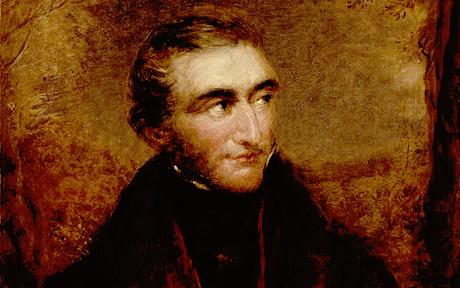
 by Tom Gurney
Tom Gurney BSc (Hons) is an art history expert with over 20 years experience
Published on June 19, 2020 / Updated on August 29, 2026
Email: tomgurney1@gmail.com / Phone: +44 7429 011000
Overview
Joseph Mallord William Turner lived from 1775 to 1851 and built one of the most wide-ranging careers in British art. He was born in London, trained through the Royal Academy, became a full Royal Academician while still young, taught perspective, travelled repeatedly through Britain and Europe, worked across watercolour, oil, drawing, etching and print design, and left a vast body of work to the nation. His biography is therefore not simply the story of a painter who became famous for light. It is the story of a professional artist who used every part of the London art world available to him and then pushed landscape and marine painting into new kinds of ambition. [1][2][3]
Turner's life is sometimes told through colourful anecdotes about secrecy, rough manners, storms or eccentric habits. Those stories can be memorable, but they easily distract from the better documented structure of his career. The reliable outline is strong enough on its own. The National Gallery records his entry into the Royal Academy Schools in 1789, his Royal Academy watercolour exhibitions from 1790 and his oil exhibitions from 1796. [1] The National Galleries of Scotland identifies him as the youngest full member of the Royal Academy in 1802. [2] The Metropolitan Museum of Art notes his later election as Professor of Perspective and his continuing activity in Academy governance. [3] These facts show an artist who rose through institutions, not one who existed apart from them.
The most useful way to follow Turner is chronological. His early years were grounded in London topography and architectural drawing. His first public success came through watercolour. Oil painting expanded his scale and public ambition. Travel gave him subjects, sketch material and memories that he could transform in the studio. The Royal Academy supplied recognition and a competitive exhibition culture. Print projects widened his audience and income. Late works brought criticism as well as admiration. After his death, the Turner Bequest made his studio legacy central to the national collection. Each phase adds something essential to the biography.
At a Glance
- Born1775, London [1]
- Royal Academy SchoolsEntered in 1789 [1]
- First Academy watercolours1790 [1]
- First Academy oils1796 [1]
- Royal AcademicianFull member in 1802 [2]
- TeachingProfessor of Perspective [3]
- PracticeWatercolour, oil, drawing, etching and print design
- TravelBritain and Europe
- Died1851, Chelsea [1][5]
- National legacyThe Turner Bequest [4][7]
Contents
- Overview
- London Origins
- Royal Academy Training
- First Exhibitions
- Academician and Ambition
- Travel and Sketchbooks
- Watercolour, Print and Income
- Teaching and Perspective
- Patrons, Studio and Independence
- Modern Life and Historical Scale
London Origins
Turner was born in London in 1775. Institutional summaries usually locate his early life around Covent Garden, where his father worked as a barber. [1][2] This urban beginning matters. Turner would become famous for mountains, seas, harbours, storms and luminous distances, but his career began in a dense commercial district near theatres, shops, markets and the professional networks of London. The city gave him access to patrons, print sellers, exhibition rooms, artists, architects and the Royal Academy. He did not emerge from a remote landscape tradition. He became a landscape painter through a metropolitan art economy.
The National Galleries of Scotland notes that early sketches were shown in his father's shop before Turner studied at the Royal Academy Schools. [2] That detail is useful because it places the young artist in a practical world of display and local visibility before formal academic recognition. It also suggests why drawing skill mattered so early. Drawings could be seen, discussed and perhaps sold before a young artist had access to major exhibition spaces. For Turner, drawing was not a minor preparation for painting. It was the first public evidence of ability.
London also gave Turner a relationship with theatre and print. The Met records that he gained experience beyond the Royal Academy by colouring prints, working as an architectural draughtsman and designing theatrical scenery. [3] Those activities help explain the mixture of precision and drama in his mature work. Architectural practice sharpened structure and perspective. Print work trained tonal translation. Theatre encouraged dramatic scale, light and staging. None of these experiences should be treated as a simple cause of later masterpieces, but together they formed a practical education in how images address viewers.
Turner's family circumstances should be handled carefully. Many biographies discuss his father, his mother and private pressures, but the safest public emphasis is that his early environment placed him near both manual trade and visual commerce. The barber's shop detail is well established in museum summaries, and the Royal Academy chronology is secure. More intimate claims require stronger evidence and are not needed to understand the broad movement of his career. The young Turner was already close to the worlds of drawing, exhibition, print and urban drama.
Royal Academy Training
Turner entered the Royal Academy Schools in 1789. [1] He was fourteen, and the Met specifies that he was admitted first to the Plaster Academy and then to the Life Class three years later. [3] This training gave him access to formal study at the central institution of British art. The Academy offered casts, life drawing, lectures, hierarchy, competition and the annual exhibition system. It also placed Turner among other young artists who were trying to turn skill into public standing.
It is easy to misread Turner's later freedom as a rejection of training. In fact, his work repeatedly shows how deeply training mattered. Perspective, architectural spacing, contour, tonal order and historical reference remain important even when the finished surface appears turbulent. The late Turner who dissolves a ship into weather is still the artist who learned to draw buildings, measure recession and organise a picture for public viewing. His radicalism grew out of discipline.
The Met also describes an informal educational setting in the 1790s, where Turner joined Thomas Girtin and others in copying prints, watercolours and topographical drawings at the home of Dr Thomas Monro. [3] That gathering is important because it connects Turner to a wider culture of copying and exchange. Copying was not merely imitation. It allowed young artists to absorb conventions, test materials, compare solutions and understand how earlier images were constructed. For Turner and Girtin, topography, wash, architecture and landscape practice became shared ground for development.
Topographical training shaped Turner for life. The National Gallery places his earliest work within the eighteenth-century topographical tradition. [1] That tradition valued recognisable places, architecture and careful description. Later, Turner would often transform place into atmosphere or memory, but the knowledge of place remained. His imaginative works gained force because they were not detached from observation. They were reworked through it.
Competition with earlier painters was one of the motors of Turner's biography. He did not inherit landscape as a fully secure public language. He helped make it one. The Royal Academy gave him audiences accustomed to comparing genres, sizes, subjects and reputations. Turner responded by making landscape take on the seriousness of history painting without surrendering its attachment to weather, place and atmosphere. This was a long campaign rather than a single breakthrough. Each exhibition success allowed him to test a larger claim.
The Academy years also reveal a practical temperament. Turner learned how to use institutions without becoming routine within them. He could present works that satisfied assumptions of learned ambition and then unsettle those assumptions through colour or handling. He understood the value of titles, exhibition timing, comparison, reputation and return appearances. His biography is therefore also a study in professional strategy. Turner made his career through public systems, but he kept bending those systems toward his own purposes.
First Exhibitions
Turner's public exhibition career began early. The National Gallery records watercolours shown at the Royal Academy from 1790 and oils from 1796. [1] That sequence is crucial. Watercolour was the first medium through which he gained public attention. Oil painting followed as a higher-status arena for larger claims. Turner did not abandon watercolour when he moved into oil; he carried lessons between media throughout his career.
His early watercolours were careful, recognisable and connected to topographical demand. They showed that he could describe buildings, landscapes and monuments with precision while also managing light and tone. Such works placed him in a tradition that could attract patrons interested in British scenery, travel, architecture and antiquarian subjects. At the same time, they helped Turner develop habits of looking that later became more dramatic.
The move into oil painting allowed Turner to compete more directly with history painting, marine painting and old-master ambition. The Met describes him as demonstrating mastery of watercolour, oil painting and etching, with output ranging from local topography to storms and awe-inspiring terrain. [3] This range was already implicit in the 1790s. Turner was not choosing between precise drawing and expressive drama. He was learning how to make each strengthen the other.
The Royal Academy exhibition system meant that success depended on visibility in a crowded field. A young artist had to attract attention, satisfy patrons, negotiate criticism and establish a recognisable identity. Turner did this by making landscape increasingly ambitious. Early exhibition was not only a matter of presenting finished works; it was a public test of how far a landscape artist could rise in a culture still shaped by academic hierarchies.
The first exhibition years also show how carefully Turner built momentum. Watercolour let him enter public culture early, but it did not confine him to a specialist identity. Oil painting let him work on a larger scale, yet he kept the habits of watercolour alive. Drawing remained the connective discipline behind both. This mix of media gave him flexibility with patrons and critics. A collector might know him through a watercolour view, another through an engraved design, another through an Academy oil. Turner did not need a single path to reputation because he cultivated several at once.
That flexibility helped him survive changing taste. Topographical views, historical landscapes, marine subjects, travel watercolours, poetic compositions and modern scenes all found places in his career. Some belonged to the market for recognisable scenery; others declared high ambition. The biography of Turner as a public artist is partly the biography of a man who kept finding new uses for landscape. Instead of remaining within one early success, he treated landscape as an expanding field.
Academician and Ambition
Turner's election as a full Royal Academician in 1802 marked a decisive professional achievement. The National Galleries of Scotland describes him as the youngest ever full member of the Royal Academy in that year. [2] The Met gives his full membership at age twenty-six and records that he remained active in Academy life for decades. [3] Membership gave Turner prestige, status and a platform. It also confirmed that his ambition was recognised by the institution he had entered as a student.
The same period saw Turner pressing landscape toward greater intellectual range. The National Gallery notes his interest in Dutch marine artists, Claude Lorrain and Richard Wilson. [1] These models were important because they offered different ways to elevate landscape: marine drama, classical light, ideal scenery and national tradition. Turner studied them not to remain derivative, but to place himself in a lineage he could challenge. His later condition that selected works be displayed with paintings by Claude shows how seriously he regarded that comparison. [4]
Academy status also affected Turner's sense of what landscape could do. Landscape was not merely view-making. It could include ancient history, biblical disaster, literature, war, commerce and modern technology. The Met states that Turner believed landscapes could carry artistic, historical and emotional meanings and presented himself as an heir to great history painters. [3] That ambition explains why his biography cannot be separated from the changing status of landscape in Britain. Turner's life was partly a campaign to enlarge what landscape painting could claim.
The early Academician years also brought professional independence. Turner eventually established his own gallery, a fact noted by the Paul Mellon Centre in its brief biography. [5] His own display space gave him a degree of control over how works were seen and marketed. This was not a retreat from public culture; it was another way to manage a career within it. Turner understood that visibility, comparison and possession mattered.
Full membership did not end the pressure to prove himself. If anything, it raised the stakes. Turner now had to sustain a reputation among colleagues, patrons and critics who expected major work. This helps explain the scale and variety of the following decades. He did not settle into repeating early formulas. He expanded marine drama, classical landscape, historical subjects, topographical publication and continental travel. The young Academician became a mature artist by turning institutional success into permission for wider risk.
The Academy also gave Turner a national platform at a time when British art was negotiating its own identity against continental precedents. His admiration for Claude and the old masters did not make him less British. It gave him a way to claim that British landscape could stand in the same historical conversation. That claim would become especially visible after death, when the Claude pairing in his bequest turned artistic rivalry into a permanent curatorial condition. [4]
Travel and Sketchbooks
Travel became one of the engines of Turner's art. The Met describes five decades of sketchbook use across tours through England, Scotland, Wales and continental Europe, including Belgium, France, Holland, Italy, the Rhineland and Switzerland. [3] These journeys supplied more than scenery. They generated visual notes, compositional possibilities, colour memories, architectural details, weather observations and subjects that could return years later in finished works.
Turner's sketchbooks are central to his biography because they show the continuity between travel and studio invention. Tate's research publication presents the world's largest collection of his sketchbooks, drawings and watercolours and frames them as an exceptional insight into his creative process. [6] That archive makes it possible to see Turner not only as a maker of famous exhibition pictures, but as a working artist who constantly gathered material. Travel was a method of thinking.
The sketchbooks also protect against a false division between fact and imagination. Turner often began from observation, but his finished works could combine viewpoints, intensify weather or transform a motif through memory. The Met gives the example of the Venice oil exhibited in 1835, explaining that it combines multiple viewpoints into a view that could not be seen from a single position. [3] This does not make Turner careless with place. It shows how he converted travel evidence into pictorial invention.
British travel remained important throughout his career. Scotland, Wales, the Lake District, Yorkshire, the Thames, the south coast and other regions offered subjects for drawing, watercolour, print and oil. Continental travel expanded the range further. The Alps brought Sublime scale. The Rhine and Switzerland offered rivers, mountains and castles. Italy and Venice gave architecture, antiquity, light and old-master memory. Turner's biography is therefore also a map of repeated movement.
The practical side of travel should not be missed. Turner gathered material with speed and discipline, often making drawings that were not meant as finished works but as stored visual intelligence. Such notes could preserve a skyline, a bridge, a bend in a river, a mountain profile or a tonal relation between cloud and water. Later, in the studio, these fragments could be reorganised. The result was not simple transcription. It was a career-long cycle of seeing, retaining, combining and intensifying.
Travel also changed Turner's sense of scale. British topography gave him recognisable places and local histories. Alpine and continental journeys confronted him with mountains, river journeys, old cities and weather on a different register. Italy offered antiquity and artistic memory. Venice offered reflective instability. The biographical point is that travel widened both his subject matter and his pictorial grammar. He learned new kinds of distance, new light conditions and new ways for architecture to sit in atmosphere.
The sketchbooks made that widening continuous. Because so much material survived in the Turner Bequest, later viewers can trace how journeys fed his imagination over time. A drawing might remain unused for years, or a place might return in a different medium. This delayed transformation is central to Turner. His biography is not a chain of isolated trips followed by isolated works. It is a network of memory, notebooks, commissions, exhibitions and revisited subjects.
Two regional studies show how particular journeys accumulated across the career. Turner and Wales follows the early tours through ruins, rivers and working landscapes, while Turner and the Isle of Wight brings together his visits, coastal subjects, castles and the Cowes regatta.
Watercolour, Print and Income
Watercolour was not an early phase that Turner outgrew. It remained one of his most important practices. The National Gallery states that his work included watercolours, oils and engravings, and the Paul Mellon Centre describes the same career through painting, printmaking and watercolour. [1][5] The Met gives a detailed account of watercolours related to tours and print series, noting that such works helped disseminate his principles and produce income. [3]
This commercial dimension should not be separated from artistic seriousness. Turner worked in a world where artists needed patrons, exhibitions, sales, commissions and publication opportunities. Watercolour could serve collectors directly, but it could also become the basis for engraved series. Print projects allowed his images to circulate beyond a single owner or exhibition room. They also required him to think about how light, form and atmosphere could survive translation into another medium.
The Met identifies the Liber Studiorum, issued between 1807 and 1819, as a major statement of Turner's elevated ambitions. It describes the series as seventy prints combining Turner's etched outlines with mezzotint work by other artists and organised under landscape categories such as Pastoral, Marine, Mountainous, Historical, Architectural and Epic Pastoral. [3] The title deliberately echoed Claude's Liber Veritatis, placing Turner in open dialogue with an old-master model. This was biography as artistic self-positioning. Turner was using print to declare the scope of landscape.
The technical exchange between watercolour, print and oil was equally important. The Met notes that Turner adapted watercolour methods to oil painting, building forms from foundations of colour. [3] That adaptation helps explain why some later oils seem to glow from within or dissolve contour through light. The biography of Turner the painter is inseparable from Turner the watercolourist and print designer. His innovations came from movement across media.
Print also gave Turner a way to think in series. A single exhibition picture could make a strong public statement, but a series could map a whole theory of landscape. The Liber Studiorum categories were a kind of artistic self-definition, naming the range he wanted landscape to cover. Pastoral, marine, mountainous, historical, architectural and epic pastoral were not just labels. They were claims that landscape had breadth equal to the older prestige of history painting.
The market for engraved views also kept Turner connected to readers and collectors who might never own a major oil painting. This broader circulation matters biographically because it made his career less dependent on one type of patron. It also placed him inside publishing networks, where images had to be repeatable, legible and commercially viable. Turner's colour experiments therefore developed alongside, not apart from, a practical understanding of reproduction and sale.
Teaching and Perspective
Turner's appointment as Professor of Perspective confirms another side of his career. The Met records that he was elected to that role five years after becoming a full Royal Academician. [3] Perspective may seem distant from the hazy atmospheres for which Turner is best known, but it is central to his formation. The ability to construct space, stage architecture and control recession gave him a framework that could later be stretched, compressed or obscured.
Teaching also placed Turner within the intellectual life of the Royal Academy. He was not only sending works to exhibitions; he was part of an institution that trained artists, debated standards and governed artistic prestige. The Met notes that he remained active in Academy roles and briefly served as acting president in 1845. [3] This makes the later image of Turner as an outsider misleading. He could be controversial, but he was also deeply embedded in official British art.
Perspective mattered to many of his subjects. Architectural interiors, ruins, harbours, bridges, Venetian spaces, railway structures and classical compositions all require spatial intelligence. Even when Turner makes space uncertain through mist or glare, the uncertainty works because a structure is being transformed. Without underlying construction, dissolution becomes merely vague. Turner knew how to make spatial order visible, and he knew how to make it flicker.
His teaching role also marks the difference between practice and persona. Stories about Turner's gruffness or secrecy may be entertaining, but his institutional career shows durability, responsibility and sustained professional engagement. He had students, colleagues, critics, patrons and obligations. He could be private in some matters and public in others. A serious biography has to hold those facts together.
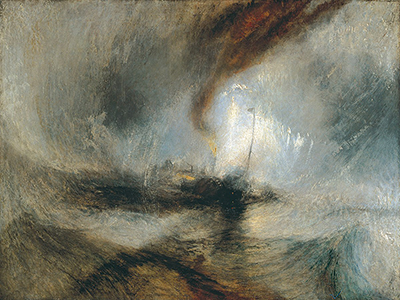
Perspective also gives a useful key to Turner's late freedom. An artist trained to construct space can choose when to destabilise it. Turner often makes viewers feel that weather, glare or motion have interfered with ordinary vision. That effect depends on control. In harbours, city views and railway subjects, the spatial field may be partly hidden by atmosphere, but it rarely feels arbitrary. The biography of the Professor of Perspective and the biography of the painter of dissolving light are the same biography.
The Academy role also kept Turner in dialogue with younger artists and with institutional assumptions. Teaching perspective was not the same as teaching colour or landscape imagination, but it confirmed his authority in a core academic discipline. This complicates the idea that he was simply a rebel against academic standards. He could defend, teach and use those standards while making works that strained them.
Patrons, Studio and Independence
Turner's career depended on a combination of public exhibition, private patronage, print circulation and his own management of works. The Paul Mellon Centre notes that he established his own gallery. [5] That act matters because it shows an artist interested in controlling display and access. A private gallery could support sales, reputation and direct encounter with works outside the Academy calendar.
Patronage also shaped subject and opportunity. Turner worked for collectors who wanted topographical views, travel subjects, watercolours, engravings and paintings. He also cultivated major exhibition works that could advertise ambition. This double life between market and public statement was not unusual, but Turner pursued it with particular range. A small watercolour for engraving and a large Academy oil might belong to different economies, yet both could contribute to the same reputation.
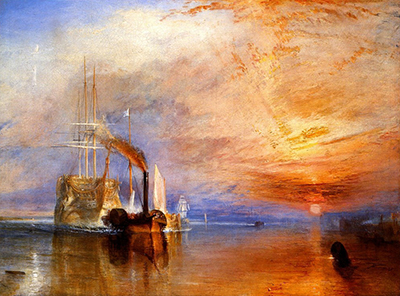
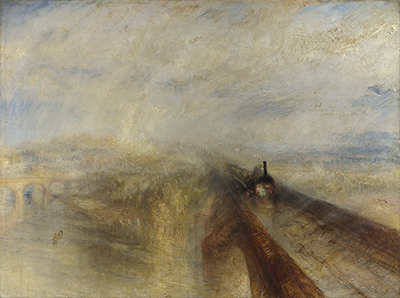
The National Gallery's artist account notes Turner's interest in contemporary technology and connects that interest with works such as The Fighting Temeraire and Rain, Steam, and Speed. [1] These subjects show a mature artist watching the world around him change. Patronage and market did not confine him to safe views. He could turn modern transport, steam power, naval memory, fire and social violence into subjects that challenged viewers.
Professional independence also meant that Turner retained many works. The later bequest would be possible because so much remained in his possession. Some works had been exhibited, some were unfinished, and some belonged to a wider studio inheritance. This complicates the biography because Turner did not simply produce, sell and disappear from his own work. He lived among pictures, studies and stored material that later became part of national art history.
His own gallery and retained works also affected how he thought about legacy. Turner was not passive about reputation. He made choices about what to show, what to keep and how to position himself against earlier artists. The bequest condition involving Claude is the clearest later evidence of that ambition, but the pattern appears earlier in the way he organised his career. He understood that the meaning of an artist's work depends partly on where and beside what it is seen.
The patronage world around Turner was socially complex. Collectors, aristocrats, publishers, institutions and critics all mattered. Some bought finished works; others commissioned views or supported print projects. Turner navigated this world without reducing himself to one role. He could supply a market and still pursue artistic competition. He could cultivate patrons and still keep works for himself. This tension between commerce and independence is one of the reasons his career remained so productive.
Modern Life and Historical Scale
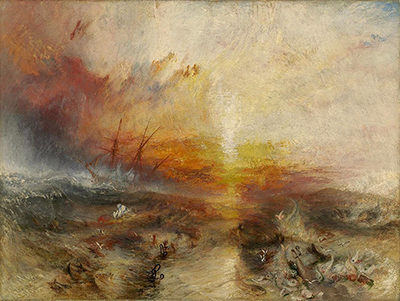
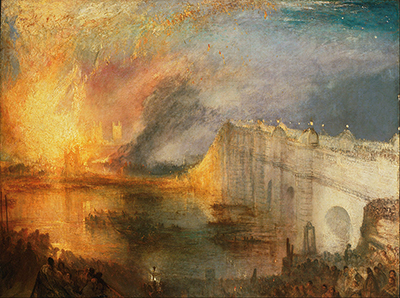
Turner came of age in a period of war, industrial growth, expanding empire, urban change and new forms of transport. His biography intersects with that modern world, but not through journalism alone. He transformed contemporary subjects through the language of landscape and history. The Met's essay discusses the fire that destroyed the Houses of Parliament in 1834, the violence of the slave trade in Slave Ship, and the industrial force of Rain, Steam, and Speed. [3] These works show Turner taking events and structures of his own time into the field of high ambition.
His treatment of modernity was rarely simple celebration or simple condemnation. Steam can be powerful and unsettling. Fire can be dramatic and destructive. The sea can be beautiful and violent. A ship can be both a vessel of national memory and an object moving toward disappearance. Turner's biography becomes more coherent when these tensions are allowed to remain. He did not merely illustrate modern life; he made viewers feel its instability.
Historical scale also came from older subjects. The Met notes Turner's study of Renaissance and Baroque masters and his interest in Poussin, Raphael, Titian and other predecessors. [3] The National Gallery identifies Claude and Wilson among formative landscape models. [1] Turner used those inheritances to claim that landscape could carry poetry, history and moral pressure. He could paint ancient Carthage or a modern railway with a related seriousness, even though the subjects belonged to different worlds.
This range sometimes made him difficult for critics. The more Turner pressed colour, atmosphere and loose handling, the more some viewers questioned finish and legibility. The Met records criticism of his handling and the later defence by John Ruskin. [3] Controversy was therefore part of the biography, not a late accident. Turner's public career involved repeated negotiation between recognition and resistance.
Modern subjects also sharpened the question of what landscape could include. A railway bridge, a burning parliament building or a slave ship might seem far from the calm ideals associated with Claude. Turner did not solve that distance by choosing one world over the other. He brought modern violence, speed and change into a pictorial language already trained by history, poetry and old-master example. That mixture is one reason his biography continues to feel modern without removing him from his own century.
The moral pressure of some subjects requires particular care. Turner could make terrible events visually compelling, and that tension should not be softened. The point is not that beauty excuses violence. Rather, Turner often used colour, weather and composition to make violence harder to ignore. His mature career repeatedly tests whether landscape can hold grief, terror and historical responsibility as well as scenery.
Turner’s encounter with modern industry also extended to whaling. The painting study Whalers looks closely at the hunt and its unstable sea, while Turner and Whaling places those images within the wider relationship between art, commerce, extraction and the limits of human mastery.
Venice, Italy and Late Vision
Italy had a special role in Turner's mature imagination. Rome connected him with classical and Renaissance ambition. Venice gave him a city of water, architecture, reflection and memory. The Met's discussion of Venice, from the Porch of Madonna della Salute notes that Turner combined several viewpoints into an impossible but compelling view. [3] That example captures a larger truth about his travel art: he did not merely report what he saw. He reconstructed place through pictorial intelligence.
Venice suited Turner because it joined many of his deepest interests. It was a city of light and water, but also a city of history, commerce and artistic inheritance. Buildings could appear solid and dissolving at once. Reflections could double and disturb architecture. Colour could seem to rise from water rather than sit on walls. Venice allowed Turner to make observed place behave like memory.
The late works are often discussed as if they break entirely with the rest of his life. A better biography sees continuity. The same artist who learned topography, perspective and old-master composition also learned how to loosen them. The same traveller who recorded places in sketchbooks later created images where place seems unstable. The same watercolourist who understood transparency and wash brought those lessons into oil. Late Turner is not a sudden abandonment of discipline; it is a long practice driven to more open results.
Late career also brought stronger critical division. Ruskin's defence, which grew into Modern Painters, is a major part of Turner's reception. [1][3] Yet Turner should not be reduced to Ruskin's version of him. Ruskin helped many readers understand the painter's seriousness, but Turner's career was already built from decades of work, travel, institutional achievement and market success. The artist did not need later praise to become important, though that praise shaped his afterlife.
The late works can look abrupt if the earlier career is compressed. In a fuller biography, they appear as the result of long accumulation. Watercolour taught Turner how colour could structure space. Travel taught him how memory changes what is seen. Print taught him the power of tone and sequence. Perspective taught him how to build and disturb space. The Royal Academy taught him how public ambition is staged. Late Turner draws on all of these lessons.
This is why the late biography should avoid simple decline narratives. Age and changing circumstances are part of any long life, but late Turner cannot be explained by age alone. The works still involve choice, habit, memory and technical resource. Some are hard to categorise because they were not all made for the same purpose. Some belonged to public exhibition; others remained in the studio. A careful biography leaves room for these distinctions.
Ruskin and Criticism
John Ruskin met Turner in 1840, according to the National Gallery's summary, and became one of the major defenders of his work. [1] The Met connects Ruskin's defence to criticism of Turner's loose handling in the 1830s and notes that the argument developed into the multi-volume Modern Painters. [3] This critical relationship is important, but it should be placed in proportion. Ruskin did not create Turner's achievement. He argued for it.
Turner's critics often struggled with the very qualities that later viewers value: intense colour, atmospheric uncertainty, compressed detail, blazing light and surfaces that can seem unfinished. Some criticism came from assumptions about finish and clarity. Some came from discomfort with the way Turner made subject dissolve into weather. His art could look excessive to viewers who wanted stable outlines or straightforward narrative.
Ruskin's defence gave language to Turner's seriousness as a painter of nature, truth and modern perception. It helped frame him for later nineteenth-century audiences and beyond. But Ruskin also shaped what later viewers expected to find. A modern biography should use Ruskin as part of Turner's reception rather than as the only key to his meaning. Turner's own career, Academy position, exhibitions, travels, technical range and bequest all provide independent evidence of importance.
Criticism also reminds us that Turner was contemporary before he was central. The works now treated as monuments entered the world as risky public objects. They were reviewed, questioned, praised, misunderstood and argued over. Turner's biography includes this unstable reception because it shows how innovation becomes history only after conflict.
Ruskin's role also demonstrates how artists can be remade by criticism while still resisting any single interpretation. Ruskin helped frame Turner as a painter of truth to nature and moral vision. Later generations found other Turners: a precursor of modern abstraction, a master of atmospheric colour, a painter of empire and violence, a technician of watercolour, a traveller, a London professional. None of these identities is sufficient alone. Biography has to let the record remain multiple.
The critical afterlife also affects how modern viewers approach the work. A painting that once seemed unfinished may now seem daring. A picture once attacked for looseness may now appear rigorous in its handling of perception. This reversal should make biography more cautious, not less. It shows that reputations are made through changing arguments, and that Turner's career has never stopped being interpreted.
Death and Bequest
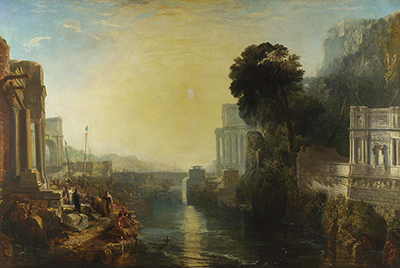
Turner died in 1851. The Met notes that he was buried in Saint Paul's Cathedral and that his bequest entered what became the Tate collection. [3] The National Gallery gives a fuller account of the Turner Bequest, explaining that he left a large group of paintings to the nation and attached a condition that Dido building Carthage and Sun Rising through Vapour should be displayed with selected works by Claude. [4] That condition is revealing. Turner wanted his afterlife to be framed through comparison with an old master he had studied and challenged.
The bequest was not straightforward. The National Gallery records that Turner's cousins contested his will, that a settlement followed, and that the resulting national gift became larger than the original condition alone. [4] Its account gives the total as close to three hundred oils plus roughly thirty thousand sketches and watercolours, among them three hundred sketchbooks, with most of the group now at Tate Britain. [4] Tate's project record separately notes approximately 37,500 accessioned works from the Turner Bequest in 1856. [7] Those figures are not interchangeable, because institutions count categories differently, but together they convey the exceptional scale of what survived.
The bequest changed Turner's biography after death. It made his studio legacy a public resource and allowed later generations to study his process in unusual depth. Finished paintings, unfinished works, sketches, watercolours and notebooks could be considered together. That survival makes Turner less like an artist known only through polished exhibition statements and more like an artist whose working life remains visible.
The National Gallery and Tate distribution also shaped public memory. Some major paintings remained at the National Gallery, while Tate became the principal home of the wider Turner Bequest. [1][4] This split means that Turner has more than one institutional identity. He is both the painter of celebrated national works and the artist of thousands of studies, drawings and experimental objects. His biography ends with death, but his artistic life continued through the collections created by the bequest.
The bequest also turned private accumulation into public evidence. Works that might have been dispersed, hidden or lost became part of a national research and display structure. That is why Turner can be studied with unusual depth: the famous works can be compared with sketches, unfinished material and studies that reveal decisions behind them. The biography of Turner after 1851 is therefore partly institutional. Museums, cataloguers, conservators and historians have continued to shape how his life is understood.
There is a final irony in this afterlife. Turner valued competition with old masters and public reputation, but the bequest made his working remains as important as his finished triumphs. Modern audiences often meet him not only through the grand statement but through evidence of process. This broader survival suits the career. Turner was always more than a maker of isolated images. He was a worker across media, a collector of visual experience and an artist whose life was built from repeated acts of looking.
Character and Caution
Turner has attracted stories about eccentricity, secrecy and private life. Some may have evidence behind them; others have grown through repetition. A responsible biography should not pretend that personality is irrelevant, but it should not use anecdote as a substitute for documented career structure. Turner's privacy, family relationships and late-life arrangements deserve careful handling because overconfident storytelling can distort the work.
What can be said securely is that Turner was professionally ambitious, unusually productive and committed to the institutions and markets that supported his art. He studied, exhibited, travelled, taught, managed works, engaged print culture and left a major public legacy. He could be controversial and admired at the same time. He could be loyal to old masters and experimental in handling. He could work from close observation and produce images that seem almost visionary.
The strongest biographical portrait is therefore not a caricature of a solitary genius. Turner was a London artist shaped by training, competition, labour, travel, commerce, criticism and public ambition. His individuality lies not in being outside history, but in what he did with the historical conditions around him. He used them to remake landscape.
This caution does not make Turner less vivid. It makes him more interesting. The documented Turner is already complex: a Covent Garden child who became an Academician; a watercolour prodigy who transformed oil painting; a traveller who kept returning to London; a teacher of perspective whose late works make sight unstable; a successful professional who left a difficult and magnificent national inheritance. The life does not need exaggeration. Its force lies in the way ordinary structures of training, work, travel, display and legacy were pushed into extraordinary artistic consequence.
Turner's biography also reminds viewers that artistic change is rarely clean. He did not move in a straight line from tradition to modernity. He carried tradition with him, tested it, altered it and sometimes made it almost unrecognisable. He remained attached to institutions while challenging viewers. He pursued markets while retaining works. He studied old masters while painting steam, smoke and violent weather. His life is best understood as a sequence of pressures held together by relentless practice.
Frequently Asked Questions
He first built public recognition through watercolour, showing works at the Royal Academy from 1790. He exhibited oils from 1796, became a full Royal Academician in 1802 and used landscape, marine painting, travel subjects, print projects and later modern subjects to expand his reputation. [1][2][3]
Yes. The Met records that Turner was elected Professor of Perspective after becoming a full Royal Academician, and that he remained active in Academy roles through much of his life. [3]
The Turner Bequest brought an exceptional body of work into public ownership after his death. The National Gallery gives the legacy as almost three hundred oils and about thirty thousand sketches and watercolours, including three hundred sketchbooks; Tate separately records approximately 37,500 accessioned works from the 1856 bequest. [4][7]
Discussion
Which documented turning point best explains the scale of Turner’s career?
Reader Insights
Where does training become public ambition?
How do travel, teaching and print projects complicate the image of Turner as a solitary painter?
How does the Turner Bequest change what a biography can show?
Join the Conversation
Share a close observation or a question for other readers.
References
- National Gallery, London, "Joseph Mallord William Turner 1775-1851." https://www.nationalgallery.org.uk/artists/joseph-mallord-william-turner
- National Galleries of Scotland, "Joseph Mallord William Turner." https://www.nationalgalleries.org/art-and-artists/artists/joseph-mallord-william-turner
- Elizabeth E. Barker, "Joseph Mallord William Turner (1775-1851)," The Metropolitan Museum of Art, Heilbrunn Timeline of Art History. https://www.metmuseum.org/essays/joseph-mallord-william-turner-1775-1851
- National Gallery, London, "The Turner Bequest." https://www.nationalgallery.org.uk/about-us/history/the-turner-bequest
- Paul Mellon Centre, "Research Joseph Mallord William Turner." https://www.paul-mellon-centre.ac.uk/archives-and-library/artist-subject-guides/joseph-mallord-william-turner
- Tate, "J.M.W. Turner: Sketchbooks, Drawings and Watercolours." https://www.tate.org.uk/art/research-publications/jmw-turner
- Tate, "J.M.W. Turner: Sketchbooks, Drawings, Watercolours," project record. https://www.tate.org.uk/about-us/projects/jmw-turner-sketchbooks-drawings-watercolours