

 by Tom Gurney
Tom Gurney BSc (Hons) is an art history expert with over 20 years experience
Published on June 19, 2020 / Updated on August 29, 2026
Email: tomgurney1@gmail.com / Phone: +44 7429 011000
Overview
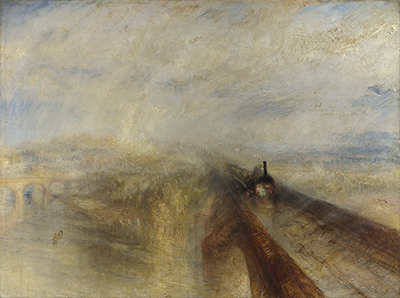
J. M. W. Turner's Rain, Steam, and Speed - The Great Western Railway stands among the most concentrated images of modern transport in nineteenth-century British painting. The National Gallery dates it to 1844, records the medium as oil on canvas, gives the dimensions as 91 x 121.8 cm, and identifies the work by inventory number NG538.[1] The Gallery lists the work in its main collection, acquired through the Turner Bequest of 1856, and recorded it in Room 40 when checked.[1]
The painting shows a steam engine crossing the Maidenhead Railway Bridge in rain.[1] The bridge was designed by Isambard Kingdom Brunel, completed in 1838, and in use from July 1839.[1] The train moves along the Great Western Railway, whose line connected London with Bristol and Exeter.[1] Turner places the engine, bridge, river, weather and surrounding countryside in one fast-moving field of perception.
The subject is modern, but the painting is not a simple celebration of machinery. The National Gallery stresses that Turner frequently painted contemporary life and was interested in industry and technology, making it unlikely that this picture should be read as a rejection of modernity.[1] The opposite error would be just as limiting. Turner does not merely praise the railway. He paints what speed does to vision, landscape, weather and older forms of movement.
The title gives the best clue. It does not say only "The Great Western Railway." It says Rain, Steam, and Speed - The Great Western Railway. Nature, technology and sensation are joined before the railway company is named. Rain blurs the view, steam marks the engine's force, and speed transforms space. Turner makes the railway visible as an experience, not merely as a machine.
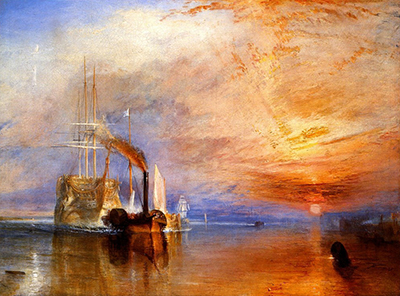
That is why the painting matters within Turner's late work. It belongs beside The Fighting Temeraire as a major image of steam and transition, but the emotional structure is different.[3] In The Fighting Temeraire, steam pulls an old warship away. In Rain, Steam, and Speed, the engine advances through the storm toward the viewer. One painting makes modern power elegiac; the other makes it immediate.
The painting also matters because it makes modern speed difficult rather than merely exciting. Turner does not give the viewer an easily legible railway scene with every detail safely arranged. He makes the bridge compress distance, lets rain disrupt certainty, and places older forms of movement almost at the edge of visibility. The result is a painting about seeing under pressure.
That pressure is historical as well as optical. Railways were changing how people understood journey time, landscape, weather, class and bodily travel. Turner did not stand outside those changes and illustrate them from a distance. He treated them as material for serious painting, making a locomotive and a railway bridge worthy of the same ambition he had long brought to storms, fires, myth and sea subjects.
At a Glance
- ArtistJoseph Mallord William Turner
- Full titleRain, Steam, and Speed - The Great Western Railway
- Date1844
- MediumOil on canvas
- Dimensions91 x 121.8 cm
- CollectionNational Gallery, London
- InventoryNG538
- AcquisitionTurner Bequest, 1856
- BridgeMaidenhead Railway Bridge over the Thames
- RailwayGreat Western Railway
Contents
- Overview
- Object Identity
- Railway and Bridge
- Train, Engine and Wagons
- Rain and Weather
- Steam and Visibility
- Speed and Perception
- Hare, Boat and Plough
- Industrial Modernity
- Comparison with The Fighting Temeraire
Object Identity
The National Gallery's full title is Rain, Steam, and Speed - The Great Western Railway.[1] The title must be kept intact before any shortened form is used, because "The Great Western Railway" locates the image within a specific nineteenth-century transport network. Turner is not painting an anonymous train. He is painting a modern railway identified with one of Britain's most ambitious lines.
The date is 1844.[1] This places the painting after the opening of the Maidenhead Viaduct to railway use in July 1839 and during the 1840s railway boom described by the National Gallery.[1] It also places the work late in Turner's career, when he had already treated fire, sea, Venice, shipwreck, slavery and steam as subjects in which atmosphere and modern experience could become inseparable.
The painting's support and scale matter. At 91 x 121.8 cm, the canvas is wide enough for bridge, train, river and fields to unfold across a broad view.[1] Yet the engine is not treated as a small anecdotal detail. Its dark front and smoke become the visual motor of the composition. The painting is landscape, but landscape reorganized by railway speed.
The Turner Bequest context is also important. The picture entered the National Gallery as part of the national inheritance after Turner's death.[1] Like The Fighting Temeraire, it has become one of the works through which modern viewers understand Turner's late imagination: luminous, difficult, forceful and concerned with the new technologies reshaping Britain.
Butlin and Joll's catalogue remains useful as a broader oil-painting framework, but the National Gallery supplies the controlling public object facts for this work.[4] That distinction matters because the painting has attracted a dense history of commentary, anecdotes and symbolic readings. Secure interpretation starts from title, date, medium, dimensions, inventory number, railway setting and the Gallery's account of the subject.
The object identity also guards against treating the painting as a generic image of "progress." It is more precise than that. It is a 1844 oil painting of a train on the Great Western Railway, crossing Brunel's Maidenhead Viaduct over the Thames in rain.[1] Turner's poetry begins from those concrete anchors.
The National Gallery's title also keeps the three experiential terms in view. "Rain," "steam" and "speed" are not decorative additions to a railway subject. They are the conditions under which the railway appears. Turner makes the picture's identity depend on atmosphere, mechanical force and altered perception before the named company completes the title.
The format of the work supports that ambition. A horizontal canvas can hold bridge, river, fields and sky, yet Turner compresses those elements around the locomotive's advance. The painting is broad enough to be landscape and concentrated enough to feel like impact. Its identity is therefore double: a view of a place and a study of velocity.
Railway and Bridge
The National Gallery identifies the bridge as Maidenhead Railway Bridge, or Maidenhead Viaduct, crossing the Thames between Taplow and Maidenhead.[1] Brunel designed it for the Great Western Railway, and the Gallery records that it was completed in 1838 and in railway use from July 1839.[1] These details are not decorative. They establish the painting as an image of named infrastructure.
The bridge carries the train through the scene on a strong diagonal. The National Gallery notes the exaggerated foreshortening of the viaduct, which leads the eye toward the horizon and suggests the speed with which the train bursts through the rain.[1] Turner uses perspective not simply to describe structure but to produce acceleration. The bridge is a machine for seeing quickly.
The railway line matters as much as the bridge. The National Gallery states that the Great Western line ran to Bristol and Exeter and that by 1844 more than 100 miles of it had already been built.[1] The painting therefore speaks to a large transport system, not just a single crossing. The train belongs to a network that was changing time, distance and travel across Britain.
The viewpoint is also controlled by the Gallery's account. We are looking east toward London while the train heads west.[1] That means the engine comes toward us while also moving away from the capital into the west of England. The painting's directional force is complex: visually, the train advances; geographically, it travels westward. Turner makes that tension part of the image's energy.
The older road bridge on the left is Taylor's bridge, built in the 1770s.[1] Its presence gives the railway bridge a historical counterpart. Turner does not isolate the new viaduct from earlier transport structures. He places modern rail beside older road crossing, river movement and rural labour. The picture becomes a layered history of travel.
The bridge is therefore not a neutral platform. It is the painting's structural armature. It organizes space, gives the train its diagonal path, places the railway above the Thames and turns engineering into pictorial drama. Brunel's infrastructure becomes a visual instrument in Turner's hands.
The bridge also changes the social meaning of the river. The Thames remains visible, but it is no longer the only major path through the landscape. The train crosses over water rather than following it. This crossing is a compact sign of a new relation between engineering and geography: the railway does not wait on older travel paths, but imposes a new line across them.
Turner avoids treating Brunel's bridge as an isolated triumph of construction. The viaduct is partly hidden by rain, speed and atmosphere. Its grandeur lies less in static architectural display than in what it enables: a train rushing across the Thames at a pace that changes the viewer's sense of distance. The bridge matters because it makes the scene move.
The diagonal also sets up a psychological relation with the viewer. A bridge seen from the side could be admired calmly. This bridge is experienced as a narrowing track along which a dark engine advances. Turner turns infrastructure into encounter. The viewer does not simply look at the railway; the railway seems to arrive.
Train, Engine and Wagons
The National Gallery identifies the engine as a "Firefly" class locomotive.[1] It pulls unroofed open-goods wagons in which the cheapest passengers could travel.[1] That fact matters because the train is not only an engineering object. It is a vehicle of public travel, classed experience and bodily exposure to weather.
The engine appears through rain rather than in crisp profile. Turner gives enough information for recognition: the dark funnel, frontal force, smoke or steam, and the line of wagons behind. But he does not freeze the locomotive into technical clarity. The train is seen under the conditions of speed and weather. It is not a museum specimen. It is an event.
The National Gallery records that average engine speed on the Great Western Railway in 1844 was 33 mph, while long level stretches such as the Maidenhead Viaduct could reach an unprecedented 60 mph.[1] Those numbers help explain the painting's visual urgency. For many viewers in the 1840s, railway velocity was not routine background. It was a new pressure on perception.
Turner converts that pressure into paint. The engine comes forward as if the viewer's eye must react quickly. The bridge narrows, rain veils the distance, and the track becomes a compressed path of motion. The train is not just travelling through the landscape. It is changing how landscape can be seen.
The wagons add a human dimension. The cheapest passengers could ride in unroofed open-goods wagons, exposed to rain and speed.[1] Turner does not make those passengers the focus, but their presence in the Gallery's account reminds us that modern transport was experienced through bodies, cost and social position. The railway changed perception, but it also changed everyday movement.
The engine's force is not heroic in a conventional sense. It is dark, frontal and difficult to read through the weather. Its power is felt less through polished detail than through compression, direction and atmosphere. Turner makes the locomotive a visual impact rather than a neatly described machine.
The "Firefly" identification should be used carefully. It gives a useful class name for the engine, but Turner does not paint a catalogue illustration of locomotive design.[1] The engine's pictorial role is to carry force through rain. The viewer reads it by its approach, funnel, puffs of vapour, dark mass and relation to the bridge rather than by a complete mechanical inventory.
The open wagons also complicate any easy romance of rail travel. Speed was thrilling, but it could also be exposed and uncomfortable, especially for passengers travelling in cheaper conditions.[1] Turner does not foreground those passengers, but the National Gallery's account keeps the human experience of the train in view. Modernity here includes bodily vulnerability to weather.
The locomotive's forward thrust also makes the viewer aware of modern time. The train does not drift or meander. It arrives according to mechanical rhythm, railway line and engineered momentum. Turner's handling turns that rhythm into visual urgency, making the act of looking feel compressed.
Rain and Weather
Rain is not background in this painting. It is one of the title's first terms. Turner asks the viewer to understand the railway through weather, and weather through railway speed. The National Gallery describes the engine crossing the bridge in rain and stresses the way the train bursts into view through that rain.[1] The atmosphere is the condition of seeing.
Rain makes outlines uncertain. It softens fields, water and distance, and it prevents the railway from becoming a dry diagram of engineering. The bridge remains legible, but the world around it is unstable. Turner makes rain part of the painting's modernity: speed does not clarify the world; it can blur it.
The title also gives rain equal status with steam and speed. That equality is important. Turner does not place technology over nature in a simple hierarchy. Rain, steam and velocity act together. The engine produces one kind of vapour; the weather produces another kind of visual interference. The viewer meets both as forces.
The National Gallery notes John Gage's observation that the title points toward forces of nature rather than simply a view of the railway.[1] That reading helps keep the painting from becoming mechanical illustration. Rain and sunlight, fields and river, steam and train all participate in the image. The railway is modern, but it is not outside nature.
The rain also changes time. A clear railway view might let the viewer examine the bridge and train calmly. Turner's rain makes the moment urgent. Things appear and disappear. The train comes forward before the eye can settle. Weather helps Turner make speed visible.
In that sense, Rain, Steam, and Speed belongs to Turner's broader art of atmosphere. He had long used mist, sea spray, fire, smoke and sunset to make historical subjects into sensory experiences. Here, rain does the work of modern perception. It makes the machine feel immediate, unstable and hard to contain.
The rain also protects the painting from becoming a simple portrait of technology. If the engine and bridge were sharply exposed under clear light, the viewer might read the work primarily as industrial description. By making rain so central, Turner brings the modern machine into the same realm as storm, sea and vapour. The railway becomes a weather event as much as a transport event.
This is one reason the painting can feel both contemporary and timeless. Its named railway belongs to a precise historical moment, but its rain belongs to Turner's long engagement with unstable atmosphere. The picture holds a new machine inside an older painterly problem: how to make air, moisture and light visible.
Rain also changes moral tone. It prevents triumphal clarity. The train is powerful, but it is not cleanly glorified. It emerges through a world that resists full control. Turner lets weather remain active, reminding the viewer that modern machinery operates within nature rather than outside it.
Steam and Visibility
Steam is the title's second term, and it links technology to atmosphere. The engine's vapour is a sign of mechanical power, but it also participates in the painting's blur. Steam marks the train as modern while making its form less stable. Turner uses the very sign of industrial energy to dissolve hard edges.
The National Gallery notes that in 1844 engines did not produce the great clouds of steam later associated with steam locomotives, and that Turner represents steam through three small puffs from the engine's funnel.[1] That detail matters because it keeps the painting historically grounded. Turner is not simply filling the sky with theatrical vapour. He is calibrating the engine's presence within a rain-filled scene.
The smoke or steam from the engine is visually modest compared with the whole field of weather. This balance is important. The train is powerful, but it is not the only force in the painting. Rain, light, river, bridge and terrain all shape what the viewer sees. The modern machine enters the atmosphere rather than replacing it.
Steam also changes the meaning of the Thames. The river had long supported boats, trade and older forms of travel. In Turner's painting, the railway crosses over it. The steam engine does not follow the waterway; it cuts across it on engineered structure. The old relation between river and movement is altered by bridge and rail.
Yet Turner does not make the river obsolete. The National Gallery identifies a small boat on the left as one of the painting's slow, non-mechanised details.[1] The boat remains visible within the new world of rail. It helps define the contrast between older movement and the mechanical speed above it.
Steam therefore becomes more than a fuel effect. It is a sign of altered space. The train can cross water, compress distance and reorganize travel. Turner paints that alteration through haze, speed and diagonal force rather than through explanatory detail.
Visibility is therefore unstable by design. The viewer knows that a train is approaching, but the rain and vapour keep the object from settling into fixed outline. Turner makes modern technology partially knowable through its effects. The engine is recognized by what it does to space, air and attention.
The small puffs of steam are especially important because they resist later assumptions about railway imagery. Modern viewers may expect dramatic clouds from steam locomotives, but the National Gallery notes that engines of the period did not produce the great vapour masses familiar from later visual culture.[1] Turner keeps the effect relatively restrained while allowing rain to carry much of the atmospheric drama.
The title's order also matters. Steam sits between rain and speed. It belongs to the engine, but it also behaves visually like weather. This middle position makes steam the hinge between nature and technology, between atmosphere and machine.
Speed and Perception
Speed is the title's third term, and it may be the painting's deepest subject. Turner does not simply depict a fast train; he tests how speed changes visual experience. The bridge's foreshortening, the engine's frontal advance and the rain's blur all work together to make the viewer feel movement before fully parsing it.
The National Gallery states that the viaduct's exaggerated recession suggests the speed with which the train appears through rain.[1] This is a pictorial decision, not merely a record of bridge geometry. Turner uses perspective to make space collapse quickly. The eye is pulled along the track, then thrown toward the dark engine.
The hare sharpens the theme. The National Gallery explains that Turner lightly brushed a hare roughly midway along the rail track to represent natural speed in contrast to mechanical speed.[1] The animal is now invisible because the paint has become transparent with age, but it can be seen in an 1859 engraving.[1] This is one of the painting's most important small details, and it must be handled with source care.
The hare also unsettles a simple machine-versus-nature reading. It is not just a victim or a decorative emblem. It brings an older measure of velocity into the modern railway scene. A hare had long been an image of natural quickness, but the train redefines the scale of speed. Turner places two kinds of motion in relation without turning the painting into a slogan.
The National Gallery records a recollection from George Leslie that Turner was adding final touches shortly before public exhibition and that the hare, not the train, was said to represent speed.[1] The claim is valuable because it preserves an early interpretive memory, but it should not make the rest of the painting irrelevant. The train, bridge and rain still create speed through composition.
Speed is therefore distributed. It belongs to the train's motion, to the hare's body, to the diagonal bridge, to the viewer's eye, and to the weather that prevents leisurely inspection. Turner makes speed a visual condition rather than a single object.
The painting also asks what happens when the old measures of speed no longer suffice. A running hare had once been a powerful emblem of quickness. In Turner's railway world, the hare is still meaningful, but it is no longer the upper limit. Mechanical velocity changes the scale against which natural movement is judged.
The National Gallery's speed figures help make this transformation concrete. Thirty-three miles per hour as an average, and up to 60 mph on long level stretches, were extraordinary in relation to older travel by foot, animal, boat or coach.[1] Turner does not need to write those numbers into the image. He turns their effect into a visual shock.
Speed also changes the viewer's body. The eye follows the track too quickly, reaches the engine, then has to search back into rain for secondary details. This rhythm imitates a modern encounter with rapid transport: perception first registers impact, then reconstructs context afterward.
Hare, Boat and Plough
The National Gallery identifies three small details that extend the painting's theme of speed and modernity: the hare along the track, the boat on the river to the left, and the horse-drawn plough near the right edge.[1] These motifs should not be overdeveloped beyond the evidence, but they are central to the Gallery's reading of the work.
The hare is the most famous of the three. Because the paint has become transparent with age, modern viewers may not see it in the painting itself.[1] That invisibility matters. A detail meant to carry speed has nearly disappeared from sight, while the train remains visually dominant. The painting's own material ageing has changed how its symbols are encountered.
The boat offers a slower form of movement on the Thames.[1] It recalls a world of river travel that predated the railway's high-speed crossing. Turner does not remove the boat from the scene. Instead, he places it below and beside the modern transport system. Older movement continues, but it has been visually subordinated by rail.
The plough points toward rural labour.[1] Its near invisibility is also meaningful. The countryside remains present, but the railway alters the viewer's access to it. The field is no longer simply pastoral space. It is part of a landscape crossed and accelerated by modern infrastructure.
Together, hare, boat and plough prevent the train from standing alone. They set mechanical speed against natural speed, river movement and agricultural labour. The painting's modernity is not only the locomotive. It is the new relation among forms of movement.
These details also show Turner's compression. A lesser painting might separate railway, animal, boat and labour into clear narrative zones. Turner embeds them in rain and perspective. The viewer must search, infer and compare. The painting makes modernity difficult to see all at once.
The small motifs also keep the painting from becoming only an image of machinery. The hare, boat and plough carry older forms of motion and work into the railway age.[1] None of them stops the train. None of them disappears entirely from Turner's world. Their value lies in comparison: they show what the new speed has changed.
The plough is especially quiet. It is easy to overlook because Turner does not turn agricultural labour into a central anecdote. Yet its presence near the edge of the picture matters. The railway crosses a landscape still shaped by work in fields. Modern transport does not arrive in an empty space; it passes through older economies and habits.
The boat plays a related role on the Thames. It does not oppose the railway dramatically. It simply continues another kind of movement below the bridge. Turner lets the viewer understand change through coexistence. Old and new forms of travel share the image, but not equal visual force.
Industrial Modernity
The Met's Heilbrunn essay places Rain, Steam, and Speed - The Great Western Railway among Turner's responses to contemporary life, describing it as an image that evokes the Industrial Revolution's rapid transformations through strong diagonals, bold light-dark contrasts and turbulent handling.[2] That framing is useful because it connects the painting to a wider historical shift without reducing it to a mechanical illustration.
The National Gallery's account is equally important because it rejects a simple anti-modern reading. Turner was interested in industry and technology, used modern transport, and saw both train and bridge as subjects worthy of painting.[1] The picture's ambiguity comes from this seriousness. Turner treats the railway as powerful, unsettling and visually magnificent.
Modernity here is sensory. It is rain on the eye, speed in the diagonal, steam in the air, and the engine's forward pressure. Turner does not paint the railway as a chart of progress. He paints the experience of confronting it. The viewer feels the train before fully understanding its parts.
The painting also complicates older ideas of the sublime. Earlier sublime subjects might involve mountains, storms, seas or ancient catastrophe. Here, a railway crossing the Thames becomes a vehicle for grand emotion. Turner makes a modern machine and a modern bridge capable of the same intensity as natural or historical drama.
This does not mean the painting is simply "modernist" in a later twentieth-century sense. The Met notes Turner's importance for later abstraction, but the painting remains grounded in a named railway, bridge, river and date.[2] Its force comes from the meeting of recognizable subject and nearly overwhelming handling.
Industrial modernity is therefore not an external theme imposed on the picture. It is built into the way Turner makes the viewer see. Bridge, engine, weather, animal, boat and field become parts of one transformed visual environment.
This is the main difference between an object-centered reading and a general discussion of Turner and industry. The painting does not need broad claims about all modern technology to matter. Its evidence is local and precise: one train, one bridge, one river crossing, one weather condition, one group of nearly hidden comparative motifs. From those particulars, Turner builds a much larger sense of change.
The painting also speaks to modernity as uncertainty. The viewer can identify the bridge and train, but the painting resists full clarity. Rain interrupts vision; speed shortens time for recognition; the hare almost vanishes; field labour and boat movement sit at the margins. Modernity is not presented as a clear future but as a transformed way of seeing.
That uncertainty is why the work avoids propaganda. It neither instructs the viewer to cheer the railway nor tells the viewer to fear it. Instead, Turner lets the viewer experience power, blur, force, speed and coexistence. The railway is neither wholly outside the landscape nor comfortably absorbed by it.
Comparison with The Fighting Temeraire
The National Gallery directly compares Rain, Steam, and Speed with The Fighting Temeraire, noting that Turner contrasts the pre-industrial with the modern in both paintings.[1][3] The comparison is useful, but it must be kept controlled. The Temeraire painting is about an old warship being towed toward dismantling; Rain, Steam, and Speed is about a train advancing across a railway bridge.
In The Fighting Temeraire, steam pulls the past away. In Rain, Steam, and Speed, steam drives into the present. The emotional tone changes accordingly. The Temeraire picture is elegiac, built around sunset, old naval memory and a tug's dark work.[3] The railway painting is more immediate, frontal and weather-driven.
The direction of movement is also different. The Temeraire is passive under tow; the locomotive is active, rushing forward. The old ship receives much of the visual tenderness in the earlier work, while the steam tug carries the action. In the railway painting, the train itself is both subject and force. There is no dignified old vessel to absorb the viewer's sympathy.
Both paintings avoid simple verdicts. The Temeraire image mourns an old naval order but recognizes steam's practical force.[3] The railway image recognizes the excitement and disturbance of mechanized speed without turning the train into either hero or villain.[1] Turner repeatedly finds complexity in transitions between old and new forms of movement.
The comparison also shows how differently Turner could paint steam. In The Fighting Temeraire, steam is part of a tug's dark intrusion into a scene of farewell.[3] In Rain, Steam, and Speed, steam becomes one member of a trio with rain and velocity. It is atmospheric as much as mechanical.
Together the works reveal Turner's unusual seriousness about transport. He did not treat steam power as an unworthy modern nuisance. He made it central to images about memory, perception and historical change.
The comparison also shows a shift from farewell to arrival. The Fighting Temeraire moves toward disappearance; Rain, Steam, and Speed comes forward in active presence. The steam tug in the earlier painting is subordinated to the old ship's dignity, even while doing the work. The locomotive in the later painting is the visual center of force. Turner changes the emotional grammar of steam.
The two paintings also use water differently. In the Temeraire painting, the Thames carries a naval relic toward its end.[3] In the railway painting, the Thames is crossed by a new structure and visually subordinated to rail. The river remains meaningful in both, but its relation to modern power changes.
This controlled comparison helps prevent overstatement. Turner did not have one fixed response to steam. He used steam to think about different historical situations: the passing of a warship, the rush of railway travel, the visual strain of weather and speed. The railway painting should be read on its own terms, not as a repetition of the Temeraire elegy.
Composition and Diagonal Force
The composition is built around diagonal thrust. The bridge enters the field at an angle, and the train rides that angle toward the viewer. The National Gallery highlights the abrupt foreshortening of the viaduct as a means of suggesting speed.[1] Turner turns perspective into physical sensation.
The diagonal does more than lead the eye. It destabilizes the scene. The viewer is not given a calm, frontal architectural view. Instead, the railway line cuts through rain, water and land. The engine's approach feels almost invasive because the diagonal converts depth into momentum.
The double rail track is reduced to a single narrow line, a choice the National Gallery notes as another way Turner accentuates speed.[1] This simplification is important. Turner adjusts visual information to sharpen experience. He does not need every rail described evenly. He needs the track to function as a speeding line.
The bridge's structure also organizes contrasts. Above is the train; below is the Thames. To one side are field and plough; elsewhere, boat and older bridge. The modern railway does not erase the older world, but it crosses over it. That spatial relation gives the painting much of its meaning.
The horizon is pulled into the action. The eye follows the bridge back, then rebounds toward the engine. The painting makes distance active. Space is no longer a calm recession into background; it is a path of acceleration.
Turner's handling makes the diagonal even more forceful. Rain and loose paint prevent architectural precision from becoming static. The composition feels engineered and atmospheric at once. That duality is the painting's central achievement.
The diagonal also creates a relationship between danger and attraction. The engine comes toward the viewer, but not in a fully theatrical collision. It is near enough to feel forceful and distant enough to remain embedded in landscape. Turner balances approach and depth so the viewer experiences speed without losing the wider world.
The bridge's geometry gives the eye a path; rain interrupts that path. This alternation is crucial. If the line were too clear, the image would become a demonstration of perspective. If the rain were too opaque, the train would lose force. Turner holds the two in tension, making the painting both structured and unstable.
Compositionally, the older motifs sit against the diagonal's dominance. The boat, plough and hare create small counterpoints to the railway's line. They do not stop the motion, but they prevent the viewer from reading the train as the only meaningful presence. The whole canvas becomes a comparison of speeds.
Turner, Perspective and Visual Experiment
Turner was Professor of Perspective at the Royal Academy, and the National Gallery notes that his study of perspective, including through Poussin and Claude, may have informed the railway painting.[1] This context matters because the painting's apparent looseness does not mean indifference to structure. Turner knew how perspective worked, and he used it expressively.
The railway gave him a new perspective problem. How could painting show speed, not just distance? How could a bridge be made to feel like motion? How could a train appear through rain without becoming illegible? Turner answered through diagonal recession, atmospheric blur and selective emphasis.
The result is not photographic. It is pictorially constructed. Turner reduces some details, intensifies others and lets weather interfere with form. This is a carefully built visual experiment in which the train's speed alters the very conditions of representation.
The Met's account of Turner as an innovator is relevant here.[2] His late handling could appear bold, turbulent and difficult to conservative viewers, yet it allowed him to address modern subjects with unusual force. Rain, Steam, and Speed depends on that innovation. A tidier style might have described the train but failed to convey its impact.
Perspective in this painting is therefore not academic display. It is emotional engineering. The bridge is drawn and distorted enough to make the viewer feel velocity. The railway line becomes an instrument for compressing space.
This is why the painting still feels urgent. Even viewers accustomed to high-speed travel can sense Turner's discovery: mechanical speed changes not only how people move, but how the world appears.
### Material Handling
The National Gallery gives the medium as oil on canvas.[1] That simple fact matters because Turner's handling of oil paint is central to how the painting works. Rain, steam, light, bridge and engine are not separated by hard descriptive outlines. They are built from tonal shifts, smears, contrasts and passages of colour.
The Met notes that Turner carried habits associated with watercolour into oil, using colour-based construction to create luminous and evocative forms.[2] That broader observation helps explain why the railway picture does not behave like a conventional mechanical view. Turner uses oil to suggest atmospheric pressure and motion.
The hare's material condition is especially revealing. The National Gallery says Turner added it lightly over earlier paint, and that the ageing surface has made the animal disappear from normal view.[1] A small symbol of speed has been changed by the material history of the picture itself. The work's present appearance is therefore not exactly the same as its 1844 exhibition appearance.
The paint handling also makes the train both present and elusive. The engine is dark enough to anchor the composition, yet rain and atmosphere keep it from becoming sharply bounded. Turner gives the machine force without reducing it to clean outline. This is a painting about moving through a medium: air, rain, steam and paint.
The bridge receives a similar treatment. Its geometry is strong, but its edges participate in the weather. The structure remains identifiable, yet it is never detached from the conditions around it. Turner makes engineering and atmosphere interdependent.
The surface therefore carries the painting's argument. Modern speed is not represented only by subject matter. It is embodied in the way forms press forward, blur, dissolve and reappear.
This surface quality also explains why the painting can seem at once descriptive and elusive. The title, bridge and engine give firm anchors, but the paint refuses a clean separation between them. Rain, steam and speed are not just named; they are enacted through handling. The work's material condition becomes part of its meaning.
The nearly lost hare is a useful reminder that paintings change over time. A motif visible through engraving may now be hard to detect on the canvas.[1] Interpretation has to account for that changed visibility. The painting's present viewers encounter a slightly different balance of evidence than early viewers did.
Exhibition and Reception
The painting was shown publicly in 1844, and the National Gallery's bibliography records early responses from the same year, including W. M. Thackeray's writing and J. G. Kohl's account of Britain.[1] The public exhibition context matters because the railway was not a distant historical subject. It was contemporary life, recognizable and debated.
The 1840s were marked by railway expansion. The National Gallery refers to railway mania and notes that the Great Western Railway had already built more than 100 miles of line by 1844.[1] Turner's painting entered that moment. Viewers were not looking at an antique curiosity; they were looking at a new force changing travel and landscape around them.
The Jane O'Meara story also belongs to reception history. The National Gallery records her later claim, told to Ruskin, that she had travelled on the line during a storm in 1843 and later believed a fellow passenger leaning from the train window must have been Turner.[1] The Gallery treats this as an account, not proof that Turner literally painted from such a journey. The responsible conclusion is uncertainty.
That uncertainty is useful. It prevents the painting from being reduced to a single biographical anecdote. Turner may have travelled on the line; he may have known engravings of trains moving diagonally at speed; he certainly understood perspective and modern transport as pictorial problems.[1] The work does not depend on proving one dramatic train-window moment.
The painting's early and later bibliography shows how persistently it has attracted interpretation.[1] Critics and historians have asked whether it is about progress, nature, speed, perception, railway culture or industrial transformation. The answer is not one of these alone. Turner built a painting capable of holding them together.
Its reception also connects to Ruskin's defence of Turner more broadly. The Met notes that harsh criticism of Turner's loose handling helped provoke Ruskin's defence, which grew into Modern Painters.[2] Rain, Steam, and Speed belongs to the visual world that made Turner both celebrated and contested.
The National Gallery's record also makes clear that the railway painting continued to be discussed across later scholarship.[1] That long attention is not surprising. The picture touches several large questions at once: how painting can represent speed, how modern transport changes landscape, how industrial forms enter art, and how visible details can be hidden by both weather and ageing paint.
The 1844 exhibition moment is especially important because the railway was current experience, not nostalgia. Many viewers would have known the excitement, discomfort, controversy or novelty of rail travel. Turner offered them not a clean endorsement but a painting that made their own world look strange, grand and unstable.
The Jane O'Meara anecdote belongs in this atmosphere of memory and recognition. Its value is not that it proves Turner leaned from a train window. The National Gallery does not let it do that.[1] Its value is that viewers quickly wanted to connect the painting's force to embodied experience: rain, travel, exposure, speed and a human face in a railway carriage.
How to Read Rain, Steam, and Speed
Start with the title. Rain, Steam, and Speed - The Great Western Railway gives three forces before naming the railway.[1] The painting is about atmospheric condition, mechanical power and velocity as much as about a specific line.
Then identify the bridge. It is Brunel's Maidenhead Viaduct over the Thames between Taplow and Maidenhead.[1] The bridge gives the train its diagonal path and turns engineering into pictorial movement. Its foreshortening is central to how the work suggests speed.
Next, look for older forms of movement. The National Gallery identifies the hare, the boat and the plough as details that extend the speed theme.[1] The hare contrasts natural and mechanical speed; the boat and plough mark slower, non-mechanised activity.
After that, attend to the weather. Rain and steam make the image hard to read in a productive way. Turner is not failing to describe. He is painting the way speed and weather alter description. Uncertainty becomes part of perception.
Finally, avoid simple verdicts. The painting is not merely pro-railway or anti-railway. Turner was interested in industry and technology, and the National Gallery says he saw train and bridge as worthy subjects.[1] The picture is best read as a sensory encounter with modern transport.
Read the minor details only after establishing the main structure. The hare, boat and plough are meaningful because they sit within a scene already ruled by diagonal force, rain and railway motion.[1] Isolating them too early can make the painting feel like a set of symbols. Turner instead makes them part of a larger visual pressure.
It also helps to compare the painting with The Fighting Temeraire without letting that comparison take over. Both pictures involve steam and older forms of movement, but the railway painting is more direct, frontal and perceptual.[3] The train is not carrying a relic away. It is changing the viewer's experience of the landscape as it arrives.
Frequently Asked Questions
The National Gallery records the full title as Rain, Steam, and Speed - The Great Western Railway.[1]
The National Gallery dates the painting to 1844.[1] That places it after the Maidenhead Viaduct entered railway use in 1839 and during the 1840s railway boom.
The National Gallery, London holds the painting under inventory number NG538. The Gallery lists it in the main collection and recorded Room 40 as its display location when checked.[1]
The bridge is Maidenhead Railway Bridge, also called Maidenhead Viaduct, crossing the Thames between Taplow and Maidenhead. It was designed by Brunel.[1]
That should not be stated as fact. The National Gallery records a later story told to Ruskin by Jane O'Meara, but also says we cannot be certain whether the painting was inspired by a recent journey or whether Turner travelled on that stretch of track.[1]
The National Gallery says Turner used the hare to contrast natural speed with the mechanised speed of the engine. Because of changes in the paint surface, the animal is no longer normally visible on the canvas, though it appears in an 1859 engraving.[1]
Not simply. The National Gallery says Turner was interested in industry and technology and likely did not intend a rejection of modernity.[1] The painting treats the railway as powerful, sensory and ambiguous.
Discussion
How does Turner make railway speed alter the viewer's experience of landscape and weather?
Reader Insights
How does the viaduct's diagonal make the locomotive feel faster?
Where do rain and steam become difficult to distinguish?
Does the painting celebrate, question, or simply intensify railway power?
Join the Conversation
Share a close observation or a question for other readers.
References
- National Gallery, London, "Joseph Mallord William Turner, Rain, Steam, and Speed - The Great Western Railway." https://www.nationalgallery.org.uk/paintings/joseph-mallord-william-turner-rain-steam-and-speed-the-great-western-railway
- Elizabeth E. Barker, "Joseph Mallord William Turner (1775-1851)," Metropolitan Museum of Art, Heilbrunn Timeline of Art History. https://www.metmuseum.org/essays/joseph-mallord-william-turner-1775-1851
- National Gallery, London, "Joseph Mallord William Turner, The Fighting Temeraire." https://www.nationalgallery.org.uk/paintings/joseph-mallord-william-turner-the-fighting-temeraire
- Martin Butlin and Evelyn Joll, *The Paintings of J. M. W. Turner*, revised edition, Yale University Press, 1984.