

 by Tom Gurney
Tom Gurney BSc (Hons) is an art history expert with over 20 years experience
Published on June 19, 2020 / Updated on August 29, 2026
Email: tomgurney1@gmail.com / Phone: +44 7429 011000
Overview
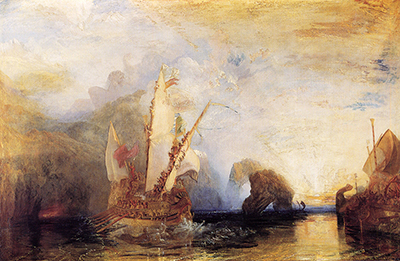
J. M. W. Turner's Ulysses deriding Polyphemus - Homer's Odyssey is one of the great mythological seascapes in British art. Painted in 1829, it belongs to the National Gallery, London, where it is recorded as NG508.[1] The National Gallery gives the medium as oil on canvas, the dimensions as 132.5 x 203 cm, and the acquisition credit as the Turner Bequest of 1856.[1] The full title matters because Turner is not offering a generic marine sunrise. He is staging a precise Homeric moment through light, colour, ship, cliff and mythic apparition.
The subject comes from Book IX of Homer's Odyssey. Ulysses, having escaped from the cave of the Cyclops Polyphemus, sails away from the island and turns back to taunt the giant. The National Gallery describes Ulysses standing on his ship beneath a red banner, wearing a helmet and scarlet cloak, raising his arms in victory and holding the flaming torch with which he blinded Polyphemus.[1] The huge Cyclops is not a clear theatrical figure in the foreground. His shadowy body lies across the clifftop above, almost absorbed into land, mist and dawn.[1]
The painting is also a major statement about colour and light. The National Gallery links it to the increasing role of colour and light in Turner's historical landscapes and notes that it anticipates the visionary qualities of his later work.[1] Turner makes sunrise do more than illuminate a story. It becomes the force that organises the entire painting: the ship, the sea nymphs, the flying fish, the red signals, the distant cliff, and the almost hidden giant all exist inside an atmosphere of brilliant transformation.
John Ruskin later called the work "the central picture of Turner's career", a judgement recorded by the National Gallery in its account of the painting's reception.[1] That phrase should be used carefully. It is not a neutral fact about all Turner scholarship; it is a powerful Ruskinian assessment. Still, it helps explain why the painting has often seemed to stand at a turning point. It gathers classical subject, Claudean sunrise, Italian experience, optical colour and Turner's growing expressive freedom into one densely imagined seascape.
The painting is therefore best approached as a convergence rather than a single-theme work. It is literary, but not only literary. It is marine, but not only marine. It is a colour experiment, but not a detached exercise in brilliance. Turner makes each register answer the others. The Homeric taunt gives the picture narrative tension; the ship gives it forward motion; Polyphemus gives it danger; Apollo's dawn gives it cosmic scale; Claude gives it an artistic ancestor to challenge. The result is a painting in which myth and modern pictorial ambition become inseparable.
At a Glance
- ArtistJoseph Mallord William Turner
- Full titleUlysses deriding Polyphemus - Homer's Odyssey
- Date1829
- MediumOil on canvas
- Dimensions132.5 x 203 cm
- CollectionNational Gallery, London
- InventoryNG508
- AcquisitionTurner Bequest, 1856
- Literary sourceHomer's Odyssey, Book IX
- Central imageUlysses' ship leaving Polyphemus at sunrise
Contents
- Overview
- Object Identity
- The Odyssey Episode
- Ulysses, Polyphemus and the Problem of Seeing
- The Ship and the Sea
- Apollo, Dawn and Mythic Time
- Claude and the Sunrise Tradition
- Colour, Optics and Expressive Direction
- Reception and Ruskin
- Rome, Sketches and Preparation
Object Identity
The National Gallery records the full title as Ulysses deriding Polyphemus - Homer's Odyssey.[1] The date is 1829, the artist is Joseph Mallord William Turner, the medium is oil on canvas, and the dimensions are 132.5 x 203 cm.[1] The painting entered the National Gallery through the Turner Bequest in 1856 and is listed with the inventory number NG508.[1] At the time of the National Gallery record checked for this project, it was not on display.[1]
Those facts establish the work as a large, finished oil painting from Turner's mature period. It was produced for public exhibition and belongs to the same broad phase in which Turner was rethinking how history painting could operate through landscape, marine space and light. The title announces a classical narrative. The form of the painting asks the viewer to experience that narrative as a dazzling event of colour.
The National Gallery also notes Turner's previous ownership and the original frame.[1] These details are worth holding in mind because they remind us that the painting had an object life before and after museum ownership. Turner made it as a public-facing work, kept it within his own holdings, and left it to the nation through the bequest that shaped so much of his posthumous reputation.
Butlin and Joll's catalogue of Turner's paintings remains a key scholarly anchor for works of this kind, giving a broader framework for title, exhibition, provenance and related oil-painting context.[2] That catalogue grounding matters because Ulysses deriding Polyphemus - Homer's Odyssey is unusually rich in literary, visual and technical associations. A clear object identity keeps those associations from overwhelming the painting itself.
This is also why the Homer subtitle should not be dropped too quickly. The shorter title, Ulysses Deriding Polyphemus, is convenient, but the full National Gallery title fixes the painting to the Odyssey. Turner is not merely showing a ship and a giant. He is translating a named episode from epic poetry into a seascape of dawn, boast, escape and danger.
The dimensions also change how the picture works. At just over two metres wide, the painting is large enough for the ship, sea, cliff, sky and sunrise to operate as a theatrical field. The viewer is drawn first into colour and radiance, then into the smaller incidents that explain the title. This scale supports Turner's method: a story that could be stated in a sentence becomes an environment that must be searched.
Because the National Gallery record includes the original frame and Turner's previous ownership, the work can also be read as part of Turner's own self-curation.[1] He did not let this picture vanish into ordinary sale history during his lifetime. Its later place in the Turner Bequest helps explain why Ruskin and later viewers could treat it as a central public expression of Turner's powers.
The Odyssey Episode
In Book IX of the Odyssey, Ulysses tells how he and his men were trapped by Polyphemus, a man-eating Cyclops. Ulysses deceived the giant, blinded him while he slept, and escaped with his surviving companions. The National Gallery summarises the scene as the morning after the escape, when Ulysses sails away and shouts his name back at Polyphemus.[1]
This moment is psychologically complex. Ulysses has survived through cunning, but his taunt is dangerous. By declaring himself, he turns escape into self-display. The painting captures that threshold between triumph and risk. Ulysses raises his arms and looks back, but the giant has not vanished. Polyphemus remains present above, enormous, wounded and still threatening.
Turner avoids a simple duel between two large figures. Ulysses is visible, but small within the ship and the larger field of light. Polyphemus is vast, but almost fused with cliff and atmosphere. This arrangement changes the Homeric episode from a theatrical confrontation into a landscape of recognition. The viewer must search for the figures, just as meaning must be drawn out of the light, mists and forms around them.
The torch is especially important. According to the National Gallery, Ulysses lifts the flaming torch with which he blinded the Cyclops.[1] In a lesser painting, that object might become a blunt symbol of victory. Turner places it within a world already saturated with sun, fire, reflection and colour. Human flame and solar light belong together, but they are not equal. Ulysses' torch is one spark inside a much larger dawn.
The story therefore remains clear, but not dominant in a narrow way. Turner keeps the Homeric narrative active while giving it to the sea and sky. The epic event is not reduced to illustration. It becomes an atmospheric drama in which speech, sight, blindness, dawn and escape overlap.
The taunt is crucial because it changes the painting's moral balance. Ulysses is not shown at the moment of practical escape from the cave, when survival depends on silence and disguise. He is shown after the danger has apparently passed, when pride pushes him to speak. The ship is moving away, but his body turns back. That backward gesture keeps the island and the giant emotionally present.
Turner makes this backward pull visible across the whole composition. The ship moves outward, the dawn opens forward, and yet the title directs attention back to Polyphemus. The scene is built from opposing motions: escape and return, triumph and risk, light and shadow, human wit and giant violence. This is why the painting feels more complex than a simple victory scene.
Ulysses, Polyphemus and the Problem of Seeing
The painting turns on acts of seeing and not seeing. Polyphemus has been blinded. Ulysses looks back. The viewer tries to locate the giant and understand the scene through brilliant haze. Turner builds the Homeric subject into the mechanics of perception.
Polyphemus is not absent, but he is difficult. The National Gallery describes his huge shadowy body lying sprawled across the clifftop above the ship.[1] That placement is more unsettling than a clearly outlined monster would be. The Cyclops becomes part of the landscape, a wounded force embedded in rock and mist. He is a body, a cliff, a memory of violence and an impending threat.
Ulysses is easier to find because costume and gesture identify him. The helmet, scarlet cloak, raised arms, red banner and torch draw attention.[1] Even so, he is not monumental. His ship and crew occupy a busy marine field. The heroic figure is active, but the painting's scale prevents him from becoming the only point of meaning.
The visual problem mirrors the moral one. Ulysses has survived through intelligence, but his triumphant speech exposes him. The scene asks whether victory is secure when it becomes boast. Turner's sunrise is radiant, yet the drama beneath it remains unstable. Polyphemus is injured, but not powerless. Ulysses is free, but not yet safe.
This tension gives the painting unusual depth. It is easy to admire its light and colour before attending to its danger. Turner encourages that double response. The beauty of the dawn and the risk of the moment cannot be separated. The painting asks viewers to see triumph and peril in the same burst of radiance.
The question of sight also has a painterly dimension. Polyphemus has lost sight; Ulysses advertises himself; the viewer strains to see the giant; the dawn both reveals and obscures. Turner turns visibility into a subject. He does not provide all information with equal clarity because the story itself is about deception, recognition and the consequences of naming.
That is one reason the painting avoids ordinary theatrical clarity. A sharply staged monster throwing a rock at a clearly placed hero would be easier to decode, but less searching. Turner's version makes the viewer participate in delayed recognition. The scene comes together gradually, through colour, silhouette, gesture and informed looking.
The Ship and the Sea
The ship is the centre of human action. It carries Ulysses and his men away from the island, and it becomes the stage from which Ulysses performs his taunt. Yet Turner does not treat it as a clean diagram of marine structure. The vessel is alive with flags, rigging, figures, colour and movement. It is at once a vehicle, a stage, and a fragment of history caught in mythic light.
The red banner above Ulysses is one of the painting's strongest signals. It helps anchor the eye amid the broader glow. Red appears as a colour of command, danger and theatrical clarity. In a scene so dominated by yellows, blues, mists and sea light, the red elements give narrative accents without overpowering the whole.
The sea is not a neutral surface. It carries the ship outward, reflects the atmosphere, and receives mythological presences. The National Gallery notes luminous sea nymphs and flying fish gathering at the prow as the sun rises through morning mist.[1] These details enlarge the episode beyond natural marine travel. Ulysses' escape takes place in a world where sea, myth and light are all active.
Turner's sea nymphs should not be treated as decorative extras. They belong to the painting's mythic register, but they also help move the eye toward the prow and into the forward motion of the ship. Their luminosity turns the escape into a threshold event, as if the vessel were moving out of one enchanted condition into another.
The flying fish add another kind of movement. They blur distinctions between air and water, surface and ascent. In a painting already organised by sunrise and mist, such details matter. Turner is not building the scene from hard separations. He makes the world fluid, unstable and responsive to the force of light.
The ship's crowded visual activity also counters the stillness often associated with grand sunrise compositions. Ropes, banners, figures, prow, nymphs and fish create a field of signals. These signals do not all point in one direction. Some announce triumph; others suggest enchantment; others pull attention into marine space. Turner uses the vessel as a concentrated zone of human and mythic energy.
This concentration is necessary because the rest of the painting is so expansive. Without the ship, the scene could dissolve into sunrise and cliff. With the ship, the viewer has a point of narrative pressure. Ulysses' boast is made from a small area of the canvas, yet that small area activates the entire landscape around it.
Apollo, Dawn and Mythic Time
The rising sun is one of the painting's most powerful features. The National Gallery identifies dawn as represented by the brilliant disk of the sun being drawn upward by the horses of Apollo.[1] Those horses are hard to see today, but their presence matters because Turner turns sunrise into a mythological event rather than a simple natural effect.
Apollo's dawn links the Homeric story to a wider classical world. Ulysses' escape is not isolated from cosmic order. The sun rises as the ship leaves the island, making the moment both narrative and universal. The day begins, the hero escapes, the giant suffers, and the sea opens.
The National Gallery notes that the horses of Apollo were modelled in part on those from the Parthenon frieze, visible at the British Museum from 1817.[1] This detail helps explain how Turner folded modern London viewing, ancient sculpture and Homeric story into a single image. The painting is not simply "Greek" in a vague way. It belongs to a nineteenth-century world in which classical art was being studied, displayed and reimagined.
The dawn also changes the emotional temperature of the episode. In Homer, Ulysses' taunt has grave consequences because it helps Polyphemus call down Poseidon's wrath. Turner does not paint a calm happy ending. His sunrise is glorious but charged. The beauty of the light does not cancel the danger of the hero's pride.
This is why the painting's mythic time feels layered. It is morning after a night of violence. It is a legendary escape from an epic poem. It is a nineteenth-century response to classical sculpture, Claudean seaports and modern colour theory. Turner holds all of these times inside one sunrise.
Apollo's presence also prevents the dawn from being merely optical. The sun is a physical source of light and a mythological sign. It belongs to natural observation and to classical imagination at once. That dual role is exactly suited to Turner, whose mature paintings often make it difficult to separate natural effect from symbolic force.
The hard-to-see horses matter for the same reason. They remind us that some of the painting's detail is submerged within brilliance. Turner does not always make mythic figures obvious. He lets them emerge from light, mist and motion. The painting asks for close looking but never gives up its atmospheric unity.
Claude and the Sunrise Tradition
The National Gallery states that the painting was a response to the sunrises of Claude, including Seaport with the Embarkation of Saint Ursula, which Turner admired.[1] This relationship is central. Turner had long measured himself against Claude's classical landscapes and seaports. In Ulysses deriding Polyphemus - Homer's Odyssey, the dialogue becomes especially brilliant and competitive.
Claude's sunrise paintings offered a model of luminous distance, ordered harbour space and classical mood. Turner takes that inheritance and fills it with mythological movement, bright colour and expressive intensity. The result is not a rejection of Claude. It is an answer to Claude from a painter determined to make light more active and emotionally charged.
The comparison also clarifies the painting's structure. Like a Claudean seaport, Turner's work uses water, boats, distant light and classical reference. But Turner's sunrise is less serene. It burns, floods and transforms. The ship does not simply rest within a balanced world. It moves through a radiant crisis.
This is part of Turner's broader ambition in historical landscape. He was not content to paint literary subjects as clear illustrations. Nor was he content to paint light as beautiful atmosphere alone. He wanted light to carry narrative consequence. In this painting, sunrise becomes the medium through which Ulysses' boast, Polyphemus' pain and the ship's escape are all understood.
The Claude relationship also prevents the painting from being seen as pure fantasy. Turner is working within a recognised European tradition of classical seaport painting, but he transforms its terms. The old language of sunrise and harbour becomes more vivid, more unstable and more psychologically charged.
Turner's response to Claude is also a response to artistic authority. Claude had long represented an ideal of luminous classical landscape. Turner admired him deeply, but admiration did not mean submission. In this painting, the older ideal is pushed into a more volatile register. The sunrise is not only beautiful; it is almost overwhelming. The classical world is not only balanced; it is morally and visually unsettled.
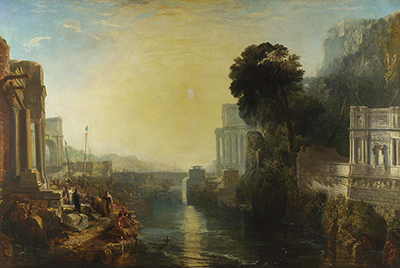
That competitive inheritance links Ulysses deriding Polyphemus - Homer's Odyssey with Turner's other major classical works. Yet this painting has its own emphasis. In Dido Building Carthage, civic foundation and Claudean harbour order are central. In Ulysses, the ship is escaping, the giant is wounded, and light arrives as a force of release and hazard. Turner adapts the classical seaport language to a very different emotional situation.
Colour, Optics and Expressive Direction
The National Gallery emphasises the painting's rich range of colours, from deep cobalt blues and fiery reds to delicate pinks, greens and yellows.[1] It also links the painting to Turner's shift toward colour and light over what Turner called "historic tone" in historical landscape.[1] This is one of the central reasons the work feels so important.
The phrase "historic tone" suggests the older assumption that serious history painting should be governed by a restrained tonal unity. Turner pushes against that assumption. In Ulysses deriding Polyphemus - Homer's Odyssey, colour is not an ornament laid over narrative. Colour is the condition through which narrative unfolds.
The National Gallery connects this shift with contemporary interest in optics, including Goethe's Theory of Colours, which Turner probably discussed with Charles Eastlake, later the translator of Goethe's book.[1] This does not mean the painting is a scientific diagram. It means Turner's colour was part of a wider culture of inquiry into perception, light and visual sensation.
Townsend and Smibert's How Turner Painted is useful here because it treats Turner's materials, colour and compositional process as central to his achievement, not as secondary craft detail.[3] In a painting like Ulysses deriding Polyphemus - Homer's Odyssey, technique and meaning are inseparable. The light does not merely decorate the escape; it creates the terms on which the escape can be seen.
The colour structure also complicates the mood. The painting is gorgeous, but not simple. Red can signify triumph, alarm and theatrical display. Yellow light can feel liberating and overwhelming. Blue can cool the scene while deepening its mystery. Turner uses colour to keep the work emotionally mobile.
The colours also help organise attention. Red pulls the viewer toward Ulysses and the banner. Yellow and pink open the dawn. Blues deepen the marine setting and hold the heat of the sunrise in tension. Greenish and cooler notes prevent the picture from becoming only a golden blaze. Turner's range of colour gives the painting its movement from human action to cosmic light.
This chromatic richness helps explain the mixed early response recorded by the National Gallery.[1] Viewers who expected a more subdued history painting could see the colour as excessive. But that excess is part of Turner's invention. The painting argues, visually, that colour can carry historical and emotional meaning with the force once assigned to contour, gesture and tonal restraint.
Reception and Ruskin
The National Gallery records that the painting had a mixed reception, including one hostile review that attacked its intense colouring.[1] That hostility is not surprising. Turner was pushing historical landscape toward a brighter, more expressive language that could seem excessive to viewers expecting stricter tonal discipline.
Ruskin's later response moved in the opposite direction. Writing after Turner's death, he declared it "the central picture of Turner's career", a phrase the National Gallery preserves in its account of the work.[1] Ruskin's judgement is famous because it treats the painting as a kind of hinge: a work in which Turner's gifts of subject, light, colour and imaginative force meet with unusual completeness.
The broader National Gallery account of Ruskin helps explain why his view carried weight. Ruskin's first volume of Modern Painters was written largely in defence of Turner, and the Gallery describes Turner as Ruskin's artistic hero.[4] Ruskin insisted on the truth of Turner's depiction of nature against critics who attacked it.[4] His admiration for Ulysses deriding Polyphemus - Homer's Odyssey belongs to that larger defence of Turner's visual imagination.
Still, Ruskin should not be allowed to replace close looking. Calling the painting central does not tell us how it works. The force of the work lies in its relationships: Homeric story and sunrise, human boast and giant injury, Claudean inheritance and chromatic experiment, mythic detail and marine movement.
The mixed reception is useful because it reminds us that the painting's brilliance was not automatically comfortable. What now looks like Turner's mastery could also look, to some early viewers, like excess. That tension is part of the painting's history. It shows Turner risking intensity in order to make history painting answer to colour.
Ruskin's admiration also needs to be placed beside his broader role in Turner's reputation. The National Gallery notes that Ruskin defended Turner's work and promoted the truth of his treatment of nature against hostile critics.[4] That defence was not merely biographical loyalty. It shaped how later readers learned to value Turner's intensity. Ruskin gave language to works that many viewers found difficult.
Even so, the painting should not be handed over entirely to Ruskin's phrase. Its centrality can be tested by looking. Does it bring together Turner as reader of epic, rival of Claude, painter of sea, student of colour, and maker of public exhibition pictures? It does. That is the practical value of Ruskin's judgement: it sends us back to the painting's internal richness.
Rome, Sketches and Preparation
The National Gallery connects the painting with oil sketches Turner made in Italy between August 1828 and February 1829.[1] It also notes that shipping delays affecting canvases from Rome forced Turner to produce new works, including this one, for the Royal Academy exhibition of 1829.[1] This background gives the painting a practical urgency as well as a mythological one.
Turner's Roman experience mattered because it exposed him to ancient art, Renaissance painting, and intense debates about colour, light and historical painting. The National Gallery notes that in Rome he may have seen Annibale Carracci's Polyphemus frescoes in the Palazzo Farnese, and that he had exhibited bold works there, including Regulus.[1] These connections should be handled as context rather than as a claim that any single source explains the painting.
The Tate record for a study related to Ulysses Deriding Polyphemus gives further evidence of the work's preparatory network, identifying a related work on paper from around 1829.[5] Such studies matter because they show Turner thinking through the subject in more than one medium. The finished National Gallery oil is the public culmination, but it belongs to a wider process of invention.
This preparatory context helps correct a common misconception about Turner's brilliance. The painting's luminous freedom can make it look as if it appeared in a rush of pure inspiration. In reality, Turner repeatedly used sketching, study, travel memory and exhibition pressure to build his finished works. The freedom of the final painting depends on that disciplined groundwork.
The 1829 exhibition context also sharpens the painting's ambition. Turner needed a work that could stand publicly, answer classical and Claudean precedents, and announce his ongoing power as a history landscape painter. Ulysses deriding Polyphemus - Homer's Odyssey does exactly that. It turns contingency into opportunity.
The related studies also help explain the painting's balance between speed and structure. Turner could work with extraordinary freedom because he had accumulated visual resources: ships, sunrise effects, classical references, Italian memory, and compositional experiments. The finished work may feel explosive, but it is not careless. Its radiance is organised through long practice.
This matters for viewers who see only the brilliance and miss the craft beneath it. The picture's seeming excess depends on decisions about where to place Ulysses, how much to reveal of Polyphemus, how to set red against yellow, and how to make mythic details visible without letting them break the whole. Turner makes abundance look inevitable.
How to Read Ulysses Deriding Polyphemus
Begin with the full title. Ulysses deriding Polyphemus - Homer's Odyssey tells us that the painting is rooted in a specific literary episode.[1] The word "deriding" is important: this is not simply escape, but escape turned into taunt.
Next, find Ulysses beneath the red banner. The National Gallery describes him in helmet and scarlet cloak, raising his arms and holding the torch used to blind Polyphemus.[1] That cluster of red, gesture and flame anchors the human story within the larger dawn.
Then search for Polyphemus. His huge shadowy body lies across the clifftop, but Turner makes him difficult to isolate.[1] That difficulty is meaningful. The blinded giant is both figure and landscape, threat and memory, body and atmosphere.
After that, let the sunrise organise the painting. Apollo's horses, sea nymphs, flying fish, ship, mist and colour all belong to the same luminous field.[1] Turner is not asking the viewer to choose between myth and nature. He makes myth visible through nature.
Finally, consider the painting as a response to Claude and as a step toward Turner's later expressive freedom. The National Gallery's account links it to Claudean sunrise, colour theory, mixed reception and Ruskin's later admiration.[1] The painting is strongest when all of these contexts remain in play, while the viewer keeps returning to the dazzling, dangerous moment of Ulysses' boast.
One useful test is to ask what would happen if the Homeric story were removed. The painting would still be a brilliant sunrise, but much of its tension would disappear. Another test is to ask what would happen if the light were made subordinate to a clear heroic scene. The painting would become easier but far less Turnerian. Its greatness lies in the pressure between story and light.
That pressure is why the work can absorb repeated looking. The viewer can begin with Homer, move to Claude, return to the ship, lose Polyphemus in the cliff, find Apollo's dawn, and then reconsider Ruskin's judgement. Each context opens the painting without exhausting it.
Frequently Asked Questions
The National Gallery gives the title as Ulysses deriding Polyphemus - Homer's Odyssey.[1] The Homer subtitle identifies the painting with Book IX of the Odyssey.
The painting is dated 1829 by the National Gallery.[1] It belongs to Turner's mature period, after his Italian work of 1828-29 and during a phase of intense interest in colour and light.
Turner shows Ulysses sailing away after escaping from Polyphemus, the one-eyed Cyclops who had held him and his men captive. Ulysses looks back and taunts the giant, raising the torch used in the blinding.[1]
Turner makes Polyphemus a huge shadowy form across the clifftop rather than a sharply isolated monster.[1] This makes the giant feel fused with cliff, mist and memory, and it turns the act of searching into part of the viewing experience.
Ruskin later called it "the central picture of Turner's career", according to the National Gallery.[1] The judgement reflects the way the painting brings together subject, colour, light, Claudean ambition and Turner's increasingly expressive style.
Discussion
How does Turner make a dangerous Homeric boast unfold through sunrise, colour and uncertain visibility?
Reader Insights
How does the difficulty of locating Polyphemus deepen the story of blindness?
How do ship, banner, fish and sea nymphs direct the escape?
Where does Claudean sunrise become distinctly Turner's own?
Join the Conversation
Share a close observation or a question for other readers.
References
- National Gallery, London, "Joseph Mallord William Turner, 'Ulysses deriding Polyphemus - Homer's Odyssey', 1829." https://www.nationalgallery.org.uk/paintings/joseph-mallord-william-turner-ulysses-deriding-polyphemus-homer-s-odyssey
- Martin Butlin and Evelyn Joll, *The Paintings of J. M. W. Turner*, revised edition, Yale University Press, 1984.
- Joyce Townsend and Tony Smibert, *How Turner Painted*, Thames & Hudson. https://www.thamesandhudsonusa.com/books/how-turner-painted-softcover
- National Gallery, London, "John Ruskin and the National Gallery." https://www.nationalgallery.org.uk/paintings/john-ruskin-and-the-national-gallery
- Tate, "Joseph Mallord William Turner, Study for 'Ulysses Deriding Polyphemus'." https://www.tate.org.uk/art/research-publications/jmw-turner/joseph-mallord-william-turner-study-for-ulysses-deriding-polyphemus-r1184437