


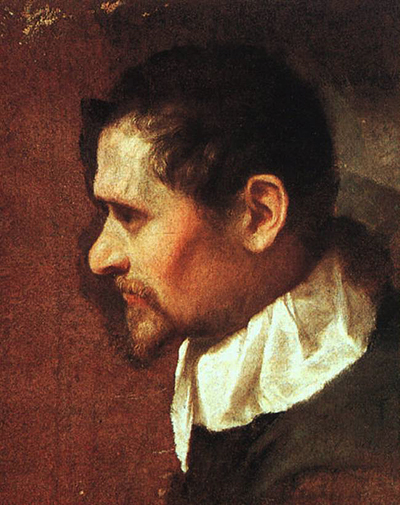
 by Tom Gurney
Tom Gurney BSc (Hons) is an art history expert with over 20 years experience
Published on June 19, 2020 / Updated on November 29, 2026
Email: tomgurney1@gmail.com / Phone: +44 7429 011000
Annibale Carracci: Introduction
In The Bean Eater, a man lifts a spoon and looks up. The bread, onions and jug remain precisely where he left them. His hand holds the spoon in mid-air, and there is just time to notice the beans before he seems likely to go on eating. In the Farnese Palace, Annibale Carracci used the same alertness to bodies in motion on the scale of a vaulted ceiling. The procession of Bacchus and Ariadne moves among painted figures that seem to lean out into the room. The painter could make an encounter feel immediate whether the viewer stood across a table or looked up from the floor of a Roman palace. [1] [2]
Annibale Carracci (1560–1609) was a Bolognese painter, draughtsman and printmaker. He helped establish an academy with his brother Agostino and cousin Ludovico, then moved to Rome to work for Cardinal Odoardo Farnese. Drawing from life and studying earlier art were complementary practices for the Carracci. They could watch a model reach, sit or turn, then ask how Correggio, Titian or Veronese had arranged light and colour around a figure. These ways of working help explain why Annibale's paintings can feel so different in subject and scale while remaining recognisably the work of the same artist. [2] [3]
At a Glance
- ArtistAnnibale Carracci
- Life1560–1609
- Principal placesBologna and Rome
Annibale Carracci and his circle
Explore the artists who shaped Carracci’s work and those who carried it forward.
- Correggio: Annibale studied Correggio’s paintings in Parma. Their figure groups and colour mattered to Annibale’s altarpieces and intimate devotional work. [3]
- Paolo Veronese: Veronese was among the Venetian painters Annibale studied. The resulting attention to colour and pictorial staging is particularly relevant to the Bolognese paintings. [3]
- Agostino Carracci: Agostino joined Annibale in the family academy and contributed to the Farnese Gallery. Surviving studies help trace the two brothers’ distinct roles. [4]
- Domenichino: Domenichino’s Landscape with a Fortified Town is closely based on Annibale’s Flight into Egypt. [5]
- Francesco Albani: After Annibale fell ill, Albani took responsibility for completing paintings devised for the Herrera Chapel. [6]
Annibale Carracci in context
Italian Renaissance precedents
16th century [3]Carracci Academy, Bologna
From the 1580s [7]Baroque classicism
Late 16th–early 17th century [4]Ludovico Carracci
1555–1619 [8]Agostino Carracci
1557–1602 [4]Annibale Carracci
1560–1609 [3]Domenichino
1581–1641 [5]The Butcher’s Shop
Early 1580s [9]The Bean Eater
Late 16th century [1]Two Children Teasing a Cat
About 1587–88 [10]The Choice of Hercules
1595–96 [11]Assumption of the Virgin
About 1600–01 [3]Landscape with the Flight into Egypt
Early 1600s [13]Essential Annibale Carracci works
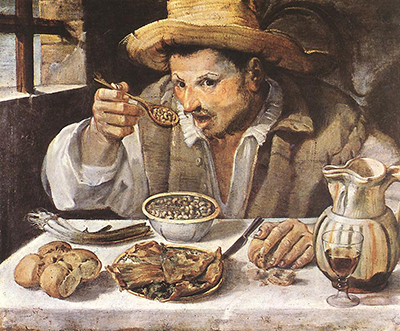
The Bean Eater
Late 16th century · A diner looks up with his spoon still raised.
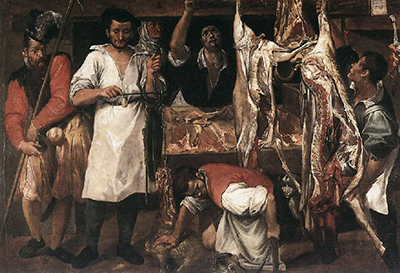
The Butcher’s Shop
Early 1580s · The monumental Oxford canvas puts work on the scale of a large history painting.
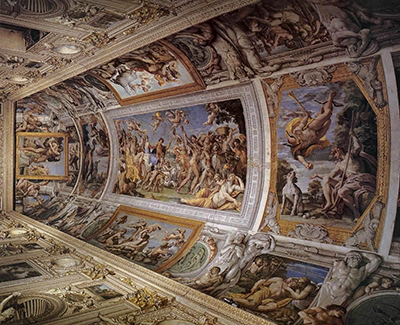
The Loves of the Gods and the Farnese Gallery
From 1597 · Myths and painted frames fill the Farnese Gallery vault.
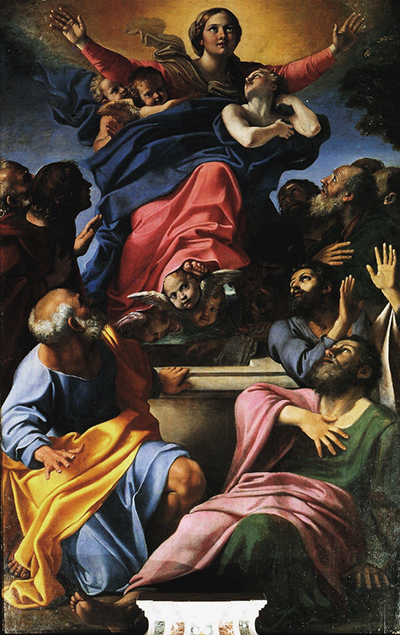
Assumption of the Virgin
About 1600–01 · The Virgin rises over the apostles on the Cerasi Chapel's altar wall.
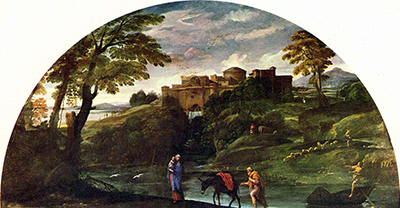
Landscape with the Flight into Egypt
Early 1600s · Small travellers cross a broad landscape painted for the Aldobrandini.
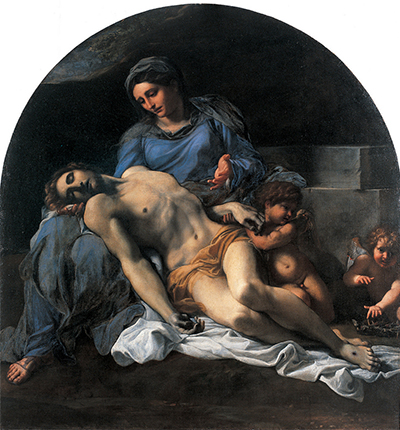
Pietà
About 1599–1600 · Two angels accompany Mary and Christ in the Farnese devotional canvas.
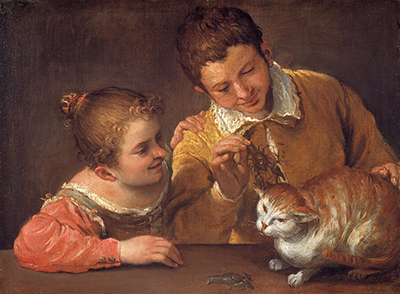
Two Children Teasing a Cat
About 1587–88 · Two children lean over a cat and a crayfish.
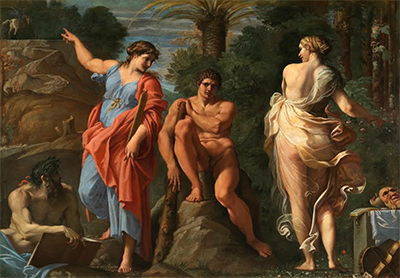
The Choice of Hercules
1595–96 · A Farnese ceiling canvas contrasts two roads and two ways of life.
Contents
- Bologna and the study of ordinary life
- From the altarpiece to the small devotional painting
- A Roman palace and the Loves of the Gods
- What drawings and prints could do
- A river, a road and a tradition of landscape
- Designs carried on by other painters
Bologna and the study of ordinary life
The Carracci established their school and workshop in Bologna in the 1580s. The Pinacoteca Nazionale uses the name Accademia degli Incamminati and describes a workshop in which young painters could study the living model alongside the work of sixteenth-century masters. The Carracci Academy taught a way of putting those exercises to work. A figure studied from life might still need its pose adjusted to read well at a distance or fit a larger group. The examples of older painters offered ways to make those changes and preserve the sense of a weight, a look or a passing movement that the painter had observed. [2] [7]
In 1584 Filippo Fava hired Ludovico, Agostino and Annibale to decorate the principal floor of his palace in Bologna. The great hall tells the story of Jason and Medea in eighteen scenes around the room. One episode shows Medea by a stream at night. Her ritual takes place in a landscape lit by the moon, under conditions of light a painter could try to imagine from experience. Someone looking up at the frieze has to turn from one episode to the next. The Carracci were already thinking about how movement through a room could help a viewer follow a story. The project also gives a firm point of reference for their joint work. Its commission names three painters, and the frieze makes sense as a shared undertaking even when the hand responsible for a particular passage is harder to establish. [14]
The man in The Bean Eater is close enough for a viewer to see how he gathers his fingers around the spoon. A stiff fold at his wrist holds the shape of the gesture, while the loose edge of his hat and the shine on the jug take just a few strokes to suggest. The Colonna Gallery describes the meal as a peasant's, but the man's occupation and identity remain open. What the painting supplies is the interruption itself. The table bars the way into the picture, and his look brings the person on our side of it into the scene. At the Metropolitan Museum, the children in Two Children Teasing a Cat are equally caught up in an action that could change in the next instant. The loose handling of paint serves the quick movements of the children and the animal. [1] [2]
At Christ Church Picture Gallery in Oxford, The Butcher's Shop approaches the width of a small wall. A man bends low over a carcass, another works at the counter, and the open space between them makes it possible to take in several separate tasks at once. The Oxford gallery considers portraits of the three Carracci among the possible explanations of the painting. The figures' coordinated work is visible however one understands their identities. The Kimbell Art Museum's Butcher's Shop is a separate, much smaller painting, less than three-quarters of a metre wide. With the counter and hanging meat close to its edges, it concentrates attention on a much tighter area of the shop. The two canvases show how much the scale of a picture affects our sense of what is happening across it. [9] [15]
Painting itself was one of the occupations Annibale watched. In the Hermitage drawing studied by Lyubava Chistova as A Young Artist at Work, a figure copies a picture with his head inclined towards it. Supplies sit on the table and at his feet. Chistova points to sculptures in the room that may be antiques, the sort of objects a student could learn from. The drawing makes the academy’s emphasis on studying other art easier to picture as physical work. One has to stand in a particular place, look carefully at something already made, and decide how to get what one sees down by hand. [16]
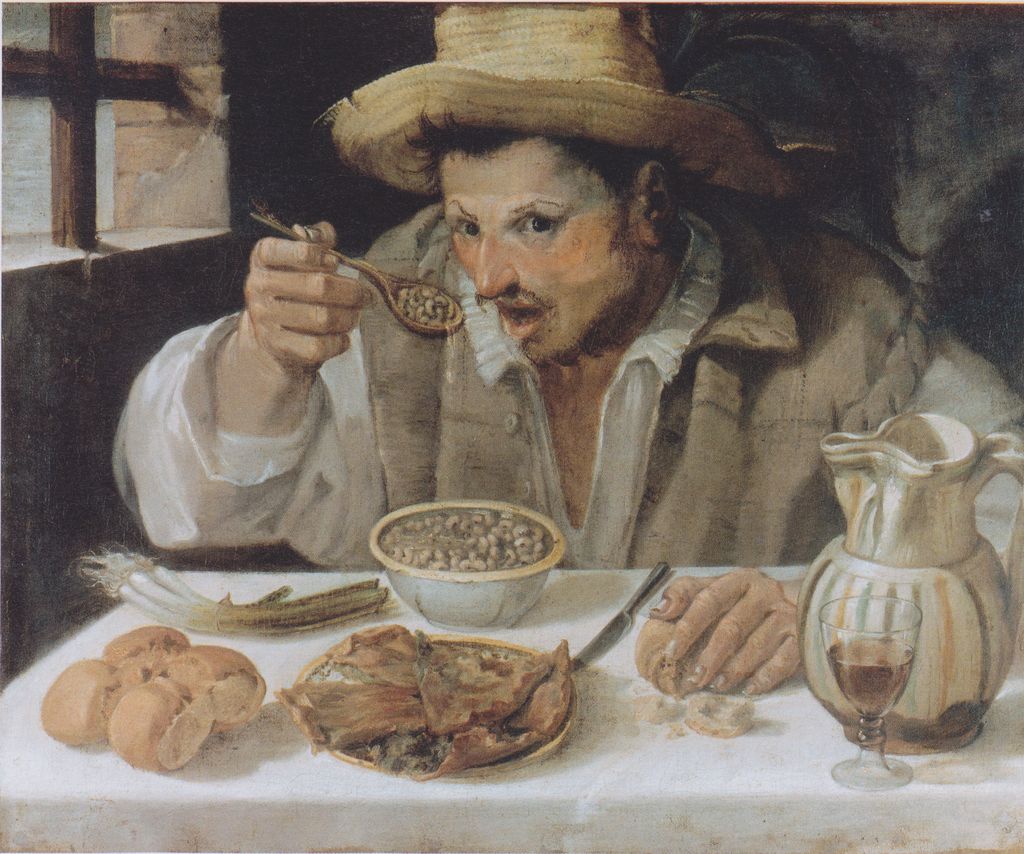
Annibale Carracci, The Bean Eater. Galleria Colonna, Rome. Image source. Public domain.
Four stages of Annibale Carracci’s career
These periods group related developments; painting, travel and local work overlap across their boundaries.
Observation and early painting
Bologna was the setting for the painter’s family collaboration, work from life and early paintings of meals and trades.[3]
The Carracci in Emilia
The Carracci combined work from life with the study of earlier painting. The family undertook decorative commissions together as Annibale developed paintings for churches and collectors.[8]
Painting for the palace
The Camerino and Gallery called for different solutions. The movable Hercules canvas and the Gallery vault bring painted myth into different architectural settings.[4]
Altars, landscapes and late studies
Annibale continued to make devotional paintings and designs for Roman patrons. Illness affected the later Herrera commission, and drawings from the final years survive.[6]
From the altarpiece to the small devotional painting
The Carracci also studied the older art that filled churches in northern Italy. The brothers' six copies after Correggio's lost frescoes for the apse of San Giovanni Evangelista in Parma survive in the Farnese collection at Capodimonte. Made on canvas, the copies preserve figures from a decoration that was later destroyed. Annibale and Agostino could study the way a painted body occupied an elevated, curved architectural setting as they worked out how to translate what they saw onto a movable surface. The surviving canvases also allow a comparison of the brothers at work on a common model. [3] [17]
The Saint Matthew Madonna, painted in 1588 for the merchants' chapel in San Prospero in Reggio Emilia, now belongs to the Gemäldegalerie Alte Meister in Dresden. From below, the viewer would have seen the saints grouped around the throne, with the Virgin and Child above them. Part of the painting's appeal is the way the weight of the clothes anchors the figures even as their heads, hands and glances turn the eye upward. The warmth of the colours and the assembly of saints beneath a high throne bring Venetian altar painting to mind. The painting gives a sense of what Annibale took from studying the Venetian masters and what he had to work out for a particular congregation and chapel. [2] [18]
Near the other end of the scale is Christ appearing to Saint Anthony Abbot, an oil on copper now at the National Gallery in London. The saint's book is on the ground, and demons crowd against him. Raised eyes and outstretched arms carry the viewer upward to Christ. The copper supports details visible at close range, down to bright points on the teeth and eyes of the creatures. Larry Keith's technical study compares this picture with the National Gallery's Montalto Madonna, also painted on copper. The latter is a Holy Family with the infant John the Baptist. The two works share a small, smooth support even though one picture builds tension through a swarm of tiny figures and the other draws attention to the measured gestures of a family group. [19] [20]
On the small wooden panel known as Christ appearing to Saint Peter on the Appian Way, the height of the cross is part of the encounter. Christ carries it past Peter, who has been trying to get away from Rome. The picture makes their exchange legible in the differing direction of their steps and the distance between their hands. Carracci compresses a question, an answer and the prospect of Peter's return into a meeting on a road. In the Capodimonte Pietà, Christ's body lies across the front of the scene. The way it rests against the Virgin's lap recalls Michelangelo's treatment of the subject in sculpture. One picture depends on a meeting that divides a journey in two. The other asks the viewer to stay with the weight of the body and the closeness of those gathered around it. [21] [22]
A Roman palace and the Loves of the Gods
The brothers visited Rome in 1594, and Annibale moved there in 1595. Cardinal Odoardo Farnese first put him to work on the Camerino, his private study. The Choice of Hercules, now at Capodimonte, occupied a central position on its ceiling. The hero pauses between two figures who direct his attention towards different paths. The route towards Virtue climbs steeply into the distance. From the floor, that ascent was part of a picture the viewer already had to look up to see. The canvas was made for an architectural setting and could be removed from it. The later gallery scheme depended more completely on the vault and walls of the room. [23] [24]
The Princeton study for The Choice of Hercules shows an earlier, markedly off-centre arrangement. In the painting the hero ends up between his two advisers, one on either side. Shinsuke Watanabe has compared the trees in another preparatory drawing, at the Louvre, with Marco Dente's engraving of Venus Wounded by a Rose's Thorn. The palm and the angles of branches are among the details that led him to propose the print as a source. An ancient marble relief has also been proposed as a model for the grouping of a seated man between two women. A drawing made towards a single ceiling painting could bring very different sorts of images into play, even if individual motifs disappeared before the work reached the ceiling. [25] [26]
Work on the Farnese Gallery began in 1597. The gods appear in separate scenes set within a painted structure of frames, figures and simulated stonework. At the corners there seem to be openings to the sky. A painted nude can seem to cast a shadow in the room, while a grey figure beside him has the appearance of sculpture. The distinction is made in paint, by the handling of colour, light and weight. Michelangelo's ceiling in the Sistine Chapel and Raphael's Roman frescoes offered examples of how an artist might populate an architectural structure with painted bodies. In the Farnese Gallery, those possibilities were brought to bear on stories of desire and transformation drawn from classical mythology. [2] [23] [27]
The central Triumph of Bacchus and Ariadne is full of bodies that seem to follow the sound and motion of a procession. The chariots hold its centre while smaller groups sway, lean or gather at the edges. An immense drawing at the Galleria Nazionale delle Marche in Urbino preserves the planning of one such group, the part of the procession with Silenus. A cartoon like this was made at the scale of the figures to be painted. The surviving section alone required more than fifty joined sheets of paper. At that scale Carracci could settle how the figures overlapped and change small parts of a pose before the work reached the ceiling. [23] [28]
Other sheets clarify the extent of the collaboration. The National Gallery now attributes the large cartoon Cephalus carried off by Aurora in her Chariot to Agostino and allows a possible contribution by Annibale to the dog. The evidence of related preparatory drawings helps make the case for Agostino's part. The sheets have also retained signs of how the design reached the plaster. The Cephalus cartoon was cut up for tracing, while the cartoon of a woman being carried off by a sea god was pricked in preparation for transfer. The London exhibition in 2025 made those physical traces accessible beside the images themselves. A Louvre exhibition in 2025–26 and its catalogue brought the drawings for the Camerino and the Gallery into the same study. In Rome the 2014–15 conservation campaign treated the wall and vault paintings together with the stucco, the different surfaces that make up a viewer's experience of the room. [27] [29] [30] [31]
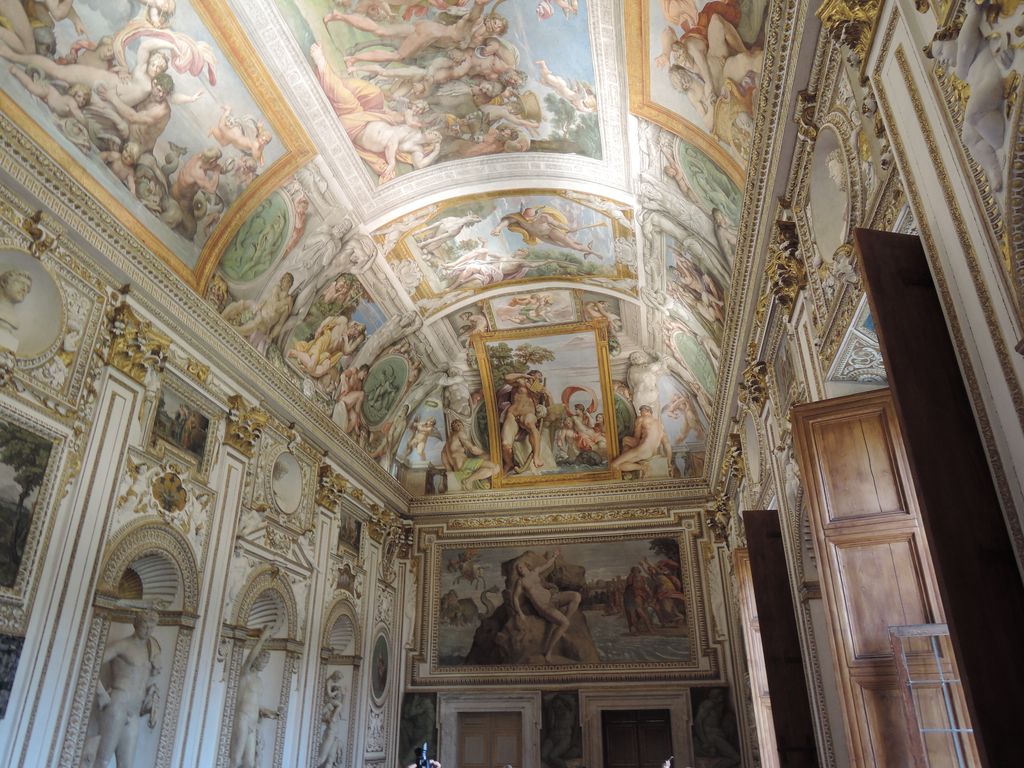
Interior of the Farnese Gallery, Palazzo Farnese, Rome. agennari. Image source. CC BY 2.0. Proportionally resized for web display.
What drawings and prints could do
In Annibale's drawings, an exacting study of an individual body can sit alongside a rapid note of motion or light. A red-chalk study of a young man lying with his head tipped back and his eyes closed was shown in Tokyo in 2025 as part of an exhibition from the Nationalmuseum in Stockholm. The same exhibition included his study of a standing young man in pen and brown ink over an underdrawing in black chalk. A change of medium changes the kind of information that can be recorded quickly. Chalk can build the soft transitions between the face and neck of a reclining model. A pen can give a raised shoulder or a bent joint a decisive edge. The Tokyo exhibition also showed Annibale's portrait of the painter Ludovico Cardi, known as Cigoli. A drawn head could preserve an individual likeness as readily as it could help a painter work out an angle of view. [32]
An unusually specific example of the study of antiquity survives in Frankfurt. In Annibale's drawing of a flute-playing Cupid and Silenus at the Städel, brown wash marks the shade under the trees and the figures listen or play in the open air. The museum connects the sheet both to ancient engraved gems now in Naples and to Annibale's painted panel Marsyas and Olympus in London. The tiny gems could supply poses and a relationship between two figures. The sheet gives them a bank, trees and stretches of light. It shows how an ancient object could furnish an idea for a painter who was still free to reconsider the setting and even the names by which the figures would ultimately be known. [33]
Annibale's prints gave designs a different life. The Detroit Institute of Arts and the Rijksmuseum hold impressions of his 1590 Holy Family with Saint John the Baptist. Lines cut or bitten into a plate can describe shade by crossing one another, and the white of the paper can stand for light. This is a different problem from building shadows out of coloured paint, even when the subject is familiar from an oil of the Holy Family. The Metropolitan Museum also holds a print of The Drunken Silenus taken from the engraved interior of a shallow silver cup. It preserves the design of a worked object in a form that could be kept in an album. The credits on a print can point to more than one person. Agostino's engraving of Aeneas carrying his father out of Troy, for example, records a design by Federico Barocci. It demonstrates how a Carracci could be both an interpreter of another painter and the maker of an image with its own audience. [2] [34] [35]
A river, a road and a tradition of landscape
In the Washington River Landscape, painted around 1590, the trees closest to the viewer are in shadow. A boat slips past behind one of the trunks, then the river bends into a brighter distance. The shadows guide the eye towards the open water and back to the irregular shapes of the foreground. A boatman has work to do, and his passengers occupy themselves within the narrow space of the boat. Their presence gives the river a human scale. The National Gallery of Art describes how Carracci developed this kind of painting from observations made outdoors. Alternating banks and trees spaced at intervals give the finished canvas a deliberate order. Its apparent ease depends on how carefully the painter apportions near ground, water and sky. [36]
The Landscape with the Flight into Egypt in the Galleria Doria Pamphilj was made as a lunette for the Aldobrandini palace chapel. Its arched field holds a river, buildings and a succession of paths and banks. Mary and Joseph are small enough to be overlooked on first seeing it. When the eye finds the travellers, the distances already established by the water and the slopes become part of what the journey requires. The painting belongs to a chapel ensemble worked on by Annibale and members of his workshop. Its shape and its modestly scaled figures make sense together. The biblical episode occupies a few steps on one path through a setting that continues well beyond the people we have been asked to follow. [13] [5]
Domenichino's Landscape with a Fortified Town, probably painted in the mid-1630s, shows how an artist who knew the chapel could carry its ideas into a new painting. The National Gallery identifies the Flight as its principal model. In Domenichino's picture the eye again moves from figures at the water's edge to buildings farther away. A boatman, shepherd and fishing party give the view a different distribution of incidents, and the painting can be read in several directions without following a single episode. The related arrangement makes the differences matter. Domenichino could retain the structure of a landscape he admired while giving the people in it other things to do. [5]
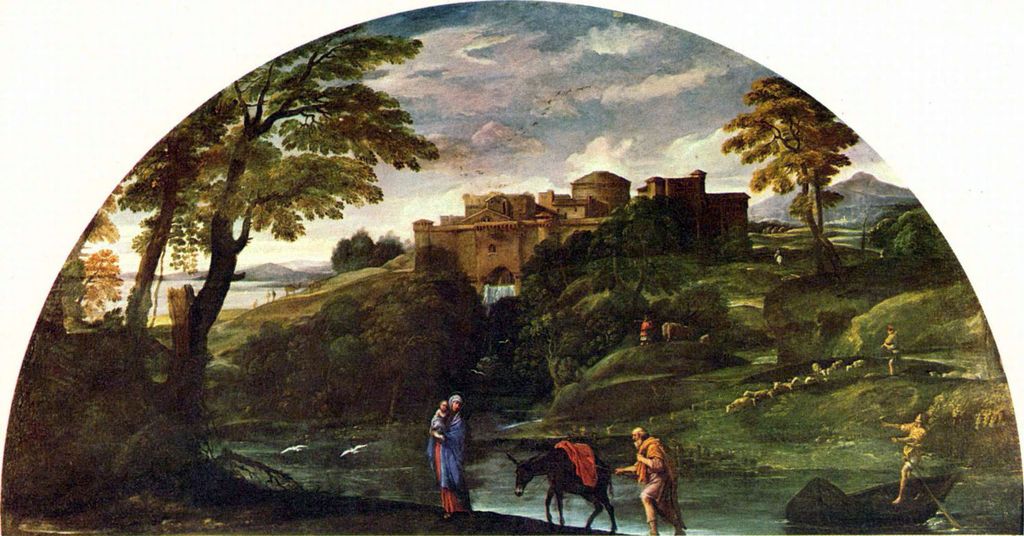
Annibale Carracci, Landscape with the Flight into Egypt. Galleria Doria Pamphilj, no. 236. Image source. Public domain.
Designs carried on by other painters
In his last years in Rome, Annibale took on the decoration of the Herrera family chapel at San Giacomo degli Spagnoli. The Herrera Chapel frescoes told the story of Saint Didacus of Alcalá. Annibale conceived the programme and began the designs. From 1605, serious illness shifted responsibility for carrying it out to Francesco Albani. The paintings were detached in the nineteenth century. Seven surviving fragments went to what is now the Prado and nine to the academy whose pictures are held on deposit at the Museu Nacional d'Art de Catalunya. The two museums and Palazzo Barberini brought the dispersed works together for an exhibition in 2022. Their arrangement makes it possible to consider what a viewer in the chapel would have seen above the altar or high on a wall, and to distinguish the person who planned a whole room from the painters who completed it. [6] [37]
Annibale died in Rome in 1609. For the generation that followed, his work offered several practical examples of what a painter could do. Albani could realise a programme whose design was already under way. Domenichino could turn a chapel lunette into the starting point for a different kind of landscape, then make large working drawings for frescoes of his own. The next generation absorbed a method as well as a repertoire of subjects. The biography follows the people and commissions behind that work. Across the surviving paintings, the method is often clearest in small things. A boatman's pole puts the river into motion, a gesture beside a body can slow the eye, and a man's spoon held above a table can stop it altogether. [2] [3] [5] [6]
Exhibition catalogues and studies
The Drawings of Annibale Carracci. Daniele Benati and contributors. National Gallery of Art, 1999.
The exhibition catalogue traces drawing across the artist’s career and records the life-size cartoon lent from Urbino. Read the NGA publication.
Dessins des Carrache. La fabrique de la Galerie Farnèse. Victor Hundsbuckler. Musée du Louvre and Lienart, 2025. In French.
The catalogue assembles known preparatory drawings and examines how they relate to the painted decoration. View the Louvre catalogue.
Raw Painting: The Butcher’s Shop by Annibale Carracci. C. D. Dickerson III. Kimbell Art Museum and Yale University Press, 2010.
A study of the Kimbell canvas and the early work that put everyday labour at the centre of the painting. View the publisher’s record.
Artworks directory
Paintings, frescoes, drawings and prints, with separate entries for documented versions and collaborative projects.
Discussion
Look again at the images and ideas explored in Annibale Carracci. These editorial prompts invite your observations.
Reader Insights
Which work makes Carracci’s attention to an ordinary gesture easiest to see?
What changes when you compare his figures in a room-sized fresco and on a small devotional panel?
Join the Conversation
Share a detail, comparison or question about Annibale Carracci below.
References
- Galleria Colonna, Colonna Gallery, description of Il Mangiafagioli and its display. View source.
- Keith Christiansen, The Metropolitan Museum of Art, Annibale Carracci (1560–1609), Heilbrunn Timeline of Art History, with related object records. View source.
- National Gallery, London, Annibale Carracci, biography and collection overview. View source.
- Musée du Louvre, The Carracci Drawings and the Farnese Gallery. View source.
- National Gallery, London, Landscape with a Fortified Town, NG6629, comparison with Carracci's Flight into Egypt and Aldobrandini workshop context. View source.
- Museu Nacional d'Art de Catalunya, Annibale Carracci. The Frescoes of the Herrera Chapel, commission, division of work, detachment and exhibition itinerary. View source.
- Pinacoteca Nazionale di Bologna, Sala 23: I Carracci, the Accademia degli Incamminati and approach to teaching. View source.
- Genus Bononiae, Palazzo Fava. View source.
- Christ Church Picture Gallery, Oxford, Our Collections, entry on The Butcher's Shop, scale and interpretations. View source.
- The Metropolitan Museum of Art, Two Children Teasing a Cat. View source.
- Catalogo generale dei Beni Culturali, Ercole al bivio. View source.
- Fondazione Federico Zeri, Pietà. View source.
- Galleria Doria Pamphilj, Paesaggio con la fuga in Egitto, inv. 236, the canvas's original setting and composition. View source.
- Genus Bononiae, Palazzo Fava, Gli affreschi dei Carracci, the eighteen scenes of Jason and Medea in the great hall. View source.
- Kimbell Art Museum, The Butcher's Shop, AP 1980.08, object entry. View source.
- Lyubava D. Chistova, “A Young Artist at Work. The Problem of the Artist’s Status in the Drawings of Annibal Carracci”, HSE University Journal of Art & Design, no. 1 (2026), fig. 1 and discussion of the Hermitage drawing. View source.
- Museo e Real Bosco di Capodimonte, Il nuovo allestimento per le copie dei Carracci dei perduti affreschi del Correggio, the six surviving canvases and conservation programme. View source.
- Fondazione Federico Zeri, Madonna con Bambino in trono e santi, record 112196, date, original location and Dresden holding. View source.
- National Gallery, London, Christ appearing to Saint Anthony Abbot, NG198, object record. View source.
- Larry Keith, National Gallery, London, “Annibale Carracci's ‘Montalto Madonna’”, National Gallery Technical Bulletin 29 (2008), comparative examination of the two coppers. View source.
- National Gallery, London, Christ appearing to Saint Peter on the Appian Way, NG9, object record and narrative. View source.
- Museo e Real Bosco di Capodimonte, Oggi è il compleanno di ... Annibale Carracci, section on the Farnese paintings and the Michelangelo comparison. View source.
- National Gallery, London, The Carracci Cartoons: Myths in the Making, commission, chronology and preparatory methods, 2025 exhibition. View source.
- Museo e Real Bosco di Capodimonte, Il Plateau con la decorazione di Ercole al bivio, discussion of The Choice of Hercules and its reception. View source.
- Princeton University Art Museum, Study for the Choice of Hercules, 2008-43, the asymmetrical early design. View source.
- Shinsuke Watanabe, National Museum of Western Art, Tokyo, “Annibale Carracci’s Hercules at the Crossroad and Marco Dente’s Print”, pp. 22–27, figs. 1–5, preparatory drawing and discussion of sources. View source.
- National Gallery, London, Cephalus carried off by Aurora in her Chariot, NG147, commission history and current cartoon attribution. View source.
- National Gallery of Art, Washington, The Drawings of Annibale Carracci (1999), cat. 47, A Bacchic Procession with Silenus, Galleria Nazionale delle Marche, Urbino. View source.
- National Gallery, London, Annual Review 2024–2025, “The Carracci Cartoons: Myths in the Making”, tracing and pricked transfer evidence. View source.
- Musée du Louvre, Dessins des Carrache. La fabrique de la galerie Farnèse, 2025–26 exhibition and catalogue notice. View source.
- Ministero della Cultura, Il restauro della Galleria dei Carracci in Palazzo Farnese a Roma, the 2014–15 conservation campaign. View source.
- National Museum of Western Art, Tokyo, Renaissance to Baroque Master Drawings from the Nationalmuseum, Stockholm, 2025 bilingual exhibition checklist, nos. 17, 18 and 20. View source.
- Städel Museum, Frankfurt, Flute-playing Cupid and Silenus in an Arcadian Landscape, 462, related London panel, Louvre drawing and Neapolitan gems. View source.
- Detroit Institute of Arts, The Holy Family with Saint John the Baptist, 1590, collection record and reproduction. View source.
- Rijksmuseum, Heilige Familie met de jonge Johannes de Doper, 1590, print record. View source.
- National Gallery of Art, Washington, River Landscape, 1952.5.58, painting and compositional analysis. View source.
- Museo Nacional del Prado, Museu Nacional d’Art de Catalunya and Gallerie Nazionali di Arte Antica, Los frescos de la capilla Herrera, 2022 Spanish exhibition dossier, introduction and exhibition material. View source.