 by Tom Gurney
Tom Gurney BSc (Hons) is an art history expert with over 20 years experience
Published on June 19, 2020 / Updated on November 29, 2026
Email: tomgurney1@gmail.com / Phone: +44 7429 011000
The Choice of Hercules: Introduction
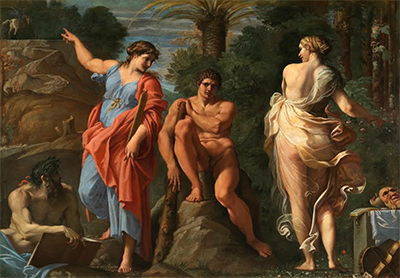
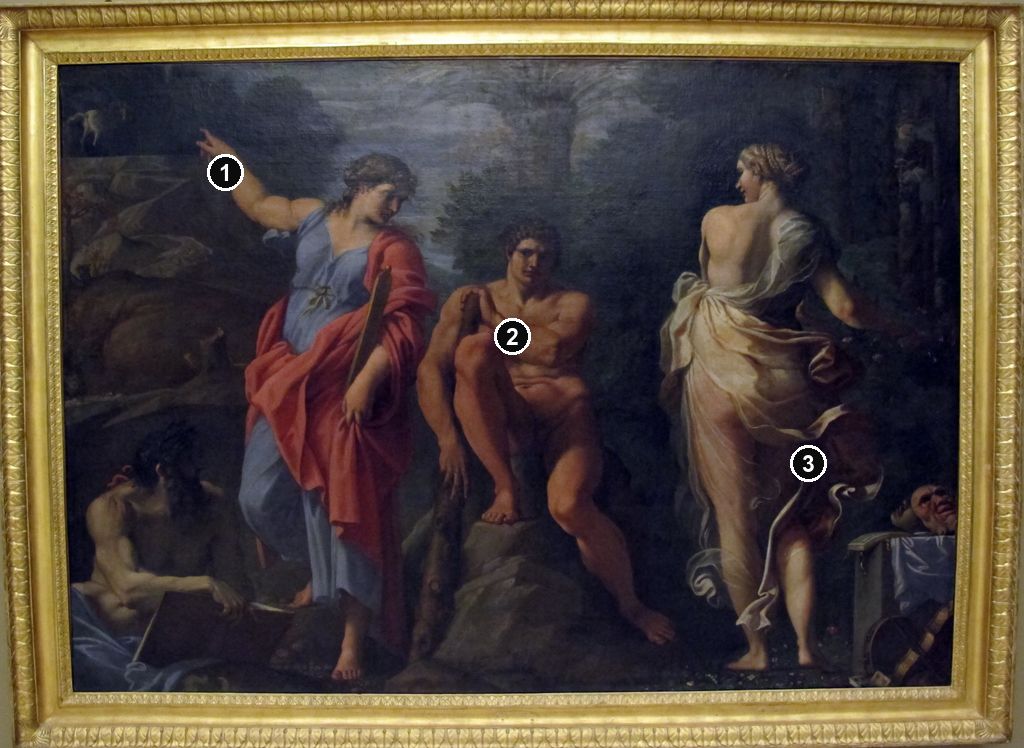
Annibale Carracci painted The Choice of Hercules around 1596 for the ceiling of Cardinal Odoardo Farnese’s private room in Rome. Hercules sits between two women who point towards different ways of life. On the left, Virtue directs him up a rocky slope. On the right, Pleasure invites him into a shaded grove. The muscular young man could stand up at any moment, but the picture holds him in the instant before he acts. The original oil on canvas, known in Italian as Ercole al bivio, belongs to the Museo e Real Bosco di Capodimonte in Naples (inv. Q 365). A copy occupies its former place in the Palazzo Farnese. [1] [2]
At a Glance
- ArtistAnnibale Carracci
- Date1595–96
- MediumOil on canvas
Contents
- Two ways through the landscape
- A Greek story for a young cardinal
- The canvas overhead
- From pen study to painted canvas
- From Rome to Parma and Naples
- From impressions on paper to a porcelain tray
- Annotated details
Two ways through the landscape
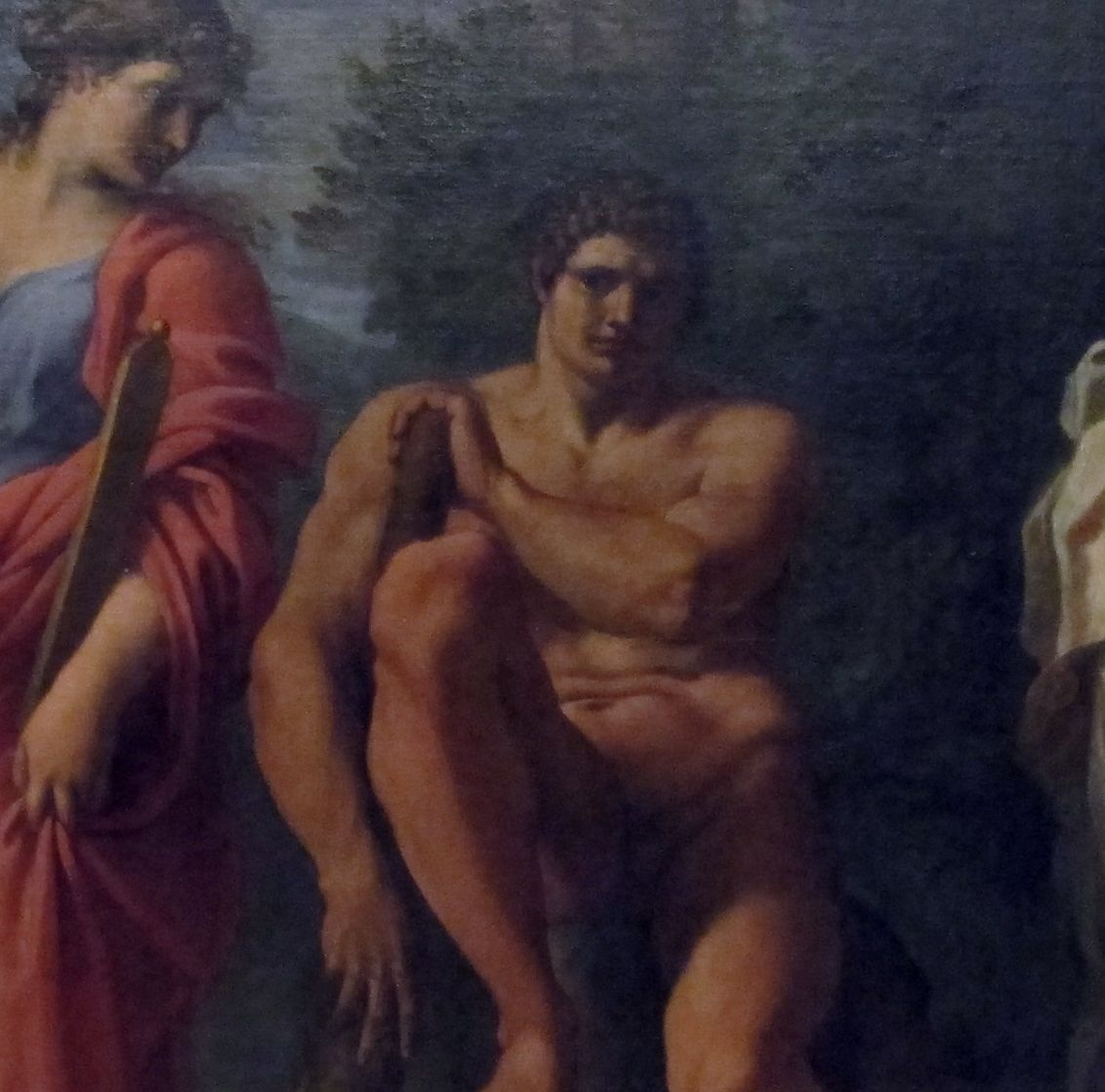
Hercules sits on a rock with a club at his side and one knee raised. His weight bears down through the arm that hangs over the club, while his upper body turns towards the argument around him. The palm rising above him anchors the middle of the canvas. Its crown spreads in both directions, even as the two women pull his attention apart. Bellori read the palm as a sign of Hercules’ future victories. It stands at the point where the advantages of either path remain to be proved. [3] [4]
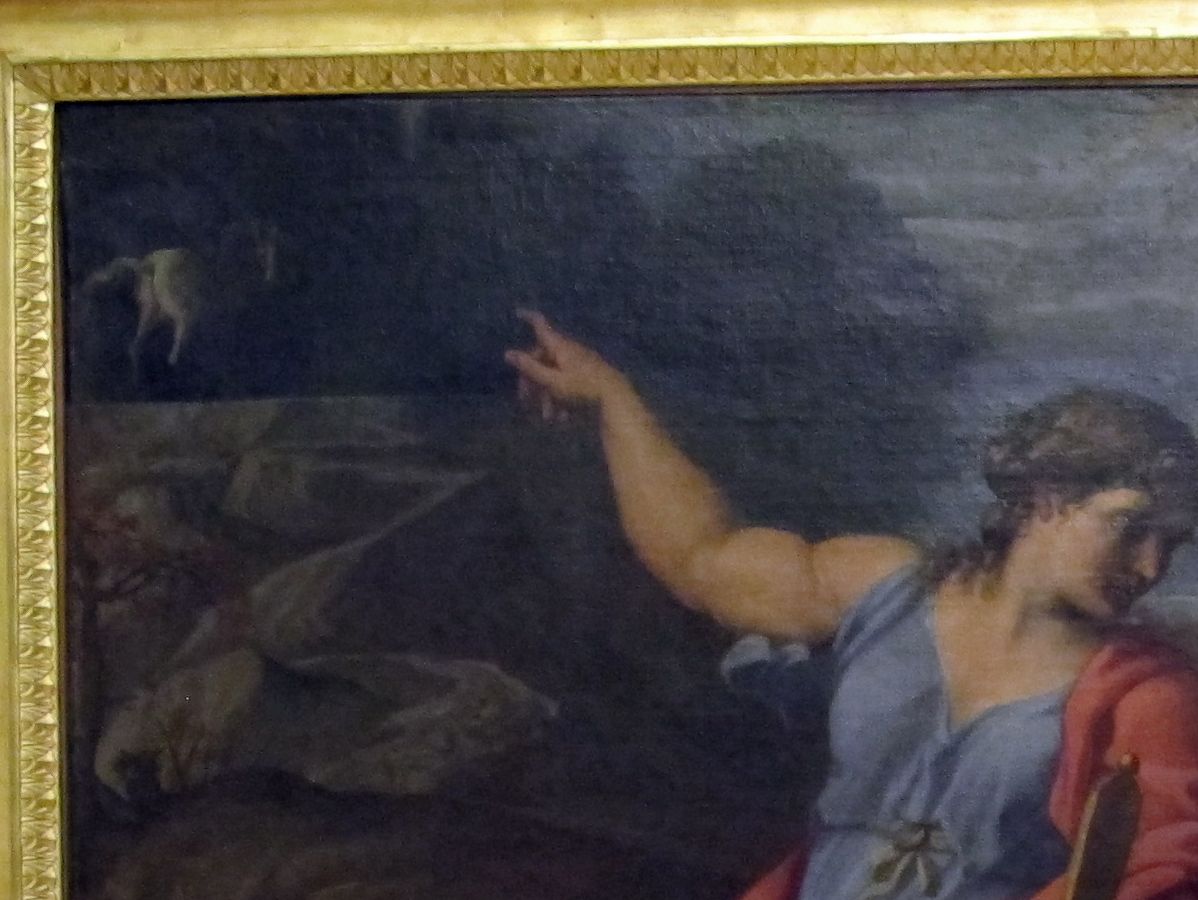
Virtue, on the viewer’s left, wears blue with a red mantle and carries a short sword. Her extending arm picks out a narrow way that turns up the rock. At the summit, a small winged horse stands clear of the slope. This is Pegasus, who can suggest the upward reward of Virtue and whose appearance also has a Farnese resonance. Near the lower left corner sits a laurel-crowned poet with writing materials. His presence brings another kind of reward into the picture. A difficult deed may be remembered and celebrated after its completion. The poet’s posture recalls a reclining river god, an association that helps explain why the figure can look like part of the landscape when seen at a distance. [3] [4]
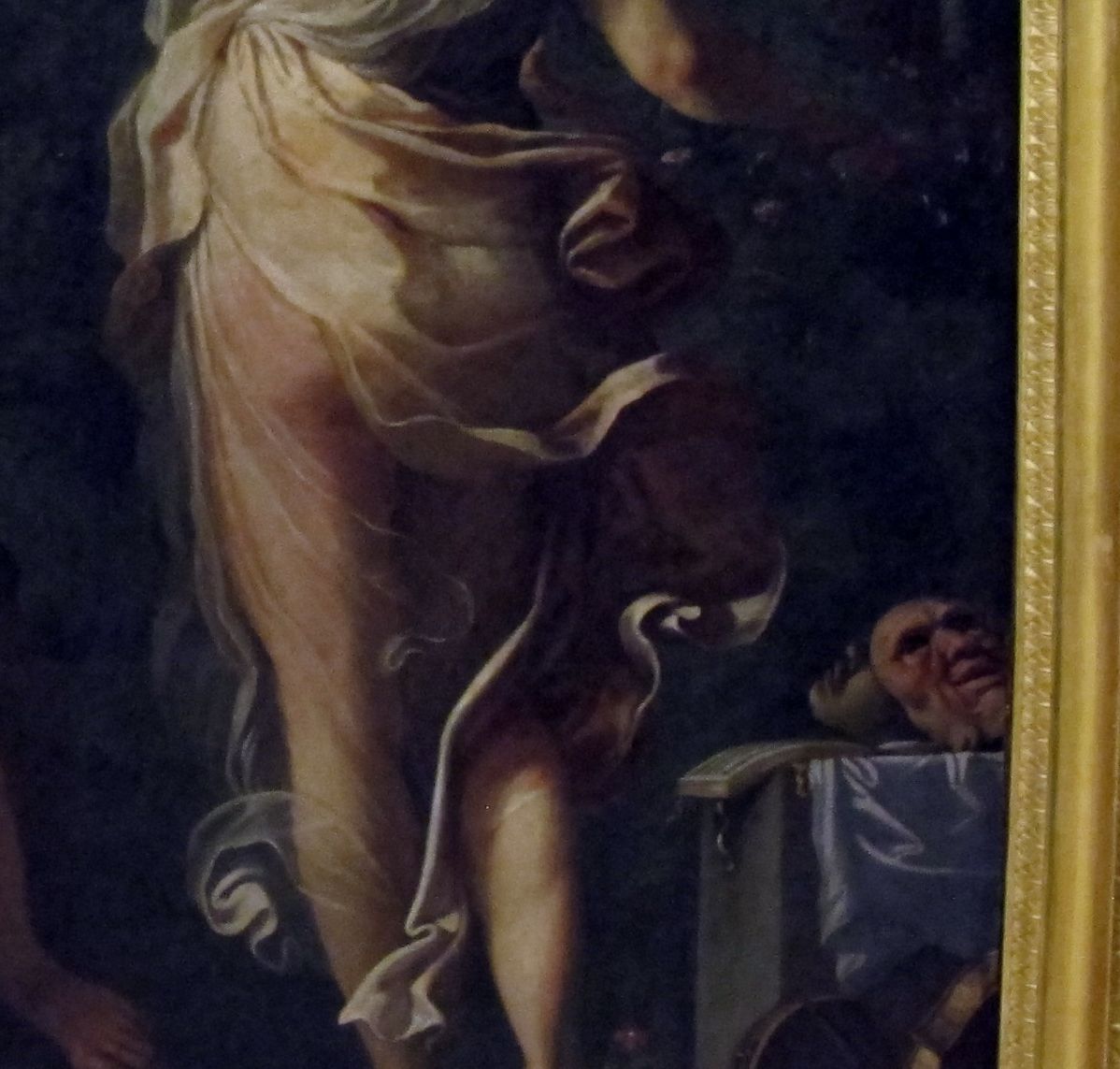
Pleasure turns her bare back towards the viewer, and a thin drapery winds around her legs. Her outward gesture leads into the trees. From the front of the painting her route appears easy to enter, but its destination disappears into foliage. The objects low on the right give immediate substance to her appeal. Playing cards, theatrical masks and a musical instrument offer diversion now. Their placement also creates a counterpart to the poet’s materials on the other side. Across the bottom edge, Carracci sets objects we can inspect against one another. Above them he sets two landscapes we can try to follow. [3] [4] [5]
The figures fill most of the canvas. The landscape acquires its force in the narrow openings between and around them. The blue and red of Virtue and the pale fabric around Pleasure are easy to distinguish against dark vegetation. The colour recalls the Venetian painting that Annibale had studied before coming to Rome, and the clearly drawn outlines give the figures the weight of sculpture. The painting allows both qualities to operate at once. Colour guides us to the speakers, and the hero’s seated bulk keeps their claims in balance long enough for the viewer to weigh them. [1] [4] [6]
Annotated Details from The Choice of Hercules
The numbered points identify visible features discussed in this article. Return from each detail to the numbered overview. Annibale Carracci, The Choice of Hercules. Museo e Real Bosco di Capodimonte, Q 365. Photograph by Sailko. Image source. CC BY 3.0. Numbers added to a separate overview. Details cropped from the original photograph. Image derivatives use CC BY 3.0.
Details from THE CHOICE OF HERCULES
Compare the cropped details with the source images above. Notice how their colours, shapes and positions contribute to the larger compositions.
Virtue points uphill
Virtue’s extended arm directs attention towards the rough ascent on the left. The passage is dark enough to make the outline of her forearm particularly clear.
Hercules listens
The seated figure’s bent legs remain planted on the rock while his head turns towards Virtue. The pose holds the decision in suspense.
Pleasure and her gifts
Bright drapery wraps around Pleasure and marks the entrance to the other path. At lower right the nearby objects extend her appeal beyond the figure herself.
A Greek story for a young cardinal
In Xenophon’s Memorabilia, Socrates retells a story attributed to the Greek teacher Prodicus. Hercules, on the threshold of adulthood, sits apart to consider what kind of life to lead. A woman who calls herself Happiness promises him every enjoyment at the smallest possible cost in effort. Virtue argues that the things worth having, from bodily strength to the esteem of friends and cities, demand work and care. The promise of an easy life has its own persuasive force. Carracci gives it a figure as conspicuous as Virtue and makes Hercules visibly subject to both appeals. [7]
The seventeenth-century writer Giovanni Pietro Bellori described Hercules as still attending to Pleasure while inclining his eyes towards Virtue. His account appeared in 1672, decades after the commission. It records an early reading of the hero’s divided attention and helps explain why his expression can look less certain than the room’s larger story. In the canvas his feet are still on the rock. The neighbouring pictures can show the consequences of his choice while the central scene preserves the difficulty of making it. [5] [8]
Odoardo Farnese was the second son of Alessandro Farnese, Duke of Parma and Piacenza, and had received the cardinal’s hat in 1591. He was in his early twenties when Annibale decorated the Camerino. Reading Hercules as a model for Odoardo connects the young hero’s choice with the responsibilities of his patron. The moral could speak to a prince of the Church whose authority came in part from his family and whose position also asked him to demonstrate religious virtue. The comparison works as an allegory of the patron’s office and aspirations. The young man’s club and imposing physique mark him out as Hercules. [2] [5]
Fulvio Orsini, the Farnese librarian, antiquarian and adviser, helped shape that comparison. His involvement rests on evidence from correspondence with Odoardo in 1595. The letters establish a firmer basis for his participation than the idea of a complete written script specifying every episode and gesture. Francesco Mozzetti points out that Orsini lived in the palace and could discuss the design there. The successive drawings show how many choices about pose, dress and composition remained to work out on paper. Orsini’s emblem for Odoardo, three lilies tied by a ribbon bearing a Greek motto about rising towards God, provides a direct link between the room’s imagery and its patron. [2] [5] [9]
The canvas overhead
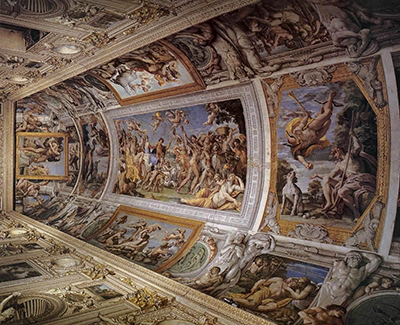
The Camerino is a small vaulted room on the palace’s main ceremonial floor, within the more private part of Odoardo’s apartment. It is often called his study. A 1612 bill referring to a vaulted room where the cardinal slept and a four-poster bed recorded in the Camerino in 1644 have also prompted a bedchamber reading. The bill leaves room for debate over which space it describes, and the inventory postdates Odoardo’s occupancy. The private setting remains important whichever function one favours. The later Farnese Gallery was a separate room and commission, with a ceiling centred on The Triumph of Bacchus and Ariadne. [2] [5] [10]
Seen from the floor, the painted rock and Hercules’ raised knee come forward within the high rectangle. The figures line up in a shallow foreground, so their silhouettes and gestures carry across the room. The steep path then recedes inside that frame, towards a horizon with its own logic. Carracci made a picture that could be read while looking up at it, with a view into a landscape that retains a recognisable ground plane. The installation is an example of a quadro riportato, a picture set into the overhead decoration as though hung there. Here the centre really was a separate canvas, while the neighbouring painted compartments imitate framed pictures on the vault. [1] [2] [6]
The ceiling organizes the story around that central choice. In one of the adjoining compartments Hercules bears the globe, and in another he rests from his labours. Bellori read the globe-bearing Hercules as an image of contemplation and the resting hero as an image of the active life. A viewer can also read them in narrative terms. The adolescent who listens to Virtue will one day have the strength to carry the burden, and the hero shown resting has earned his rest. An engraved gem associated with Orsini helped shape the imagery of the resting Hercules. Elsewhere in the room the Catanian brothers carry their parents to safety, making filial duty legible through what the brothers do. Those surrounding episodes have their own subjects, but they all change what it means to look back up at the youth at the centre. [2] [5] [8]
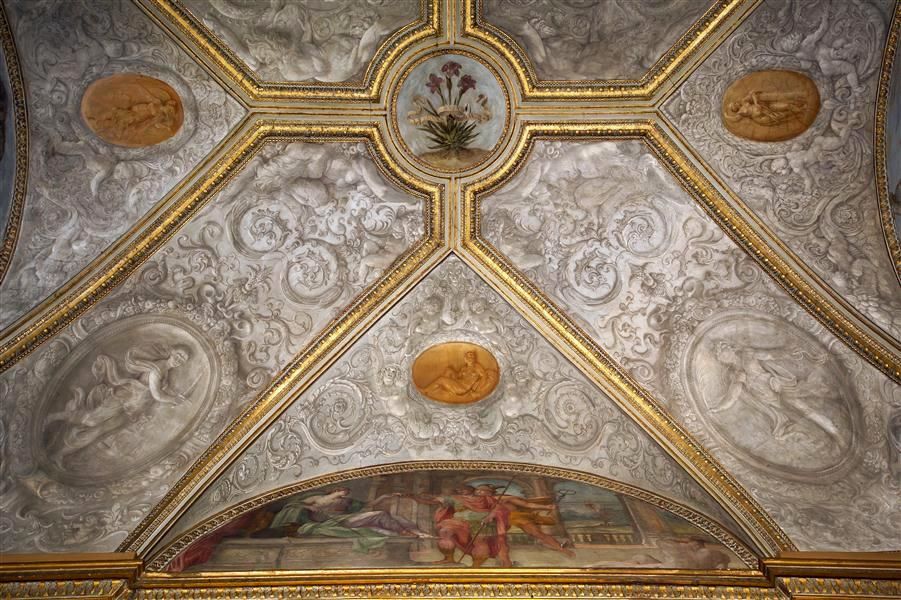
The Camerino ceiling, Palazzo Farnese, Rome. A copy occupies the central position of The Choice of Hercules. Image source. Public domain.
From pen study to painted canvas
A drawing at Princeton University Art Museum shows how different the arrangement could have been. In this rough study, Annibale tried an asymmetrical grouping and sketched the figures with brief, broken pen strokes. In the finished work he put Hercules between the two speakers, leaving stretches of landscape beyond both of them. Setting the advocates on either side turns an exchange among figures into a choice the viewer can trace from the centre to the edges. A more developed drawing in the Louvre studies the right-hand part of the composition. The Louvre relates it to a companion sheet in Dijon and records that Giuseppe Passeri later copied both. [11] [12]
An earlier decoration in Bologna shows that Annibale already knew how to use Hercules and Virtue in a ceiling. The national catalogue dates the fresco Hercules Guided by Virtue in Palazzo Sampieri to 1593–94 and attributes it to him. There the hero appears in the act of following Virtue. The Roman canvas makes the first step itself a question, reserving much of its space for the appeal of a second guide. [13]
The sources for Hercules’ pose are more complicated than his club might suggest. Erwin Panofsky compared the triad with an ancient relief of Hercules among the Hesperides, an argument that later scholars have questioned. The famous Farnese Hercules, then displayed in the palace courtyard, is another point of comparison for the massive body. Hendrick Goltzius’s engraving of that statue records a viewer’s encounter with its scale. He shows the marble figure from below and behind, with two small observers at its feet. His print is a record of the sculpture in its own right. [4] [14]
Shinsuke Watanabe has argued for a more specific graphic source in Marco Dente’s engraving Venus Wounded by a Rose’s Thorn, represented by an impression in Tokyo’s National Museum of Western Art. He notes similarities in the bent leg, the seated pose and the group of trees that carries over into the Louvre drawing. He also proposes that Annibale reversed which knee was raised so that the painted shadow would cover the groin consistently with the light in the ceiling decoration. The argument concerns how Carracci adapted a printed figure and landscape to the demands of a particular ceiling. The change of subject, from Venus to Hercules, makes the transformation especially clear. [4] [12]
From Rome to Parma and Naples
Capodimonte’s account dates the substitution of the copy to 1662. The original was sent to Parma, where it first hung in the Palazzo del Giardino and was later displayed in the ducal gallery in the Palazzo della Pilotta. It reached Naples in 1734 with the Farnese collection under Carlo di Borbone. The move from a private Roman vault to the ducal picture gallery placed the painting in a new company of works. The competing gestures and paths still tell the story on their own, while the flanking scenes of the hero bearing a globe and resting after his labours remain in Rome. [1] [3]
The canvas travelled again during the upheavals of the revolutionary and Napoleonic years. After French forces seized it in 1799 it was taken to Rome, where it was deposited at San Luigi dei Francesi under the care of Giuseppe Valadier. It returned to Naples in 1801. Capodimonte traces a further move to Palermo with Ferdinando IV in 1806, a return to Naples in 1815 and an eventual transfer back to Capodimonte in 1958 when the painting collections were separated from the archaeological holdings. [3]
From impressions on paper to a porcelain tray
A print could put the Camerino’s central design into collectors’ hands long before the canvas left Rome on Capodimonte’s chronology. The Rijksmuseum has Nicolas Mignard’s 1637 etching of Hercules choosing between Virtue and Vice. Its impression passed through the collection of Michiel Hinloopen, whose mark survives on the sheet. Pietro Aquila made another version in the later seventeenth century, now represented by impressions including one at the Metropolitan Museum of Art. Aquila and publisher Giovanni Giacomo de’ Rossi circulated the Camerino and the larger Gallery in separate series. Capodimonte identifies thirteen sheets for the Camerino and twenty-one for the Gallery, both listed in the publisher’s 1677 sales catalogue. [15] [16] [17]
Later works also used the composition more freely. The Met’s etching published by Johann Jakob Frey the Elder, dated 1700–52, is catalogued after both Carlo Maratti and Annibale Carracci. The Musei di Genova hold a drawing by Paolo Gerolamo Piola that takes Carracci’s design as a point of departure. Another kind of reproduction appeared in 1838, when Antonio Mannelli engraved the subject from a drawing by Giovanni Molino in a series illustrating the Real Museo Borbonico. The named roles in the last example trace how a collector could receive an image of the painting through another artist’s drawing and the engraver’s plate. [18] [19] [20]
Around 1801–02, the Real Fabbrica Ferdinandea in Naples put the composition at the centre of a porcelain tray, or plateau, now at Capodimonte. The rocky path, shaded grove and painted figures all reappear inside a richly gilded border. The raised gold reflects a technique then being adopted from Vienna at the Bourbon court. An impression from Aquila’s series is documented among the factory’s print resources, giving the decorators a plausible model. The decorators’ precise use of the print or the canvas remains uncertain. Angela Caròla-Perrotti has also suggested that the tray may have commemorated the painting’s return to Naples in 1801. [3] [17] [21]
At 22 by 32 centimetres, the tray allows a viewer to take in the details at close range. The fork in the landscape fits inside the space bounded by the gilding, just as it once fitted inside the architectural frame of the Camerino. In the palace, Carracci asked a viewer below the canvas to look up towards the little horse on the rock. On the tray, the same gesture sends a viewer’s eyes across a surface held almost within reach. [2] [3]
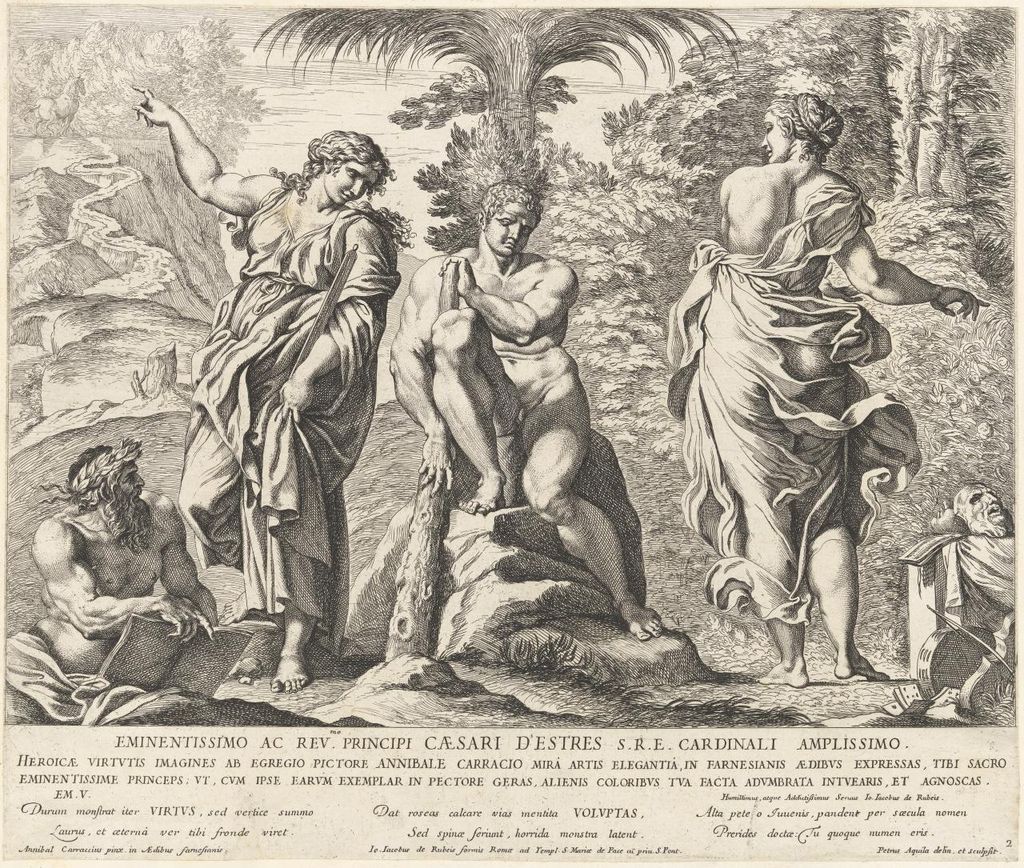
Pietro Aquila after Annibale Carracci, Hercules at the Crossroads. Print after the composition in the Camerino Farnese. Image source. Public domain.
Artworks directory
Paintings, frescoes, drawings and prints, with separate entries for documented versions and collaborative projects.
Discussion
Look again at the images and ideas explored in The Choice of Hercules. These editorial prompts invite your observations.
Reader Insights
How do the two paths guide your attention before you identify the characters?
How would the painted decision read differently from below in the Camerino?
Join the Conversation
Share a detail, comparison or question about The Choice of Hercules below.
References
- Italian Ministry of Culture, Ercole al bivio, national catalogue entry 1500625745 View source.
- Musei Capitolini, Il Camerino, exhibition room text View source.
- Angela Caròla-Perrotti, Ercole al bivio e la storia del plateau di Capodimonte View source.
- Shinsuke Watanabe, Annibale Carracci’s Hercules at the Crossroad and Marco Dente’s Print View source.
- Opher Mansour, Cardinal Virtues. Odoardo Farnese in His Camerino View source.
- Dayton Art Institute, Annibale Carracci, the Camerino Farnese View source.
- Xenophon, Memorabilia 2.1, University of Leeds Hercules project edition View source.
- Giovanni Pietro Bellori, Vita di Annibale Carracci, Le vite de’ pittori, scultori et architetti moderni, Rome 1672, pp. 33–37 View source.
- Francesco Mozzetti, Il Camerino Farnese di Annibale Carracci View source.
- Pinacoteca di Brera, DescriVedendo Brera, Carracci at Palazzo Farnese View source.
- Princeton University Art Museum, Study for the Choice of Hercules, 2008-43 View source.
- Musée du Louvre, Le Choix d’Hercule, preparatory drawing View source.
- Italian Ministry of Culture, Ercole guidato dalla Virtù, Palazzo Sampieri View source.
- Metropolitan Museum of Art, Hendrick Goltzius, Farnese Hercules, 17.37.59 View source.
- Rijksmuseum, Nicolas Mignard, Hercules moet kiezen tussen Deugd en Ondeugd View source.
- Metropolitan Museum of Art, Pietro Aquila, Hercules at the Crossroads, 51.501.933 View source.
- Museo e Real Bosco di Capodimonte, acquisition of the porcelain plateau View source.
- Metropolitan Museum of Art, Hercules at the Crossroads, published by Johann Jakob Frey the Elder, 53.600.863 View source.
- Musei di Genova, Paolo Gerolamo Piola, Ercole al bivio View source.
- Italian Ministry of Culture, Antonio Mannelli and Giovanni Molino, Ercole al bivio, 1838 View source.
- Italian Ministry of Culture, Art Bonus, porcelain plateau with Ercole al bivio View source.