 by Tom Gurney
Tom Gurney BSc (Hons) is an art history expert with over 20 years experience
Published on June 19, 2020 / Updated on November 29, 2026
Email: tomgurney1@gmail.com / Phone: +44 7429 011000
Annibale Carracci Drawings: Introduction
On a sheet of red chalk in the Louvre, a boy lifts his shirt over his head. His body twists and one leg takes his weight. Annibale Carracci studied that movement closely enough to carry it into an altarpiece of the Baptism of Christ. On a sheet several metres wide in Urbino, the same artist worked out how a crowd of revellers would look high on the ceiling of the Farnese Gallery. The first drawing isolates a gesture. The second gathers a procession and puts it on the scale at which it could be painted. Between them lies a range of work that includes experiments with poses, plans for whole rooms, sketches of riverbanks and drawings made on the backs of prints. [1] [2] [3]
The paper can tell us when in that process a drawing was used. An unfinished second outline may preserve a rejected choice. Small holes following an outline can show that someone prepared to carry the design onto another surface. Ink on the back of a study can belong to a subject entirely different from the one on the front. Those clues make Annibale's sheets worth seeing alongside his paintings. They reveal decisions that a single finished image can make look inevitable. [2] [4] [5]
At a Glance
- ArtistAnnibale Carracci
- DateAbout 1600
- MediumCharcoal and chalk on blue paper
Contents
- Drawing from life in Bologna
- How a design changes
- Designing a room on paper
- Cartoons and the evidence of transfer
- Riverbanks, domestic scenes and faces
- Drawings from the final years
- An original, a workshop drawing or a copy
- Annotated details
Selected drawings
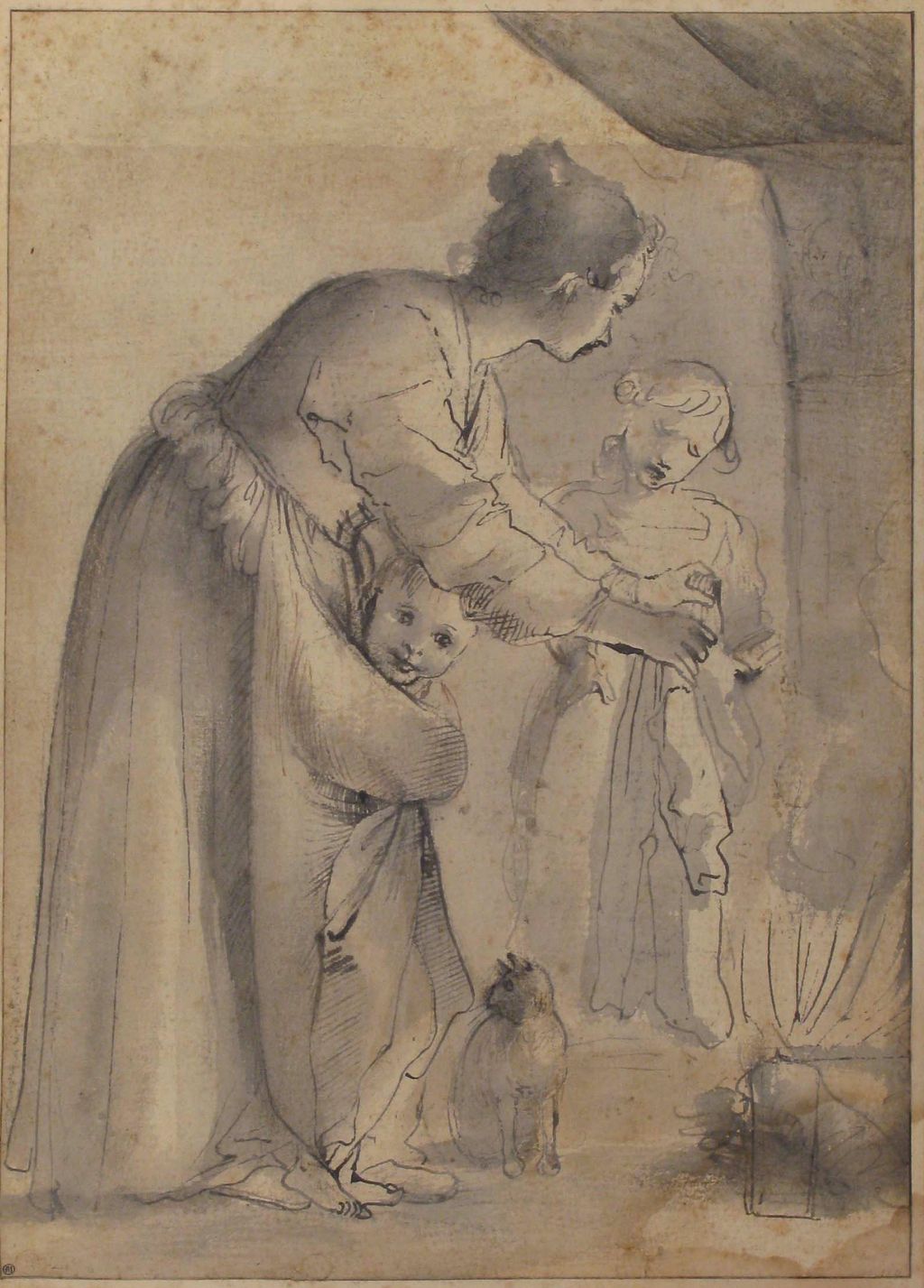
A Domestic Scene
Annibale Carracci, A Domestic Scene. The Metropolitan Museum of Art, 1972.133.2. Image source. CC0 / Public domain.
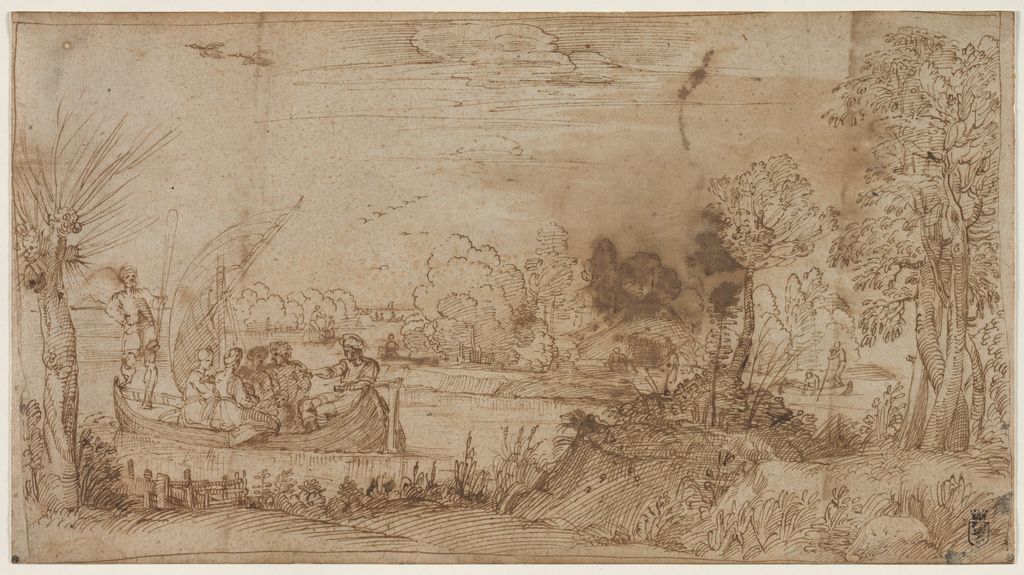
River Landscape with Boats
Annibale Carracci, River Landscape with Boats. Pen and brown ink. Cleveland Museum of Art, 1972.101. Image source. CC0 / Public domain.
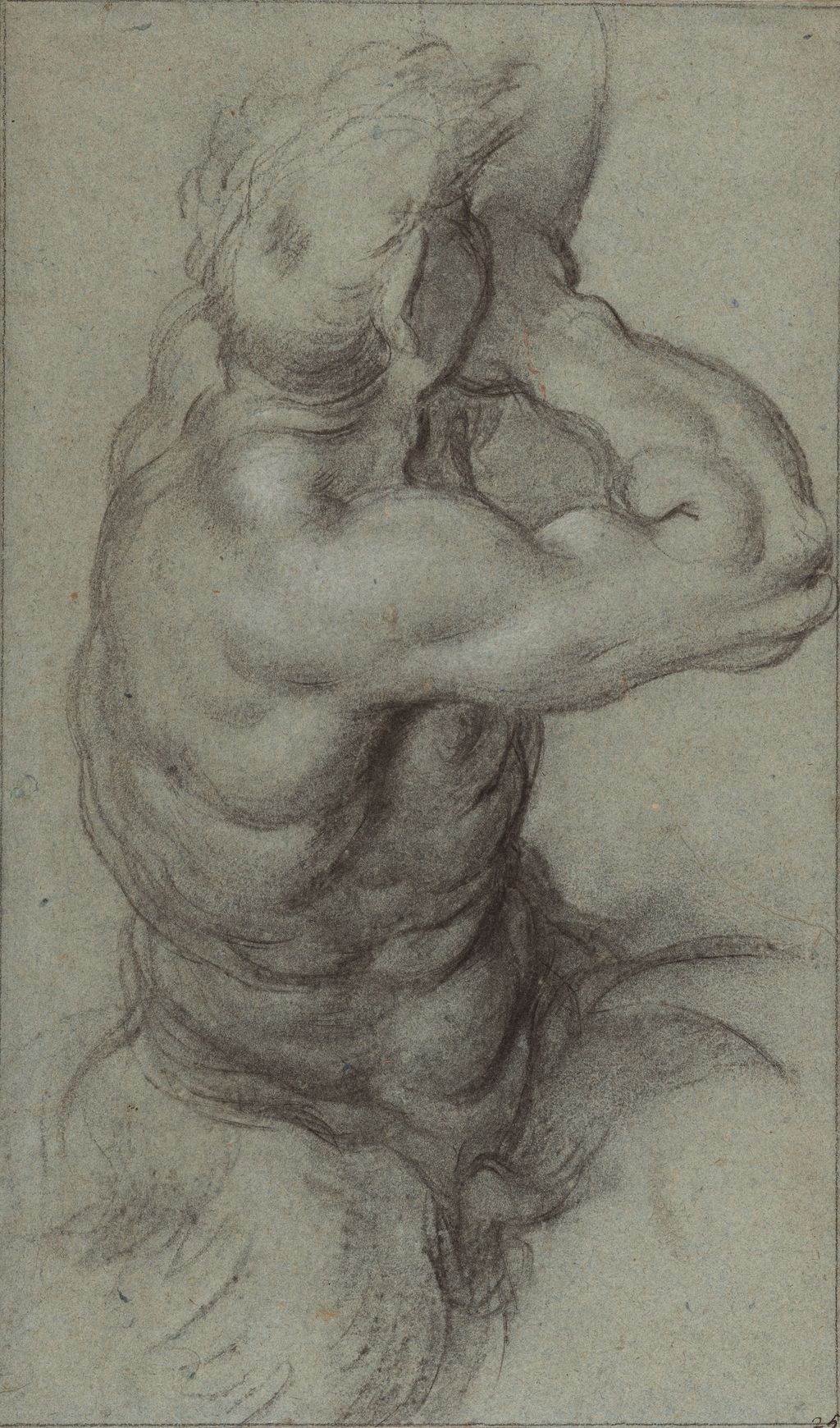
Study of Triton Blowing a Conch Shell
Annibale Carracci, Study of Triton Blowing a Conch Shell. Study for a figure in the Farnese Gallery. The J. Paul Getty Museum. Image source. CC0 / Public domain.
Drawing from life in Bologna
In the Carracci Academy, Annibale, his brother Agostino and their cousin Ludovico made drawing from the live model a shared practice. The Morgan's A Boy Lying on His Back, dated about 1582 in its centennial exhibition, gives an idea of the problems they set themselves. When a body is seen along its length, limbs that we expect to see extended can overlap or contract to an unfamiliar shape. Rather than arrange the boy to make the anatomy easy to follow, Annibale makes us work out how the nearer and farther parts fit together. On a horizontal sheet only 26 centimetres wide, a change of viewpoint is enough to change the whole account of the body. [2] [6]
The Morgan groups the drawing with related experiments by the Carracci that view posed figures from unusual angles. Its centennial label connects Annibale's study with a painted Lamentation by Ludovico. A body that first occupied the floor of a studio could furnish a pose for the dead Christ in another artist's painting. The drawing establishes how the figure is seen, while the painting puts the body among mourners and gives the pose a particular meaning. A figure's use in a painting is only one piece of the evidence for the hand that drew it. [6]
In the Louvre's Boy Taking off His Shirt, the thin, warm outline and the darker hatching around the leg do different jobs. The contour lets the eye follow an action still in progress. The hatching puts one side of the body into shadow and establishes the turn. Daniele Benati identified the weight-bearing pose and twist in a foreground boy in the Baptism at San Gregorio e San Siro in Bologna. In the altarpiece the youth also has to respond to another child and direct attention towards the baptism. His arm consequently has a different part to play. A second study in the Uffizi, 16509 F, is closer to the painting in the upper body and arm, though its head is at another angle. The artist could keep what he wanted from a pose and reconsider the rest at a different stage. [1] [2]
An old inscription on the Louvre sheet names Correggio. The museum now catalogues the drawing as Annibale's. Benati saw Correggio's example in the softness of the contours, so the old name gives us a clue to the sheet's reception, while the close comparison with the altarpiece helps establish its use. A similar tension appears in the British Museum's A Boy Taking off His Sock, once in Rubens's collection. It also carries Correggio's name. Benati gives the boy to Annibale and sees the figure as an exercise, while connecting the landscape and stony terrain on the same paper with Annibale's Dresden Saint Sebastian. Different parts of one sheet can have different destinations. [1] [2]
Annotated Details from Annibale Carracci Drawings
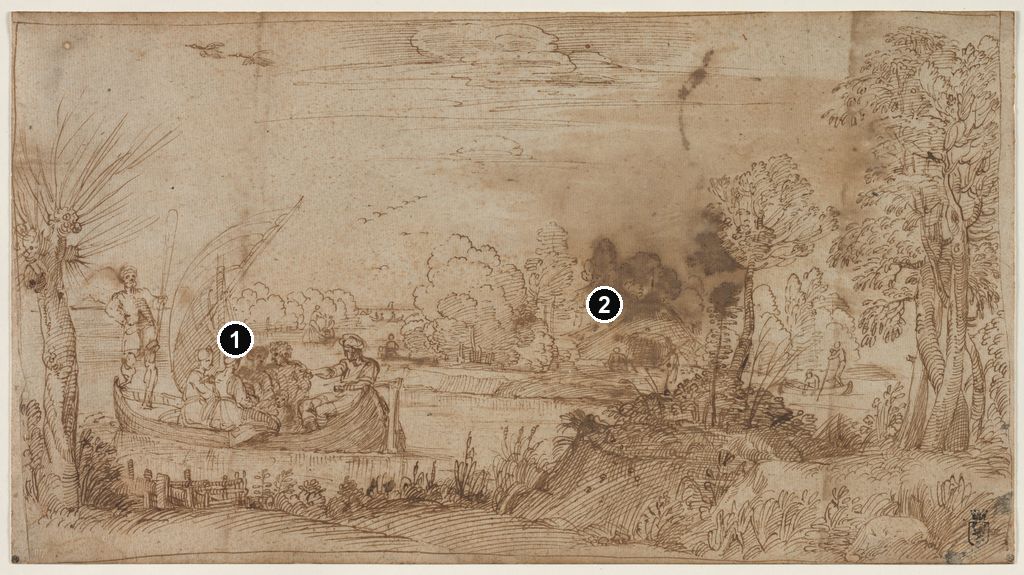
The numbered points identify visible features discussed in this article. Return from each detail to the numbered overview. Annibale Carracci, River Landscape with Boats. Pen and brown ink. Cleveland Museum of Art, 1972.101. Image source. CC0 / Public domain.
Details from ANNIBALE CARRACCI DRAWINGS
Compare the cropped details with the source images above. Notice how their colours, shapes and positions contribute to the larger compositions.
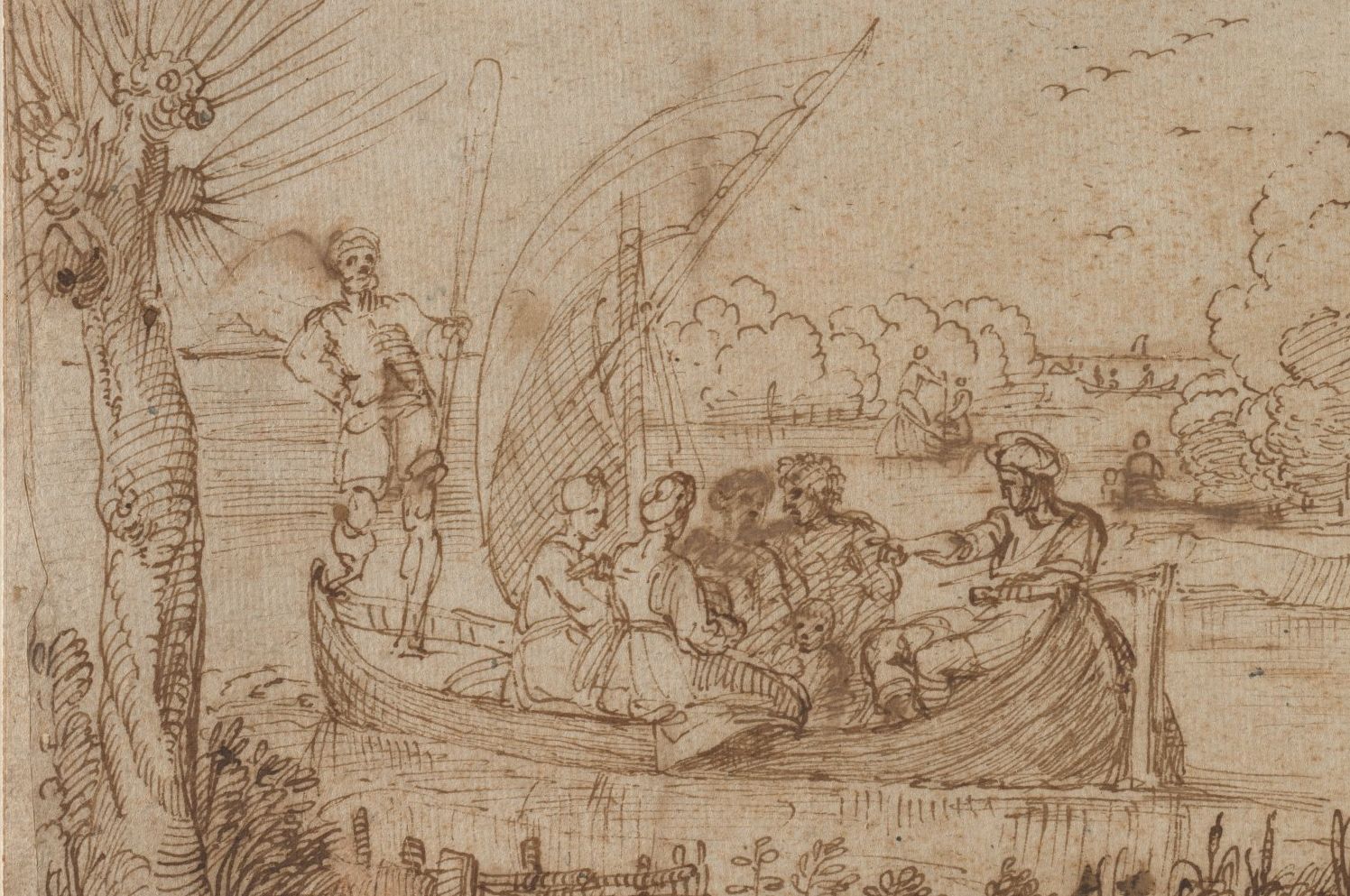
The boat and the willow
Tighter repetitions of the pen describe the bank, willow and boat. Within that dark cluster the upright figures can still be distinguished against the open water.
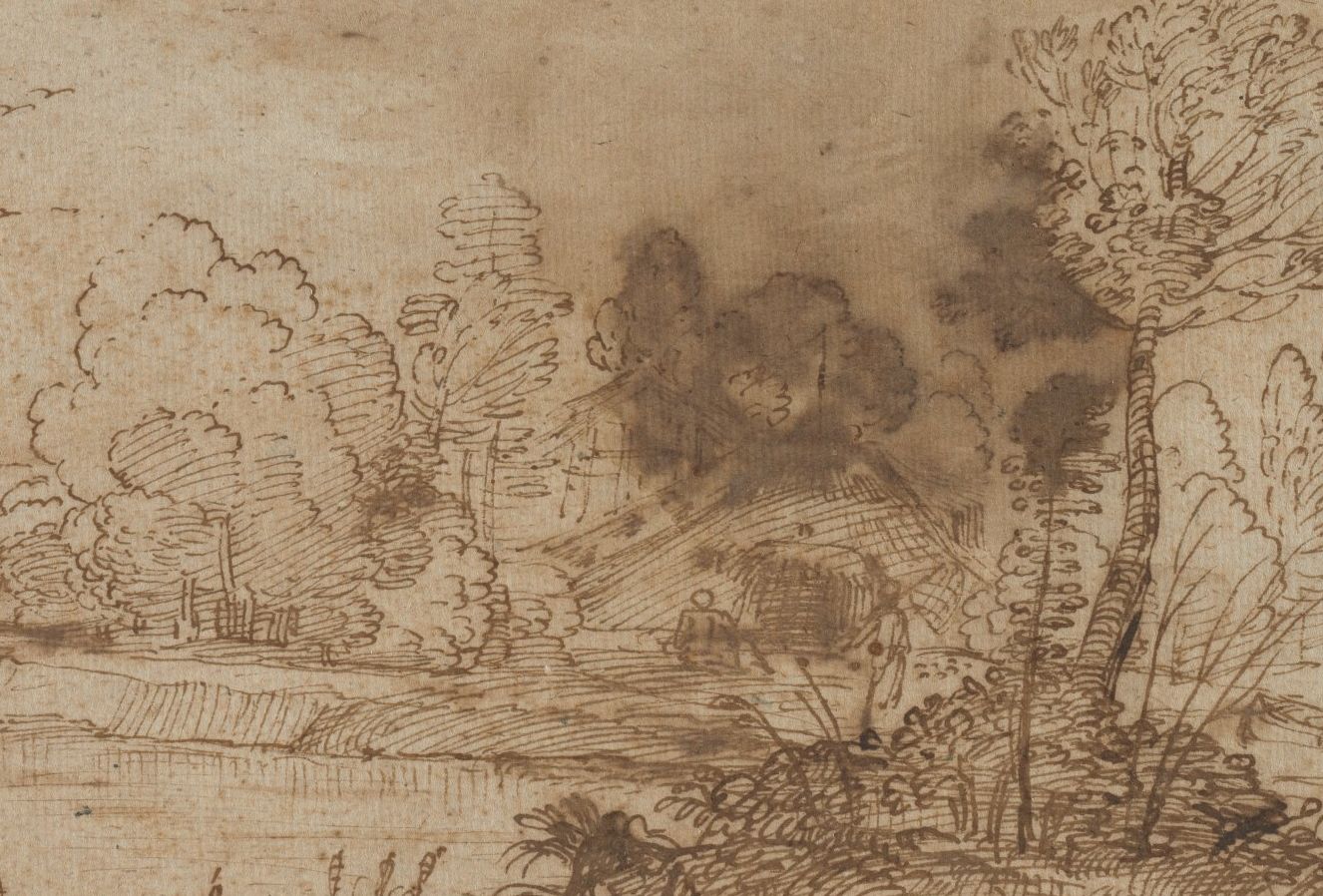
Lines marking the distance
The thin strokes behind the boat give the horizon its scale. The more densely worked banks interrupt the broad area of untouched paper.
How a design changes
Preparations for Saint Roch Distributing Alms show how much a figure depends on decisions about the whole picture. The Boijmans Van Beuningen sheet of a seated woman is worked in black chalk with white highlights on blue paper that has discoloured. The paper supplies a middle tone. Carracci could press darkness into the creases and pull pale ridges out of the fabric with white. Seen close up, those folds tell us where the cloth falls under its own weight and where the raised knee holds it up. In the Dresden altarpiece she sits prominently at the front, looking up towards the saint and indicating her empty bowl. The fold study gives that gesture a body and a place among the people around her. [7]
Surya Stemerding's Boijmans catalogue entry traces an earlier state of the design through prints after a preparatory model and through technical evidence from the canvas. Annibale had planned a landscape behind the gathering and had begun laying out the picture on the canvas before reversing the composition. Architecture replaced the landscape. The Rotterdam woman already faces as she does in the painting, placing the figure study after the design had changed direction. A slight rounded mark beneath her knee also has a counterpart in the composition. The entry suggests that the roll of cloth could be a swaddled child, an interpretation that remains open. The marks and folds establish the sheet's place in the work more firmly than they establish the meaning of that detail. [7]
At the Real Academia de Bellas Artes de San Fernando in Madrid, a study for Venus, Adonis and Cupid has undergone a different change, in its attribution. Earlier cataloguers gave it to Giulio Cesare Procaccini. Alfonso E. Pérez Sánchez identified it as a first idea for the treatment in the Prado and a version in Vienna. Where a drawing makes a first proposal for a group, broad correspondences matter more than an exact match of fingertips or folds. The comparison also shows why a preparatory sheet can illuminate more than one painted version without resolving every question about their relationship. [8]
A model, a sculpture and a drawing could each contribute different things. In the Art Institute of Chicago sheet for Hercules Resting, which the Morgan exhibited, the antique Tiber river god offers a precedent for the recline. Annibale uses black and white chalk on blue paper to set out the mass of the resting figure and studies his head and foot separately. The sheet is connected with the Camerino frescoes in the Palazzo Farnese, in the same private study as the ceiling canvas The Choice of Hercules. For the Gallery, a Windsor sheet, RCIN 902096, uses the Belvedere Torso by another route. The Louvre identifies a live model posed in imitation of the antique fragment. That study furnished the figure to the right of Jupiter and Juno, an atlante or sculpted-looking male support. With a person holding the twist, Carracci could see how light played across the pose before turning the result back into an imitation of sculpture in paint. [9] [10]
Another design problem survives in the Städel Museum's Two Young Satyrs Picking Grapes, a drawing attributed to Annibale. Pen in brown and black runs over red chalk, and a piece of paper inserted between the parts widens the sheet. The Städel relates it to painted panels in London that may have decorated a keyboard instrument. The drawing allows a glimpse into a wide landscape beyond the figures. The related painting brings grape gathering and the figures much closer to the eye. The small inserted strip records a very practical freedom available on paper. The draughtsman could make room for a different interval within the design by physically enlarging its surface. [11] [12]
Designing a room on paper
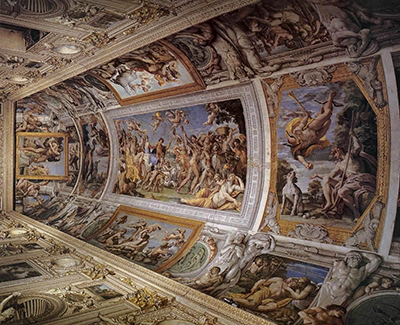
In the Farnese Gallery, drawings had to solve the spaces between the stories as well as the stories themselves. In the Louvre's Project for the Decoration of the Farnese Gallery, INV 7416 recto, Annibale tried out the framework of the decoration and details of the mouldings. Red chalk and brown pen are both visible on a sheet under 40 centimetres high. Take in the overall arrangement, then look at the smaller investigations of profiles and edges. The thickness of a moulding and the apparent weight of a support would affect which areas of the ceiling seemed to project and which opened into deeper space. The Louvre compares the design with another of its sheets, INV 7418, and a related study in Copenhagen. Look for the roundel beneath the upright frame. As Gail Feigenbaum notes in the Washington catalogue, its whole circle survives in red chalk, while the pen makes the frame seem to cover part of it. One shape physically drawn over another becomes a suggestion of depth that Carracci could carry into the vault. There, painted mythologies look as though they have been framed and placed in front of the surrounding decoration. [2] [13]
Turn that paper over and the scale of attention shifts again. On the verso of INV 7416 is a view on the Tiber, near the Isola Tiberina in Rome, beside an unfinished moulding study. The Louvre collection page uses the title View of the Ponte Sisto, on the Tiber. Its 2025–26 exhibition checklist gives the Isola Tiberina title. The inventory number and the side of the sheet identify the drawing across those descriptions. On the same support Annibale could investigate the shape of an invented surround and record the structures set along an actual stretch of water. [4] [14]
Victor Hundsbuckler's 2025–26 Louvre exhibition made those small decisions legible by relating the sheets to a reconstruction of the vault. Preparations such as heads, hands and individual legs could be compared with the larger painted grouping. A study of one hand or leg occupies a substantial part of a sheet even when its counterpart takes up a tiny part of the room. The exhibition also brought together designs for the adjacent Camerino and showed restored cartoons made much later for the Farnese Gallery's French reproduction in the Tuileries. Those French sheets record another generation's effort to transfer a ceiling. They belong to the story of the frescoes' renown and to a different campaign of drawing from the one that created the room. [14] [15]
Cartoons and the evidence of transfer
A cartoon is a full-scale drawing from which a design can be transferred. For fresco the working surface is intonaco, the smooth, fresh plaster. A painter could trace through a cartoon with a pointed stylus and leave a line pressed into the plaster. With another method, known as pouncing, the contours were pierced and powdered material passed through the holes, producing dotted outlines. A patch of fresh plaster had to be painted while it remained workable. The patch covered in one session is a giornata, from the Italian for a day's work. A large picture could therefore proceed in a number of sections, with the painted figures eventually concealing many of the divisions that had governed their making. [16] [5]
Annibale's cartoon in Urbino, inv. 1/D, preserves the Silenus group from the right half of the Triumph of Bacchus and Ariadne. The museum's Italian national record identifies the sheet as a preparatory drawing mounted on canvas. In the 1999 Washington catalogue Margaret Morgan Grasselli noted pierced outlines, indications of pouncing and an absence of the irregular cut edges that would fit the separate plaster patches on that half of the ceiling. She proposed that the surviving cartoon passed its outlines onto a second one, now lost, and that the second sheet was cut up for the actual transfer. That reading accounts for a working drawing several metres across surviving together despite the practical demands of painting the fresco. It also allows for change after transfer. The catalogue points out differences in drapery and in the outline of Silenus's head between the cartoon and the paint. It also records more than fifty joined sheets of paper. The joins that built up the working surface and the edges that would have been needed to fit a day's plaster answer different questions about how the cartoon was made and used. [2] [3]
The National Gallery in London preserves two other large cartoons from the same ceiling. It catalogues both under Agostino Carracci. In Cephalus carried off by Aurora in her Chariot (NG147), the main contours were traced with a stylus and the cartoon was cut into sections for use. The Gallery considers the dog in the foreground a possible contribution by Annibale. A Woman borne off by a Sea God (?) (NG148) has the uncertainty about the subject built into the title. Here the outlines were pricked. The Gallery proposes that the holes were made through a second sheet below the first, which would supply a substitute to cut and use. In the same room and at similar scale, there is evidence for two ways of getting a drawing onto the ceiling. [5] [17] [18]
The London studies also show how conservation can aid interpretation. Their paper originally had a blue-grey tone between the charcoal shadows and the white lights. It had changed considerably in colour and the drawings had been mounted on canvas. Conservators separated the old support and devised a more stable backing. The bulletin documents how the papers, incisions, holes and joins were examined. The published study and current collection pages make it possible to see an object at once as a drawing in light and shade and as a working template. In a reproduction, the joins can be mistaken for wear. On Cephalus and Aurora, they help explain the division of labour over successive areas of plaster. [5] [17] [18]
Riverbanks, domestic scenes and faces
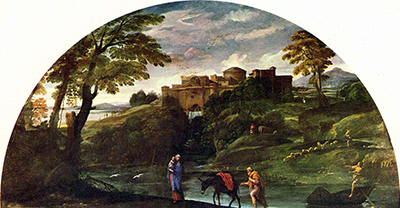
In the Morgan's Eroded Riverbank with Trees and Exposed Roots, about 1590–92, the line of the bank itself holds the scene together. Pen strokes gather under the trees and open out along the worn bank so that the exposed roots can be followed back into the ground. The Morgan thinks Carracci probably began this unusually close study from life and finished it in the studio. Cleveland's River Landscape with Boats, about 1590, gives ink a different reach. Its water holds the long view open between the banks. Compare that device with Eroded Riverbank and with the painted River Landscape in Washington. A stretch of relatively empty paper can do work that the paint does with reflected light and shifts of colour. [19] [20] [21]
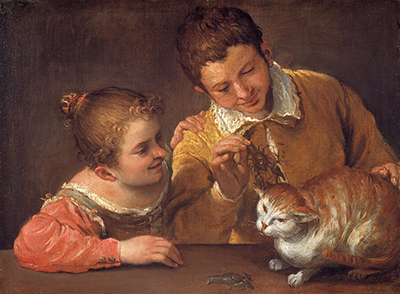
In A Domestic Scene at the Metropolitan Museum of Art, two children and a cat attend to a woman at a hearth. The Met lists black chalk as well as pen and wash. In its reading of the sheet, the pale, freely applied washes give the encounter its atmosphere. The light seems to pool near the hearth and lose strength as it moves away from the fire. Compare it with Two Children Teasing a Cat, also in the Met. The drawing spreads attention across the room and makes us follow where the figures look. The painting closes in on the faces and the immediate predicament of the cat. The Met catalogues the sheet as Annibale's and records earlier objections. Ann Sutherland Harris gave it to Ludovico and Babette Bohn ruled out Annibale and Agostino. Loisel defended the current attribution, pointing to the freedom of the lines and the attention to feeling between the figures. The Met also holds Vincenzo Vangelisti's eighteenth-century print after this drawing. Its reversal is another clue to the object's history. [22] [23] [24]
A face could be studied for a painted role, drawn for its character or made the subject of a visual joke. In the British Museum's sheet of caricatures, Pp.3.12, a man's profile approaches the shape of a ram's head. Catherine Loisel points out that transformation and traces another bearded profile across the sheet, a Louvre head study and related drawings. For the 1999 catalogue she considered the British Museum sheet in connection with an attribution to Agostino and argued for Annibale. Bellori, writing in the seventeenth century, recalled Annibale giving animals human likenesses, useful testimony for the interest such drawings aroused. The passage and the recurring profiles shed light on a practice that Annibale and Agostino both explored. [2] [25]
A pen and brush study in the Hermitage, Young Artist at Work, turns the attention onto the act of drawing. The figure bends over his task, and the large outline of his hat and costume draws the eye before it reaches his working hands. In an illustrated Russian study, Lyubava Chistova puts the sheet between representations of an occupation and caricature, reading a possible edge of comedy in the figure's proportions and dress. Compare it with the later portrait traditionally identified as Cigoli, whose concentration at his desk is likewise the point of the pose. The two pictures of artists at work convey very different impressions of the job. [26] [27]
Drawings from the final years
After Annibale became seriously ill in 1605 his ability to take on major projects declined. Carel van Tuyll's study of the final period at the Morgan draws attention to the continuing activity on paper. One small pen drawing there, 1978.17, brings Mary and the Child together in one group and explores a piper, dancing children and spectators nearby. The museum connects it with a lost Adoration of the Shepherds. Turn the sheet over and another kind of work appears. Annibale drew on the back of a proof impression of his Christ Crowned with Thorns, before lettering was added. A later state of the print carries the date 1606. The proof places the pen drawing in the orbit of his late printmaking while leaving the exact date of the ink open. [28] [29]
The red-chalk Portrait of the Artist Ludovico Cardi, called Cigoli in Stockholm catches a bearded figure using pince-nez as he works. His downward look and the accumulation of strokes around his head and upper body give his attention a direction. The sitter's name is recorded in an inscription on the back. Nicholas Turner, accepting the attribution to Annibale, dated it between Cigoli's arrival in Rome in 1604 and Annibale's death in 1609. The Nationalmuseum also records other possibilities, including Loisel's suggestion of Agostino. That difference would have consequences for the date since Agostino died in 1602. When the drawing was shown in Tokyo in 2025, it was presented under Annibale's name. The date and name on a label are judgments about the object, open to scrutiny as the drawing passes between collections and exhibitions. [27] [30]
An original, a workshop drawing or a copy
A title can describe the same image circulating at different times. The Louvre's Sleeping Venus Surrounded by Cupids in a Landscape, INV 7571, is a seventeenth-century pen and brown wash copy after the Sleeping Venus painted by Annibale, now in Chantilly. Catherine Loisel catalogued the draughtsman as an anonymous Italian. The Louvre also records two sketches in an album by Giovanni Benedetto Castiglione that take up the composition. The drawings show how the image travelled after the commission. The Louvre's Arion Saved by a Dolphin has a more immediate connection to the making of the Farnese Gallery. It belongs to a group of pen studies for frescoes set into stucco on the long walls. Its collection entry keeps the workshop attribution proposed by Loisel in 2004. The same entry records that Carel van Tuyll and Victor Hundsbuckler have since argued that the group is by Annibale himself. The relation between drawing and wall is secure even while the name of the draughtsman is under discussion. [31] [32]
The 1999 Washington exhibition assembled 96 sheets in the first exhibition devoted specifically to Annibale's drawings. Putting his work together gave scholars and visitors a chance to see how his red chalk, pen and wash change with each task. The 2025–26 Louvre exhibition gathered the Farnese drawings around a shared commission, making it possible to set Annibale's contributions alongside Agostino's and the workshop's. Start close enough to see whether a mark follows an outline, revises it or goes through the paper. Then compare the sheet with the object, other drawings and the collection record. A pierced line in Urbino and a shadow across a boy's leg in Paris have very different stories to tell. [1] [2] [15] [33]
Catalogues of the drawings
The Drawings of Annibale Carracci. Daniele Benati and contributors. National Gallery of Art, 1999.
The exhibition catalogue traces drawing across the artist’s career and records the life-size cartoon lent from Urbino. Read the NGA publication.
Dessins des Carrache. La fabrique de la Galerie Farnèse. Victor Hundsbuckler. Musée du Louvre and Lienart, 2025. In French.
The catalogue assembles known preparatory drawings and examines how they relate to the painted decoration. View the Louvre catalogue.
Artworks directory
Paintings, frescoes, drawings and prints, with separate entries for documented versions and collaborative projects.
Discussion
Look again at the images and ideas explored in Annibale Carracci Drawings. These editorial prompts invite your observations.
Reader Insights
Which marks best show an idea being revised on the sheet?
How does a drawing’s purpose change what you should look for in it?
Join the Conversation
Share a detail, comparison or question about Annibale Carracci Drawings below.
References
- Musée du Louvre, Jeune garçon enlevant sa chemise, INV 7320 recto. View source.
- Daniele Benati et al., The Drawings of Annibale Carracci, National Gallery of Art, 1999, cat. 6 and 8 on the two studies of boys, cat. 40 on the Gallery design, cat. 47 on the Urbino cartoon, and cat. 82 and fig. 2 on the caricatures. Read catalogue. View source.
- Ministero della Cultura, Trionfo di Bacco e Arianna, Urbino cartoon, accession 1/D, national catalogue record 1100262860. View source.
- Musée du Louvre, Vue du Ponte Sisto, sur le Tibre, INV 7416 verso. View source.
- Gabriele Finaldi, Eric Harding and June Wallis, The Conservation of the Carracci Cartoons in the National Gallery, National Gallery Technical Bulletin 16, 1995, pp. 30–46. Read technical study. View source.
- The Morgan Library & Museum, A Boy Lying on His Back, 2024.157, object record and related sheets. Read centennial exhibition labels. View source 1. View source 2.
- Surya Stemerding, Museum Boijmans Van Beuningen, Studie van een op de grond zittende vrouw, I 447 (PK), Italian drawings collection catalogue. View source.
- Real Academia de Bellas Artes de San Fernando, Estudio de Venus, Adonis y Cupido, D-2256. View source.
- The Morgan Library & Museum, Study of Hercules resting, with separate studies of his head and foot, Art Institute of Chicago 2019.838, Gray Collection exhibition entry. View source.
- Musée du Louvre, Un spectaculaire trompe-l'œil, study of a living model after the pose of the Belvedere Torso, Royal Collection RCIN 902096. View source.
- Städel Museum, Zwei Satyrknaben, Weintrauben pflückend, attributed to Annibale Carracci, 4272 Z. View source.
- National Gallery, London, Silenus gathering Grapes, NG93.1, and the proposed keyboard instrument. View source.
- Musée du Louvre, Projet de décoration pour la galerie Farnèse, INV 7416 recto. View source.
- Musée du Louvre, Département des Arts graphiques, Dessins des Carrache. La fabrique de la galerie Farnèse, 2025–26, exhibition checklist. View source.
- Musée du Louvre, The Carracci Drawings. The Making of the Farnese Gallery, exhibition dossier, curatorial overview and Tuileries cartoons. Read dossier. View source.
- National Gallery, London, Cartoons, glossary of transfer methods. View source.
- National Gallery, London, Agostino Carracci, Cephalus carried off by Aurora in her Chariot, NG147. View source.
- National Gallery, London, Agostino Carracci, A Woman borne off by a Sea God (?), NG148. View source.
- The Morgan Library & Museum, Eroded Riverbank with Trees and Exposed Roots, 1972.6, exhibition entry. View source.
- Cleveland Museum of Art, River Landscape with Boats, 1972.101. View source.
- National Gallery of Art, River Landscape, painting, 1952.5.58. View source.
- The Metropolitan Museum of Art, A Domestic Scene, 1972.133.2. View source.
- The Metropolitan Museum of Art, Two Children Teasing a Cat, painting, 1994.142. View source.
- Catherine Loisel, Variantes et copies dans l’atelier des jeunes Carracci, 1580–1588, discussion of the hearth drawing and fig. 30. Read study. View source.
- Musée du Louvre, Département des Arts graphiques, Tête d'homme barbu de profil vers la gauche, with references to the related British Museum and other sheets. View source.
- Lyubava Chistova, “Young Artist at Work”. The Problem of the Artist's Status in Annibale Carracci's Drawings, HSE Art and Design Journal no. 1, 2026, illustrated study of Hermitage ОР-21177 and comparative works. Read article. View source.
- Nationalmuseum, Stockholm, Portrait of the Artist Ludovico Cardi, called Cigoli, NMH 944/1863, collection record and attribution discussion. View source.
- Carel van Tuyll van Serooskerken, Annibale Carracci at the Morgan. Drawings from the Artist's Final Period, 2019 lecture and overview. View source.
- The Morgan Library & Museum, Shepherd with Pipes, and Two Dancing Children; Virgin and Child with Heads of Four Spectators, 1978.17. View source.
- National Museum of Western Art, Tokyo, Renaissance to Baroque. Master Drawings from the Nationalmuseum, Stockholm, 2025 exhibition and checklist. View source.
- Musée du Louvre, Vénus endormie et entourée d'amours, dans un paysage, INV 7571 recto, anonymous Italian copy after Annibale. View source.
- Musée du Louvre, Arion sauvé par un dauphin, workshop of Annibale Carracci. View source.
- National Gallery of Art, The Drawings of Annibale Carracci, Washington exhibition, 1999–2000. View source.