 by Tom Gurney
Tom Gurney BSc (Hons) is an art history expert with over 20 years experience
Published on June 19, 2020 / Updated on November 29, 2026
Email: tomgurney1@gmail.com / Phone: +44 7429 011000
Landscape with the Toilet of Venus: Introduction
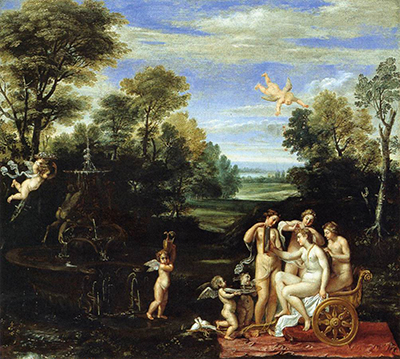
Francesco Albani's Landscape with the Toilet of Venus sets a small gathering in the lower right of a woodland clearing. Venus sits in a chariot while her attendants arrange her hair. A fountain ornamented with satyrs stands across the clearing, and cupids bring flowers through the air. Albani painted this oil on canvas around 1605–10. It measures about 90 × 100 cm and belongs to the Pinacoteca Nazionale di Bologna, where its inventory number is 6503. The Fondazione Federico Zeri catalogues it under Albani and preserves Annibale Carracci as a historical attribution. [1] [2] [3]
Carracci's connection with the painting goes deeper than the old catalogue name. His earlier Venus Adorned by the Graces in Washington supplied Albani with a model for the group. Carracci may also have contributed to the design of the Bologna painting if it was conceived as a companion to a landscape of Diana and Callisto. That proposal concerns the invention of the composition. The Bologna canvas itself is catalogued as Albani in Italian records and in the loan schedule for the Prado's 2011 landscape exhibition. [1] [2] [3] [4]
At a Glance
- ArtistFrancesco Albani (historically attributed to Carracci)
- DateAbout 1605–10
- MediumOil on canvas
- Bologna paintingPinacoteca Nazionale di Bologna, 6503. Catalogued under Francesco Albani by the Fondazione Zeri.
- Washington comparisonNational Gallery of Art, 1961.9.9. Venus Adorned by the Graces by Annibale Carracci.
Contents
- Venus in the clearing
- What Albani took from Carracci
- Was the landscape designed as a companion?
- From the Orléans collection to Bologna
- How Albani revisited the scene
- Annotated details
Venus in the clearing
The toilet in the title is Venus's toilette, the work of dressing and adorning herself. It is a scene of several tasks carried out at once. The women bend their heads and bring their hands close to the goddess's hair, and a kneeling cupid lifts a small object towards her. Look at how closely the faces and hands are gathered, then at the much greater span across the sky. One airborne cupid brings a vase of flowers from the left and another scatters blossoms from above the goddess. The preparations occupy the clearing at several heights. [3] [5]
The gilded chariot wheel and the red fabric beneath it give the pale bodies at the right a firm footing. The wheel is still in full view while Venus sits, which makes the gathering feel like a stop in a journey. On the left, the water catches the light in short strokes against the shadow around the fountain. The small cupid standing between the fountain and chariot helps carry the eye across the foreground. Behind him, the darker trees frame a strip of sunlit land. The break in the woods is narrow, but it lets the eye travel a long way past the figures. [3] [5]
Catherine Puglisi traces the gestures to a late antique poem by Claudian on the marriage of Honorius and Maria. The poem describes the Graces working separately on Venus's hair as she consults a mirror. It was available in Italian in Vincenzo Cartari's handbook of ancient gods, which also describes pictures of Venus and her company as good wishes for brides. This tradition helps explain how a scene as quiet as having one's hair arranged could evoke love and marriage. The first owner and intended setting of the Bologna painting remain uncertain. [3]
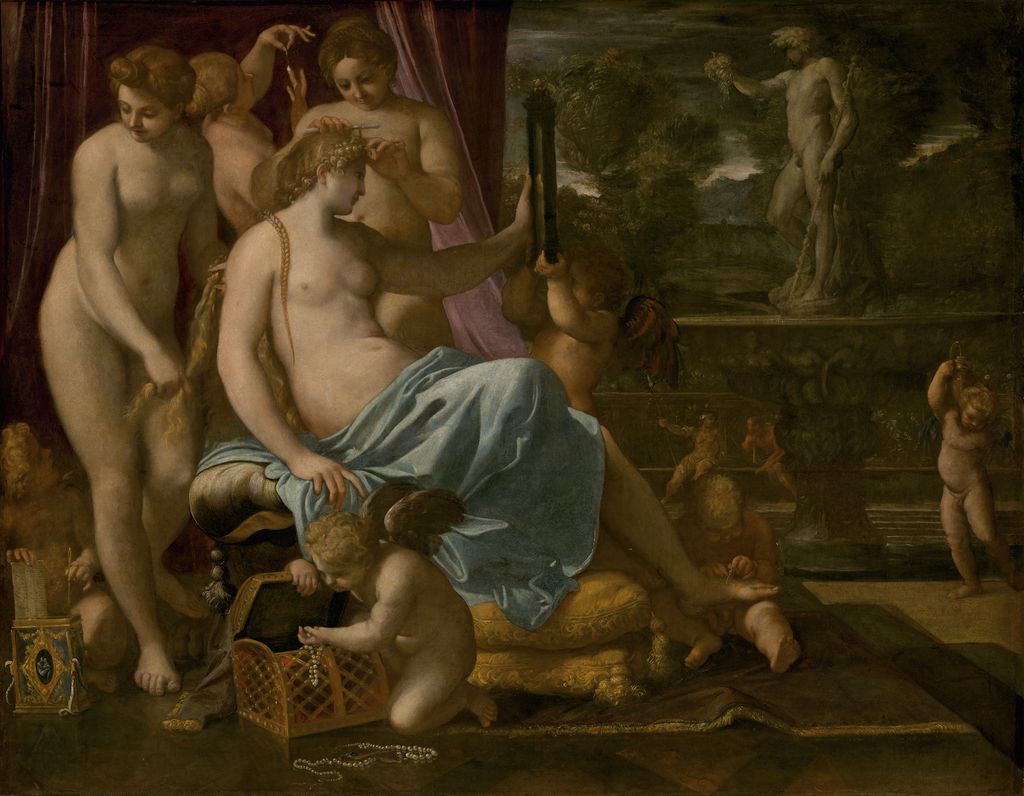
Annibale Carracci, Venus Adorned by the Graces. National Gallery of Art, Washington, 1961.9.9. Image source. CC0 / Public domain.
Annotated Details from Landscape with the Toilet of Venus
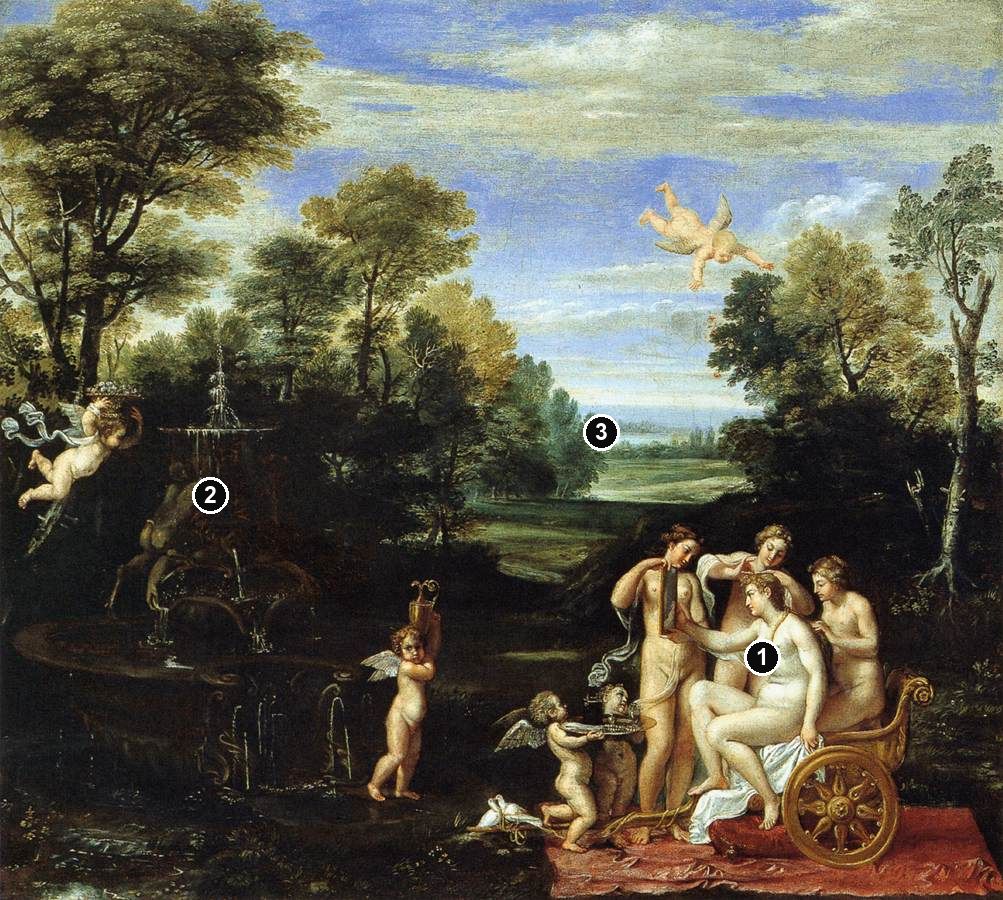
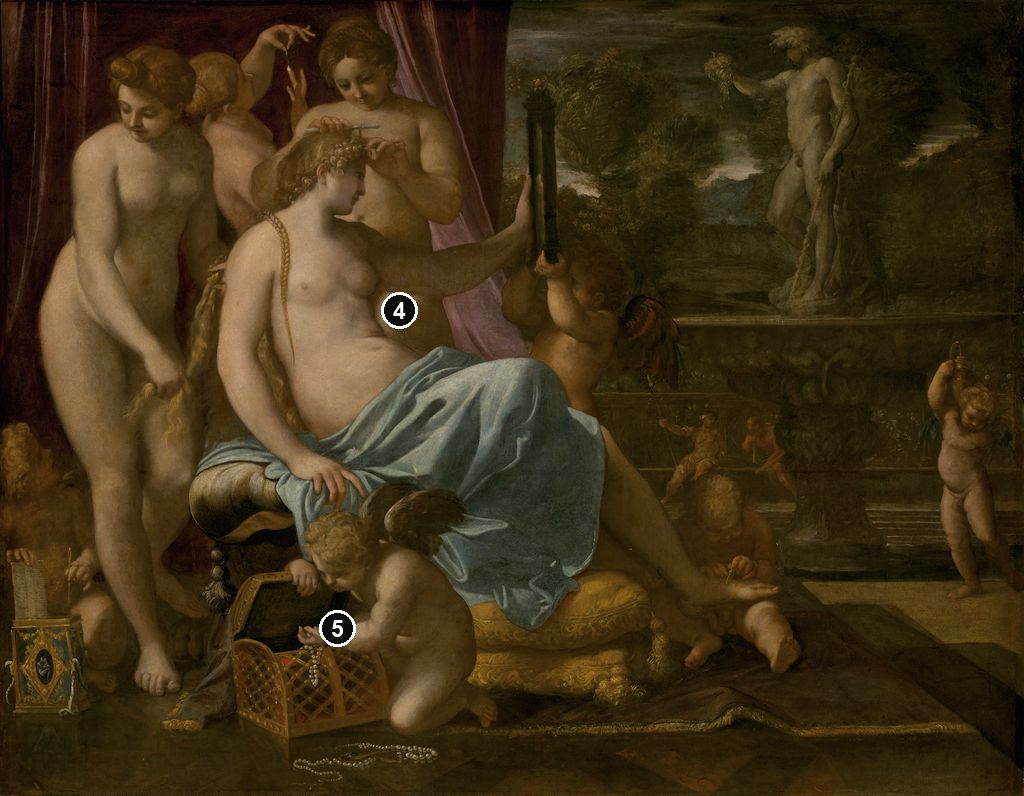
The numbered points identify visible features discussed in this article. Return from each detail to the numbered overview. Each caption identifies the work shown.
Landscape with the Toilet of Venus in Bologna
Francesco Albani, historically attributed to Annibale Carracci, Landscape with the Toilet of Venus. Pinacoteca Nazionale di Bologna, 6503. Image source. Public domain.
Venus Adorned by the Graces in Washington
Annibale Carracci, Venus Adorned by the Graces. National Gallery of Art, Washington, 1961.9.9. Image source. CC0 / Public domain.
Details from LANDSCAPE WITH THE TOILET OF VENUS
Compare the cropped details with the source images above. Notice how their colours, shapes and positions contribute to the larger compositions.
Landscape with the Toilet of Venus in Bologna
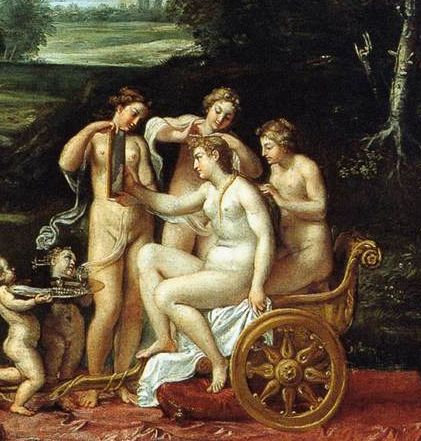
Venus and her attendants
The figures huddle around the seated Venus and the gold wheel of her chariot. The grass and trees behind them make the pale flesh and fabric stand out.
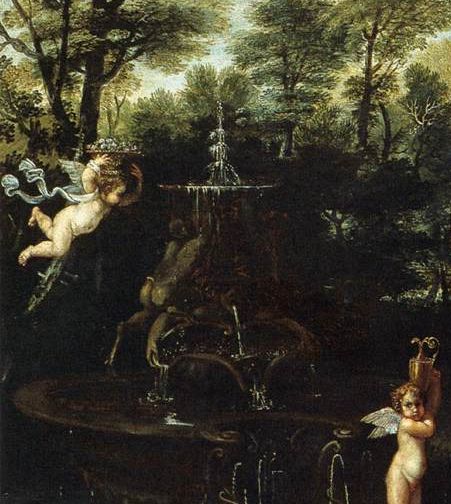
The fountain and its basin
A narrow movement of falling water descends into a sculptural basin. Deep shade connects the water to the wooded half of the composition.
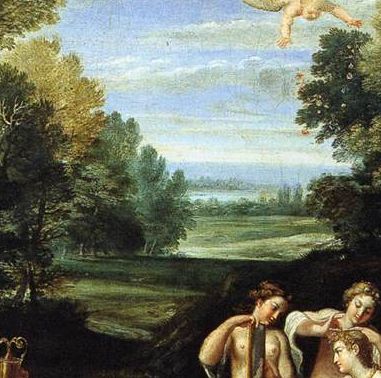
The opening through the trees
Through the trees, bright ground reaches towards a blue horizon. The view into the distance interrupts the close, dark vegetation on both sides.
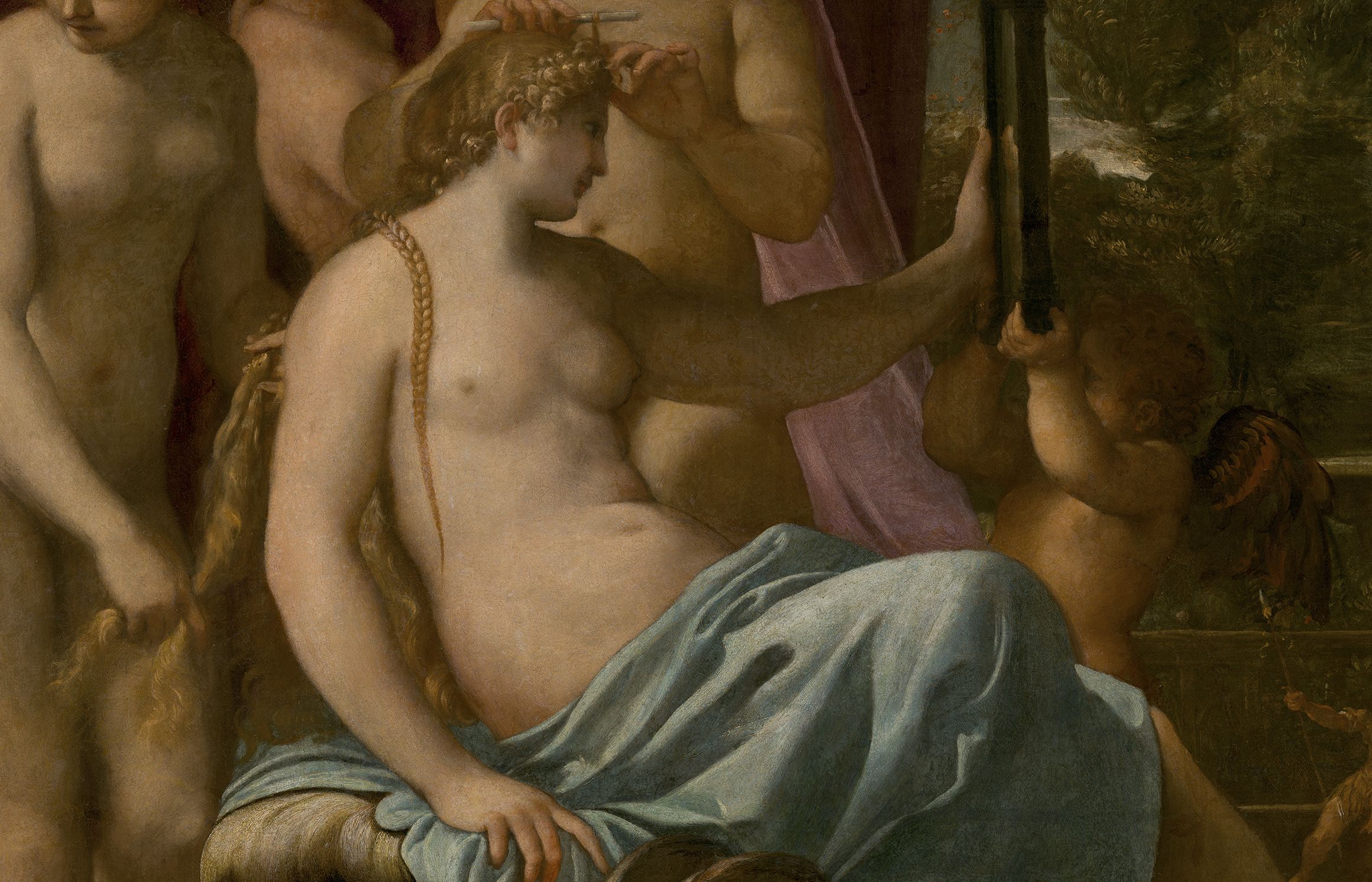
Venus Adorned by the Graces in Washington
The seated Venus in Washington
Hands gather around Venus’s head, wrist and lap. Her chair and the attendants occupy the larger part of the left side of Carracci’s composition.
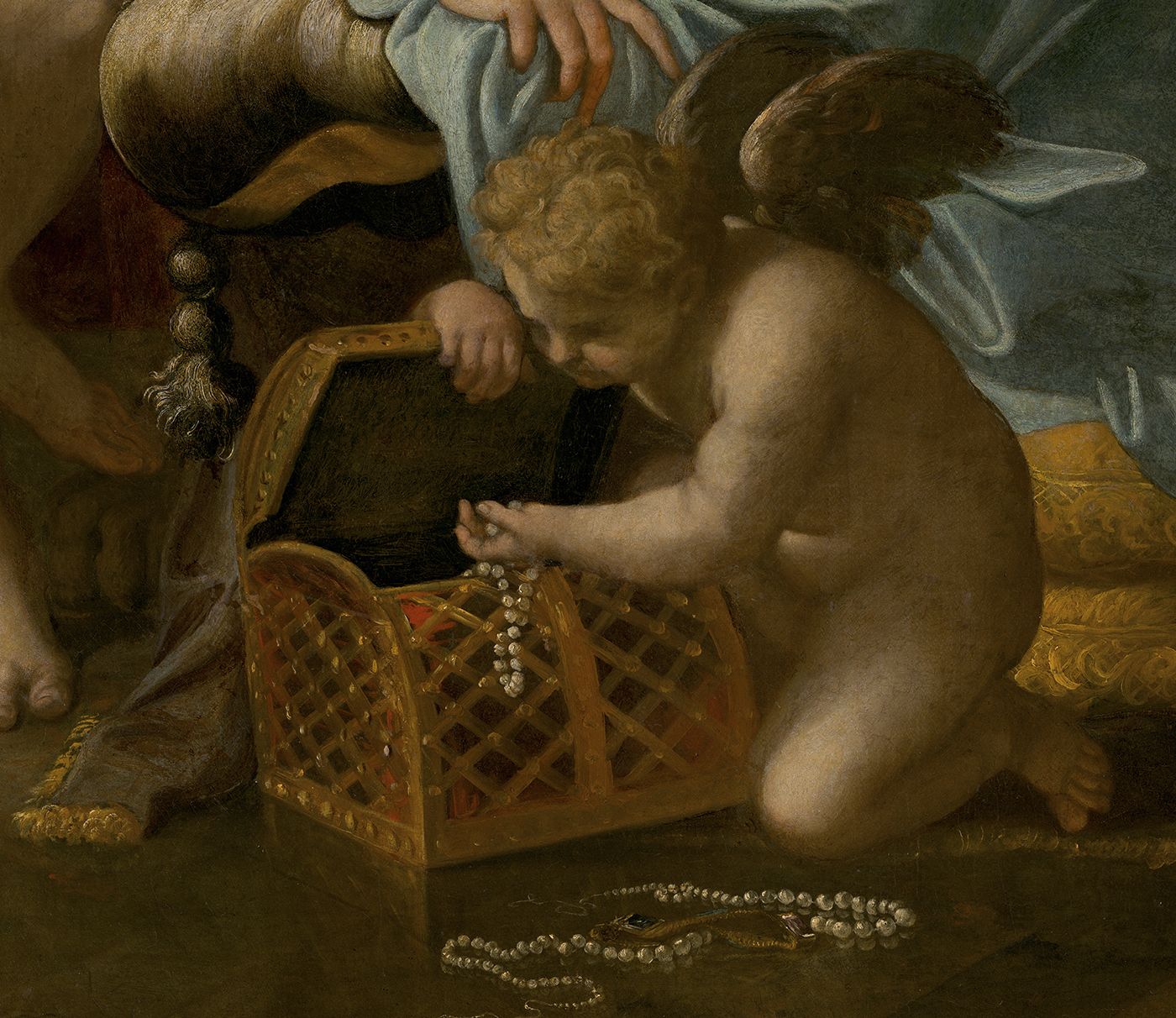
A winged figure at the basket
The child bends into the contents of the basket. The detailed opening of the lid and the strands beside it bring the viewer closer to the preparations.
What Albani took from Carracci
The best comparison is Annibale Carracci's Venus Adorned by the Graces, dated 1590–95 by the National Gallery of Art in Washington. Its accession number is 1961.9.9. At 133 × 170.5 cm it is substantially larger than the Bologna painting, and it was painted in oil on a wooden panel before being transferred to canvas. In Washington, Venus sits on the left beneath a hanging curtain. The Graces attend to her hair and a pearl, and putti busy themselves with her sandal, jewellery and grooming tools. Across the terrace, to the right, a statue of Bacchus rises from a fountain. Two figures sit further back by a balustrade, near the opening onto the landscape. [4]
Puglisi relates Carracci's approach to Titian's Venus with a Mirror, also in Washington. Titian's goddess fills much of the picture while a winged attendant raises the mirror to her eye level. Carracci pulls back to accommodate a company of full-length figures in an outdoor setting. In the Bologna canvas the movement continues outward. The group appears at a reduced scale and faces the other way. The chariot becomes Venus's seat and the fountain on the left is given its own sculptural character. The arrangement of faces and attending hands remains familiar, particularly in the poses of Venus and the woman working on her hair. [3] [4] [6]
The change in the role of the fountain is especially easy to see. Carracci puts Bacchus on an upright pedestal where the sculpture can be seen against the view past the terrace. In Bologna the fountain anchors the opposite side of the clearing from the chariot. The satyrs belong to a garden ornament with enough weight to balance a small crowd. Carracci uses the curtain and balustrade to tell us where the company has gathered. Albani gives much of that work to the trees and the open ground. The tall trees and broad opening to the sky make the airborne cupids legible well beyond the immediate circle around Venus. [3] [4] [6]
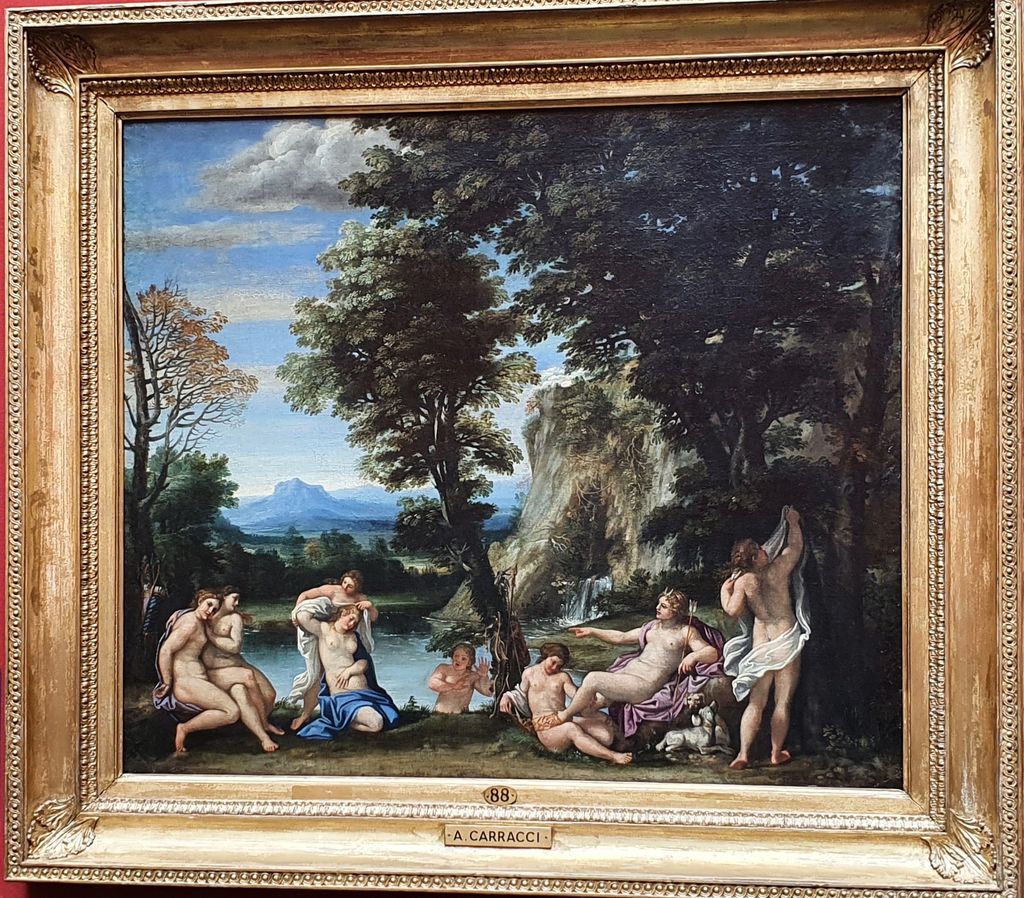
Annibale Carracci, Landscape with Diana and Callisto, the painting proposed as a companion to the Bologna canvas. Photograph by Yair Haklai. Image source. CC BY-SA 4.0. Proportionally resized for web display under the same CC BY-SA 4.0 licence.
Was the landscape designed as a companion?
The Fondazione Zeri records Landscape with Diana and Callisto in the Duke of Sutherland's collection as the companion to the Bologna canvas. Pictures intended to hang as a pair are called pendants. Here the proposal has some appeal on visual and thematic grounds. In both paintings, a group of figures from ancient myth occupies a limited part of a wooded setting. In the Callisto story, Diana and her companions discover Callisto's pregnancy. Placed beside the gathering around Venus, it would give a very different inflection to the sight of a goddess surrounded by women in the open air. [1] [3] [7]
Puglisi treats the pairing as probable and proposes that a sketch by Annibale may have supplied the Bologna design. Matching a painting that already existed would give Albani a reason to work with such a sketch. Readers can compare the Washington and Bologna pictures directly. The proposed sketch remains hypothetical. [1] [3] [4]
The artist behind the Sutherland landscape is also debated. Clovis Whitfield has argued for Agostino Carracci on the basis of similarities to his work in other media, including the 1599 print Omnia vincit amor. Whitfield also proposes that Giovan Battista Viola painted the landscape in the Bologna canvas, with Albani responsible for the figures. That is a published interpretation. The Zeri catalogue and both modern government records give the work to Albani. [1] [2] [7] [8]
The Herrera Chapel frescoes show how closely Albani and Annibale could work on a major project in Rome. The Museu Nacional d'Art de Catalunya explains that Annibale devised the chapel's decoration and began its preparatory designs. After he became ill, Albani took over the project from 1605. That delegation is documented for the chapel. It helps explain how one artist's design could be developed by the other, while the case for any comparable division of labour in the landscape rests on its own evidence. [9]
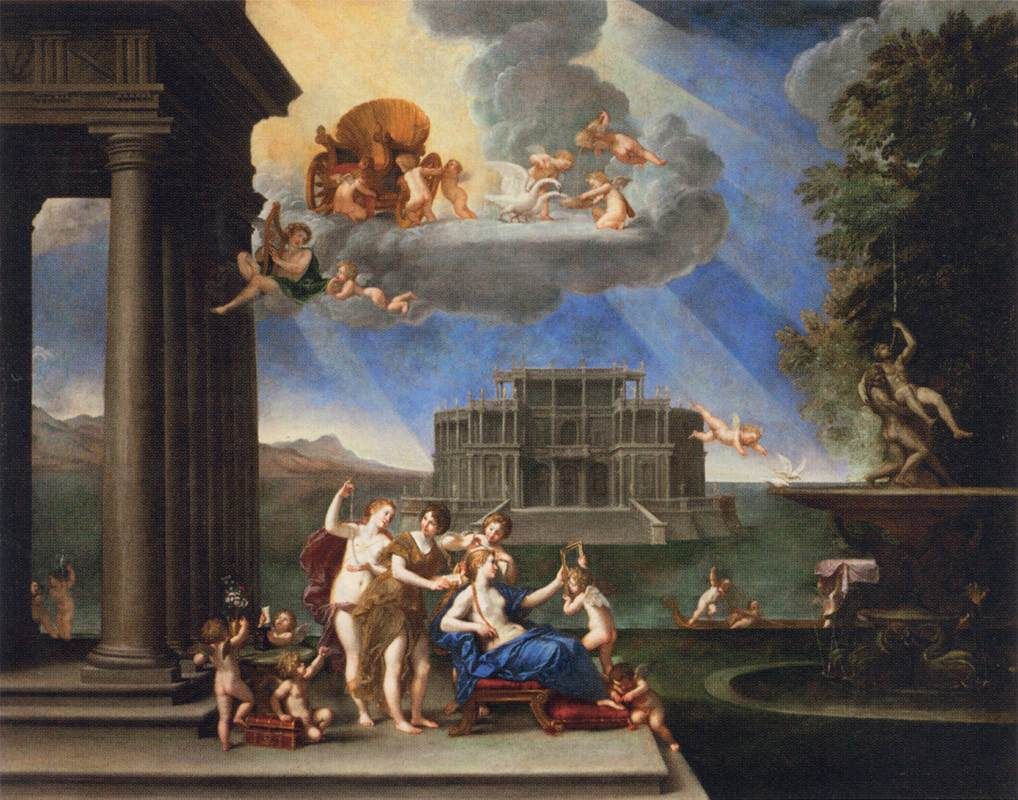
Francesco Albani, The Toilet of Venus, a later version painted for the series commissioned by Ferdinando Gonzaga. Musée du Louvre, INV 9. Image source. Public domain.
From the Orléans collection to Bologna
The old Carracci name can be followed through collections. Peter Humfrey's study of the Earl of Darnley's picture gallery at Cobham Hall identifies the Bologna canvas with the Toilet of Venus that passed out of the Orléans collection. Thomas, second Lord Berwick, bought it at the Orléans sale alongside Titian's Rape of Europa. Humfrey dates their passage from Berwick to John Bligh, fourth Earl of Darnley, to the early nineteenth century, giving about 1800–10 for the Toilet of Venus. The German art historian Gustav Friedrich Waagen saw the painting in the Darnley collection. [5] [10]
Waagen described the work under Annibale's name, singled out its warm, transparent colouring and careful execution, and repeated the earlier judgment of Crozat that Albani's manner could be traced to this picture. Waagen's account shows how much the name on a picture could shape its interpretation. The resemblance could serve as an example of Carracci's influence at Cobham Hall. Once the painting is understood as Albani's, its handling of the figures becomes evidence of how he used what he learned from Carracci. [3] [4] [5] [10]
The Darnley study tracks the work to lot 11 at Christie's on 1 May 1925 and identifies it with the painting now in the Pinacoteca. The Zeri catalogue records a private collection in Vienna and a sighting at Paul Drey Gallery in New York in 1968. Those entries supply intermediate locations in the picture's later history. The details of the gallery's acquisition in Bologna remain open in these records. The Carracci attribution also persisted in photographs and books. Annibale's name was written on the back of a photograph by A. Villani e Figli whose archive now catalogues the pictured painting under Albani. A second photograph in the Zeri archive, by Martin Gerlach, also carries Annibale's name in its historical title. Zeri lists the work's entry in Gianfranco Malafarina's 1976 catalogue of Carracci's paintings. [1] [5] [11]
The Italian Ministry of Culture identifies Bologna 6503 as Albani's Toletta di Venere. The state guarantee schedule for the Prado's Rome: Nature and the Ideal. Landscapes 1600–1650 likewise names Albani and gives the medium, size and Bologna inventory number. Entry 37 makes the difference especially clear for anyone looking for the canvas by title. The Bologna loan was entered in Spanish as El tocador de Venus. The Prado has its own painting by Albani with that title under the accession number P000001. [2] [8] [12]
How Albani revisited the scene
In a fresco at Palazzo Giustiniani at Bassano Romano, Albani put the gathering into an upright format. The scene belongs to a room devoted to Phaethon. Venus and the Graces are clothed, and two of her companions react to Phaethon's fall on the vault above. The mirror has passed from a cupid to a Grace. The scene makes sense as part of a room in which the viewer can look beyond the figures and up to the event that interrupts them. Around 1611–12, Albani adapted the group to fit a spandrel between the curves of the Allegory of Time vault at Palazzo Verospi in Rome. Puglisi suggests that an assistant probably painted this passage. [3]
The Galleria Borghese version in Rome, inventory 040, is a round canvas 154 cm in diameter. Part of a group of four mythological pictures, it gives a prominent place to cupids playing with produce and is associated by the gallery with Spring. Albani's figures attend to Venus beneath a tree, and the fruit, putti and foliage carry activity around the circle. The gallery connects the cycle with Philostratus's ancient account of cupids at play through the seasons. Puglisi sees a further precedent for the roundel in the playful cupids of Carracci's Sleeping Venus at Chantilly. The gallery also considers how the addition of The Triumph of Diana might have altered the meaning of the set. The catalogue records the acquisition in 1622 and discusses differences of scholarly opinion on when the paintings were executed. [3] [13]
For the much larger canvas now in the Louvre, inventory INV 9, Albani moved the action to a terrace near a classical portico. Venus sits on a gold throne with a red cushion. The vase of flowers is set on a table. The gold and velvet belong to a palace setting, and the flowers have been brought down from the sky. The Louvre records the original commission in 1621 for Ferdinando Gonzaga's Villa Favorita outside Mantua and dates the canvas to 1621–33. Puglisi traces the change from a fresco project to a series of oils that Albani completed in 1633 for Gian Carlo de’ Medici after the duke's death. Ferdinando also commissioned a version from Guido Reni, who concentrated the action around life-size figures. Albani’s Louvre canvas is more than two metres high and was one of four mythologies in the series. [3] [14]
Around 1640, Albani returned to the motif on two canvases closer in size to the one in Bologna. They are now in the Prado and the Gaudium Magnum collection. The Prado painting retains a fountain and a cupid occupied with Venus's sandal. In the Gaudium Magnum painting the fountain disappears, a table to the right holds jewellery, and a cupid embraces a decorated vase. Puglisi suggests that a design kept in the workshop made it possible to transfer the core group and vary the accessories for individual patrons. She distinguishes these variations from works produced by assistants copying successful compositions. [3] [12]
The objects that recur across these paintings serve different purposes. A vase on a table adds to the objects arrayed around the goddess on her terrace. In Bologna a vase appears in flight, and the flowers being scattered above Venus draw the eye across open sky. The setting contributes as much to the pace of the scene as the delicate work of the hands. [3] [5]
Artworks directory
Paintings, frescoes, drawings and prints, with separate entries for documented versions and collaborative projects.
Discussion
Look again at the images and ideas explored in Landscape with the Toilet of Venus. These editorial prompts invite your observations.
Reader Insights
How are the garden, fountain and figures arranged to hold your attention?
What evidence would help separate the design of the composition from its execution?
Join the Conversation
Share a detail, comparison or question about Landscape with the Toilet of Venus below.
References
- Fondazione Federico Zeri, Toletta di Venere, record 59736 View source.
- Boletín Oficial del Estado, Prado exhibition state guarantee, annex entry 37 View source.
- Catherine Puglisi, Toilet of Venus, Gaudium Magnum Foundation, especially figs. 3, 5 and 8–9 and notes 12–15 View source.
- National Gallery of Art, Annibale Carracci, Venus Adorned by the Graces, 1961.9.9 View source.
- Peter Humfrey, The collection formed by the 4th Earl of Darnley and his Picture Gallery at Cobham Hall, Kent, fig. 15 and appendix, RKD digital library View source.
- National Gallery of Art, Titian, Venus with a Mirror View source.
- Clovis Whitfield, Agostino risarcito parte II, About Art Online, discussion of the Sutherland landscape and Bologna canvas View source.
- Italian Ministry of Culture, administrative record identifying Pinacoteca Nazionale di Bologna inv. 6503 View source.
- Museu Nacional d'Art de Catalunya, Annibale Carracci. The frescoes of the Herrera chapel View source.
- Gustav Friedrich Waagen, Treasures of Art in Great Britain, letter XXIII, p. 21 View source.
- Fondazione Federico Zeri, A. Villani e Figli photograph, record 194536 View source.
- National Gallery of Victoria, Italian Masterpieces from Spain's Royal Court, list of works from the Prado View source.
- Galleria Borghese, Toilette of Venus (Spring), inventory 040 View source.
- Musée du Louvre, La Toilette de Vénus, INV 9 View source.