 by Tom Gurney
Tom Gurney BSc (Hons) is an art history expert with over 20 years experience
Published on June 19, 2020 / Updated on November 29, 2026
Email: tomgurney1@gmail.com / Phone: +44 7429 011000
Two Children Teasing a Cat: Introduction
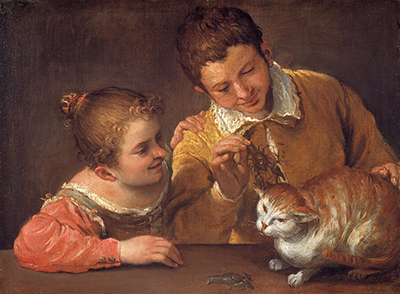
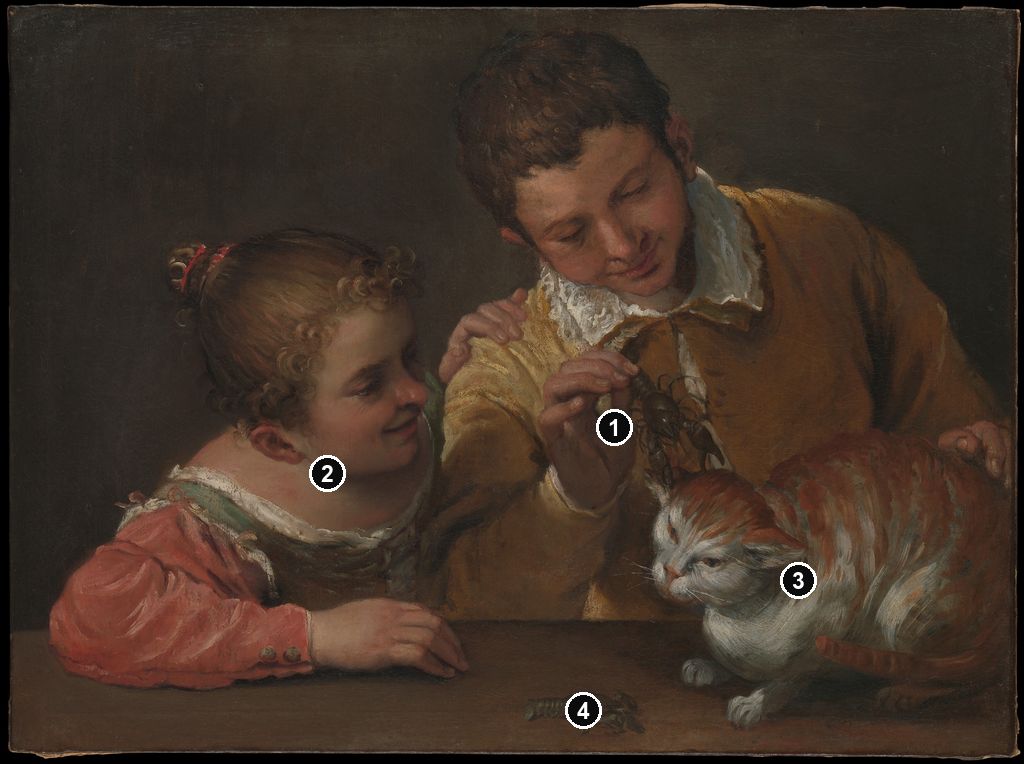
A boy dangles a crayfish over a cat's ears. A girl braces herself against his shoulder and leans in to see what happens. The cat crouches on the table, its head angled away and its front paws close to its chest. The attraction of Annibale Carracci's Two Children Teasing a Cat lies in the uneasy pause while the prank is still underway. The children know what they are doing, but their expressions suggest they have given little thought to what the cat might do. Painted around 1587–88, the oil on canvas measures 66 × 88.9 centimetres and belongs to the Metropolitan Museum of Art in New York, which acquired it in 1994. [1] [2] [3]
At a Glance
- ArtistAnnibale Carracci
- DateAbout 1587–88
- MediumOil on canvas
Contents
- What the children are doing
- How the painting makes the moment feel immediate
- A possible proverb and three ways to paint surprise
- Another cat in Annibale's work
- Attribution, versions and collectors
- A later Bolognese scene with a cat
- Annotated details
What the children are doing
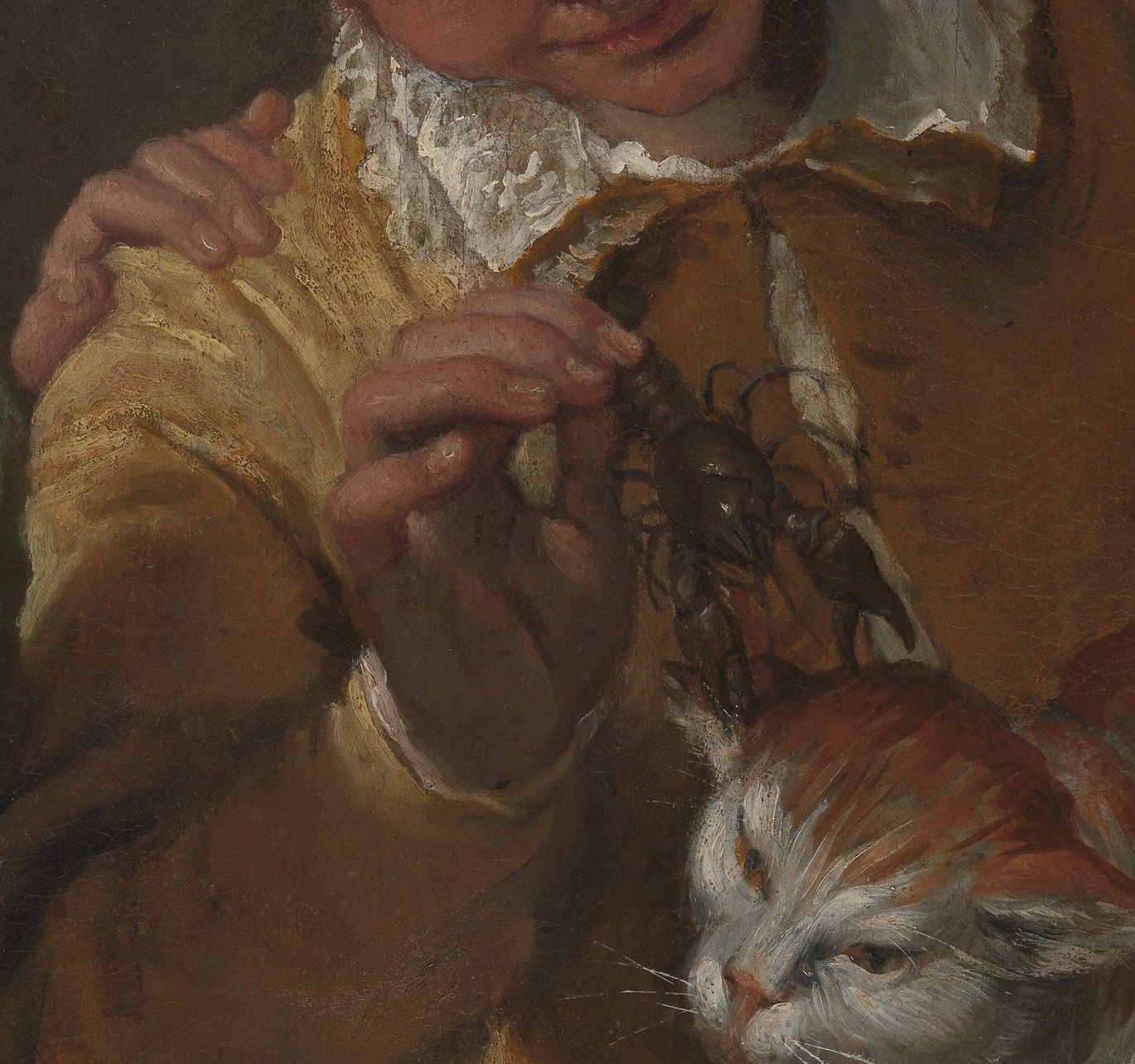
Start with the boy's raised hand. His thumb and forefinger hold the dark crayfish so that its legs and pincers hang close to the cat's head. His other hand lies on the animal's back. Seen by itself, that second gesture could pass for a child's way of stroking a pet. With the first hand in view, the same touch looks like a way of keeping the cat within reach. The smaller crayfish on the tabletop is easy to miss because it is nearly the colour of the wood. Spotting it gives the eye a second chance to recognise what the boy is holding. [1] [2]
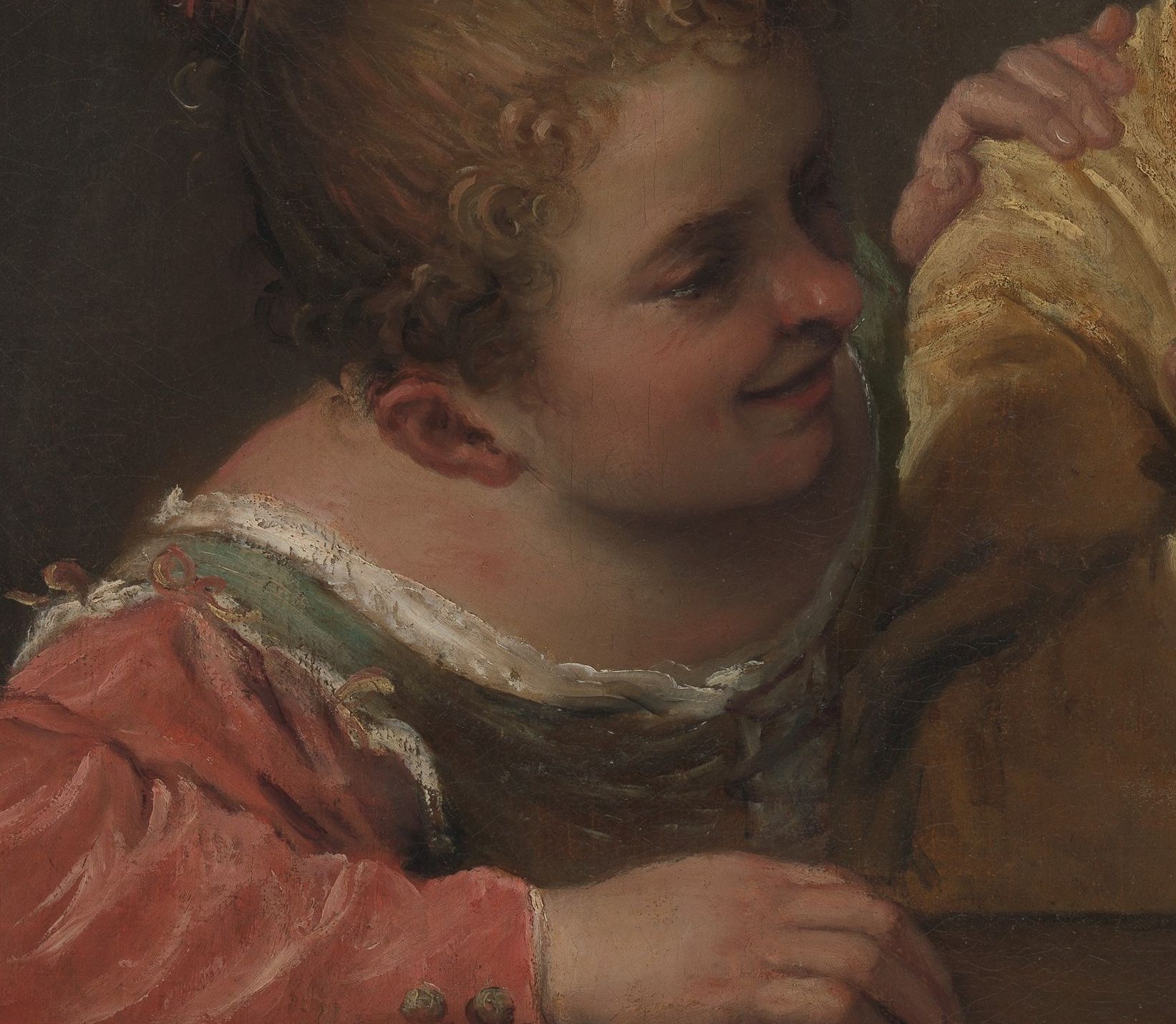
The girl is close enough to see the pincer and the cat's ear. One hand rests at the edge of the table, while the other hooks lightly over the boy's shoulder. Her posture makes her an eager participant even though she is holding neither the animal nor the crayfish. Her smile is easy to see in profile. The boy's head tips downward and his smile is more private, partly concealed by the angle of his face. Their gestures suggest familiarity. They could be siblings, as the Met curator Keith Christiansen has proposed, but their relationship and identities remain uncertain. The clothes make the figures vivid as individuals without establishing their family's rank. [1] [4]
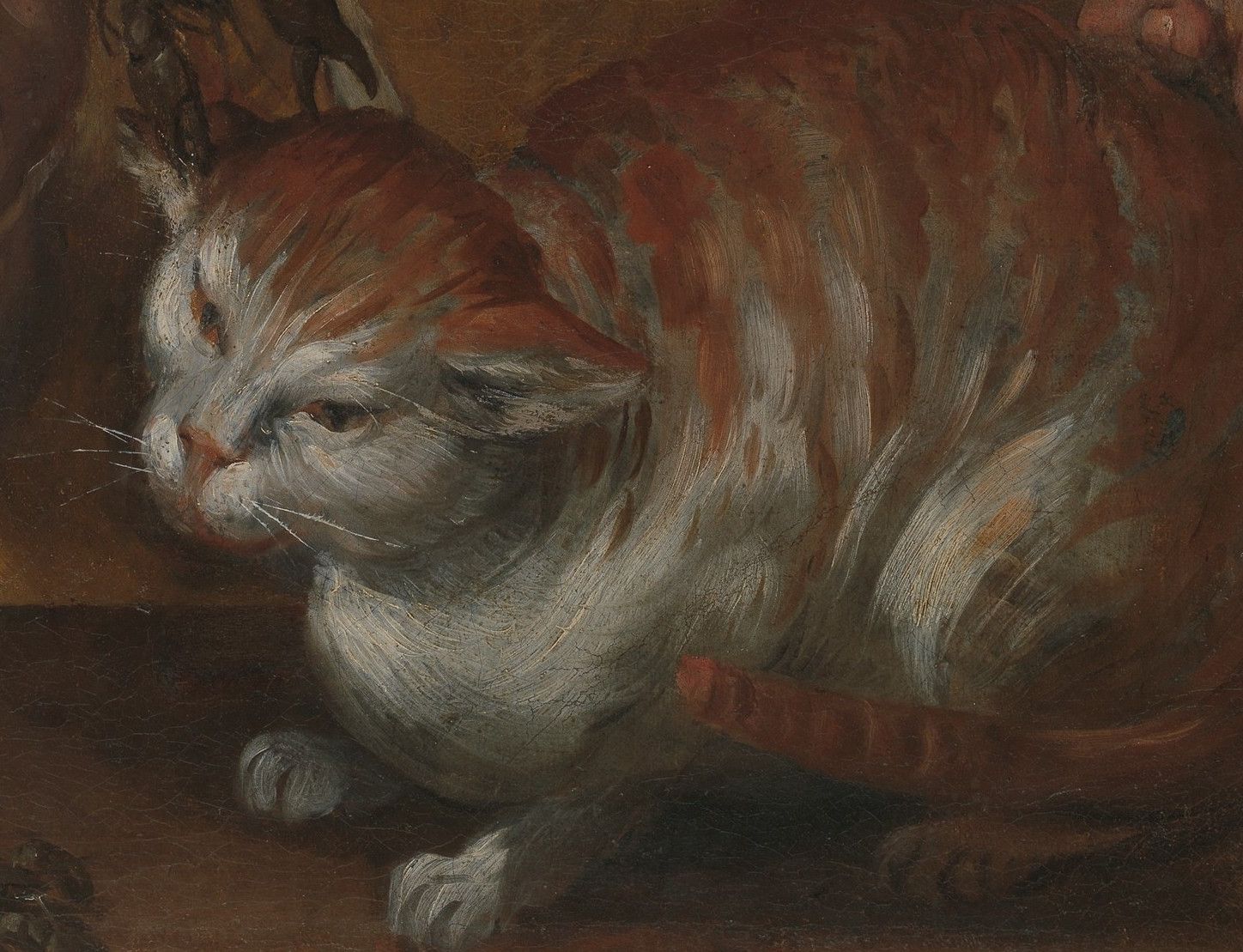
The cat has a distinct expression of its own. Its ears draw back and its eyes turn down and to the left. The orange back hunches beneath the boy's hand, and the pale strokes across the muzzle make the whiskers easier to see than the pincer above them. Two possible reactions remain in play. The cat might twist or scratch to get away, and the swinging crayfish could catch the fingers that hold it. Carracci leaves both possibilities in the future. [1] [5]
Annotated Details from Two Children Teasing a Cat
The numbered points identify visible features discussed in this article. Return from each detail to the numbered overview. Annibale Carracci, Two Children Teasing a Cat. The Metropolitan Museum of Art, 1994.142. Image source. CC0 / Public domain.
Details from TWO CHILDREN TEASING A CAT
Compare the cropped details with the source images above. Notice how their colours, shapes and positions contribute to the larger compositions.
Crayfish and fingers
The child holds the crayfish above the cat. The creature itself almost disappears against the costume, while the grip and lowered gaze indicate where to look.
The girl's expression
The girl leans across the edge of the table. Her partly lit face and the line of her gaze direct attention towards the other child's hand.
The cat under the hand
The cat's head drops and turns to the left. Its compact posture presses down against the tabletop as the children's hands converge above it.
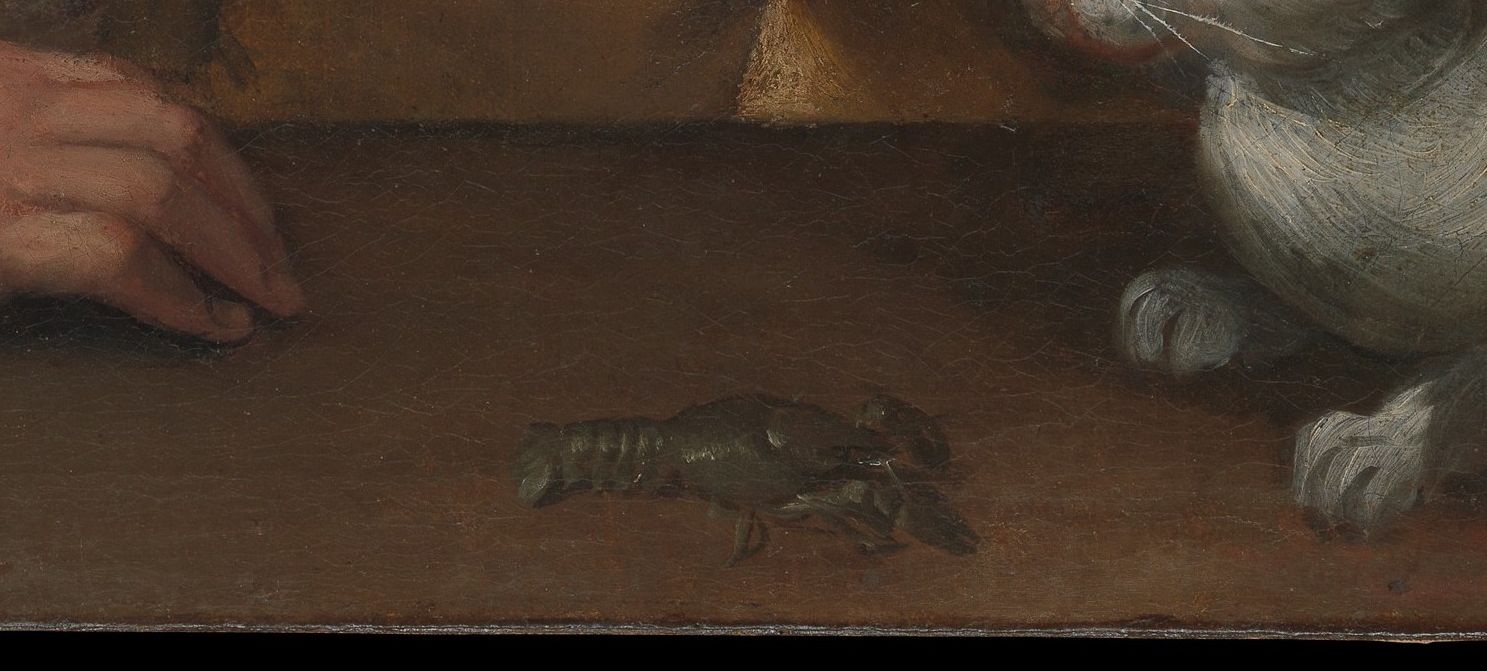
A second crayfish
A second crayfish lies along the front edge of the table. Its low position is easy to miss while looking at the creature the boy holds up.
How the painting makes the moment feel immediate
The dark wall gives away almost nothing about the room. At the bottom of the canvas, the plain tabletop brings the viewer close to the level of the animal. The boy's inclined head and the girl's upward turn lead toward the fingers at the centre of the action. Then the cat's pale muzzle pulls the eye down. Carracci has arranged four hands, two faces and an animal in a shallow space, so each new detail changes how the other gestures read. The girl's hand on the shoulder and the boy's hand on the animal's back have a similar curve, though one steadies the observer and the other appears to restrain the subject of the prank. [1]
The brushwork varies in pace from one surface to another. The warm red of the girl's sleeve is crossed by irregular pale strokes following its folds. Highlights merge into the underlying colour in places, a wet-into-wet handling that Christiansen singles out. The little red ribbon in her hair takes only a few marks, while quick, overlapping strokes of rust, grey and white give the cat its patchy coat. The boy's pale collar and the light catching the curve of his shoulder separate his head and body from the dark wall. The uneven way light catches cloth, hair and fur is central to the impression of movement. The Queensland Art Gallery and Gallery of Modern Art picked out the sleeve, shoulder and thinly brushed cat when the picture travelled to Brisbane in the Met exhibition European Masterpieces. [2] [4]
Swift-looking marks tell us how the painting appears, and some give clues to its handling. The alignment of the faces and hands gives the encounter a deliberate structure. Christiansen suggests that the artist could have drawn the children from posed models. He links the painting's loose handling to the practice of making oil sketches in the studio and to the brushwork Annibale learned from Venetian painting. Together these possibilities help explain how closely observed expressions could be put to work in a carefully arranged scene. [4]
A possible proverb and three ways to paint surprise
The Met raises the possibility that the prank illustrates an Italian saying akin to “let sleeping dogs lie.” The warning fits the way the boy has put himself within reach of both claws and pincers. The painting also lets the viewer share the children's curiosity about how far they can go. With the outcome withheld, their pleasure and the animal's discomfort occupy the same moment. The proverb is a possible explanation for the choice of subject. The story remains intelligible without knowing any particular saying. [1] [2]
Christiansen compares the picture with Sofonisba Anguissola's Boy Bitten by a Crayfish, a mid-sixteenth-century drawing in the Museo di Capodimonte in Naples. In the drawing, the boy's finger is already caught and his mouth opens in distress. The girl beside him reacts with amusement. Christiansen recalls Giorgio Vasari's account of Michelangelo challenging Anguissola to show a child crying. The drawing puts crying and laughter side by side. Carracci gives the crayfish a different role, putting it in a child's hand as an instrument of teasing and leaving the main reaction still to come. Anguissola's sheet has a documented connection to the collection of Fulvio Orsini and then to the Farnese. That history makes the comparison especially pertinent, although it does not establish when Annibale first saw the drawing. [4] [5] [6]
Caravaggio's Boy Bitten by a Lizard, painted about 1594–95 and now in the National Gallery in London, offers a third way to time a scene like this. Its subject jerks back as the lizard clamps onto his finger, one shoulder suddenly bare, with fruit and a glass vase beside his hand. In Carracci's picture the tabletop is almost empty and the children still control the action as far as they know. In the Caravaggio, the still life partly conceals the source of the shock. Putting the three works side by side makes the timing of each artist's choice visible. [1] [4] [7]
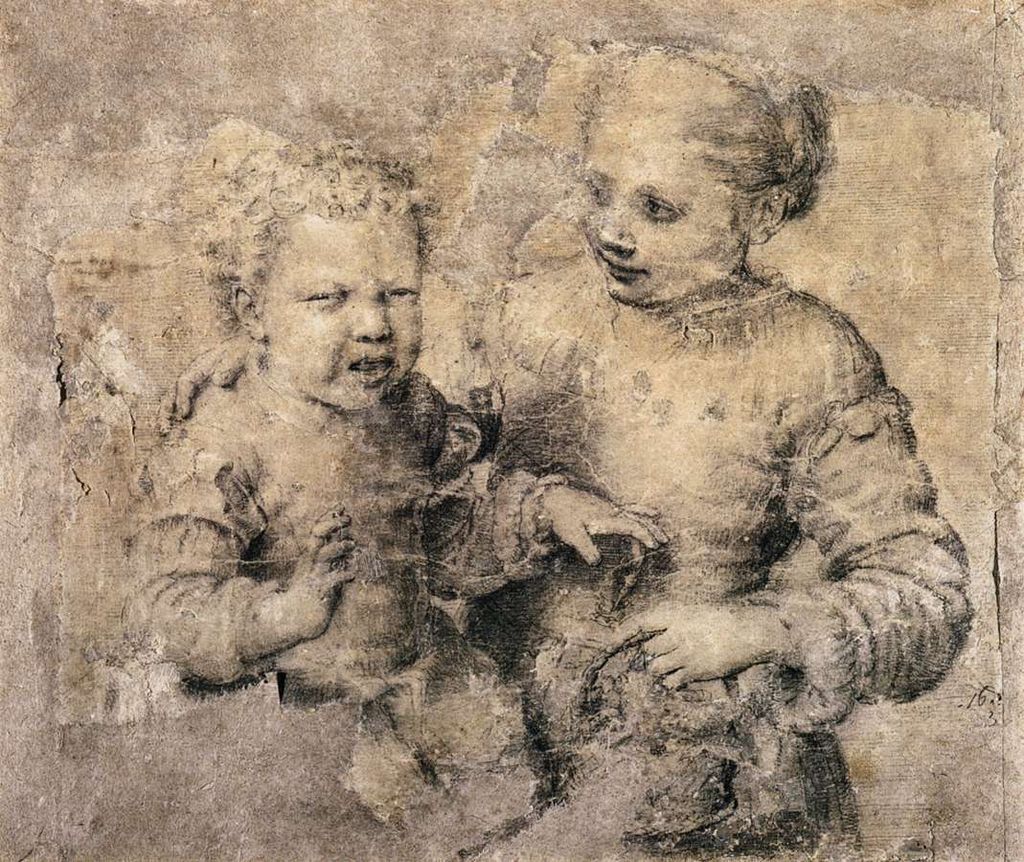
Sofonisba Anguissola, Asdrubale Bitten by a Crayfish. Museo e Real Bosco di Capodimonte, Naples. Image source. Public domain.
Another cat in Annibale's work
In the Met's A Domestic Scene, dated 1582–84, a woman bends to warm a child's nightgown at the hearth. One child is tucked against her side and looks out, another stands close to the fire, and a cat sits upright near the woman's feet. The children and cat belong to a household occupied with a shared task. Where the oil painting crowds its figures across a table and singles out a movement, the upright drawing lets the eye travel from the woman's bent head down her skirt and back across the children to the fire. Brown and grey washes, pen lines and the light paper create the sense of a room lit by the hearth. [8]
The Met catalogues the drawing as Annibale. The sheet has had its own attribution debate, including an old proposal for Bartolomeo Schedoni. The Met also records that the Carracci specialist Babette Bohn rejected both Annibale and Agostino as possible authors. Its composition and subject are distinct from the teasing scene, and there is no established preparatory connection between the two museum objects. The comparison shows how differently the same kinds of household subjects could be brought together. In the drawing the cat is present while the humans take care of one another. In the oil it is the centre of an experiment whose consequences the children have yet to discover. [1] [8]
A second comparison is Cleveland's Boy Drinking, dated 1582–83. The boy tips up his glass, and the light caught in the glass and the rounded jug gives a simple movement the complexity of an optical demonstration. Both paintings cut in close enough to make a fleeting action worth studying. In Cleveland, the glass and jug occupy the place of greatest attention. In New York, the raised fingers and the animal's ear do that work. This willingness to give a passing action the full attention of an easel painting helps explain the Met's description of the cat painting as an early Italian example of genre painting, the depiction of scenes from everyday life. [1] [9]
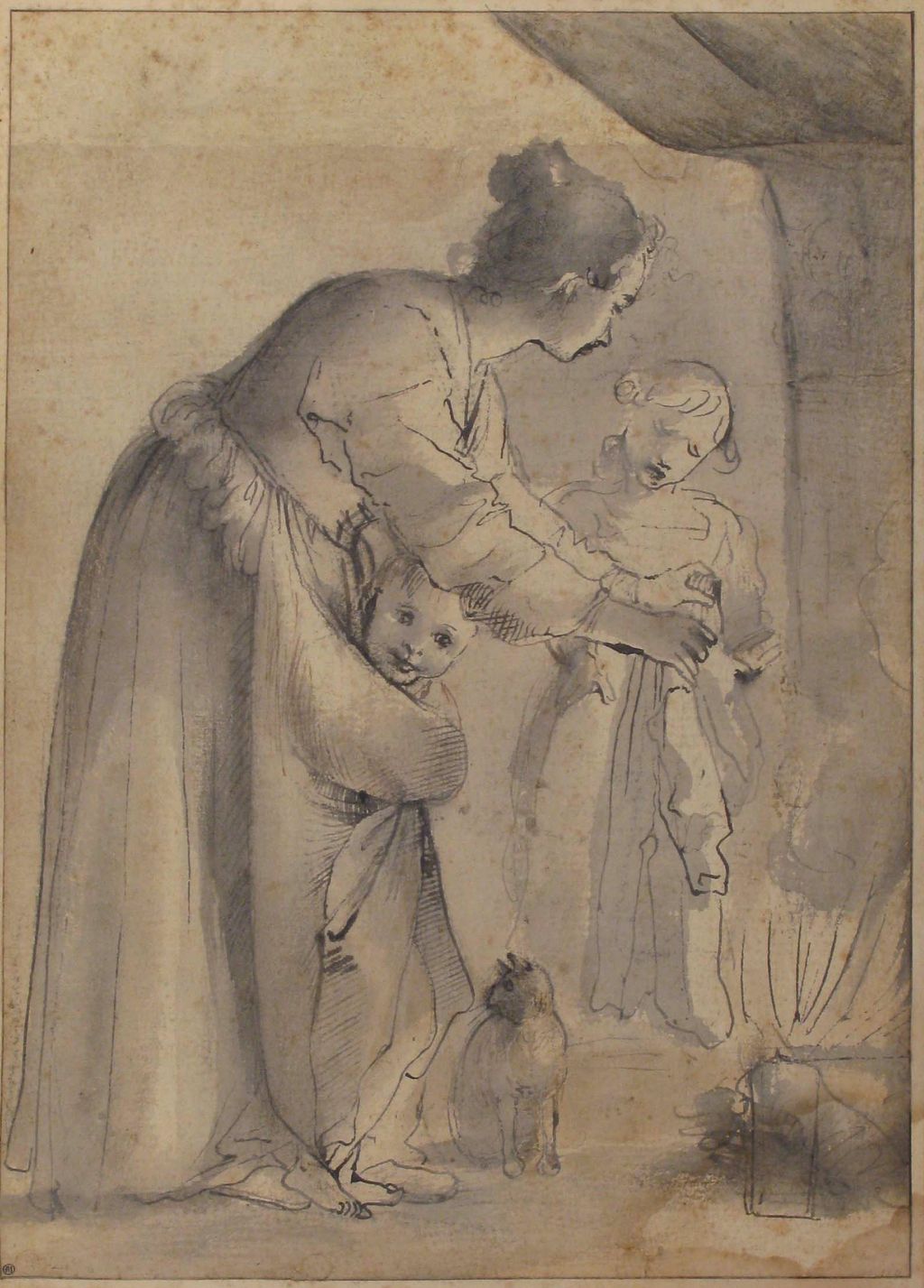
Annibale Carracci, A Domestic Scene. The Metropolitan Museum of Art, 1972.133.2. Image source. CC0 / Public domain.
Attribution, versions and collectors
The attribution has changed in print. In the Met's 1994 acquisition bulletin, Christiansen listed Agostino or Annibale Carracci. The handling of the boy's white collar and shirt recalled Paolo Veronese and suggested Agostino to him at the time. The entry also drew attention to a Farnese collection inventory from around 1680 that listed a scene of this subject under Agostino's name. The present Met attribution is Annibale, in agreement with the Fondazione Federico Zeri and with Daniele Benati's entry in the 2006–07 Bologna and Rome exhibition catalogue. The clothes remain a clue to Venetian painting as an influence even as the balance of the attribution has shifted. The date is also approximate. The acquisition bulletin proposed around 1590, while Zeri places it around 1588 and the Brisbane exhibition gave a range of about 1587–88. [1] [2] [3] [5] [10]
The Farnese inventory is evidence that the subject circulated in more than one form. Catherine Loisel points out that its dimensions describe an upright picture and its figure wears red. The Met canvas is horizontal and its boy wears ochre. Loisel has also published a different, closely related canvas in a private collection in which a black-and-white cat bares its teeth and fruit shares the tabletop with two pink crayfish. She proposes that this version may also be by Annibale and reads its changes as a possible shift toward an allegory of touch. It remains a separate object, and the argument about its authorship does not transfer its details or proposed meaning to the Met painting. [1] [5]
The picture's route to New York can be followed in inventories and sales records. Loisel traces a probable early identification to an inventory made after Girolamo Ranuzzi's death in 1667. A later Ranuzzi inventory names the incident with the cat and crayfish as a work by Annibale. Another lists a copy, by which time the painting is traced to the collection of Cardinal Tommaso Ruffo. The Met identifies Ruffo as an owner and notes that he also owned Velázquez's Juan de Pareja. Loisel follows the picture through Sir William Hamilton and Charles Greville to the Earl of Carlisle, who acquired it at Greville's sale in 1810. Fondazione Zeri records the subsequent connections with Castle Howard and the London art market, including the Sotheby's sale in April 1994, the year of the Met's acquisition. The Fondazione also records the canvas's return to Italy for the 2006–07 Bologna and Rome exhibition. [1] [3] [5]
A later Bolognese scene with a cat
Giuseppe Maria Crespi's Girl with a Cat at the Fitzwilliam Museum takes up a comparable exchange in a very different format. In the small upright canvas a girl holds a dead mouse in front of a dark cat. The child and animal are again close enough to touch, with a small creature between them and a gesture that seems to invite a reaction. Crespi gives the cat something to pursue, where Carracci gives it a reason to retreat. As a later Bolognese comparison the picture shows how much could be varied within a scene made of so few elements. [11]
Artworks directory
Paintings, frescoes, drawings and prints, with separate entries for documented versions and collaborative projects.
Discussion
Look again at the images and ideas explored in Two Children Teasing a Cat. These editorial prompts invite your observations.
Reader Insights
Which part of the painting turns the crayfish into the focus of the scene?
Does recognising a possible proverb change your reading of the children’s expressions?
Join the Conversation
Share a detail, comparison or question about Two Children Teasing a Cat below.
References
- The Metropolitan Museum of Art, Two Children Teasing a Cat, object 1994.142 View source.
- Queensland Art Gallery and Gallery of Modern Art, European Masterpieces tour stop on Two Children Teasing a Cat View source.
- Fondazione Federico Zeri, Bambini che giocano con un gatto, work record 57562 View source.
- Keith Christiansen, Going for Baroque, The Metropolitan Museum of Art Bulletin, winter 2005, pp. 18–20 View source.
- Catherine Loisel, Variantes et copies dans l’atelier des jeunes Carracci, 2026, figs. 46–49 and notes 108–117 View source.
- Michel Hochmann, Les dessins et les peintures de Fulvio Orsini et la collection Farnèse, 1993 View source.
- The National Gallery, Caravaggio, Boy bitten by a Lizard, NG6504 View source.
- The Metropolitan Museum of Art, A Domestic Scene, object 1972.133.2 View source.
- The Cleveland Museum of Art, Boy Drinking, object 1994.4 View source.
- The Metropolitan Museum of Art, Recent Acquisitions 1993–1994, fall 1994, p. 20 View source.
- The Fitzwilliam Museum, Giuseppe Maria Crespi, Girl with a Cat, object 221 View source.