 by Tom Gurney
Tom Gurney BSc (Hons) is an art history expert with over 20 years experience
Published on June 19, 2020 / Updated on November 29, 2026
Email: tomgurney1@gmail.com / Phone: +44 7429 011000
Christ in Glory with Saints and Odoardo Farnese: Introduction
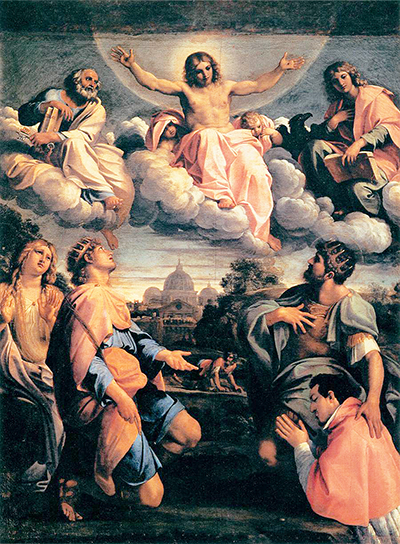
Cardinal Odoardo Farnese kneels at the lower right of Annibale Carracci’s Christ in Glory. His palms are joined, his head is bowed and a crowned saint rests a hand on his shoulder. Above them, Christ opens his arms against a ring of light. The cardinal’s painted likeness is small enough to look vulnerable beneath that gesture, yet his choice of saints gives the altarpiece a remarkably personal character. Carracci painted the work around 1600, the date used by the Opificio delle Pietre Dure and the 2026 Forlì exhibition. The Italian national catalogue dates it slightly earlier, to about 1597–98. The oil painting measures 194.2 × 142.4 cm as listed at Forlì and belongs to the Galleria Palatina at Palazzo Pitti, Florence, where it is inventoried as Palatina 220. [1] [2] [3] [4]
At a Glance
- ArtistAnnibale Carracci
- DateLate 1590s
- MediumOil on canvas
Contents
- Looking up from the altar
- The two crowned saints and England
- The Magdalene’s chapel at Camaldoli
- Drawings for heaven and earth
- What the canvas reveals
- From the hermitage to Palazzo Pitti
- Annotated details
Looking up from the altar
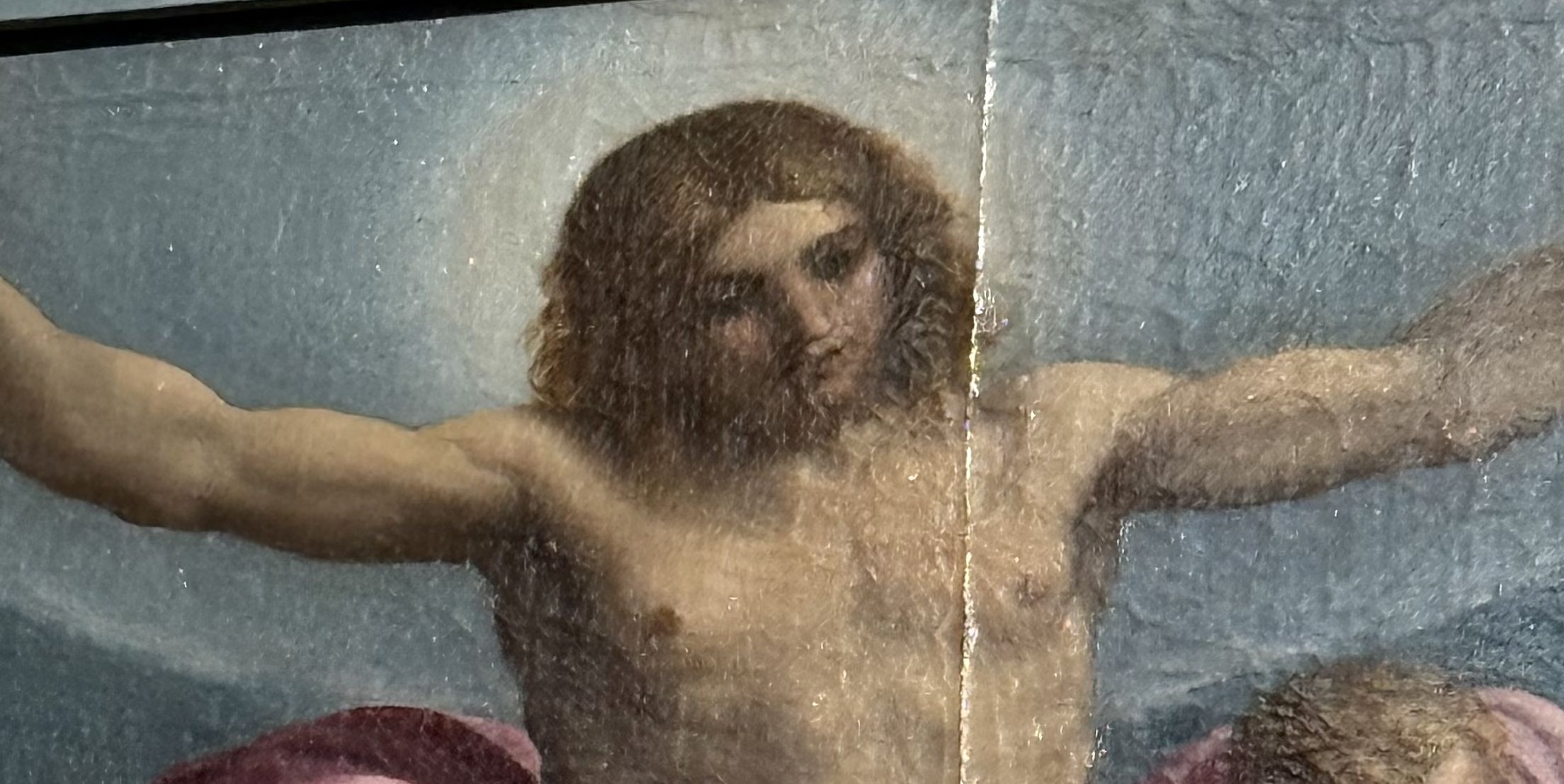
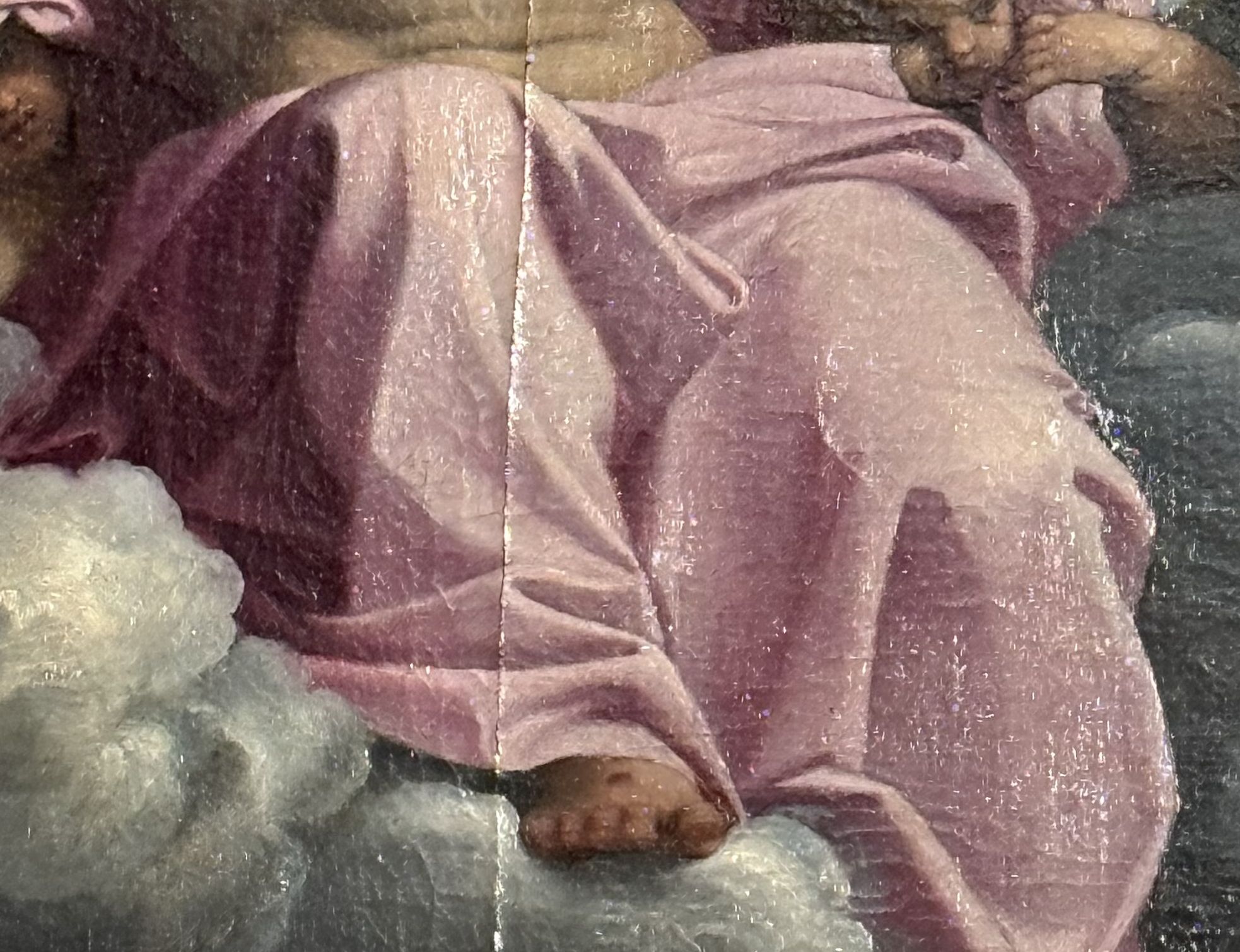
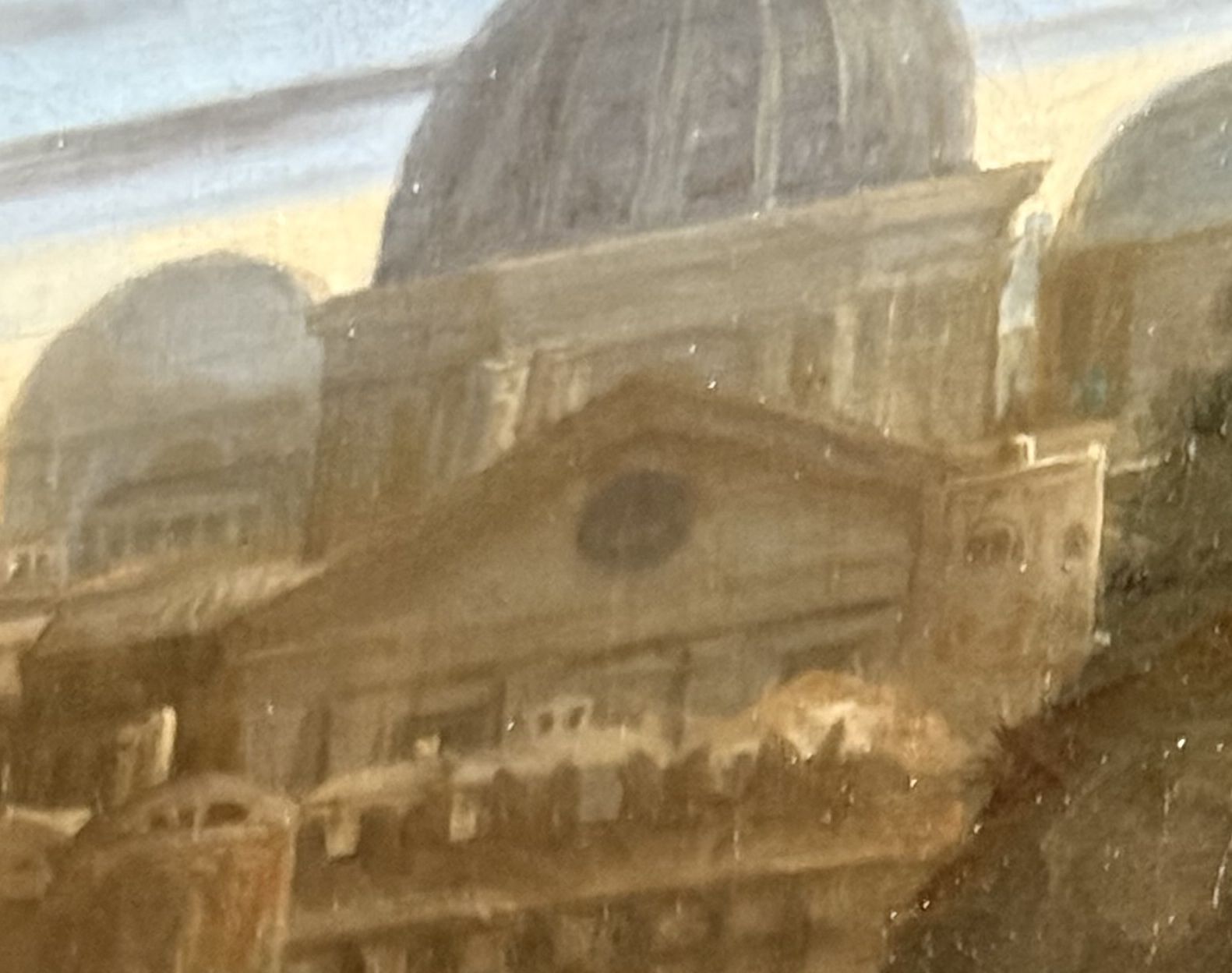
A stretch of air separates the rocky foreground from the clouds, and the dome of Saint Peter’s Basilica appears through that opening. The pale dome stands out between the dark trees, its smaller neighbours just visible above the façade and enclosing walls. Christ’s extended arms span the opening from above, while one bare foot descends below the clouds. The drop of the foot and the sweep of the pink mantle make his seated body feel suspended over the ground. The Opificio relates this upward view to the painting’s function above an altar and to Venetian illusionistic painting. [1] [3]
Peter sits on the viewer’s left, holding the keys. He bends forward, with the foot nearest us jutting out from his pale garment. On the opposite cloud John the Evangelist turns inward, one hand to his chest and a book across his lap. The dark eagle beside him is his traditional emblem. Both apostles are angled towards the central figure, yet the way they occupy the clouds differs. Peter’s weight bears down towards the figures on earth, while John’s inclined head and hand draw the gaze back towards the light. Carracci gives each of them a place within the curve of Christ’s outspread arms. [1] [3]
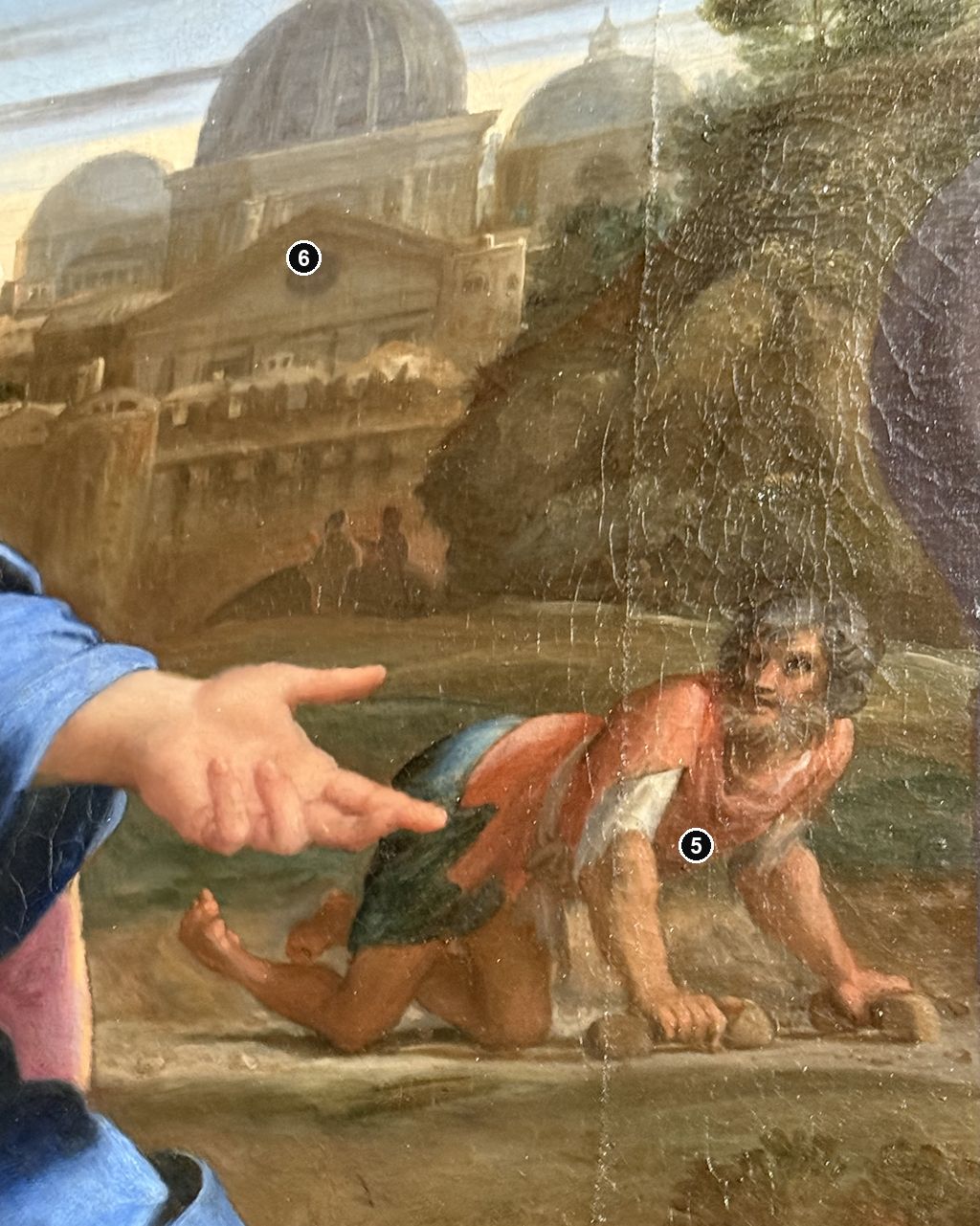
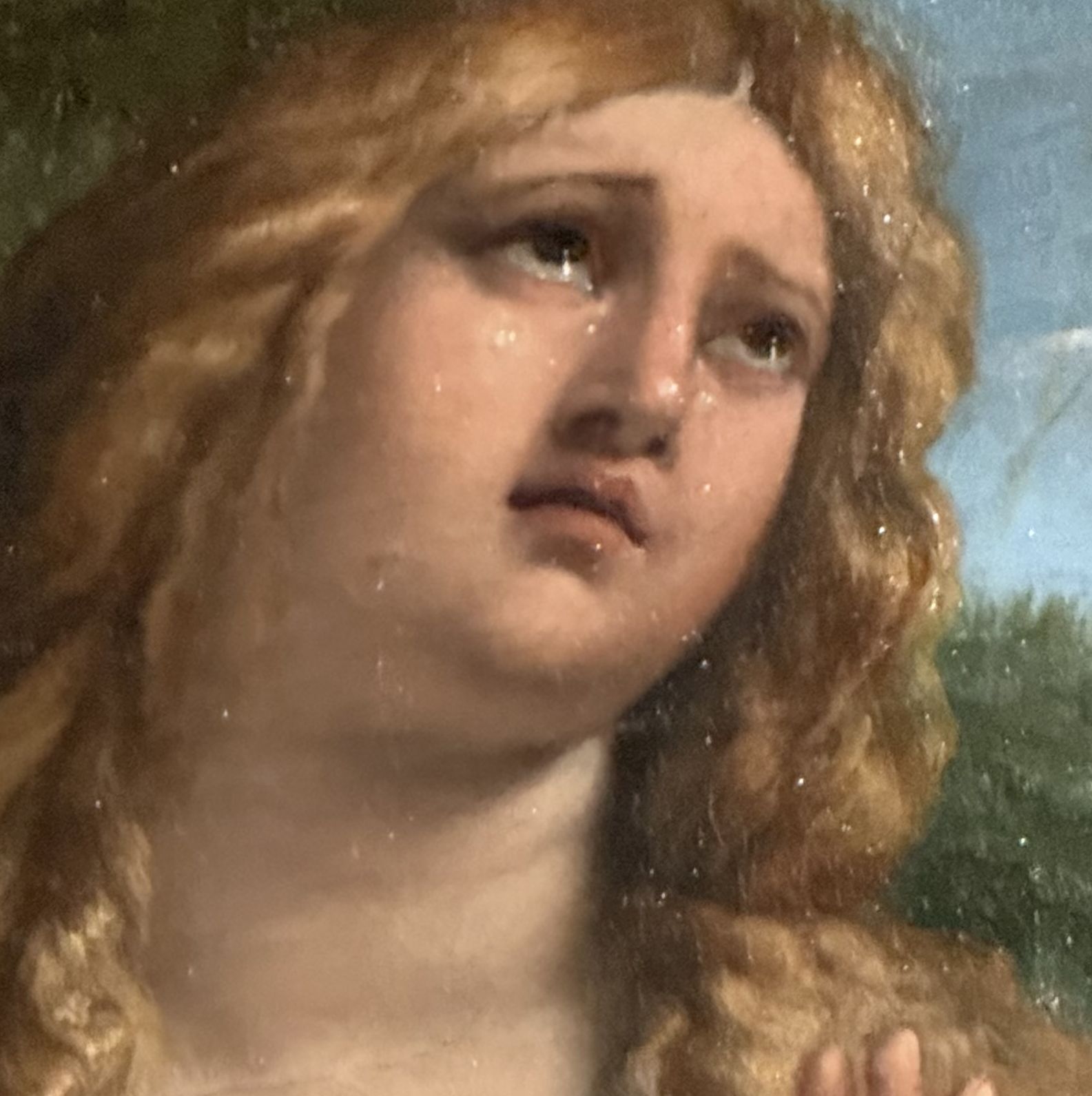
Near the ground, Mary Magdalene appears at the far left, half a step back from the crowned figure traditionally identified as Saint Hermenegild. Her raised hands and upturned face continue the movement begun by his upward glance. His open hand leads into the middle distance. There, a much smaller man braces himself on two low supports and turns his face towards the foreground. On the other side, the crowned Saint Edward looks up towards Christ, his right hand at his own breast and his other hand resting on the shoulder of the cardinal. The cardinal’s joined hands close this sequence of gestures. Worshippers standing below the altarpiece could follow them from the level of a kneeling figure to the vision overhead. [1] [3] [4]
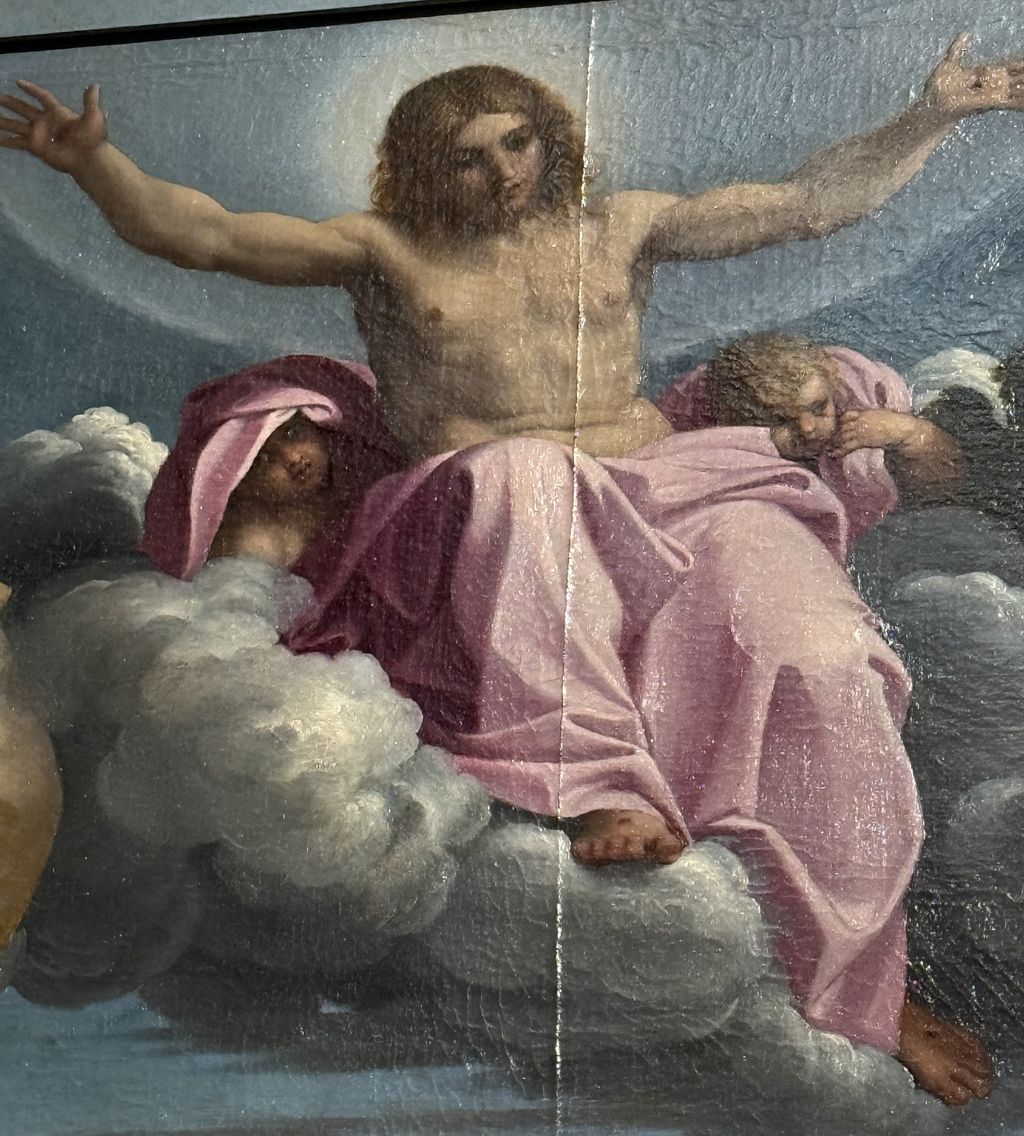
Christ in the upper register of Annibale Carracci’s Christ in Glory with Saints and Odoardo Farnese. Galleria Palatina, Palazzo Pitti. Photograph by Nicola Quirico. Image source. CC BY-SA 4.0. Proportionally resized for web display under the same CC BY-SA 4.0 licence.
Annotated Details from Christ in Glory with Saints and Odoardo Farnese
The numbered points identify visible features discussed in this article. Return from each detail to the numbered overview. Each caption identifies the work shown.
Christ in the Clouds
Christ in the upper register of Annibale Carracci’s Christ in Glory with Saints and Odoardo Farnese. Galleria Palatina, Palazzo Pitti. Photograph by Nicola Quirico. Image source. CC BY-SA 4.0. Numbers added to a separate overview. Details cropped from the original photograph. Image derivatives use CC BY-SA 4.0.
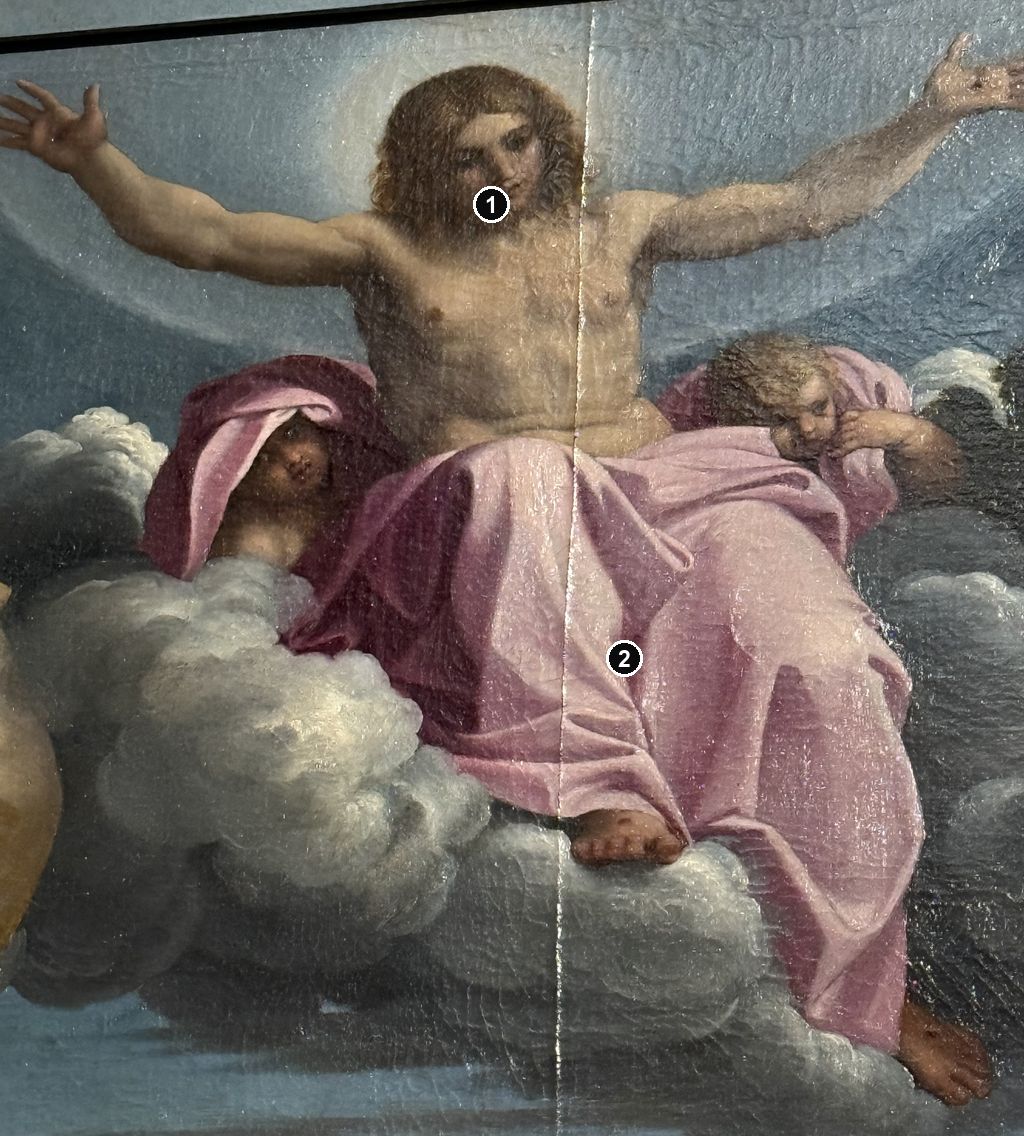
Mary Magdalene
Mary Magdalene in Annibale Carracci’s Christ in Glory with Saints and Odoardo Farnese. Galleria Palatina, Palazzo Pitti. Photograph by Nicola Quirico. Image source. CC BY-SA 4.0. Numbers added to a separate overview. Details cropped from the original photograph. Image derivatives use CC BY-SA 4.0.
The Man Near St Peter’s
The man braced near the ground in Annibale Carracci’s Christ in Glory with Saints and Odoardo Farnese. Galleria Palatina, Palazzo Pitti. Photograph by Nicola Quirico. Image source. CC BY-SA 4.0. Numbers added to a separate overview. Details cropped from the original photograph. Image derivatives use CC BY-SA 4.0.
Details from CHRIST IN GLORY WITH SAINTS AND ODOARDO FARNESE
Compare the cropped details with the source images above. Notice how their colours, shapes and positions contribute to the larger compositions.
Christ in the Clouds
The spread arms
Christ extends both arms across open sky. His shoulders and hands establish the upper register around his face.
Pink folds against cloud
Broad bands of pink cloth cross the lap. Their angular edges stand out against the soft transitions in the cloud.
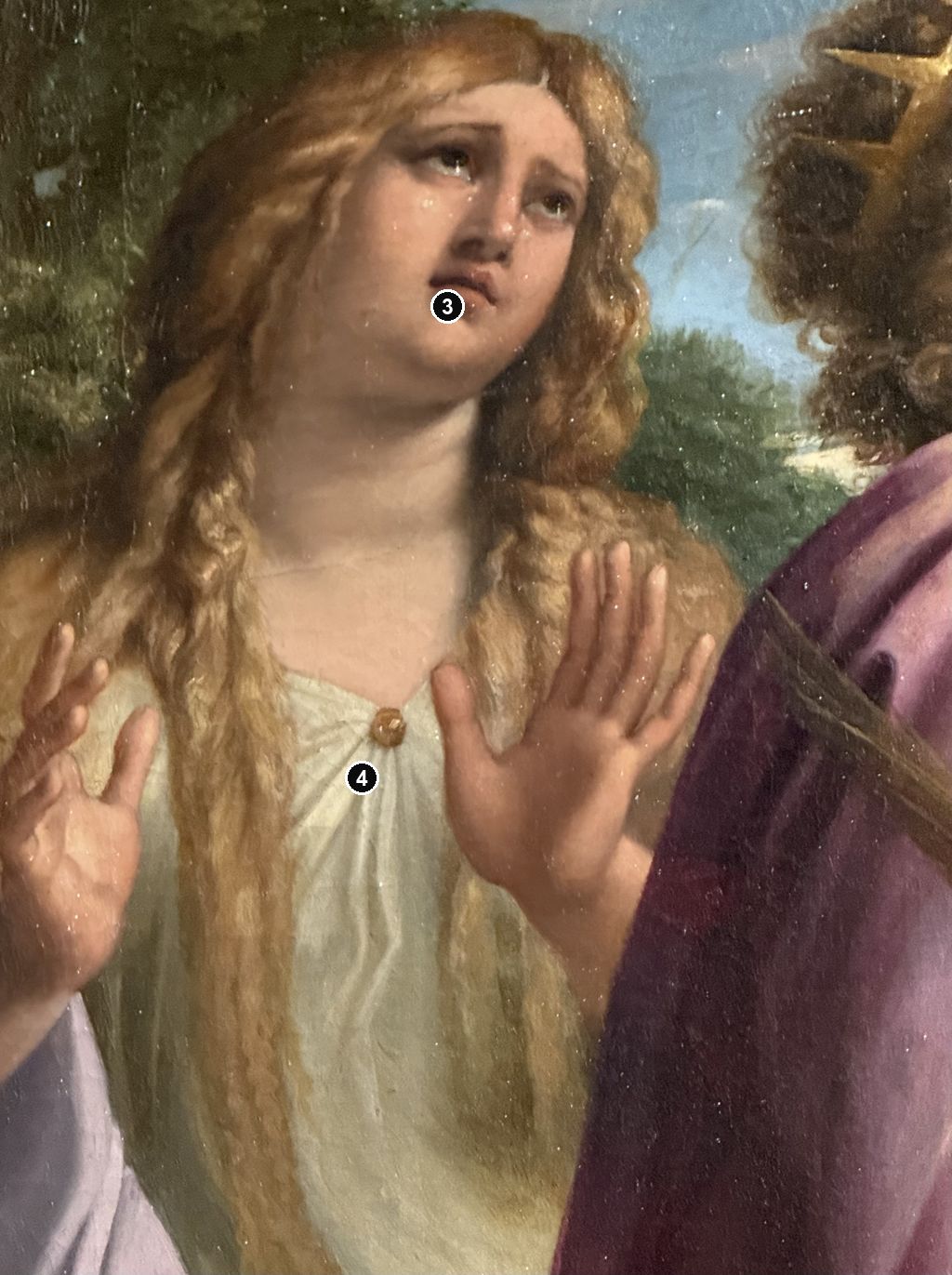
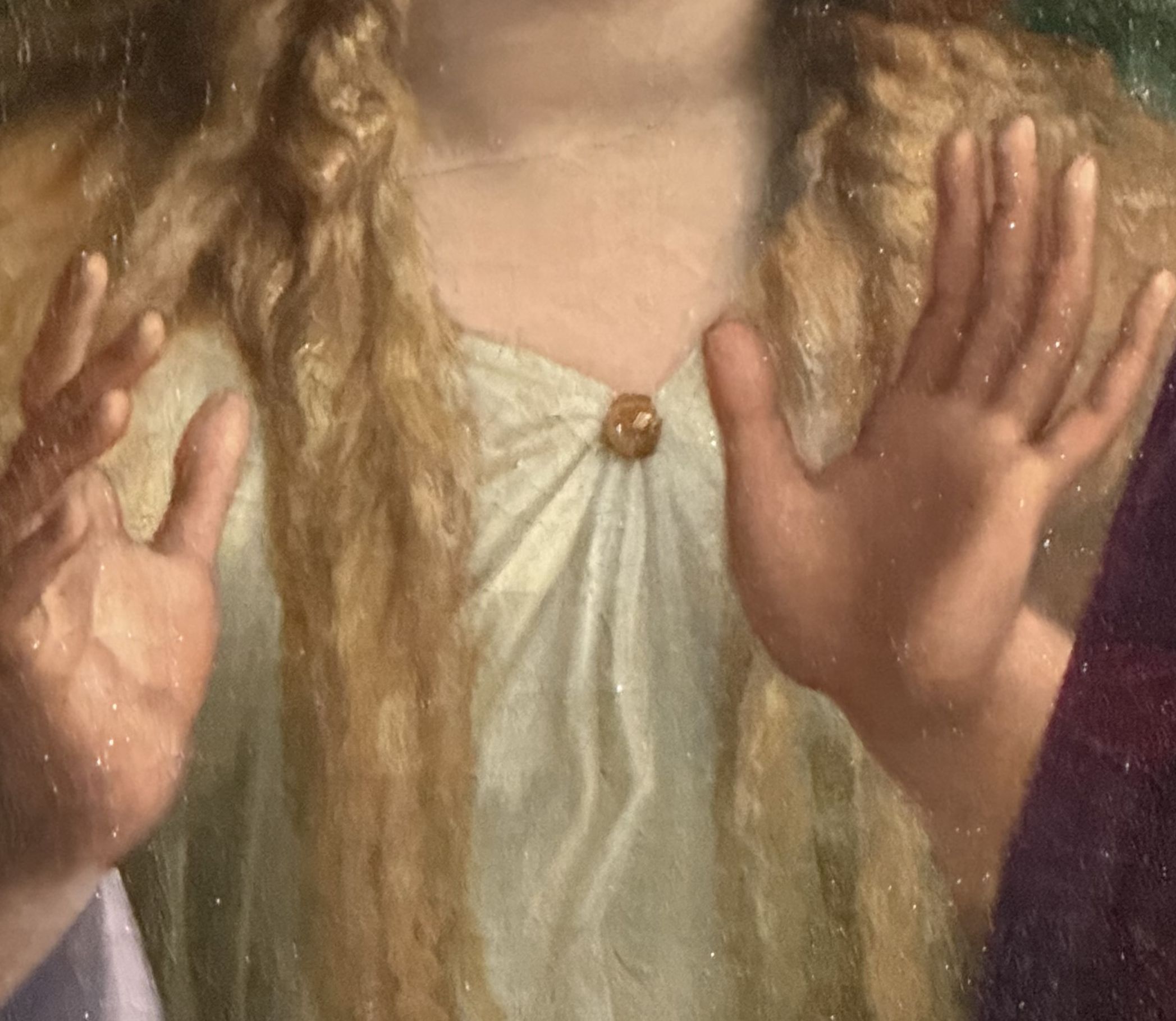
Mary Magdalene
The raised gaze
The head turns upwards as the hair falls past the shoulders. The turn carries attention beyond the figures at ground level.
Open hands
The hands rise on either side of the chest, with the palms visible. The golden clasp and pale garment keep them separate from the figure beside her.
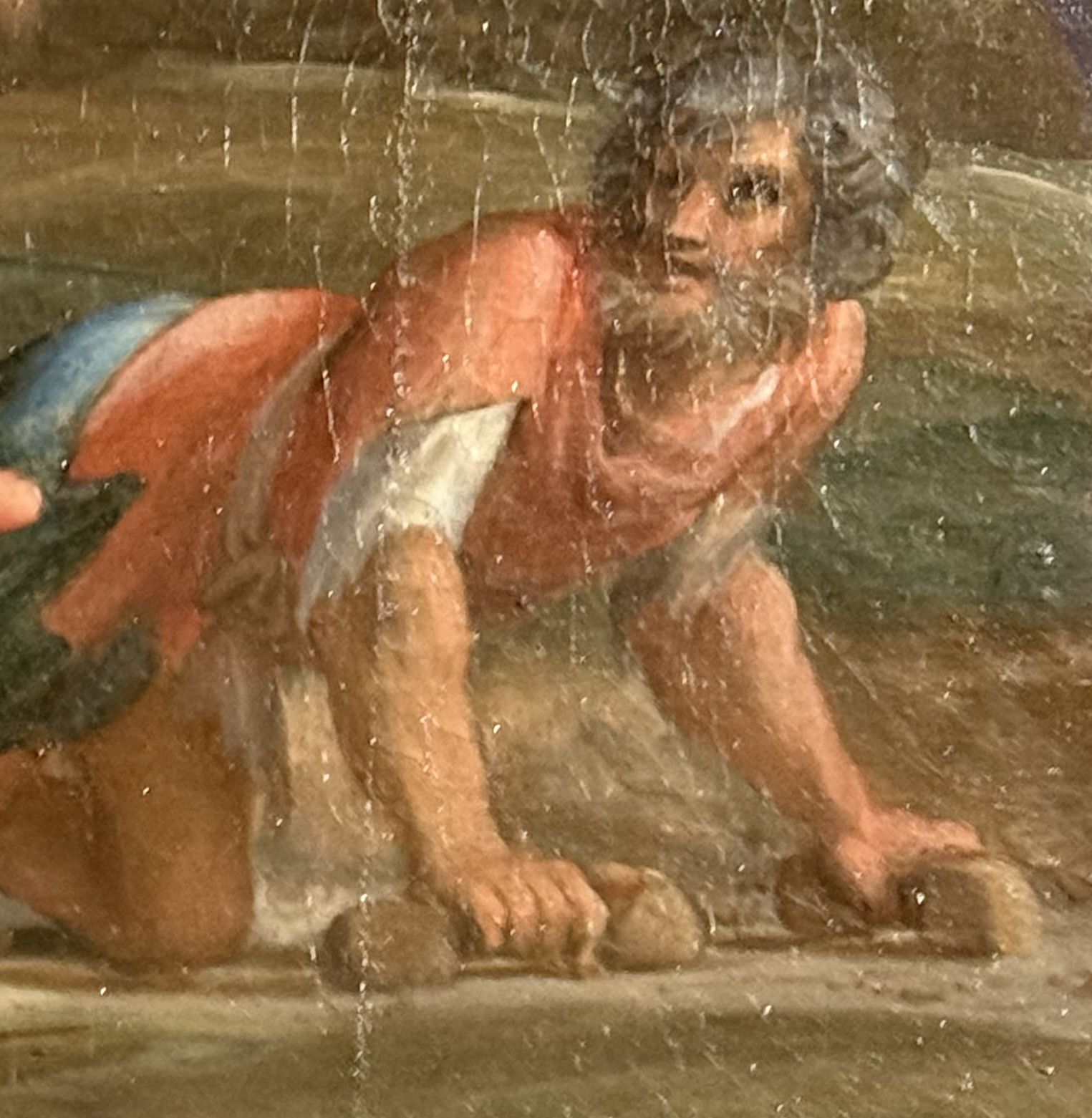
The Man Near St Peter’s
The figure braced at ground level
The man supports himself close to the ground. A brightly lit hand extends into the foreground from the left of this photograph.
A distant dome
Domed and rectangular forms recede through a narrow band of landscape. Their muted colour makes the detail easy to miss in the full canvas.
The two crowned saints and England
The museum catalogues identify the two kings as Saint Hermenegild, the Visigothic prince and martyr, and Saint Edward of England. Edward, usually understood here as Edward the Confessor, shares the cardinal’s name. Odoardo was the son of Alessandro Farnese and Maria of Portugal, and his mother’s descent from England’s royal house gave that pairing a dynastic resonance. Hermenegild carries a martyr’s palm. He also brings Catholic Spain into the picture’s field of reference. Stefano Pierguidi has questioned the identification, however. In a related Farnese portable altarpiece, Pierguidi reads the crowned saint’s martyrdom scene as that of Edward the Martyr, another English king, rather than that of Hermenegild. At the centre, the small figure moving on hands and knees has been read as a reference to the legend of Edward carrying a man who could not walk to the altar of Saint Peter at Westminster, where he was healed. If that reading is right, the distant Roman basilica and the little figure refer to different places joined by devotion to the same apostle. [1] [3] [5] [6] [7]
Roberto Zapperi argued that the picture belongs to Odoardo’s efforts to position himself as a possible Catholic successor to Elizabeth I. The queen had no children, and Catholic candidates for the succession sought support before her death in 1603. Edward’s presentation of his namesake before Christ and the prominence of Saint Peter’s lend themselves to that reading. The cardinal’s links to Spain make Hermenegild intelligible in a painting about dynastic alliances as well. An alternative, associated with Silvia Ginzburg, connects the picture to Odoardo’s appointment as cardinal protector of England in February 1600. That interpretation explains the English saint and the Roman basilica in terms of the cardinal’s responsibilities in Rome and fits the dating around 1600. The crown, the basilica and Edward’s gesture can serve both readings. In the painting itself, red silk and a white surplice still identify the donor by his rank in the Church. [5] [6] [7] [8] [9]
The two readings have different implications for Camaldoli. In the succession account, a work conceived in Rome with political ambitions in view may have been sent to the hermitage after James VI of Scotland succeeded Elizabeth in 1603. The Magdalene’s inclusion and the related altar furnishings provide positive evidence for a commission conceived for her chapel, whatever hopes the cardinal brought to the project. Pierguidi suggests that the political reading can fit the hermitage itself, where the painting could have served Odoardo’s private devotions. His eye for architectural detail also led him to suggest that Carracci’s omission of a lantern from the Clementine Chapel’s dome might contain a jab at the patronage of Pope Clement VIII, a proposal that goes beyond what the painted view alone can establish. [3] [5] [9] [10]
The painting can also be read as a memorial image. Odoardo’s enduring likeness, held in prayer before Christ, would have recalled the founder to those who worshipped in the chapel after his lifetime. That commemorative function is an inference from the portrait and its setting. His documented burial was at the Gesù in Rome. At the same church, a monument Farnese commissioned for Cardinal Roberto Bellarmino gives a comparison in marble. In Gian Lorenzo Bernini’s bust, Bellarmino’s hands meet at his chest just as Odoardo’s do in the painting, with both portraits cropped close across the body. Tomaso Montanari saw the likeness as evidence that Bernini drew on Carracci’s praying donor for a funerary portrait. [5] [7] [11] [12]
The Magdalene’s chapel at Camaldoli
Farnese endowed a cell dedicated to Mary Magdalene at the Camaldolese hermitage in the Tuscan Apennines. Families had long supported the eremitic community through the building and furnishing of cells, which included spaces for private worship. The Magdalene’s traditional life as a penitent in the wilderness gives her a particular relevance in this setting. She appears at the edge of the foreground rather than at the centre of the painting, yet her face and hands bring the attention back up from the foreground. Her presence gives the chapel’s dedication a place within a scene otherwise dominated by the apostles, royal saints and donor. [3] [10] [13]
The gifts associated with the chapel included two textiles now in Florence’s Museo dell’Opera del Duomo. The paliotto covered the front of the altar table. Its silk, metal-thread embroidery and painted applications surround the cardinal’s arms, where six lilies sit beneath a cardinal’s hat. The matching pianeta, or chasuble, was worn by the priest saying Mass. Made by Roman textile workers to Carracci’s design, these objects unite painting with fabrics that would catch and reflect available light. Christ and the four male saints recur across the ensemble, while the Magdalene is absent from the textiles. The correspondences make more sense if one imagines the canvas above the altar and the related imagery below it or moving in front of it during worship. [3] [10] [14]
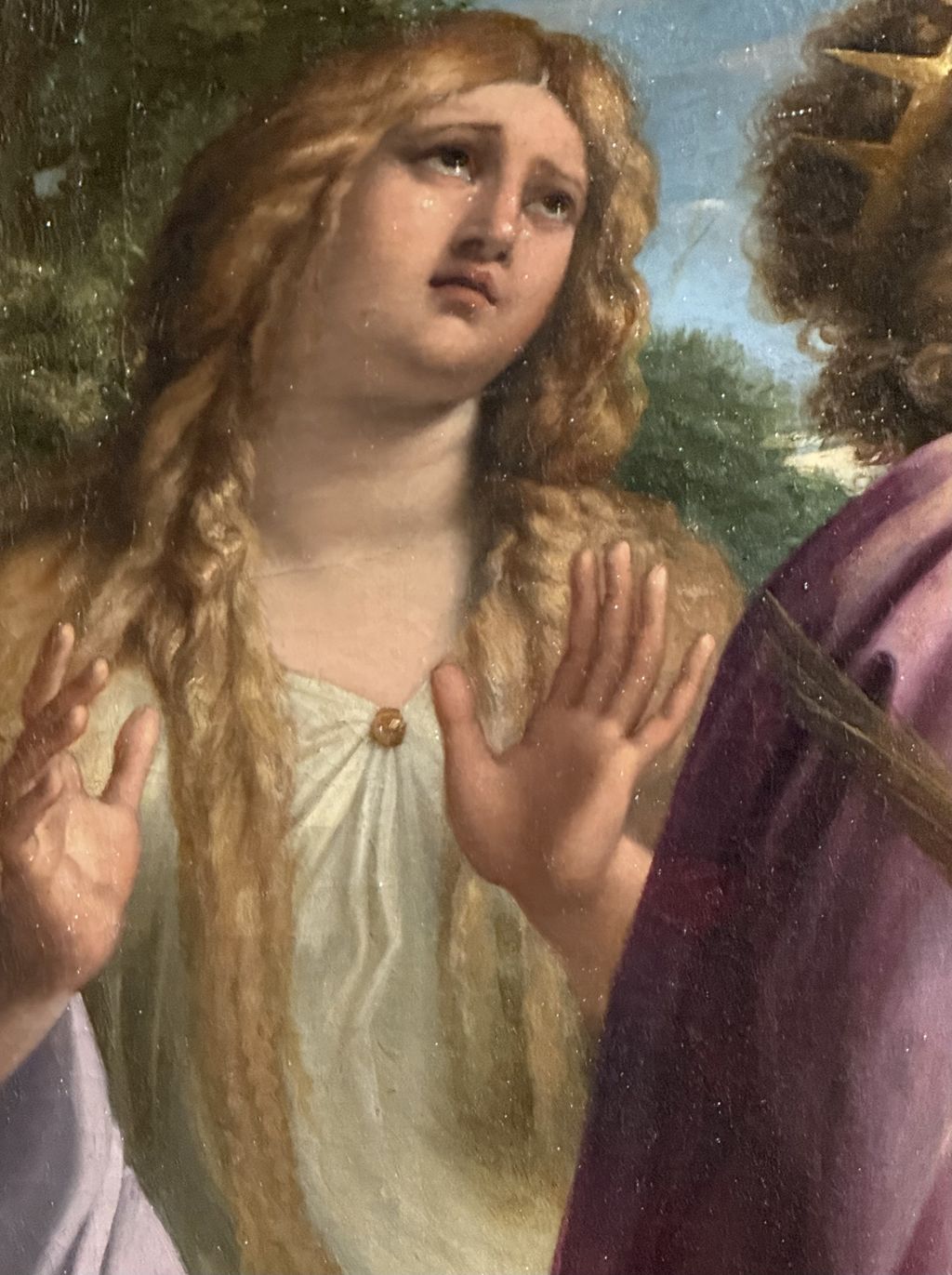
Mary Magdalene in Annibale Carracci’s Christ in Glory with Saints and Odoardo Farnese. Galleria Palatina, Palazzo Pitti. Photograph by Nicola Quirico. Image source. CC BY-SA 4.0. Proportionally resized for web display under the same CC BY-SA 4.0 licence.
Drawings for heaven and earth
An ink drawing at the Palais des Beaux-Arts in Lille, inventory Pl.148, isolates Christ with Peter and John. At 20 × 28.5 cm it has a horizontal format appropriate to the group across the top of the vertical painting. The three figures work as a composition on their own, with Christ’s gesture at the centre and a saint at each end. A Renaissance precedent for an enthroned Christ flanked by holy figures is Giulio Romano’s Deesis with Saints Paul and Catherine, now in Parma. The Pilotta connects that painting to a drawing in the Louvre long associated with Raphael’s workshop. The likeness lies in the arrangement around Christ, while Carracci’s use of the scheme gives the heavenly group a specific relation to the kneeling patron and the landscape below it. [15] [16] [17]
Dalma Frascarelli connects the Magdalene’s tilted head to a figure from the ancient Niobid group, found near the Lateran in Rome in the late sixteenth century. Carracci’s surviving chalk study of the head of a daughter of Niobe, now in the Royal Collection, belongs to his study of the group. The Royal Collection connects its sheet to other pictures and decorations, so the drawing is best compared as evidence of his interest in the sculpture. In the altarpiece the lifted chin and parted lips have the immediacy of a woman caught in prayer. The comparison helps explain how Carracci could find a convincing expression for a Christian figure in a sculpture made for an entirely different story. [18] [19]
What the canvas reveals
The conservation team at the Opificio examined the painting with X-rays, infrared reflectography and pigment analysis. The canvas consists of two pieces of linen joined vertically where the seam can avoid the main faces. About seven centimetres of the prepared linen were brought into use at the bottom during the making of the work. Infrared images disclosed revisions to the cardinal’s joined thumbs and to the Magdalene’s raised fingers. An earlier version of Edward’s eye looked farther down. Carracci’s adjustments concentrated on details that direct our attention, from the precise shape of a praying hand to the angle of a saint’s gaze. [3] [20]
The clouds are painted in lead white, with pink from Christ’s mantle deliberately allowed to show beneath them. The result makes it possible to read the cloud as a thin veil in one place and a bank that can bear the weight of a figure in another. Ultramarine made from lapis lazuli was found in both Carracci’s sky and the strip painted above it decades later by Niccolò Cassana. The two men used different preparation layers, and the later blue was painted to go with a picture whose varnish had already aged. [3] [20]
From the hermitage to Palazzo Pitti
Carracci’s crowned figure at the left may have had an afterlife in another Farnese commission. Giovanni Morello suggested that Domenichino borrowed that figure’s features for Emperor Otto III in a fresco for the Abbey of Grottaferrata. Local tradition had identified the emperor as a portrait of Odoardo, but the comparison with Carracci’s painting points instead to the youthful saint with the lifted head. [21]
Grand Prince Ferdinando de’ Medici brought the painting to Florence near the end of the seventeenth century. The national catalogue records it in a Palazzo Pitti inventory of 1698, while leaving the precise transfer date open. Cassana’s addition of about 13 centimetres at the top and the carved and gilded frame belong to the painting’s adaptation for the grand-ducal collection. When the Opificio thinned the discoloured varnish, the difference between the two skies became more apparent. The team preserved Cassana’s strip and devised a removable, colour-matched cover using a photographic composite taken from Carracci’s sky. The arrangement preserves the evidence of the enlargement and allows the altarpiece to be seen within its historic frame. [1] [3] [20]
The painting returned to the subject of Farnese patronage in the 2022 exhibition Il pittore e il cardinale at the Pinacoteca Stuard in Parma, where it was shown alongside objects from the Camaldolese community. It travelled again in 2026 to the Museo Civico San Domenico in Forlì for Barocco. Il Gran Teatro delle Idee. There it appeared in the opening section, which explored how artists around 1600 worked from both observation and the example of antiquity. Forlì placed the picture near such works as Ludovico Carracci’s Conversion of Saul and Rubens’s Saint Sebastian Freed by Angels, where a bodily response to divine intervention offered a different way into each scene. [2] [4] [22] [23]
Artworks directory
Paintings, frescoes, drawings and prints, with separate entries for documented versions and collaborative projects.
Discussion
Look again at the images and ideas explored in Christ in Glory with Saints and Odoardo Farnese. These editorial prompts invite your observations.
Reader Insights
How does the painting distinguish the donor and saints from the figure of Christ above them?
What changes when you read the painting as a Farnese commission?
Join the Conversation
Share a detail, comparison or question about Christ in Glory with Saints and Odoardo Farnese below.
References
- Catalogo generale dei Beni Culturali, Cristo in gloria e Santi, 0900297761, Palatina 220. View source.
- Fondazione Cassa dei Risparmi di Forlì, Barocco. Il Gran Teatro delle Idee, exhibition checklist, section 1. View source.
- Opificio delle Pietre Dure, Annibale Carracci, Cristo in Gloria e Santi, 1600 ca., conservation project GR 13311. View source.
- Gallerie degli Uffizi, Artworks temporarily not on display, 6 May 2026, loan listing for Palatina 220. View source.
- Stefano Pierguidi, ‘Annibale, Domenichino e Lanfranco: episodi di committenza artistica di tema sacro di Odoardo Farnese e della sua cerchia’, Saggi e memorie di storia dell’arte 32, 2008. View source.
- Arnold A. Witte, The Artful Hermitage: The Palazzetto Farnese as a Counter-Reformation Diaeta, 2008, introduction and chapters 2 and 5. View source.
- Dizionario Biografico degli Italiani, ‘Farnese, Odoardo’, Treccani. View source.
- Fernando López Chaurri, ‘La melancolía de Annibale Carracci: consideraciones sobre sus posibles causas y sus consecuencias’, De Arte 22, 2023, discussion of the Farnese succession reading and the Camaldoli donations. View source.
- Roberto Zapperi, ‘Odoardo Farnese, principe e cardinale’, in Les Carrache et les décors profanes, École française de Rome, 1988, pp. 335–358. View source.
- Opera di Santa Maria del Fiore, Paliotto Farnese, Museo dell’Opera del Duomo. View source.
- Catalogo generale dei Beni Culturali, Gian Lorenzo Bernini, Ritratto del Beato Roberto Bellarmino, ca. 1623–24, 1200762339B. View source.
- Tomaso Montanari, Il Barocco, Einaudi, 2012, p. 64. View source.
- Fondazione della Comunità monastica di Camaldoli, Quadreria, history of commissions for the hermitage and monastery. View source.
- Opera di Santa Maria del Fiore, Pianeta Farnese, Museo dell’Opera del Duomo. View source.
- Réunion des Musées Nationaux–Grand Palais, Le Christ en gloire avec saint Pierre et saint Jean, Palais des Beaux-Arts de Lille, Pl.148, archived record. View source.
- Fondazione Federico Zeri, Annibale Carracci, Cristo in gloria tra san Pietro e san Giovanni Evangelista, drawing and related painting. View source.
- Complesso Monumentale della Pilotta, Giulio Romano, La Deesis e i santi Paolo e Caterina. View source.
- Dalma Frascarelli, ‘Rubens, l’antico e l’Italia dei filosofi’, in Rubens e la cultura italiana: 1600–1608, 2020, figs. 7–8. View source.
- Royal Collection Trust, Annibale Carracci, The head of a Niobid, after the antique, RCIN 902028. View source.
- Marco Ciatti, Luisa Gusmeroli, Claudio Seccaroni, Carlo Galliano Lalli, Giancarlo Lanterna and Federica Innocenti, ‘La pala di Annibale Carracci nella Galleria Palatina. Proposte di lettura e considerazioni tecniche derivate dal restauro’, OPD Restauro 28, 2016, pp. 105–129. View source.
- Giovanni Morello, ‘La Vita Nili negli affreschi del Domenichino’, p. 596, n. 31. View source.
- Comune di Parma, Il Pittore e il Cardinale. Annibale Carracci e Odoardo Farnese tra Roma e Camaldoli, exhibition record. View source.
- Deputazione di Storia Patria per le Province Parmensi, Odoardo Farnese e Annibale Carracci, notice of the 2022 exhibition at the Pinacoteca Stuard. View source.