 by Tom Gurney
Tom Gurney BSc (Hons) is an art history expert with over 20 years experience
Published on June 19, 2020 / Updated on November 29, 2026
Email: tomgurney1@gmail.com / Phone: +44 7429 011000
Venus, Adonis and Cupid: Introduction
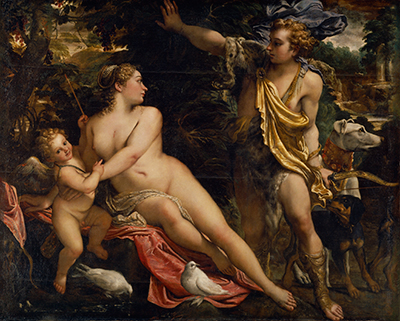
A faint red mark on Venus’s chest and an arrow beside her head tell the story of Annibale Carracci’s Venus, Adonis and Cupid. Cupid leans against his mother as she turns to look at a hunter emerging from the trees. Adonis looks back at her, his bow lowered and his hand raised above him. The two have only just caught sight of each other, but anybody who knows the myth also knows how their encounter ends. Carracci painted this large oil on canvas, now in the Museo Nacional del Prado in Madrid, around 1590, during his Bologna years. [1] [2] [3]
At a Glance
- ArtistAnnibale Carracci
- DateAbout 1590
- MediumOil on canvas
Contents
- A meeting in the woods
- Cupid’s arrow and the coming hunt
- Titian’s farewell and Veronese’s pause
- What the drawings and X-rays reveal
- From Naples to the Spanish royal collection
- Annotated details
A meeting in the woods
Venus sits on rose-red cloth spread over the ground, with a lighter fabric caught across her lap. Her legs extend diagonally towards the hunter, while her face turns upwards to meet his. Adonis bends into her space from the right. His raised arm crosses the dark upper part of the canvas, bringing his hand almost directly above her. The gestures join the two halves of the picture even though the figures’ hands never meet. At 212 by 268 centimetres, the canvas gives those gestures the scale of a physical encounter. [1] [3]
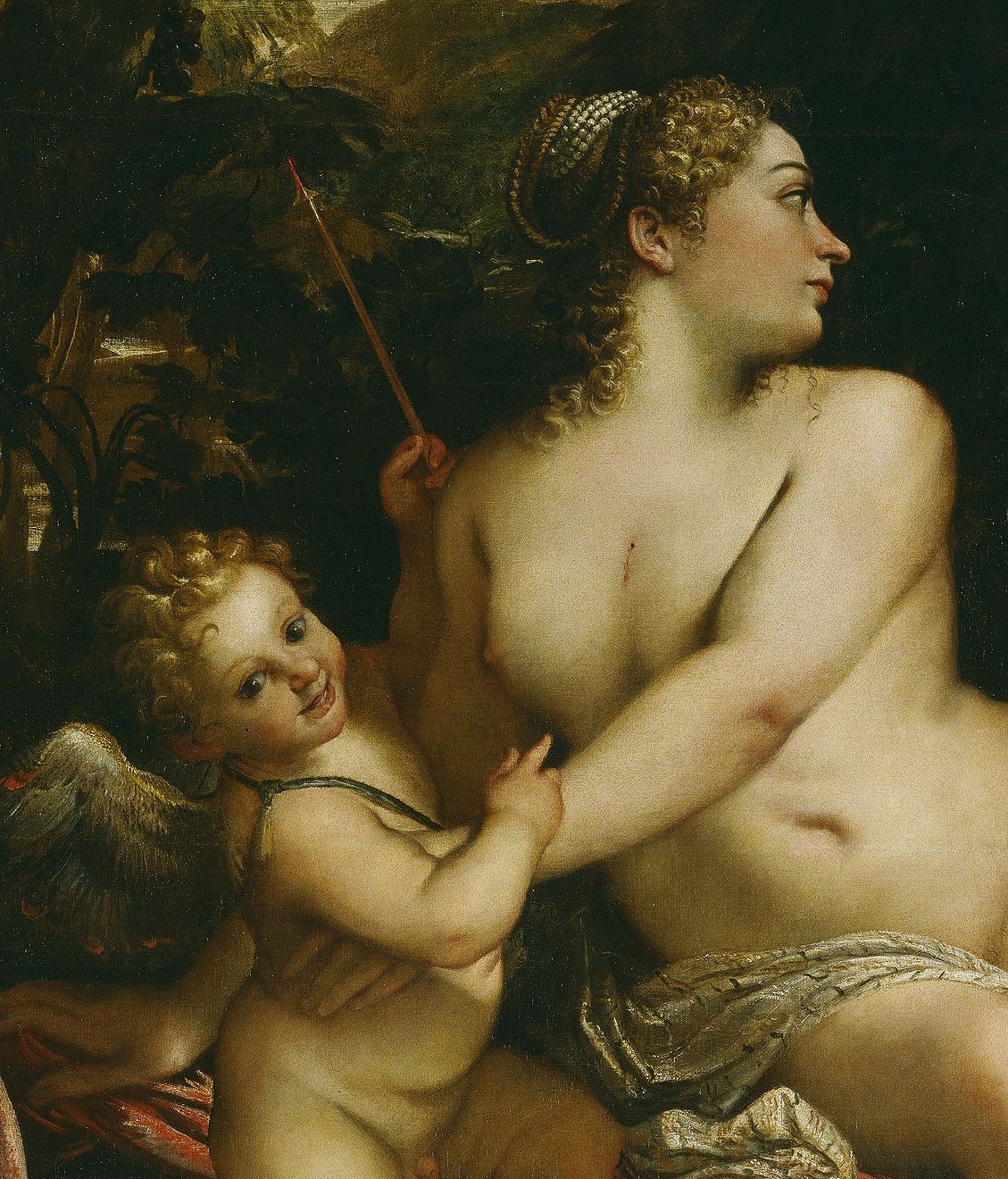
Follow the figures’ eyes and a second exchange becomes apparent. Venus and Adonis look towards each other, while Cupid turns out towards the viewer. His expression gives the scene a note of complicity. One hand closes around Venus’s arm. The other lifts the slender arrow, easy to miss against the foliage beyond her shoulder. Carracci puts the source of the injury and its effect in the same tightly grouped passage. The child’s little wing and the line of the arrow are enough to identify him, while the small mark at the centre of Venus’s chest explains why her attention has shifted so suddenly to Adonis. [1] [4]
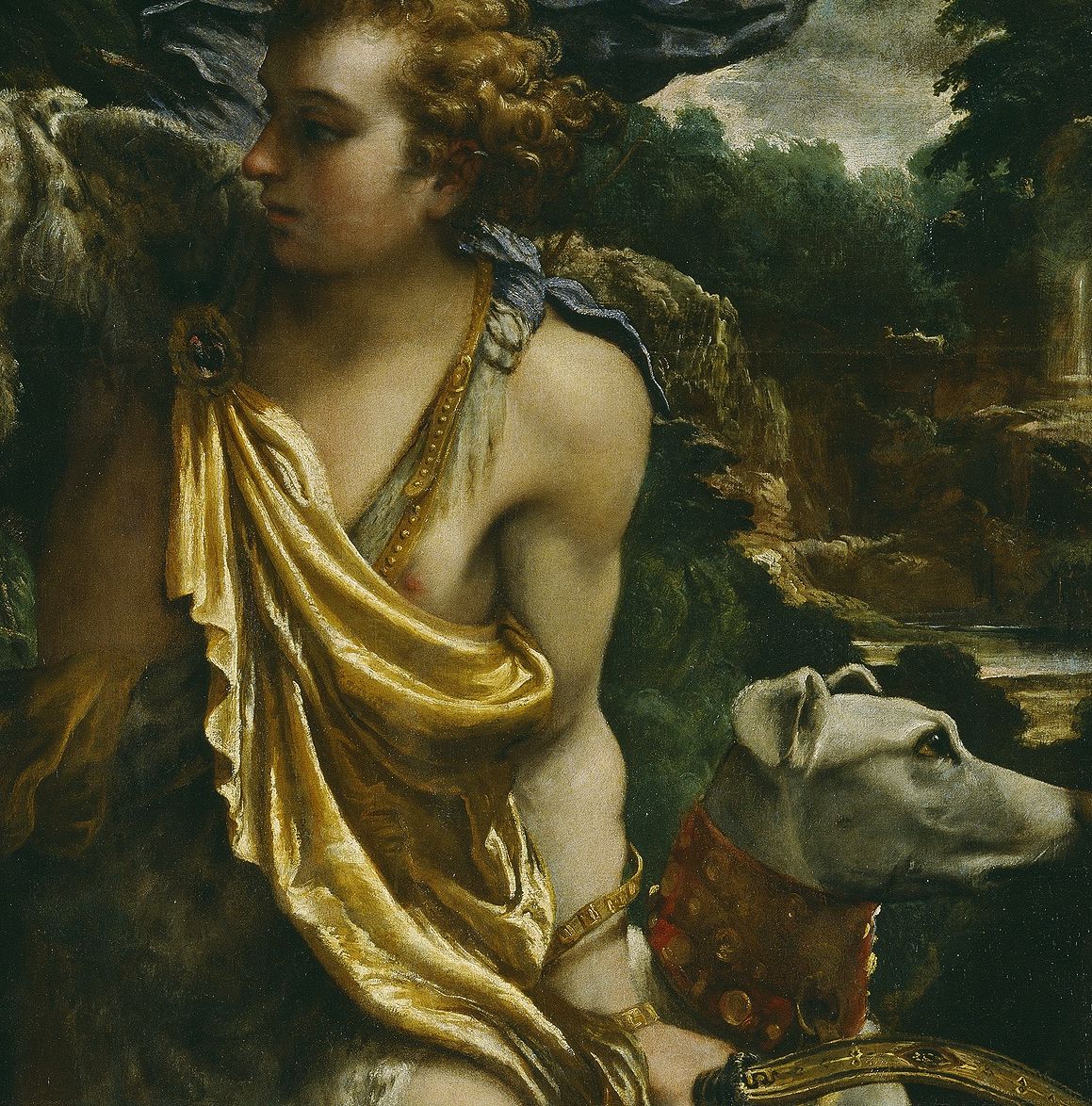
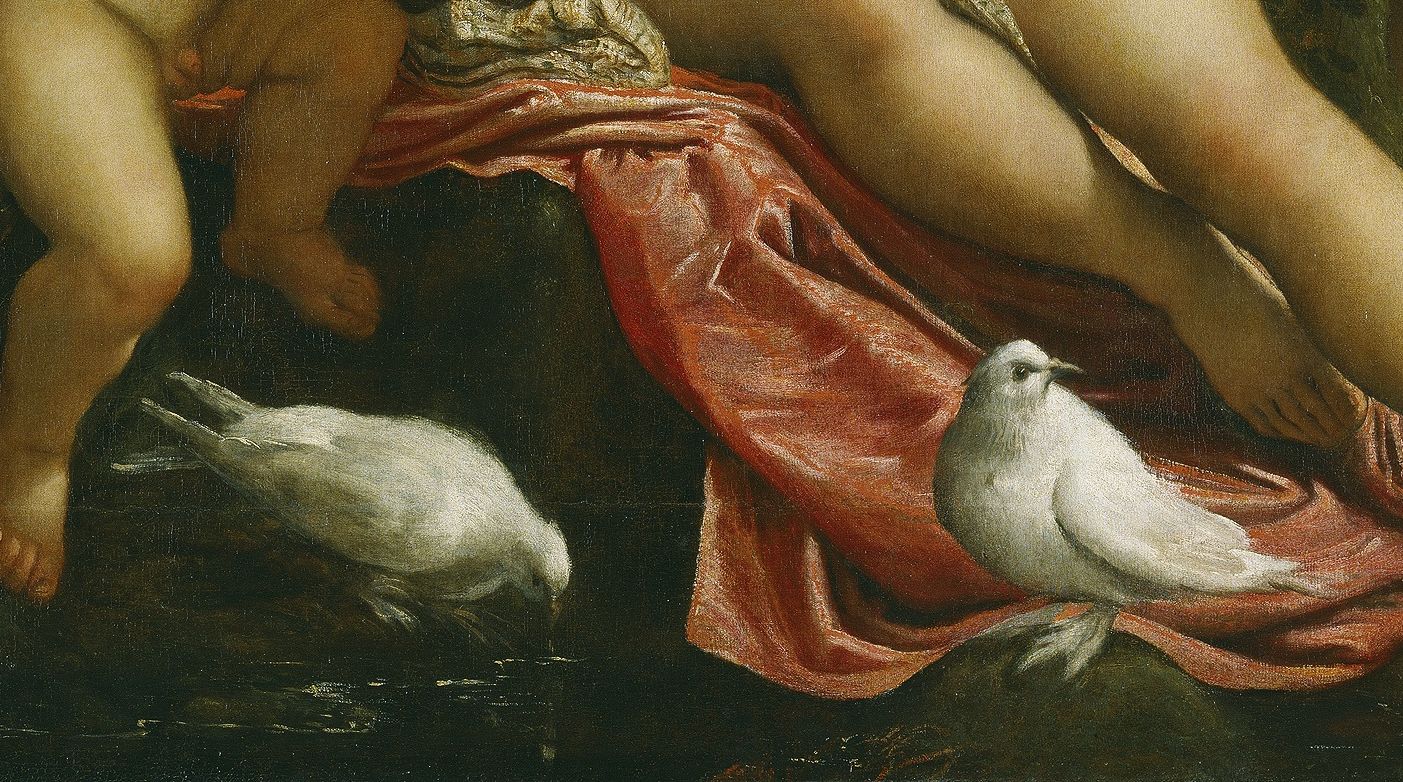
Adonis’s costume balances the luminous flesh at the left. Gathered gold cloth crosses his torso and catches the light in narrow ridges. A blue drapery arcs behind his head, and the rough edge of an animal skin shows at the raised arm. The hand at his thigh holds a bow beside a pale hound with a broad red collar. Farther down, the dark coat of a second dog nearly disappears into the shadows beside his legs. Compare the direction of the pale hound’s muzzle with Adonis’s face. The animal looks towards the right edge of the picture while its master has stopped and turned towards Venus. At the opposite edge, two pale birds occupy the ground below her. One dips its head and the other perches on a fold of red fabric, bringing a quieter movement into the bottom of the picture. [1]
Carracci makes the woodland feel enclosed. The deepest tones run behind the figures, giving Venus’s profile and Adonis’s arm a clear outline. Smaller pockets of light open at the upper left and at the far right behind the dogs. That last glimpse of space gives the hunt somewhere to continue, while the bow, collars and forward attention of the dogs keep it present in the clearing. A viewer unfamiliar with Ovid can still see that Adonis has been interrupted on his way somewhere. [1]
Annotated Details from Venus, Adonis and Cupid
The numbered points identify visible features discussed in this article. Return from each detail to the numbered overview. Annibale Carracci, Venus, Adonis and Cupid. Museo Nacional del Prado, P002631. Image source. Public domain.
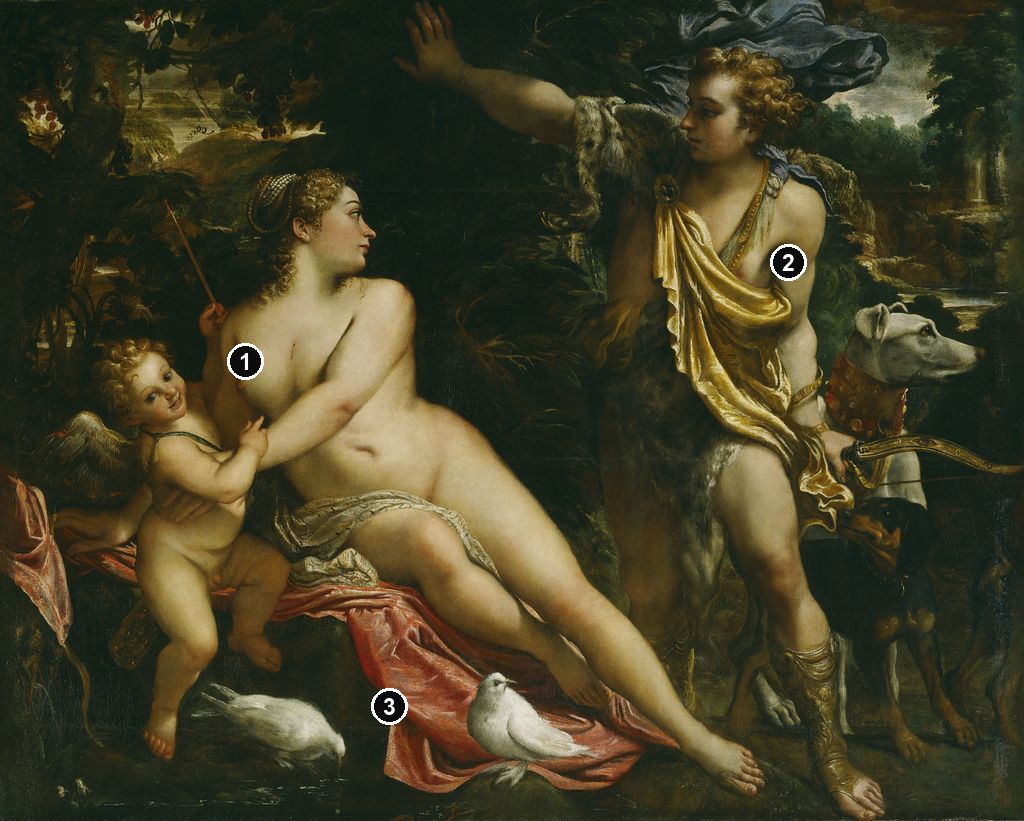
Details from VENUS, ADONIS AND CUPID
Compare the cropped details with the source images above. Notice how their colours, shapes and positions contribute to the larger compositions.
Cupid and Venus
The smaller figure reaches across Venus’s arm while she turns her head toward Adonis. Their overlap draws attention to her change of direction.
Adonis and his pale hound
The hunter approaches from the right with wind catching his drapery. The pale hound extends its head in the same half of the picture.
The pair of doves
Two pale birds appear low in the scene below Venus. Their quiet forms and bright plumage stand out beside the coloured fabric.
Cupid’s arrow and the coming hunt
In Book 10 of Ovid’s Metamorphoses, a projecting arrow grazes Venus while Cupid is kissing her. She dismisses the scratch at first, then becomes so taken with Adonis that she gives up her usual haunts to follow him. She hunts alongside him, pursuing animals that take flight and warning him against those that stand their ground. During their time together she tells him the story of Atalanta and Hippomenes, another tale in which desire has consequences its participants fail to reckon with. [4]
The poem eventually gives the dogs the initiative. They rouse a boar, which Adonis wounds before it turns on him. Venus hears his cries and returns to find him dying. She changes his blood into a short-lived flower, vulnerable even to the wind. Carracci brings the arrow wound and the meeting together, allowing the viewer to watch Ovid’s explanation of Venus’s love play out in a single encounter. The equipment Adonis carries belongs to his life as a hunter, and the audience’s knowledge of what eventually happens makes the dogs’ eagerness ominous. [1] [4]
The sequence also explains the uneven footing of the lovers. A goddess who can inspire desire in others is subject to it herself. Cupid’s outward look gives the viewer a moment to notice that reversal while Venus is still absorbed in the surprise of seeing Adonis. The hunting party beside him points to a later reversal, when the goddess who can transform his blood proves unable to save his life. [1] [4]
Titian’s farewell and Veronese’s pause
The Prado also holds two earlier paintings of the story by Titian and Paolo Veronese. In Titian’s Venus and Adonis, made for Philip II and dated 1554, Venus throws her arms around the young man as he breaks away for the hunt. Her back faces the viewer, and the two bodies strain against one another. Three dogs accompany the hunter in the Prado version, while Cupid sleeps off to the side. Andrea Bayer’s study of Titian’s versions for the Metropolitan Museum of Art notes that Ovid gives no explicit scene of the lovers struggling in this way at the moment of departure. Titian turned the warning and its tragic aftermath into a farewell that could be understood through the figures’ physical struggle. [5] [6]
In Veronese’s Venus and Adonis, about 1580, the hunter sleeps with his head in Venus’s lap. She fans him, while Cupid occupies himself with a dog that could wake him. The danger lies beyond the figures’ interval of rest. In Carracci’s canvas the hunter is awake and already equipped for the chase, but the immediate event is Venus’s awakening to him. Cupid belongs to that event and makes its cause visible. Taken together, the paintings show how a different role for one child or one dog can change which point in a myth the viewer understands to be unfolding. [1] [5] [7]
The Prado exhibited the three canvases together in 2005 as a sequence from the first encounter through the lovers’ time together to the departure for the hunt. Its exhibition account also identifies the Venetian paintings as possible sources for Carracci. The juxtaposition helps explain how he could borrow the setting, figures and hunting motifs familiar from Venetian mythologies while arriving at a distinct narrative moment. It leaves open exactly where or in what form he encountered the precedents. [5]
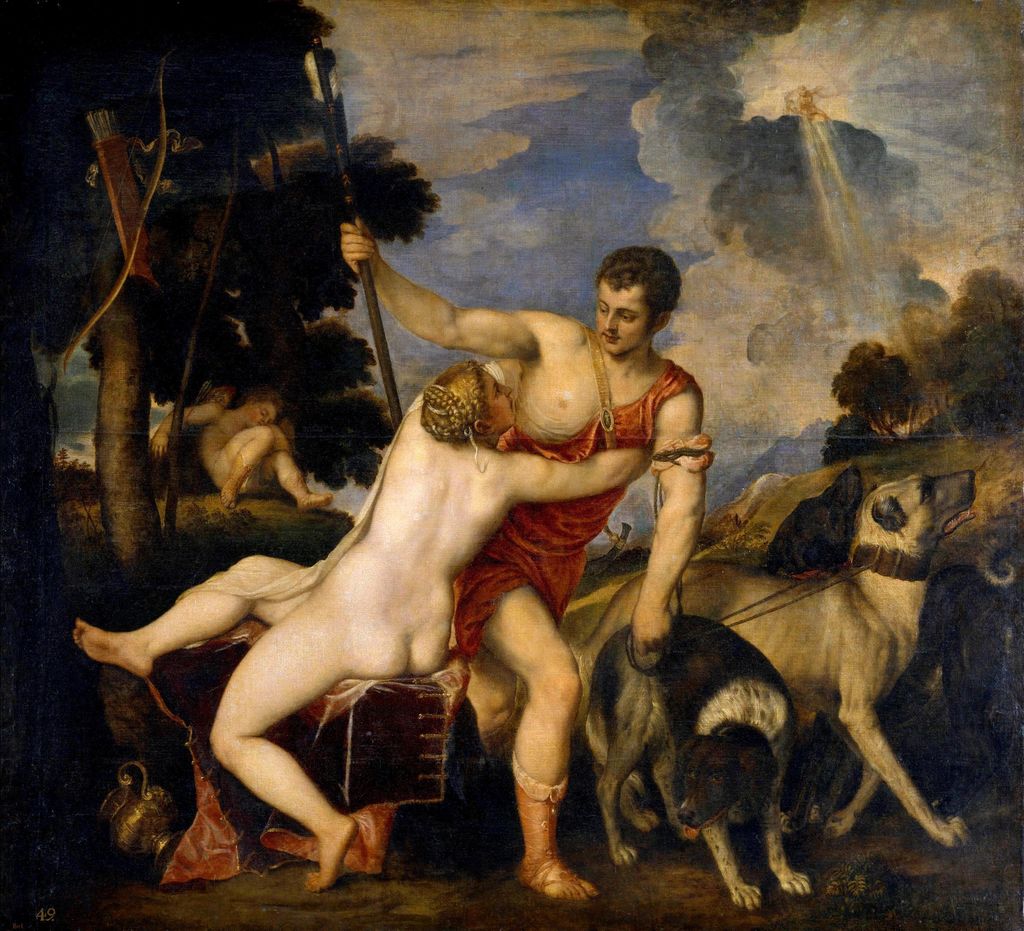
Titian, Venus and Adonis. Museo Nacional del Prado, P000422. Image source. Public domain.
What the drawings and X-rays reveal
A preparatory study at the Real Academia de Bellas Artes de San Fernando in Madrid, D-2256, gives an early view of the design. Drawn in sepia ink on paper and dated 1588–1590 by the Academy, it already places the raised arm of the upright hunter against the reclining figure at the left, with dogs at the right. The figures and foliage are set down in quick marks, and the seated group takes shape with far fewer strokes than the standing hunter. On the canvas, the lit profiles and Cupid’s face give those groups a much more definite relationship. The sheet itself once passed under the name of Giulio Cesare Procaccini. Alfonso E. Pérez Sánchez identified it as an early idea for the Prado painting and the related Vienna version. [8]
Other studies bring individual parts of the composition into focus. A black-chalk study for Adonis in the Uffizi is reproduced in the Prado’s exhibition catalogue. In the 1999 exhibition catalogue The Drawings of Annibale Carracci, Catherine Loisel discusses a British Museum dog study, Pp.3.18, whose profile appears to have been used in reverse for a dog in the Madrid painting. That suggestion helps explain the concentrated observation in a passage that could easily be overlooked beside the larger figures. Notice the angle of the pale dog’s jaw, the folds around its ear and the way the collar pulls the skin at its neck. [9] [10]
Changes continued on the canvas. The Prado cleaned the painting ahead of its 2005 exhibition and examined it using X-radiography and infrared imaging. It exhibited the radiograph alongside preparatory drawings and other material from the treatment. The museum’s report describes a succession of revisions, and curator Andrés Úbeda de los Cobos identified the figure of Adonis and his dogs as particularly affected. Carracci was still developing the arrangement in paint after deciding on the overall design in the study. The exhibition catalogue, edited by Úbeda with María Álvarez-Garcillán Morales and Ana González Mozo, brought the history of the picture, its restoration and the technical investigation together. [5] [11] [12]
The Kunsthistorisches Museum in Vienna holds a related canvas of Venus und Adonis, inventory 234. In its Caravaggio & Bernini exhibition the museum credited the painting to Carracci and workshop and likewise read the scene as Venus falling in love after Cupid’s arrow pricks her. This shared arrangement accounts for the ease with which reproductions of the two pictures can be confused. The preparatory sheet illuminates the design common to both, while the radiograph exhibited by the Prado records decisions made on the Madrid canvas specifically. [5] [8] [13]
From Naples to the Spanish royal collection
Philip IV acquired the canvas in 1664 from the collection of the Marchese di Serra di Cassano. At the Royal Alcázar in Madrid it hung above the door of the Galería del Cierzo, a prominent position documented in the palace’s inventories. The painting survived the Alcázar fire of 1734 and appears in inventories of the royal workshops afterwards. Its later whereabouts tell a different story about how such paintings were displayed. It passed through the restricted rooms of the Academy of San Fernando in the reign of Charles III before entering the Prado in 1827. It spent part of its museum history on deposit at Madrid’s Central University and returned by the mid-1960s. [3] [5]
The composition reached viewers outside Spain in another form. The Louvre holds a 1655 etching by Luigi Scaramuccia, made before the royal acquisition. The Prado also has an impression of Scaramuccia’s design. In the print the hunter stands at the left and Venus and Cupid appear at the right, reversing the arrangement of the painting. The positions of the raised hand, the leaning Cupid and the two foreground birds remain recognisable without the painted colours. In the canvas it is often the gold sash or Venus’s lit face that draws the eye first. The print shows how much of the encounter can also be carried by the lean of a body and the turn of a head. [1] [14] [15]
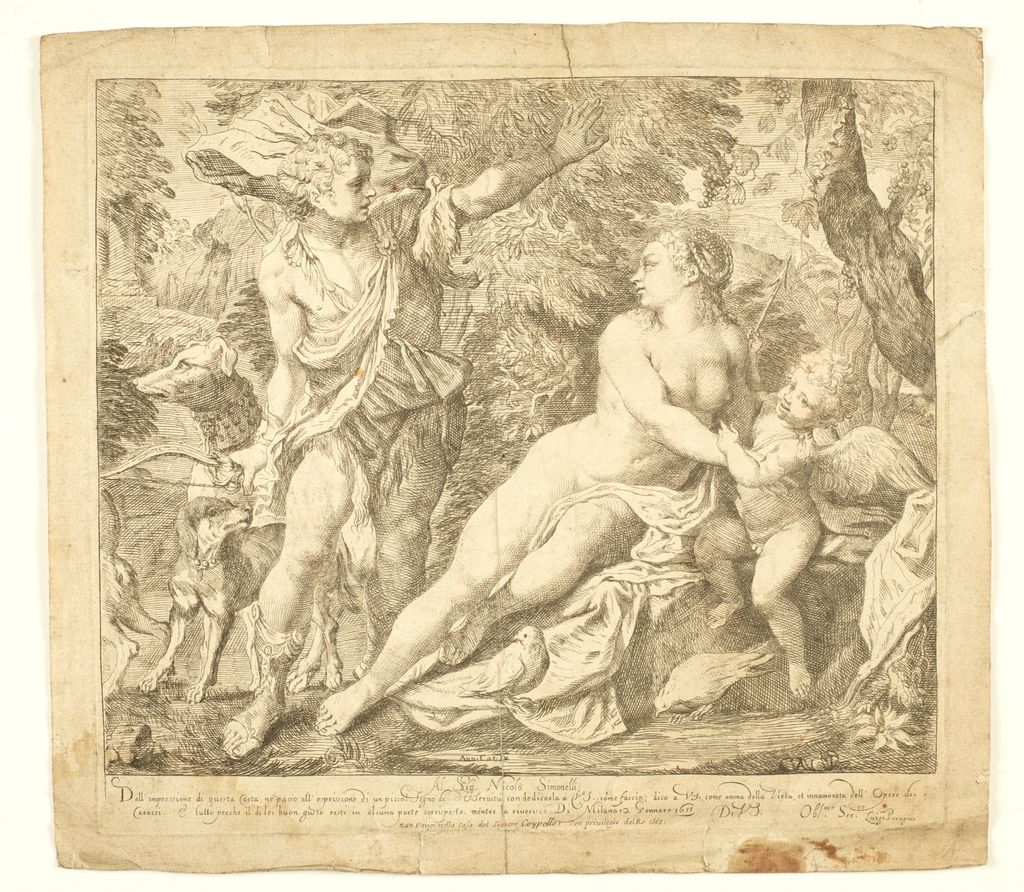
Luigi Scaramuccia after Annibale Carracci, Venus, Adonis and Cupid. Etching. Museo Nacional del Prado, G05911. Image source. Public domain.
Artworks directory
Paintings, frescoes, drawings and prints, with separate entries for documented versions and collaborative projects.
Discussion
Look again at the images and ideas explored in Venus, Adonis and Cupid. These editorial prompts invite your observations.
Reader Insights
How do hands and lines of sight establish the two figures’ different intentions?
What does the artist reveal by painting the moment before departure?
Join the Conversation
Share a detail, comparison or question about Venus, Adonis and Cupid below.
References
- Museo Nacional del Prado, Venus, Adonis and Cupid, P002631 View source.
- Museo Nacional del Prado, Venus and Adonis and the story of Hippomenes and Atalanta View source.
- Fundación Universitaria Española, Venus, Adonis y Cupido View source.
- Ovid, Metamorphoses, Book 10, translated by Brookes More View source.
- Museo Nacional del Prado, Memoria de actividades 2005, exhibition and restoration accounts View source.
- Andrea Bayer, North of the Apennines, The Metropolitan Museum of Art Bulletin View source.
- Fundación Amigos del Museo del Prado, Veronese’s Venus and Adonis View source.
- Real Academia de Bellas Artes de San Fernando, Estudio de Venus, Adonis y Cupido, D-2256 View source.
- Fundación Universitaria Española, Study for Adonis in the Uffizi View source.
- Catherine Loisel, catalogue no. 14 and note 2, The Drawings of Annibale Carracci View source.
- El País, Andrés Úbeda de los Cobos on the Prado’s radiograph, 18 April 2005 View source.
- Andrés Úbeda de los Cobos, María Álvarez-Garcillán Morales and Ana González Mozo, Annibale Carracci’s Venus, Adonis, and Cupid View source.
- Kunsthistorisches Museum, Amore, Caravaggio & Bernini exhibition View source.
- Musée du Louvre, Luigi Scaramuccia, Vénus et Adonis, 12878 LR View source.
- Museo Nacional del Prado, Memoria de actividades 2016, Scaramuccia print G05911 View source.